Archive for the ‘Uncategorized’ category

Deficit of Trust in Government – How To Carry An Old Dog Downstairs

February 3, 2010

Obama and other politicians speak of “a deficit of trust” in governmental institutions.

I have a little, old, dog.  She is little enough and old enough that I generally can (must) carry her through the halls of my building, and out through the small back yard, until we get to the public sidewalk, before I can put her down without fear of prohibited incident.

I carry my dog on this journey like a baby, legs up.  She is incredibly passive in my arms, motionless through the bounces of the few flights of stairs, through the turns in the hall and yard, through the plunge into the frigid winds of lower Manhattan. Her stillness seems to reflect an absolute faith that, as her person, the one who feeds and shelters and takes care of her, I will do the right thing by her, carrying her to her appointed spots, not dropping, dislodging, or otherwise discombulating.

People are not really like dogs.  (Some may find this unfortunate.)  Yet the bases for trust are similar—a relationship or experience of a person or institution that gives rise to a feeling that the trusted one is competent, well-meaning, and that the relationship is beneficial, even necessary,  for the trustor’s well-being.

A belief in competence is paramount.  My dog is downright wiggly in unsure hands.  Babies are often like that too, fussing and crying when they sense inexperience.

Many adults do not seem to have an innate gauge of competence.  (Many voted for George W. Bush, for example.  Twice.)   Still, they must, at least, believe in competence.

Integrity’s important too, a lack of scandal.  But integrity is really a part of meaning well, of the trusted one looking out for the trusting.

Then there’s the question of benefits.  And necessity.  My dog (children too) trust me even when I have to do painful things to them, such as cleaning that yucky eye hair (that’s in the case of my dog), in part because they have been  acutely aware of all I have provided– food, shelter, college tuition (that’s in the case of my children).  It’s not as if the benefits are a quid pro quo for the painful treatment;  it’s more that the benefits somehow prove that the painful treatment is not arbitrary or mean, but a necessary part of taking care.  (Different versions of trust based on necessity/desperation arise in the case of a plumber, doctor,  accountant.)

Because benefit/necessity is so important to  maintaining trust, it’s difficult to understand how government can engender it simply by cutting taxes.  For trust to be felt, value must be provided, not just reduced expense.

Of course, the urge for endless tax-cutting arises in part because of a disbelief in government competence.  Then too, many refuse to believe that government benefits reach them.  (These kinds of people shout that the government should “keep its hands off their Medicare.”)

Others simply don’t see a need for government.  (I don’t know how these people plan to provide for fire departments, child labor laws, clean air and water.)

What to do?   In order for a “deficit of trust” in government to be filled, people have to be convinced that a more secure, stable, educated, and unpolluted society is a particular benefit to them, a necessity for the future, and something government is capable of helping to provide.

A tall order.

Of course, getting rid of the scandals would help too.

What’s Up With Robert Pattinson? Cartoons? Elephants? Is It All Just Coincidence? Hmmm…..

February 2, 2010

Rob Pattinson With Beard

Every once in a while, one is lucky enough to have confirmation that one really does exist in the world, and that, despite all evidence to the contrary, the little pebbles of one’s actions create ripples that are more extensive than one could ever have projected.

The confirmation of my particular ripple effect has come in the convergence of two extremely newsworthy events:

1.  Robert Pattinson is the subject of a new biography written in cartoon form for Fame magazine, and

2.  Robert Pattinson is  slated to star in the film Water For Elephants to be directed by Sean Penn and supposedly to be shot in upstate New York this summer.

Ahem.

I humbly submit that this blog has long combined writing about Robert Pattinson with

(i)  cartoonish depictions of same;

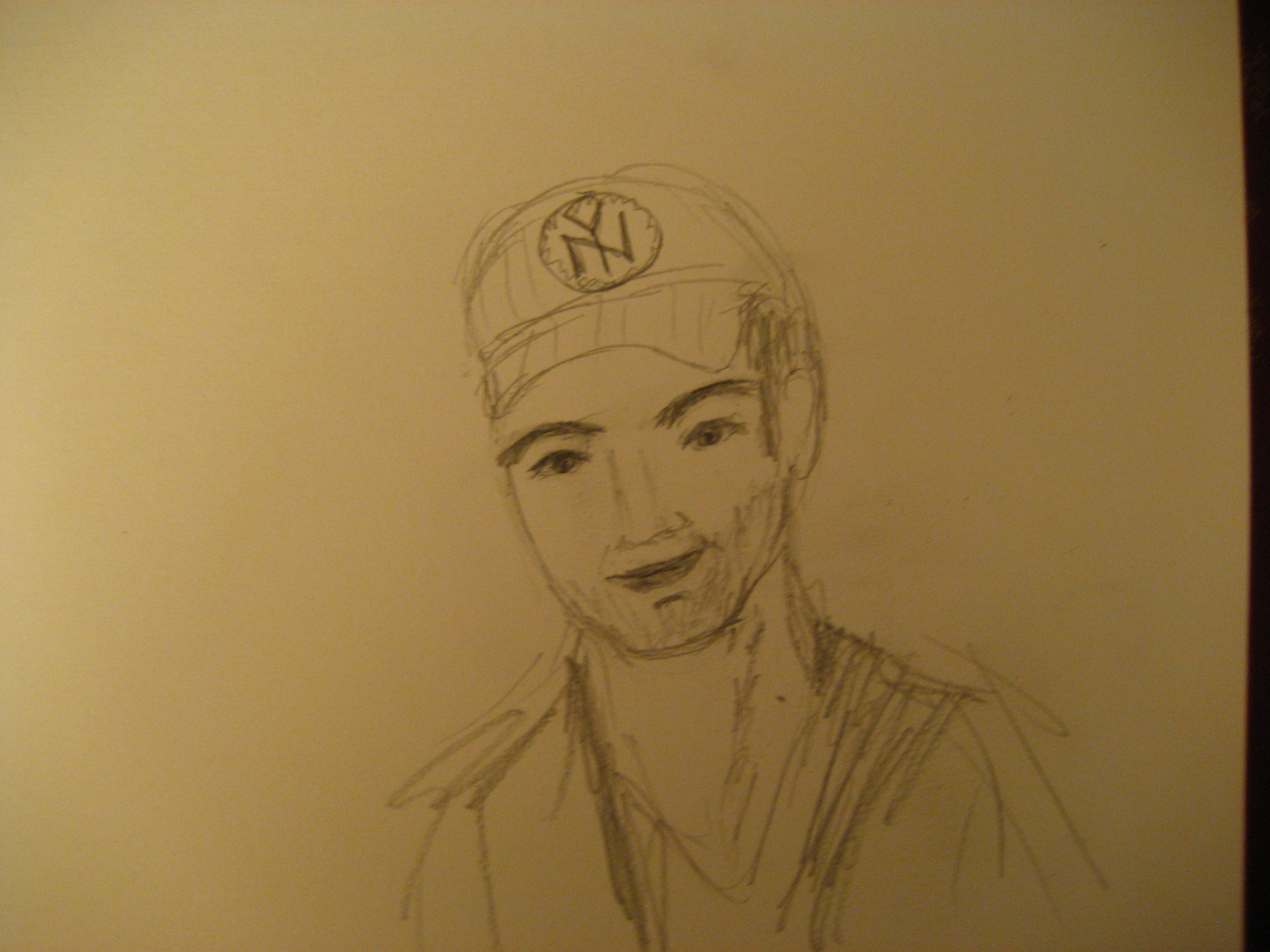
Rob Pattinson With Yankees' Cap

(ii)  elephants,

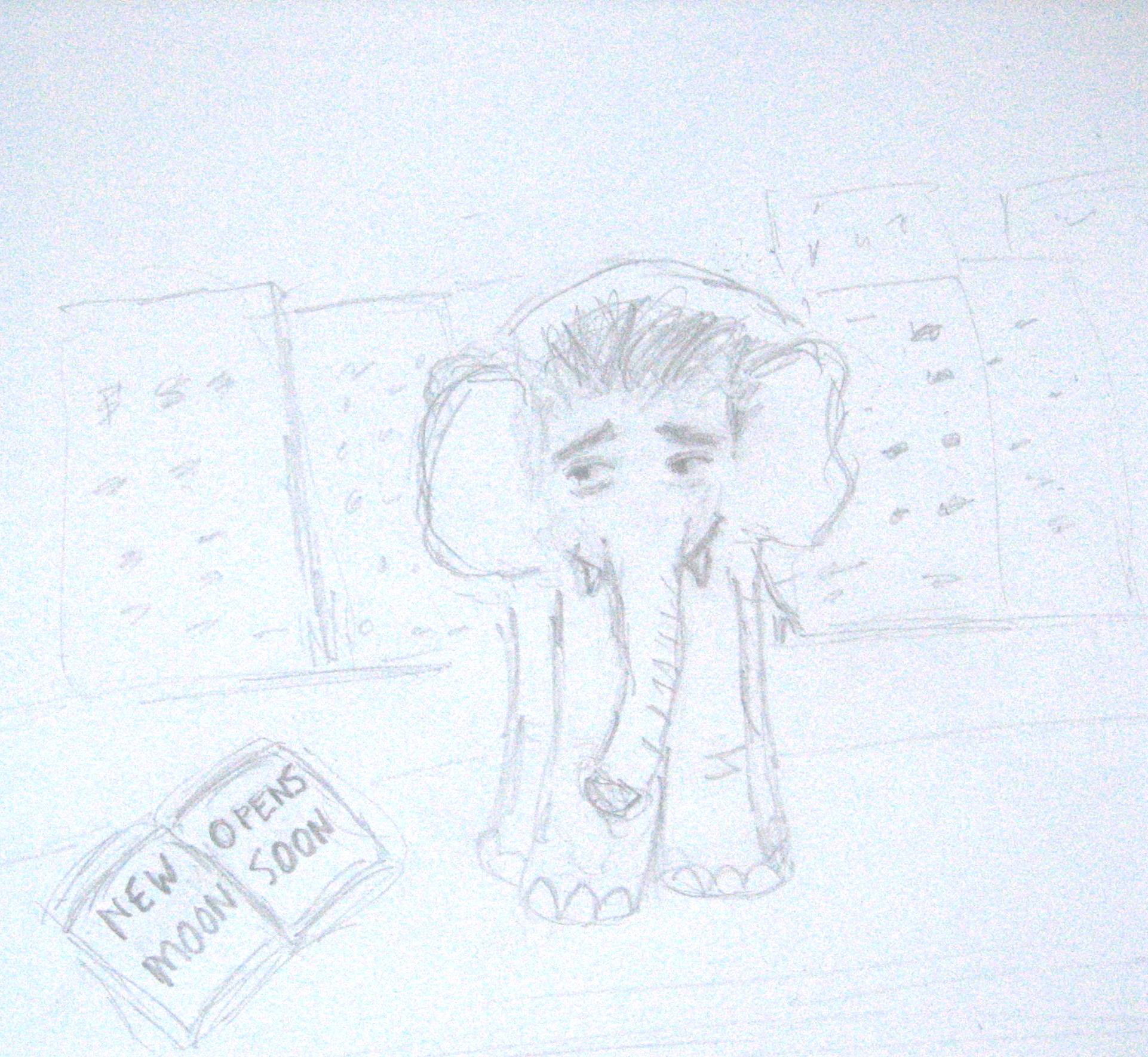
Vampire Elephant Contemplating New Moon

and (iii)  a dash of upstate New York (also with a couple of elephants).

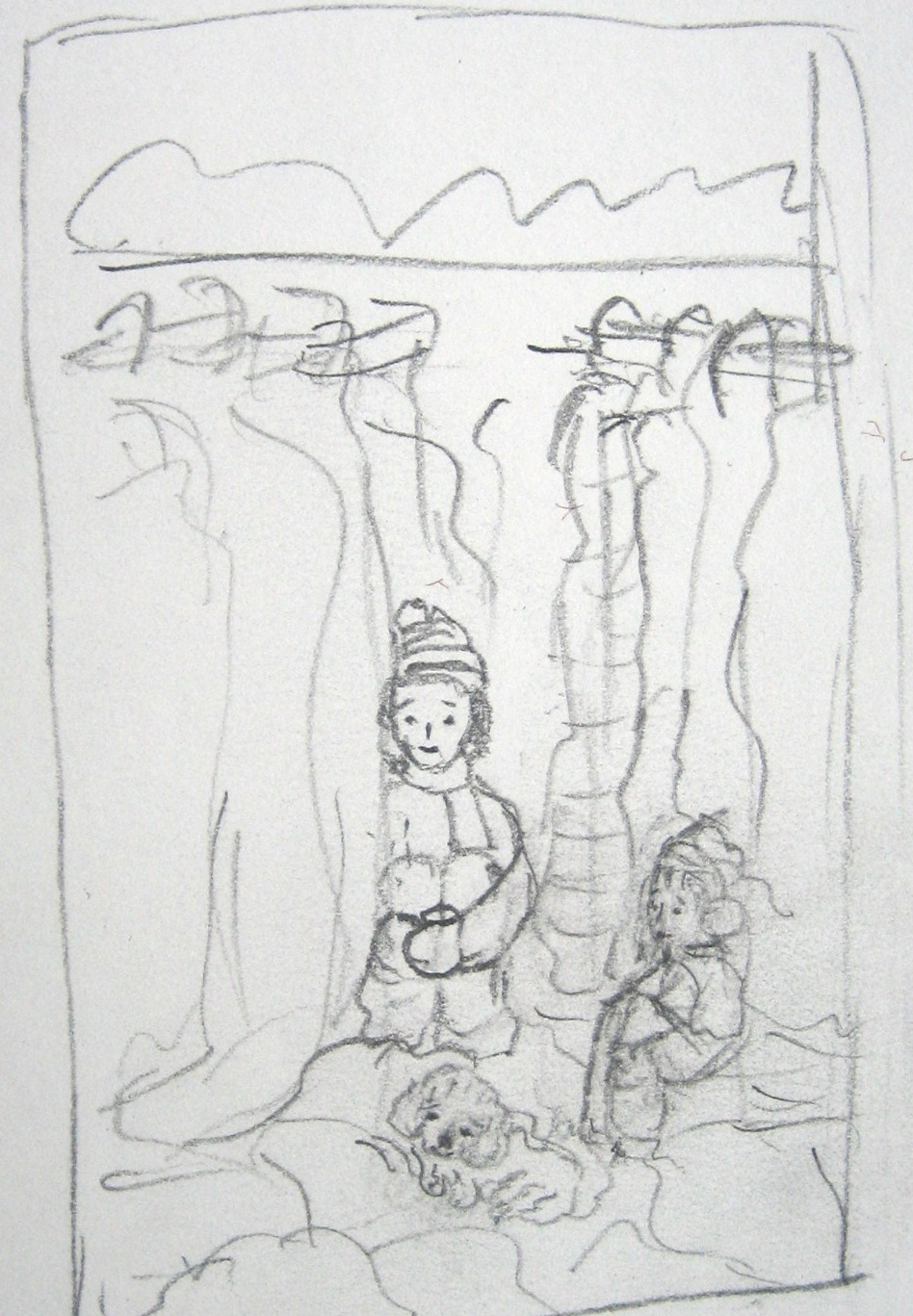
A Couple of Elephants in the Catskills

The coincidences just mount up!

Coincidences?  Hmmm…..

Further investigation may be required.

Further Investigation

Rob–if, in fact. you are reading this, give me a call!

For more Pattinson, check out the Robert Pattinson category on the home page of this blog;  for more elephants, check out the elephant category.  And, for even more elephants, check out 1 Mississippi by Karin Gustafson on Amazon.com

Back To The Grammys Briefly – All Buff, Pink Singing Sideways (In the Shower)

February 1, 2010

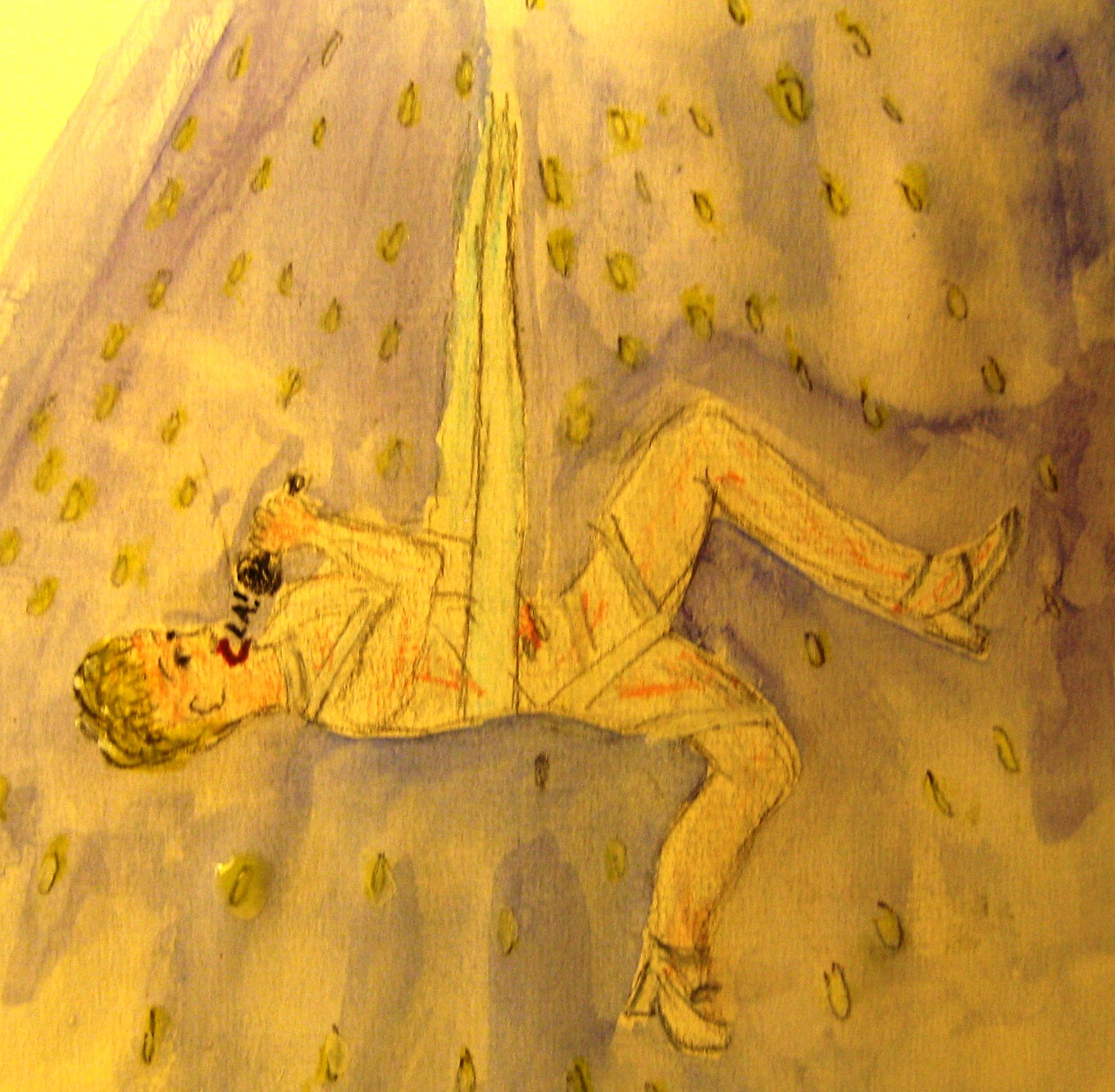
Pink (Sideways) Under Sprinkler System (New Take on Singing In The Shower)

I never watched the Grammys before Sunday night.  I still have never watched the WHOLE Grammys.  (I wonder why.)

When did singers begin needing biceps as large as breasts as standard equipment?  (Sorry to be crude.  The Grammys tend to bring that out in one.)

Hard to imagine Judy Garland with biceps.  (Instead of shoulder pads.  See e.g. Judy in For Me and My Gal.)

Singers have long been good dancers.  (Imagine Judy Garland.)  But when did they have to become gymnasts?  (There was, I guess, Fred Astaire on the ceiling.  But I always thought that was a camera trick.)

Sometimes it is not hard to understand why much of the world (particularly the non-Western world, the muslim world) disdains (that’s putting it mildly) Western pop culture.

Yes, there’s a kind of verve.   Singing sideways under a sprinkler system is pretty amazing.  And the muscle tone is pretty darn spectacular.  And all the participants seem to clap for each other with admirable generosity.   Still, well….

“The Jihadist Next Door” – A Dangerous Story Of A Boy

February 1, 2010

Yesterday’s Sunday New York Times Magazine featured a chilling article by the Pulitzer Prize winning Andrea Elliott about Omar Hammami, The Jihadist Next Door, a leader, or at least participant, in the Somali terrorism group, Shabab.   The article portrays Hammami as a gifted, loved child, born and raised in Alabama, the son of a Southern Baptist mother and Syrian, Muslim, father, the wisecracking, devoted brother of a loving, slightly hippiefied, sister.

The article traces Hammami’s life through childhood, high school, a couple of years of college,  through his increasing disaffection with the U.S., his move to Toronto, then to Egypt (which he found disappointingly secular), and finally to Somalia where he became aligned with the violently jihadist Shabab.   (He is now apparently the subject of a sealed federal indictment.)

Hammami was a charismatic youth, popular in school and high school, until an increasing devotion to Islam, and a somewhat rebellious nature, appears to have estranged him from local peers.   Increasingly discomfitted by the freedom of women in Western society, and desperate for marriage himself, he married an Islamic  Somali woman (in Canada).  Though they had a child, he seems to have spent remarkably little time or energy on his marriage.  (His wife eventually filed for divorce.)

The online version of the article shows an illustrated timeline of Hammami’s life, including a propaganda/”promotional”  video in which he is pictured.  Most of the video shows soldiers in training, loading and reloading assault weapons first in a leafy courtyard, then grouped in a congenial circle (all the guys together) over a pleasantly lilting soundtrack of (presumably) Islamic music.

Of course, the big question the article poses is “why?” “How did this happen?”  “What can be said to have radicalized a small-town boy from Alabama?”

Hammami’s family seems both mystified and grief-stricken by his transformation.  The article, to its credit, doesn’t openly draw conclusions.   But certain factors do pop into one’s mind.  The biggest one, perhaps, is a grandiose determination to be special, celebrated, heroic, combined with a need for excitement, drama;  the desire for the life of a movie character.

The urge for specialness marks Hammami’s words (as recorded in the article);  they are combined with a sense of duty  (a kind of altruism gone off) as well as a craving for adventure.  In a December email, Hammami writes his sister, Dana, “I hear bullets, I dodge mortars, I hear nasheeds” — Islamic songs — “and play soccer. Sometimes I live in the bush with camels, sometimes I live the five-star life. Sometimes I walk for miles in the terrible heat with no water, sometimes I ride in extremely slick cars. Sometimes I’m chased by the enemy, sometimes I chase him!…. I have hatred, I have love….  It’s the best life on earth!”

It sounds a bit like a desert version of James Bond, only with Boy Scout (non-babe) elements.

Certainly, the feeling that validation only comes with specialness, celebrity, fifteen minutes of fame, is a big issue in our current culture.  So is the belief, exemplified by multiple movies and TV shows, that only one, or perhaps just a small band, of very determined special people(a la Jack Bauer) are needed for earth-shaking, earth-saving, or earth-destroying feats.

The appeal to young men of adventure, danger, heroics (especially when dressed up with the bunting of sacrifice and societal purpose) is age-old.  It’s used in U.S. military recruiting materials;  it’s part of the appeal of video games and fantasy novels.   (It’s even sited in recent child-rearing books– see, e.g., The Dangerous Book For Boys.)

The need for brotherhood is as old as Robert Bly.  (That’s a joke; sorry, fans of Robert Bly and Iron John, sorry,Robert.)

Which raises another element that comes subtly through the article–Hammami’s homophobia; a desperation for a normality hoped to be found in marriage, followed by a distancing from the”wifey”.

Who knows what all this means?  Certainly,  not this amateur psychologist.  Whatever the reasons for Hammami’s development, the story is a sad and scary one,  worth reading well.

Grammys – Live Blogging, Robotic Performers

January 31, 2010

The second time today that I was happy to close my eyes during a musical performance  (see prior post “Eyes Wide Shut”) has been the Grammys!  I have to confess to never before seeing the Grammy awards.  They were turned on in my apartment to see Stephen Colbert, who appeared all too briefly.

Since then, Jennifer Lopez has appeared in a dress empaneled with packing material, Beyonce has impersonated an angry robot, Fergy has been involved with even angrier robots, and tonsils have borne heavy impact.  Dancers have shown a great deal of  self-righteousness and a lot of breast and thigh.  Pink started off in a cut-up beach robe, and ended up in a be-ribboned body suit hanging from the ceiling in.  What was perhaps most amazing about her singing was that she could do it at all while sideways suspended under a sprinkler system.

Popular culture, amazing!  Is it really popular?!

Zac Brown Group won best new artist, and so far have also been the best just regular nice guys.

Oh wait!  Colbert just won one.  I take it all back.

When the “Cool Crowd” Becomes the Absolutely Freezing Crowd

January 30, 2010

Question Is: Will She Make Room For You?

Last week, on a relatively balmy day, I wrote about being part of the “cool crowd”.  That is, those people who, out of carbon, monetary, or logistical concerns, keep their indoor heat low (or nonexistent.)

Today, temperatures in downtown Manhattan have sunk to the teens, and the cool crowd is likely to be shivering.  (At least anyone in my apartment is.)

Here are some tips as to how to handle these low temperatures without losing cool crowd status:

1.  Huddle with your dog in a small closet which is out of the wind and layered with clothing (both hanging and fallen to the floor.)

2.  If the dog won’t make room for you, bake.   Bread, pies, cookies.   (This uses some fossil fuels but is at least productive of something besides heat.)    People say that chopping kindling warms you twice, first when chopping, then when burning, but baking goodies warms you three times:  once in the hot oven, secondly, when supplying you with calories, and third, as an extra layer of flab.

3.  Tape a hot water bottle to your stomach, under the down blanket.   (If you are like one of the followers of this blog, try one of those toasted rice or corn cloth bags that you can heat up in a microwave.)

4.  If you don’t have a hot water bottle, or a toasted rice or corn bag, sit with a turned-on laptop on your bare stomach.  If your ears are cold, try calling your mom on your cell phone.   (That’s a joke, Mom.)  (Seriously, Mom.)   (I like long phone conversations too.)

5.  Drink hot caffeinated beverages (perhaps while talking to your mom) until you get such a splitting head-ache that you really do crave some nice cold air.

6.  Turn on James Brown.  Dance.  Make sure to close your blinds.

7.  Spend as much time as possible outdoors.  Preferably in some cozy little café.  Or, as the evening chill falls, bar.

Yes!

The Pain You’re Not Supposed To Have If You Do Yoga Regularly

January 29, 2010

The Non-Multitasking Yogi

Pain.  I have all kinds of handwritten posts about Obama and trust in government that I was going to type up today.  But I wake up (that’s not actually correct since I don’t think I  slept), I get up with a figurative stake of ache in the middle of my upper back, which  precludes me from doing anything but looking absolutely straight in front of me.  (This means I  can’t type anything pre-jotted.)

People who do yoga everyday are not supposed to have back pain.  I do yoga everyday.

The catch is that people who also multi-task nonstop really do not do yoga all that well.  Real yoga involves taking the time to breathe, sustain, to focus.  Multi-tasking yoga is a bit of a whipstitch physically—it may hold body and soul together, but just barely.

I practice ashtanga yoga (a great form for home practice, developed primarily by Shri K. Patabhi Jois).  And yesterday evening, because I had skipped my normal rushed morning’s practice,  I took the time to do it well.   I not only did it well, in my guilt over skipping, I did twice as much as normal.

(Guilt and yoga are not a great combination.)

Ashtanga yoga is done as a series of pre-set exercises.  When you have done a couple of the series for some years, they are pretty much imprinted on your brain and body.  In other words, once you start one, you just kind of go through it like a dance routine or a song.

The power of a routine is incredibly strong.   A routine, in this case, the yoga series can, amazingly, carry you through all kinds of physical or mental failings.   I have done ashtanga with colds, hangovers, pulled muscles, torn cartilege.

The routine, like a memorized song, must be stored in a different part of the brain than the part involved with decision-making, fear, tentativeness, even perhaps common sense.    (I always think of victims of strokes who cannot speak but who can speak or recite poetry.)

While you are in the middle of the routine, you are simply swept along.  But once you are out of the routine’s anesthesizing groove….

Oops.

After Multi-tasking Yoga

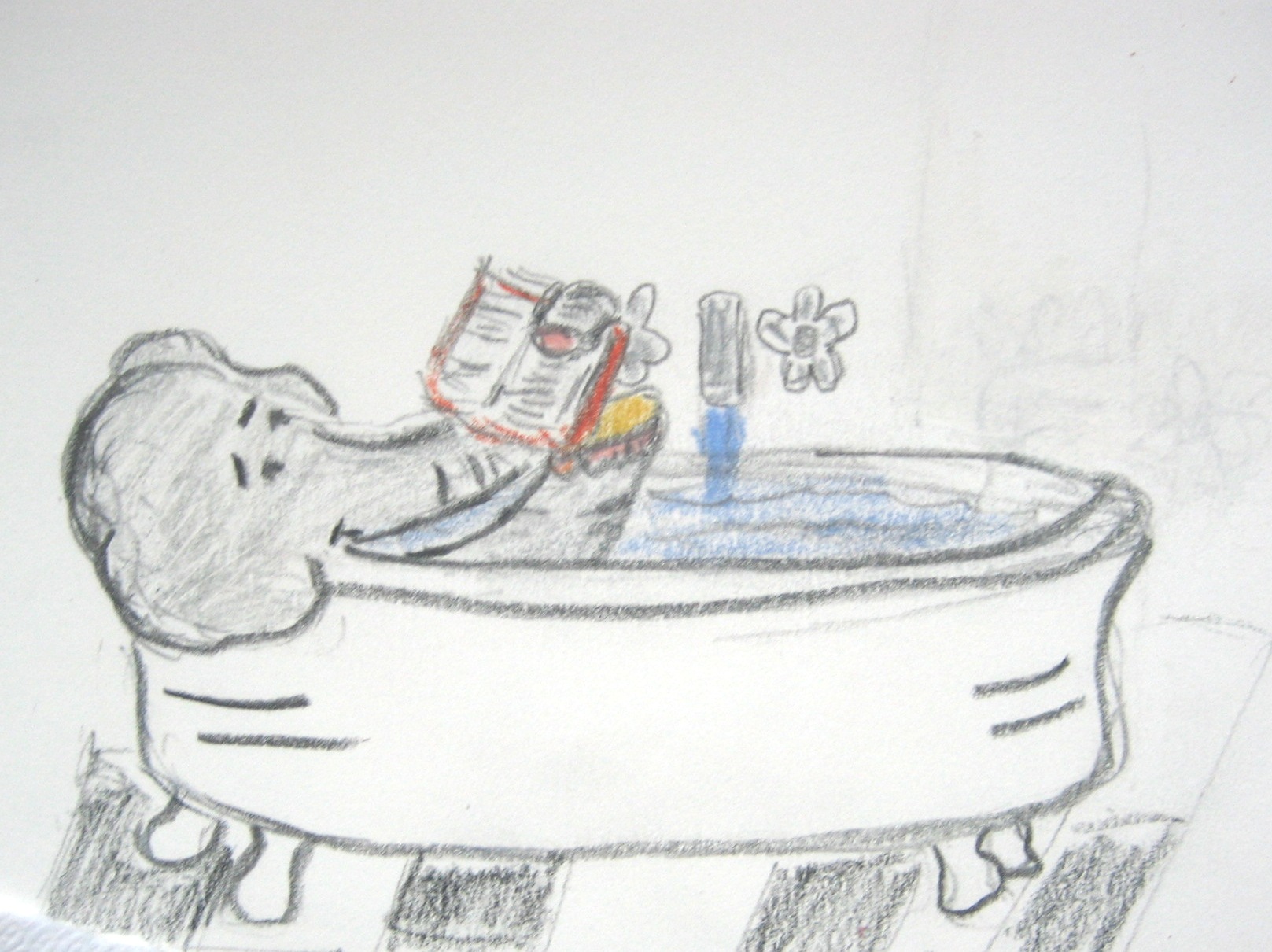
Even After the iPad – Reasons to Stick With Books – The Bath

January 28, 2010

Bathtub Book

Even After the iPad;  Reasons to Stick to Books.

1.  You can take them into the bath.

2.  You can drop them in the bath (and, if you don’t mind rumpled pages, read on, without being electrocuted.)

3.  You can also drop them on the floor. (For example, at the side of your bed.)

4.  You can spill tea on them.

5.  Or pizza.  (Though it’s not so easy to spill pizza, even on a book.)

6.  They sometimes open to your favorite spots automatically.  Othertimes they open to spots you hadn’t planned on, but are glad you found.

7.  You can underline sentences or whole passages (if you’re kind of OCD.)

8.  Or keep them absolutely pristine (if you’re really OCD.)

9.  Sometimes you find things in their pages that you’d completely forgotten about—an unpaid bill, a letter from an old friend, a wilted buttercup, a spot of tea (or pizza).

10.  Some books bear handwritten inscriptions, even just a name, perhaps your grandmother’s name.  You might read these more closely than what’s in print.

PS – if you like elephants, check out 1 Mississippi by Karin Gustafson on home page or Amazon.


PPS- I am linking this to Bluebell Books Short Story Slam; the prompt was a girl in a bath–this may be a girl elephant.

Obama Message Competes With Jobs On All Levels (Including Steve)

January 27, 2010

Polls find that a majority of Americans like Barack Obama as a person.  If they have paid attention over the last year,they likely see him as both careful and deliberative.  Unfortunately, for Obama however, what many Americans want right now is not be someone with the patience of the Biblical Job, but someone with the dynamism of the Cupertino Jobs (as in Steve).

Obama’s messages tonight (I’m trying to post this before the State of the Union Address) will be competing with jobs on all levels–Americans’ needs for jobs, the many jobs in our society that need to get done, and (to add insult to injury) the buzz around Steve’s announcement of Apple’s new iPad, the new tablet computer which is supposed to fill the gap between laptop and smart phone

Jobs is a great showman.  He can make people feel that he’s filling a gap that they weren’t even fully aware of, and he can certainly make people want something that never existed before.   Yes, he’s full of hype (as in proposed battery time) as well as ideas.   But the ideas are interesting and forward-looking, and they are executed with a determined simplicity and competence which Jobs calls “magical” and which even his detractors admire.

Obama’s more orator than showman.   At his best, he can explain complex and conflicting facts and feelings, and if not rationalize them, at least, put them in the same picture, a picture drawn from a single perspective.   But, in the last few months, under the weight of conflicting pressures, needs, greeds, and niceties, he’s let the picture he paints seem both stale and muddied.

Of course, it’s a lot harder to move a balky, favor-seeking,group of legislators, a “gotcha” press, a forgetful group of (greedy) bankers and a forgetful (and suspicious) populace, than your own company.   Obama also inherited a virtually no-win situation;  he”s blamed for not moving forward fast enough on an economic ship that was actively sinking at the time he boarded it.

But if he wants to keep the faith of the American people, he does need to move forward, he does need to fill gaps, he does need to figure out how to integrate jobs into his programs; and he needs to do it in a way that is workably simple, simply workable.  (And, apparently like the iPad, with greater speed than anticipated.)

Jobs jobs jobs.

ps- disclosure–the writer is a fan of Apple, and owns some of its stock.

Blocking Writer’s Disorganization

January 26, 2010

As some of you know, I’ve written several posts on blocking writer’s block.  (Check out that category!)  But in the last couple of hours/days, I’ve been dealing with a different problem.  Writer’s disorganization.

Mine centers on one of the least-cited negative qualities of working on a computer – the  ability to save multiple, vaguely distinguished, drafts.

It sounds wonderful in principal.  The ability to “save as,” repeatedly, means that you never have to throw anything away.  You can experiment with all kinds of revisions.   Unlike a visual artist working on a single canvas, you rarely have to irrevocably choose what works best.

But combining (i) revision with (ii) indecisiveness can be disastrous over time.  Especially if you are cursed with (iii) an aging memory, and (iv) an ability to reel off pages.

Which is the best draft?  The final draft?  The one you want to send out?

The dates should provide a clue (if you save them by date!);  however, indecisive, moody, and interrupted, rewriting may mean that your very last draft is far from your best.   (If you started changes that you didn’t carry through, your last draft may not even be fully coherent!)

If you confine the drafts to your hard drive, some trees may at least be spared.   But some of us (whose names will not be mentioned here) have developed the concept of “print only” drafts (as opposed to “read only” files), meaning that certain drafts may be  printed,  even copied, but never actually perused.  (Why is it that once one gets used to reading on a screen, the printed page seems so naked, painful, exposed?)

I certainly have yet to solve this problem.  But here are a few suggestions which, like multiple drafts, sound good at least in principal:

1.  Slow down.  When you revise, read changes carefully, maybe even aloud.

2.  Take yourself seriously.   Put your bunches of drafts in separate computer files.   If you are working with a longer piece, you might even take the time to type some little commentary at the top of the draft.  (I’ll never do this, but it sounds good.)

3.  Consider actually destroying redundant drafts.

4.  When you do print, put little footers on the pages so you know which version it is.  Put the printed copies in a little notebook, rather than a plastic bag in the back of a closet.   Label them, show them, look at them.

5.  If this is all too difficult, maybe you should just blog.  If you do it daily, you won’t have time for multiple drafts.   (Aahhh.)