Posted tagged ‘manicddaily’

For the Inspirationally Challenged – Writing Exercise for Harried Poets

October 22, 2009

For those, like me, who want to write but have limited time and mental space, inspiration can be difficult to come by. 

In large part, this is a “limited mental space” problem.  Your “free” moments may be free of immediate obligation, but your brain may still be tangled in worry, chores, regret, lonliness. 

The problem is that you don’t want to just whine.  Whining in print may offer some relief to the writer, but it’s  a  lot like the relief that vomiting offers to a person who is sick to their stomach.  It’s not all that great for the person doing it;  it’s even less appealing to their audience.

 So how can you make good use of your writing time when inspiration is otherwise engaged? 

 Here’s a trick:  try something that’s both completely arbitrary, and yet carefully defined.  In other words, a writing exercise!  The arbitrariness of the exercise can nudge you out of your over-trod groove, while the structure turns into something like a game, reducing both decisions and ego-involvement.  (It’s only an exercise!)

 In July and August, I wrote about exercises aimed primarily at prose writers.  This one is for the inspirationally-challenged poet.

 Before reading on, please set side aside snobbery.   The exercise below is a bit stupid, but it is offered as a springboard.  It relies on the fact that many poems involve tropes (a wonderful word I hardly ever get to use), that is, metaphors.  The exercise sets up a structure which is intended to turn an extended metaphor into something resembling a poem.  And it’s intended to make you think about verbs. 

 The specifics:

 First, choose an occupation, preferably one that involves some physical craft.  (Carpenter, fisherman, cook, for example, not stock analyst.)  Now, list all of the verbs that are particularly associated with that chosen occupation.  (Usually, “crafty” occupations have strong verbs.  Cook, for example: “braise, broil, boil, peel, sauté, fry, deep-fry, mince, cube, slice, skewer, stab.”)    List at least ten of these verbs.  This list is called Column B.

 Second, make a list of nouns which will be called Column A.   These nouns should be fairly randomly chosen and NOT specifically associated with your Column B verbs.  (For example, if you’ve chosen “cook” as your occupation, you can choose “mother” as a random noun, but not “chef.”) 

 While it’s nice to choose some specific nouns – such as “lilac” rather than “flower”–choose at least a couple that are very flexible  (examples:  “mother,” “father”,  “ocean”.)   You should list at least ten.

 NOW,  imagine you are at a Chinese restaurant ordering a luncheon special in which you are allowed to mix and match items from Column A (egg rolls or dumplings) with items from Column B ( bean curd homestyle or General Tso’s chicken.) 

 And NOW,  write a poem of at least five lines, using a noun from Column A and a verb from Column B in every line.   (Example:  “the ocean braised the shore.”)  (Sorry!) 

 Clarifications:  (i) Verbs from Column B can take any tense;  (ii) you do NOT need to use every word listed in Column A and Column B, just one from each Column in every line;    (iii)  line length is up to you (meaning you can use some long lines with lots of extra  uncolumned words.)

Finally, remember the two most important rules of any writing exercise:

 1.  Follow the rules.   

2.  Cheat.  (Remember that you’re trying to write a poem, not an exercise.)  

And, NOW, get going. 

Tomorrow, I’ll post some samples of my own.
Snoring Through Executions

October 22, 2009

An article that caught my eye from the October 20, 2009, The New York Times was titled “One Reporter’s Lonely Beat, Witnessing Executions,”  (by Richard Pérez-Peña.)

Because I was reading the Times online, I picked the title out of the list of most currently emailed articles  and clicked on it.  This meant that I had no idea what newspaper section it had been printed in, no sense of the other stories around it, no context.

As a result, I clicked with the calm certainty that the article would be about Iran, or Afghanistan, or China, some distant locale of renowned penal severity.  In fact, it was about Texas.

The article, moreover, did not truly focus on the high number of annual executions in Texas, but on the press coverage (or lack thereof) of so many of such executions.

Apparently, there is now only one reporter regularly covering the “execution” beat, an Associated Press reporter, Michael Graczyk, based in Houston.  Mr. Graczyk has witnessed more than 300 executions, although he has, in fact, lost count.

Mr. Graczyk has increasingly become the only member of the press at these Texas executions, the only only non-interested witness (neither a family member of the victim, or inmate.)   This is attributed to (i) the shrinking size of newsrooms and budgets, and (ii) the fact that executions in Texas have become so routine.

In the interest of neutrality, Mr. Graczyk does not reveal his personal views on capital punishment, though he says he often stands in the viewing room of family members of the victim.  (There are apparently two viewing rooms, one for family members of the inmate, and one for family members of the victim.)  However, he says he makes this choice partly because it’s easier to get out of victim’s room faster and file his story faster.

I am against capital punishment.  I know that the crimes involved are beyond heinous.  I have to admit that I probably would be too wimpy to even hear about  many of them;  Mr. Pérez-Peña says that the details of many are “so gruesome it is hard to imagine that they are real.”   I also believe that it is possible that some relief is felt by a victim’s family upon the extermination of a person who has caused so much horror and suffering.  Even so, I am against state participation in further violence.  I certainly wouldn’t release a killer (and I understand that that is what many fear), but I don’t believe in adding more killing into the equation.  It concerns me that violence begets violence;  it worries me that pre-meditated, state-justified, violence makes for an even more violent culture; a place where violence is a readily-thinkable option.

Even if one is not against capital punishment, however, it is chilling to think that there are parts of our country, including the localities in which many of the executions are actually held, in which they are increasingly not considered newsworthy.

As the article says, “the only sound regularly heard during the execution itself, is, of all things, snoring.”

Yoga Done Right

October 21, 2009

Yesterday, I explained how to rush through the whole Ashtanga primary yoga series in just a couple of short pants (as in breaths, not trousers.)

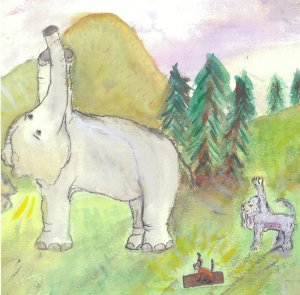
Below is an illustration of Ashtanga yoga done right, with steadiness, cheefulness, balance, and most importantly, an elephant.  (Also practicing are a little white dog and a yogini mouse.)

The pose depicted is trichonasana (triangle pose).  The animals are really quite good at it, particularly considering all the extra legs.

Elephant - Dog - Mouse Trichonasana

Elephant - Dog - Mouse Trichonasana

(All rights reserved.  Karin Gustafson)

Unfortunately, the elephant-dog-mouse yoga book, from which this picture is taken, is not yet finished.  But, if you like the style, check out 1 Mississippi, by Karin Gustafson at the link above.

Go Yankees! Go Sabathia!

October 21, 2009
Go Yankees !  Go Sabithia!

Elephant Baseball.

A masterful job by Sabathia.  (I’m sorry–I think  I draw elephants better than people.) 

Though if you like elephants,   check out 1 Mississippi, by Karin Gustafson at link above.

How To Do Ashtanga Yoga In One Short Breath

October 20, 2009

I am a longtime and very proud devotee of Ashtanga Yoga. This is a form of yoga pioneered by Shri T. Krishnamacharya and the much beloved Shri K. Patabhi Jois. It involves six fairly long series of poses (though most practitioners stick to the first “Primary” series), which are intended to energize the body, clarify the mind, and purify just about everything.   Ashtanga is supposed to be practiced six days a week, preferably in the morning.  (An empty stomach is recommended; a non-empty stomach is regretted.)

It is a great form of yoga, especially for people, like me, who have a hectic schedule, as it is designed for self-practice.  Not only does Ashtanga provide a  series of pre-set poses, it includes certain transitional movements between each pose. This takes decision-making out of home practice, an immense benefit for those who already have too many other things to think about.

Breathing in Ashtanga, as in all yoga, is super important: each transitional movement corresponds to a specific inhalation or exhalation, and each pose is ideally held for eight steady breaths.  This means that Primary series, if done right, should take between an hour and an hour and a half, to complete.

Some of us, however, have managed to shorten the required time span to approximately fifteen minutes.

Here’s how:

1. First, practice for years. It’s important to know the poses in your bones so that when you whiz through them you don’t need to spend a single extra second thinking about what comes next.

2. Second, be Manic.

3. And slightly depressed.

4. Start a daily blog.

5. But keep your day job.

6. Most importantly, fuel the flames of family and personal drama with long drawn-out conversations or email each morning, so that you really don’t have more than fifteen minutes to do yoga. (Ignore possible effects of yoga’s calming influence, if done correctly.)

7. Don’t mind if you wrench your knee or shoulder throwing yourself into convoluted positions. (Alignment always felt kind of boring anyway.)

8.  Who said you had to do the complete pose?   At least, your bending that wrenched knee.

10. Try not to mind that a practice that is supposed cultivate deep breathing and energetic stillness is whipping by in panting exhaustion

11. Congratulate yourself on the fact that you are practicing yoga at all.

12. (If you can call that practicing . Or Yoga.)

13. But keep practicing anyway. (As that great sage Scarlett O’Hara said, tomorrow is another day.)

Balloon Boy – His Father Tempting Not Just Authorities But Fate

October 19, 2009

One of the great ironies of the story of Falcon Heene, the boy who was not found in his father’s helium balloon was that in fact the boy was caught in another kind of bubble of his dad’s, a bubble of grandiosity, delusion, deception, craziness.

As almost everyone in the U.S. now knows, Richard Heene (the father) thought he’d raise media hype to both a new high (about 11,000 feet) and, possibly, a new low.  His hope was apparently to create some kind of family “reality” tale, which, like many, was based not on reality but a perverse pursuit of drama and attention.

Heene’s sons, particularly Falcon, were caught up in this drama as compelling foils.  All kids are cute, but these boys are really cute; little Artful Dodgers, as it were, to Heene and his wife’s Fagan and Nancy.  (Unfortunately, reports of Heene’s temper and of a complaint of domestic violence also bring up worrisome hints of Bill Sykes.)

You can’t help but feel incredibly sorry for the kids, especially Falcon (maybe as much of an Oliver as an Arful Dodger), whose discomfort was enough to make him physically ill during two TV interviews, literally sick to his stomach.  Oddly, the guilt he must feel now stems largely from honesty, from openly alluding to his father’s script.

The whole story raises a lot of questions both about Heene and about the reality show culture.

But one of the questions that hits me the hardest is not how Heene could have had the chutzpah, or the incentive, to try to fool the authorities, but simply how he could have stood to tempt fate in this awful way.

Most people, certainly in the traditional world, but also today, would not even speak theoretically of possible ill befalling their children.  Many people would have difficulty actually forming words around such horrible speculations.  I am an attorney in my real life, and even when writing memos related to estate planning, I frequently use vague, pablumesque, words to describe the future mortality of a loved one:  “if something were to happen to” so-and-so, I write.  “Pre-decease” is another good, legalistic word, simply because it is both Latinate and elaborate enough to create distance from what it truly means.

“God forbid” was and continues to be the typical phrase of protection against such terrible speculation.  “God forbid,” combined, after a silent prayer, and then perhaps a  knock on the head.  (Something wooden.)

One hates to see families split up. But you can’t help but worry about those kids in their father’s bubble, whether up in the air, or firmly tethered in their own back yard.

Yea Mariano! – Go Yankees!

October 19, 2009
Go Yankees!

Go Yankees!

Just got home to see Mariano pull Yankees out of tight spot, Angels everywhere.   I’m posting for good luck!  Sorry for the repetition (but if Yankees repeat winning….)

Robert Pattinson Unmasked, Carefully Carved

October 18, 2009

In the blues of Sunday evening, I looked up two conflicting articles in the blogosphere.  Both about you know who.  (Hint—it’s not Voldemort.)

They present an interesting contrast.  One is from an internet site called Irish Central, which has never liked Robert Pattinson because of all the attention he (inadvertently) stole from the Irish actor, Pierce Brosnan, in the filming of Remember Me in New York this past summer.   Irish Central had a few articles back then (i) comparing the relative virtues of RPatz and Brosnan –you can guess who came out ahead, and (ii) saying how much friendlier Brosnan was to fans.  (Of course, Brosnan was not the guy who was grabbed from every direction, chased into collisions with taxi cabs, and forced to stand in a seven foot high box during breaks in the on-street filming.)

In this weekend’s Irish Central article, focusing on bestselling Halloween masks (presumably in Ireland), the Central reports, snarkily, that the mask of the “pretty boy” vampire isn’t even in the top ten.  It goes on to mock Rob: “if your halloween mask won’t sell, what kind of horror film movie star are you?”

Irish Central bases its snarkiness on one major misapprehension—the Twilight films aren’t horror films, they are romances.  Since when do romantic heroes sell Halloween masks?

Never.  What romantic heroes apparently sell at Halloween (or distribute in large numbers free of charge) are pumpkin stencils!  I learned this from another, much smaller, internet site called Huliq, which reports on the popularity of free downloadable pumpkin stencils of RPatz as Edward Cullen.  (You know the pose–it’s the same one used on the RPatz shower curtain–he looks angry/determined with criss-crossing eyebrows, and puffed- up hair.)

I took a look at these stencils, and frankly, you’d have to have the manual dexterity of Michelangelo to carve one into a pumpkin.  (Although the directions helpfully suggest using toothpicks to hold the bridge of the nose in place.)

Which brings up another mistake in Irish Central’s whole put-down of RPatz.  Who even wears big rubber cover-your-whole face Halloween masks?  Not young women.  Not ‘tween girls.  Not even older, weird, women.   Not, in other words, Pattinson’s primary fan base.

But who, one wonders, carves Robert Pattinson pumpkin faces?

Simple!  People who want to win a Rob-O-Lantern contest!

What a world/internet.
P.S. If you want help with elephant-o-lanterns, check out 1 Mississippi by Karin Gustafson on link above or at Amazon.

Baseball and Life – Yankees-Angels Game 2 – The Blink Factor/The Not-Blinking Factor-Boom Boom Boom

October 18, 2009

My good luck tricks seemed to have worked once more for the Yankees—i.e. last night during the second Yankees-Angels game, I posted my elephant baseball picture AND, at a certain critical juncture, stopped watching.   (See earlier post re good luck “Talismans” and my personal effect on Yankees’ baseball.)

I won’t take all the credit for the victory—there was also Jeter, Cano, and Mariano, Jerry Hairston, Jr., A-Rod, and Damon (who made some really terrific catches), Melky Cabrera, Phil Coke, and Joba (who still seems a little pudgy boy to me especially when he celebrates), and Molina, who had a really hard job as catcher for A.J. Burnett, who also, as starter, deserves some credit, despite the way in which his wild pitches can drive a fan crazy.  (The frustration he causes is frankly not completely redeemed by the whipped cream pies.)

Then, there was just the Yankee grit, that somehow, so frequently, manages to just hang on and on and on.

Watching the videos of the end of the game this morning made me think (yes, it’s a cliché) of baseball as a paradigm of life.  Yes, again, yes, it’s a cliché.  Still, it seems somehow a more appropriate paradigm than a lot of other big sports.  (Which I have to confess don’t interest me enough to know much about them.  Still, I hate to think of any sports in which (i) people are repeatedly tackled and concussed, or (ii) forced to chase around constantly with little chance of achieving many goals, as better paradigms.)
What is unusual about baseball is simply how fast everything moves when it does, finally, move at all.   The replays of the last moments of last night’s October 17th game against the Angels are particularly striking.  On the Yankees’ site, they show footage taken from nearly every angle, even one that simply shows Cabrera running, relatively quickly for a big guy, to first.

In case, you didn’t follow the game, in the thirteenth inning, with a man on first and second, Yankee Melky Cabrera hit a ball that bounced between first and second.  The Angels’ second baseman, Maicer Izturis, stopped the ball, then, trying for a double play, threw it hard and fast to Angels’ short stop Erik Aybar, who stood at second, and who frankly seems like a really a surly, cocky sort of guy (if you are a Yankee’s fan), who missed it.  The Angel’s third baseman, Chone Figgins, stopped Izturis’s throw, but bobbled the ball.  In the meantime, Hairston Jr., who’d been holding on third before Izturis’s error, dashed towards home. Hairston was immediately overrun by the rest of the Yankees’ team and quickly assumed a fetal position on the ground as they all energetically patted him.

The long and short of that detailed explanation is simply that, although it takes a long time to write it all down, the play actually happened in an incredibly short period of time:  boom (Cabrera connected with the ball), boom (Iztura stopped and immediately threw it), boom (it slid below Aymer’s glove), boom (Figgins bobbled it), boom (Hairston slid into home).  When the footage that just focuses on Cabrera is shown, you see from the way that he turns, delighted, that the run has already been scored even as he makes it to first base.

The speed of it all is especially amazing because most of baseball is so slow.  The pitcher stands and postures, eyes narrowing and re-narrowing, with little shakes or nods of the head to the catcher, the batter (if Jeter especially), re-tightens his gloves (two or three or four times), re-squares his shoulders, gently sways the bat,  everyone constantly repositions their stances (usually spitting or blowing a bubble at the same time in a sort of homage to old-time multi-tasking).  Everyone, pitcher, batter, catcher, batter, in and out fielders, both wait and prepares.  Even the audience waits, though it doesn’t prepare so much as eats and drinks, crosses its fingers and yells. So much waiting, so much preparation, so much eating and drinking, finger-crossing  and yelling.  And then, boom, boom, boom, boom.  The moment arrives and players are suddenly expect to act, react, not just to make decisions, but to carry them out – boom boom boom.

Okay, you get it.  This is where the paradigm part comes in. There are obvious parallels to situations in the marketplace–buying and selling on the stock market, buying and selling anything, anywhere.  And also to moving around a potentially dangerous world–driving a car, for example,  especially in, or around, an accident.  The way action unfolds in baseball parallels many emergency situations actually; an emergency, a threat, that can also turn into an opportunity (i.e. the near double-play that becomes a winning score for the opposite side.)

So many parallels:  the need to be able to act even in the midst of a mouthful! The need to keep a mouthful going in order to be able to act!  The blink factor!  Or, maybe it’s the not-blinking factor!  The waiting, the planning, the practice, and then the OMG moment, which never takes exactly the shape anticipated, and frequently involves both a solo effort AND team work, and if not exactly team work, at least the avoidance of collision.  (A-Rod and Mariano were a great example of that in the tenth inning when they both ran towards a flying bunt, which was then caught by Mariano.)

Ah, Mariano….

Go Mariano!!!

October 17, 2009

There’s nothing else to say at 11:01.

(Bottom of 8th, second game against Angels, October 17, 2009)