Archive for the ‘Uncategorized’ category

Why I Stay Up Late Rereading Silly Books i.e. Twilight (ha!)

August 25, 2009

Why I Stay Up Late Rereading Really Silly Books (Like, I’ll Admit It, Twilight, New Moon, Eclipse, Breaking Dawn, even Midnight Sun….)

  1. Otherwise, I read The New York Times.
  2. Or check on the stock market.
  3. Ugh.
  4. Books like Twilight have happy endings which, at all moments, even the “tense” ones,  can be foreseen by the reader.  Especially on a re-read.
  5. In the world of Twilight, even environmental issues, like the poaching of endangered species in national parkland, are dealt with soothingly.  (The  vampires only go after an “excess” of such endangered species after all, and with only their teeth as weapons.)
  6. And man’s inhumanity to man turns out to be actually vampire’s inhumanity to man, which somehow feels a lot less disturbing …  (I mean, what can you expect from a bunch of bloodcrazed supermodels?)
  7. Health care issues, at least in terms of access to treatment and payment for care, are arranged with breath-taking ease.  Of course, it helps to have a vampire doctor in the house.  And, in Breaking Dawn, a personal x-ray machine.  (Though blood banking’s a bit tricky.)
  8. Hardly anyone in the books seems to actually work at a job for pay except the policeman father (Charlie) who apparently plays cards with other officers much of each day.  Yes, Bella has a part-time job, but whenever this is mentioned, she’s being urged by her employers to take time off.  (The altruistic vampire doctor, who seems somehow to work at the hospital on a volunteer basis,  doesn’t count.)
  9. The New York Times, when I read it, frequently mentions the large number of ordinary Americans not working, being shunted to part-time jobs, or forced to take time off.   Somehow these practices seem a lot more fun in Twilight.
  10. Not only more fun.  More lucrative.  In the best-selling fantasy saga, college tuition and living expenses can actually be earned in one of these barely-existent part-time jobs.  By a teenager.
  11. More importantly, it’s somehow more pleasant to identify with Bella Swan than Maureen Dowd;
  12. More pleasant to read what Edward Cullen has to say than David Brooks, Paul Krugman, Bob Herbert, and/or Frank Rich.
  13. After all, Edward Cullen is even better than Robert Pattinson.
  14. True love conquers all.

Anniversary

August 22, 2009
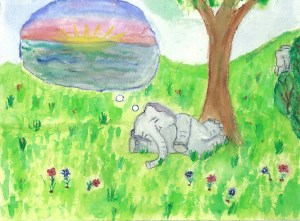
Catskill Mountain Wedding With Elephants

Catskill Mountain Wedding With Elephants

Mist

Mist rises over lake like fish jumping
like heart wishing like eye
blinking like memory crying like fir boughs
sighing like awe inspiring, like hope
dying (not needed, not even considered), like
dawn breaking like
love making like
water curling in its fall,
like head on lap on
lips on lips on hips
on you on me, like
fingers fingering,
brushing against a nipple,
or being brushed
like something somewhere
sure of joy,
like the thing itself.

All rights reserved.

Friday!!!

August 21, 2009
What I Hope To Do This Weekend

What I Hope To Do This Weekend

Single Parenting – A Bit Of A Lump

August 20, 2009

What do you do when you turn around and realize that your truly wonderful, generous,  sweet child has become a bit of a, you know, lump?

I’m not talking about weight gain.

I’m talking about sitting there.  Or lying there.  Curled around a laptop computer.  Or cell phone.  Surrounded by dirty dishes.  A half-full cup of juice or tea balancing.   A peach pit to the side.

Wait a second.  Make that a laptop computer only.  Because at about 1 a.m. the child realizes he or she has lost their cell phone.

They don’t know how it could have happened.

It being 1 a.m. you don’t feel like starting a lengthy discourse on the demerits of a bag (used as purse or messenger bag) that doesn’t close and from which you, as parent, have repeatedly witnessed things fall.

But seriously, how did it happen?

I’m not talking about the loss of the cell phone.

It’s possible that some single parents are stern taskmasters.  They know they can’t do everything and make that clear to their children at an early age.  They inculcate chores.

But some single parents (ahem) find it easier to just do the chores themselves.  They hate to cajole, nag, fight.  Such single parents value the household harmony achieved from separation from a mate; they can’t bear to disturb that peace with harsh words about undone dishes, unclean rooms, untaken-out garbage.  “You’ve got to choose your battles,” such parents insist.

And then these parents are surprised by the sudden realization that there is a bit of a lump sitting on the couch.  Texting or IMing into the night.  Surrounded by food-smudged dishware.  Who’s just misplaced something.

Boot camp is difficult to carry out.  A maiden aunt may be useful in this area.  Or a martial arts instructor.

Or maybe you yourself can muster the requisite sternness.  Consistency can be hard to maintain for a single parent who has, historically, hated confrontation, but it’s worth a try.

Because here’s the point: one some level, the missing cell phone is actually the byproduct of the sofa’s dirty dishes.  An extension of parentally-enabled inattention.

But how to impress that fact on a child, a truly wonderful child, who’s somehow gotten, well, just a little bit lumpy?

You may have to get really quite mad.

(At a certain point, this can generally be arranged.)

FINAL NOTE – Many single parents (i.e. people like me)  have repeatedly through their lives lost cell phones, keys, wallets, keys, glasses, credit cards, keys, clothing, dog leashes, keys, important documents, credit cards, glasses, keys, etc., even when they pride themselves on their dish-doing, and would hate for people to characterize them as in any way lumpy.    So all tongue in cheek, please.

Check out 1 Mississippi at link above.

Niceness – Writing – “Oh Plunge Your Hands In Water”

August 19, 2009

I was thinking today about women from my generation–I don’t quite want to confess what generation that is, let’s just say that we are just old enough to actually remember when President Kennedy was shot–and the internal pressure many of us feel to be “nice.”

We are sometimes accused these days of being overly nice, or artificial or precious in our niceness, or just plain mamby-pamby.   This really is maddening.  Some of us are still too well-trained to get openly mad about these  unfair characterizations, but they are still upsetting.

This piece  deals with that issue indirectly.   It was actually a writing exercise, written with my writing buddy, in a ten or fifteen minute session based on the phrase “Plunge Your Hands in Water” from the poem “As I Walked Out One Evening,” By W.H. Auden.

(The Auden poem is simply wonderful.    Here’s a link to an online copy:  http://www.poemhunter.com/poem/as-i-walked-out-one-evening-3/.)

The piece has been slightly edited since the original exercise, but it really still is an exercise.   (Sorry.)

(Final point re my Blocking Writer’s Block series – a line from a poem can be a great starting point for a writing exercise.   While your exercise may be quite different from the poem, your work will may still get some depth from such an elevated jumping off point.)

“Plunge Your Hands in Water”   – W.H. Auden

At my elementary school cafeteria, the tiles were blue green grey and the trash cans were an amalgam of ketchup and fishstick skins and small red milk cartons usually half full.  The women were large and wore white stiff dresses like nurses.  They served the food in surgically cut portions on brown cafeteria trays, which were topped with mauve or yellow plates, the colors of everything an illustration of the word “faded.”  Their big rounded hair curved around their heads like the double breast that curved from their fronts, the hips from their sides.  It was good food–we all knew that–good meaning solid.  No one used the word nutrition much back then; what we knew was meat and starch, ketchup and pickle.

We sat at long tables, whose benches folded out;  the tables were cleaned with vinegar water and the whole placed smelled of the Golgotha Christ, his side or head or thirst, a reminder that we were all there, undeservedly, to be saved.

We were supposed to sit still but I dreamt that everyone ran from gorillas who chased us from spot to spot–through the lunch line, inbetween the line and the tables, then from the tables to the garbage cans.  They were big furry gorillas who ran on two legs, their forearms outstretched as they chased, while we ran, ran to do what we were supposed to do, and then sat where we were supposed to.

It was an old-fashioned school;  ice cream did not appear for some years.  When it did, all hell broke loose.  No one would eat anything else and Scott entertained us all with taking the chocolate coating from his ice cream bar and spreading ketchup and mustard on the vanilla ice cream, then re-anointing it with its chocolate sheathe.  The girls squealed in horror, the boys howled and scowled, as he took a big smiling bite, the ketchup/mustard smearing his lips with variegated orange like a fire-eater’s.   The girls pretended to bend over in nausea, and Scott looked like he felt incredibly cool for a time, though he was a troubled boy, a sad boy, a boy on whom I felt somehow that belts had been used, and who, in first grade, sometimes peed in the little classroom bathroom with the door open.   I felt it my duty to always smile at him, and he, in turn, sent me a letter covered in huge slanted writing I LOVE YOU.

I felt sadder than ever for Scott watching him eat that ice cream, thinking of his open-doored pee, and kept my head down, only looking up with the corners of my eyes, and even then trying to focus on the gorillas, the chase, and the fact that if I sat exactly where I was supposed to, they wouldn’t be able to get me, and maybe not anyone, no matter how they circled.

From Rat Race to Rat Rut

August 18, 2009

In the Science Times section of today’s New York Times (August 18, 2009), is a great article about the effects of stress on brain circuitry.  (“Brain is a Co-Conspirator in a Vicious Stress Loop” by Natalie Angier.)

Ms. Angier reports a study by Nuno Sousa of the Life and Health Sciences Research Institute in Portugal which described how chronically stressed rats succumbed to habitual and seemingly compulsive routines (like repeatedly pressing a bar for food pellets that they had no intention of eating).  The study found that underlying changes had actually taken place in the brains of these rats, with decision-making and goal-oriented areas of the brain shrinking, and areas related to habit-formation swelling.

As Ms. Angier writes, the stressed rodents “were now cognitively predisposed to keep doing the same things over and over, to run laps in the same dead-ended rat race, rather than seek a pipeline to greener sewers.”

In other words, the stressed rats got into a rut, dug, in part, by their own brains.

There’s no clear answer to why the stressed brain is so prone to habit formation.  One possibility posited in the article is that the brain in crisis may try to shunt activities to automatic pilot simply to free up space for  bigger questions.  Which, because of the concomitant weakening of the ability to make decisions, the stressed brain just can’t deal with.

Ah.

This syndrome sounds familiar.   Especially the compulsively pressing the lever part.  (Although it’s a bit hard to imagine any kind of food pellet I wouldn’t eat when under stress.)

Still, after reading the article, I came up with the following list.

Ten Signs That You May Be A Rat in a Rut.   (Or How To Know If Your Brain’s In Stress.)

1.   When you are not sitting at a computer, you check your blackberry every few minutes, even on an underground subway train.

2.   You check your blackberry when stepping out of the subway just to see how long it takes to get service back.  You study the little flashing arrows as you climb the subway stairs, conscious of your breath.

3.   If, after a while, no one’s written, you start to open spam.  Just to clear it out.  Just in case there’s something that’s not spam.  You even open some of the messages for p*n*s enl*rg*m*nt.   (Yes, you’re a woman, but you’re only checking those to see how they managed to get through your spam filter.)

4.   When someone on the phone talks of an article they’ve read, you find it online before they finish their sentence.   (At least you think they haven’t finished their sentence.  You were doing a Google search so you’re not really sure.)

5.   You convince yourself that your interest in Robert Pattinson is a sociological study of our media/youth culture.  (Oh that RPatz!  Oh those Paparazzi!)  You are alternatively amazed at how little and how much is on Google News in the articles posted on Pattinson during the “Last Hour.”

6.   You peruse the sales of online retailers even though you have no money, and (thankfully) no pressing needs.  When you buy something, you congratulate yourself on how much you saved.

7.   You check all the stocks that have gone up dramatically in the last few months but that you did not buy.  (You studiously avoid checking stocks you own, hoping that you can not check those long enough to forget what they were.)

8.   You find yourself reading the same books again and again.  These books are fantasies in which unreal things happen to unreal people, ending happily.  You don’t find the books especially satisfying after the tenth read, but, on the other hand, they are also not disturbing.

9.   Your eyes are sore at night.  When you wake up the next morning, they are still sore.  Even so, you reach for your laptop and/or blackberry first thing.  You decide that a glare screen is the only solution, and shop for one online, looking for sales.

10. Your daughter shouts from the other room at about 9:45 p.m, “are we going to have dinner soon?”   You are working on a computer that has no glare screen.  “Just a minute,” you tell her some time later.

(Wait, what did they say about food pellets?)

If you are more interested in elephants swimming than rats racing, check out 1 Mississippi at the link above or on Amazon.

Blocking Writer’s Block Part VII – Don’t Show Draft Manuscripts Too Soon

August 16, 2009

Rule No.  9  –  Be Brave but Know Yourself.  Don’t Show Drafts Too Soon.

In Part VI of this series, as Rule No. 8, I wrote, Be Brave, Read Aloud.  That post was about the liberation of reading your writing exercises aloud to your writing buddy, almost immediately following the writing of them.

This type of immediate reading is very different from handing out a written draft of your work, a manuscript.  In that case, I would not urge bravery, so much as self-knowledge.  (Or perhaps bravery and self-knowledge.)

Here’s the gist of it (for me at least):

I am incredibly insecure.  Especially about writing.

It’s frankly amazing to me that I can do this blog.  ( All I can think of is that it must have something to do with Robert Pattinson.  I mean, if you’re going to be silly, you might as well take it to the max!)   Even so, the night that I realized a guy in my office had discovered my blog name, I got physically ill.  I thought I would simply have to drop the whole thing.

But I kept on.  Because it really is useful for a writer to have a sense of audience (even a slightly noncomprehending one).

I also believe that, if you ever wish to publicize your work, it’s important to expand the limits of what you can tolerate–your comfort level, or perhaps more accurately, your discomfort level.    Keep in mind that even when your discomfort level gets quite high (that is, when you can tolerate a whole bunch of it),  you should not expect the discomfort to convert to ease.   You will still feel uncomfortable with many of the same things, the difference is that you will be able to breathe through more of them.

That said, be very careful of prematurely sharing work that is truly important to you.  The danger is not copyright infringement so much as ego infringement.  Ego incapacitation.

The showing of a manuscript can be paralyzing.  I usually cannot revisit the project when it is out with a reader.   If I do try to re-read it, it’s like looking at a mirror under an interrogator’s bright light.   Every single blotch shows up.  Stain, tear.  (How could I not realize that I had a long strand of toilet paper hanging out from under my skirt?)

Even after comments have been delivered, it can be difficult to pick up the work again.

A caveat to this rule.  The process does get considerably better with time. And, frankly, it is crucial to show manuscripts to test readers.  (Your goal is to produce a good manuscript after all, not to simply shield your ego.)

One way to reduce the possible unpleasantness of showing work  is simply to really know your manuscript.  A good technique here is to wait a few weeks without looking at the manuscript before giving it to anyone else.  Then, still before you give it out, read it again yourself.  (If you can stomach it, read it aloud to yourself.)

When you do give the manuscript out, try to separate yourself from it so that any criticisms will not seem to be shots at you personally.  In other words, go back to Rule No. 1 (in Part I of blocking writer’s block):  don’t care so much.

At the same time, don’t forget Rule No. 2 – care.   Care enough to want to make your manuscript better.  Accept that part of that process is finding out what just doesn’t work.

Most importantly, look for a sympathetic reader, ideally, someone who is also interested in writing.  People who are not writers will not realize (i) the amount of work you have done or (ii) how sensitive you are.

But be sensible as well as sensitive.  If the manuscript is about your childhood, maybe your mother, or even sibling, is not the best first reader.  If it’s about your marriage, maybe you should  start with someone other than your spouse.   If it’s about Robert Pattinson, probably best to avoid your boss.

If you are interested in counting and elephants and watercolors, as well as writing, check out 1 Mississippi at link above or on Amazon.  Thanks!

Writer’s Block – Part , Rule No. Don’t Show Your Drafts Too Soon.

In Part of this series, Rule No. , I said Be Brave, Read Aloud. I meant by that to read your writing exercises aloud to your writing buddy, almost immediately following your first writing of them. This type of exposure of work that is absolutely fresh (and clearly clearly a draft) is incredibly exhilarating. And the great thing about reading aloud is that you’re not actually showing anything to anyone—you read the words aloud, and then you can basically swallow them again. You can keep them private as long as you wish.

For me this type of immediate reading is very different than actually handing out a written draft. In the case of written drafts, I’m not sure that I would urge bravery, so much as self-knowledge. And, if you are someone who is prone to writer’s block, you may wish to exercise some caution.

Here’s the gist of it for me at least:

I am incredibly insecure. Especially about writing.

It’s frankly amazing to me that I can do this blog at all. All I can think of is that it must have something to do with Robert Pattinson. (I mean, if you’re going to be silly, you might as well take it to the max!) Even so, the night that I realized a guy in my office had discovered my blog name, I got physically ill. I thought I would simply have to drop the whole thing.

But I kept on. Because it really is useful for a writer to have a channel, some sense of audience (even perhaps a slightly noncomprehending one). Writing is lonely enough as it is; if it is not a tool of communication (simply because no one reads it), the activity becomes very hard to sustain.

Another reason I kept on is because I truly believe that it’s important to try at least to expand the limits of what one can tolerate–one’s comfort level, or perhaps more accurately, one’s discomfort level. This comfort or discomfort level is very different from the comfort zone. If you ever wish to put any of your work in public, it is important to expand the level of discomfort that you can tolerate. Keep in mind that eve when your discomfort level gets quite high (that is, when you can tolerate a whole bunch of it), you should not expect the discomfort to convert to ease (to any kind of zone). Many of the same things will still be uncomfortable to you, you should will be able to breathe through them.

That said, be careful of prematurely sharing work that is truly important to you. By work, I mean a manuscript which is still in process. Because I know a little about law, a lot of people ask me questions about manuscripts and copyright infringement. But the danger here is not copyright infringement so much as ego infringement. Ego incapacitation.

The showing of a manuscript can be paralyzing (at least to me). I usually cannot revisit the project when it is out with another reader. If I do look at it, it’s like looking at a mirror under a spot light. Every single blotch shows up. Stain, tear. (Oh, and by the way, did you realize you had a long strand of toilet paper hanging from under your skirt?)

Even after the reader is finished, even after comments have been delivered, it can sometimes be very very difficult for me to pick up the work again.

A caveat to this rule. The process of showing work does get considerably better with time. And in general it is actually crucial to show manuscripts to readers. The comments of others are absolutely invaluable. (Your goal is to produce a good manuscript after all, not to simply prop up your ego with fake pats on the back.)

But if you are prone to writer’s block, take care. Know your discomfort limit. Know your reader. Know your manuscript too.

One technique is to wait a few weeks without looking at the manuscript before giving it to anyone else. Then, still before you give it out, to read it again yourself. At this point, you yourself will be more of a fresh reader, and can perhaps see the weak spots yourself.

When you do give the manuscript out, try to separate yourself from it a bit so that any criticisms will not seem to be shots at you so much as at the manuscript. In other words, go back to Rule No. 1 (in Part I of blocking writer’s block): don’t care so much.

At the same time, don’t forget Rule No. 2 – care. Remember your goal is to write a good manuscript, a great manuscript. Care enough to make it better.

One last tip—look for a sympathetic reader, ideally, someone who is also interested in writing. People may not realize (i) the amount of work you have done or (ii) how sensitve you are.

Also, be sensible as well as sensitive. If the manuscript is about your childhood, maybe your mother, or even sibling, is not the best first reader. If it’s about your marriage, maybe start with someone other than your spouse. If it’s about Robert Pattinson, probably best to avoid your boss.

Early Saturday Morning Gym

August 15, 2009

(Before reading, you may wish to check out previous post re “Friday Night Gym” for analysis of comparative virtues.)

Five Reasons to Go to The Gym Early Saturday Morning

1.  It makes you feel incredibly disciplined.

2.   It’s not crowded.  The  other people there  look  sleepy-eyed but take-chargey.   You are quite sure, while avoiding all mirrors, that you look super take-chargey.

3.  These take-chargey people do not let the staff vacuum right next to where you huff.    Besides the staff is really sleepy-eyed and not in the mood to vacuum.  (They are the ones that kicked you out last night, remember?)

4.   If you go now, you don’t have to go later,  a time of  serious nautilus puddles.  Let’s not even talk about the Saturday afternoon pool.  (Has anyone studied the human body effects of diaper moisture retardants combined with chlorine? Lots and lots of chlorine?)

5.  You’re getting fat.

Five Reasons Not to Go to the Gym Early Saturday Morning

1.  Who anointed you as the keeper of the Discipline fleece?  And what about the links between sleep and productivity, huh?  Huh?

2.    Who said that “take-chargey” was a good look for you anyway? (BTW, you forgot  to take charge of the puffy circles under your eyes. )

3.  The staff really doesn’t care about your work-out schedule.

4.  If you went later, you could get kicked out at closing and you wouldn’t have to stay there so long.

5.  You’re getting fat no matter what.

If you want something to check out on a Saturday,  try 1 Mississippi at link above or on Amazon.

Friday Night Gym

August 14, 2009

Five Reasons To Go To The Gym Friday Nights

1.  It makes you feel incredibly disciplined.

2.  It’s really uncrowded.

3.  The staff are extremely attentive.

4.  It closes early so you don’t have long to work out.

5.  You’re getting fat.

Five Reasons Not To Go To The Gym Friday Nights

1.  It’s hard to feel good about being disciplined when the rest of the world is out partying.

2.  You see the same old people there every Friday night.  They are beginning to seem very same and very old.  You wonder about your own sameness and oldness quotients.

3.  The staff are so anxious to get rid of you they vacuum right where you huff.   You feel too bereft to ask them to stop, certain that they, at least, have other places to go.

4.  If you’re not going to work out very long, what’s the point?

5.  You’re getting fat anyway.

Friday A.M. – Almost There….

August 14, 2009

10 A miss

From 1 Mississippi,  check it out at link above or Amazon.

All rights reserved.