Archive for the ‘Uncategorized’ category

Parenting – Second Tweenage – Kidults

August 13, 2009

A few years ago, a new age category came into common parlance – “tweens” – kids phasing from childhood to teenagerdom.   I think the category was partly invented as a marketing tool, like a Hallmark card holiday (see e.g. Office Assistant’s Day.)   Tweens seemed to need special merchandise, their own stores, their own books, their own clothes sizes.

I never was conscious of my own children being tweens.  But lately, I’ve been thinking about another transitional age period, which,  for now, I  call “kidulthood.”

Kidulthood extends from age seventeen or eighteen until some time in the mid-twenties.  (Not, let’s hope, beyond that.)

Your children will always be your children.  Even now, my 84 year old mother worries frequently that I get overly tired, and should get that checked out.

Kidults are people whose parents worry that they need a lot of things checked out:  like their teeth or their tickbites, their summer job prospects, or the status of their college applications.

My mother and I differ from kidults and their parents in that the question of who will actually get all these things checked, and who will do the nagging about the checking, has been settled a long time ago.

Kidults and their parents have not quite resolved these issues.  (Well, the nagging part is pretty much settled—that falls on the parent.)

Probably the first experience parents have of kidulthood is the college application process.  Some (possibly mythical) kids take care of the whole college application process completely on their own.   Some (certainly mythical) kids even do all their own financial aid applications.

But some kids need, well, encouragement.

The issues between kidults and their folks usually become somewhat easier once college has been entered, but they can linger.  In fact, once a kid has been more autonomous (or at least been away from home for long periods), and has independently arranged some doctor’s appointments (at least those required for the Pill), the parent can find themselves getting really frustrated.   Because at this point, the kidult oresents the parent’s intervention; while the parent resents the kidult’s passivity, certain that if they don’t do something parental (at least nag), then other doctor’s appointments (e.g. the ones for that strange mole or that tooth that’s gone awry) just won’t get made.

And what about health insurance?

And the lube job on the car?

And that jury notice?   And tax returns?

Even the most responsible kidult usually doesn’t find this kind of thing nearly important as most parents.

Yes, kids have to learn to act on their own.  And most seem to eventually.  But sometimes kidults, just like older adults, can use a little help.  Concrete help, i.e. not nagging.

The simple act of offering to keep a kidult company while important actions are taken can be very useful.  (Often the offer alone will trigger the kid do the thing themselves just so you don’t keep them company, but sometimes they do appreciate it moral support.)

Offering to help out with pertinent phone calls can also be a way of getting unattractive tasks done.  (Strangely, a lot of modern kidults seem a bit stymied by dealing with bureaucracy over the phone.  Until doctors make appointments by email, this can be a bit of a handicap.)

But it’s important, parent, to always doublecheck how much the kidult really needs your help, and how much of the perceived need is simply the result of you insisting your child do things your way.

You need to be aware too of how much you simply miss your kid in that new adult.

For me, the most effective guard against over-intervention has been my own aging processs, i.e. early senility.  (See e.g. previous posts re Robert Pattinson.)  I’m someone who could easily get caught in oversolicitous parenting.  Fortunately, for my kids, however, I have enough trouble keeping track of my own life these days.

If you have younger kids or even kidults (who like watercolors and elephants), check out my counting book 1 Mississippi at link above or on Amazon.
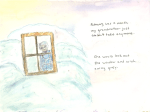
Elegy

August 12, 2009

Old friend died today.   This poem was written and illustrated for February and also for my grandmother, but my friend’s death put me in mind of it.

All rights reserved.

“Beneath It All”

August 11, 2009

For those of you (especially those who know me) who really don’t get all this Pattinson stuff (and forget that I write teen novels), I’m posting a poem.   This was not an exercise poem, sort of a teen poem, or early teen.

Beneath it all

Beneath the red over blue sky,
she walked a beam, its wood dark
as charcoal;  just below it, gravel.  Still,
she held arms out
to her sides
as if balancing on a narrow ledge, in
a harsh wind,
pretending.  Pretending too
that she was still a little girl, while
also pretending
to be older.  To be younger
and older both
felt cute,
like wearing,with conscious insouciance,
a too-short skirt over legs
that had learned allure.
Sure of the man watching, she also
pretended to slip, then
caught herself, smiling in mock
relief, the feel of control surging through her
like growth itself.
She had much to learn and
would have a hard time at it.

Don’t forget to check out 1 Mississippi!

Beneath it all

Beneath the red over blue sky,

she walked a beam, its wood dark

as charcoal; just below it, gravel. Still,

she held arms out

to her sides

as if balancing on a narrow ledge, in

a harsh wind,

pretending. Pretending too

that she was still a little girl, while

also pretending

to be older. Younger

and older both

felt cute,

like wearing,

with conscious insouciance,

a too-short skirt over legs

that had learned allure.

Sure of the man watching, she also

pretended to slip, then

caught herself, smiling in mock

relief, the feel of control surging through her

like growth itself.

She had much to learn and

would have a hard time at it.

Six Reasons Why Modern Females May Prefer to Click on Robert Pattinson Rather than Marlon Brando.

August 11, 2009

The one person in my office who knows about my maternal interest in Robert Pattinson (see earlier post, “why my feelings for Robert Pattinson must be strictly maternal”) is mystified.

He can’t believe that anyone, including anyone of the female persuasion, is actually interested in Robert Pattinson.  He starts going on about Marlon Brando and Clark Gable.  They were men, he tells me, while Pattinson, like so many modern male movie stars he says, is just a grown-up boy.

I agree with him.  (See e.g. Brad Pitt, Tom Cruise, and Leonardo DiCaprio.)

Though, of course, in Pattinson’s case, he still really is kind of a boy.

I also agree that as some of these “boys” i.e. Brad, Tom and Leonardo, age, they lose a lot of their appeal.  (Although I have to confess I never ever understood the appeal of a Brad Pitt or Tom Cruise.)

I blame it a lot on bone structure.   But my friend doesn’t listen to me.  He goes on and on and on about Marlon Brando.   Now there was someone, he says, for women to get excited about.

Having, by chance, recently revisited clips from both On the Waterfront and A Streetcar Named Desire , I have to admit that my mystified friend has a point.  The young Brando is physically beautiful.  Then there is his power, passion, intensity.   I follow his hooded eyes, especially in Streetcar, my own eyes sometimes becoming hooded because the movie is so very painful.

Still, there are reasons why some modern females may prefer to spend their down time clicking on images of Rob.   Here are a few of them:

Six Reasons Why Modern Females May Prefer to Click on  Robert Pattinson Rather than Marlon Brando

  1. He’s alive (putting all vampiric characterizations aside.)
  2. He has not yet put on over a hundred pounds or so, and then charged astronomical fees for very small parts.
  3. Yes, he is less threatening than Brando.  For one thing he’s British, seemingly middle-class.  It is hard to imagine someone with his accent and bearing slamming a woman against a mirror. (Although I guess there will be some female vampire slinging in the upcoming Eclipse movie, vampires don’t seem as vulnerable as Vivien Leigh.)Most modern females aren’t really comfortable with the idea of being slammed against a mirror, no matter how passion-filled and intriguingly sweat-soaked the slammer.
  4. He (RPatz) looks like a male model.  I do not believe that most modern females actually want to be involved with someone who looks like a male model; however, they like the idea of being desired, at least talked to in a friendly way, by someone who looks like a male model.  There’s simply that elusive quality:   when you look at Brando and Gable, you kind of know that they will end up with some woman, no matter what.  But you suspect that it will be a faintly blousy,  big-hearted woman.  (Sort of like Belle, the good hearted madam in Gone with the Wind.) Yes, there’s Eva Marie Saint, but there’s also Stella.But the modern boy-type actors with the fashion model faces somehow seem more unavailable than Clark or Marlon.  Perhaps because they have such a definite hint of narcissism in their features.  While any woman’s good sense should tell her to stay away from narcissists, many women just love a challenge.  (If you can capture the heart of a narcissist, then, you must be very special indeed.)

    The weird thing here is that Brando, off-stage, really was an egomaniac, whereas Pattinson, with his self-deprecating Britishness, makes his fans think that maybe, despite the face, he isn’t.

  5. The modern boy types, even scruffy, have a certain affluence.  (It’s probably the feeling that they could always make money modeling.)  Whereas Brando carries himself like someone who would immediately spend (or lose) any money he made.    (See e.g., It Happened One Night where Clark is a down and out reporter and Guys and Dolls where Marlon ends up working for the Salvation Army.)
  6. A lot of modern women (e.g. me) are deeply tired, and prefer, in their down time, relatively soothing fantasy to gut-wrenching intensity.  You actually have to sit and, wincing, watch Streetcar; i.e. it’s not a flick for the quick passing click.

Poem for a Summer Night

August 10, 2009

This is a poem that I know wrote  as an exercise with my writing buddy, whom I’ll call Agnes.   I don’t remember the requirements of the exercise exactly as it’s an older poem.  I think we had to use verbs associated with butchers – “mince,” “debone,”” weigh,” “haggle,” (we had a list of these) in conjunction with a few random nouns– “leaf”,  “barefoot,” “moon.”

It’s a country poem, though I remembered it tonight, walking sticky city streets.

Summer Night

The frogs mince the night with
keening chants that haggle with the moon
for precedence: whether still, dead, light can outweigh
the cry of living tissue, deboning the memory
of barefoot afternoon in the black green
lurk, a leather  of
heavy leaf and humid longing.

(All rights reserved, as always.)

For something cool and blue, check out the link re 1 Mississippi, available on Amazon.

Nine Reasons Why I’m Glad I Won’t Be Free to Watch Tonight’s Teen Choice Awards

August 10, 2009
  1. Because I really do understand that my attachment to Robert Pattinson is bizarre and embarrassing and that it’s best not to feed it.
  2. Because I’m afraid that my bizarre and embarrassing attachment to Robert Pattinson won’t survive actual, meaning virtual, exposure to him.   (No offense, Rob.)
  3. Because it’s hard to imagine myself watching any show in which Brittney Spears may be receiving some kind of lifetime achievement award.  (No offense, Brittney.)
  4. Because I used to think of myself as a person who really liked Charles Dickens, Virginia Woolf, Nadine Gordimer, James Joyce, Palestrina, Steve Reich….  (No offense, Charles, Virginia, Nadine, James, Pal, Steve.)
  5. Because I’m seeing a dear old friend instead who had Nureyev quality bone structure as a young man, and may, come to think of it, be part of the reason for my bizarre and embarrassing obsession, but most likely wouldn’t understand it.  (No offense, Rudy.)
  6. Because I won’t be able to stand listening to a lot of teenagers saying “phenomenal” no matter how good looking they are.  (No offense, teens.)
  7. Teen Choice Awards?  Who ever heard of the Teen Choice Awards?
  8. I don’t even watch the Oscars.
  9. Because if I continue with embarrassing bizarreness, I can always fast fast fast forward on youtube.

I’m sure there are many more reasons.  Apologies for those rooting for my better nature!

Go Yankees! (Oops! Elephantoms!)

August 10, 2009
In honor of Yankee Sweep

In honor of Yankee Sweep

All rights reserved.
If you like elephants, check out link for 1 Mississippi.

Blocking Writer’s Block – First Assignment – Sample “I remember”

August 9, 2009

In yesterday’s post, I suggested “I remember” as a writing exercise.  It’s a place where almost anyone can start writing any time.

I did my exercise in a beauty salon waiting for a hair cut.  I have to confess I cheated a little.  Because I knew I’d assigned it, I started the exercise in my head en route to the salon;  I also had to write down the last few sentences after they finished the haircut.  (They wouldn’t let me hold my notebook once the shampooing began.)

I did try not to erase or cross out when I wrote, or since this is an exercise, to edit, when I typed (though I did change names.)

Finally,  I didn’t intend to make the exercise itself about writing exercises and writing buddies, but because I was thinking about the blog, that’s what came to mind.  Which was fine.   The point of the exercise, if you try it, is to write about what you remember at the moment you sit down.  So here’s what I came up with 1:30 p.m., August 8, 2009.

“I remember”–

I remember when I first started these writing exercises.  It was years ago now;  I was invited into a group, a women’s group; I guess it was inherent back then that it was partly about writing, partly about “empowerment.”

There was Barbara with frizzy black hair and a dark green minivan; Helena who was Finnish, made documentary movies about anti-abortionists, and lived in a heavily subsidized mouth-watering West Village apartment right next to the Hudson.  (I never could figure out how she finagled that one.)  There was Evelyn who had long Auburn hair and a fey Pre-Raphaelite pout to her lips and who already, she told us later, borrowing sunblock, had had a melanoma removed.  There was Carrie, who I think was my original contact and who later came up to my house in the country one summer weekend with new husband in tow.  It was an unusually hot weekend and she insisted on dragging a mattress from the atticky bedroom I’d assigned them, down the stairwell and onto the screened porch that was just outside my window.  It’s an old house; it was an equally old mattress.  Mouse droppings littered the stairwell marking the path the mattress had lumped down.  The next day, still hot, she walked around most of the morning in a loose sweater with no underwear (pants either) making coffee for the new husband.  I’d recently gone through a wrenching separation from my own husband.  Suffice it to say, I never invited Carrie back again.

Then there was Agnes.  Agnes who was slender and small and upright in every sense of the word.  A dancer, an editor, a reader, a disciplined person, her back was straight at all times; her clothes trim and unwrinkled even if somehow vintage, her wavy hair pulled back, sometimes with tortoise shell combs which seemed in my mind to have the authority of reading glasses.

Helena, the one doing the documentaries about anti-abortionists, seemed to me to write about blood;  Evelyn, sex, Carrie, irritations, Barbara, the family life, Agnes, the physical and mental world, accreting images with great precision.  And me, probably pain at that point in my life (wrenching separation, remember?)

It was fun.  We usually met at Carrie’s or Helena’s since they’d managed the best apartments.  We ate chips, but since this was New York and either the West Village or the Upper West Side, they were special chips, like Blue chips (blue organic corn) or vegetable chips (sweet potato or taro), served with, you know, hummus.

Slowly, somehow, I don’t know how long it took–maybe Carrie’s bottomless weekend in the country precipitated it, it ended up being Barbara and Agnes and me.

We met at coffee shops, restaurants, choosing places for their lack of, or low, music;  their lack of, or slow, service; their lack of, or little interest in the fact that every few minutes we would each read aloud.

Barbara died a few years ago.

I remember her writing about braiding her daughters’ hair, the luck that her own was so curly (the girls were half African-American, she wasn’t), what that gave them in common.

I remember her writing about the slap of her feet in her Karate dojo.  There was a host of square shouldered men at her funeral—black belts, I thought.  The sweat that gathered in the crease inside her elbow. The joy of a kyaii.

I remember her writing about sex; her husband coming home too late, proffering her his cock.

You get to know your writing buddies very very well.

You know about the times they fought with their parents, their boyfriends in back seats, the times they lied to themselves and others, the times they told the truth.

I remember a last writing session.  I don’t know what we wrote about.  Barbara made mango-scented green tea.  She was drinking a lot of green tea those days though the cancer was irretrievably advanced.  She dragged equipment behind her around the apartment, black plastic sacking on wheels.  She’d always been someone with dimples.

Agnes and I still write together when we have time.

Blocking Writer’s Block – First Assignment

August 8, 2009

Since I’ve been writing so much about the value of writer’s exercises, I thought it might be interesting to actually give you one.

The rules are:

  1. Write for a pre-set time.  Ten minutes is a good start.  If you go over, fine, don’t go under.
  2. Don’t stop moving your pen, or stop typing.  If you are using a pen, use a good one, with flow.  If you are typing, try not to read too much as you go.
  3. Don’t cross out.  Don’t erase. Don’t backspace.  If you want to use a different word than the one you’ve just used, just write down the new word.  But keep going.  Don’t stop to judge or evaluate.
  4. Feel free to cheat a little if rules make you feel stuck.

(As noted previously, these rules are derived from Natalie Goldberg, Writing Down the Bones.)

The topic is “I remember“.  This is a nice topic for writers who are blocked, for writers who are not blocked but very tired, for people who don’t consider themselves writers but would simply like to write.   Hardly anyone can truly say that they can’t come up with something.

I will post mine tomorrow.

Check out 1 Mississippi, for people who don’t care so much about writing, but want to learn to count.   Link to the side.   On Amazon.

Blocking Writer’s Block – Part VI – Be Brave – Read Aloud

August 8, 2009

I want to begin with apologies for my last post to those who are not interested in Robert Pattinson’s struggle with paparazzi.  I find the subject fascinating – the part about the struggles with the paparazzi, that is — but I understand it’s not everyone’s cup of tea.  So let’s try blocking writer’s block again:

Rule No. 8   –  Be Brave.  Read Aloud.

If you’ve been following this blog at all, you may remember Blocking Writer’s Block Rule No. 3 –  Get a Friend.

By “friend,” I mean writing buddy, someone that you actually write with, meaning right next to, someone with whom you do writing exercises.  Your writing buddy may also be someone with whom you share finished, or nearly finished work, but the exercises I’m talking about are the ones that you do on the immediate spur of a new topic, the ones that you write for a set period of time (ten to twenty minutes usually) without stopping, erasing or crossing out.

The next step- after your set time for each exercise is finished –is for you and your buddy to read your exercises aloud.

To each other.

Right then and there.

(I’m not joking, and I want to take advantage of this break in the flow to give credit to Natalie Goldberg,  Writing Down the Bones, who originally popularized these types of writing processes.)

Yes, I know.  Reading aloud is a bit like taking off your clothes in a crowded room.  Only worse.  Because the crowd may be so busy, people may not even notice your nakedness.  Okay, they’ll probably notice.  But it’s a crowd, right?  There may be no one that you know, no one that you need ever see again

Your writing buddy is presumably a friend of sorts.  He/she is staring (i.e. listening) right next to you.  At/to just you.  You hope to know each other for a long time to come.

Plus, you’ve just done an exercise that absolutely proves how idiotic you are.

But here’s the trick of it.  Your writing buddy has to read aloud too.  You might even be able to make them read aloud first.  They too have written an exercise that exposes their idiocy.

When you each start removing the clothes… ahem… reading aloud, it’s a tremendous feeling—of freedom, exhilaration, acknowledgement, even if coupled with acute embarrassment.

I don’t know if it helps, but usually my writing buddy and I preface each reading aloud with some well-worn warning such as “this one is so stupid.”  Or “I don’t know where this came from.”  Or a simple heartfelt groan.  This type of introduction is not obligatory, but it does tend to clear the throat.

Natalie Goldberg sets a few ground rules for the listeners of read-aloud exercises.  These include a prohibition against evaluating the work—against saying anything akin to either “I really like that,” or “eeuww.”  In Natalie Goldberg’s workshops, she urges the listeners simply to echo the phrases that they remember from the piece, a practice which encourages closer listening, but also tends to emphasize what was most vivid about the writing.

That’s probably a good idea.  Even praise can be stultifying in the case of exercises;  soon you are distracted, writing your exercise for the praise, and frankly, you can’t always do a good one.  (Then, when you don’t, you feel horrible.)

But for me and my buddy, Natalie’s prohibitions are hard to follow.  We really don’t have the short-term memories anymore to repeat too many phrases  that we’ve just heard.   And we know each other too well not to guffaw, or say “wow” or “whoops!”  So we are usually quite free with our commentary.  This makes our writing time more fun.  I would warn you, however, that beginners at these exercises might want to be a bit more circumspect.

Still, the question of evaluations raises an important point.  One of the greatest things about reading an exercise aloud is that you are putting your work out into the world.  You are exposing your work in a very intimate way;  it’s not just your words you are putting out there, it’s also your voice.  It could hardly be more personal.

But what’s great, what might even make it possible, is that you’re only doing it for a minute or two.  You’re reading aloud, and then you are done.  No one’s taping you.  No one has your printed page to peruse.  You’ve put it out there, then grabbed it back.

Besides, it’s a DRAFT.  You did it in ten minutes, fifteen minutes.

It’s relatively easy under these circumstances to follow the first rule of blocking writer’s block which is simply not to care too much.

Nonetheless, they are your words, it is your voice, it does take courage.  So be brave—read aloud.

You’ll be very glad you did.

(To be continued with Rule No. 9Don’t be too brave too soon!  Know your limits.)

Also, sometime soon, I’d like to write about the benefits of reading drafts aloud to yourself, and reading at public readings.  But that’s for the future.

For now, please check out the link for 1 Mississippi, my counting book for children who like elephants (and watercolors) on Amazon.  See the link above.