Archive for August 2009

Re “Symbol of Unhealed Congo” N.Y. Times August 4

August 5, 2009

I  read a chilling article in the New York Times this morning (by Jeffrey Gettelman, published in August 4, 2009 New York Times) about the increasing number of male rape victims in the Congo. It’s an experience of absolute destruction for these men and boys. Some do in fact die shortly after the rapes, others live as if dead.

The horror for the men does not end with the particular violence. Their culture frequently does not extend empathy, but confronts them with derision. Which is what they also feel for themselves. They seem to be derisive of themselves not because they somehow attracted the fate they suffered, but simply because they experienced it.

The article points out that, of course, there are many more women rape victims than men, and that many of their lives are destroyed as well. But I’m not writing here to compare the levels of destruction of the two sexes—destroyed is destroyed.

I don’t really like to read these types of articles.  Sometimes I just don’t.

But skipping over the articles feels almost worse than reading them. Not that I do anything when I read them. (I sometimes, but I have to confess, rarely, give to charities working in war zones.)  I tell myself when I do read an article like this that I am trying to make myself aware. At least I am learning about the suffering, somehow bearing witness to the horror.

But does that actually mean anything?  Isn’t it pathetic in every sense of the world?  Why don’t I do more?

Is it because I am basically so comfortable in my life that I can’t identify with this suffering? Or is it because I am so bothered by my relatively minor discomforts that I refuse to identify?

Or am I just lazy? Miserly?  Self-aggrandizing?

Maybe.  I don’t know.

For me the articles raise another question too. (Not how can people be so cruel to each other?  Though that’s a pretty good one.) Simply why is life so unfair?

Why are some people made to suffer so horribly?  How is it that they can be  snatched out of their lives and destroyed? How come nobody (nobody else) stops it?

I understand that these questions reflect my rather luxurious expectation that life should be fair. That good should triumph at least by the last minute. That every cloud should have a silver lining. That all should ultimately turn out to be for the best.

I know it’s crazy, immature.  But I grew up watching Hollywood movies, reading great and not great novels, going to church, believing in the U.S. of A., being given many many advantages.

In the world of my youth, nothing was supposed in vain. No accident was completely senseless, without at least a teaching.  Certainly, there were events deemed unfortunate, even tragic–bad marriages, irrecoverable accidents– but one tried to not talk of such events too much.  And if one did speak of them, to emphasize what came out of them that could be called good.

In this belief system, one tries to hope that maybe the increase in male rape will somehow bring attention to these issues, will focus the world’s mind more than all the female rape, will make people act in the Congo, will bring some kind of peace.

Even I, a child of the West, a lover of storybook endings, cannot swallow that. Not for these particular men anyway, these men who each stare away from the camera in the Times.

So what should I do?

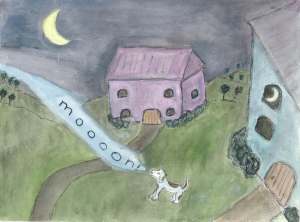
Full Moon Tomorrow But I’ve Only Scanned Crescents

August 5, 2009
From "A Definite Spark", an illustrated pantoum

From "A Definite Spark", an illustrated pantoum, copyright Karin Gustafson

Blocking Writer’s Block – Part V – No Permission Needed

August 4, 2009

Rule No. 7  – You don’t need permission to do your work

Sometimes if you are a parent, a partner, or even just someone living with others in this world, your writing, painting, music-playing, yoga – whatever it is that you aspire to keep doing in your private life, whatever it is you do to feel fully you—gets overlooked because you’re convinced you don’t have the time.

Rather, you’re convinced that you don’t have the “right” time.

You wait for the opportune moment; those precious minutes in which there’s nothing else you think you need to do, nothing that you think others need you to do.

Then, even when there really isn’t anything, or not very much—dinner is done, kids and partner are, sort of, settled in–you wait a bit longer.  Partly because you’re tired, and partly because the moment still doesn’t feel right.  You don’t feel free enough to begin.  Something is still missing.

Often what you are truly waiting for is to be given permission, permission to turn to your private work, permission to take time to be solely yourself. Sometimes, especially if you are on the insecure side, you are even waiting to be urged, encouraged, exhorted.   You want someone to give you a cue, to tell you that the moment you have been waiting for has arrived, to get you going.

Don’t do this.   It will not get you to your work nor will it endear you to your loved ones.  (Or at least, it won’t endear them to you!)

Because even the most enlightened children are not going to turn to you and say, “hey mom, don’t bother to make those cupcakes, why don’t you just go write for a while?”

Your loving partner is unlikely to volunteer: “I’ll just turn off the t.v. dear, so you’ll have peace to work by.”

Unless you work in a zoo, your employer will not come out with “we’ve noticed you like drawing elephants.  Why don’t you just stay home and practice Fridays?”

Not even the dishes soaking in the sink will quietly give you the freedom to go and write that sonnet.

Don’t get mad at them.  (Especially not the dishes or the children.  The partner maybe.)

Because this is a battle you have to take on yourself.  If you want to do your work, you have to allow yourself to do it.  (More than allow, you have to make.)

This means accepting that no permission is necessary; that there is no “right” moment, just this moment.

If you succeed in seizing the moment, accept in advance that you are unlikely to win any kudos.  The children, husband, dishes, may listen to your sonnet; but they probably won’t congratulate you on it.  Not enough to make you feel completely justified anyway, to give you retroactive permission.

At least not at the beginning.

Hopefully, as everyone ages, they may be happy that you were able to be fully yourself.  They may recognize that you were giving them permission to be fully themselves too.  Even though no permission is necessary.

And even at the cost of those cupcakes.

Check out my counting book with beautiful paintings of elephants (no permission was necessary) on Amazon.  See link to 1 Mississippi.

Pictorial Interlude – Pantoum

August 4, 2009
From "A Definite Spark"

From "A Definite Spark"

last post re parenting – apologies for typo

August 4, 2009

Apologies for text that was mistakenly plopped in the middle of my last post re single parents putting on their shoes.  This (a plug for my counting book 1 Mississippi) was added at the last minute and  somehow landed in the wrong place.

These things happen.   It’s fixed now.  If you tried to read that post already, and were discouraged by weird text in the middle, please check out the post  again.    Sorry.

For Single Parents About to Explode – Put On Some Shoes

August 3, 2009

There’s a Buddhist teaching about the most skillful way to protect one’s feet from all the sharp stones that litter one’s path.

The question is whether you should wait to walk until the path, the whole earth, is covered with soft leather so that your feet will be protected from the sharp stones.   Should you yourself try to cover the earth with this soft leather?

The answer is no, silly.  (Although Buddhists don’t usually add that last part.)

Still, the answer is no.  You can’t coat the earth with soft leather, you should put the soft leather on your feet.  You should put on shoes if you want to mitigate all that sharpness.

I’m probably misphrasing this teaching.  (Sorry!)  But even my garbled version offers good advice, especially for single parents.

What are some of the main characteristics of single parents?

  1. The single parent is generally exhausted.
  2. On the good side, the single parent is usually less likely than the paired parent to be having daily arguments with another adult (except on the phone or through attorneys.)  On the bad side, the single parent is less likely  to have the daily succor (sorry) of another adult.
  3. Because of the lack of adult company, the single parent tends to want their kids to be their friends.  (As much as they try to resist this.)
  4. The single parent has to be the heavy.  Because of the child’s dependence, the single parent also has to be the softie.   Agh.

What does all this mean?

That, for single parents, it can be very hard to say no.  Even when we really really want to.

“No, we can’t go to the toy store right now, I’m exhausted.”  “No, you can’t stay out till 1: 30.  That’s too late and besides, I’ll be exhausted waiting up.”  “No, your boyfriend can’t stay over again.  The whole situation is still a bit strange to me and I’m already exhausted by it.”

Now keep in mind, I’m not advocating any particular limitations here (though I do believe in limitations.)  The important point are the words:  “even when we really really want to.”

Also, before going further, maybe I should broaden my audience.  This advice may not just be geared to single parents but to boomer and post boomer parents.  People who are constantly explaining things to their children; people who want to be understood by their children;  people who believe that if they only explain the reasoning behind their decisions (ad nauseum), the children (rational beings) will simply have to see agree.

But the children don’t always agree.  Often, no matter how much the parent explains, the children continue to want, to wheedle, to wish for.

So what?

But the guilty single or boomer or post-boomer parent can’t stand discontent in their children.  They want everyone to be in agreement.   So they frequently say yes, reluctantly, even though they really want to say no.  Even though they may believe no is the correct answer.

Sometimes, this is no big deal.  Sometimes it works out just fine.  Sometimes, yes may have been the right answer.

But when the parent really really wants to say no, saying yes is a bad idea.   Because, in that case, the parent’s patience grows thin.   That parent already feels compromised, put upon, and she/he is not in the mood for more.  So one wrong move on the part of the child, sometimes even a move that is not truly horrible–such as a polite request for a really cheap toy, an arrival at 1:43 due to the unavailability of taxis, or the child (not such a child) and boyfriend leaving shoes straddling the living room floor, can set that parent up for a major snap.

And once the single parent, the boomer or post-boomer parent, snaps, she or he feels bad.    (What happened to rationality?  How could I have said that?)

The problem is that you simply let yourself get pushed beyond your limit.  You were trying so hard to be your biggest, most p.c. self, that you snapped into your angry, most intolerant self.

In other words, you thought that your feet were tough enough to take sharp stones without any leather.

The overworked single parent can even begin to blame their explosion on the child.  Why did they ask you for something they must have known you were against?  They know how you hate to disappoint them?  Why didn’t they protect you?

In other words, why didn’t they coat the path with soft leather for you? 

But they’re the children.  They want.  You’re the parent.  You decide.

So put on some shoes.

And just say no.

(And if you have snapped, remember that life is long; and both children, and parents, forgiving.)

P.S. If you are a parent (or know a parent), check out 1 Mississippi, counting book on amazon for little children:  http://www.amazon.com/s/ref=nb_ss_gw?url=search-alias%3Daps&field-keywords=Karin+Gustafson&x=12&y=14

Also, my series on Blocking Writing Block will definitely be continued soon.   Thanks for comments.

Pictorial Interlude – Villainelle (preview)

August 3, 2009

This illustration from Villainelle by Karin Gustafson (BackStroke Books) (to be published soon as part of A Definite Spark, An Illustrated Guide to Kids, their Parents, and their Pachyderms.)

from Villainelle

from Villainelle

Check out already published children’s counting book 1 Mississippi on Amazon:  http://www.amazon.com/1-Mississippi-Karin-Gustafson/dp/0981992307/ref=sr_1_1?ie=UTF8&s=books&qid=1249300645&sr=8-1

Blocking Writer’s Block – Part IV

August 2, 2009

Rule No. 6.  Go into yourself.

Yes, I know.  Yesterday’s rule (Blocking Writer’s Block – Part III) was get out of yourself.   And yes, if you are following this blog at all, you probably see a certain pattern emerging. (Other than the pattern in which I write a few serious blogs and then sneak in some commentary on Robert Pattinson.)

But my advising you to go into yourself right after I’ve told you to get out of yourself is really not a contradiction.  Because what I’m advocating is that the two steps be taken at different times.  (Also, remember that I am writing about writer’s block here.  If things are flowing, do whatever you want.)

Getting out of yourself means getting out of your normal grooves. Getting a fresh starting point.

But once you have that starting point, you need to have something to say, right?  Something not generic, something unique.  You have one great big source of the non-generic right at your fingertips.  This is yourself.  Your own set of experiences, which if observed with precision and care, are inherently unique.

Now, I really do not push the idea that all writing should be memoir, or confessional, or navel-gazing.  Besides the huge danger of self-indulgence, self-justification, martyrdom, in that kind of writing, your friends and family will never speak to you again.

But it really is helpful in getting out of writer’s block, in writing exercises, in loosening up your writing sinews, to feel free to write from your own experience, to write of what you know well.

This does not have to be directly about yourself.  It can be the mood of your childhood kitchen summer mornings, or Sunday mornings, or Sunday nights—each one way way different.   It can be the geometry of light on the bottom of your community swimming pool;  it can be the lines on the bark of a locust tree you used to lean against, counting, when “it” in hide and sick.

Don’t get me wrong.  I love plot, narrative.  And I love things that are created and fantastical.   (I’ve written a fantasy novel which I hope to publish soon.)   And frankly, getting too caught up in your own experience can inhibit invention, and can be very very limiting.

But in an exercise in which your primary goal is to simply learn how to think with your hands, to let words flow through your fingertips, it is usually easiest at first to focus on what you know.

It actually takes a lot of courage.  The subject is there, but grasping the details, and then putting them on the page, can take real fearlessness.  Especially when writing with a buddy.  Especially if ever actually re-reading on your own.

But be brave.  Take up the thread you’ve been given, that surprising thread that you got from someone else—that topic, or those random words—and follow the thread into yourself.  Follow it through curve and cranny.  Take a Rube Goldbergesque approach to your exercise.  Put in the leaky bucket and the grandmother in the rocking chair, don’t worry about sleekness–whatever works is terrific, whatever gets the job done.

Remember always, if not now, when?

And if you do follow the thread to something that actually happened to you, then sit inside that happening and look at it freshly.  Can you see the pores in your Uncle’s nose?  Tell us about them.  Were there fireflies blinking right next to the laces of your husband’s hiking boot?  Make them blink on the page.

Pretend that a brain surgeon has accidentally stimulated that place in your brain where all that particular data are stored.  Was there mica in the dust in the curb?  Did your friend hold out her hands as she balanced on the brick wall?  Did her fingers lengthen in the grey air?   Use memory, but feel free to mix in invention.  And if you’re stuck, look around the room you are writing in.  Or rustle further around inside.  You’ve had tons of experiences.  Mix it up.   You don’t need to stick with just one.

And remember always always, that this is an exercise, a draft.  Is your time really so precious you can’t spend a bit on something that you might end up throwing away?  Oh please!

To be continued. …

Check out my children’s picture book 1 Mississippi  on Amazon:  http://www.amazon.com/1-Mississippi-Karin-Gustafson/dp/0981992307/ref=sr_1_1?ie=UTF8&qid=1249231671&sr=8-1

Blocking Writer’s Block – Part III – Get Out Of Yourself

August 1, 2009

Rule Number 5 – Get Out of Yourself.

Sometimes all you can think when you sit down to write is that you can’t write, you hate writing, you have nothing at all to say.

Jotting down this litany can be a legitimate way to get started.   At least, it gets your pen or fingers moving.  Pretty soon, though, it’s boring—or in the case of the variation used in The Shining – ‘all work and no play makes Jack a dull boy’ – seriously creepy.  In other words, you are putting something down on the page, but you are still stuck in a rut, a rut of your own stuckness.

One way to avoid this stuckness is to try to get out of yourself, your typical grooves.  If I were more Buddhist, I would probably suggest looking around yourself, feeling your connection to the greater world.  But since I am a dyed-in-the-wool pragmatist (who likes the idea of Buddhism but is not so good at its practice), my advice is to get someone else to give you a topic (or, even better, a simple set of words.)

By “topic”, I don’t mean a paper topic, something to mull over and explicate.  I mean a writing exercise topic, something to use as a jumping off point; a stepping stone into your stream of consciousness.  But a new stepping stone, not one of the habitual ones that’s become a boulder sealing off flow.

Writing exercises are a wonderful tool for breaking down writer’s block.  They deserve their own posts, which I hope to write.   As a brief introduction here, I’ll just say that the exercises I prefer are short, sweet, and relatively low risk.  They have three basic parameters (derived again from Natalie Goldberg, Writing Down The Bones):

1.  Pick a set short time period for each exercise in advance.  Use a clock, and make yourself and your writing buddy stick to it.    (Ten minutes is a good amount to start with.  If you want to be anarchical—try seven, twelve or thirteen minutes.  Five is a bit short.)

2.  Keep your pen moving or your fingers typing throughout your set time.  (Meaning don’t stop and think about what you are going to write next, just write.)

3.   No crossing out; no back-spacing, no deletes.   (Not during your time limit.)

So back to your topic (someone else’s topic).  Choices are infinite.  It can be a single starting point:  “I remember” can be a good one, or “I don’t remember.”   Something about grandmothers often works (almost everyone has something to write about their grandmother.)

But although that kind of single topic can be interesting, you can also get stuck all over again trying to pick the “right” one.

To skip that quandary, it’s sometimes best to just use a list of 5-7 random words as “topic”.   The advantage of several words is that none has to be ideal.  The requirement is that you simply have to use the words, not actually write about them—they are not your theme (unless you want one of them to be.)

It’s best if the words are not chosen by you, or at least not by you alone.  (Choosing with a buddy is fine.)  This is because it can be very very hard to make a fresh channel through your own head.  The mind is just so tricky—it tends to cling to the old grooves, comfortable with the familiar, even the painful, tiresome familiar.  The mind is also a master of self-justification; it loves to set up situations in which it can say, ‘I told you so.’

A quick example:  let’s say that you’re stuck trying to write about your cousin’s wedding last year (or last decade) when you suddenly realized that everyone in your family thought you were too bossy, too demanding, to insecure, to ever feel loved.  You’ve tried to write the story, you may even need to write the story, but you just haven’t been able to.

So maybe you need to put it aside for a bit; warm up those fingers with something completely different.  But if you’re picking you own random words, you may still end up with “rice, veil, resentment, glare, daggers, heart, tin cans.”  Pretty soon you’re stuck all over again; you may be writing, but your subject may also be the same old thing–how lousy you feel about yourself and your family.

But if your buddy, or if you have no buddy, your friend, your child, or even your dictionary, picks the words, you might end up with things like” drill, jackhammer, whammo, smudge, chocolate cake” words that have a better chance of taking you into unexplored territory.

You may not initially feel like exploring that territory.  Let’s say you’re completely disinterested in drills, only mildly interested in chocolate cake.   Your exercise doesn’t need to be about drills; it just needs to use the word.  It can come out as metaphor: “the chords of Wagner’s wedding march were like a jackhammer, drilling into her brain.”  Or, “the icing formed a snowy veneer, but she knew that her cousin, who truly was the bossy, demanding one in the family, had insisted on a chocolate cake beneath it.”

So maybe you can’t leave your groove.  Still you can at least approach it from a different direction.  The direction may just feel like a detour but, like the classic detour, it may also help you bypass the closed lanes of your normal route and to miss all those pesky orange cones.

Please check out my picture book, 1 Mississippi, at Amazon.com.  http://www.amazon.com/1-Mississippi-Karin-Gustafson/dp/0981992307/ref=sr_1_1?ie=UTF8&qid=1249155338&sr=8-1