Posted tagged ‘ManicDDaily poetry’

“Idiomatic” Poem (“Bits and Pieces”)

November 12, 2011

DVerse Poets Pub, a great community for struggling and less struggling (i.e. successful) poets, has a poetics challenge today requesting poems written with idiomatic language.  The idioms I use are not so colorful as let’s say, letting the cat out of the bag, but here’s the poem:

Bits and Pieces

Bits and pieces make a whole;
we use them to fill up a hole
shaped like a merely mortal soul.
Bits and pieces take their toll.

Bits and pieces don’t seem real,
and yet they occupy that reel
of all we say and do and feel
beneath the ever-thickening peel.

Bits and pieces are what we’ve got–
all that’s left and not forgot
(after all that time we shot).
Were they all we ever sought?

That can’t be true, we wanted more.
Surely, they’re what we settled for
and now somehow must find enough,
forget the diamonds, love the rough.

Veteran’s Day – Flash 55 (“Enlisted”)

November 11, 2011

20111111-072604.jpg

Thinking of Veteran’s Day today.  This is also a post for Friday Flash 55.  (Tell it to the G-Man.)

Enlisted

What they carry–
the risk of not coming back,
or coming back different;

of being killed,
maimed;
killing, maiming;
coming back
different;

love/hate.
not-necessarily-hate/gun/mission,
training/sweetness/
us.

Somebody’s got to do it.

The risk of coming back
some body.

Know somebody now
joined up.
May he stay
joined,
up,
himself.

PS – I’ve slightly edited the poem since first posting this morning.  (Almost all the poems I post are drafts, so changes are needed.)  Kept to the 55 words though!


PPS – I wanted to fit a little more love into the poem, but have been a bit constrained by the 55 word limit.  I do want to take this opportunity to send love, thanks and blessings to all veterans on this day and every day.


Prose to Poem (Plagiarism too?) (“Time Times Time”)

November 10, 2011

Solar Powered Timekeeper?

The wonderful dVerse Poets Pub, hosted today by Zsa of the zumpoets site, presents a very interesting challenge for participating poets–the conversion of prose to poetry.  The idea is to make the prose, someone else’s (and hopefully not under copyright) into, more or less, your own poem (or an amalgam of youand the prose writer.)

I copped mine from good old Charles Dickens.


Time Times Time

It was the best and worst–it
was time.  It was
time times time–it
was age.   Of
wisdom/foolishness
epic; belief (aching incredulity);
Light seasoned by
Darkness; where hope
winters, despair
springs, and everything before us
feels
like nothing; a time 

we go direct
to Heaven
only

if there’s no
other way.

Here’s the true text, from the opening of A Tale of Two Cities:

“It was the best of times, it was the worst of times, it was the age of wisdom, it was the age of foolishness, it was the epoch of belief, it was the epoch of incredulity, it was the season of Light, it was the season of Darkness, it was the spring of hope, it was the winter of despair, we had everything before us, we had nothing before us, we were all going direct to Heaven, we were all going direct the other way – “

Magpie Tale (Pantoum)

November 6, 2011

20111106-010947.jpg

The drawing above is based on the prompt of Tess Kincaid at Magpie Tales, which was a photograph from a cemetery.  The photograph offered a lot of possibilities; my poem is a pantoum about a funeral, the differing feelings (from numbness to grief) that go through one’s brain at such an event.

What Funerals Are For

I worried that I might not be able to stop
the posturing that shaped my busy mind—
all I’d see, all whom I might know,
imagined encounters over funeral supper wine.

The posturing, the shape of busy mind,
dwarfed the Jesus-coated windows, babes in stone,
(imagined encounters over Last Supper wine)
when fingers touching lid, they led it down.

Dwarfing the Jesus-coated windows, babes in stone,
a block of wood, of over-polished grain,
as fingers touching lid, they led it down,
pulling with it, a winding sheet of weighty pain.

A block of wood, of over-polished grain—
I knew she couldn’t breathe there, that she’d no more breath
pulling within a winding sheet of weighty pain,
weeping without will, without relief.

I knew she couldn’t breathe there, that she’d no more breath,
and all I saw, all whom I might know,
weeping without will, without relief.
I worried that I might not be able to stop.

Man’yoshu Poetry? (What’s that?) With Ladybug

November 3, 2011

20111103-082544.jpg

I swore to myself (and this blog) that I would devote at least some of this month to a modified Nanowrimo of revising old manuscripts.  But… it’s really hard to get the steam up for a long project mid-work-week.  So, instead, here is my contribution to dVerse Poets “Form For All” Night, which today focuses on Man’yoshu poetry, a form of Japanese Poetry that includes variations dedicated to love/longing. There is a wonderful exposition of this particular tradition written by “Lady Nyo” a/k/a Jane Kohut-Bartels, that can be found here.

I’m afraid my picture turned out better than my poem, but here’s my own rough attempt:

Ladybug On Navy Shawl

A ladybug, deep
orange, lands on the navy
of my paisleyed shawl;
mountains uplift the view but,
because I cannot
see through eyes that turn green when
faced with color, I
mean, your eyes, all here pales, and
my mind looks past the
now to times when you watched it
with me, when the here,
because you were there, held such
wonders always, your quick breaths.

Magpie Tales (89) (“These Words Are No Nest”)

October 30, 2011

20111030-104458.jpg

This is a post (1001th – an apology to those who subscribe) made for Tess Kincaid’s Magpie Tales. Each week Tess posts an interesting photograph as a prompt. The above is my personal take on the photo–I’ve revised it a bit to fit in with the poem below, a sonnet of sorts.

No Nest

These words are no nest.  They won’t warm you
when I’m gone.  You won’t be able to tuck
your head under a t, though it starts true,
slip fingers down n‘s curve, deftly pluck
replies from even the unsilent e‘s.
They won’t warm me either–no echoes
in ashen brains, though spread upon a breeze.
As twigs and hair and grass and dust close in,
words will be somewhere else; just as what peeps
behind these eyes, this voice, this flickering
insistent maw of self, will, at best, sleep
long.  But for now, I’m here, a bickering
steadfast word monger, building a place
of syllabic lingering, would-be embrace.


(I am also linking this poem to The Poetry Palace weekly poets’ rally.)

Conversation Poem? (“No Good Answer”)

October 29, 2011

dVerse Poets Pub has a poetics challenge today, hosted by the wonderful Claudia Schoenfeld (who lives in Germany but writes beautiful poetry in English)  asking for a “call and response” or conversation poem.

The poem below is a conversation in which one person speaks in words, the other gestures.  it’s a pretty grim poem, sorry.  (Please remember it’s a poem, i.e. work of art! )  Also note that, although it rhymes and has line breaks, pauses should really only be taken where punctuated and not at the end of a line.

No Good Answer

She took a brush and hit her hand,
trying hard to make a stand.

“Just go,” he sighed,
“it’s just not working.
You’ve got to know
I’m not just jerking
you around.
No, it’s just the way I am is all,
I’m not the one for you at all.”

She stuck a tack into her wrist,
showing him a bloodied fist.

He shuddered, turned aside his head,
“It’s time for me to go to bed,”
then left her for their one spare room,
while she sat on beneath a gloom
of fear
that she would stop the pain
so that it would not come again.

But she was frozen, could not move,
luckily, perhaps, since all self-love
had vanished
just as his had done,
not to be found under moon or sun.

Conflation in Poetry? Hmmmm…. “Far”

October 27, 2011

20111027-041736.jpg

As followers of this blog know, I’ve gotten very involved of late with the dVerse Poetry Pub, and poetry in general.  (There is nothing like community for stimulating work. )  The prompt today by Emmet Wheatfall deals with “conflation,” what I think of as piecing things, often disparate, together.  I don’t know if this poem totally qualifies, but it is a poem I’ve had on my mind, and that I re-wrote (and improved) with the idea of conflating themes in mind.   

Far

We pushed from cold night into a Chinese restaurant,
the fluorescents reverberating like the din.  One waitress
wiped the table, burnishing smears into reflection;
 another balanced a rounded pot of tea and a fist’s stack
of cups (their sides glowing, incongruously,
with little seeds of translucence, grains of rice
made glass), the pot so full
that tea brimmed to the edge of its
spout with every shift from level, hip
or wrist, a
glimmering lithe tongue.

A man in my group had, some time before,
lost his adult child.  It had been sudden, she
had been young.
It was hard for me to look at him,
each expression–his patience
with the waitresses, concern about the chairs, even his
cold-reddened skin—a riddled mask
over the shear of loss that had left
the merest sense of face, worn
like the extremity
of an icon, the bronze saint whose foot has been rubbed
to a bare grip, slip
of soap, by petitioners who have
prayed to be washed clean, not of sin, but suffering.

The teapot begged to be poured; the waitress ran its
gulping stream over the beaded cups, steam rising into
air that ached to be warmed, the door, the night, opening
always at our side.

I could almost not look
at the man, as if his pain
might brim over,
scald me too, and yet another part of me,
what I like to think of as a part
that catches light like the curve of
a cup, or perhaps a part that is
dark, swirling, like the grain in the veneer
of even a plastic tabletop, that part that
somehow recalls a tree (or at least, the idea
of a tree), shifted my chair closer, wanting
to  drink with him that
fresh, hot tea, 
anything that could pass for succor.

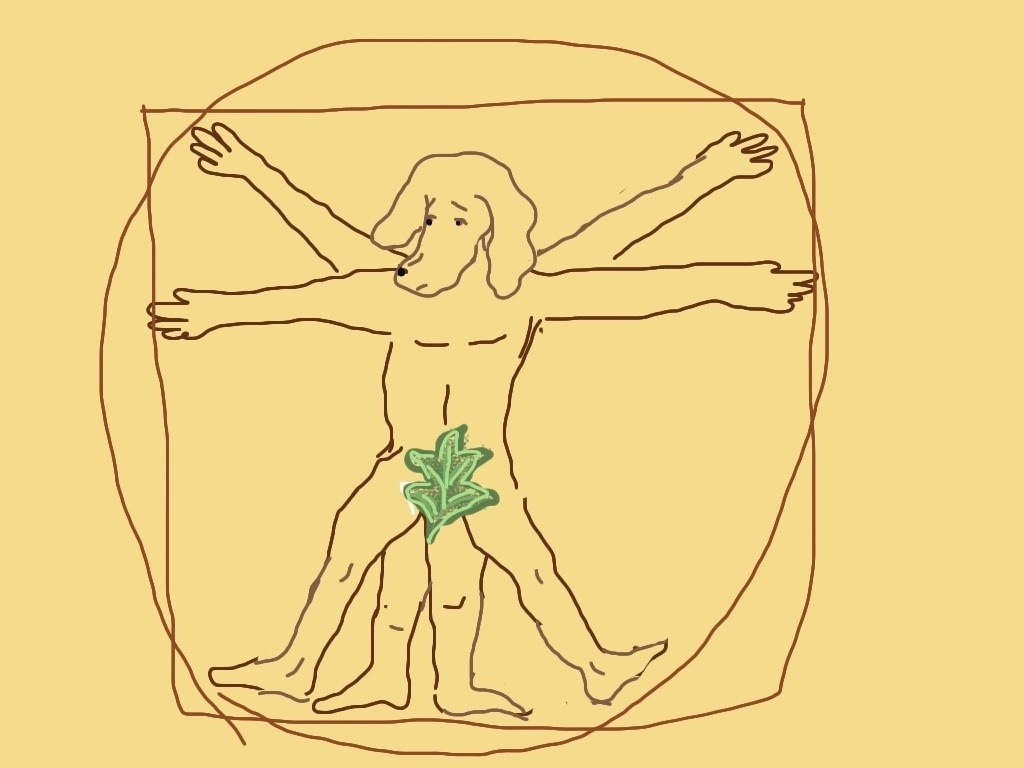
“Here, Body” (The Body Is Not Your Good Dog.)

October 25, 2011

20111025-121306.jpg

I’m sorry.  There is an incurable goofiness about some of my drawings.   I did this one (based on Leonardo) for the recently revised poem below.  It is quite a serious poem and not really much about dogs, so forgive me for being misleading.

The poem is being posted for dVerse Poets Pub Open Link Night (Tuesdays) hosted by the wonderfully generous (and thankfully, humorous) Brian Miller.

Here, Body

The body is not your good dog.
It may sit, lie down, roll over,
but there’s a limit to its Rover
aspect.  No spank
will keep it from
accident; no leash
train it to the right; no yank
make it heel
feelings.

You tell it what to want, but
it will vaunt
its fleshly, furry ways,
sneaking food when already fed;
taking up all the room on the bed;
whiffing what should not be sniffed;
its passion aimed at but a toy–
here, girl; here, boy–
that can never love it back.

It will decay
though you say stay. Still,
you will love it,
this not-good dog;
for even as you scold and cajole,
call,
and despair
of calling,
you will find yourself
cradling it;
you will find yourself
in its arms.

Magpie Tales – “Oncoming” (Sonnet)

October 23, 2011

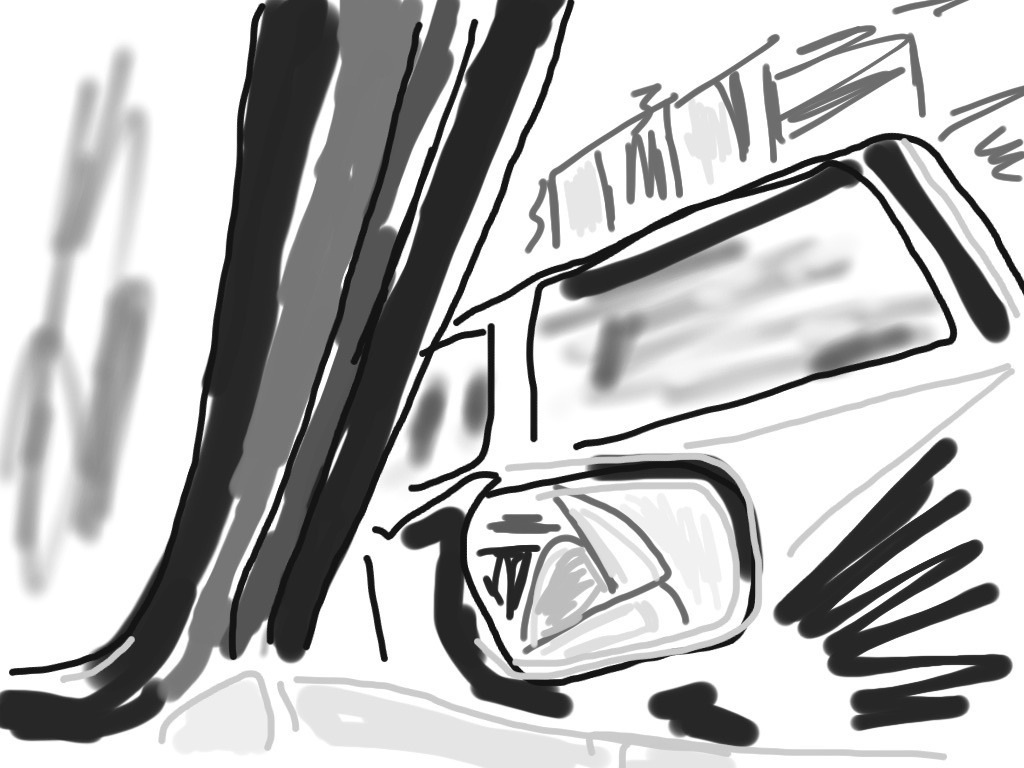
This is a sonnet I revised in connection with the weekly prompt of the “Magpie Tales” blog, hosted by Tess Kincaid.  Tess posted a great photo of a city street, seen both from a car and in a car’s rear view mirror, but I have re-drawn the picture (above) to fit a little closer to my poem.  (Still, not a true fit, sorry!)

Oncoming

There were one, two, three, four, trucks and we’d hit
sparks, some devilish configuration
of torque and stone, radii and slip,
that spit the car from its lane as from
the sea, only to buck and plunge it through
the waves of semis; to the right, the poles
of overpass pulled us to some untrue
North, as if to catch whatever souls
the trucks might miss.  We were on a visit
to a grandmother, but I can’t recall
a later meal or kiss, only that minute
on the road there, the unreeling miss and haul
of grill, glass flashing glass, my father’s swerves–
the way space looks, time feels, when fate uncurls.