Posted tagged ‘Karin Gustafson’

What Makes Young People (And Some of Us Others) Re-read

October 27, 2009

For those of you who actually follow this blog, and don’t just click on a link that happens to mention Robsten or the Twilight Saga, I’m sorry!  There’s not been much poetry over the last couple of days, but a lot of clicks.

Yes, I like the clicks.  (And, strangely, “Robsten” seems to generate a whole bunch more than, let’s say, “sestina.”)

But I want to explain to you (who may not understand why in the world I write about this stuff) that I truly am interested in a couple of facets of Twilight mania (besides each of Rob’s cheekbones.)

First:  despite all the poetry I’ve posted on this blog, I am mainly a fiction writer, primarily for children and young adults.  As a result, I am fascinated by the question of what makes people read a book again and again.  And I have to say (without mentioning anything about my own experience) that the Twilight mania proves Twilight et al. to be a set of those much re-read books.

It’s a given that books that generate this type of obsessive re-reading are not always particularly “good” books, i.e. well-written.  In fact, many “good” books, that is, really profound, original, heart-wrenching, or poetic books, are not the most dog-eared at the end of the day (or lifetime.)  It’s almost as if such books are too sharp, too bitter, too stinging, to be savored again and again (in the same way that grapefruit is not typically considered a comfort food.)

This is not to say that much re-read books are poorly written!  (Charlotte’s Web and  Harry Potter are much re-read great books.) Only that good writing alone does not make a book a good re-read.  (Nor does a good plot, good jokes, good suspense, even though one or more of these is likely to be present.)

So what does make a book a good re-read?

To me, the distinguishing factor is that the book creates characters with whom readers like to spend time, sometimes, too, a world in which readers like to spend time.

Reading a book is a commitment.  It means hours in which you are not conversing, i-ming, watching TV; hours, in other words, in which you are alone.  Sometimes, in fact, a book is a way to be alone, a path to privacy in a place with hard-to-place boundaries, such as a subway, or, if you are a child, a family dinner.

Because of the inherent solitude of reading, it is important that the main character is good company—fun, cool (but not too cool as to be unempathetic), willing to share confidences.  Being admirable is helpful too, as long as there are also sympathetic and/or humorous failings and idiosyncrasies.  (Sam Vines, Captain Carrot, Granny Weatherwax in Terry Pratchett, even Hercule Poirot in Agatha Christie.)

The world of a much re-read book can, of course, have its dark side.  But it is hard to repeatedly spend time in a world that is overwhelmingly creepy or frightening. (The Road, by Cormac McCarthy, and even Cold Mountain, by Charles Frazier, are obvious examples of wonderful books in which the worlds created, or re-created, are just too horrific to motivate re-reads.  On the children’s shelf, similarly, the later tomes of the wonderful, His Dark Materials by Phillip Pullman, that is, The Subtle Knife and The Amber Spyglass, also, with the exception of certain scenes, get both too threatening and rarified for a child’s immediately repeated visits.)

Ideally, the created world, even if dark, has a fun, semi-magical side.  (Hogwarts, obviously; the barn in Charlotte‘s Web, Florida, as seen by Carl Hiassen, Discworld, as envisioned by Terry Pratchett.)

Re-reading is a particular practice of the young and the young (or perhaps, immature) at heart who can repeatedly find sustenance in something that’s already well-digested.  (Sort of like baby penguins.)   This may be because the young (and not young, but immature) are themselves subject to (i) so much fluctuation, and (ii) so much beyond their control, that they find special comfort in the predictability of a “known” fiction.   The combination of the familiar with the fantastical may be especially appealing.

Romance makes a great re-read as well.   First love is a story that has been told again and again and again; is it any wonder that some people don’t mind re-reading the exact same version of it?

Which brings me back to Twilight.

Tomorrow or in the near future (if I get time),  I’ll write about the second facet that I find interesting—that is, what makes people re-see a movie, as opposed to re-read a book.

In the meantime, check out 1 Mississippi by Karin Gustafson on Amazon.

Go Yankees! Hoping For Luck.

October 25, 2009
Go Yankees!

Go Yankees!

Top of the Ninth, Yankees ahead, Mariano on the mound, hoping for luck, continued luck.  (And pennant.)

If you like elephants, with or without baseball, check out 1 Mississippi, by Karin Gustafson, at link on homepage, or on Amazon.

Another Poetry Exercise Sample – Family Finishes

October 24, 2009

In the last couple of posts, I’ve discussed a poetry exercise for the inspirationally-challenged.  (See prior posts for the inspirationally-challenged for detailed instructions.)  The exercise basically involves choosing a craft or occupation, and listing the verbs associated with that craft or occupation.  These tend to be strong, particular, and colorful words and verbs.  These are then used in the drafting of  your exercise poem.

Here is another set of examples, which again, I’ve grouped as a single poem since they were all based on the same exercise.  This one involved the craft of carpentry.  (See e.g. “level,” “sand,” “smooth,” “measure,” “adorn,” “glue,” “hammer,” “file,” “nail,” “shape,” “cut,” “drill,” etc.)   I haven’t been able to locate the list of exercise nouns in my disorganized notebooks, but I know I included certain good generics like “mother”, as well as the nice specific tangible words “tulips” and “stickiness.”

Family Finishes

I.

The perfect mother sands the child down to her image, or
an image, filing away the
unsightly, the angry, the unspeakable.
She drills in a face fit for a pageant, as
smooth as balsam, as modeled as
the keel of a canoe.
Cutting the child to measure, she
ignores the stickness of any unseamed tar.

II.

A family levels itself to just folks with enough distance,
an occasional pageant – picnic or funeral – joins the blood again,
a bienniel application of glue.
The occasions are muddled with the stickiness of the blood, the
mother hammering away at the grandmother, the son
nailing the father, the family portrait gathering a  sullen patina.

III.

Steeped in tradition, the young mother thought
to measure out love in spoonfuls,
smoothing away excess and screwing it into a tied-up sock.

Blasphemy to mount to ecstasy over your child.  No.  Passion
was to be hammered down to fit the furniture, adorn the home,
like a bowl of tulips shaped to
its interval.  But the small white
fist that gripped her finger leveled her training,
proper restraint transmuted from an aged wine to water,
casks burst to loose a stream, river, flow barely banked,
clear, sparkling.

All rights reserved.  Karin  Gustafson

Also, check out the updated page re ManicDDaily.  With a photo!  (Ha.)

Poetry Exercise For Those “At Sea”

October 23, 2009

Yesterday, I set forth the rules for a somewhat reductive poetry exercise for the inspirationally-challenged.   (https://manicddaily.wordpress.com/2009/10/22/for-the-inspirationally-challenged-writing-exercise-for-harried-poets/)

The exercise mandates the writing of a poem which is really an extended metaphor;  the tension in the poem comes from using a set of physically- charged, action verbs.  These are verbs which describe tasks performed in a particular occupation or craft (and are listed as Column B) .  The poem is put together from a list of these Column B verbs, and a random list of unrelated nouns  (Column A). The poem is put together by making lines which use a word selected from Column A and a word selected from Column B  (and, of course, other words.)

Here is a a poem (a connected pair of poems) which I did a few years ago using this exercise.   Unfortunately, despite spending some time looking through my very disorganized notebooks, I have not been able to find the full Columns A and B that I used;  however, I know that the chosen occupation was “sailor.”  (I’m not sure of the nouns except to be certain that “gutter”, “mother”, and, I believe, “burlap”, and “brick” were among them.)

The “sailor” words went fairly far afield from those that you might at first associate with sailor–they included words like “weigh”  (as in weigh anchor), “spy”, “navigate,” “haul,” “scrub” (as in scrub the deck), “run” (as in run up a flag), “tack”, “man” (as in man the deck), “cast”, “seek”, “spy”, among others.  (If you are doing this exercise, feel free to be similarly wide-ranging in your choices.)

The poem has been edited since the first iteration.  I’m posting it because I like it even though I’m not sure it’s the best illustration of the exercise.  (Tomorrow, I’ll post a less edited poem, that may be a better illustration.)  Still, I hope it gives a taste of how a “set” of verbs chosen as part of an exercise can direct your ideas if you are someone, like me, who is frequently “at sea.”

At Sea

I.  Brother

The boy hauled the roses like burlap sacking
that scrubbed his arms with prickle.
Navigating the bunch through kitchen door which he kicked
to the side for noise value,
he hated his mother.  What he wanted was to man
the road, casting his day by the side
of the long green wood where he
could lurk and spy and brick up
hideouts with clods of dirt and brush and never lean
to any whim or wish except
of sky and guttering stream
to whose wills he’d willingly tack
his whole young life.

II.  Sister

The girl rigged her skirt to
the base of her hips,
tacking the elastic waist
to her pelvis, a convenient gutter
for fabric that would run its own course.
Bottling lips into an appraising O,
she weighed her chances, spying out
navel and the smooth flat skin of her belly
like the long sought shore, distant
yet within reach.

All rights reserved.  Karin Gustafson

For the Inspirationally Challenged – Writing Exercise for Harried Poets

October 22, 2009

For those, like me, who want to write but have limited time and mental space, inspiration can be difficult to come by. 

In large part, this is a “limited mental space” problem.  Your “free” moments may be free of immediate obligation, but your brain may still be tangled in worry, chores, regret, lonliness. 

The problem is that you don’t want to just whine.  Whining in print may offer some relief to the writer, but it’s  a  lot like the relief that vomiting offers to a person who is sick to their stomach.  It’s not all that great for the person doing it;  it’s even less appealing to their audience.

 So how can you make good use of your writing time when inspiration is otherwise engaged? 

 Here’s a trick:  try something that’s both completely arbitrary, and yet carefully defined.  In other words, a writing exercise!  The arbitrariness of the exercise can nudge you out of your over-trod groove, while the structure turns into something like a game, reducing both decisions and ego-involvement.  (It’s only an exercise!)

 In July and August, I wrote about exercises aimed primarily at prose writers.  This one is for the inspirationally-challenged poet.

 Before reading on, please set side aside snobbery.   The exercise below is a bit stupid, but it is offered as a springboard.  It relies on the fact that many poems involve tropes (a wonderful word I hardly ever get to use), that is, metaphors.  The exercise sets up a structure which is intended to turn an extended metaphor into something resembling a poem.  And it’s intended to make you think about verbs. 

 The specifics:

 First, choose an occupation, preferably one that involves some physical craft.  (Carpenter, fisherman, cook, for example, not stock analyst.)  Now, list all of the verbs that are particularly associated with that chosen occupation.  (Usually, “crafty” occupations have strong verbs.  Cook, for example: “braise, broil, boil, peel, sauté, fry, deep-fry, mince, cube, slice, skewer, stab.”)    List at least ten of these verbs.  This list is called Column B.

 Second, make a list of nouns which will be called Column A.   These nouns should be fairly randomly chosen and NOT specifically associated with your Column B verbs.  (For example, if you’ve chosen “cook” as your occupation, you can choose “mother” as a random noun, but not “chef.”) 

 While it’s nice to choose some specific nouns – such as “lilac” rather than “flower”–choose at least a couple that are very flexible  (examples:  “mother,” “father”,  “ocean”.)   You should list at least ten.

 NOW,  imagine you are at a Chinese restaurant ordering a luncheon special in which you are allowed to mix and match items from Column A (egg rolls or dumplings) with items from Column B ( bean curd homestyle or General Tso’s chicken.) 

 And NOW,  write a poem of at least five lines, using a noun from Column A and a verb from Column B in every line.   (Example:  “the ocean braised the shore.”)  (Sorry!) 

 Clarifications:  (i) Verbs from Column B can take any tense;  (ii) you do NOT need to use every word listed in Column A and Column B, just one from each Column in every line;    (iii)  line length is up to you (meaning you can use some long lines with lots of extra  uncolumned words.)

Finally, remember the two most important rules of any writing exercise:

 1.  Follow the rules.   

2.  Cheat.  (Remember that you’re trying to write a poem, not an exercise.)  

And, NOW, get going. 

Tomorrow, I’ll post some samples of my own.

Yoga Done Right

October 21, 2009

Yesterday, I explained how to rush through the whole Ashtanga primary yoga series in just a couple of short pants (as in breaths, not trousers.)

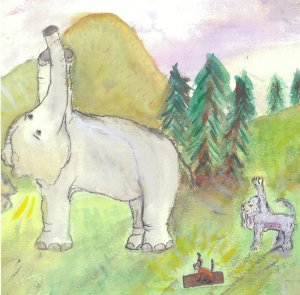
Below is an illustration of Ashtanga yoga done right, with steadiness, cheefulness, balance, and most importantly, an elephant.  (Also practicing are a little white dog and a yogini mouse.)

The pose depicted is trichonasana (triangle pose).  The animals are really quite good at it, particularly considering all the extra legs.

Elephant - Dog - Mouse Trichonasana

Elephant - Dog - Mouse Trichonasana

(All rights reserved.  Karin Gustafson)

Unfortunately, the elephant-dog-mouse yoga book, from which this picture is taken, is not yet finished.  But, if you like the style, check out 1 Mississippi, by Karin Gustafson at the link above.

Go Yankees! Go Sabathia!

October 21, 2009
Go Yankees !  Go Sabithia!

Elephant Baseball.

A masterful job by Sabathia.  (I’m sorry–I think  I draw elephants better than people.) 

Though if you like elephants,   check out 1 Mississippi, by Karin Gustafson at link above.

How To Do Ashtanga Yoga In One Short Breath

October 20, 2009

I am a longtime and very proud devotee of Ashtanga Yoga. This is a form of yoga pioneered by Shri T. Krishnamacharya and the much beloved Shri K. Patabhi Jois. It involves six fairly long series of poses (though most practitioners stick to the first “Primary” series), which are intended to energize the body, clarify the mind, and purify just about everything.   Ashtanga is supposed to be practiced six days a week, preferably in the morning.  (An empty stomach is recommended; a non-empty stomach is regretted.)

It is a great form of yoga, especially for people, like me, who have a hectic schedule, as it is designed for self-practice.  Not only does Ashtanga provide a  series of pre-set poses, it includes certain transitional movements between each pose. This takes decision-making out of home practice, an immense benefit for those who already have too many other things to think about.

Breathing in Ashtanga, as in all yoga, is super important: each transitional movement corresponds to a specific inhalation or exhalation, and each pose is ideally held for eight steady breaths.  This means that Primary series, if done right, should take between an hour and an hour and a half, to complete.

Some of us, however, have managed to shorten the required time span to approximately fifteen minutes.

Here’s how:

1. First, practice for years. It’s important to know the poses in your bones so that when you whiz through them you don’t need to spend a single extra second thinking about what comes next.

2. Second, be Manic.

3. And slightly depressed.

4. Start a daily blog.

5. But keep your day job.

6. Most importantly, fuel the flames of family and personal drama with long drawn-out conversations or email each morning, so that you really don’t have more than fifteen minutes to do yoga. (Ignore possible effects of yoga’s calming influence, if done correctly.)

7. Don’t mind if you wrench your knee or shoulder throwing yourself into convoluted positions. (Alignment always felt kind of boring anyway.)

8.  Who said you had to do the complete pose?   At least, your bending that wrenched knee.

10. Try not to mind that a practice that is supposed cultivate deep breathing and energetic stillness is whipping by in panting exhaustion

11. Congratulate yourself on the fact that you are practicing yoga at all.

12. (If you can call that practicing . Or Yoga.)

13. But keep practicing anyway. (As that great sage Scarlett O’Hara said, tomorrow is another day.)

Baseball and Life – Yankees-Angels Game 2 – The Blink Factor/The Not-Blinking Factor-Boom Boom Boom

October 18, 2009

My good luck tricks seemed to have worked once more for the Yankees—i.e. last night during the second Yankees-Angels game, I posted my elephant baseball picture AND, at a certain critical juncture, stopped watching.   (See earlier post re good luck “Talismans” and my personal effect on Yankees’ baseball.)

I won’t take all the credit for the victory—there was also Jeter, Cano, and Mariano, Jerry Hairston, Jr., A-Rod, and Damon (who made some really terrific catches), Melky Cabrera, Phil Coke, and Joba (who still seems a little pudgy boy to me especially when he celebrates), and Molina, who had a really hard job as catcher for A.J. Burnett, who also, as starter, deserves some credit, despite the way in which his wild pitches can drive a fan crazy.  (The frustration he causes is frankly not completely redeemed by the whipped cream pies.)

Then, there was just the Yankee grit, that somehow, so frequently, manages to just hang on and on and on.

Watching the videos of the end of the game this morning made me think (yes, it’s a cliché) of baseball as a paradigm of life.  Yes, again, yes, it’s a cliché.  Still, it seems somehow a more appropriate paradigm than a lot of other big sports.  (Which I have to confess don’t interest me enough to know much about them.  Still, I hate to think of any sports in which (i) people are repeatedly tackled and concussed, or (ii) forced to chase around constantly with little chance of achieving many goals, as better paradigms.)
What is unusual about baseball is simply how fast everything moves when it does, finally, move at all.   The replays of the last moments of last night’s October 17th game against the Angels are particularly striking.  On the Yankees’ site, they show footage taken from nearly every angle, even one that simply shows Cabrera running, relatively quickly for a big guy, to first.

In case, you didn’t follow the game, in the thirteenth inning, with a man on first and second, Yankee Melky Cabrera hit a ball that bounced between first and second.  The Angels’ second baseman, Maicer Izturis, stopped the ball, then, trying for a double play, threw it hard and fast to Angels’ short stop Erik Aybar, who stood at second, and who frankly seems like a really a surly, cocky sort of guy (if you are a Yankee’s fan), who missed it.  The Angel’s third baseman, Chone Figgins, stopped Izturis’s throw, but bobbled the ball.  In the meantime, Hairston Jr., who’d been holding on third before Izturis’s error, dashed towards home. Hairston was immediately overrun by the rest of the Yankees’ team and quickly assumed a fetal position on the ground as they all energetically patted him.

The long and short of that detailed explanation is simply that, although it takes a long time to write it all down, the play actually happened in an incredibly short period of time:  boom (Cabrera connected with the ball), boom (Iztura stopped and immediately threw it), boom (it slid below Aymer’s glove), boom (Figgins bobbled it), boom (Hairston slid into home).  When the footage that just focuses on Cabrera is shown, you see from the way that he turns, delighted, that the run has already been scored even as he makes it to first base.

The speed of it all is especially amazing because most of baseball is so slow.  The pitcher stands and postures, eyes narrowing and re-narrowing, with little shakes or nods of the head to the catcher, the batter (if Jeter especially), re-tightens his gloves (two or three or four times), re-squares his shoulders, gently sways the bat,  everyone constantly repositions their stances (usually spitting or blowing a bubble at the same time in a sort of homage to old-time multi-tasking).  Everyone, pitcher, batter, catcher, batter, in and out fielders, both wait and prepares.  Even the audience waits, though it doesn’t prepare so much as eats and drinks, crosses its fingers and yells. So much waiting, so much preparation, so much eating and drinking, finger-crossing  and yelling.  And then, boom, boom, boom, boom.  The moment arrives and players are suddenly expect to act, react, not just to make decisions, but to carry them out – boom boom boom.

Okay, you get it.  This is where the paradigm part comes in. There are obvious parallels to situations in the marketplace–buying and selling on the stock market, buying and selling anything, anywhere.  And also to moving around a potentially dangerous world–driving a car, for example,  especially in, or around, an accident.  The way action unfolds in baseball parallels many emergency situations actually; an emergency, a threat, that can also turn into an opportunity (i.e. the near double-play that becomes a winning score for the opposite side.)

So many parallels:  the need to be able to act even in the midst of a mouthful! The need to keep a mouthful going in order to be able to act!  The blink factor!  Or, maybe it’s the not-blinking factor!  The waiting, the planning, the practice, and then the OMG moment, which never takes exactly the shape anticipated, and frequently involves both a solo effort AND team work, and if not exactly team work, at least the avoidance of collision.  (A-Rod and Mariano were a great example of that in the tenth inning when they both ran towards a flying bunt, which was then caught by Mariano.)

Ah, Mariano….

Who Needs Water? Drilling the Marcellus Shale

October 17, 2009

Ten Reasons (That Anyone Can Understand) Why New York Should Say No to Upstate Natural Gas Drilling.

1.  You need water to make beer.

2.  Even a cold bath is better than one that leaves you with boils.

3.  Casino-Resorts without (a) hot tubs (that don’t leave you with boils), or (b) good beer (I’ve heard Adirondack is infinitely superior to Coors) tend to go bust.

4.   Milk is good for your teeth.

5.  Mountains are good for your soul.

6.   When the animals go, we’re next.

7.   It’s hard to create jobs in a place where you can’t drink, bathe, feed animals, or wash clothes in the water.

8.  It’s hard to keep jobs downstream of a place where you can’t—oops! Correction.  It’s hard to keep jobs in a place whose reservoirs hold water that can’t be drunk, bathed in, or used for any human or animal purpose.

9.  Wyoming was once a beautiful state.

10.  And I haven’t heard that it’s become the jobs capital of the country.

Six Reasons Why New York Should Say Yes to Natural Gas Drilling

1.  I can take my one-time drilling lease payment and rent a trailer (maybe) somewhere a whole lot warmer than Upstate New York.

2.  Those stupid dairy cows really build up a stench.

3.   Coors is okay by me.   (Better not drill in Colorado.)

4.  Mountains make me carsick.

5.  Those stupid, rich, New Yorkers—don’t they just buy bottled water?

6.  They don’t use water to make diet soda, do they?  Regular?