Posted tagged ‘Karin Gustafson poetry’

Repetition Raises A Villanelle (“Shattering”)

September 24, 2011

20110924-033243.jpg

This is another post inspired by dVerse Poets Pub, a really supportive website for online poets. The prompt this time concerned poems that deal in repetition. As followers of this blog know, I’m devoted to the villanelle, a poetic form that is based on repeating line sequences. This villanelle is part of a pair–its companion piece, “Burned Soldier” may be found here, as well as a discussion of how to write a villanelle. Both poems were inspired by the ongoing wars in Afghanistan and Iraq. Any thoughts or suggestions most welcome.

Shattering

The shattering of lives should take some time.
It shouldn’t come in flashes, clods of dirt,
no moment for altered course, for change of mind.

The actual choice ahead should be well-signed–
pre-emptive smoke, perhaps a blood-soaked shirt–
the shattering of lives should take some time.

He knew that road was risky, heard a whine,
but in the end those warnings were too curt,
no moment for altered course, for change of mind.

Hard to foresee your own true body lined
with metal plates and plastic tubes of hurt;
the shattering of lives should take some time.

So many hours after to refine
what happened in that second’s blinding lurch,
no moment for altered course or change of mind.

Or was it fate? A studied path, not whim?
His heart tried hard to measure out the worth
of shattering lives. It would take some time,
with no moment for altering course or mind.

(All rights reserved.)

P.S. – I’ve posted a lot of villanelles, which is a favorite form for many years. I love the music- and yet, the repetition. They can be found by checking out that category from home page.

Sestina – “Pink” – and Little “How-To”

September 22, 2011

20110922-034822.jpg

This is an old poem that I am reposting as part of dVerse Poets Pub formal poetry exercises and also for Jingle’s prompt re color. It is a sestina, one of my favorite forms (though I don’t do them enough.)

I’ve included a little information about my take on the form below.

Pink

Trees full of blossom, the night smells pink
though it’s black, a thick summer darkness
barely held back by window screen.
I hear dishes in the sink, a familiar clatter,
and think of the summer kitchen
of my youth (my grandma’s), where the women wiped

the dishes, too many for the rack, wiped
the oilclothed table too; the men, skin pink
from glossy food, escaped the kitchen
glare, slinking into the darkness
of the den, the chatty t.v. clatter
a sound fluorescence against the dim screen.

There too, we were protected by a screen
from bites, buzz, wing, and the wind that wiped
that stretched-flat land, a soft clatter
of night and grass and damp that blew towards the pink
edge of dawn, an engine of chill darkness
that was only truly blocked by the glow of kitchen

yellow. I watched one aunt in the kitchen,
amazed that she never even tried to screen
her keen sense of life’s darkness.
When she looked at my grandmother, she often wiped
her eyes, and sniffing, face too pink,
cleaned with a banging clatter.

Though she was always a center of clatter,
that aunt. She had a kind of two-walled kitchen
in her own house, open; and wore hot pink,
played jokes, charades, a half-hearted screen
of despondency, still, the good housewife, she wiped
the smallest speck from her counters. Her own darkness

seeming inevitable, it was a darkness
she hurried towards, smoking, drinking hard, the clatter
of uncertainty (as to timing) wiped
her out. In the meantime, she cleaned-—my grandma’s kitchen
after her death, and, at the Funeral Home, made a quick screen
of the corpse. “That lipstick’s way too pink,”

she hissed, then wiped my grandma’s lips like a kitchen
stain. Despite the clatter in my brain, I served as screen,
a guard in the blossomed darkness, as she rubbed off pink.

(All rights reserved. Karin Gustafson – from Going On Somewhere, available on Amazon.)

The sestina is an extremely “ordered” form of poem with a strict line structure that focuses on six repeating “end words,” (that is, the last word in each line.) Thankfully, these end words do not have to rhyme.

There are six six-line stanzas, and six repeating end words. At the end of the six six-line stanzas, there is a three-line stanza (the “envoie”), in which the six repeating words are used again, two per line.

The hard part is not just repeating the six words, but repeating them in the right order; each stanza turns itself partly inside out for the next one. The music of the poem comes from the shifting, and sometimes surprising, echo of the repeating words. If the meaning and tone of the words can also shift through the poem, a kind of irony can be found.

Here’s how the form works:

For notation purposes, I’ll assign each end word a number – 123456. That is the order of the first stanza.

The second is 615243. The third is 364125, the fourth 532614, fifth 451362, and finally 246531. You’ll notice that the last line of each stanza becomes the first of the next, the second- to-last line, the third, etc. It helps to think of the stanzas as interlocking or clasped hands, with the clasp between the fingers moving up the hands with each stanza. (I guess they’d have to be Anne Boleyn-style hands – six fingers.)

There are different forms for the order of the words in the last three-line stanza; my favorite puts the words in reverse of their original order, meaning 65,43,21.

The form is hard, yes. A tip: once you’ve decided on your repeating words, write them down in the prescribed order for the entire poem. (This means that you’ll have a nearly blank page or so, with just a column of numbers and words on one side.) This list will not only help you keep your focus; it will also avoid the frustration of having a nearly finished poem that, you suddenly realize, did not quite follow the rules. (If it’s a great poem as is, terrific. But if you wanted to write a great sestina, this can be upsetting.)

It is useful to pick end words with flexible meanings and usage (meaning words that can be either nouns or verbs, even homonyms). Commonplace words are easier, but less interesting.

Unable to Change or Fix Life Poem–Yellow Glads–Grasping At Straws (And Contentment)

September 17, 2011

20110917-020340.jpg

The political scene seems too grim to even contemplate these days, so turning back to poetry. Poetry! And iPad Art! Although this poem is fairly serious too– Any suggestions, comments, are most welcome, particularly with respect to title.

There

There is so much in life
we cannot change or fix:
your dear friend stacked
with flowers, yellow glads
and lilies white, the green baize
cloth that masks the upturned
earth; the tumor that
takes over a torso, the still
familiar face that can’t digest
the body’s betrayal;
time spent more carelessly
than cash (loose minutes
rarely found in turned-out pockets);
all those difficult years
when contentment was there–
there–there within our grasp if we had just
grasped less; the
flotsam jetsam straws we clung to,
drowning rafts, that
sparkle now in the current of all that’s past,
catching against far shoals, banks, shores–
there–there–there–

(As always, all rights reserved.  Karin Gustafson)

(If you are a reader from the wonderful dVerse Poets Pub, the link to the train poem which I should have written and posted today to participate in the Pub is here.)

AND NOW!  I am posting this one to the dVerse Poets Pub Open Link night and also to the ver supportive Promising Poets Parking lot (blogspot).    Thanks for the opportunity.

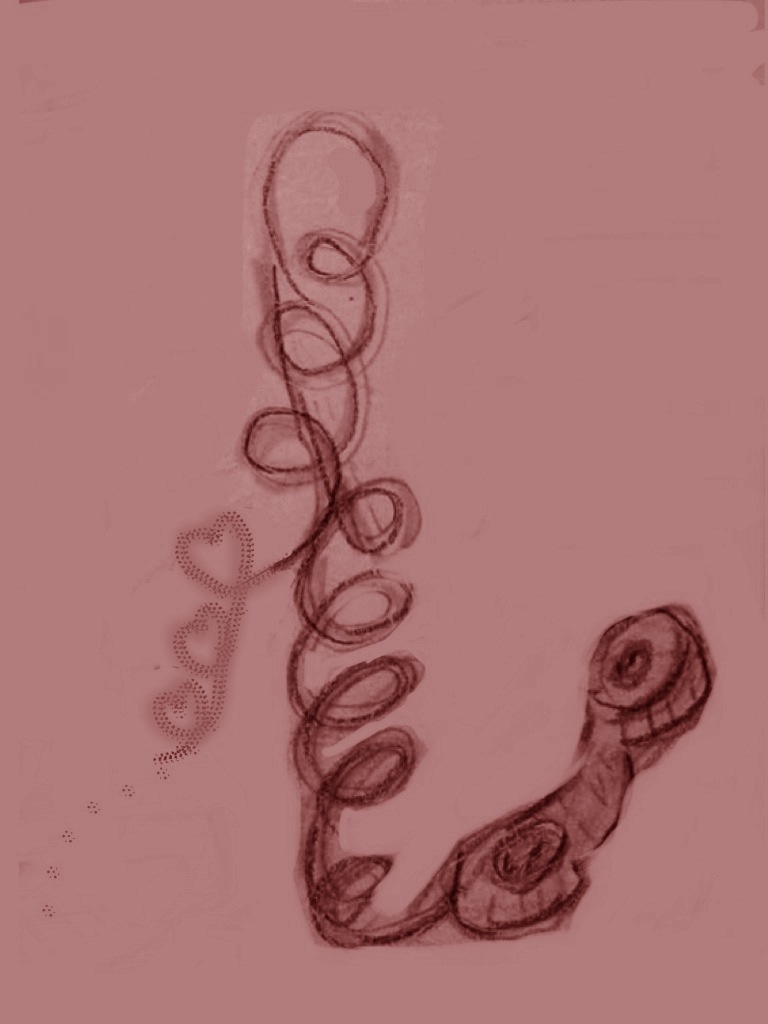
Pick-Up Poem (Not what it sounds like)

September 14, 2011

20110914-103023.jpg

Sorry, sorry, the title of this post is a bit misleading. The poem is about picking up the phone, not picking up in a bar. However, bloggers like stats; provocativeness improves stats; and well, I’m sure you are picking up the gist of this.

All that said, here’s the poem:

When you don’t pick up

One reason I hate so much

the times you don’t pick up

is that they throw me into

a certain (but I hope distant)

moment in which you are truly gone

or I am gone, when whichever

of us is left will have

no one to call, though perhaps

we will still call–knowing me, I won’t

be able to stop–but we

will have no one to answer, though certainly
you will try out of steadfast love

to answer, and me because I can never

shut up–but still, it will not

be an answer that says,”I’m coming,

I’m almost there,” or if it does, it will

be that rather tricky coming of

the nearly departed, which, of course,

is not what either of us want exactly,
at least 
not at this present moment,
which 
is why I really do wish

you’d stay near a phone always

so that I could gather up

your sweet hello

every single time I call and know, yes,

that you are coming, yes,

that you are still here.

(All rights reserved.)

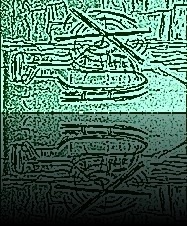
9/9/11, Helicopters in Lower Manhattan, Poem

September 9, 2011

20110909-105840.jpg

9/9/11

I wake this morning in lower
Manhattan to the broken
record roar of helicopter hover,
finding my heartbeat synchronous–
pa-nic-nic-nic-nic-nic,
not wanting to be here
anymore right now
September 9, 2011.

Remember a woman, blonde,
with a blue knit cap, December 2001,
caught at the edge
of the slope, her skis sideways, stuck aslant,
afraid to just slide down, to
stay still too; she’d brought
her kids for fun, her husband
gone, they’d only found his
hand, itself lucky. My own
husband reached out his
across the cold,
coaxing her restart.

Away today, he tells me,
over the phone, not to worry
about participating in any event, hoopla,
no disrespect intended.

(As always all rights reserved.)

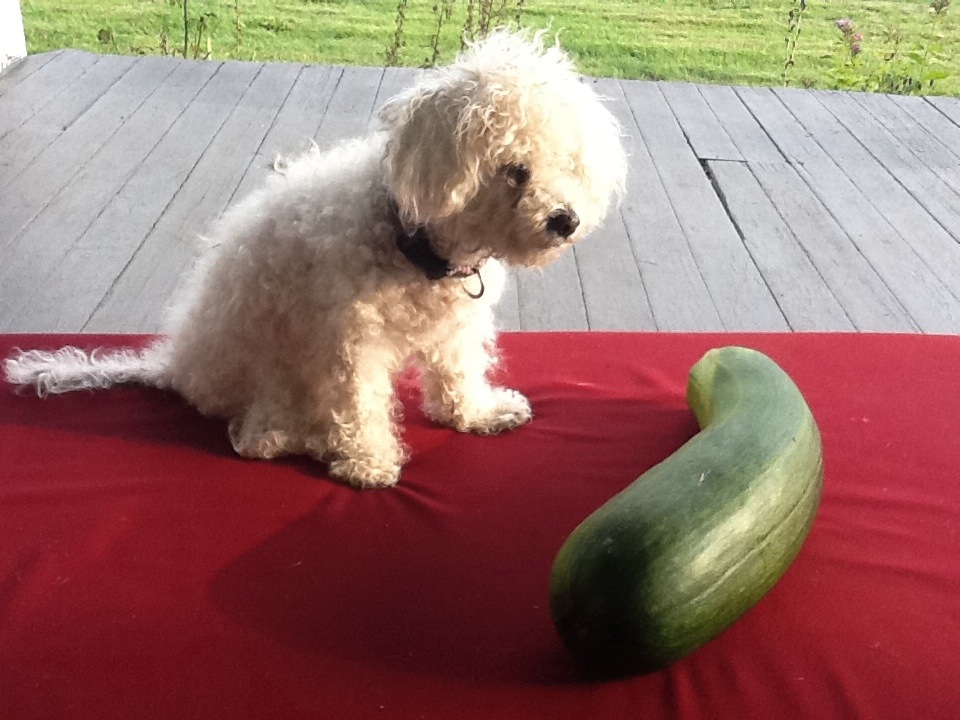
A Small Dog Is To A Large Zucchini

September 2, 2011

20110902-081617.jpg

A Small Dog Is To A Large Zucchini

A small dog is to a large zucchini
what a bungalow is to a road (six lane),
what a tadpole is to a Peach Bellini
made from a magnum of Champagne,
what a thimble is to a Fred Fellini
and miso soup was to Charlemagne–
the nexus, to some, seems very teeny,
to others, perhaps, it’s simple, plain.
All I know is that my large zucchini
and my small dog just aren’t the same.

(As always, all rights reserved.)

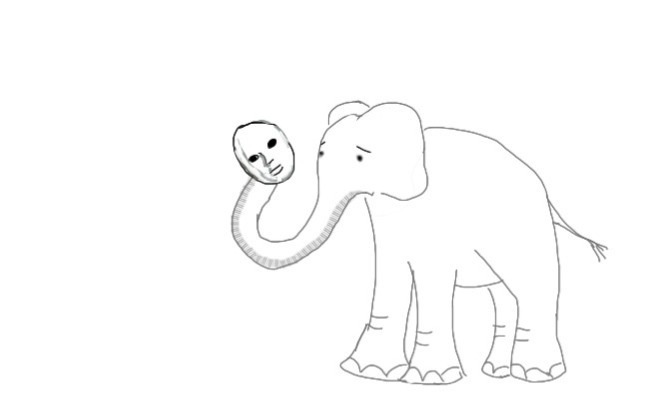
Public/Private disconnect (Sonnet) (With Elephant)

June 21, 2011

20110621-105412.jpg

I hate to admit it but I’m kind of a solipsistic person.  It’s not that I don’t like people–I take a strong interest in trying to help others (particularly if it involves telling them what to do.)

But I am just awful in social situations – parties, gatherings, even sometimes work settings.  To some degree, this may have something to do with not being completely at ease with either my “public” persona or private persona.

At any rate, here’s a kind of gloomy sonnet about this kind of public/private disconnect.

Because I am now linking this post to dVerse Poets Pub Raising the Bar for critiquing, I am going to put up two versions of this poem, an older and newer.  (I think the older may be better, but it’s also the one with which I am more familiar.)   They are both a bit self-pitying, although that may be something that makes them universal.

The first is the older  version:

Pretending

 After years, pretending to be what you’re not
becomes a nature;  a second skin
coating you like a kind of make-up, caught
in your pores, nestled in your grooves, a twin
of features, caked, you need not reapply.
But habits, faces, fail and it wears thin,
until, worn through, you can hardly try
anymore.  Too wary, weary, the word
“cagey” describes so much of what you’ve been,
the opposite of free-flying bird,
while unheard, and hardly there within,
is all you’ve been saving, what you hid, why
you did this, what wasn’t supposed to die.

Newer:

Pretending

After years, pretending to be what you’re not
becomes a nature;  a second skin
coating you like a heavy make-up, caught
in your pores, nestled in your grooves, a twin
of features, caked, you need not reapply.
Sometimes the habit fails, pretense wears thin,
that face that clung is suddenly wrung dry–
you don’t want to re-affix, but the word
“cagey” catches so much of what you’ve been–
the opposite of free-flying bird–
that, though you wish more than anything
to be seen, take wing; fretful, you still try
to keep tight all within.  Oh me.  Oh my.

If you are interested in my poetry, check out my poetry book, Going on Somewhere (by Karin Gustafson, illustrated by Diana Barco, cover by Jason Martin) on Amazon.

If you are interested in my elephants, check out my children’s book, 1 Mississippi,  on Amazon.

National Poetry Month – Day 30 – “End of National Poetry Month Haiku”

April 30, 2011
20110430-095851.jpg

"April is the cruelest month" (version filtered on Photogene)

End of National Poetry Month Haiku

Some say that April is the
cruelest month. They must
be people who write poems.

All rights reserved.  Suggestions welcomed.  Thanks much for checking in on all the draft poems this month!

"April is the cruelest month." (Unfiltered.)

National Poetry Month – Day 28 – “Relic”

April 28, 2011

20110428-111658.jpg

Relic

Poets write of rust, decay, time wearing out or thin,
but time’s spin makes for a preciousness too, imparts
like dew, an aura, as seen around
Ty Cobb’s dentures, still firm, at The Baseball Hall
of Fame, George Washington’s at Mt. Vernon.
Even the belongings of the obscure
acquire the gild of treasure–the small green
rubber boots bought as a joke for my dog
found fifty years later in my mother’s garage.
And then there are objects that become relics
even before time’s passage.  I think of
the chocolate Easter egg, kept in the freezer, that my grandmother took a nibble
from every night before her fall; she’d gotten less than
half-way through; my mother saved the remainder, still foil-wrapped
in blue, for years afterwards, the surface of the
chocolate whitening like the cataract over an eye, making it
harder and harder to see what was once so clearly
in front of you.

All rights reserved.  Suggestions welcome.

National Poetry Month- Day 21- “Sleep-Deprived Ride”

April 21, 2011

20110421-080519.jpg

Here’s another poem written in my favorite venue and time – New York City subway car, a.m. just past rush hour. Today, however, I was not in the best mood. Here’s today’s draft poem, again in honor of National Poetry Month.

Sleep-deprived Ride

Three days of 2 AM
makes for a wan
morning commute.
Brain is mute;
colors blur along edges.
When a child screams–SCREAMS–
at the hedge of his
stroller, the brain
twists at its own edge,
or just pushed over,
‘my purse!’ it panics next;
awareness jerks
to the strap
over arm, wrist, lap,
that stolid mass of care that never
stays up past midnight, holds all.
Still there, thank God
(though barely sensed),
still, there.

All rights reserved.  Suggestions welcomed