Archive for the ‘Uncategorized’ category

More Palin On Climate Change–Emit, baby, emit

December 22, 2009

Yesterday, I wrote about Palin’s tweets on climate change.   (Twitter–such an intelligent way to discuss complex scientific and political issues.)

Palin’s complete-sentence comments on climate change, posted on Facebook (another high level political forum) and in an op-ed piece in the Washington Post, are a little less fragmented than her tweets.  But they illustrate a similar disjointed logic that is geared towards “catchy” reductiveness, self-promotion, and a refusal to face true choices (a “have your cake and eat it too” mentality.)

Catchiness comes in “word bites:”   for example, she accuses California Governer Schwarzenegger of harboring a vain “greener than thou” attitude.  (This put-down does not make a huge amount of sense since she also accuses him of being too green.)   She  accuses Gore and other environmentalists of promoting “Doomsday scenarios.”  (This last is also strange coming from someone who, seemingly, believes in the Book of Revelation.)

Any science that finds a connection between man’s activities and climate change is “agenda-driven,” even “fraudulent”.  (Another odd comment given the known efforts of the Bush administration to politically manipulate scientific data.)  Nonetheless, Palin promotes the idea that there has been a huge conspiracy of scientists for the last twenty years falsifying scientific records related to climate change:  “Vice President Gore,” she writes, “the Climategate scandal exists. You might even say that it’s sort of like gravity: you simply can’t deny it.”

The purpose of this vast scientific conspiracy is never specifically stated by Palin; the scientists seem somehow motivated by a vaguely elistist wish simply to make the American people suffer.

Palin, eager to seem pleasing and maverick at once, typically attempts to pay lip service to both sides of the debate.  She proclaims herself a believer in climate change, and to have initiated “common-sense” efforts in Alaska to deal with its effects.  (Presumably, these efforts did not involve any limitations on snowmobiling, drilling, or safeguarding of polar bear habitats.)   Her bottom line, however, is that she refuses to believe, no matter what,  in any connection between man’s activities and climate change, while she is completely certain that there will be an irremediable economic cost in reducing emissions.  Ergo, emit, baby, emit.

A “real world”, as she calls it, analysis.

Palin andClimat Chng: Happn’g 4 Ions

December 21, 2009

As my family, with some embarrassment, will attest, I am not someone who feels a knee-jerk hatred of Sarah Palin.  I don’t agree with her on virtually any issue, but I think she is smarter, or at least, shrewder, than many people from my neck of the non-woods (New York City) admit.  I also have a soft spot for Palin simply based on the memory of her youngest daughter (Piper?), seen at the Republican convention, earnestly pressing down Palin’s baby’s wayward bangs with a saliva-moistened palm.  (It’s hard not to like Piper.)

But Palin’s blindness to reason and fact really get to me; Palin is especially upsetting because she’s so glib, so willing to cast aside the complications of truth to get to the beguilingly simplistic.  She’s a bit like a cheerleader: as long as something is catchy, short, and supports her team, she will (smilingly) say it, whether or not it makes sense, or is even consistent with her other positions.

The most recent example of Palin’s reductiveness can be seen in her remarks on climate change.  Palin’s comments were made in the form of “tweets,”  a good method of communication for Palin since fractured thinking is not only allowed, it’s practically mandatory:

“Copenhgen=arrogance of man2think we can change nature’s ways.MUST b good stewards of God’s earth,but arrogant&naive2say man overpwers nature.   (Palin Tweet, 11:44 PM Dec 18th from TwitterBerry ).

Earth saw clmate chnge4 ions;will cont 2 c chnges.R duty2responsbly devlop resorces4humankind/not pollute&destroy;but cant alter naturl chng.” (11:57 PM Dec 18th from TwitterBerry)

There’s no room for the complications of science and fact here; no space for actual data.

There’s not even room for eons of change, but only “ions,” those teeny little charged particles that (according to some bogus scientists) make up various atoms and molecules.

I understand that Palin’s position is based, in part, on her Christian faith; but her faith seems terribly reductive here.   Although Palin pays lip service to a broader view of the environmental equation ( “humankind/not pollute and destroy”), this statement seems just a spoonful of sugar (to help the development go down).   It’s worth noting that one of Palin’s earlier tweets that day congratulates the Alaskan legislature on fighting the Endangered Species Act, a fight in which Alaska is working to delist the polar bear and to avoid a listing of the ribbon seal, two species that have been harmed by a severe decline in habitat due to climate change.

Apparently Palin believes that the polar bear and seal can live 4 ions, even without a habitat.

Cookies!

December 20, 2009

Watch Out For Mustard!

Gingerbread Yankee

Gingerbread Baseball Glove

Gingerbread Cow

Gingerbread Feet

Mistake And Giraffe

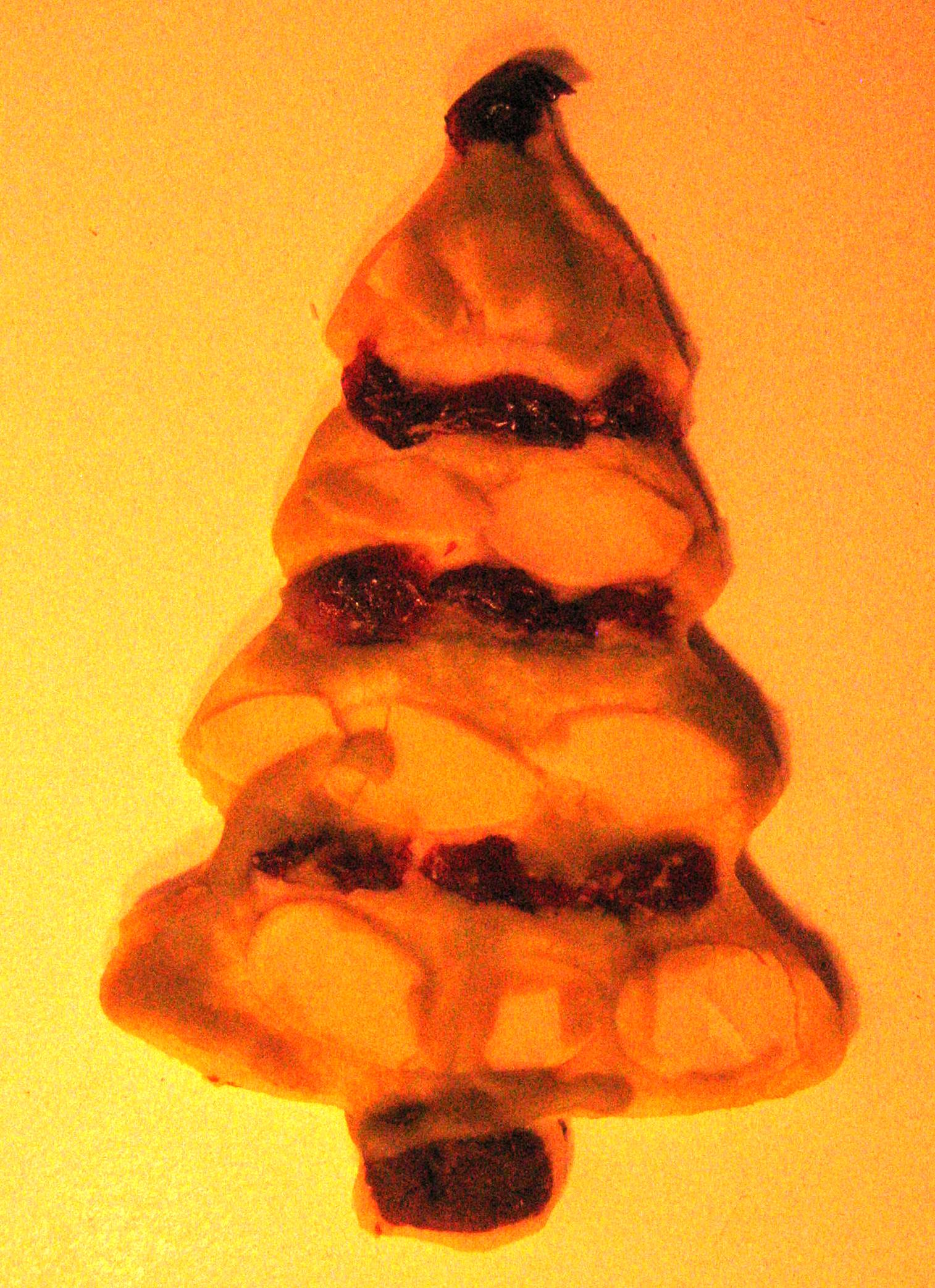
Weird Tree

Tools

Many many thanks to those who actually did the decorating.

Manhattan Before Christmas – The Super is Everywhere!

December 19, 2009

If you live in Manhattan, there are several traditional signs that Christmas is coming–that big white star by Tiffany’s, the tree at Rockefeller Center,  the Strauss Waltzes in Grand Central and the laser reindeer dancing among its regular constellations.

Then there are the signs that are closer to home:

1.   Your doormen suddenly begin opening doors for you.

2.   The Super, whom you’ve not seen in a few months, hangs around chatting with the doormen (despite the fact that they are so busy opening doors.)

3.   Xeroxed sheets with the names of the doormen, the Super, the Super’s assistants, the porters, the cleaners, the plumbers, and even of the people who will come and paint and plaster your apartment once you move out, are stuffed under your door.

4.   Faux fir branches bedeck the outdoor café next to your building.  You realize, on closer inspection, that they have been wrapped around a collapsed outdoor umbrella, which has also been covered with garbage bags, duct tape, and little twinkling lights.  (It actually looks okay at night.)

5.  The huge inflatable rat that sometimes grins at the end of your block due to ongoing labor disputes has been replaced by a huge inflatable elf, announcing the sale of Christmas trees.

6.  The sidewalk holding these trees smells really good for once.    (How do they keep the dogs away?)

7.  You realize, at the gym, that you did not lose the ten pounds you said you would.  The reflection of the twinkling lights from the outdoor umbrella stand just below the gym window reminds you that it’s too late now (unless you can somehow manage a juice fast in the next five days.)

8.  You try a hair cut instead.

9.  The doorman, smiling as he opens the door when you come from the salon, tells you how nice it looks.

10.  You look for that xeroxed piece of paper so that you will spell his name right.

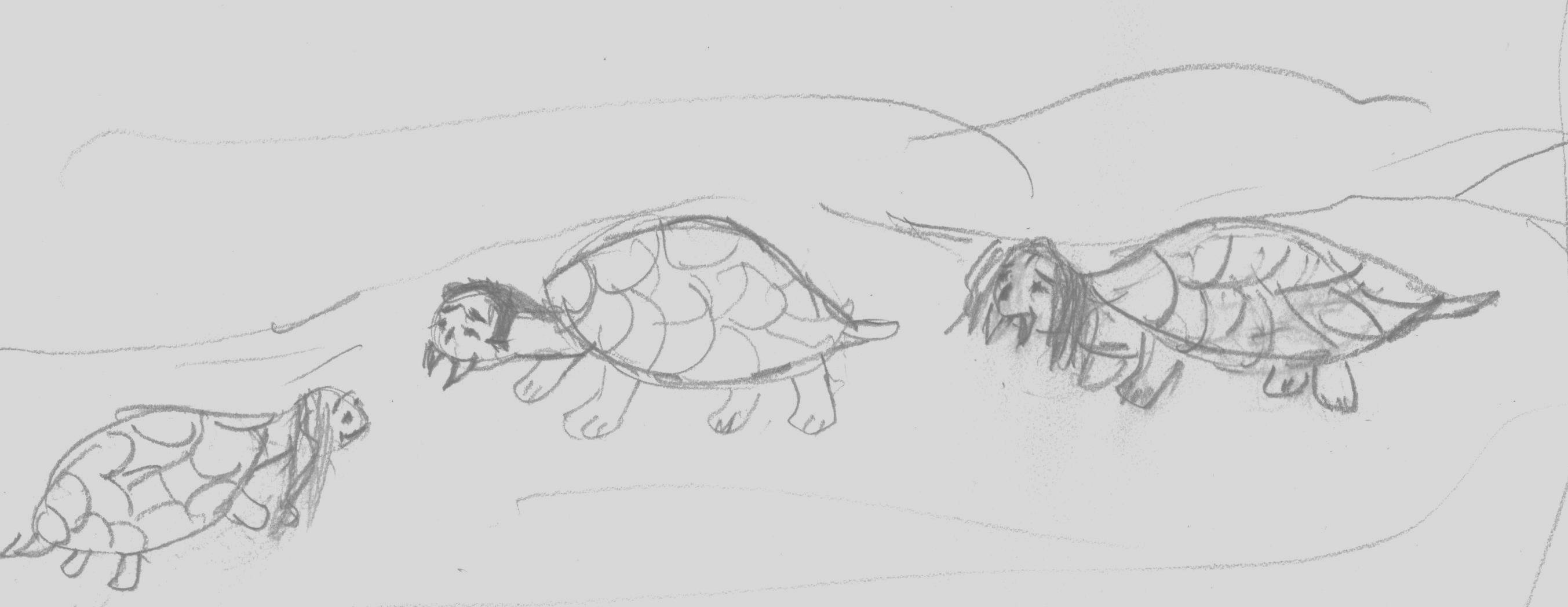
Friday Night Silliness – True Blood Turtles

December 18, 2009

Sookie Stackhouse, Bill Compton, Eric Northman, as Turtles

It’s been a very long week.  (I’ve never actually seen the show True Blood, but I’m guessing it doesn’t have turtles.)

Escapism – One Could Do Worse Than Eric Northman

December 17, 2009

A  couple of weeks ago, I wrote a post about the lure of mind candy when escapism hits. At around the same time, I wrote a post about reading nine Sookie Stackhouse/True Blood vampire novels in one week.  (This, I should note, was not a week in which I was on vacation sitting reading on a beach.)    Comparing the Sookie Stackhouse vampire novels to the few other vampire novels I’ve read (the Twilight Saga), I said that the Stackhouse books weren’t really such great re-reads because they were mysteries rather than romances.

A couple of weeks, and several re-reads, later, have led me to revise that opinion.  The Sookie Stackhouse books actually are fairly romantic, at least fairly raunchy, and they score quite well on the escapist/obsessive-compulsive/manicD re-reading charts.  (The audible books read with a delightful Southern accent by Johanna Parker, are also pretty helpful for the highly-pressured who eschew medication.)

I also want to revise my previously posted opinion of the character of Eric Northman (noting again that I’ve never seen the True Blood TV series.)  I said in my post that  I thought Eric was too devious to be a romantic hero.  While I think it very unlikely that Sookie ultimately ends up with Eric (because of the whole non-aging, non-childbearing, vampire thing), she could definitely do worse.

Re-reading these books has also led me to wonder what exactly people, escapist people, like about vampire novels.

Of course, there’s the utter (fun) silliness.

Then too, there’s the attraction (for female escapists) of unpopular girls suddenly being swooped up into a world of super-handsome, super-devoted, rich, handsome, strong, protective, males.

But I think what escapists are particularly attracted to is the dominance of compulsion in these books.  The vampires are portrayed as beings who, despite being control freaks, are implacably driven by the rules of their deeper natures–their desire for certain scents of blood; their apathy towards other beings; their inescapable hierarchies.  Anyone in escapist mode finds both these battles with compulsion, and the many guiltless surrenders to it, pretty intriguing.

Secondly, there’s the inner logic.   Once you make the huge leap into the world of all these crazy magical beings, everything else is very rational, ordered, in the books.  Certainly, there is a lot of violence, but it’s never random.  (Books with seemingly random, yet very real violence, like, for example,  Cormac McCarthy’s All the Pretty Horses¸ only make an escapist feel terrified; as if his or her lack of attention to the details of daily life could lead to some truly disastrous consequence.)

Finally, the dialogue-filled prose forms a comfortable groove in the stressed brain a whole lot faster than something like, let’s say, Heidigger.  This accessibility makes them particularly good for reading on a treadmill, of virtually any kind.

Go-For-The-Throat December–Getting It All Done Now

December 16, 2009

The last few years have led me to the conclusion that I should simply find a way to skip fall.   That sounds like a dance or marital arts move – as in “skip jump” or “break-fall”–but what I’m talking about is that breathtaking (in all senses of the word) period from mid-September (beginning from around the time of year that first the World Trade Center, then a few years later, Lehman Brothers, fell) until Christmas.

The very beginning of September is acceptable.  Even pleasant.  It can still get steamily hot, but there’s a halcyon edge to the sunlight.  The sky is more often blue than white; the farmer’s markets smell like apples; if you live in those parts of  New York City where they still have Korean vegetable stands, the sidewalks are laden with chrysanthemums.  Yes, in early September, you have to get the kids back to school, or, if you’re lucky, move them to college.  But, with practice,  you find that either of those goals can be pretty readily accomplished with several rolls of duct tape and a usable credit card.

But once September merges into October, a go-for-the-throat pressure sinks its teeth into New York City life.   By November/early December, this morphs into a go-for-the-jugular stress which makes one  forget how really beautiful the leaves just were.

So much to do.  Right now.

Do people live this way in the rest of the country?   Certainly, they did not in prior history.  They were physically busier—think of the difficulty of having to heat water just to wash clothes.  (Of course, in the City, I have to carry my laundry up and down a few flights of stairs, and used to have to drag it across two courtyards.  Yes, I appreciate that’s not the same as gathering wood.)

And yet, the busy-ness of today’s constant mind gyrations—the nonstop, if often inconsequential, “right-nowness” of a life lived on the computer—has its own wear and tear.  (Presumably, in prior ages people got to sit quietly for at least a little bit, watching the fire heat up their laundry water.)   Of course, people can probably sit quietly now too, even in New York, without multiple Microsoft “windows”, constant channel changing, commercial breaks, cell phones, emails, deadlines, if they have either (i) a large trust fund, and/or (ii) a certain force of will.

Enough whining!  I felt a tide turn today as we crossed the December mid-point, a place  where it suddenly became clear that what “needs” to get done before the end of the year either will (because it’s already almost done), or won’t.

And then, we will enter those freezing days of January, February, March, when everything—buildings, sidewalk, street, sky—becomes so grey that it’s hard, for a time, to measure the progression of the season.  The words “hunker down” will line our turned-up collars, and we will know once again that we are “in it” for the long haul.

Which, from December’s perspective, looks like a great relief.

“In the Ukraine”

December 15, 2009

Here is another poem which has the dank feel of early winter.  It was written after reading about Father Desbois, a French Roman Catholic priest, who has worked in the Ukraine to document the murder of Ukranian jews during the Holocaust.  It was brought to mind today by Hanukkah (another shining of light), and the terrible news of a different priest (a Russian Orthodox priest) leading a crowd to attack  a Menorrah in  Moldava, neighbor to the Ukraine.

In the Ukraine (sixty-some years later, still finding)

Reluctant shovels prod earth;
roots grip hard; growth
took well here,  the ground
not trod by paths, boots,
only perhaps by light feet running on a dare,
and the fine dart of swallows,
a swivel of darkness against blue-violet,
evening sky;
the underdirt unfolds in webs
of stems as pale, as green, as bones;
coarse hair that might have grown too, white.
Men pause, leaning against
shovels’ long-grained necks; it feels
like gasoline coming up,
a poison surely
that must come out, that wants to come out,
still burns.
The priest extends his hand, not touching flesh or cloth–
“this was the place?”
His voice reminds them of rock–worn, smooth,
soft, hard, a color that seems to them indeterminate–
at least, they don’t know what it’s called.
Looking down from beneath wool cap, a looser collar
swallows unseen, then digs again.
Too late to bargain.
Yellowed pages rumpled
like the inside of that non-priest’s collar, the returning circle
of neck, have been
produced;  the prints of names
(letters quavering like blades of sea grass)–
the smudged “A” of
“AVRAHAM,” the terminal H of
“DEVORAH”–have been again recorded.
Dark eyes’ insistence
on having once seen, has been seen.
Burns coming up, those digging
want to spit it out
but can’t, not here.

All rights reserved, Karin Gustafson.

Homemade Presents- Forget the Pomander

December 13, 2009

As those of you know who read about the “sheep” costume made by/for a young daughter at Halloween, I’m a big believer in home-made celebrations.  It’s fun for kids, a great way to hold out against commercialization, and terrific for grandparents who have pretty much all that they need.

That said, coming up with gifts that can be made by very young children can be difficult.  Of course, there’s always the picture–the child’s painting or drawing which can be framed, or better yet, converted (commercially) into a plate or mug.   (My mother-in-law had a beautiful hors d’oevre plate emblazoned with a vivid shooting scene made by a young grandson, for example.)

But my kids and I tried to come up with things that could be completely made at home.

Our first effort was a set of “pomanders”.  These are those oranges stuck with cloves.  Supposedly, people like to stick them in drawers to make the drawers smell nice (and not just to hide the pomanders.)

Pomanders are not a terribly satisfying gift.  For one thing, they are much harder to make than they look.  This is probably not surprising because they look incredibly unimpressive.

We moved on from pomanders to home-made Christmas ornaments.  Did you know that you can bake playdoh?  You can, but shouldn’t.

If you do not heed this warning (let’s say, because you have no viable sense of smell), you can make some hard-baked cute little blue animals and yellow stars.  Remember to leave holes for strings or ribbons with a scissors point or sharp pencil before baking.

Ornaments made from cardboard, colored foil, and glitter (lots and lots and lots of glitter), instead of playdoh,  might work out better if you ever want to use your oven again.

Speaking of baking, one of our most enterprising home-made gifts was a gingerbread house.   My kids did a few of these at school fairs with graham crakers, canned frosting, and all kinds of gumdrops.   These were pretty artificial constructions, however, built with artificial stuff over milk cartons; strictly inedible.   Finally, we graduated to the real thing.  A gingerbread house baked from dough rolled out into matching rectangles, i.e. walls.

The walls were to be stuck together with sugar glue, not elmers, and, most impressively, were to have stained glass windows, made from powdered hard candy.  (Put the hard candy in plastic wrap and hit it with a hammer.)

The project was both amazingly time-consuming and nervewracking.  A great deal of extra frosting and an unexpected interior wall was needed in the end, as were several books to hold the walls in place until all the sugar and frosting cemented (about twelvehours)

The end result was amazing.  A lit candle could be put inside, and the stained glass windows (not blocked by the unanticipated interior wall) shimmered.  It also, eventually, tasted quite good.  (Gingerbread has a long shelf life.)

As a final note, if you can’t manage a homemade present, kids can at least make wrapping paper.  Potatoes can be carved into great printing tools,  fingerpaint substituting for ink.    (If the potatoes don’t work, “hand” fingerprinted wrapping paper is also pretty terrific.)

In Search Of Saddle Shoes, Catholicism, Advent Calendars,

December 9, 2009

Two things I dearly wished for as a child were (i) to be Catholic, and (ii) to have saddle shoes.

They both represented a certain organization in my mind.  (Not organization, as in the Church, or Thom McCann;  organization in the sense of order, structure, rhythm.)

Catholicism was represented  by the couple of Catholic families on my street.  These each had enough children to require regimentation.  Rooms were shared; chores were assigned; eating was done only at meals, which were also on a kind of rota.  Fish sticks, of course, on Friday—these were not a particular source of envy.  Spaghetti on Saturdays.  The smell of the sauce emanated from my Catholic neighbor’s kitchen for hours, an unseen tomatoey aura that seemed to heighten the heavy greens of our semi-rural suburbia.  My Catholic friend, Susie, came out afterwards with sunsetty orange stains around her mouth.

Saddle shoes seemed in my mind to be Episcopalian.  (At least, the two girls I knew who wore them were.)  The mothers of these girls, like the Catholic mothers, did not work outside the home.  Less stressed than the Catholic mothers  (fewer children),  they wore their hair with either a schoolgirlish flip or bound in braids, and, on their feet,  trim white anklets.  (Seriously, anklets.)   They organized Brownies, Girl Scouts, volunteer stuff.  This, plus the anklets, seemed to give them a clear edge in the saddle shoe department:  they knew where to buy them.

I had a working mother, a rarity back then.  Yes, she made spaghetti sauce, but not for hours.   She wore hose.  And was too busy, and guilty (like many working mothers), to maintain a clear structure of delegated tasks.

As I grew older, a working mother myself, my childhood envy of Catholicism and saddle shoes spread to Advent calendars.  Setting aside all religious elements, Advent calendars represented patience, organization. If you’re going to have an Advent Calendar for your kids, you need to keep it in a special place,  consult it every day, only allow one little square to be opened at a time.

I tried.  But some  of us veer towards the energetic rather than systematic.  We squeeze things in, eating when we are hungry,  reading a book all night long.  We can hardly wait to wrap a present before we give it, make spaghetti sauce from a jar.  And will likely never ever get to wear saddle shoes.

Awww…

ps – for anyone who doesn’t know (I find this hard to imagine), saddle shoes are those beautiful, cow-like, curvy, black and white, or brown and white oxfords.