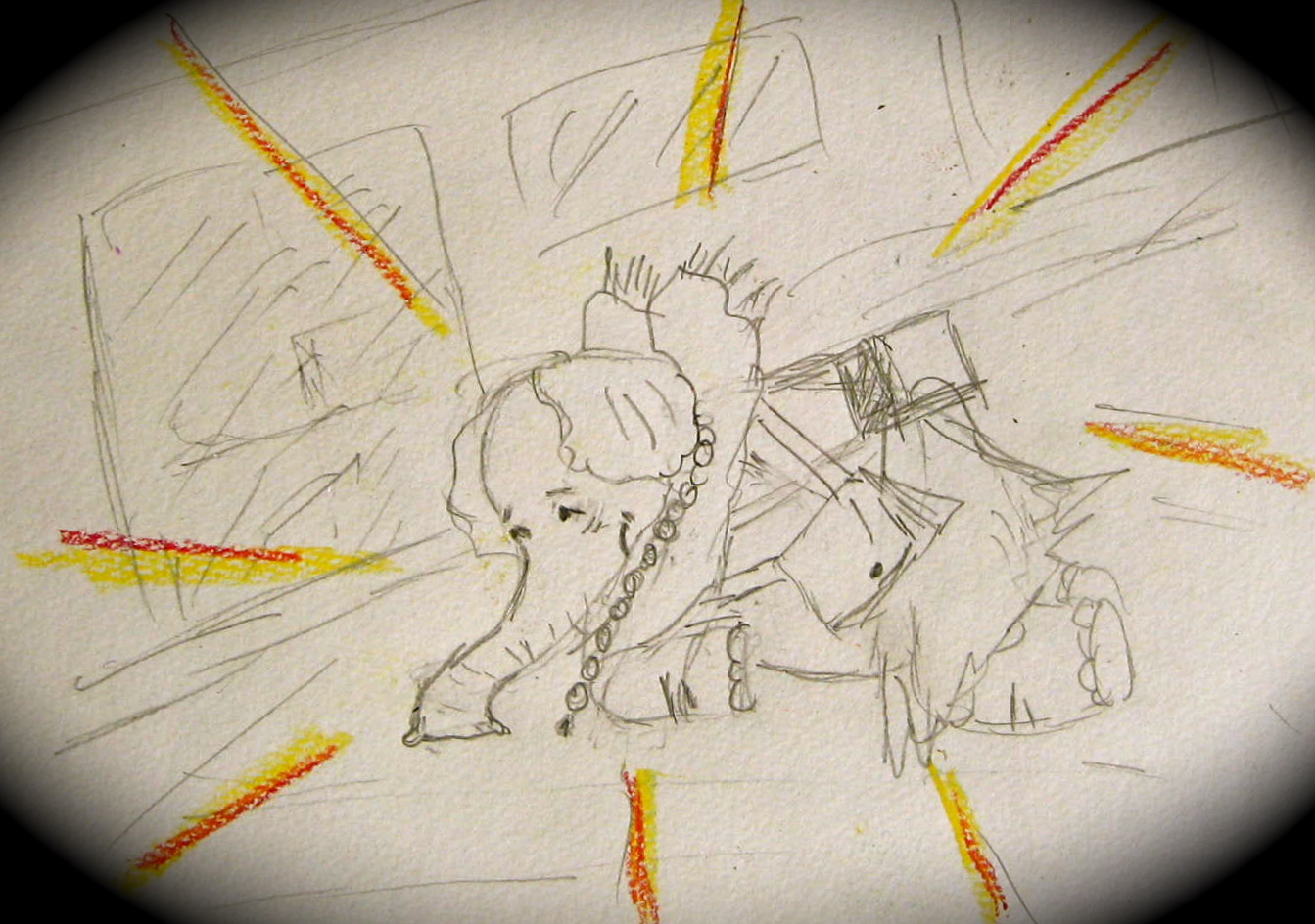
Archive for the ‘Uncategorized’ category

More on Nanowrimo–Opting for Artistry (Agh!)–Missing the Astaire

November 2, 2010

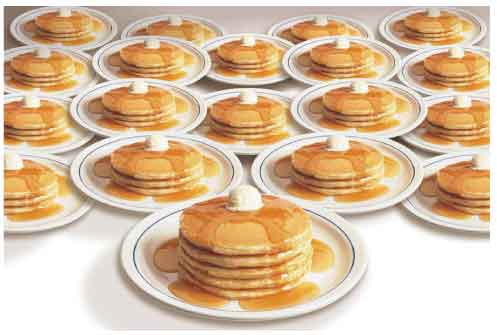
All pancakes one pancake?

So far, I seem to be opting for the artistic in my nanowrimo novel.  I have to confess that I think this is nearly always a mistake,

No offense to you true artists out there, but art is very difficult to sustain in a novel.  “Artistry” is even harder.

By “artistry”, I mean (at least in my case) a certain kind of dissonant fragmentation (i.e. modern artistry, post-war, post-a-bunch-of wars).     It can work wonderfully in visual art, and even in a poem, but in something that takes a while to absorb–say a novel (you have to read it)–there had better be something very very good there, some hook.

Agh!

Weirdly enough, I have also been listening to a great deal of Fred Astaire.   (Dancing makes me happy!)   Fred Astaire illustrates amazing artistry, not particularly “high” as in “highbrow” (only high-stepping.)

He is silly, clever;  even his most abstract dance maneuvers fold into a kind of narrative–they have a beautiful symmetry.

And yet, even though I really do believe in that kind of symmetry, I am not pursuing it, or, for that matter, a plot, a plan, a maneuver.  Rather, I am trusting in my unconscious as I write, right now.  It’s not “automatic writing” a la Yeats, but just what comes next and next and next, (in my brain, not in any time sequence.)  I’m basically layering with whatever my brain ladles out.    My only hope is that there will prove to be a connection in the sense that, in one brain, all pancakes are (sort of) one pancake.  But, well–if all pancakes are one pancake, then what is a “short stack?”

Agh! (aghaghagh!)   (short stack of aghs.)

All Words And No Play (Err… Plot) –A Dull Beginning To Nanowrimo

November 1, 2010

All Words And No Play

Did you really think I would leave you?  For a month?  Promptly At The Beginning of that Month?

I did start working on Nanowrimo (National Novel Writing Month)  this morning, but frankly, all I’ve written so far are words.  Close to 3,000 of them–I was on a fairly long train ride with a computer handy–but they are hardly more interesting than “All work and no play makes Jack a dull boy.”

Or Jill.  (Dull girl.)

This is one of the problems of not having the time or emotional energy to plan a novel before beginning.    (Yes, I’m whining already.)

Of course, you can be inspired to write things you have been longing to write about, words you may even have been storing up–but, ideally, a novel should not be a tool for revenge on close family members.   It’s best (if you want to keep your family intact) to suppress some of that energy.  Or at least channel–ahem– disguise–it.

It’s also useful when you sit down to write your novel to keep in mind the types of books you actually like to read.

I look at myself.    If I start with no plan, if I just “let it rip”, I can end up churning something out that is vaguely gut-wrenching; but it also risks being a more violent form of navel gazing.

While the books I most enjoy have stories.

I will include my morning’s words as part of my word count for Nanowrimo purposes, (i) because I’m competitive, and (ii) a bit of a cheater.  And, more importantly,  because I think you do have to work off some dross when you are doing something arbitrary.   And you might as well give yourself some credit for that.

But what I tell myself that I have to remember is that for all the jokes,  I am  trying to write a novel here–not a diary, a rant, a collection of memories.   I am trying to write something that can be read, and not just written.

Enough said.

(PS–No, I’m not posting old novel yet as I’m concerned it will dissipate focus even more.  Agh.)

Trying To Plan A Novel? (For Nanowrimo?)

October 28, 2010

Three days and very very few hours until November and Nanowrimo begin and I still haven’t spent a moment mapping out a plan.

Nanowrimo, as you may know, is National Novel Writing Month–a month in which any one of the writing persuasion is justified in caving in to all anti-social, anti-utilitarian, and Auntie-Mame tendencies in order to pound out a novel (or 50,000 words) in thirty days.

Technically, you are not supposed to put a word to paper (okay, screen) prior to 12:01 a.m. November 1.

Planning is allowed, however: outlines, mapping, character sketches, thinking.

(The deadline is self-imposed.  No would actually know if you cleverly converted outlines into written text… a week or so before November 1.)

But here I am.  Not planning anything yet, because, in my ManicDdaily way, I am grappling with personal and professional issues that feel in the instant like matters of crippling importance.  (In fact, it’s probably the feelings that are crippling, the matters less so.)

Enough said.  What do you do when you don’t have a plan for a novel and you really really want to write one anyway?

First of all, be honest.  You say you don’t have a plan, but is there nothing kicking around your cranial closet?  What about an old plan, discarded plan, some plan that seemed at one point impossible to you?

When you come up with that old plan–and seriously, just about everyone has one–think about whether you could commit to it for a month.  More importantly, could you have fun with it?

Don’t pass over a plan because you think it’s stupid or impossible, but only because you are genuinely not interested.  And even then, think twice.  (The novel loves narrative–it really is helpful to have an idea for one.)

If you can’t come up with a plan, you can always try just writing.  Start with a scene, a place, a person, a feeling, relatively random words set down upon the page.  (The human mind’s love of narrative is so strong that a story is likely to take over even when using this method.   Eventually.)

But take care.  This kind of writing (which the Nanowrimo staff calls writing “by the seat of your pants”) can feel emotionally satisfying at its inception (like therapy) but can sometimes bog down (like therapy), especially if it wanders too much into the territory of a roman a clef.

Which brings up another important point.   Whether you are a “pantser” or a planner, try to let go of the angst. There may be a nobility to enduring suffering, but few people want to read pages and pages of how you have endured yours.  Whining tends to be very hard to shape.

Besides, what fun is it avoiding the trials and tribulations of your personal life for a month if you’re going to spend your whole time writing about them?

(The lady doth protest too much, methinks.)

Pearl Makes Distinction Between Egg and Light Bulb

October 27, 2010

The last couple of days I’ve posted somewhat abstruse poems about mistaking eggs for a light bulbs.  Pearl, however, has not been confused.

More Thoughts On Eggs And Lightbulbs

October 27, 2010

Egg Head?

Yesterday I posted a villanelle mistaking an egg for a light bulb.   I was thinking about that today on the subway and came up with this poem.  Perhaps, I should say, draft poem.   Any suggestions are most welcome.

An Egg is not a Light Bulb

An egg is not a light bulb.
An apple is not an orange.
A square peg does not fit
into a round hole.

Actually, an apple is a lot closer
to an orange or even
to a round hole
than an egg
to a light bulb.

Though an egg can
have a certain luminescence.
In a pitch black room, for example,
an egg would be better than nothing
(especially if hard-boiled).

Except that a hard-boiled egg
has a blank crustiness
about its shell, like rough
plaster, or better,
gesso stuck insistently
to what would otherwise be
a relenting stretch of raw canvas,
while an uncooked egg, be it white
or brown (truly a dim peach),
has the iridescence of a pearl,
a tear, a newly-hatched idea,
which is represented (typically)
by a light bulb hovering
just above, or even inside,
a human head.

So maybe, thinks the head,
this thing called life
is possible.

Need An Excuse To Write? – Nanowrimo (National Novel Writing Month)

October 25, 2010

One week until Nanowrimo (National Novel Writing Month) begins.

I confess that I am writing about Nanowrimo mainly to steel myself to actually do it.

National Novel Writing Month, in case you haven’t heard, is a month in which you try to write a novel (or 50,000 words) in the month of November.  You and a zillion other people.

Yes, it’s arbitrary.

Why not write a novel during the month of August?  Or from mid-January to mid-February?  (Better yet from mid-January to mid-December?)

And why make the effort to write so public?   With so much hoopla?

Many of the good (and silly) reasons to try Nanowrimo can undoubtedly be found, somewhere, on the very comprehensive website–www.nanowrimo.org.

One of my favorites is the excuse Nanowrimo provides–the justification (good for at least a month) to put your writing first.  Here is how it works:

“Clean the fridge?   Yes, I did notice that green sphere (too furry for cabbage), but I’ve got to get to work on my Nanowrimo.”

“You say we need new sheets, towels, glasses, winter coat, blender and they’re all on sale this Veterans’ Day?   (But I’m only on Chapter 3!)”

“You expected Turkey?”

PS – sorry that the video is not exactly up to snuff!  I really don’t have the hang of it yet, still don’t have camera, and don’t have a clue about editing commands, or uploading, and it takes forever.  Agh.

Blocking Writer’s/Editor’s Block – Major Restructuring? (Maybe Focus On the Laundry)

October 24, 2010

A bit of a dreary Sunday.

The good news:  This morning, I finished a re-write of an old Nanowrimo novel.  This does not mean that I actually finished re-writing it, but that I finished another complete round of revisions.

The bad news:  I haven’t done my laundry yet and the laundry room here gets really crowded Sundays.

The good news:  This afternoon, I started another round of revisions on this same old Nanowrimo novel, going through it one more time.  For a while, the whole thing just seemed to work.

The bad news:  Then, I ran into a chapter that I seem to have over-edited my last time through, trying to break up the scene.  Now I think I have to seek out some of that old deleted material.

The good news:  I have a bunch of laundry to do.

As I’ve mentioned before in posts on writer’s block, my block does not arise in my initial writing, but in the editing and revising.

Part of my problem is that I sometimes want to make the manuscript to take a shape it doesn’t want.   I will try a major restructuring, hoping that certain kinds of manipulation–flashbacks, changes of view–can supply the momentum and drama that the plot is lacking.

This type of re-organization may work for some writers.  I’m not sure I’m not one of them.

Please understand that I am not saying here: “first thought best thought.”  I strongly believe in revision and editing.  (Except perhaps on this blog–sorry!)

But, for me, the editing sometimes works best on a sentence to sentence basis.  Or, even better, through cuts.   (One can get very enamored of sections that don’t move a story forward, especially when you’ve heavily re-written these sections on a sentence to sentence basis.)

But changes that involve fitting the manuscript into a different framework, or inserting a… device… tend to be less successful for me.

A good test of whether structural changes are useful is whether you can actually carry them out.  If, as you go through the manuscript, the changes feel increasingly hard to write, they are probably not helping you.

Again, I’m not saying that re-envisioning of a manuscript is not sometimes important.  Filling in blanks or making blanks can help you find your voice and your audience; it can feel both creative and compelling.

The key word is “compelling”.

Good writing does not re-write itself, but if it becomes too much of a tussle, you might consider a return to your initial, rawer, vision.  This at least will have a certain energy and drive.

Here’s the point:  be realistic about the true nature of your first draft.  If you have made an amuse-bouche, don’t try to stretch it into a full course meal.  If you keep trying to inject further substance into it, you may end up with something that can hardly be chewed (much less digested).

Now, about that laundry….

Questions of the Placement of Man (And Woman) In the Grand (or not so grand) Scheme of Things – Tea Party/Here and Now

October 23, 2010

At a kind of center

Dashing across Broadway to the corner of Fulton, late for work, and thinking about my next blog post–an off-shoot of “Lord Help Us!”, about the Tea Party’s doubts in man-made climate change.

One major distinction between Tea Party types and students of science and history is their view of Man’s place (especially the place of American Man) in the whole big scheme of things.

Swing past the thick green posts at the top of the train entrance, the heavy iron scrollwork now muted by a zillion and one paint jobs; to my left, a T-Mobile (I think) store, petals of yellow ad flash in the darkly reflective glass.

Tea Partiers, pattering down the stairs, especially those who identify themselves as Christians (with a capital “C”), believe that Man (particularly American Man) is made in God’s image, the apple (only not the apple) of His eye.  As a result, creation revolves around Man; the Earth is at his disposal.

By American Man, I also mean Woman. I grimace in frustration as I slow for one carrying a baby carriage.  (I usually do offer to help women with carriages but this one is already mid-stairs, and taking up the whole stairs too–no way will I get past her.)

Few serious students of science or history can truly believe this.   Scientists tend to be conscious of the fact that the Universe (and even the Earth) have had a long life span that didn’t include Man in a starring role, and also that it’s possible for Man to write him/herself out of the future script.  Serious historians, for their part, cannot truly believe that all of human history has been one big build-up to Sarah Palin.

I chuckle inside, feeling suddenly energized by snarkiness.  But now I see with absolute certainty, even though just from the corner of my eye, the dull sliding silver of the train.  Still moving, meaning it’s pulling in, but there’s that baby carriage and mother, and now an older lady too, and it’s a narrow entrance, but there are three turnstiles–THREE!–the rectangular lights of the train windows slow–

If all of the Earth is supposed to be FOR man, how can we wreck it, thinks the Tea Party–

I really don’t want to be rude, but oh come on–train doors opening–I jog to the left of the baby carriage, the mother, the older lady in black wool coat, slightly bent, carrying a bag, Christ–got to get around that too–determined not to discombobulate them,veering to the farthest turnstile that I never use–what did someone say the other day?–that that turnstile didn’t work, no, that the closer one didn’t work?  Random notes of random sentences depress the fervor of my Metrocard slide until the green “GO” magically appears and I push the heavy slots (it’s one of those floor to ceiling turnstiles), galloping towards the bright rectangular squares at the end of the dim concrete–

Ohnoohnoohdamn.  On hands, ouch, knees, face burning–I really should never wear a scarf–this purse–did I break anything?  The older bent lady in the black coat alarmed–I try not to think about how my hands sting and what kind of germs are crawling onto them, looking up  around tangle of neck–

The doors are still–open–I scramble upright, lunging stiffly, mumbling apologies to the old lady–oh no, my necklace unclasped, my lucky necklace, about to fling itself–grab it with one hand as I stumble into the white light of the car, the other holding open the door, turning back to those left behind.   The mother with the carriage hasn’t yet gotten through the turnstile, the old lady at the far edge of the platform–

“No no.”  She shakes her head with a smile.  I can’t tell if she’s wise, or heading for a whole different line.

I let go of the door, reclasp my necklace, resettle my scarf, wipe my hands on my pants, then don’t wipe my hands, then–ah–sit down, pretending that no one is looking at me.

Head in the clouds, theories, egocentric snarkiness, leads to–scraped knees, stinging hands, I bend down over my notebook.

Wait–that’s my stop!  Already??!!!

(Isn’t the “here and now” part of what science is all about?)

Hurry hurry hurry out the door.
Corporate Creepiness in Post-(Pre-) HAL Days (Gmail Scans)

October 21, 2010

HALcyon Days?

Everyone finds Big Government creepy these days.  When I think of some of those likely to be elected soon, I share this feeling.

But lately I’ve been finding a lot of corporate conduct creepy too.  (I’m not going to even get into the huge bonuses for executives of the TARP banks.  Or the News Corporation taking advantage of the Citizens United ruling to make large donations to Republican coffers.)

What I’m thinking of are the more subtle corporate practices, things which make my skin crawl–

1. Google. Do you have a Gmail account?  Have you noticed that when you write a friend about a sale on bagels and cream cheese, the margin of your next email is covered with ads for bakeries and the “happy cow” online cheese company?

Or that when your daughter writes you about a risque costume she is ordering for a play she is directing, the side of your in-box is plastered with lingerie proposals?

Did you happen to mention to anyone that your car has died?  Lo, and behold, the replacement that you are considering is available all over the side of your computer screen.

Coincidence?  Magic?  Nope.  Google scans your mail to customize your advertisements.

Google assures subscribers that no human reads the mail, but in these post-(or should I say pre-) HAL days, I’m not sure whether that’s more or less creepy.  (I’m also not sure that I believe it.)

2. UPS. I love UPS guys. (And gals, I suppose, though I don’t see so many of them.)    They tend to be in good-enough shape to look strong, and yet not buffed, in their cozy brown shorts.  And they smile.  And they bring packages!  All under an aura that’s part  “Oh-uh the Wells Fargo Wagon,” part “Legally Blonde.”

But UPS has recently contaminated the underpass in the old Helmsley building on Park Avenue with a re-written version of the song “That’s Amore”, only now it’s “That’s Logistics.”

AIEEEEEEE!  I actually walk through this underpass, now a dizzying mix of Hollywood Amalfi and bureau-corporate speak– a couple of times a day.  Double AIIEEEEEEE!

3. Service Surveys! Every time you have any corporate interchange, you receive a frigging questionnaire–a little proto-SAT just because you paid a bill online.

Then the margin of your Gmail account is filled with offers for credit services.

And speaking of corporate exchanges and HAL, I really do hate that bright voice.  “I didn’t understand your response!” it says perkily.  (Five times.)

4.  Spam. How did I get on a list for commercial real estate in Karachi?  (I never even write gmails about it.)


Blocking Writer’s Block – Hold Your Nose Perhaps (But Don’t Shut Your Eyes)

October 20, 2010

As a daily blogger, I probably don’t seem much affected by writer’s block.  (Even when I don’t have much to say, I seem to be able to get it onto the screen.)

Here’s a confession:  my writer’s block, which is intense, comes towards the end of the process.

Getting a major project  done to the point of being able to say–this is the best I can do, the final shape I want these ideas to have–is nearly impossible for me.

The closer I get to completion, the more my stomach turns.  My whole being becomes one huge wince.   Unfortunately, squinched-up eyes don’t copy edit.

In the midst of this ongoing wince, I tend to make one of three bad choices – (i) I let the manuscript languish; (ii) giving up, I simply send it off.   (When the recipient mentions that it’s not quite finished, I cringe more and let it languish.), or (iii) I change the manuscript so radically that it is once again far from completion.  (Then, growing tired of it, I let it languish.)

Some of these difficulties may come from childhood, the curse of precocity.  When you are a precocious child (as many writer/artist types are), you always have the benefit of a certain handicap.  (“So what if his monograph spells Nietzche wrong a couple of times?  He’s only four years old!”)

Precocity is a protective clothing, highlighting every good quality, blurring every fault, chafing, at times, sure, but other times cozy.  But when the precocious child grows up, he or she, like the emperor, suddenly finds that all that clothing has blown away.  Oops!  Embarrassment sets in big-time.

Since this is a truly difficult problem for me, it’s hard to come up with tips.  These sound promising:

  1. The classic advice is to get a little distance from a nearly finished manuscript (i.e. put it in a drawer.)  This does help you to see the manuscript more clearly, but do not expect it to make the process significantly less painful.
  2. Make yourself begin.  Hold your nose if you must, but don’t shut your eyes.  (Keep in mind that eventually some interest or craft will kick in and it won’t feel so bad.)
  3. Make yourself move along.   I really like the Apple software “Pages” because when I re-open a manuscript, it takes me right to the place I left off instead of back to the beginning.    (In Word, I tend to spend months and months snagged on the first twenty pages.)
  4. Make yourself stop.  At a certain point, you will be playing around with minor edits that do not make your manuscript better. Worse, you start making such major changes that you are really writing a completely different piece, one that is farther than ever from being finished.  Maybe your original concept needs these major changes, or maybe you are just sick of it.  Try to be honest.  Allow yourself to begin something new.  (So what if you, like Shakespeare, are using similar themes and characters?)  (P.S. when your ego’s in tatters, feel free to glom on to some  good old grandiosity.)
  5. At some point, you really should proofread the printed pages, and not just look at the screen.  My best advice for this–get outside help (i.e. a really good friend or, maybe, an M.D.)

(Ha!)