Archive for the ‘poetry’ category

Order (Of Sorts) Instilled in Difficult Play Date

June 13, 2014

20121123-125601.jpg

Order (Of Sorts) Instilled in Difficult Play Date

Terra Cotta
was not exactly
terra firma.
Not like play-doh
which could make my say-so
fly–
for I was a pro
at play-doh
and the ability
to form beings
out of clay–elephants, turtles,
little blue guys–
grants, in childrens’ eyes
a God-like guise.

But terra cotta
was what we had to hand,
an old birthday gift
of stiff mud (tan),
and would have to do.

Messy, still, absorption
ensued,
as we molded, between our palms,
calm–
it came
in little wet lumps
with eyes, ears,
rocket ship cones,
taking us for whole
half-hours completely out
of this world.
**************************

Here’s a rather silly little poem for Fireblossom Friday, on With Real Toads, to write something prompted by the work of Guido Vedovato, a naive painter and sculptor, whose works may be found here. In my case, the inspiration was his very sweet sculptures that look as if molded from clay. I used to take immense pleasure making play doh objects and, yes, even terra cotta–though it is a much much harder medium–with my children and their friends when they were small.

Note that although Vedovato’s sculptures (particularly of horses) were the inspiration for this poem, the above picture is of a little terra cotta elephant made by me. His images may be found at the website, where they are protected by copyright. (Mine are too, by the way! Ha!)
 

Lore

June 12, 2014

20140612-231601-83761975.jpg
Lore

My grandfather was grievously wounded,
World War I.

Perhaps, because I never met him,
it took me years
to get the story straight.

Who did he fight for?
Was Sweden even in the war?
Or was it Germany, where he’d studied
as a young man?
(This thought I always tried
to banish–but how could it be for the States, I’d wonder,
when he could only just have come–)

But war is its own country,
and all I really understood
was that he’d marched so deeply into it
that he was reported killed in action,
and his name engraved,
while he was nursed unknown,
on a monument to
the fallen.

For years, I imagined
that monument to be
in Stockholm or thereabouts–even connecting the mistake
with his emigration–
My idea: that the strange reception he’d received
on returning to the place
where he’d been given up for dead
had caused him to leave
for good.

But the truth is:
Sweden was neutral in the war,
he fought for the U.S.,
the monument sits
in a leafy park in Minnesota.

After learning all of that, I imagined him visiting the park
of a Sunday,
a sly grin on his face (akin to the laugh
of someone who looks up, bruised but intact, after
a prat fall)
as he stood in the shade of tree and column
tracing his name and the date
of his supposed demise.

I don’t know why I imagined the grin.
Maybe because he was known
for a twinkling sense of humor,
or maybe because when certain family members (my brother)
told the story, they were usually trying
to prove something–God’s grace–
and their voices and eyebrows
rose with the animation of someone convinced
that, finally, they had me,
their proof irrefutable.

But I don’t believe my grandfather was particularly religious,
and God and World War I
are pretty hard to link.  In fact, all I can think
is that I’ve got the story wrong again, that in real life,
my grandfather could never
have stood there and grinned.

For surely. there are other names
carved in that stone–
the names of men whose mistake
was being ordered
into fire, being entrenched
with disease–  their error
turning 18 before the 1900’s did.

After his real death, my grandfather came back
to Minnesota one more time–
so, my dad believed.
To console him, he said.
Don’t be sad, he told my father
on that ghost visit, don’t
be afraid.

In the parks in Minnesota, leaves twinkle
when they capture sun, so glad of it.


***********************************************

This is really a story and not a poem.  I should probably break up the lines into prose.  And it is way too long.  And late for the prompt that inspired it–a prompt on family history from Grace on dVerse Poets Pub.   I am also linking this to the open link day of with real toads hosted by Kerry O’Connor.  

Thanks for taking the time to read.

PS – the pic is a gold finch or oriole crossing the road.  (I don’t know what made them to do it.)  All rights reserved. 


Onomatopoeia (For You)

June 8, 2014


20140608-220326-79406551.jpg

Onomatopoeia (For You)

Words heard
as themselves,
words that sound out
what they mean–
I’m not speaking about just
“banging”
(siss boom bah),
but, for example,  “bound,”
as in leaping bouncily,
or “bound” as in
tied ’round,
or “bound”–aimed
from lost to found,
or “bound”-as in you
clasped by me
and me
locked into
you.

Or take, for another, “missive,”
as inside the envelope we make
of each other
(addressed to “dearest”, sealed
with a loving kiss),
or, for example, “missive,”
which when one of us must leave
is all we have, meaning,
like this poem,
“missive.”


*******************************

A draft poem of sorts for my husband. (Pic also by me, taken in Washington, DC by C&O Canal, all rights reserved.)

Red Letter Day

June 6, 2014

20140606-222948-80988150.jpg

Red Letter Day

D–Day
D– Night–
what makes laden men alight
into depths of icy water,
if not drowned,
met with slaughter–
Is it the one behind
who pushes?
Is it the naught behind
that rushes?

Dear Day
becoming night,
sun itself takes iron flight–
cloudburst sand replaces dawn
streaking crimson on and on–
Trees leave craters
coast apes moon
scraps of limb
strafe every dune–

D– Day,
dear God–
what remains–
so thick the sod
sown with crosses
row on row
on row on row on row on row–
**********************************

I feel a little pretentious writing of D-Day, but my dear dad was in World War II, in the European Theater as well as Pacific, coming through the beaches of Normandy (a short while after the initial invasion force), so can’t help feeling especially moved  on the 70th anniversary.  Please note that I don’ t mean the poem to be flippant–I am very uncertain of the title for that reason and worried that the poem has a very negative feel. Of course I do not mean to diminish in any way the intense bravery of the troops or of the allied cause. I mainly was just thinking of the terrible casualties.  

The poem was inspired by Herotomost’s post on with real toads about writing a letter.  I tended to think of  letter in both senses.   

There are vast cemeteries in Normandy, of troops who died in the Allied invasion.

I don’ t think this photo particularly goes with the poem, but I took the photo a few days ago and like it.  


Words that Failed Me

June 5, 2014


Though I never do.

Though I never do.

Words that Failed Me

The only words that ever failed me
were those I uttered,
voiced, when even the scrape
of toast buttered
was the better choice, more
meaningful.

For those who need badly
to be heard
need extra space
for their words to move around in,
like someone learning to park
not used to a rear-view
mirror,
like someone learning to dance
afraid to take chances,
like someone who’s been told
what to do too long,
for whom listening
is a tired song–

The words that failed me–
the ones I crowded into
the distance between us–
oh, what a fuss
they made–

****************************

I know I call them all drafts, but generally–as in the case of my last few posts–I know I should cut cut cut! However,  when you/me first write something, it’s a bit hard to cut as much as you should.  In this case, which I’m calling a draft poem, I don’t know that I’d cut but have come back since posting to change some words.  

It’s for Brian Miller’s prompt on dVerse Poets Pub prompt about when words fail you. Frankly, I believe the English language is pretty comprehensive, and really when words fail me, it is my (i) lack of good vocabulary; (ii) failure of nerve, or (iiI) as described here, talking too much.

Thinking of Sergeant Bergdahl and T.V. Commentators

June 4, 2014


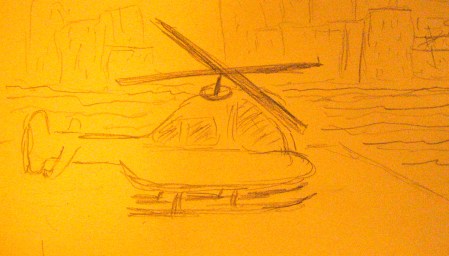
Helicopter

Helicopter

Thinking of Sergeant Bergdahl and T.V. Commentators

I grew up in the sixties when
the phrase was born,
so I can tell you that
“my country right or wrong” was not
the song of the young, but a croaking ode, reconstituted
beneath flat garrison caps, over
flapped bellies,
while the young, the young–vibrating
like reeds that whistle high
and scrape by low, the young–
for whom life is, for a while,
a succession of first times–
voice varying measures–

So, why don’t you made-up faces on television
talk about the 50,000 U.S. soldiers who deserted
the European theater, World War II,
the 100,000 Brits?

Men, riddled
by bombardment (part of the war package),
who slipped, stunned,
from their own sides’ guns, tried to stowaway
in blanks,
to secrete their crazed selves
from crazy;

men, who wanted, with unforetold
desperation, to fold their arms
on a kitchen table nights,
the room lit yellow
as a lantern in July,
only curtains ruffling,
the animals outside
not human–

I’m not saying
they should be honored,
only that your sacred cows,
the shibboleths sprouting
from your lip-glossed mouths
are highly tippable, unlike
the real kind, those still, sound, beasts
who will stand through wind and storm, their bones
propping wayward tents in their hides,
their soft dumb eyes aware in every stare
of the world’s perverse
complexity.

Something solid.
Which brings me back
to love of country,
love of
my countrymen,
right or wrong,
of thee I sing.


*********************

This is very much a draft poem, way too long, written for a “get listed” prompt by Fireblossom (Shay) on With Real Toads. I’ve edited it since posting as well.

I refer in the poem to a recent history by Charles Glass, The Deserters, A HIdden History of World War II, that reports 50,000 U.S. troops deserting from the front (a  fairly high number given that only 10% of U.S. troops involved in World War II were in combat.)   Those in combat were kept for terribly long and arduous tours, probably what caused the breakdowns  The larger number of deserting British soldiers–100,000–relates, it seems,  to the longer period of war for the British.  There were far fewer defections on the Pacific front, in part because the battles were on islands.  The desertions were very little spoken of during the war as discussion of this was thought to weaken morale and to give comfort to the other side.

According to Glass, there were a number of desertions where a man would wander off sometimes just for a few days, and then after some emotional repair, find his way back to his unit.  Apparently, front line soldiers rarely turned in the name of a deserter; if a deserter were reported it was by someone from the rear echelon.  A very interesting interview of Glass can be found here.

In terms of Bergdahl–I confess that I’ve only read aspects of the case. (I don’t have a TV, so my main knowledge is from written news sources.)  However, I am appalled at the rush to judgment.

I seed and I believe (writing poems)

June 3, 2014

20140603-225836.jpg

I seed and I believe (in writing poems)

It’s like planting
an echo.
I set down in rows, words–
they want to be heard,
to sprout sounds that will carry,
to wind their way
to some stray mind, to say
I’m here–
and for that mind to reply
oh, there you are–
somehow grounding us both–
those words flying
through pleine air-
propelled at times
by the kickstart
of metered feet,
other times just flapping
for all they’re worth.

*******************
Draft poem for Shanyn’s prompt on dVerse Poets Pub about what we’d like our poems to seed.

After discovery/confession/wearing-off of charm

June 1, 2014

After discovery/confession/wearing-off of charm

The thorns are everywhere
and sharp,
as if for one hundred years,
she’s slept.
No place to turn
without pain.

He lies next to her, still,
sheet pulled over
one shoulder,
only, she thinks, the sleep is feigned;
perhaps his eyes
aren’t even closed.

This is not a bed
of roses.


*****************************

Here’s a poem of sorts inspired by the suggestion of “M” of the Grapeling blog, to write a poem based upon my process notes for “Rosa Multiflora Gore.”  The note is the first two lines of this poem.  The poem does not in anyway reflect my current state of mind (!) but it’s what came up thinking about the line. I am also linking to dVerse Poets Open Link Night, hosted by Mary. 

Rosa Multiflora Gore

May 31, 2014

20140531-143536-52536097.jpg
Rosa Multiflora Gore

Sometimes, I feel a curmudgeon
bludgeoning bush, butchering
blood-red boughs,
snipping grounded throats, clippers straining
at my hip–
but this green deserves
demonizing,
an invader–

So, despite sure wounds,
I wage the losing war, wade in,
lending my mettle
to soft-speared grass, show-spiked
dandelion,
Queen Anne’s Lace, my liege.


*******************************


Rosa Multiflora, also called rambling rose, is an invasive species that has moved into my area of the Catskills.  The flowers are actually incredibly pretty and fragrant too, but it would, if it could, crowd out all the native plants, and make fields one big thorn bush (a  Sleeping Beauty mid-nap kind of landscape.)  Every once in a while, I undergo battle against it.  (The thorns are everywhere and sharp.)

The poem with title (and even hyphenated words, counting as two–HA!) is exactly 55 words–it was written for Hedgewitch’s Flash 55 prompt on With Real Toads.  (As pretty much always, all rights reserved on text and drawing. )

Trip (Part of the Underside)–Italy ’65

May 30, 2014

Sketch2

Trip (Part of the Underside)–Italy ’65

We dried our underwear
up and down the Riviera.
It waved, not from the boot
of our car but the lip
of its sunroof,
the tourist’s multi-furcated flag (skirt-hanger), ironically
for the Sixties, one of surrender,
pretty much all
white cotton.

We lost a bra once, straps flapping free
on a mountain curve’s swerve–bigger things to think about–
trucks–
than even my mom’s
double b–

lacing our way by the sea
except those times my dad missed
the turn-off, the day then passing
in granite and abyss, gray-faced–

So, what kind of artist
does that make me?
Thinking of underwear?

Though, I also remember
greened-
metal ribs, the patinaed squibs
of deified beard,
the vast muscled heights
of the Sistine,
the surprise of
its many white triangles
(so very like
that underwear
that never quite dried
hotel nights–
we’d packed
pretty light–)

the dark reflections (agony)
of the Pieta,
the foot of some saint smoothed
to a sliver of soap–pilgrims–
the sunburnt eyelids of so many many
tiled roofs–


**************

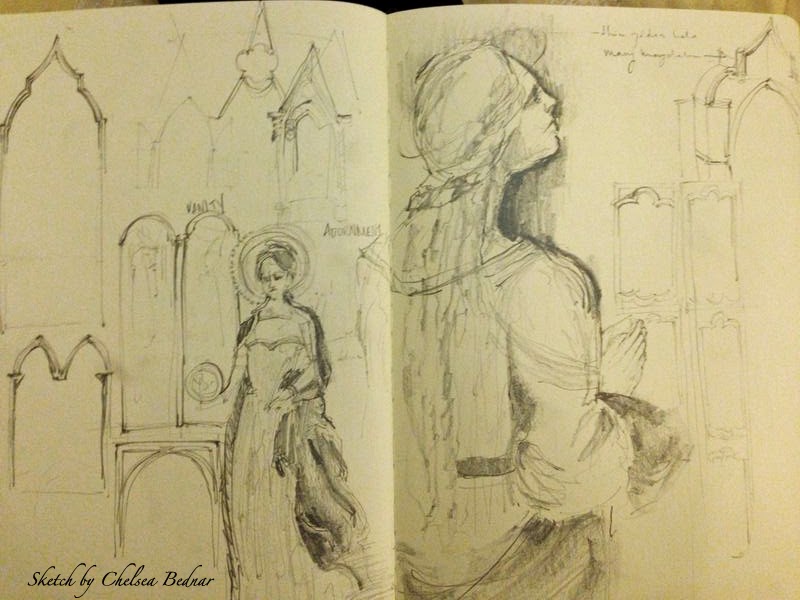
Another draft poem of sorts–I say draft because it is so hot off the press–for the Real Toads prompt of Margaret Bednar to write a “sketch book poem.”  Margaret posts wonderful drawings by her daughter, Chelsea, who is now studying in Italy.  I include a sketch by Chelsea Bednar above.   (This has been edited since first posting.)