Archive for February 2010

Bella and Sookie, Edward Cullen, Bill Compton- The Lines Are Drawn

February 9, 2010

Read yesterday about the upcoming first run publication of 350,000 copies of the new Twilight graphic novel.  “The characters and settings are very close to what I was imagining while writing the series,” Stephanie Meyers, the author of the original Twilight series has said of the graphic novel.  (Does this mean that Ms. Meyers always pictured the characters and settings as cartoonish?)

Okay. Stop.  Guilty confession time.  As followers of this blog know, I wallowed in the Twlight series.  I have also, more recently, wallowed in another vampire series—The Southern Vampire Series by Charlaine Harris, also known as the Sookie Stackhouse Mysteries.

(What can I say?  I get tired, manic, depressed.)

Which brings up another question.  Why is the Twilight Saga (whose collective sales have now reached 45 million) so much more popular than the Southern Vampire Sookie Stackhouse Series?

(Don’t get me wrong.   Charlene Harris is unlikely to live in a garret.  Still, 45 million!)

What makes the difference especially remarkable is that the two series have enough in common to make a vampiric copyright lawyer lick his blood-stained chops.  Both focus on a human-vampire love story; both share telepathy, characters whose minds cannot be permeated by telepathy, super-handsome, super-sexy vampires (well, Edward Cullen is sexy in principal at least), shape-shifters/werewolves, love triangles,  heroinic (as in both addictive and held by the heroine) special blood, attempted suicide through sun-stepping, a ruthless vampire hierarchy, controlling and hyper-jealous male lovers, and fast, fancy cars.   Most importantly, both series have spawned commercially-successful screen versions.

So what makes for the phenomenon? (Other than the casting of Robsten.)

First, there’s the teen factor.  Perhaps (believe or not) tweens and teens simply read more.  After all, they have parents who tell them to turn off the TV and the internet, and they usually don’t have full time jobs.

Then there’s the identification factor.  Bella Swan, the Twilight heroine, is herself a teenager. (Sookie’s in her early twenties.)

More importantly, Bella is presented as Every Girl—Every Girl who is cute enough but clumsy, and who also happens to have some nearly magical qualities (not even known to herself) which, in turn, attract a consummately handsome, devoted, rich, strong, elegant, vampire; a vampire, who, although insistently male (at least he insists he’s male), loves her for her essence, not her body; a body which he adores,  but which he heroically resists (sigh), both to protect her soul and safety.

Sookie is harder to identify with.  She is very much not Every Girl, but a cocktail waitress specifically based in Northern Louisiana.    She introduces herself in the first book Dead Until Dark as someone suffering from a deformity.   She’s also super-attractive.     (The way her mental abilities cause human suitors to lose interest in her well-built body is a bit like the pre-feminist tales of women who were told to hide their smarts if they wanted to hold onto a man.)

Sookie’s vampires, unlike Edward Cullen, have little high-minded hesitancy about sex (or about manipulation and violence.)   Moreover, Sookie’s vampires (i) don’t just lust after her blood but frequently bite her, and (ii) spend about half of every day actually dead.  (These qualities may well be confusing to a young adult reader.)

So maybe here’s the distinction:  Twilight characters are good.  Good.  GOOD.   Except when they are bad.  Bad.  BAD.

Hmm…  Is it possible that the qualities which  seem to make Twilight so popular are the same qualities that make it adaptable to graphic novel form?  (A world that can be drawn in black and white lines.)

Teenage girls, it seems, are idealists after all.  Idealists and Every Girl and lovers of the fantastical.
Meditation on the Subway – Ripple Effect – Not Quite Tulipomania

February 8, 2010


Subway Stillness

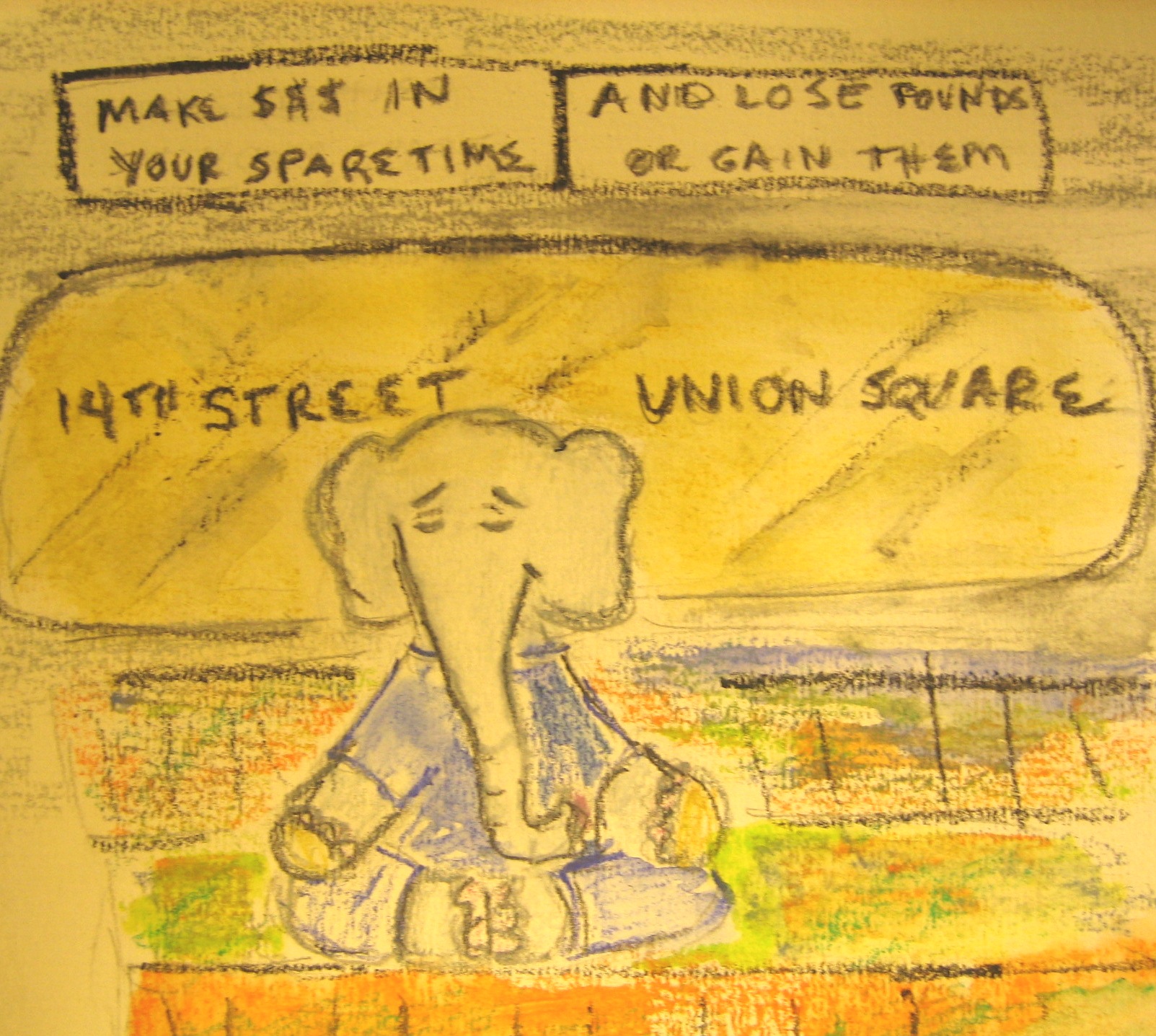
This morning as I sat on the subway I shut my eyes and focused on my breath.  I listened to the inhalation, then the exhalation; I felt the air creep up and down my nostrils.

I did not read; I did not write in my notebook; I did not check my Blackberry.

I felt my forehead loosen, my brain relax.  It was a bit like a too-tight ponytail gently being untied.  I felt too, or at least imagined, my newly-acquired peace radiating out to the entire train car.  (Miraculously, I did not check to see if this feeling was accurate.)

When I walked from my subway to my office, I kept quiet, still not checking my Blackberry, not talking on my cell, smiling in the cold February sunlight, conscious of the lines of granite against sky, the lines of spindly trees against sky, sky.   When I got to my building, I greeted people with genuine attention, catching the eye of the security guards I know without groaning about Monday, joking with my co-workers.  Later in the day, that same joking mood came back my way again.

I did all this because my eldest daughter has recently returned from her first meditation retreat.  Although I believe, at least on a theoretical level, in the benefits of meditation, I have not actually put these beliefs into practice for some time.

(Relaxation?  A glass of wine in the evening in so much easier.  Self-awareness?  Multi-tasking is so much less painful.)

But my daughter recently returned from her first meditation retreat with face fresh, eyes glowing, and an extended radius of appreciative awareness.  And so I went “hmmm…” (if not “om”), and tried for some stillness.

This is called the ripple effect.  Granted in my case, it was a pretty small ripple, still the water shifted.

We all know about word-of-month, trends, Tulipomania.   The transformation of ripples into waves is faster than ever in our computer age (although frankly some of the virtual waves are a bit on the shallow side.)  Word of mouth used to require one person to talk to another and then another and then another in a combination that was exponential but still essentially sequential; but the internet allows for word of mouth times ten.  Click, click, click, and soon thousands of people may be reached.  (Hopefully, not in one of those chain letters.)

At the same time, one’s voice can feel dwarfed by all the chatter.  And if one’s voice is dwarfed, one’s silence is absolutely crushed.  All that buzz makes what’s beneath the buzz both unheard and unhearable.  You can literally not hear yourself think; or worse, all you can hear is yourself think; and all you can think about amounts to so much twittering, so many pip-tweets.

And in the midst of the clicking, the thinking, the tweeting, one can also forget the power of the personal ripple effect; the wonderful contagion of face-to-face quiet, listening, smiles.

3-Ton Manning

February 7, 2010

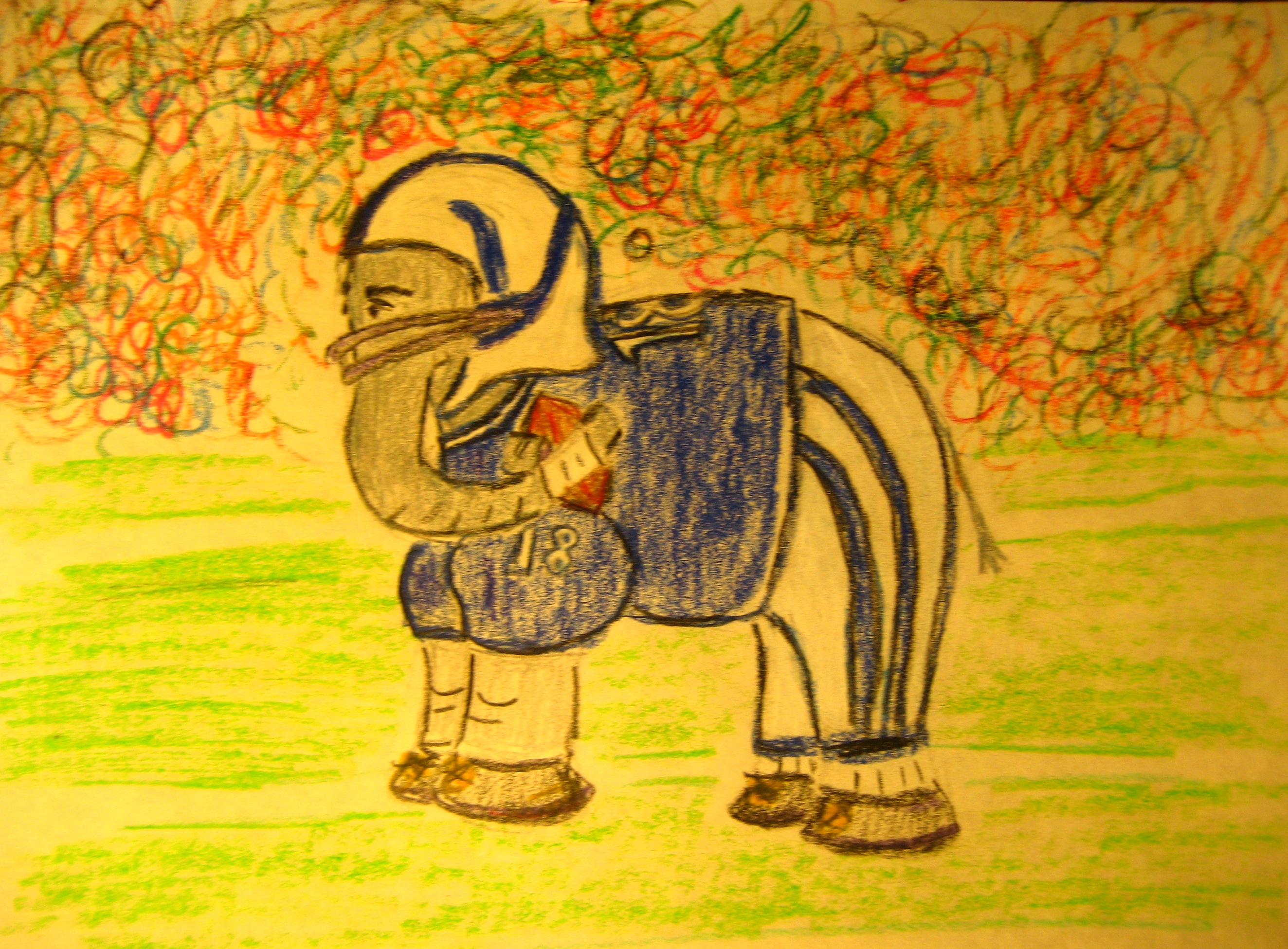
Peyton Manning as Elephant

Despite the drawing, I have to confess that I’m not much of a football fan.

I’m not sure that I’ve ever watched a full game.

Oops.

Maybe this (the middle of the game)  is not a good time to write that.

I do understand that this particular game is an exciting one.   I did miss a whole bunch in the middle, but as I write this, there’s just one point between the teams.  (Beginning of 4th Quarter.)

Still, well, there are an awfully lot of commercials.  Which are not really that great.  (Okay.   Yes, I just might go take a course in Paris soon.)

And who knew that The Who still performed?  Or were pyromaniacs?

Oops…  Just look up to see Saint intercept, run down field pointing his finger in triumph.   I’m happy New Orleans is happy.

P.S.  I do not mean to cast any aspersions on Peyton Manning by calling the elephant 3-Ton Manning;  only pointing out that if, in fact, Manning were an elephant, he would weigh at least three tons.  (Or more.)

Jon Stewart On O’Reilly – Fending Off the Rudeness and Hypocrisy Factor

February 6, 2010

Energized by anger today.  Well, anger, a good weekend night’s sleep, four or five cups of strong tea, and chocolate rice cakes.

Part of this comes from the recent Jon Stewart interview on Bill O’Reilly’s the O’Reilly Factor.   (Note—you have to pay to watch it on O’Reilly’s website, but it’s free on the Fox News site.)

I don’t much like Bill O’Reilly.  I don’t much like any news opinion show.  To tell the truth, I don’t much like TV news.  (Make that TV.)   So, it’s difficult for me to watch these things.

Part of the problem is that I’m not used to so much rudeness.  Stewart, the ex-stand up comedian, is the one you would expect to be profane or interrupting, but he is polite, amicable.  Although he’s certainly not a pushover, he does not lower himself to O’Reilly’s barrage of dismissive and reductive ridicule.

The other part of my problem with watching is my own rudeness.  I have a nearly uncontrollable urge to hiss things like ‘a——————‘ every time O’Reilly opens his mouth.

I did stay quiet enough to focus, however.  This is partly because Stewart clear, as well as engaging, made points which have not been adequately stressed by the more mainstream, and less comically-gifted, powers-that-be.  (Caveat– I’ve modified Stewart’s points somewhat while trying to stay within their spirit.)

First, Stewart noted the issue of hypocrisy–all the conservative commentators (and politicians) who screamed treason at any criticism of George W. Bush, while commander in chief of a nation at war, who now treat Obama as if he were not even a true U.S. citizen.

Secondly, there’s the issue of hypocrisy:  all of the conservative commentators (and politicians) who allowed Bush to spend and untax the country into the biggest deficit in history who now call themselves fiscal conservatives.

Third, there’s the issue of hypocrisy:  all of the conservative commentators (and politicians) who allowed Bush to spend, untax, deregulate, and ignore, the onset of the biggest financial crisis since the Great Depression, and now blame it on Obama.

Fourth, well, you know, hypocrisy—all the conservative commentators (and politicians) complaining about a lack of bipartisanship who filibuster even relatively low level appointments.

(There is a ton more that could be said about hypocrisy and O’Reilly personallybut I won’t go into that here.)

The American people, unfortunately, seem to expect miracles.  They seem to believe that Obama should be able to undo years of damage, in a few swift strokes.  Fox news encourages this view, while at the same time making a huge outcry when Obama undertakes any stroke at all.

The conservative media feeds a notion that only one basic change is necessary—the poof! disappearance of our problems. They foster the notion that this change could happen by, as Obama put it in the State of the Union, simply continuing the same policies that got us into this mess;  they (crazily) imply that Obama caused the damage.  (I would remind them that Lehman Brothers fell in September 2009.)

A repair with no actually fixing involved.  Wouldn’t that be nice? It’s sort of like the idea of a country waging two expensive wars while cutting taxes.

BackStroke Books was founded in 2009 by Karin Gustafson. Karin lives in downtown Manhattan, with a dog, husband and, occasionally, two grown daughters and a variety of nephews. They all give her lots of ideas, especially the dog.

Karin writes poetry, fiction and the ManicDDaily blog. She also draws pictures. These are, currently, mainly of elephants, but Karin is slowly branching out to other species. (Her dog thinks that’s a very good idea.)

“Truest Love” Poem – Dog is What Spelled Backwards?

February 5, 2010

More in honor of trust and dogs.

Truest Love

The little dog lay on its back
in the semblance of
truest love.
The woman, leaning in from above, ignored
stained whiskers and breath like fish,
in the semblance of truest love.

The little dog exalted when she came home
as if she were its dearest wish,
the answer to heart’s prayer.
She said, ‘hey there,’ and stooped
to capture some wriggle.

The little dog saw her as
itself spelled backwards;  she
accepted the role, thankful that
some being had finally taken
due note of her
existence, ignoring
breath like fish.

All rights reserved.  Karin Gustafson

In Honor of Trusting (And Smiling) Dogs

February 4, 2010

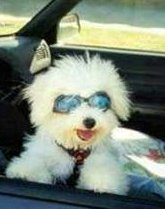
Pearl (Photo By Theodosia B. Martin)

The last couple of days I’ve been writing and thinking about the deficit of trust in government.  In the midst of this, I somehow got onto the topic of the trust shared between my dog, Pearl, and myself.

One reason that Pearl trusts me so much is that I was not the one to put goggles on her (above) and photograph her.   (That’s a joke, photographer Theo Martin!)

One reason that I trust Pearl so much is that she is cheerful and loving even when wearing silly goggles.

Some scientists refuse to attribute a complex emotional life to animals.  These, it seems to me, are very dogmatic scientists, and not very good observers of the natural world.

On the other hand (and there’s always another hand), some animal owners attribute a complicated array of human strategems to animals which, frankly, trivialize the animals’ specific and particularized intelligence.

Those are topics for another ManicDDay.   This post is really just a human strategem for posting Pearl’s picture, above, and the video link here, which was received by me in a moment when it was hard to trust in the goodness this day would bring, but which made me smile.

Dogs can do that.

Deficit of Trust in Government – The Difference Between Coke and Pepsi

February 4, 2010

Continuing to think about the deficit of trust in government.    (See prior post.)

Part of the problem (aside from a pusillanimous, self-interested congress, the unfettered flood of special interest moneys, and periodic out-and-out scandals) is that many people’s day-to-day interactions with governmental institutions have an unpleasant aspect–taxes; speeding tickets; waiting at one of those blinking yellow lights for an endless road repair; the Post Office, which, if not exactly unpleasant, often involves lines, and a high background level of frustration.  (The phrase “going postal” did not arise out of a void.) 

Then too, there’s seeming arbitrariness of government — the perception that some people unfairly get benefits while others are denied. 

Which brings us to the judicial system.   I happen to be someone with faith in the U.S. court and justice system.  I believe that it is (more or less, fundamentally, at least in principal) sound (certainly compared to many other countries.)    But its high costs combined with its power and political underpinnings can make its verdicts both terrifying and burdensome.   When they are eventually delivered.  It tends to have a velocity equivalent to molasses in a snow storm.   (Extremely expensive molasses, a very long snow storm.)   A  friend of mine living in Queens has recently spent over eight months and thousands of dollars in legal bills evicting a tenant who never paid a single dollar’s rent.  

I’m not writing here about judicial reform, or nuisance suits, or even unscrupulous lawyers.  I understand that many landlords perpetrate horrible abuses on tenants.  (I’m a tenant.) 

The point is that these factors engender an instinctive distrust for all government, not simply the difficult parts.

Unlike corporate brands, which people readily differentiate, with clear preferences for either Coke or Pepsi, Burger King or MacDonalds, Toyota (oops!) or Ford, many seem to conflate different levels and types of government–federal and local government (where money has especially undue influence), the  executive, and judicial branches, the state trooper and the FEMA social worker, the random INS or TSA worker and Obama himself. 

It’s a problem that can only be solved by individual effort; all involved (both workers and citizens) genuinely trying to do better.  

I’m not holding my breath.

Deficit of Trust in Government – How To Carry An Old Dog Downstairs

February 3, 2010

Obama and other politicians speak of “a deficit of trust” in governmental institutions.

I have a little, old, dog.  She is little enough and old enough that I generally can (must) carry her through the halls of my building, and out through the small back yard, until we get to the public sidewalk, before I can put her down without fear of prohibited incident.

I carry my dog on this journey like a baby, legs up.  She is incredibly passive in my arms, motionless through the bounces of the few flights of stairs, through the turns in the hall and yard, through the plunge into the frigid winds of lower Manhattan. Her stillness seems to reflect an absolute faith that, as her person, the one who feeds and shelters and takes care of her, I will do the right thing by her, carrying her to her appointed spots, not dropping, dislodging, or otherwise discombulating.

People are not really like dogs.  (Some may find this unfortunate.)  Yet the bases for trust are similar—a relationship or experience of a person or institution that gives rise to a feeling that the trusted one is competent, well-meaning, and that the relationship is beneficial, even necessary,  for the trustor’s well-being.

A belief in competence is paramount.  My dog is downright wiggly in unsure hands.  Babies are often like that too, fussing and crying when they sense inexperience.

Many adults do not seem to have an innate gauge of competence.  (Many voted for George W. Bush, for example.  Twice.)   Still, they must, at least, believe in competence.

Integrity’s important too, a lack of scandal.  But integrity is really a part of meaning well, of the trusted one looking out for the trusting.

Then there’s the question of benefits.  And necessity.  My dog (children too) trust me even when I have to do painful things to them, such as cleaning that yucky eye hair (that’s in the case of my dog), in part because they have been  acutely aware of all I have provided– food, shelter, college tuition (that’s in the case of my children).  It’s not as if the benefits are a quid pro quo for the painful treatment;  it’s more that the benefits somehow prove that the painful treatment is not arbitrary or mean, but a necessary part of taking care.  (Different versions of trust based on necessity/desperation arise in the case of a plumber, doctor,  accountant.)

Because benefit/necessity is so important to  maintaining trust, it’s difficult to understand how government can engender it simply by cutting taxes.  For trust to be felt, value must be provided, not just reduced expense.

Of course, the urge for endless tax-cutting arises in part because of a disbelief in government competence.  Then too, many refuse to believe that government benefits reach them.  (These kinds of people shout that the government should “keep its hands off their Medicare.”)

Others simply don’t see a need for government.  (I don’t know how these people plan to provide for fire departments, child labor laws, clean air and water.)

What to do?   In order for a “deficit of trust” in government to be filled, people have to be convinced that a more secure, stable, educated, and unpolluted society is a particular benefit to them, a necessity for the future, and something government is capable of helping to provide.

A tall order.

Of course, getting rid of the scandals would help too.

What’s Up With Robert Pattinson? Cartoons? Elephants? Is It All Just Coincidence? Hmmm…..

February 2, 2010

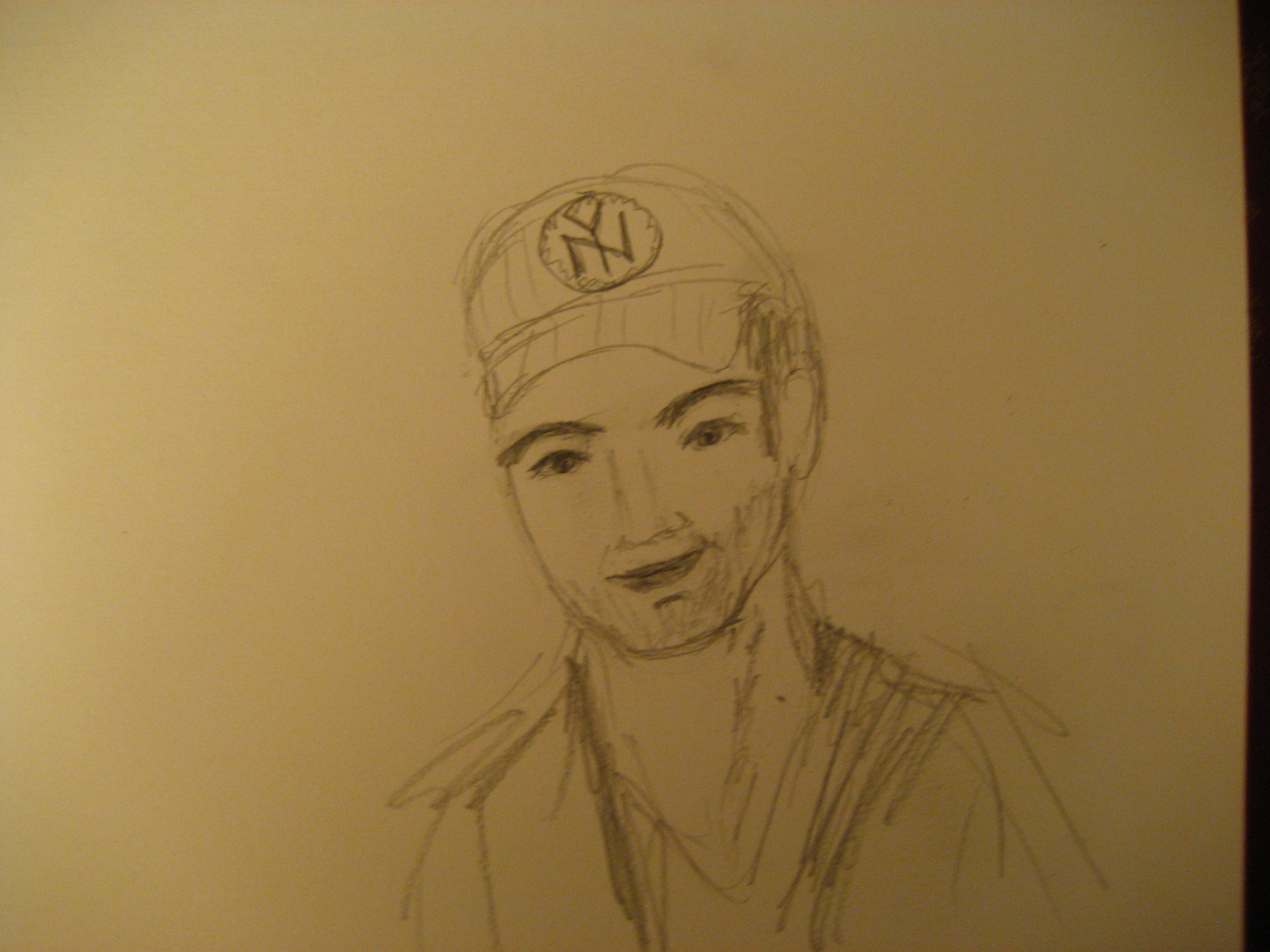
Rob Pattinson With Beard

Every once in a while, one is lucky enough to have confirmation that one really does exist in the world, and that, despite all evidence to the contrary, the little pebbles of one’s actions create ripples that are more extensive than one could ever have projected.

The confirmation of my particular ripple effect has come in the convergence of two extremely newsworthy events:

1.  Robert Pattinson is the subject of a new biography written in cartoon form for Fame magazine, and

2.  Robert Pattinson is  slated to star in the film Water For Elephants to be directed by Sean Penn and supposedly to be shot in upstate New York this summer.

Ahem.

I humbly submit that this blog has long combined writing about Robert Pattinson with

(i)  cartoonish depictions of same;

Rob Pattinson With Yankees' Cap

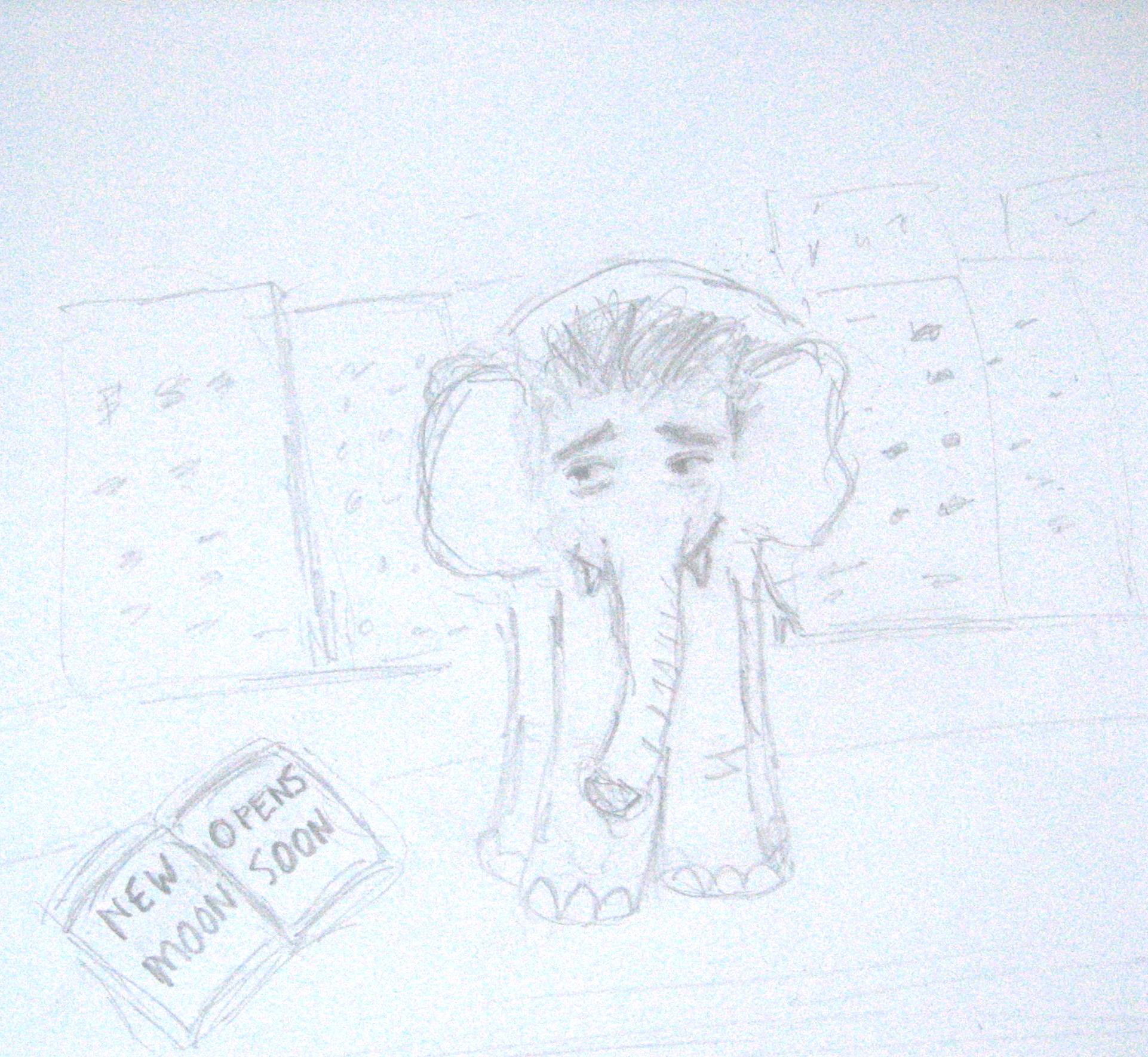
(ii)  elephants,

Vampire Elephant Contemplating New Moon

and (iii)  a dash of upstate New York (also with a couple of elephants).

A Couple of Elephants in the Catskills

The coincidences just mount up!

Coincidences?  Hmmm…..

Further investigation may be required.

Further Investigation

Rob–if, in fact. you are reading this, give me a call!

For more Pattinson, check out the Robert Pattinson category on the home page of this blog;  for more elephants, check out the elephant category.  And, for even more elephants, check out 1 Mississippi by Karin Gustafson on Amazon.com

Back To The Grammys Briefly – All Buff, Pink Singing Sideways (In the Shower)

February 1, 2010

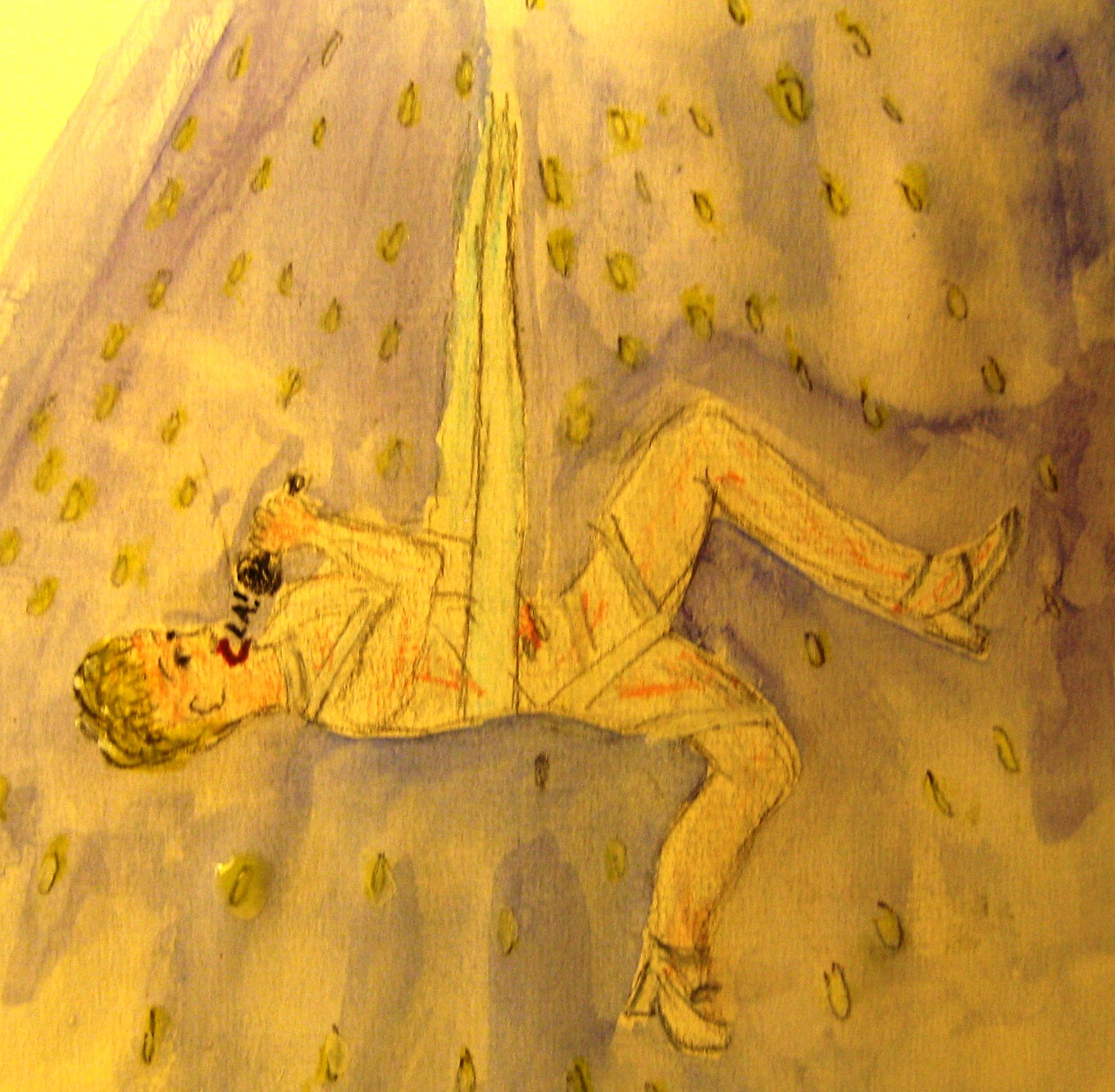
Pink (Sideways) Under Sprinkler System (New Take on Singing In The Shower)

I never watched the Grammys before Sunday night.  I still have never watched the WHOLE Grammys.  (I wonder why.)

When did singers begin needing biceps as large as breasts as standard equipment?  (Sorry to be crude.  The Grammys tend to bring that out in one.)

Hard to imagine Judy Garland with biceps.  (Instead of shoulder pads.  See e.g. Judy in For Me and My Gal.)

Singers have long been good dancers.  (Imagine Judy Garland.)  But when did they have to become gymnasts?  (There was, I guess, Fred Astaire on the ceiling.  But I always thought that was a camera trick.)

Sometimes it is not hard to understand why much of the world (particularly the non-Western world, the muslim world) disdains (that’s putting it mildly) Western pop culture.

Yes, there’s a kind of verve.   Singing sideways under a sprinkler system is pretty amazing.  And the muscle tone is pretty darn spectacular.  And all the participants seem to clap for each other with admirable generosity.   Still, well….