Posted tagged ‘manicddaily’

Incredulous In Florida

September 12, 2009

I am in Florida today which is an amazing change from downtown New York City.  For one thing, the 99% humidity rate is breathed rather than falling all around me.  Windows are shut tight, inside air is refrigerated and people stay in that air, by and large.  (At least, the only other people who stood or sat outside at the airport, where we waited for our car service, were smoking cigarettes.)

And then the guy who picked us up–a very nice, young, friendly, helpful guy, who really did not seem in any way a nut job (at least I didn’t worry that my life was in his hands as he drove us down A1A)–compared Obama’s proposals to those made by Hitler in Nazi Germany.  (Granted this was towards the very end of our ride.)

People in Florida are extremely nice, friendly, helpful.   This guy seemed another one of these nice, friendly, helpful types.

Who turned from the steering wheel to ask me whether I realized how much Obama’s civilian corp was like the S.S.

He was friendly enough to genuinely not mind our heated argument both before and after these comments.  He did not take offense at my use of expletives.

He talked about studying facts.  (I do not believe these included facts about Nazi Germany.)

He, like Joe Wilson, spoke of Obama as a liar.  When I asked him to give me an example of a lie, he couldn’t actually come up with one.  (I should have given him advanced notice he said.)  Finally, he said, well what about statements that the health care proposal would not cause cuts in Medicaid.  I said that Obama did talk about cutting waste in Medicaid.

Then he said, oh yeah, and what about Bill Ayers?

We both complained about the lack of personal responsibility in the culture.  I mentioned that Obama also stressed the importance of personal responsibility.

But he had a hard time hearing that, given Obama’s exchange with the Joe the Plumber.  He was very upset at the way that Joe the Plumber had been treated, by the way, which he seemed to view as treatment meted out by the Obama administration.   I mentioned that Joe the Plumber seemed to have landed a job as a news correspondent.

I do not want to make fun of the guy.  I liked him, even as I yelled at him  (in a motherly way).  And he, in a sheepish way, seemed to like me (though since I was also the paying customer, this is a bit hard to assess.)

But the experience genuinely shook me.   I had not realized how very far from home I’d come.

Last Villanelle for a While Re Aftermath of 9/11

September 11, 2009

Anyone who reads this blog is probably heartily sick of villanelles.  Sorry!  But here’s one more–re the aftermath of 9/11.   (

Sorry, sorry, sorry.

I do write non-villanelles.   And, while this is not the last villanelle I’ll post, I promise that it will be the last for a while.  (Future posts will also be more cheerful!)

Shattering

The shattering of lives should take some time.
It shouldn’t come in flashes, clods of dirt,
no moment for altered course, for change of mind.

The actual choice ahead should be well-signed,
the frailty of good luck, a blood-soaked shirt;
the shattering of lives should take some time.

He knew that road was risky, heard a whine,
but in the end those warnings were too curt,
no moment for altered course, for change of mind.

Hard to foresee your own true body lined
with metal plates and plastic tubes of hurt;
the shattering of lives should take some time.

So many hours after to refine
what happened in that second’s blinding lurch,
no moment for altered course or change of mind.

Or was it fate?  A studied path, not whim?
His heart tried hard to measure out the worth
of shattering lives.  It would take some time,
without moment for altering course or mind.

(All rights reserved.  Karin Gustafson)

9/11 (Villanelle)

September 11, 2009

9/11  (Villanelle)

The burning buildings woke me from a sleep
of what I thought important, nothing now.
I ran hard down the smoking, crumbling street,

praying that my child was mine to keep,
dear god oh please dear god I whispered loud;
the burning buildings woke me from a sleep.

Some stopped to stare, all of us to weep
as eyes replayed the towers’ brutal bow.
I ran hard down the smoking, crumbling street.

North sky a startling blue, the south a heap
of man-wrought cloud; I pushed against the crowd;
the burning buildings woke me from a sleep.

I’d never complain again, never treat
with trivial despair–or so I vowed.
I ran hard down the smoking, crumbling street.

I’d change, give thanks—I saw them leap—
and begged for all the grace God would allow.
The burning buildings woke me from a sleep;
I ran hard down the smoking, crumbling street.

(All rights reserved.  Karin Gustafson)

P.S. This is an old post, and an older poem, written shortly after 9/11/01 – but I am linking it to Victoria C. Slotto’s writing blog liv2write2day .

Inspiring Evening – Obama, Jeter, Jobs

September 9, 2009

9/09/09

Inspiring day/inspiring evening:  Obama delivers great and moving speech about health care.  (I never wanted this blog to be political, but when I hear Obama speak I can’t help but be appreciative.  How did we get so lucky?)

Jeter ties Lou Gehrig’s seventy-year record for hits as a Yankee.   (I don’t know enough about sports to blog about them, but when I see Jeter at bat, I can’t help but be appreciative.  Hurray, New York!)

Even Apple had something to contribute, with Steve Jobs making an appearance at an Apple conference, gaunt after his recent liver transplant, but full of sober gratitude.

I’m not in any way comparing the impact or importance of these events.  But there was something tremendously satisfying, even thrilling, about watching the footage of each of them,  all on the same evening.  Three guys doing their jobs so very well, but also with a workmanlike humility (even Steve Jobs);  three guys waiting through standing ovations, clearly moved at moments, then simply pushing ahead.   (Obama was probably a bit less moved by the ovations than Jobs or Jeter, the standing of congressman a form of literal posturing. )

Jeter’s modesty was especially impressive as he arrived at first base and  immediately bent to take off his shin protector.  Then, he seemed to quietly thank Tampa’s first basemen (who must have congratulated him), and then he simply waited as the crowd roared, twice raising his helmet, gently licking his lips, for the game to go on.

Jobs actually spoke of games in his interview, describing one of the new iPods as a video game device.  (Agh.)

And Obama, thankfully, delivered an opposite message, that the games about health care must stop.  (Though I was happy to hear him say it, I won’t hold my breath.)

9/09/09

Final added note:  I really hope that the substance of Obama’s speech does not get drowned in endless media discussion concerning the rudeness of  Republican Joe Wilson.     Unfortunately, 0ne can already hear it becoming the diversionary topic of the hour (or many many of them).

Villain-elle (With Elephants)

September 9, 2009

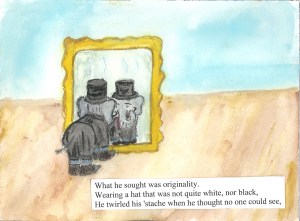
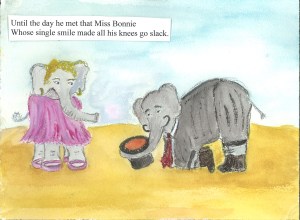
Villain-elle

#1A

2A

3A

4A

5A

6A

7A

8A

Here’s what the poem looks like in unillustrated (stanzaic – is that a word?) form:

Villain-elle

He twirled his ‘stache when he thought no one could see
and kept away from rope and railroad track,
for a cartoon villain was not what he would be–

what he sought was originality.
Wearing a hat that was not quite white, nor black,
he twirled his ‘stache when he thought no one could see.

Until the day he met that Miss Bonnee
whose single smile made all his knees go slack.
Though a cartoon villain was not what he would be,

she steered him to a classic robbery,
a bank heist with a gun, a car out back.
He twirled his ‘stache when he thought no one could see,

but see they could, if only digitally.
She whispered, as she relieved him of the sack,
that a cartoon villain was not what he would be.

‘My hero’, she sighed, and other fiddle-dee.
Then his bent head received a good hard whack.
She twirled her stash when she thought no one could see.
A cartoon villain was not what she would be.

(@ Karin Gustafson, 2009)

If you are interested in more Villanellia, check out prior posts re how to write them.

If you are interested in elephants, check out 1 Mississippi at link above.

Sticking To Villanelles (For Today) – How To Write Them

September 8, 2009

A lot of things seem to be a bit stuck right now (at least to me) or moving in molasses motion, i.e. health care reform, opposition to Obama’s verbal waylaying of U.S. school children (ridiculous!), even the ever reliable Derek Jeter.   People running in the Democratic primary in New York are calling me every other minute, and I can’t rouse the energy to even listen to their messages.  (Not even the one from Ed Koch!)

Yesterday, I promised to continue to blog about villanelles, but frankly, this stuckness made the prospect about such an arcane, “out-of-the-loop” subject seem trivial.   Surely, I thought, there had to be something more exciting I could come up with.

Then, I walked home past Ground Zero—I live in downtown Manhattan—through all the barricades that are already set up in preparation for Friday, stepping between the policemen, already manning those barricades, past the cranes and lights and dirt pit, and, suddenly, blogging about something as possibly boring as how to write a villanelle really didn’t seem so terrible to me.

I also believe in keeping promises.

So:

How to Write a Villanelle:

The most important tip I can give to anyone writing any formal verse is to feel free to cheat.  For example, if rhyme is required, don’t worry about not being able to come up with perfect ones.  Use “almost rhymes” or “slant rhymes”  (that is, “not quite rhymes”).  Besides giving you more words to choose from, this will keep the poem from being so sing-songy.

If repeated lines are called for, as in the case of the villanelle, don’t worry if you have to vary them a bit, that is, if your repeating lines don’t in fact exactly repeat.   Remember that meaning always trumps form.

It’s helpful to think of the form as a kind of a map, a means to music.  It’s useful to have all the streets laid out, but occasionally, when you want your poem to actually reach a destination, you have to cut through some back yards.

The only place where I think cheating can truly backfire is with rhythm.  Your lines don’t have to scan exactly, but if they are really off, the poem just won’t sound well.  Respecting rhythm does not mean that you have to be stick to iambic pentameter, but some attention to line length, numbers of feet or syllables, should be paid.

All that said, you can’t cheat till you know the rules.  Here are the basics:

A villanelle is a seven stanza poem, that works with rhyme, meter and repeated lines.  There are two lines that repeat through the poem;  they also rhyme with each other.  For notation purposes, I call the first repeated line “A1” (like the steak sauce) and the second repeated line “A2” (not to be confused with the Pakistani mountain).   (Under rules of poetic notation, these are both referred to as “A” lines because they rhyme with each other, the “A” rhyme.)

Other lines which rhyme with A1 and A2, but which are not the repeated lines, are denoted below as just plain “A”.

The remaining lines of the poem, which do not rhyme with the A lines, but which rhyme with each other, are denoted as “B”.

Here’s the basic form:

A1
B
A2

A
B
A1

A
B
A2

A
B
A1

A
B
A2

A
B
A1
A2

An “easy” way to remember the form is that the all the stanzas. except the last one, have three lines.  The first one begins with your A1 line and ends with your A2 line;  the next four stanzas are in a kind of order with the first ending with A1, the second A2, the next A1, the next A2 again.  (It’s sort of like shampooing your hair—”wash, rinse, repeat.”)  The B lines intersect each stanza (sort of like a basting stitch.)

The last stanza has four lines, ending with a couplet made up of A1 and A2.

It sounds a lot more complicated than it is.  As mentioned in yesterday’s blog re Villanelles and Banana Pudding, the great thing about writing a Villanelle is that you really don’t need to come up with all that many lines.  You do need to think through your repeating lines though—to make sure that they are flexible, and also that they work as a couplet.

Ideally, you also want the meaning of the repeated lines to shift as the poem progresses, and not to simply repeat in a rote manner.  You do not want the repetition to feel formulaic, but somehow illuminating.

Punctuation can help here—it can be useful, for example, for the repeated lines to sometimes feed directly into the following line or stanza and not to always end with the pause of period or comma.

And of course,  cheating can be invaluable.  Shifting the words slightly, for example, so that the lines sound almost the same, but are a teensy bit different, can help your poem actually mean something.

If this is your first villanelle, pick relatively easy rhymes.  I also find it useful to list on a separate page, all the A rhymes and B rhymes that I can think of before I move on too far with poem.  I make the list in a completely dumb way, writing down every single rhyme or near rhyme I can come up with, without regard to the poem’s subject, simply to accumulate choices.  This sounds very “unheartfelt”, but such lists can really open up your thinking, helping you to come up with much more creative and meaningful combinations than you otherwise would.

Which brings up a final point.  Yes, the form is constraining, but the constraints force you out of your typical ruts.  To write a villanelle (or any formal poem), you have to work with something other than your normal brain patterns.   This seems, to me at least (Manic-D-Daily)  invaluable.)

Here’s another one of mine:

Burned Soldier (A Mask For Face)

He tried to smile but found that skin would balk;
a mask for face was not what he had planned.
Right action should give rise to right result,

saving the day as it called on God to halt
all burn and bite of bomb as if by wand;
he tried to smile but found that skin would balk.

When they talked of graft, he always thought of molt,
as if his flesh held feathers that could span
right action, then give rise to right result—

cheeks that were smooth but rough, but loose but taut—
it all had been so easy as a man.
He tried to smile but found that skin would balk.

Hate helped at times; to think it was their fault.
But how could “they” be numbered? Like grains of sand,
like actions that give rise to like result,

like eyes that fit in lids not white as salt.
This lead white face was not what he had planned.
He tried to smile but found that skin would balk;
right action should give rise to right result.

(All rights reserved, Karin Gustafson)

Villanelles – Banana Pudding

September 7, 2009

I love formal poetry, particularly villanelles.  I will write about the exact form (a traditionally French embrace of repeating lines and rhymes) tomorrow.  (I hope.)

Today, I’ll just say that the form itself generally ensures a villanelle a certain amount of built-in music and irony.

The form is a bit complicated, however.   So getting your villanelle to more or less follow the rules, and also to make sense, is often about all you can hope for. Profundity must be left to the sidelines. (Traditionally French, remember?)

My view is, well, who really cares that much about profundity when you’ve got built-in music and irony? (I don’t. But remember that I’m also someone who has spent a not insignificant amount of time blogging about Robert Pattinson.  See e.g. posts re same. )

Another reason I like writing villanelles (besides their music) is that I am fundamentally (or perhaps I should just say, mentally) lazy. This makes a villanelle kind of perfect for me because (a) as mentioned above, profundity is often left at the sidelines, and (b) the whole poem revolves around two repeating lines.  Which means that once you get your repeating lines right, you don’t have to come up with all that much else.

The poem also involves only two different sets of rhymes: the rhyme of your repeating lines and the rhyme for the intersecting lines.   This limited rhyme scheme definitely narrows your options, a great benefit for someone like me:  a narrowed field of choices means fewer places to get lost, side-tracked.

As I was thinking about all this on the subway this morning (hungry),  I realized that the seeming complexity (but actual simplicity) of the villanelle is very much like Magnolia Bakery’s Banana Pudding.

Although the dessert, a layered concoction of creamy custard, banana slices, vanilla wafers, and whipped cream, seems very elaborate, it is in fact made with a relatively small number of ingredients, several of which are prepackaged (as in the vanilla wafers and the bananas).  What the recipe does require, however, is planning;  i.e. your pudding needs time to set, your bananas must be more or less uniformly sliced (and not too soon before assembly); your cream whipped, your wafers unboxed.  Without that planning, the whole concoction is flat, runny.

Which is amazingly like writing a villanelle.  Because you really do need to spend a bit of time getting your repeating lines right, and choosing flexible rhymes. Otherwise it will just collapse.

But once you have your base ingredients ready, the assembly is really quite fun.

Unfortunately, villanelles, like many poetic forms, seem to have fallen from fashion in modern poetry. (I’m guessing it’s the whole profundity thing.) Some critics might even say that villanelles, like Banana Pudding, are essentially a Trifle. (As in an English confection of sherry-soaked cake, fruit, custard, cream.)

All I can say is that Trifle, like Banana Pudding, is pretty terrific stuff.

*                   *                   *

Despite the similarities to Banana Pudding, most of my villanelles are not particularly light and fluffy. As a result, I am re-posting one that I posted several weeks ago simply because it is one of my more cheerful, and suits the end of summer. I’ll put some different ones up later in the week.

The two repeating lines are “our palms grew pale as paws in northern climes” and “in summers past, how brightly water shines.”  Rhymes are based on climes/shines and skin.


Swimming in Summer


Our palms grew pale as paws in northern climes
as water soaked right through our outer skin.
In summers past, how brightly water shines,

its surface sparked by countless solar mimes,
an aurora only fragmented by limb.
Our palms grew pale as paws in northern climes

as we played hide and seek with sunken dimes,
diving beneath the waves of echoed din;
in summers past, how brightly water shines.

My mother sat at poolside with the Times’
Sunday magazine; I swam by her shin,
my palms as pale as paws in northern climes,

sculpting her ivory leg, the only signs
of life the hair strands barely there, so prim
in summers past. How brightly water shines

in that lost pool; and all that filled our minds
frozen now, the glimmer petrified within
palms grown pale as paws in northern climes.
In summers past, how brightly water shines.

Copyright 2008, Karin Gustafson, All rights reserved.

If you like elephants swimming, please check out 1 Mississippi at the link above or on Amazon.

For more on Villanelles and how to write them, click here.

Ten Reasons Not To Blog

September 6, 2009

Six weeks ago when I first started “ManicDDaily”, I wrote (as my third post) “Five Good Reasons To Blog.”

I still admit to neophyte status as a blogger.  (I have yet to fully investigate the varieties of graphics and the word “widgets” just brings up strange math word problems.)

Even so, I now have enough experience under my belt to understand a bunch of good reasons not to blog.   I list ten of these below:

1.  If the word “daily” is in your title, your blog will cloud your brain for a significant portion of every single day.  On a very lucky day, it’s the cloud of a brain storm.  On a frustrating day, it’s just a plain old storm cloud (without the brain part), in which you thunder at anyone (a child or husband) who threatens to disturb your computer time.  On a normal day, it’s more like a heavy fog, thick and unnavigable.

2.   The blog (which comes with “Stats” as to the number of views per day) provides a whole new way in which you can feel rejected.  A bad day can go right on the failed marriage, questionable career, dwindling stock portfolio heap.  It can bring to mind, with really uncanny vividness, particular manuscript rejection letters,  poetry contests lost, that boyfriend in law school who (unbeknownst to you) had a real girlfriend, and even all those 4th of July swimming pool beauty contests that your mom made you enter from age 6-10 despite your increasingly poor track record.

3.  A good day (lots of views) brings a certain zing to the old step, but it also raises the question of whether the credit is truly owed to Robert Pattinson.  (See e.g. numerous posts on same.)

4.  You suddenly notice that you never have any time to do your “real writing”.

5.  And what happened to all those cute little paintings you used to make?

6.  Your family would really really like you to make dinner before 10, at least 11.

7.  Your boss would really really like you to get in before 10, at least 11.

8.  Your body would really like you to have a bit more energy for the gym.  (The stationary bike was not actually meant to be a notebook and pen bike.)

9.  Your personal yoga practice could really use a bit more focus.  Breaking off mid-pose, repeatedly, to check on early morning “Stats” rarely leads to Nirvana.  (See e.g. Reason No. 2 – a whole new way to feel rejected.)

10.  Your dog would really really like your laptop, charger, electrical cord, and notebook, to stop hogging the bed.

    Poor dog.

    Write you tomorrow.

    For September 6th (On a Lazy Weekend)

    September 6, 2009
    Six, Count 'em, Six

    Six, Count 'em, Six

    Labor Day Weekend Sunday.  Ah.

    (If you like rafts and elephants and counting, check out 1 Mississippi by Karin Gustafson at link above or on Amazon.)

    Talk About Sanctimony

    September 5, 2009

    Talk about sanctimony.   See e.g. the N.Y. Times “Lens” blog segment called “Behind the Scenes:  To Publish or Not” by David Dunlop about the decision of the Associated Press to publish the photograph of a mortally wounded marine over the objections of his immediate family members.

    The photograph was part of a series by Julie Jacobson, a photographer embedded with a Marine unit in Afghanistan.  The series shows the soldier on patrol in the streets of an Afghani village, and then the solider on the ground minutes later, tended by a fellow marine, after his leg has been taken by a rocket-propelled grenade.  The series includes photos of fellow marines mourning the soldier, before his gear, at a memorial service.

    The soldier’s father, when shown the photograph of his mortally wounded son, asked that it not be published, telling A.P. that by distributing the photo, it would be dishonoring the memory of his son.  Defense Secretary Robert Gates wrote to A.P. on the family’s behalf, saying, “why your organization would purposefully defy the family’s wishes knowing full well that it will lead to yet more anguish is beyond me. Your lack of compassion and common sense in choosing to put this image of their maimed and stricken child on the front page of multiple American newspapers is appalling.”

    But, after what Santiago Lyon, head of the phography division at A.P. called “a healthy discussion…the decision we came to was that — as a journalistic imperative — the need to tell this story overrode some of the other considerations.”

    Why am I not surprised?

    A.P. and the photographer Jacobson acknowledge that the shock value of the photo was a strong factor in their decision to publish.  (Duh.)  As Jacobson said,  “it is necessary to be bothered from time to time.”  [Italics added.]

    Okay, I understand A.P.’s position (which I’m going to accept is a good faith position and not simply as a cover for the photographer’s wish for fame and kudos, and A.P.’s wish to sell newspapers.)    I was very against the Bush administration’s refusal to allow flag-draped caskets to be filmed;  I felt it was a way to lessen the impact of the war at home, and that it, in fact, dishonored the sacrifice of the lost soldiers.

    I’m also sure that Jacobson, embedded with the troops, grew to truly care about them and their sacrifice, and that she feels very strongly about the value of her work in bringing much needed attention to them.

    So I understand (and I’m willing to believe) that A.P. and Jacobson really do want to show how awful war is, and to emphasize the burdens and terror suffered by the troops.

    What I don’t get is how A.P. decided that the collective “bothering” of casual readers  (who can, if they want to get a better view, click a button to expand the image to full screen proportions) outweighed the additional specific anguish that they were causing the soldier’s family, the people who were closest to that soldier’s face and figure, who have a claim in his remains.  (The arrogance and sanctimony of that decision is so mind-blowing that it frankly tends to shake one’s willingness to believe that A.P. and Jacobson really are acting solely in good-faith, and are not swayed by unexamined narcissism.)

    Yes, the photo makes the point about the omnipresence of terrible death in war.  But, in the face of the family’s objections, wouldn’t the image of the living soldier, with the phrase, “he was mortally wounded ten minutes later” do the trick?

    Lyon of A.P. babbled that the death “becomes very personal and very direct in some way, because we have a name, we have a home town, we have a shared nationality and we have, to a certain extent, a shared culture and some common values.”  But couldn’t A.P. have illustrated the “shared culture” business by showing the soldier at, for example, his high school prom?

    Jacobson, whom you sense is just desperate to defend her position (and is clearly devoted to a photo which she must view as one of the greatest of her career),  notes that the other marines in the squad had no objection to the idea of publication.  (I’m guessing the photo “bothered” them less since they were actually on the scene.)   Yet I wonder in this specific case if the marines were informed of the objections of their compatriot’s family.  Somehow I can’t quite hear them saying to Jacobson, “the family’s against it?  So what?”

    The final appalling piece to me of this story is the sanctimony of the New York Times.   The Times, during the slow news days of Labor Day weekend, manages to re-publish the picture (again in clickable full screen proportions). In this case,the Times is not even reporting the poor soldier’s death or the terrible burdens faced by troops in foreign wars.  No, with pompous self-regard, it is republishing the photo simply to discuss the burdens of those in the Press.   (The burdens of dealing with family wishes, societal strictures as to appropriate conduct, good taste, compassion, common sense, honor.)

    Shame on you, Times.