Archive for the ‘Vicissitudes of Life’ category

Dog Days Of Summer (Any Day Around Now In Which You Have To Do Something)

July 27, 2010

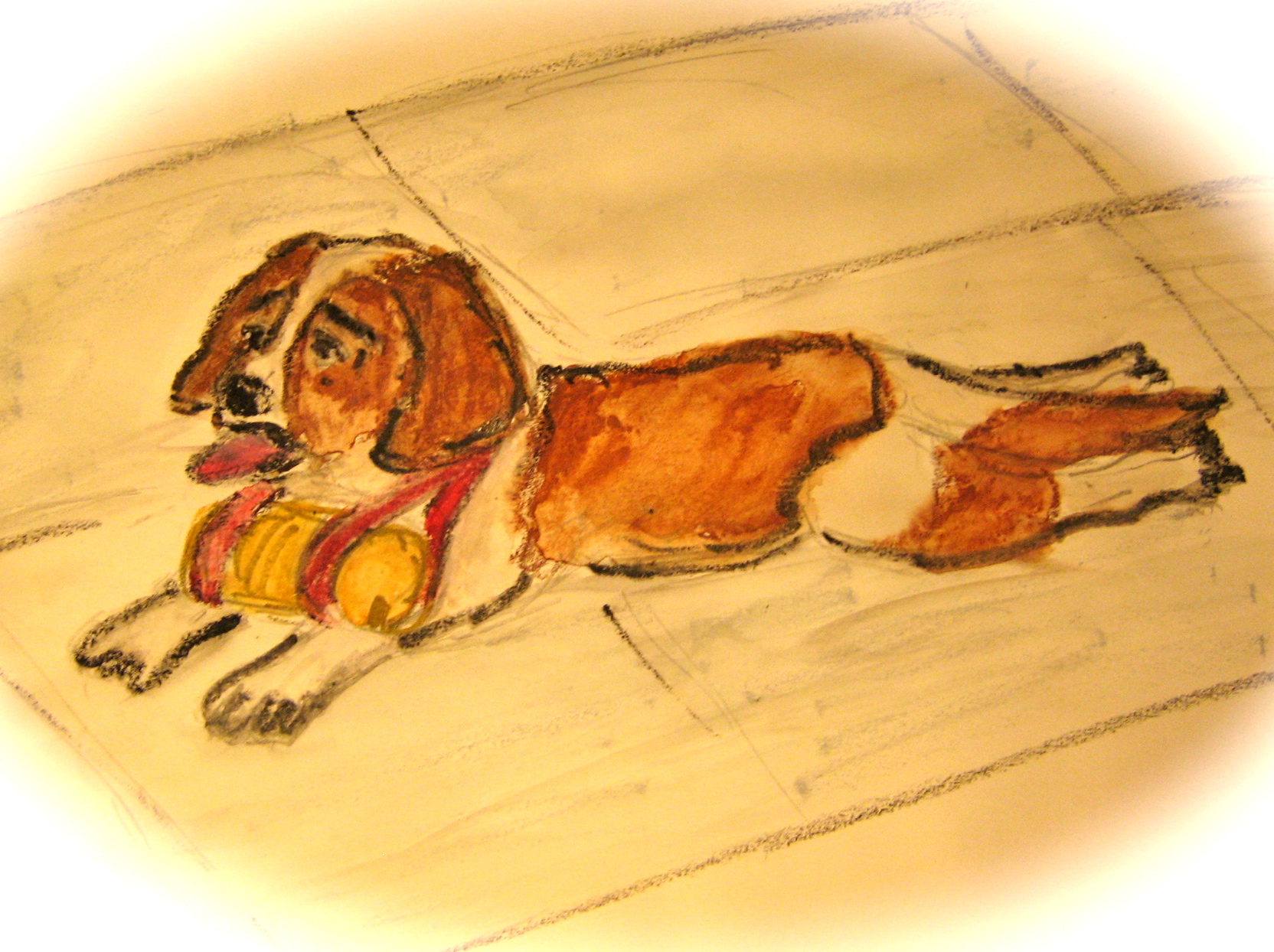
Hot Dog on Summer Dog Day

At a certain point mid-summer, the days become dog days even if not beastly hot.  If, that is, they are work days.

Many, in my generation (boomers), were lucky enough to be raised on summer vacations.  I say, raised “on” rather than raised “in,” because summer was a halcyon time of little supervision; we were hardly raised at all during those hot months, but were out in the street, a back yard, someone’s basement, the pool (or a slow rota of all of the above).  Adults were there but not right there.  They were sort of like life guards  – near enough to be summoned in a crisis, occasionally blowing a figurative whistle, mainly just hovering somewhere vaguely above us, and (on weekends at least) sunning themselves.  Their reprimands could usually be avoided by some judicious tip-toeing or scoots.

There is something magical about unstructured time, especially for children, and especially when screens (other than perhaps sunscreens) are kept, more or less, off-limits.  Unfortunately, today’s kids experience unstructured summer days less and less; school is succeeded by various day or sleep-away camps, summer schools, prep courses, and when all parties (parents and children) have vacation, it’s such a brief, valuable, time that the conscientious working parent feels (rightly) compelled to spend it actively together with their child, doing something planned.

I started to write – what about some good old-fashioned boredom?  But I’m sure modern kids get plenty bored; it just seems to be a more frenetic/passive kind of boredom, a boredom fed by digital or electronic current, or, at a minimum, a current of someone else’s control or content.

Adults suffer too.  We were raised on summer vacations, remember!  Days and days of trying to think up something fun, sometimes succeeding.

Body of Apricots

July 26, 2010

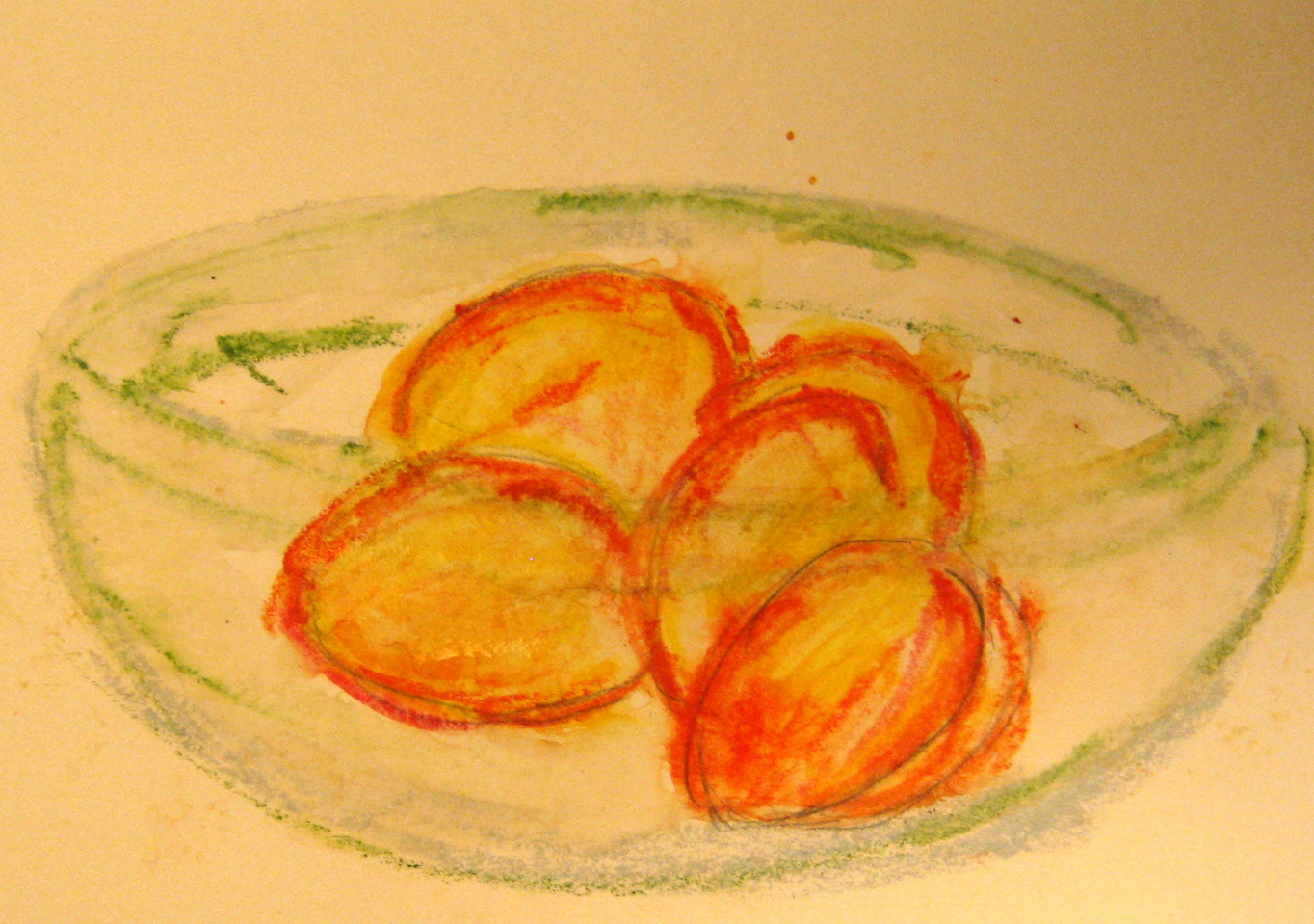
Apricots

Hard to adjust to a new day after the death of a friend.  The burden of sadness seems to sink into one’s joints (not to mention eyes, chest, forehead).

All day yesterday, I was poignantly conscious of the joy of a body.  What a delight it is when it works.  To simply move — to move simply– is an actual physical pleasure when all the parts are in order, more or less.  To stretch one’s legs, swing one’s arms, feel gravity beneath the feet.  To be touched by air, much less another person.

To eat!

Apricots!

Even less than ripe apricots!

So tart, almost like plums.  (Less than ripe plums.)  With that same inner coolness, but a soft blushed cheek.  Peel.  Skin.  Body.

Cancer – Fight For the Miraculous – Hard with Cannons

July 24, 2010

Trying to regroup a bit today, not to think too much about sad things, after the death of a dear friend.  Cancer does keep popping to the brain, though in a curiously disengaged way.  Not so much why people get it – that one’s a bit too scary.  As an inhabitant of New York City who’s ingested all kinds of particulate matter, and still makes decisions that are not proactively anti-carcinogenic, I prefer not to think of it.

What comes to mind more easily is how people fight cancer, and why?

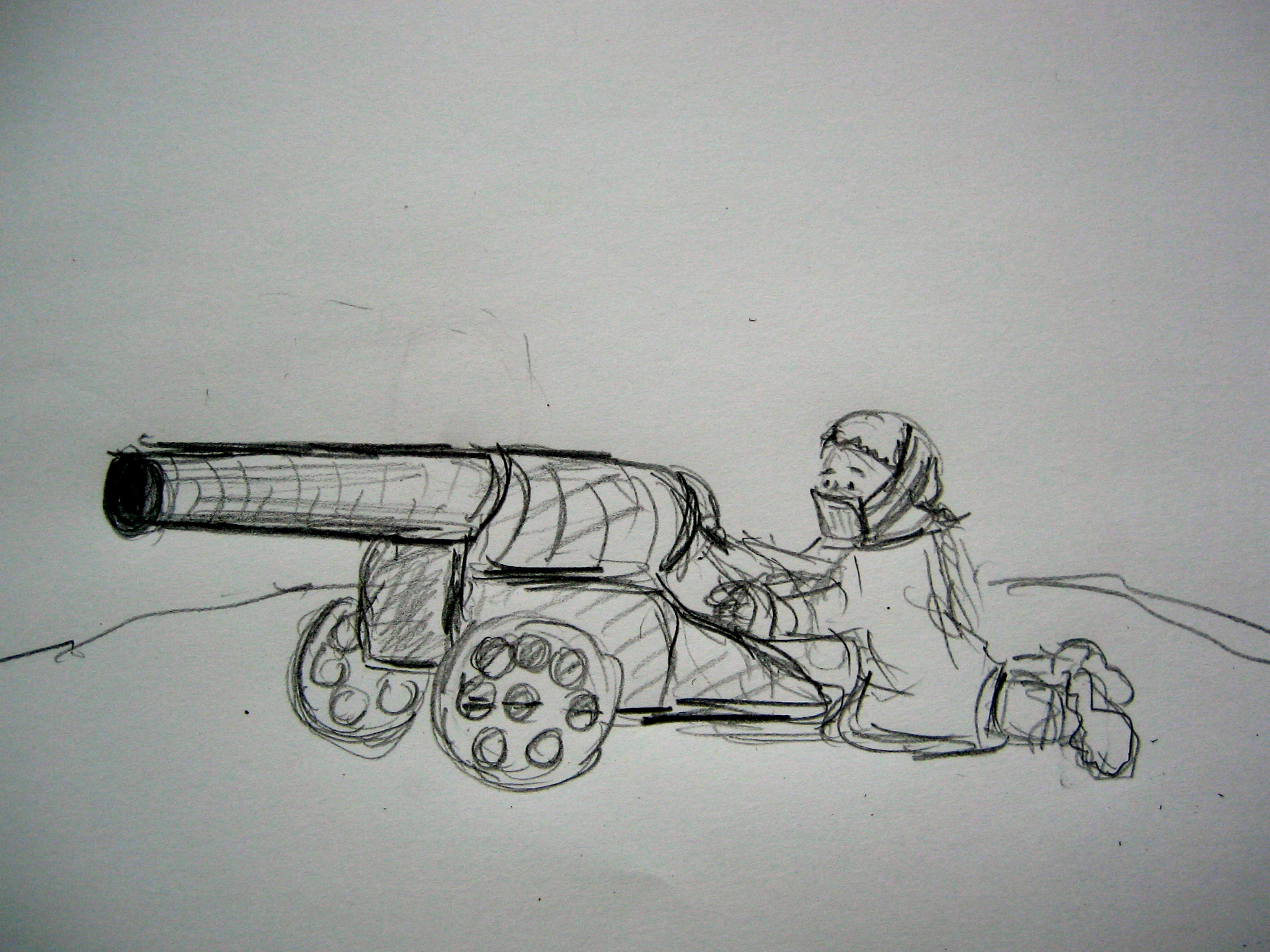
I, thankfully, have not had a personal reason to study these issues minutely, but I have to confess to some general bias against Western medicine.  It’s always seemed to me to specialize in cannons;  approaches to illness that involve heavy artillery used on a landscape (the body) which is nuanced and delicate (despite all those limbs and outgrowths), a landscape which one would just as soon save more rather than less of.   I am skeptical enough that the concept of a “surgical strike” seems hardly more precise to me when conducted by people in masks around an operating table than by pilots over a tableau of largely civilian dwellings.

I don’t mean to say that modern surgeons aren’t capable of precision (the whole skill seems to me to be absolutely amazing).  But I do think that the medical profession sometimes underrates the complications attending the procedures, the truly difficult healing processes and side effects.  The body is so complex and self-regulating;  it doesn’t particularly like to be messed with (even when its systems are out of whack.)

Pharmaceutical applications seem even less precise.  Dealing with my father’s diabetes has been an interesting lesson in this, his blood-sugar-lowing medication having been the prime cause of every emergency room visit and hospitalization over the last few years.

So complicated.  Does early detection of cancers save lives, or does it just extend the counting period?  How much good do chemotherapy and radiation do against aggressive cancers?  Does this good outweigh their stress on the healthy parts of the body, the body’s own defense mechanisms?  Or would the healthy parts of the body be weakened even faster by the cancer itself? Does the fight for extra time actually give extra time or just wear the patient out?

Of course, each case is different;  results are not fully knowable in advance.  And though experts seem to be getting better at identifying really aggressive cancers, those marked by a terrible predictability,  they have to allow for the slim chance; some possibility of unpredictability, some miraculous outcome.   Of course, it’s difficult to force the miraculous, but, as modern Americans – proud fighters, believers in belief itself, and above all, dutiful family members  – we cling to these slim chances, feel bound to try for them.

A difficult arena.

Lost Friend

July 23, 2010

A dear friend died today.  She was 58.  Like me, she was a Gemini, however, she was not “manicddaily”, but “steady-steady-daily”.  She was a wonderful person, invariably, profoundly, kind, while also persistently dogged, someone who saw things through; who sustained others through setbacks, who nurtured family and friends with a sweetness, and a sense of calm and security, even through terrible crises.

One of these was 9/11.  She lived right across the street from the World Trade Towers; she kept her family life and hopeful life and just plain daily life going through the torturous months of smoke and crowds and police lines, fear and sadness.

She was certainly her own person—her brand of kindness made many lifelong friends, maintained a devoted marriage—but she was also very strongly, markedly, a mother.  This made her youthful death especially difficult—it was terrible for her to leave her children;  terrible to cause them the pain of losing a mother.

But what could she do?  There are some things that mothers who could lift a car off their child’s legs simply aren’t strong enough to fight.   Still, I feel sure, I have to feel sure, that that strength and sweetness is still there somehow, somewhere close to home.

More Giotto – Fear of Mortality, Fear of Fear

July 22, 2010

More Giotto, Scrovegni Chapel, Detail of Lamentation

It’s hard to visit someone who is very ill.  An instinctive fear arises.  You know that the visit will engender pain–pain for the current loss, pain for past losses, pain for future losses.   The thought of pain alone brings fear; the confrontation of mortality holds additional terror.

There’s almost an animalistic fear that arises–a fear of participating in the pain that the ill person is suffering, a fear (almost) of empathy.

Then too, there are the unanimalistic, highly socialized, almost opposite, fears – a fear that you won’t feel pain, or enough pain; that you won’t react properly; that you are not close enough, that you just don’t belong.

I visited a very sick friend this evening and was a little shocked at the level of fear that overtook me on my way.  Part of what steeled me to go on was simply duty –  past promises to be supportive.  But what finally pushed me into the building was the understanding of how trivial my fears were compared to what my friend was going through; the understanding that I could only help her get through her illness and the fear of what seems sure to come next by rising above my own fear of those things.  Of course, my help would be minor in the greater context, but surely I could do that much.

All this was on the way.  When you are actually in the presence of a very sick friend or family member, the fear part of the equation largely subsides, at least the self-centered parts of those  fears.  That’s your friend there, still there, still your friend.  You are fearful then for their pain, not your own; and while it may be difficult to say things to them, their hearing uncertain, you feel as if you can think things; at least you do think things, your mind suddenly like a calming palm.  It doesn’t make sense, but still brings a kind of relief, even in sorrow.

Early Morning in Orlando Airport – Oh, the Glory of Modern Air Travel

July 21, 2010

Hang on Tight! (Fasten your Seatbelt?)

Oh, the glory of modern air travel.  I got up at 3:45 this morning (it looked like night) to make an early flight.  I always imagine an early flight to somehow be advantageous; I imagine that it will not be delayed because of problems somewhere else down the line; that I will theoretically be first.  Unfortunately, some airlines seem to do their maintenance in the early morning.  Or schedule crews that get in very late the night before.  (Airline regulations require crews to have a minimal sleep time.  This is not a regulation that I am complaining about –I just wish it applied to passengers.)

So now I am sitting here, hopeful of being bumped to an earlier later flight.

Bumped?  Hoping to jump onto, slip onto, hang onto, an earlier later flight.

No such luck.

Acknowledging Sadness

July 15, 2010

I said goodbye to a dear friend this evening.  I very much hope to see her next week but life and health are uncertain, and it seemed best not to leave things unsaid.

It is always amazing to me how important it is to say things.  Granted, I’m a talker.  (Anyone who writes a daily blog probably has to be.)  But even a “talker” (maybe especially a “talker”) can have a great deal of difficulty saying important things.

I was raised by people, Scandinavians, who did not like to draw attention to emotional circumstances.  I’m not saying that they were cold—but when my father kisses my mother, it is a highlighted, discussed, moment (and never publicly on the lips.) My parents’ parents were the kind of people who blanched even at a reference to where a childbirth took place, and would take great pains to avoid discussion of the deemed uncomfortable.  So, for example, they never mentioned blindness to a sightless cousin, or prior spouses to a divorcé or widow, or anything that might occasion offense, even if it really wouldn’t.

But my parents, for all their inherited diffidence, were somehow able to get the important words out–I love you, I’m proud of you, I’m so sorry that this has happened.

I’ve rarely found those important things to be out of place.   When sadness is in the room—not just there—when sadness fills the room, I’ve rarely regretted acknowledging it, if I can make myself.   It can be extremely difficult to make one’s self—the painful is not just awkward in our culture—human nature would truly rather it wasn’t there.   We don’t want to hurt feelings; we don’t want to do something wrong.

I guess the thing to keep in mind is that in some circumstances, sadness is there no matter what you do, feelings are hurting; things are, in fact, wrong.  Better to take on the unrecoverable moment than to let it drape you in stone; the moment itself is not stone, not lasting.  The acknowledgement of the sadness certainly won’t take it away, but at least it can offer the balm of connection, shared tears, the clasped, dear, hand.

Quatorze Juillet – French Burnt Peanuts, Fraternite, Kemp’s Ridley Sea Turtles

July 14, 2010

Oh brother how are thou?

A lot of disparate elements to pull together on today, July 14th, Bastille Day, the French national day.

My only Bastille Day actually spent in France was in Nice at age 8.  Its most memorable element was not the fireworks over the Mediterranean (although I can still picture one beautiful arc of flash) but the French burnt peanuts bought from a street vendor on the nighttime beach.  It was the first time I’d ever tasted French burnt peanuts and they were like fireworks in my mouth–hot, sweet, crinkly, crunchy, touched so delicately with salt that it might have just been the taste of the sea air on my tongue.   The nuts were, despite several prior days in France, my first real evidence of the deliciousness of French food–my parents, traveling on a strict budget, made us eat a lot of ham sandwiches put together by my mother in the car.

My next most important memory of Bastille Day is not actually my personal memory, but one recounted to me by members of my husband’s family—a patriotic group who’d lived through and/or fought in World War II, serving with the U.S. forces.  On one July 14th, during the height of DeGaulle’s France First approach (and U.S. furor at his perceived ingratitude), my in-laws and some friends celebrated  by lying down on the floor to sing the Marseillaise.  This (the floor part) was deemed to show the highest disrespect, although, for my part, I was always impressed that they cared enough about France to actually know all the words.  (Also reflecting a longstanding U.S. love-hate relationship with the French, a/k/a Freedom Fries!)

I personally never learned the full Marseillaise, but was taught the slogan words of the French Revolution – Liberté, Egalité and Fraternité.   Liberté and egalité were expected (except for the “g”) but “fraternité”  – brotherhood  – always took me aback (and not only because I was a girl.)   The American Revolution talked of freedom and justice for all (except for slaves), but did not (at least in my limited understanding) give the same emphasis to this kind of connection among people.  (My off-the-cuff, uninformed, explanation is that the American colonies were already already somewhat united against a common “foreign” enemy, while the French Revolution, more akin to a civil war, needed to emphasize alliance.)

But I don’t want to write today about the French Revolution; what I want to write about are sea turtles.  There is a very sad, if interesting, video piece in the New York Times today about forensic efforts to uncover the exact cause of the huge rise in turtle deaths in the Gulf since the BP oil spill.   (Brent McDonald, Kassie Bracken, and Shaila Diwan.) The oil is an obvious culprit, but deaths also seem to result from sea turtles drowning in shrimping nets, particularly in Louisiana which apparently does not enforce Federal law regarding escape hatches in the nets for turtles.   One thought is that, in addition to poisoning the turtles, the oil may drive them into areas that are inhospitable and unfamiliar;  the spill may have also changed the conduct of fishermen.

Many of the turtles dying are the endangered Kemp’s Ridley turtles; their life span would otherwise go into the decades.   They are beautiful, their faces seemingly embued with a thoughtful intelligence.

Which brings me back to Bastille Day—not because of Louisiana’s French roots – but because of the French Revolutionary tenet of fraternity.  It seems to me increasingly unlikely that much will be done to save turtles or any non-human species, the environment, or even the planet itself, unless and until people feel a meaningful connection with creatures other than themselves.  I don’t mean simply the sentimental connection of how endearing the creatures are (although that’s a start).  I mean a connection that be real enough to inspire actual care and sacrifice.

I don’t mean to diminish people’s concerns about their jobs, what they eat and the temperature at which they keep their dwellings.   But at the moment, there is another kind of love/hate relationship going on here (more serious than the one with the French.)  We love the idea of saving wildlife, the environment;  we hate to actually do anything about it, to change our lives.  Some kind of better balance needs to be reached between short-term, individual concerns, and longer-term, world-wide needs, an understanding that humans may not do very well in a world in which sea turtles are dying in droves, that these creatures deserve lives free from molestation and torture, that the death of a sea turtle is a death in the family.

Pushing/Falling Along

July 10, 2010

Crazy time.  I have a dear dear friend arranging for her hospice care in the city, and am up in the country drawing elephants with young kids.   So much to grieve, so much to joy in.   One of those statements that’s a cliché because it’s so true.

A [ridiculous] clock in the hall coos in the hour with varying bird song.  My mother-in-law, now gone, a true naturalist, really loved that clock, especially as hearing true bird song became difficult for her.

I suppose the deepest approach to the inevitable losses in life, the prospect of the loss of life itself, is to let go of regret, to learn to find contentment in what is before you, to stop wasting time worrying about what’s beyond recall (not of memory but of re-doing).   But that’s so hard, for me at least (a master of discontent).  For me, the more effective protocol is to make a concerted effort to remember regret, to remember, in advance, how it will feel when loss is in front of you, to remember, in advance, that this is a feeling that you don’t want to feel, and to focus, to the extent possible, on what you can possibly do to avoid the having to feel that feeling.

To imagine, in other words, that you are at a place with extremely few choices, and to think, from that position, of the choices that you wish that you had made when you had them.

I understand that it sounds Escheresque.   Perhaps this type of forward/backward thinking only works when you have dear friends who are very sick, when you want to plead with them not to go but know that you really can’t do that to them, that their life is beyond their wish and yours.

They have lived their lives well—you have no question of that–but what about you?   You feel pushed along by life,  by rapids, gravity, momentum, but is that push really irresistible? Really?

Fourths of July Past – Swimming Pool Beauty Contests – In Search of Sparklers

July 3, 2010

Sparkler?

The 4th of July was a day of mixed blessings for me.  Oh, I was proud of my country sure.  In the years before 1967-68, when I was also ten or under (oops!), it was hard for me not to think of the U.S. with anything but absolute pride.   My parents had either fought in, or been very marked by, World War II, and the feeling of the U.S. as the ultimate good guy, the savior of the world, was strongly imprinted on me.

Already, of course, there were doubts about what was going on in Vietnam, but I felt with childish certainty (strengthened by the fact that the beginning of the war was associated with the martyred John F. Kennedy), that the U.S. had, at least, entered into that conflict trying to help people.

So what marred my childhood experience of the 4th was not any doubt in the indivisible goodness of my country and countrymen, but, well, beauty contests.

My uninformed sense is that the juvenile pageant circuit is considerably larger and more professionalized now, accompanied both by heftier prizes and far thicker applications of eyeliner.

In my day, these were extremely local events, held at our local swimming pool.  Which means, yes, that they involved a bathing suit portion.  As well as a talent portion.   I don’t remember any evening gown portion, but occasionally there was bicycle decorating—crepe paper bunting was used.  Sometimes, it seems to me that the contestants were also draped in bunting, but I have a feeling that this may have been only part of my mother’s ingenuity.  In other words, I may have been the only contestant who wore bunting.  (Yes, it was red, white and blue.)

There was no congeniality part—since everyone knew each other that would probably have been considered a hurtful popularity contest.  (As if the rest of it wasn’t! )  (Some bitterness there?)

I don’t mean to impugn my mother, although she was the instigator of my participation in these activities.   She bought the new bathing suits, arranged for whatever bunting was applied, listened and encouraged my choice of “talent”, and, after the inevitable defeat always always to a girl named Karen A. (whose full name I will not use in this internet-find-your-old-friends world), she complained bitterly at the bias and short-sightedness of the judges.  (They chose Karen A., according to my mom, because her parents were super popular at the pool, i.e. they drank and partied. )

Of course, I knew there was more—even my mother would admit it eventually.   Dimples.  A certain sassiness of hips.  A two piece suit and culique of eyeliner (even way back then.)   And even more importantly — a sparky conviction which Karen A. had and I didn’t a) that the contest was fun and  b) that she definitely deserved to win it.

On my mother’s behalf, she, a brunette, was born with what was then charitably called a “Roman nose.”  It actually gave her face a striking handsomeness.  But she grew up in the age of Shirley Temple, Ginger Rodgers, Betty Grable.   And when her daughter was born short-nosed and blonde, it felt miraculous.   How could a daughter with such innate advantages not win whatever contest came her way!? !

I don’t know why I kept trying. (Correction—I don’t know why my mom kept me trying.)  I guess the only answer is that people repeat their mistakes.  (See e.g. the U.S. government and foreign wars started ostensibly to help protect fledging “democracies”.)

I say, the day held mixed blessings.  In the evening, when suburban pre-much-airconditioning Maryland finally cooled down enough for us to leave the pool, we had fireworks.  Funny little black smoking worms that my brother was permitted to light on our back patio, flame-emitting cones that only my Dad could touch, eyes averted, and sparklers, many sparklers that, even as kids, we could wave about in almost any way we wished.