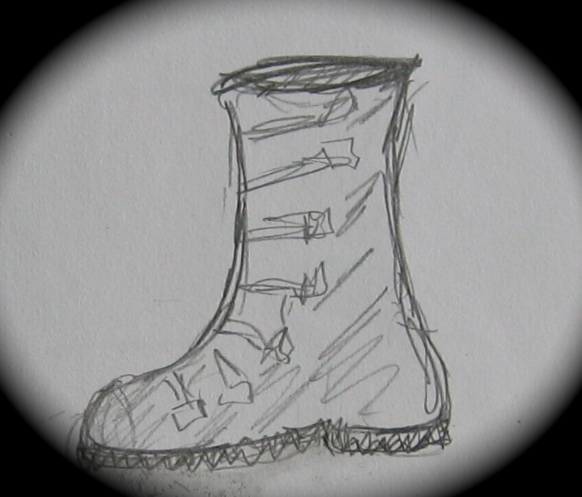
Biker Boot?
Okay, I’ll confess that one reason I’m so cranky today (see e.g. my earlier post complaining about World Cup 2010) is that in the past three days I’ve almost finished reading all of the Stieg Larsson trilogy that begins with The Girl With The Dragon Tattoo, moves on to The Girl Who Played with Fire, and (I hope) finishes with The Girl Who Kicked the Hornet’s Nest. (I do understand that there’s part of a fourth book kicking around in a computer held by the long-time companion of Mr. Larsson, who died suddenly in 2004.)
Although the books follow the same characters (more or less), Book 1 and Books 2 and 3 are quite different from each other. Book 1 is relatively self-contained, while 2 and 3 seem more like one separate, very long, book with a substantially different focus. And yet that’s not true either: Book 1 concentrates on a dysfunctional family and a corrupt and violent power structure; while Books 2 and 3 focus on a different dysfunctional family and an expanded corrupt and violent power structure.
One reason the books are so popular is the main female character of all three books, Lisbeth Salander, who, in my mind, is what results when Minnie Mouse meets Mighty Mouse meets Kevin Mitnick (world champion computer hacker), meets Bobbie Fisher, Joan Jett, Andrea Dworkin, House (the doctor on TV), and, in her teeny pair of steel tipped motorcycle boots, divides her time between tattoo parlor, boxing gym and math library. (And, of course, her seventeen inch power book.)
What makes Lisbeth so appealing is that, despite the terrible abuse she’s suffered, she remains fundamentally moral, fearless, and, even compassionate.
Also, yes, she’s very very hip.
[Spoiler Alert–sort of.] The books are good books, if not exactly great; but they do very effectively tap into that most fearful of situations in which both the “bad guys” and the “supposed good guys”—that is, the authorities—are after you, where there’s virtually no one to turn to for help, where the powers-that-be cannot be trusted. I know that’s not atypical in movie circles, but I’m not much of a movie person. So, oddly, the books they bring to my mind are “children’s books”, namely the wonderful Sally Lockhart series by Phillip Pullman, especially The Tiger In The Well, in which Sally’s property and life are taken over by a faked husband with amazing ease. (It’s Victorian England.) (Actually, the Golden Compass books also work with this theme, which is probably particularly powerful for children, given the power of authority in their lives.)
It’s strange that the latest iteration of this theme arises in Sweden, a place not pictured by most Americans as particularly venal or sadistic. (I guess it’s been a long time since Ingmar Bergman.)

 ManicDDaily
Recent Comments