Posted tagged ‘poetry’

No Rest For The Weary – Metered Feet

September 24, 2009

Went to bed at one a.m.  and woke up at five.  (The way in which ten cups of strong tea remain in your system never ceases to surprise me.)

I am not someone who particularly touts the benefits of sleep.  It’s great stuff, but the fact remains that there are only 24 hours in the day, and, when you have a day job, only so many (other) hours can be spent unconscious.  (That’s a joke, boss.)

Nonetheless, I do think that, over time, sleep deprivation can put a serious dent in creativity.  Great swathes of the sleep-deprived brain are spent on questions such as what is your husband’s cell phone number again, and where did you just put your purse, socks, apple, keys, and, most importantly, that fresh cup of tea?   Under those circumstances, it’s hard to make space for new combinations of brain waves.

As a result, I decided today to write about something kind of technical, which is meter in formal poetry.  Ta Da!

Or rather:  taDa taDa taDa TaDa TaDa.

The above, by the way, is my version of iambic pentameter, probably the most common form of meter in traditional English verse.  (I base this statement on the fact that iambic pentameter is the form of virtually all the lines of Shakespeare’s  plays, other than the prose dialogue of his commoner characters such as the Rude Mechanicals in a Midsummer’s Night Dream. )

There are variations.  But before going into these, I want to take a break to thank another blogger, Patrick Gillespie, who writes Poemshape at wordpress  and who kindly wrote about my poetry and blog: http://poemshape.wordpress.com/2009/09/24/another-poet-childrens-writer/.  Gillespie knows a great deal about poetic meter.  And although he inspired me to continue with this subject, I had oddly already started writing about this morning on the subway.

So:

If rhyme gives a kind of music to poetry, meter is what makes it dance.   Ironically, meter is measured in “feet” (sort of like toe-tappings.  Also, like the English system of distance measurement.)  A line which is written in “pentameter” has five feet.

A “foot” of poetry generally varies in length between one and three syllables.   (Two is probably the most common.)

There are various terms for the specific rhythm of a “foot” of a poem. An iambic rhythm is a ta-Da, with the emphasis on the second syllable.  A trochaic rhythm is the opposite of an iamb: Ta-da.  (A better example may be “Dada” as in Marcel Duchamps.)   A spondee is a foot with two syllables of equal stress as in “graveside”.  (Sorry for that one.)   Two types of feet which use one long syllable and two short unstressed ones are dactyls and anapests. (What comes to my mind is “Heidigger”, a dactyl, although a perhaps better, example is “Pattinson”.)

It’s all kind of complicated.  Which is why I tend to write poems using a syllabic count rather than using meter based on “feet.”  (Perhaps I should have told you this before the long explanation.)

Yes, it’s cheating.  And lazy.  But using a syllabic count is quite helpful to a striving poet, particularly when sleep deprived.

When writing formal poetry, I also aim for pentameter, because that length of line seems very natural.  To reach an approximation of pentameter, I try to keep the lines between 9 and ll syllables (though 12 can also sometimes work).

Keep in mind, if you try this technique, that a syllabic count really is not same as a count of feet.  You need to be careful that you are not reading the line in an odd or contrived way in order to get it to sound “right.”

I include below another example of a villanelle.  I chose this one because it describes the aging, sleep-deprived brain, although the meter is not that great and may not qualify as as “pentameter.”  The second repeating line: “as pink as dusk (not dawn), the half-light of the day” is a bit long but just about works because,  arguably, it ends with two “anapests.”

Villanelle to Wandering Brain

Sometimes my mind feels like it’s lost its way
and must make do with words that are in reach
as pink as dusk (not dawn), the half-light of the day,

when what it craves is crimson, noon in May,
the unscathed verb or complex forms of speech.
But sometimes my mind feels like it’s lost its way

and calls the egg a lightbulb, plan a tray,
and no matter how it search or how beseech
is pink as dusk (not dawn), the half-light of the day.

I try to make a joke of my decay
or say that busy-ness acts as the leech
that makes my mind feel like it’s lost its way,

but whole years seem as spent as last month’s pay,
lost in unmet dares to eat a peach
as pink as dusk (not dawn), the half-light of the day.

There is so much I think I still should say,
so press poor words like linens to heart’s breach,
but find my mind has somehow lost its way
as pink as dusk (not dawn), the half-light of the day.

(All rights reserved, Karin Gustafson)

Do check out1 Mississippi, my children’s counting book, Going on Somewhere, my book of poetry, and Nose Dive,  comic novel.

Also, I am linking this to The Purple Treehouse today, where C.C. Champagne is talking about syllables in poetry.

Subway Sonnet – Train Chemistry – Light That Cannot Be Broken Down For Parts

September 23, 2009

Molecules (poem by Karin Gustafson, drawing by Diana Barco)

I updated this post for the dVerse Poets Pub prompt for poems about trains and am also linking to Victoria C. Slotto’s blog liv2write2day relating to poems about light.     This poem is not a new one, but it was written on and prompted by the subway on a Monday, thinking about a beautifully sunny Sunday before.

This is a sonnet, a variation of the regular form 14 1/2 lines rather than the requisite 14.   I added the extra couple of words at the end to combat that “patness” that sometimes results from a sonnet’s final couplet.

Molecules

Yesterday in the dim fluorescence
of subway car, I thought of molecules.
They seemed, in that greyed light, the essence
of life.  I saw them stretched in pools,
sometimes seemingly limpid, other times
volcanic, fervidly swooping me
abubble, then mucking me into slimes
of laval woe, a test tube of to be
or not to be.  Today, I’m by the sea,
and water, vaster than pools, sparkles
under light so immense it cannot be
broken down for parts, yet its particles
raise up the non-molecular part
of me, what refuses to lose heart,
no matter–

(All rights reserved.  Karin Gustafson)

(The drawing above is by my dear friend Diana Barco, who illustrated my book of poetry called “Going on Somewhere,” available on Amazon.)

Check out 1 Mississippi at link above also.

Speaking of Fireflies

September 20, 2009

I posted an earlier poem re fireflies, but here’s actually a nicer one:

Porch

The porch pulled them to its side,
invited nestling upon shaded planks,
recalled cool soft times, clover in fields,
the day she cut his hair, and then they picked
out smooth flat stones,
and lined them along its surface, thick with
years of knobby deck paint.  Against it,
the stones shone like perfect moons to plant upon
winter table tops, reminders
that nights sown by fireflies
were going on some where, some time.

(All rights reserved.  Karin Gustafson)

Check out 1 Mississippi at link above or on Amazon.  Review it if you have one!  If not, get one!

Spenserian Sonnet (Still Not Keats)

September 18, 2009

Last night (well, very early this morning), I posted an example of a Shakespearian sonnet, which is probably the most common form of sonnet in English.   Another variation is the Spenserian sonnet, named for Sir Edmund Spenser, (author of the wonderful wondeful Faerie Queene.)

Spenser (1552-1599) was born and died a little before  Shakespeare (1564-1616).   Although their lives overlapped, my very brief research has informed me that the group of Shakespeare’s sonnets were not published until 1609 well after Spenser’s death.  They were apparently without Shakespeare’s permission.   Two were published a bit earlier, but likely also after Spenser’s death in 1599 (also without Shakespeare’s permission.)  (And this was well before the internet.) 

Spenser’s form is slightly more strict than Shakespeare’s.  A more limited rhyme scheme requires the poet to stick to the second set of rhymes of each quatrain in beginning the next quatrain.    This makes for a series of couplets throughout the poem and not simply at the end:

A
B
A
B
B
C
B
C
C
D
C
D
E
E


The couplets interspersed in the poem can create a beautiful echoing effect.  However, as in the case of the Shakespearean sonnet, that darned couplet at the end can be a real problem.   (See yesterday’s post concerning the difficulty of ending a sonnet without sounding like you are neatly “summing up” all that came before.)

Even so, a sonnet is a fun, flexible, form. 

A couple of pointers:  (I pass these on, not as a sonnet expert, but as a sonnet lover.)  

The rhymes (and meter) make music.   I believe this music works best, however, if it subtle,  almost a kind of murmuring, rather than a series of “bada-bings.”    (Remember you are writing a sonnet, not a limerick.)

The subtlety can be achieved by using run-on lines; these are lines in which the thought or sentence does not end with the rhyme at the end of the line, but in which the thought or sentence runs over.  This means that these is no pause at the end of each line, unless it is called for by a comma or period.   

 The use of run-over lines requires that some care is taken with respect to punctuation.  (Readers! please follow the punctuation.) 

Additionally, I like NOT to capitalize each new line as I feel that encourages a kind of pausing at the end of the line, and to discourage a more flowing read.   

Spy Games

We played spy games galore in the basement.
Running spy games with the boys, our bent hands
guns, till sweating we lay down on cold cement,
shirts pulled up, chests hard.  Not much withstands
the leaching chill of earth, the deep down sands
beneath a childhood basement, except perhaps
the burn of nipple, the future woman’s
breasts.  Our spy games just for girls had traps–
some of us played femmes fatales, poor saps,
while the leader girl was Bond–0-0-7.
She hung us ropeless from the bathroom taps,
then tortured us in ways that felt like heaven,
the basement bed our rack, what spies we were,
confessing neither to ourselves nor her.


(All rights reserved.  Karin Gustafson)


 P.S.  Check out 1 Mississippi.  (It’s neither Spenserian or Shakespearean, but it will teach your child to count.)

Sonnets!

September 18, 2009

Sonnets have fourteen lines.

Count ’em.

Sometimes they are combinations of eight and six; sometimes four and four and four and two; sometimes strange intersections of four and six, eight and two (only adding up to fourteen.)

I have been thinking about them since hearing about Bright Star, the new Jane Campion movie about Keats.  (I haven’t seen the movie yet, so can make no recommendations.)

Keats wrote great sonnets, even developing his own form.

Even so, I tend to stick to Shakespeare’s form.  (Shakespeare, of course, wrote really great sonnets.)  His form is extremely easy to remember, and relatively easy to write, as it uses a broad assortment of rhymes.

If I’m feeling more ambitious, I’ll try Spenser’s format, which is similar to Shakespeare’s, but uses a more limited rhyming pattern.  (I’ll explain each in the next few posts.)  I have never written a sonnet in Keats’ form (though I intend to try.)

Shakespeare’s form is set forth below.  Remember, under conventions of poetic notation, a rhyme ending a specific line is denoted by a capital letter, so that the first set of rhymes is denoted as “A”, the second set of rhymes as B, the third set “C”, etc.

Shakespeare also uses iambic pentameter.  (More on that later.)

A

B

A

B

C

D

C

D

E

F

E

F

G

G

The biggest problem with a sonnet is often the final couplet.  It tends to have a very pat, “summing up” quality, that is hard to escape.

I do not to want my final couplet to sound like the “moral of the story”. Breaking the lines up so that they run over and do not pause at the end of each line can help in this regard.  Humor is also useful.

A subject matter which is not easily summed up, also creates a certain tension that can temper the patness of the final couplet.   Here’s one, for example on a self-administered, informal breast exam.

In the Stairwell

Descending the building’s stairs, she feels her breast,
fumbling beneath her bra to get to skin,
palpating (as they say) but in a mess
of here and there and not all within
the confines of an organized exam.
Silly to do it here, not time or place,
someone else might come, have to move her hand,
and yet fear seems to justify the race,
as if by checking each time it crosses mind,
especially checking fast, she can avoid
ever finding anything of the kind
that should not be found.  And so, devoid
of caution, but full of care nonetheless,
she steps slowly down the stairs, feeling her breast.

(All rights reserved, Karin Gustafson)

Check out 1 Mississippi at link above.

Love Poem (Tangentially) Inspired By Federer’s Defeat

September 14, 2009

This is a poem I wrote the last time (or at least ONE time, one of the few other times) that  Federer lost an important match.  In that case, it was to Nadal at one of the French Opens, which because they are played on clay, appear on a bright orange surface, when televised.  (If you have read any of my posts re writing block, you will notice that it also centers on the trials of trying to come up with a writing exercise on one’s own.)

Would-be Poet

I, who must be purposeful at every minute,
even when lying in bed miles away, call to ask you
for a prompt, something to write about, something
outside of myself.
You are watching tennis.  You’ve taken the phone into
the TV room, but, far
from its home cradle, it emits a steady cackle.
Earlier, out of love for me, you left the TV, but this is
the second call of the morning, and Federer, the champion for umpteen
seasons, is being trounced.  In my mind, I see your leg
ticcing with compressed intensity as you sit
on the edge of the bed in that far room, eyes glazed by the brilliant orange
of the beamed clay surface.
But Federer is never his best
on clay!  I want to shout.
Don’t you know that already?  Doesn’t the world?

You speak slowly, squeezing words
out of the small part of you not glued to the screen.
I think of ‘static’ not as in the phone line, or even
our relationship,  but the electrified ash of my own TV growing up,
my brother sitting in the only good
chair, his huge bare foot blocking my view, his
big toe like a weird fleshy centerpiece on a table meant
to be intimate.  Crazy-making.  But in my image,
my brother and I are still, complaints and taunts
temporarily silenced by the buzz of the Emergency Broadcast System,
ninety seconds in which we were both awed
and irritated by something other.
How about ‘Photosynthesis?’
you say.

You are not a poet; you don’t pretend to be a poet; why
do I even ask you, a non-poet, for such help?
I groan.
Wait,
you say. How about ‘ love and photosynthesis?’
I groan again.
‘Asparagus’ then,
you laugh, making some inane
remark about how it’s like your love for me, endlessly growing.

I am so jealous suddenly, of the clay, the ball, the trounced Federer, but most of all, of your ability to just sit there and watch,
guiltlessly, lovingly, full
of bright orange beams.

(All rights reserved, Karin Gustafson)

Last Villanelle for a While Re Aftermath of 9/11

September 11, 2009

Anyone who reads this blog is probably heartily sick of villanelles.  Sorry!  But here’s one more–re the aftermath of 9/11.   (

Sorry, sorry, sorry.

I do write non-villanelles.   And, while this is not the last villanelle I’ll post, I promise that it will be the last for a while.  (Future posts will also be more cheerful!)

Shattering

The shattering of lives should take some time.
It shouldn’t come in flashes, clods of dirt,
no moment for altered course, for change of mind.

The actual choice ahead should be well-signed,
the frailty of good luck, a blood-soaked shirt;
the shattering of lives should take some time.

He knew that road was risky, heard a whine,
but in the end those warnings were too curt,
no moment for altered course, for change of mind.

Hard to foresee your own true body lined
with metal plates and plastic tubes of hurt;
the shattering of lives should take some time.

So many hours after to refine
what happened in that second’s blinding lurch,
no moment for altered course or change of mind.

Or was it fate?  A studied path, not whim?
His heart tried hard to measure out the worth
of shattering lives.  It would take some time,
without moment for altering course or mind.

(All rights reserved.  Karin Gustafson)

9/11 (Villanelle)

September 11, 2009

9/11  (Villanelle)

The burning buildings woke me from a sleep
of what I thought important, nothing now.
I ran hard down the smoking, crumbling street,

praying that my child was mine to keep,
dear god oh please dear god I whispered loud;
the burning buildings woke me from a sleep.

Some stopped to stare, all of us to weep
as eyes replayed the towers’ brutal bow.
I ran hard down the smoking, crumbling street.

North sky a startling blue, the south a heap
of man-wrought cloud; I pushed against the crowd;
the burning buildings woke me from a sleep.

I’d never complain again, never treat
with trivial despair–or so I vowed.
I ran hard down the smoking, crumbling street.

I’d change, give thanks—I saw them leap—
and begged for all the grace God would allow.
The burning buildings woke me from a sleep;
I ran hard down the smoking, crumbling street.

(All rights reserved.  Karin Gustafson)

P.S. This is an old post, and an older poem, written shortly after 9/11/01 – but I am linking it to Victoria C. Slotto’s writing blog liv2write2day .

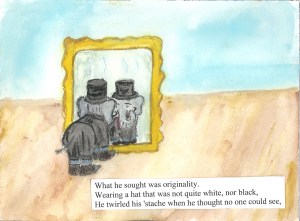
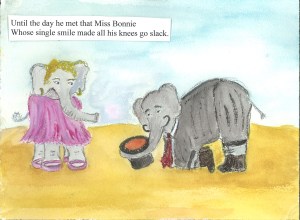
Villain-elle (With Elephants)

September 9, 2009

Villain-elle

#1A

2A

3A

4A

5A

6A

7A

8A

Here’s what the poem looks like in unillustrated (stanzaic – is that a word?) form:

Villain-elle

He twirled his ‘stache when he thought no one could see
and kept away from rope and railroad track,
for a cartoon villain was not what he would be–

what he sought was originality.
Wearing a hat that was not quite white, nor black,
he twirled his ‘stache when he thought no one could see.

Until the day he met that Miss Bonnee
whose single smile made all his knees go slack.
Though a cartoon villain was not what he would be,

she steered him to a classic robbery,
a bank heist with a gun, a car out back.
He twirled his ‘stache when he thought no one could see,

but see they could, if only digitally.
She whispered, as she relieved him of the sack,
that a cartoon villain was not what he would be.

‘My hero’, she sighed, and other fiddle-dee.
Then his bent head received a good hard whack.
She twirled her stash when she thought no one could see.
A cartoon villain was not what she would be.

(@ Karin Gustafson, 2009)

If you are interested in more Villanellia, check out prior posts re how to write them.

If you are interested in elephants, check out 1 Mississippi at link above.

Sticking To Villanelles (For Today) – How To Write Them

September 8, 2009

A lot of things seem to be a bit stuck right now (at least to me) or moving in molasses motion, i.e. health care reform, opposition to Obama’s verbal waylaying of U.S. school children (ridiculous!), even the ever reliable Derek Jeter.   People running in the Democratic primary in New York are calling me every other minute, and I can’t rouse the energy to even listen to their messages.  (Not even the one from Ed Koch!)

Yesterday, I promised to continue to blog about villanelles, but frankly, this stuckness made the prospect about such an arcane, “out-of-the-loop” subject seem trivial.   Surely, I thought, there had to be something more exciting I could come up with.

Then, I walked home past Ground Zero—I live in downtown Manhattan—through all the barricades that are already set up in preparation for Friday, stepping between the policemen, already manning those barricades, past the cranes and lights and dirt pit, and, suddenly, blogging about something as possibly boring as how to write a villanelle really didn’t seem so terrible to me.

I also believe in keeping promises.

So:

How to Write a Villanelle:

The most important tip I can give to anyone writing any formal verse is to feel free to cheat.  For example, if rhyme is required, don’t worry about not being able to come up with perfect ones.  Use “almost rhymes” or “slant rhymes”  (that is, “not quite rhymes”).  Besides giving you more words to choose from, this will keep the poem from being so sing-songy.

If repeated lines are called for, as in the case of the villanelle, don’t worry if you have to vary them a bit, that is, if your repeating lines don’t in fact exactly repeat.   Remember that meaning always trumps form.

It’s helpful to think of the form as a kind of a map, a means to music.  It’s useful to have all the streets laid out, but occasionally, when you want your poem to actually reach a destination, you have to cut through some back yards.

The only place where I think cheating can truly backfire is with rhythm.  Your lines don’t have to scan exactly, but if they are really off, the poem just won’t sound well.  Respecting rhythm does not mean that you have to be stick to iambic pentameter, but some attention to line length, numbers of feet or syllables, should be paid.

All that said, you can’t cheat till you know the rules.  Here are the basics:

A villanelle is a seven stanza poem, that works with rhyme, meter and repeated lines.  There are two lines that repeat through the poem;  they also rhyme with each other.  For notation purposes, I call the first repeated line “A1” (like the steak sauce) and the second repeated line “A2” (not to be confused with the Pakistani mountain).   (Under rules of poetic notation, these are both referred to as “A” lines because they rhyme with each other, the “A” rhyme.)

Other lines which rhyme with A1 and A2, but which are not the repeated lines, are denoted below as just plain “A”.

The remaining lines of the poem, which do not rhyme with the A lines, but which rhyme with each other, are denoted as “B”.

Here’s the basic form:

A1
B
A2

A
B
A1

A
B
A2

A
B
A1

A
B
A2

A
B
A1
A2

An “easy” way to remember the form is that the all the stanzas. except the last one, have three lines.  The first one begins with your A1 line and ends with your A2 line;  the next four stanzas are in a kind of order with the first ending with A1, the second A2, the next A1, the next A2 again.  (It’s sort of like shampooing your hair—”wash, rinse, repeat.”)  The B lines intersect each stanza (sort of like a basting stitch.)

The last stanza has four lines, ending with a couplet made up of A1 and A2.

It sounds a lot more complicated than it is.  As mentioned in yesterday’s blog re Villanelles and Banana Pudding, the great thing about writing a Villanelle is that you really don’t need to come up with all that many lines.  You do need to think through your repeating lines though—to make sure that they are flexible, and also that they work as a couplet.

Ideally, you also want the meaning of the repeated lines to shift as the poem progresses, and not to simply repeat in a rote manner.  You do not want the repetition to feel formulaic, but somehow illuminating.

Punctuation can help here—it can be useful, for example, for the repeated lines to sometimes feed directly into the following line or stanza and not to always end with the pause of period or comma.

And of course,  cheating can be invaluable.  Shifting the words slightly, for example, so that the lines sound almost the same, but are a teensy bit different, can help your poem actually mean something.

If this is your first villanelle, pick relatively easy rhymes.  I also find it useful to list on a separate page, all the A rhymes and B rhymes that I can think of before I move on too far with poem.  I make the list in a completely dumb way, writing down every single rhyme or near rhyme I can come up with, without regard to the poem’s subject, simply to accumulate choices.  This sounds very “unheartfelt”, but such lists can really open up your thinking, helping you to come up with much more creative and meaningful combinations than you otherwise would.

Which brings up a final point.  Yes, the form is constraining, but the constraints force you out of your typical ruts.  To write a villanelle (or any formal poem), you have to work with something other than your normal brain patterns.   This seems, to me at least (Manic-D-Daily)  invaluable.)

Here’s another one of mine:

Burned Soldier (A Mask For Face)

He tried to smile but found that skin would balk;
a mask for face was not what he had planned.
Right action should give rise to right result,

saving the day as it called on God to halt
all burn and bite of bomb as if by wand;
he tried to smile but found that skin would balk.

When they talked of graft, he always thought of molt,
as if his flesh held feathers that could span
right action, then give rise to right result—

cheeks that were smooth but rough, but loose but taut—
it all had been so easy as a man.
He tried to smile but found that skin would balk.

Hate helped at times; to think it was their fault.
But how could “they” be numbered? Like grains of sand,
like actions that give rise to like result,

like eyes that fit in lids not white as salt.
This lead white face was not what he had planned.
He tried to smile but found that skin would balk;
right action should give rise to right result.

(All rights reserved, Karin Gustafson)