
Posted tagged ‘manicddaily’
Last Tango In Buenos Aires? (With Elephants)
May 21, 2011
Have iPhone Will (Try To) Photograph (Despite Museum Guards, Stuffed Caiman, Nitpicking)
May 19, 2011
I’d like to blame it all on Steve Jobs, but the fact is that I was a bit of a rule bender even before I constantly carried a little portable camera on my phone.
In my defense, I don’t bend rules that make sense to me–I’d never walk on struggling grass, for example, or let my dog hinder the health of a city tree. But, lately, when it’s come to non-flash photography and museums (especially museums without competing post cards), I’ve found it a little hard to follow the straight and narrow.
It started in Colonia del Sacramento in Uruguay where one buys a single pass to about six small town museums. I really enjoyed these museums, several of which were housed in Colonial buildings and showed wonderful artifacts and reproductions of artifacts of Colonial life or depicting Colonial life, especially when I could take little photos of them (as shown below.)
href=”https://manicddaily.com/wp-content/uploads/2011/05/20110519-063651.jpg”>
Though there was also a sense sometimes that town curators were pushing just a bit too hard to give visitors their money’s worth. Take, for example, the Armadillos in the natural history portion of the Museo Municipal (otherwise devoted to Colonial furniture and armaments), the stuffed Caiman under a table and the framed 1950’s poster of the evolution of canine breeds.
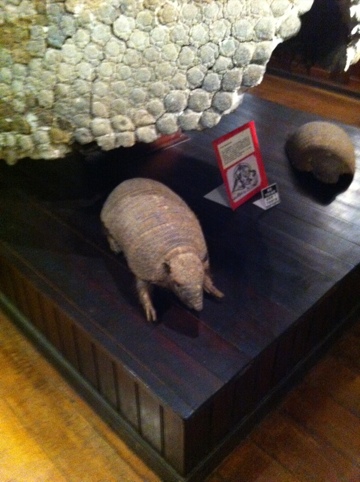

This feeling of an overly-pushed curatorial envelope was intensified at the teeny Museo del Indios in Colonia, which primarily displayed shelves and shelves of stones, some of which seemed pretty certain to have been used in native slings. (Fine. I liked the rocks. But none of them looked like they would be hurt by non-flash photography.)
Maybe this past arbitrariness was what put my teeth on edge today at the much more sophisticated Malba, Museo de Artelatinoamericano de Buenos Aires. Or maybe it was the head lice. (One of my family members picked some up in a youth hostel and we have spent some portion of this trip making sure that they were all ALL gone)
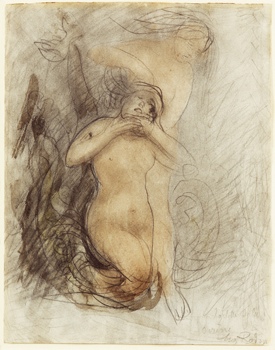
Both factors came up in the context of a beautiful drawing by Rodin. The Delousing of the Siren, I mean, Toilette de la Sirene.
The drawing, part of a terrific Works on Paper exhibit, begged to meet my iPhone. But I had already been advised by one very handsome and incredibly fashionable museum guard on a lower floor, a guard whose coiffed hair and bored expression seemed ironically calculated for a shoot, that photography was forbidden.
The guard at the works on paper exhibit was also handsome and fashionable. I was not even certain that he was a guard, until he looked up from his cell phone and began to focus on me, at which point, a quintessential guardness seemed to come to the fore. (I smiled. Probably a mistake.)
Although, to tell the truth, he may not have been focusing on me at all. The fact is that the Rodin drawing also hung in the only room of that exhibition that had an upholstered bench.
What to do? As I walked into the other rooms of the exhibition (he stayed on the upholstered bench), I tried to figure out how to turn off the clicking noise on the iPhone camera. ((I ended up with several photos of the floor.)
Every time I walked back to the Rodin, there he was. Should I pretend I didn’t know the rule? It wasn’t like I was carrying a yellow card from the first guard, but, at a certain point, I seemed to have smiled just too darn much, and I couldn’t somehow snap.
Finally, we went to a completely different floor and exhibit–Christine Pippa, a woman who makes rather political art with laminated meat and dessicated cow’s blood. I was going to settle for a surreptitious photo of the meat, despite the effect on my stomach, just to get some of my own back. But the first guard, the one who had actually seen me with the camera, had been moved down to this lower gallery, and I’d still not figured out how to turn off the iPhone’s clicking noise.
In short, I gave up, until back in our room, online, on the Malba site, I found it—-La Toilette de la Sirene! A much nicer photo than I could ever have taken.
What makes it even better: everyone’s heads (and consciences) are clear.
<a<br
MALBA-Fine Art But No Elephants
May 19, 2011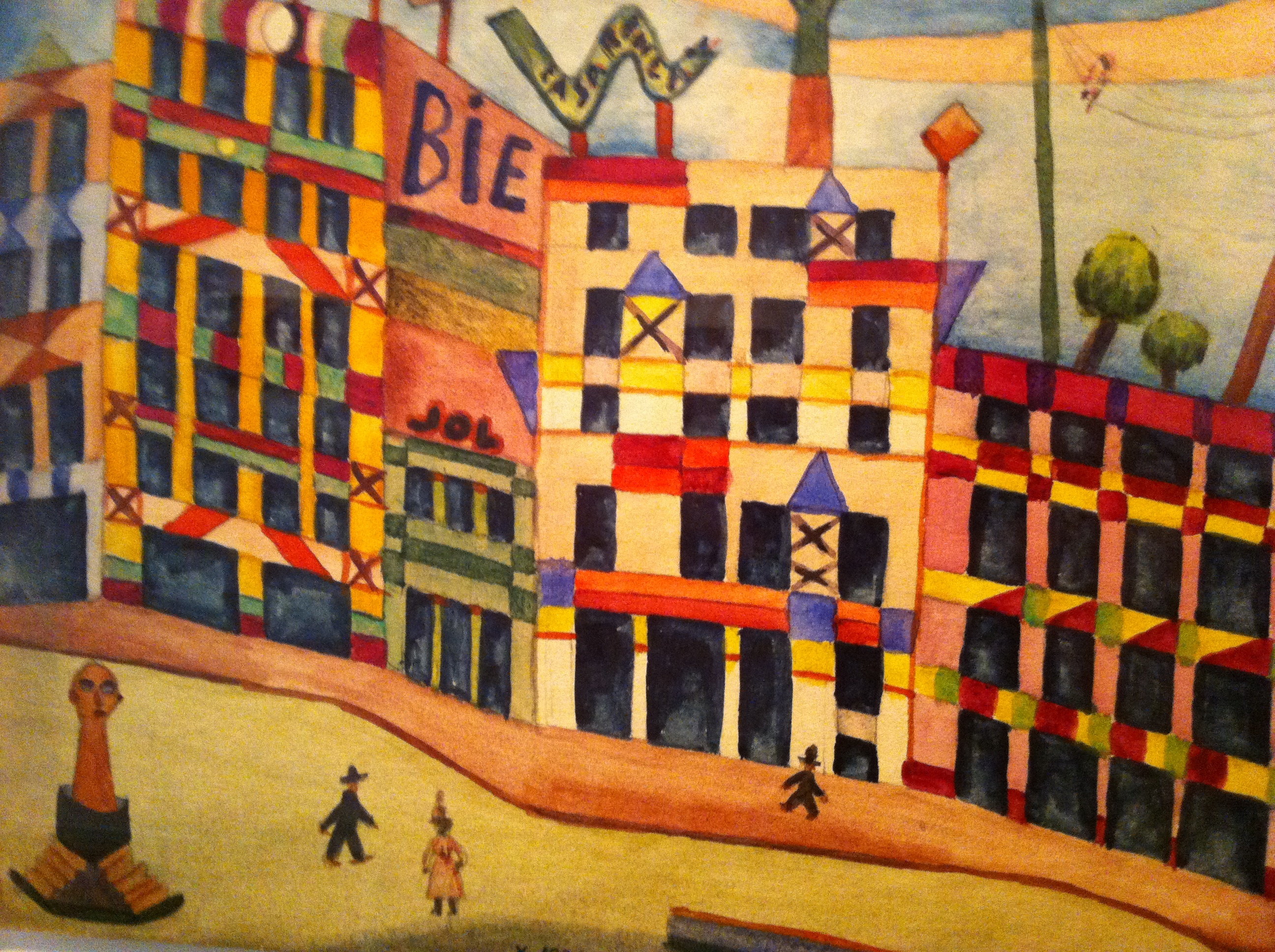
I am at the wonderful Malba today – the Museo de Arte Latinoamericano de Buenos Aires – where I am lucky enough to have the opportunity to see works by artists previously known (by me, I mean)–Frieda Kahlo, Diego Rivera, Fernando Botero–and artists previously unknown (I confess to a terrible ignorance here) – like Alejandro Xul Soler (above).
The bad news: the guards won’t let me take little photographs to draw elephants in. (For fine art with elephants, search prior posts.)
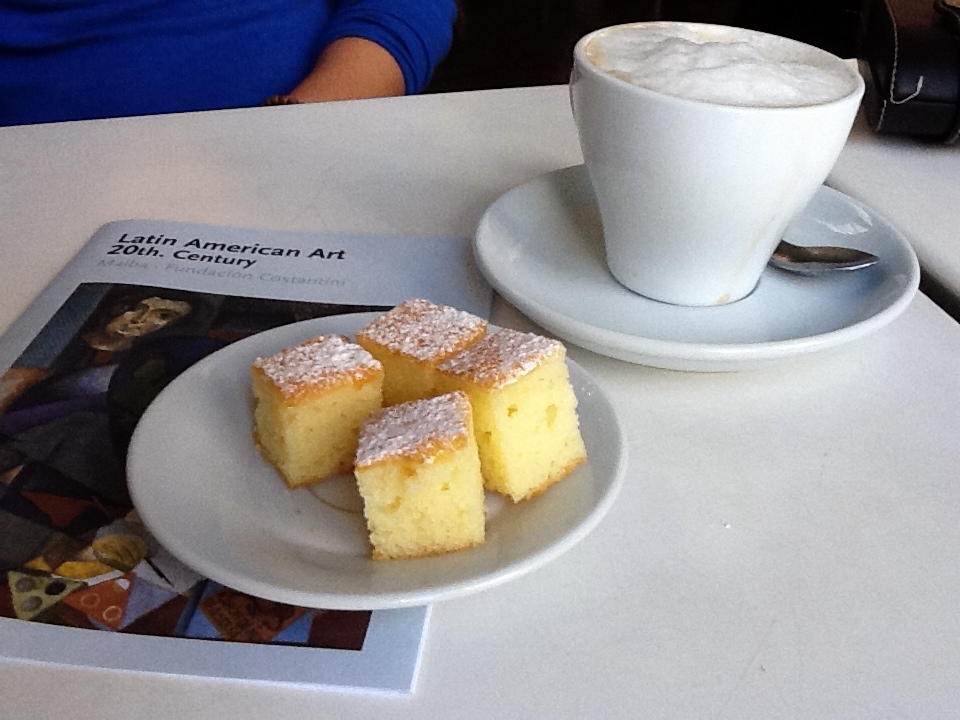
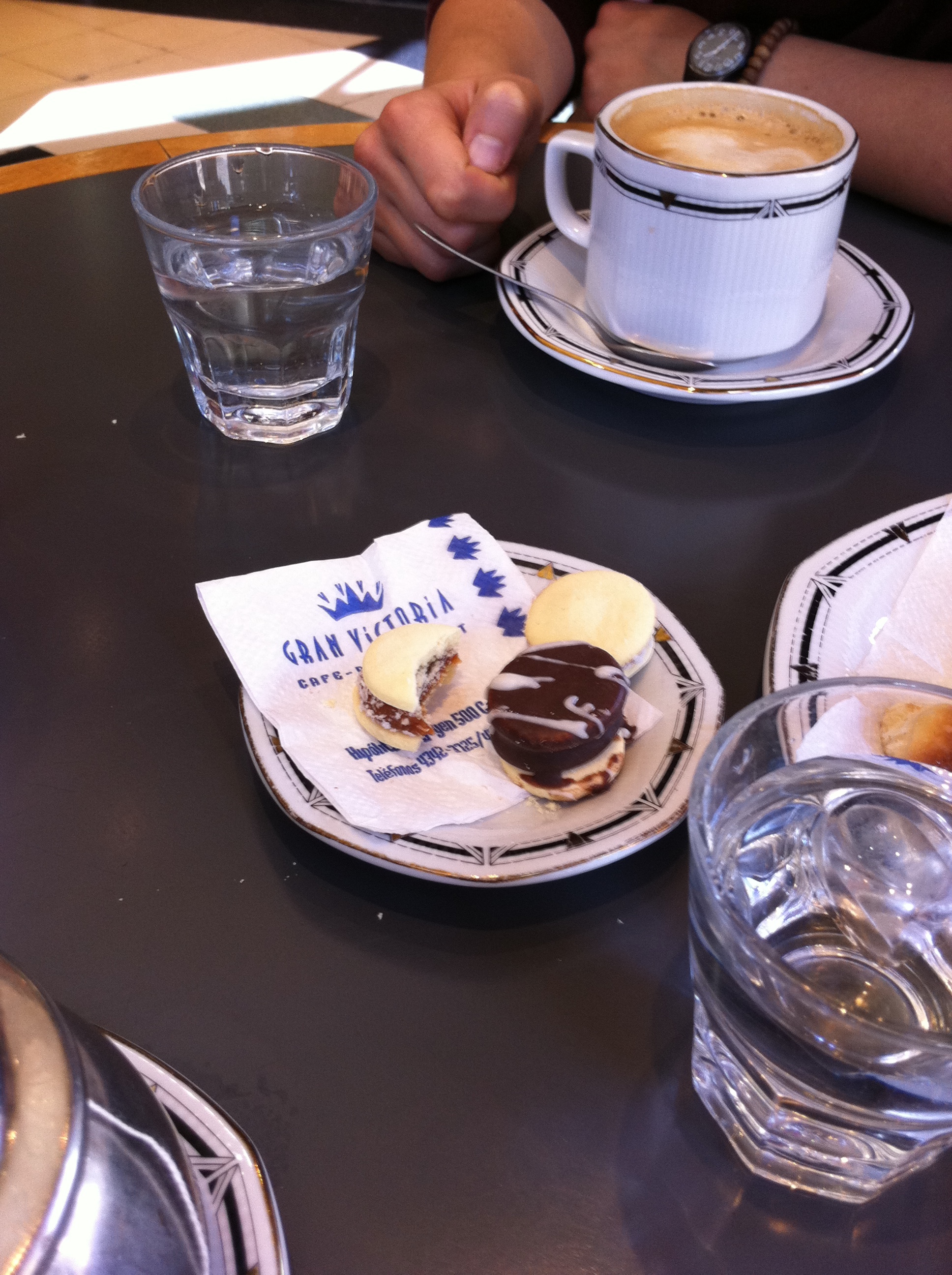
The good news: the cafe honors the city-wide tradition of serving a little plate of unordered treats with your order of coffee. Ah.
Coffee in B.A. – Lots of Little Dishes
May 18, 2011
As one of my daughters has noted, one of the great pleasures of getting coffee or tea at a cafe in Buenos Aires are all the little dishes.
This is only one of the great pleasures. The cafes are pleasant in and of themselves, with tables both inside and out, with leafy trees usually somewhere in view, if not directly overhead, with internet service and quiet and nice smells, and, above all, a sense, the minute you enter, of time stretching out before and all around you.
Of course, you do kind of need time if you are going to a typical B.A. cafe. The experience is not susceptible of rushing. Waiters typically take some appreciable fraction of an hour to note of your little fidgeting movements, or large body, at one of their tables. (This is not a complaint. Serving staff is almost invariably kind, and while they do not seem to notice little subdued bleeps of “we’re here,” they also, on the reverse side, never make signs that it’s time for you to go. It seems pretty certain, in other words, that one coffee could allow you to maintain a station in a cafe for several hours.)
Eventually, then, the order is made and one is, eventually, brought all the little dishes– a cup of coffee, a small container of sugar, a glass of water. If you are ordering tea, a small ceramic pot, and pitcher of milk. And then, the coup de grace, a little plate of some abbreviated treat–itty-bitty cream puffs, bite-sized cookies, smidgeons of brownie. (At one cafe, even side dishes holding a small scoop of ice cream.)
The treat is not something ordered by you; it just appears, as if the stimulus of caffeine demands a side of sugar for true absorption.
The best thing about the treats–well, the best thing is that they are incredibly delicious. And always a bit of a surprise. And free. And did I say delicious?
But the next next next best thing is that they are that exact size understood by any diet-conscious person to contain absolutely zero calories. Amazing.
Non-effectivo en Route
May 17, 2011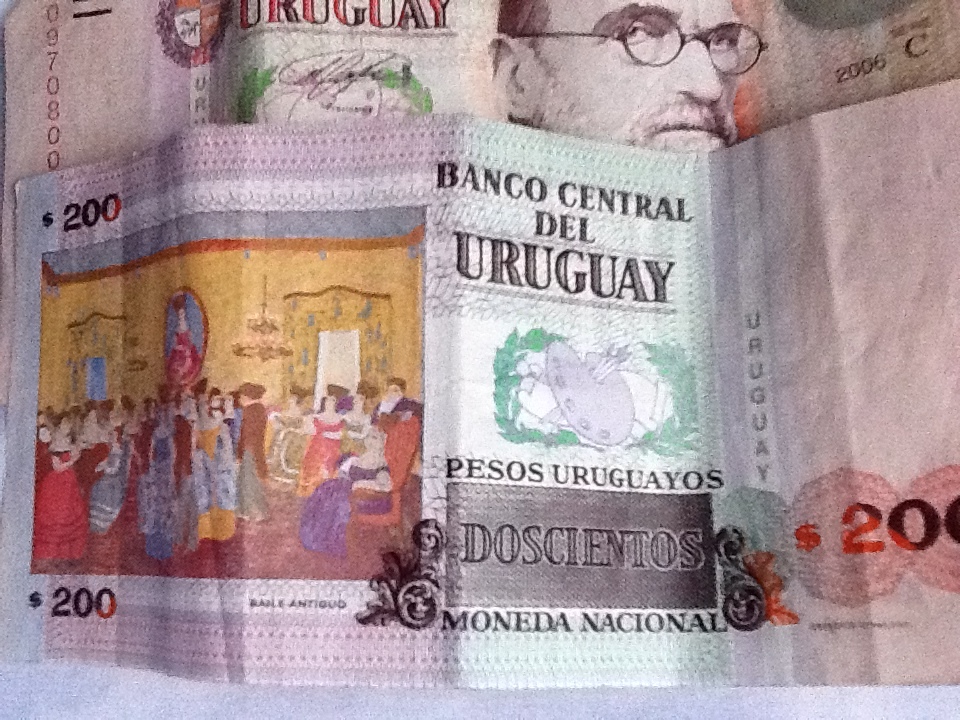
One of the hard things for me in traveling in Argentina/Uruquay is the prevalence of a cash economy. Effectivo (the real stuff) is what people want.
When I had young children in my house, and hired sitters, and took the kids to farmer’s markets for outings (okay, okay, there was also a playground there), and was late for everything (thus needing cabs), I used to carry a fair amount of cash. But I have slowly morphed into a New Yorker who buys groceries online and pays for even subway fares, much less taxis, by credit card.
The transition to cash is especially confusing when moving from country to country, especially given the various unclear fees that are attached to whatever transactions produce effective cash. Here in Uruguay, for example, one can get either dollars or Uruguayan pesos from the ATM machine, or if one finds a store that will take credit cards, one can charge in either dollars or pesos. But here’s the rub–are you converting from dollars to pesos back to dollars? And so multiplying fees? Or, by using dollars, are you skipping the 3% that most U.S. banks charge as a commission for transactions in a foreign currency and also skipping any other exchange fees?
Then, there’s the whole issue of the exchange rate that the particular establishment is offering in terms of the translation of price. In one Uruguayan restaurant, for example, one could pay in cash only, but in Uruguayan pesos, Argentine pesos or dollars. There, for some reason (an old menu?), the Argentine peso was valued at significantly more as against the dollar than in Argentina itself.
One would like to think that this confusion would make one pause before spending any money at all. Alas, it doesn’t seem to be effectivo, for that.
Heavenly – Variations On A Theme
May 16, 2011“`

This wonderfully sweet hotel in Colonia del Sacarmento, Uruguay, really knows how to take a decorating theme and run…errr…fly with it.


Even down to the soap.
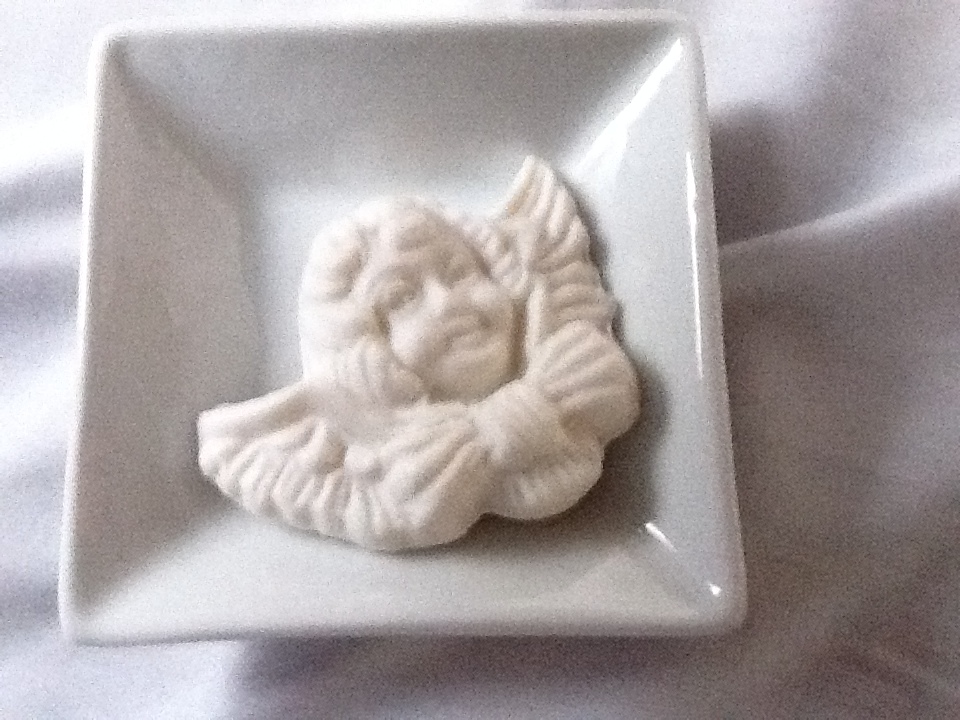
There is, however, one important sub-type missing.

Buquebus to Colonia
May 15, 2011
We are in the Barquebus where, unfortunately, we are not allowed on deck. I should explain that the Barquebus is a large ferry that travels from Buenos Aires to Colonia del Sacramento in Uruguay, and has, as its main seating area, a few hundred well-upholstered seats, four large screen TVs, a small cafeteria and a large duty free shop, which is currently being visited by nearly all of the passengers, other than us, and some children who are drumming on their serving trays.
I don’t much like boats. I say this with a stomach full of ginger, intended to combat sea-sickness.
Correction: boats are passable with a strong breeze in one’s face, or, at least, some kind of outside air.
But a boat with sealed windows and drumming children (did I mention the occasional wailing child? Oh yes, and the one who has made an accordion from a plastic bottle) is definitely not my preferred lugar.
The children are in fact very well-behaved. It’s just that I am on a boat, without a steady breeze in my face, and now that every one’s off shopping, the TVs just say “Phillips” in a completely dark screen.
On the good side, there’s a lot of impromptu percussion.
(P.S. The above is a drawing of a woman on the boat drinking matte. Matte, loaded with matteine, which appears to be very similar to the rhyming caffeine, is incredibly popular here, with men and women carrying thermoses of hot water everywhere to quickly refill their bowl of stimulating herb.)
Monster Ferry to Uruguay
May 15, 2011
Taking Buquebus Ferry to Uruquay today from B.A. Sounds pretty exciting. I anticipate/hope that it is only a monster ferry in my clumsy rendition of it above. Happy Sunday.


Recent Comments