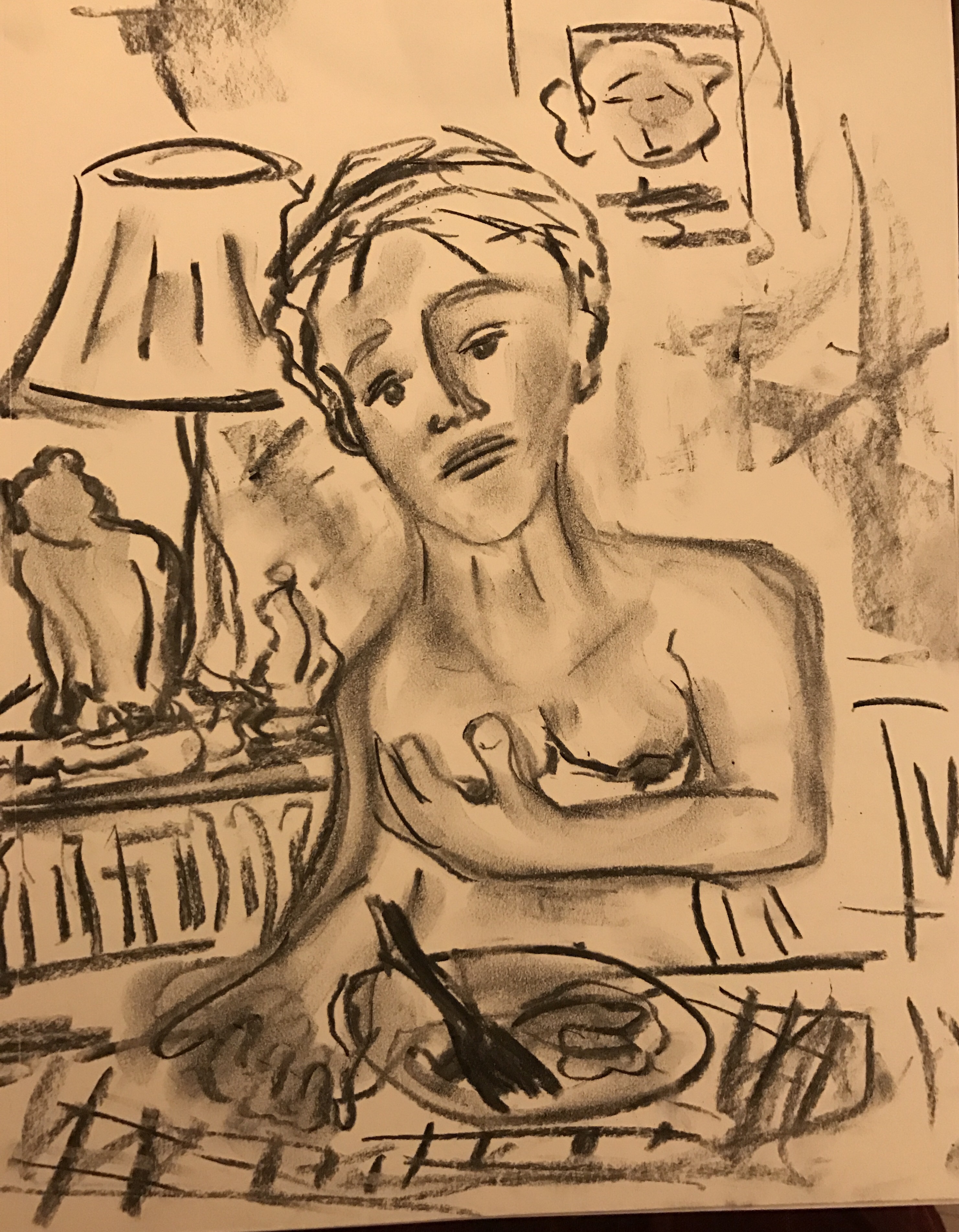
 Charcoal on paper, 2017, all rights reserved.
Posted tagged ‘breast exam’
Exam
May 19, 2017Breast Exam Sonnet
November 24, 2009American women of all ages are likely aware of a recent controversy concerning recommendations for mammograms and breast self-examination. The new guidelines issued by the United States Preventive Services Task Force suggest that screening techniques are overused, and that testing, even self-examination, should be limited, particularly in women under 50. The concern is that premature testing causes not only increased anxiety, but also unnecessary, and possibly deleterious, procedures and treatment.
This position runs squarely in the face of the popular view that early detection saves lives. (It has been especially suspect in the age of health care reform.)
Although many health professionals and cancer organizations have rallied around the old pro-testing guidelines, I, for one, favor the new, since, as a general rule, I tend to avoid all contact with doctors until gangrene is setting in. (Note to any of my children who may read this blog: I do not advocate this course of conduct for friends and family.)
The sonnet below effectively undercuts both positions, as its subject character undertakes a cursory breast exam at a hurried moment, thus managing to maintain anxiety while also avoiding effective screening. (I think it may be something many women manage.)
In the Stairwell
Descending the building’s stairs, she feels her breast,
fumbling beneath her bra to get to skin,
palpating (as they say) but in a mess
of here and there and not all within
the confines of an organized exam.
Silly to do it here, not time or place,
someone else might come, have to move her hand,
and yet fear seems to justify the race,
as if by checking each time it crosses mind,
especially checking fast, she can avoid
ever finding anything of the kind
that should not be found. And so, devoid
of caution, but full of care nonetheless,
she steps slowly down the stairs, feeling her breast.
All rights reserved. Karin Gustafson
(My apologies if I’ve posted this poem before; sometimes they get a bit lost in the mix.)
Sonnets!
September 18, 2009Sonnets have fourteen lines.
Count ’em.
Sometimes they are combinations of eight and six; sometimes four and four and four and two; sometimes strange intersections of four and six, eight and two (only adding up to fourteen.)
I have been thinking about them since hearing about Bright Star, the new Jane Campion movie about Keats. (I haven’t seen the movie yet, so can make no recommendations.)
Keats wrote great sonnets, even developing his own form.
Even so, I tend to stick to Shakespeare’s form. (Shakespeare, of course, wrote really great sonnets.) His form is extremely easy to remember, and relatively easy to write, as it uses a broad assortment of rhymes.
If I’m feeling more ambitious, I’ll try Spenser’s format, which is similar to Shakespeare’s, but uses a more limited rhyming pattern. (I’ll explain each in the next few posts.) I have never written a sonnet in Keats’ form (though I intend to try.)
Shakespeare’s form is set forth below. Remember, under conventions of poetic notation, a rhyme ending a specific line is denoted by a capital letter, so that the first set of rhymes is denoted as “A”, the second set of rhymes as B, the third set “C”, etc.
Shakespeare also uses iambic pentameter. (More on that later.)
A
B
A
B
C
D
C
D
E
F
E
F
G
G
The biggest problem with a sonnet is often the final couplet. It tends to have a very pat, “summing up” quality, that is hard to escape.
I do not to want my final couplet to sound like the “moral of the story”. Breaking the lines up so that they run over and do not pause at the end of each line can help in this regard. Humor is also useful.
A subject matter which is not easily summed up, also creates a certain tension that can temper the patness of the final couplet. Here’s one, for example on a self-administered, informal breast exam.
In the Stairwell
Descending the building’s stairs, she feels her breast,
fumbling beneath her bra to get to skin,
palpating (as they say) but in a mess
of here and there and not all within
the confines of an organized exam.
Silly to do it here, not time or place,
someone else might come, have to move her hand,
and yet fear seems to justify the race,
as if by checking each time it crosses mind,
especially checking fast, she can avoid
ever finding anything of the kind
that should not be found. And so, devoid
of caution, but full of care nonetheless,
she steps slowly down the stairs, feeling her breast.
(All rights reserved, Karin Gustafson)
Check out 1 Mississippi at link above.
 ManicDDaily
Recent Comments