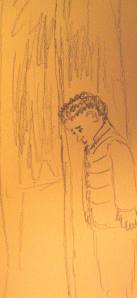
Sunday Poem (Mother, Daughter, in Father-Son Realm)

Posted February 21, 2010 by ManicDdaily
Categories: children's illustration, daughtering, poetry

Tags: , , , , , , , , ,

Script (Poem for Sundays)

A poem for Sundays–perhaps more of a story than poem.  Thanks as always for reading.

Script

Pictures hung in the Sunday School downstairs:
men mostly, whose long-haired, but not hippified, heads
were highlit with gold, clouds, doves,
and, hovering above, goatee-shaped
wisps of flame.

In the actual nave hung
only a spare metal cross,
lit by shafts of dust-mote-
dropping day.

Whenever the minister made an important point, he cupped
his hands together,
the fingers separate but clenched, the pinkies nearly throbbing
with tautness.  He used the gesture
to symbolize a knot.  But also growth.
Tense knotty growth.  How hard
it all was, how simple.

I watched the terse bend of knuckle closely, the extended
half-wound fists.  But, as the sermon droned, I turned to
other hands:  my own inside short white gloves, the
worn seam
tracing their perimeter,
like a railroad track en route to itself;
my mother’s, bare, cool, soft.
I picked up her fingers,
one by one, as if to find beneath them,
a way of passing time.

Then, just as my father’s shaved crust of chin
nodded over the crisp edge of Sunday shirt collar,
she quietly rotated
the bulletin on top of a hymnal and
modeled my name in script.
She used one of the short pencils stored in the pews
for new parishioners.  I, taking off one glove
to firmly grip the wood,
copied her letters slowly,
feeling each curve
as a blessing, a secret blessing,
for we were interlopers in that
realm of fathers/sons/ghosts,
the ones who snuck beneath the shafts of light,
then basked in them,
we women.

(All rights reserved.  Karin Gustafson)

Purple Teeth – From Generation to Generation

Posted February 20, 2010 by ManicDdaily
Categories: Stress, Uncategorized

Tags: , , , , , , , ,

Purple Teeth

I’m feeling very tired these days.

Some, as in, my husband, blame this fatigue on lack of sleep.  I say, no way José.  (That’s not quite what I say, but actually pretty close.) 

No, I blame a lot of it on my genetic heritage, those Norwegian women on my father’s side, to be specific.

There is something about Norwegian women and anemia.  So a doctor once told me.  In my possibly anemic brain fatigue, I can’t quite remember what he explained.  Perhaps the problem is that we evolved to gnaw on reindeer bones, and now don’t: I’m vegetarian and my female Norwegian forebears lived mainly on work combined with baked goods, black coffee, and the occasional round of pickled herring.  (Omegas!)

  “Work” (house work, farm work, community work) is perhaps not the best word for what energized them.  How about “will”? 

They each had rounded foreheads, and soft, but high-cheekboned, cheeks.  (Their faces seemed, a la Henry Louis Gates, to hold hints of migrations through central Asia, the Aleutian Islands, the Himalayas, maybe even Hungary.)  They had soft voices too.   (They believed in quiet, remember?)  But beneath all this softness, there were these extremely intense wills–a need to get their way.

That’s not really fair.  They weren’t selfish women;  they worked hard, and mainly for others.  As women of that generation, they were denied much that they didn’t even consider craving–power in the greater world was not just unaccessible, it was unthinkable. 

But in their home world, they maintained a very definite power.  This took the form of standards:  things you were supposed to do, and not do;  things like maintaining, at all times, order, cleanliness, a peaceful facade.   Things like baking hot dishes for the church, and the bereaved, and every day too, for the family, then washing those dishes immediately, drying them instantly with dishtowels (air took too long), and scurrying them back up in neat stacks on shelf-paper-lined shelves.   Washing, ironing and folding clothes, was done only on certain days and at certain times of day.  (To do laundry, for example, at 11 pm, even 9 pm on a Thursday night would be a sign of a breakdown of all that society held dear.  Wash was for Mondays, or at least a.m. hours.)  

But this will was not so good at the creation of red blood cells.   As my Norwegian grandmother, great aunt, greatgrandmother aged, they always seemed to turn to iron-rich vitamin liquids that turned their teeth a dull violet purple.  No matter how wilfully they tossed the little capfuls back—they would do it as if it were a shot of alcohol—the purple taint crept into their smiles.

 I find myself increasingly suffering from this rage for order.  Mine is not like theirs.  Their drawers, closets, were like large jigsaw puzzles, with everything fitted perfectly in its spot.   Mine are… well, let’s just put it this way.  I’m okay with chaos behind closed doors. 

 And did I mention that need for quiet?  Ahem.

But now (and this really is kind of scary), I found myself tired enough to toss back a tiny little capful of some dark brown, herby, iron-rich fluid, and no matter how I brush my teeth….

Further To….

Posted February 20, 2010 by ManicDdaily
Categories: Blogging, news

Tags: , , , , , , , , ,

One of the good and bad features of a daily blog (especially for a blogger with a daily job) is that it requires the blogger to get posts out quickly, sometimes before an issue is very well understood.  (Sorry!)  In such cases. the post is really a reaction (perhaps premature) to an issue, rather than any kind of cogent analysis.  Sometimes the post doesn’t even reflect the blogger’s longer-term, or considered, reaction to an issue,  but, at best, is simply a snapshot of the moments in which it was written.

Here is further information about the topics of two recent posting:   the first relates to The Line Between Satire and Sneer (illustrated by the teapot surrounded by UFOs), which expressed my wish that the TV show Family Guy hadn’t joked about  the mother of a character with Down’s Syndrome being the former governor of Alaska.    Palin and her daughter Bristol interpreted the program as a cruel jab at Palin’s son Trig (with Down’s Syndrome).  An article in today’s New York Times describes the reaction to Palin’s outrage of the actress,  Andrea Fay Friedman, who did the voice-over for the Down’s Syndrome character and who herself has Down’s Syndrome.  Ms. Friedman accuses Sarah Palin of not having a sense of humor, and of misunderstanding the episode, which presents the Down’s Syndrome character as an obnoxious but strong figure:   “I’m like ‘I’m not Trig. This is my life, ” Ms. Friedman said in a telephone interview with the Times, “I was making fun of Sarah Palin, but not her son.”

I still don’t like Family Guy.  (It’s the crassness.)  And I still wish that the show had not given Palin further “mileage”.  But the article, which gives more information about both the episode and Ms. Friedman,  certainly clarifies another perspective.

The second story which is subject to increasing illumination as the days go by is about Joe Stack, the man who ran a plane into the Austin, Texas IRS building (and whose disgruntlement with the IRS apparently began when the IRS refused to give him a tax exemption as a church.)   Gail Collins has a great article today, The Wages of Rages, about Stack, but also various lame-brained attempts of Republican politicians to expropriate Tea Party rage for political capital.   Yes, she manages to include a reference to Mitt Romney tying his dog to the roof of his car.

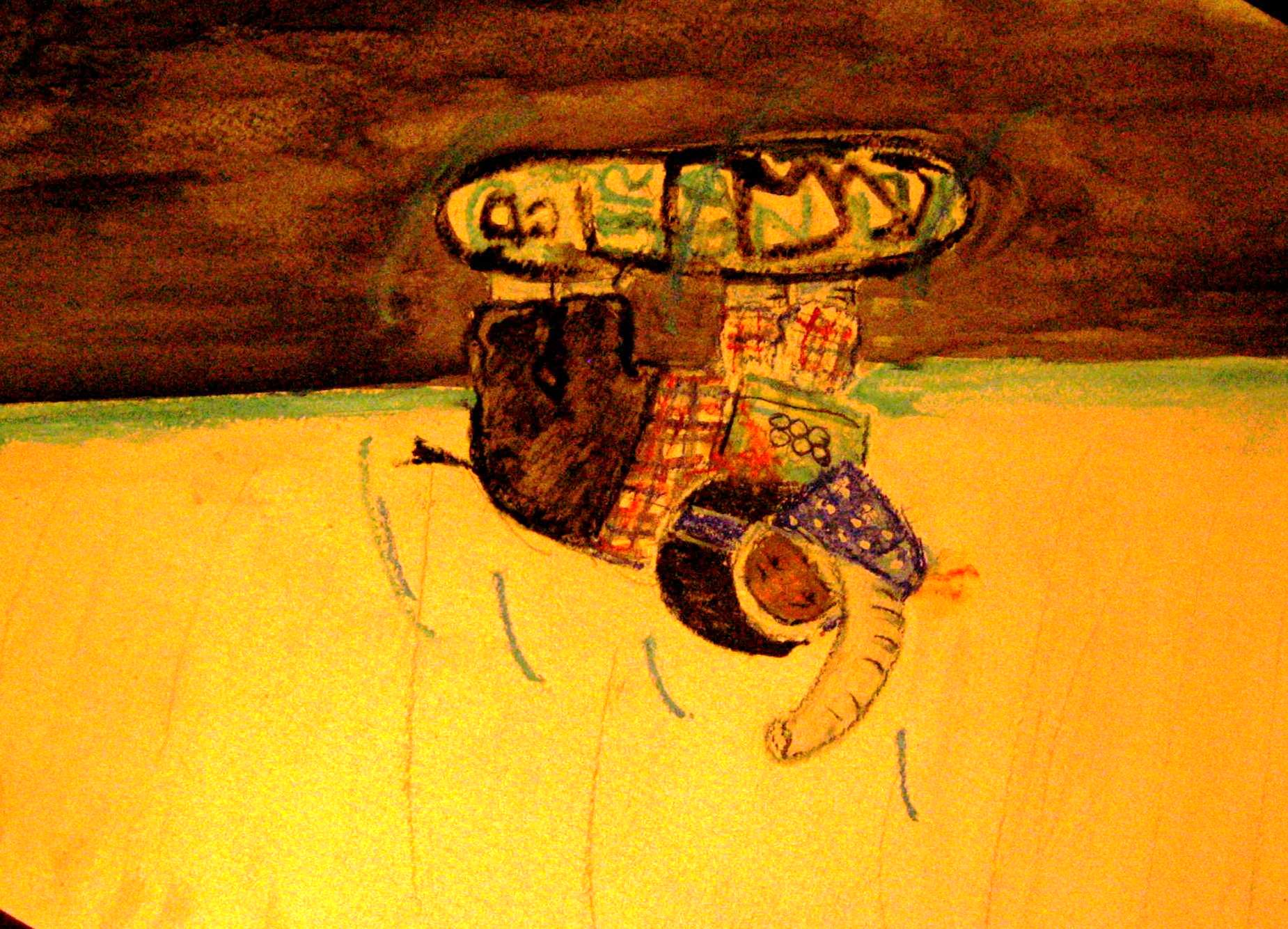
Elephants in Vancouver (Maybe)

Posted February 19, 2010 by ManicDdaily
Categories: children's illustration, elephants

Tags: , , , ,

On the Half-Pipe, But Not Quite as Confident as Shaun White

Happy Friday!

(P.S.  If you like elephants and watercolors, check out 1 Mississippi by Karin Gustafson on Amazon.)

Blowing His Stack

Posted February 18, 2010 by ManicDdaily
Categories: news

Tags: , , , , , , , ,

It’s very hard to know what to make of Joe Stack, the apparent pilot of the plane that crashed into an Austin, Texas IRS office today.

My first reaction was that this is what you (we) get when it becomes popular to demonize the U.S. tax system, to talk about revolution and seccession, and to push diabolical conspiracy theories.  But Stack doesn’t seem to exactly fit into a Tea Party profile (whatever that is.)   For one thing, he comes across as extremely anti-capitalist.  For another, though he specifically targets the IRS, his enemies are too diversified to represent a particular partisan viewpoint.

All that’s really clear from the internet letter Stack posted before his plane crash is that he was very very angry—angry that corrupt and self-defeating institutions (he names GM in particular) are bailed out while he seems to get financially hit again and again.  Angry that all kinds of people and things present obstacles to him and his retirement plan–GW Bush,  Arthur Andersen, Patrick Moynihan, sleazy accountants, tax lawyers, specific inequities in the tax code, the closing of bases in Southern California in the 1990’s, difficulties with air travel after 9/11, low pay rates in Texas, the FAA, drug companies and insurance companies, the Catholic Church, fat cats in general.

Because Stack’s’ attack was against the IRS, some people have already expressed sympathy for him (while acknowledging the horror perpetrated on his victims.)     He’s clearly someone that was pressed beyond his breaking point; reading about someone who is under such internal (and possibly external) pressure invokes a certain sympathy (in addition to a whole bunch of fear.)

But the sympathy (or at least any sympathy that I feel) ends with the bloodletting:  “violence not only is the answer, it is the only answer,” Stack writes.

Here’s where I question the influence of our culture.  The guy was clearly mad—and perhaps not just in the sense of angry.  But the fact is that we have a ‘tit-for-tat’ culture, a culture which seems to admire, or at least, accept, vigilantism.  It’s a culture that espouses hitting back, standing up for one’s self with a gun (or some kind of weapon); it is not a “turn-the-other-cheek” kind of culture, not even among much of the Christian right.

Stack complains about “taxation without representation,” but what this seems to refer to is not that he did not get a chance to voice his views, but that his views did not carry the day, that, in other words, he didn’t win.  (Does this sound familiar?)

I’ll stop right here.  Who knows yet what was really going on with the guy?   Craziness all around;  unhappiness all around.

Fear and Loathing on the Number 4 (The NYC Subway Not Much Of A Tea Party)

Posted February 17, 2010 by ManicDdaily
Categories: New York City, news, Stress

Tags: , , , , , , , ,

Boy on Number 4 Train

“The people here are f—ing animals,” said the slightly hard-faced young woman to her ten or eleven year old son as they scooted onto my express.

The train was full, but not jammed; there was space not only to breathe, but even to move around a bit.  The boy, wide-eyed and buzz-cut (his mom was holding his Yankees cap), stepped towards one of the center poles, reaching in between passengers, to hold on—his mom quickly pulled him back towards the door.

“These people push you,” she said, draping an arm around him, “I’ll push them back.”

At their side, I kept thinking how unfair this was.   Saying that people push on the train is a bit like saying that a bunch of clementines slung into a bag, clothes crushed into a hamper, or lemmings urged into the sea, push. Okay, maybe we and the lemmings do.  Some.  Still, in my experience, most New York City subway riders, especially the ones whose faces are almost grazed by my forearm as I reach for something to hold onto are pretty forbearing.  (A very different f-word.)

I’m kind of a busybody, I guess, in the sense that I pay attention to strangers.  (As noted in my previous posts, I believe in a “ripple effect” of trying to be peaceful, pleasant, on the subway.)  So now I tried to smile discreetly at the boy to reassure him that he wasn’t really surrounded by f—ing animals.

But it was hard to smile at the boy.  First, because I was afraid his mom would slug me;  secondly, because I was worrying about the fact that his mother had thrust him into a spot (by the door) where there was nothing at all to hang onto.   (I envisaged lurches, collisions, a huge altercation.)

But as the train pushed from the station, the mom grabbed him again, folding her arm around his neck.

After a minute or so, as the ride stabilized, she loosened her grip, and the boy turned himself around so that he faced the door itself and leaned right into it.   This worried me even more.  GERMS.   (I’m a mother too.)

Then I realized that he was (probably) not pressing his mouth into the rubberized seam of the door, but into the collar of his jacket. And then, that the little boy was gently but firmly hitting his buzz-cut head against the door itself.  Again and again and again.

He did not look autistic.  (Who knows?)   But he did not look like he had any “organic” type of problem that might lead to headbanging.   He just looked, well, down, as he softly banged his head.

The mother gently put her hand on the back of his head to try to stop him.  When that didn’t work, she put her hand on his forehead to shield the place that was banging.  That didn’t stop him either.

Finally, we got to Union Square where she put her arm around his neck again and told him they had to get out—

“This our stop?”

“No, to let the people get off.”

As they stepped back into the train, there was one emptied seat left, which I pointed out quickly to the woman.  I felt a little guilty as there was a little old lady right behind them, but the old lady probably wouldn’t have swooped down on the seat in time in any case, and the boy, with his mom pushing him, was a pretty good swooper.

The mother nodded at me once her son was situated,  half-smiling for just a moment.  Then she leaned heavily against the center pole, her face tired, stressed.

The incident somehow made me think of the Tea Partyers again.  I don’t think I quite said what I wanted to yesterday in my post about sneering.  And I don’t mean to imply that the woman on the train was a Tea Partyer.  Only that she seemed frustrated and fearful, and I’m guessing (with really no clear evidence) that she doesn’t much like or trust government, and probably not Obama.

A big part of me wanted to say to her:  ‘Hey!  Don’t spout the f-word to your kid.  Don’t teach pushing on the train!  Enough with automatic retribution!’

But I was able to stop myself.  Besides the fact that she really might have hit me, that kind of speech would simply not have been very useful.  As it was, I was lucky enough to be able to help her get a seat for a tired boy.  And to get a smile from her.  And for both of us to feel that strangers in our society could, in fact, have a kind of connection.

I don’t mean to pat myself on the back here.   Just to say that it felt good.

The Line Between Satire and Sneer–UFO’s and Palin, Tea Partyers and Obama

Posted February 16, 2010 by ManicDdaily
Categories: news, Obama, Sarah Palin, Uncategorized

Tags: , , , , , , , , , , , , , , ,

Tea Pot and UFOs

I freely confess that I’m not a Family Guy kind of gal.  I just don’t care for crass.

Even my beloved Robert Pattinson has really turned me off lately with his gross and negative remarks concerning female private parts.   (Better watch out for your constituency, Rob.  You haven’t exactly shown yourself to be Laurence Olivier, after all.)

Because of my dislike of crudity, I haven’t watched the Family Guy clip of the Down’s Syndrome character whose mother is the Governor of Alaska.  I  just wish it hadn’t been aired.   Mainly because I personally think it is wrong and offensive to make jokes at the expense of little children with disabilities.

Secondly (and I’m sorry if I’m being crass here myself), it feeds Palin’s mantle of media martyrdom, consequently diminishing the impact of jokes and criticism justifiably aimed at instances of her hypocrisy and untruth  (that is, meaningful satire.)

How to distinguish between mindless stupid crass jokes and meaningful satire?  I feel a little bit like Stephen Colbert here, who recently tried to use Palin’s calculus for acceptable uses of the word “retard”, distinguishing between what Palin called Rush Limbaugh’s acceptable use of the word as “satire”, and Rahm Emanuel’s unacceptable use (to characterize certain Democrats) .

(Yes, even as I write that, I’m conscious that I’m jumping onto the whole “making fun of Sarah Palin” boat.)

But here’s one of the problems with jumping on to that boat.  There are a lot of frustrated, fearful, angry people in this country who feel that Palin speaks to and for them.

Some of these people, the Tea Partyers, are relatively easy to mock.  They tend not to be “hip”;   they sometimes seem ignorant; some of their views (seccession!) seem pretty outlandish.

I especially cannot understand these people’s take on Obama.  (Some of them view him not only as  a non-U.S. citizen, but terrorist witch doctor).   The people who espouse such views  seem to me like the kind of people who believe in UFOs.  (Particularly UFOs sent into space by the Federal Government.)

But these people are not truly crazy;  they drive cars, hold jobs, pay taxes (reluctantly), raise children, take care of the elderly, work.    But they feel that they/we are in terrible trouble, and they act like people both steaming mad and desperately seeking a cure.  (They make me think of those books that advocate eating nothing but garlic or watermelon.)    The cure they want is to go back to a past that never actually was; to a simplicity that never was.

Making stupid jokes at their expense, sneering at them (and at Palin), is not a good way to quell fears,  ease resentments.

While Obama can be professorial, he is also extremely good at explaining complicated issues in simple, but not reductive, ways.    He needs to use that skill more to remind Americans of how the country arrived at this economic downturn, of why the banking system was saved, of how the Republicans in Congress (and in the White House) both contributed to the current crisis and are now blocking its repair.   He needs to keep it simple, make it direct.

And while hypocrisy may deserve satire, Obama (and his supporters) should avoid the side of the sneer.

George Washington, Sarah Palin, Cherry Pie and Christian with a capital “C”

Posted February 15, 2010 by ManicDdaily
Categories: news, Sarah Palin, Uncategorized

Tags: , , , , , , , , , , , ,

Washington and Cherry Pie

Presidents’ Day.  In my youth, we had Lincoln’s Birthday on February 12 and Washington’s Birthday on February 22.  I don’t remember specific rituals around Lincoln’s Birthday, but Washington’s was celebrated with cherry pie.

And, of course, big sales.

Now, what we mainly have are the sales.

I could not help thinking of Washington today.  Partly because I still had Sarah Palin’s Tea Party speech on my mind, “American Exceptionalism”, and the attempt (apparently among certain members of the Texas Education Board) to characterize the founding fathers as Christian (with the capital “C” and silent “F” of Fundamentalism).

Even when I was little, the one thing we all knew about George Washington was that whole incident with the cherry tree. We had been told that the story was probably not true, but understood that the point was that Washington himself was true; a good man; that even as a child (like us), he could not lie.  (I thought about him as a kind of American Pinocchio.)

Of course, even the true stories about Washington stress the strength and nobility of his character, noticeable in both his age and youth.  I read today, in connection with thinking of Washington’s character, the precepts Washington copied out at sixteen:  Rules of Civility & Decent Behavior in Company and Conversation, 110 maxims which are believed to have come from a book published in 1664 in London entitled, The Young Man’s Companion, and which, in turn, were derived from rules developed by French Jesuits in 1595.

The Rules are a detailed compendium of how to show respect and consideration to others, both in matters of literal nit-picking as well as “not-picking-upon.”  Although the rules urge a young man to keep the “celestial fire” of conscience alive, they do not seem to teach how to please a Christian God (there are no biblical references), but how to be a good, honorable, admirable person.

The founding fathers, shaped as they were by the Enlightenment, seem to me to have been big on such precepts, guidelines, universal rules.  One thinks of Ben Franklin, who, in his Poor Richard’s Almanac, published literally hundreds of adages, rules to live by.  While some of Franklin’s adages do mention God (as in “God helps those who help themselves”), and many castigate immorality (especially hypocrisy), the focus is more on prescribing a moral life because it is a key to happiness, contentment, self-fulfillment, societal good:  “Sin is not hurtful because it is forbidden but it is forbidden because it’s hurtful. Nor is a Duty beneficial because it is commanded, but it is commanded, because it’s beneficial.”  (Poor Richard’s Almanac, from 1739.)   In other words, a good life is its own reward, and, more importantly, is a reward.

Thomas Jefferson was particularly interested in theology;  he even wrote specifically about Jesus, but again, his interest seems to focus not so much the specific religious meaning of Jesus, but in Jesus as a sublime paradigm of the ethical life.  (Apparently, Jefferson’s book, published in 1820, The Life and Morals of Jesus of Nazareth, sets forth Jesus’s ethical pronouncements, while editing out the Virgin birth, the miracle stories, Jesus’s claims to divinity, and the resurrection.)

I really do not know as much about the history of these men as I would like, so forgive me (and comment) if I’m mischaracterizing them.  I’m certainly not trying to make them out as “anti-Christian”, but simply saying that it seems bizarrely reductive, simplistic, and manipulative (i) to argue that the use of the word “God” or “Creator” in our founding political documents aligns the founding fathers with the religious right; (ii) to ignore the historical context of these guys (as heavy readers of both the Bible and Voltaire), and (iii) to treat them as if they were somehow more mainstream versions of Joseph Smith, i.e. specific transmitters of divine will.

Agh!

And yes, it’s possible to be ethical and even christian without the capital “C” or the capital “F”, in the same way that one can honor the American flag without being pro-war.  One can even like cherry pie.

(All rights reserved.)

PS- if you like elephants, as well as watercolors, check out 1 Mississippi by Karin Gustafson on Amazon.

Palin on Prosperity – God Help Us.

Posted February 14, 2010 by ManicDdaily
Categories: news, Sarah Palin, Uncategorized

Tags: , , , , , , , ,

In Chilapa, Mexico

Started out today (Valentine’s Day) intending to write and draw about love and its objects.  With and without elephants.

One object of my love is tea.   My first cup, drunk while reading Frank Rich of the New York Times, unfortunately brought me to ‘tea party’.  And tea party, elephants, Frank Rich, and Valentines (as in who can be as cutesy, hokey, and reductive, as a Hallmark card–sorry, Hallmark!)–brought me to Sarah Palin.

I confess to having a hard time listening to Palin’s Tea Party speech (I had to read the transcript).  There is a teasing artifice that is deeper than the teased hair.   She zings out one-liners which she must know are not true;  she presents herself as  a spokesperson for the “little guy,” while keeping a continual eye on the nontransparent ball of personal enrichment and aggrandizement.

(One of the personally most aggravating inconsistencies is her castigation of government programs while touting herself as the protector of those with special needs.  Who pays for the lifetime care of most people with special needs, Sarah?

Her “solutions” are also one-liners:  on the war against terrorism:  “Bottom line, we win, they lose. We do all that we can to win.”  (Gee, amazing that no one else thought of that.)

One would think that Sarah’s highly-paid exhortations towards an un-fact-based, if strident, agenda would cause her pause, maybe even a little guilt.  But Sarah seems to bypass all those concerns by a pink cloud of religious faith:  as in ‘if we Godly people can only get into power, God will swoop down and save us.’

Palin’s actual words: “you know, we don’t have all the answers as fallible men and women.  So it would be wise of us to start seeking some divine intervention again in this country so that we can be safe and secure and prosperous again.”

I don’t doubt Sarah’s faith.  I understand people (including myself)  seeking divine support and guidance in times of trouble and not.

But what’s worrisome is Sarah’s casual equation between the search for divine intervention with safeness, security and prosperity; as if hard, fact-based, complex, boring, analysis, could be bypassed.

Putting aside some of the more philosophical questions–didn’t George W. try that?

Secondly, well, is God really that interested in the the bank bail-out?

Third, Sarah, how can be so sure that you have a better pipeline to God than Obama?   (BTW, didn’t your demi-idol Ronald Reagan consult an astrologer more frequently than a pastor? )  (And isn’t this an awfully lot like the type of things that the Taliban preach?)

Finally, aren’t there a lot of religious, even Christian, people who are not particularly safe, secure or prosperous?   (Don’t, in other words, bad things happen to good people?)

She makes me think about a trip to Mexico a couple of years ago.  Mexico is an extremely religious country;  in the small town where we stayed there were fiestas every week in which the “Cristianos” conquered the “Moros” on the paving stones in front of the local cathedral.  At one fiesta, depicted above, a man dressed in satin swaddling clothes was hung from a cross on the back of a truck.

The Mexicans, in short, are not afraid to show, even to parade, their religiousity.   And yet that country suffers from poverty, unemployment and underemployment, terrible drug violence.   Yes, it’s true that abortion, long illegal there, has very recently had a slightly greater allowance in a few Mexican states.   However, anti-abortion rules are on the rise again  (and Mexico’s economic and social problems long preceded any loosening of abortion laws.)

Sarah, please  explain.


Heart In A Box – A Simple Proposal

Posted February 13, 2010 by ManicDdaily
Categories: music, Uncategorized

Tags: , , , , , , , , , , , , , , ,

Heart In Box (by Jason Martin)

The photo above is a bit unusual at Valentine’s.  Typically there are boxes in the shape of hearts rather than hearts in plain old boxes.

Looking at the picture made me think about hearts that are out of the box. And that (wierdly enough) brought up the trend towards increasingly elaborate proposals of marriage.   (By elaborately planned proposals, I do not mean the scheme of Andy Bellefleur in one of the Sookie Stackhouse novels in which he enlists Sookie’s help in putting an engagement ring in a basket of fried chicken fingers.  Yes, they were greasy.)

I refer to the proposals that are the work of an entire business, a special “events team”.

I tend towards the spartan, but the marriage proposal business seems crazily excessive to me,  the commercialization of the personal,  the overwhelming of the heartfelt with artifice, the exchange of the truly grand for the grandiose.

I understand that people want to try to ensure the perfect moment, the perfect memory.  Perhaps they also hope that the perfect proposal will ensure the perfect marriage.  But, as two famous sages, Gautama Buddha and Mick Jagger, separately said, “You can’t always get what you want.”

Okay, okay, Buddha’s saying was more along the lines that ‘desire is the root of all suffering’, which is somewhat broader than Jagger’s pronouncement.  Buddha’s truth, after all, encompasses the idea that even if you do get what you want (such as the perfect marriage proposal), it will not ensure happiness.  (Desire and desire and desire leads to desire and desire and desire.)

Jagger’s saying, in my teenage mind, was always followed with”mumble mumble mumble…YOU GET WHAT YOU NEED,” as if basic satisfaction was a bit on the automatic, if shouted, side.

But today, when I really thought about the lyrics, and actually looked them up, I saw that they were more complex:

“You can’t always get what you want
But if you try sometimes you just might find

You get what you need.”

What does the “trying” here mean?  Or for that matter getting what you need?  Trying to get enough so that you might not get off, but at least you won’t go into withdrawal?

Maybe.  But my semi-Lutheran, semi-Buddhist, admirer-of- Mick-Jagger, self prefers to think of it as trying to find acceptance of what you already have,  trying to discover that, at least occasionally, you have enough in what is available.

Which brings me back to the heart in the box.    Creativity, memorability, glow, glimmer, really do not require so very much:  tin foil, a  discarded box, a hole cut in some white paper, a very small battery, a teeny light, darkness.

Heart In A Box (Jason Martin)