Blogging, With Elephants?

Posted May 28, 2010 by ManicDdaily
Categories: Blogging, elephants

Tags: , , , , , ,

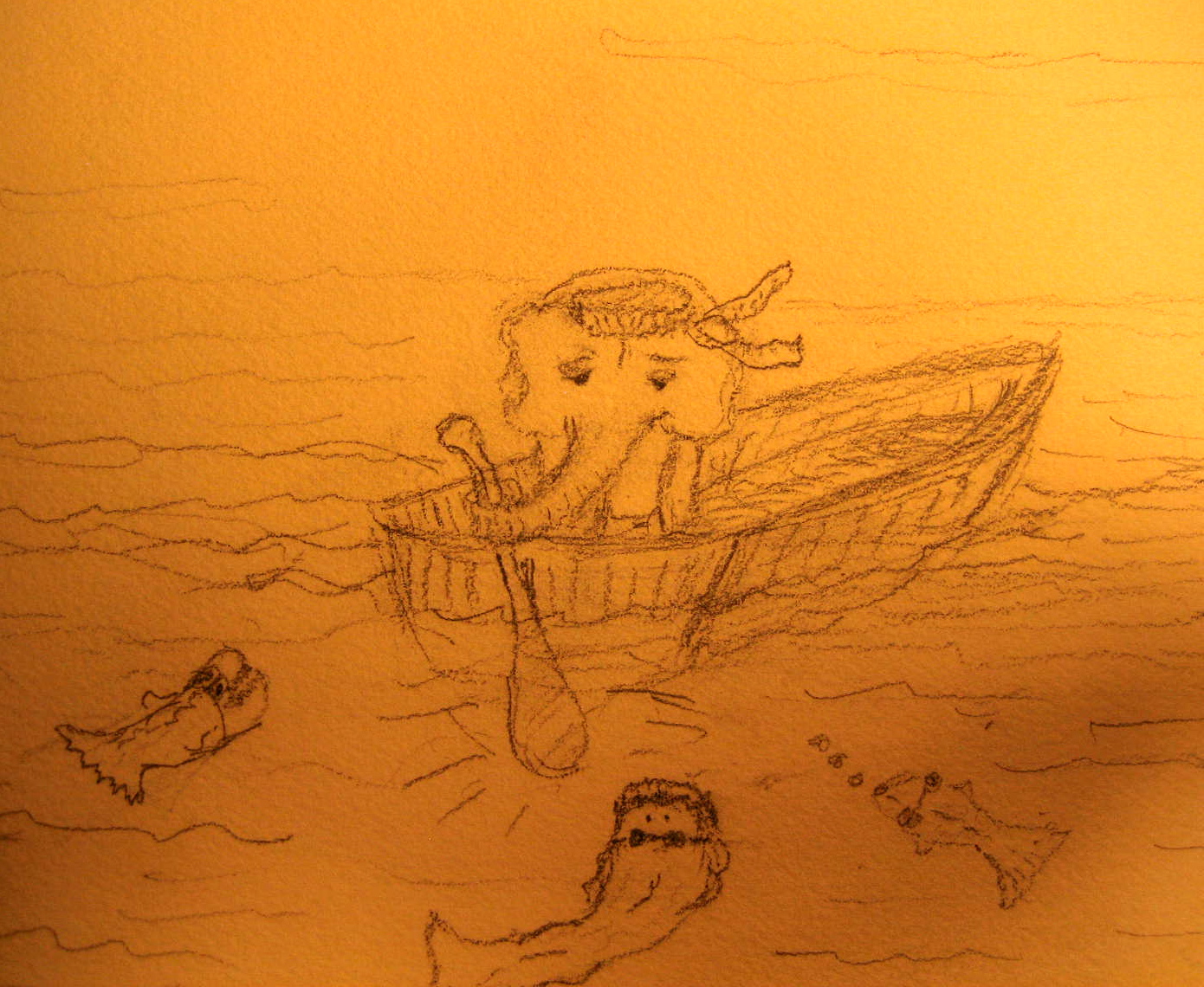
More Elephants

I am bemoaning today the lack of subject matter of this blog.   Actually, it’s not completely fair to say that there is no subject matter.  The subject matter is whatever comes into my ManicDdaily head.

I am bemoaning today the lack of consistent subject matter.

People like subject matters, just as they like a certain predictability.  It’s bred into the species, I think, maybe into living itself.  Babies with clear naptimes tend to nap  more easily and more cheerfully; dogs want to stick to their routines, marking the same old spots on their same old walks; horses find their way back into their stalls; and adults (human adults) like to get the same kind of bagel with the same kind of cream cheese, with the same kind of coffee, with the same amount of sugar and milk in it, every single morning.

As part of this preference for the routine, I am pretty sure that people tend to prefer a blog that has a theme.   Something they might even learn from, or at least, feel uplifted by.

But I don’t really know anything well enough to teach it.  Further,  anyone labeling their blog ManicDDaily may not in fact be so uplifting, so….

Hmmm…..

What can I write about?  Consistently? (Or draw?!)

Elephants?

(But shouldn’t it be meaningful?)

More elephants?

Hmmm….

Any and all suggestions are welcome .

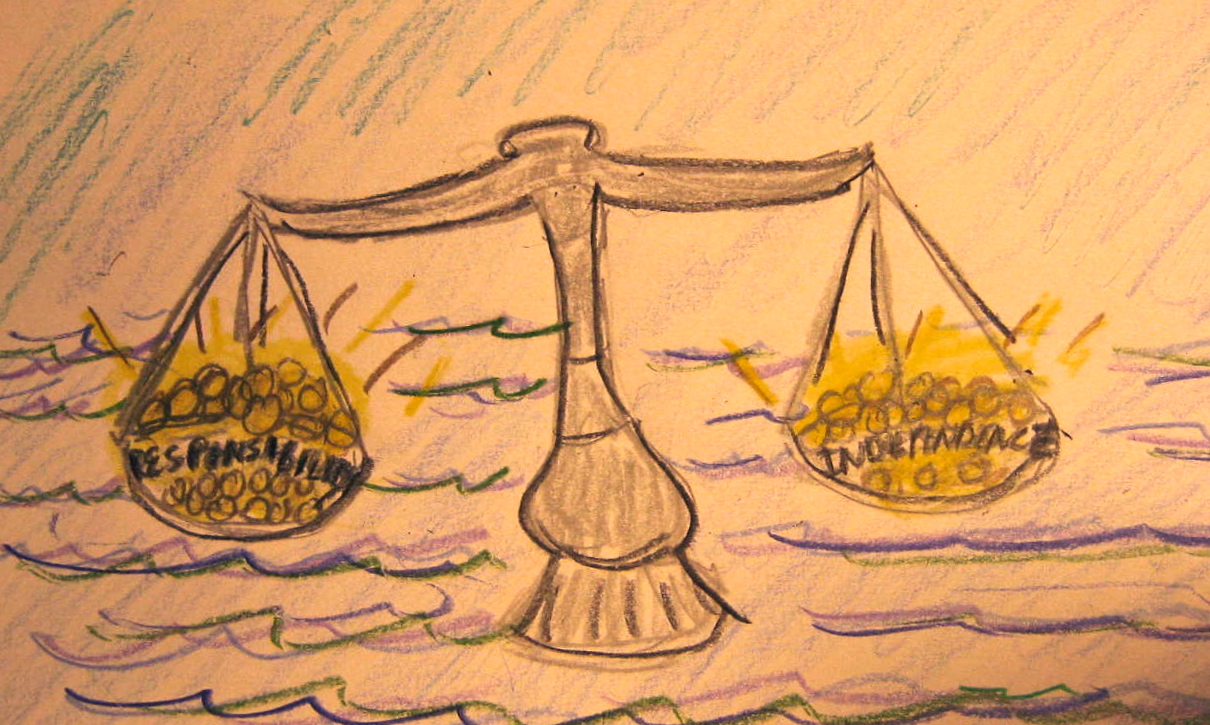
Responsibility/Independence…Independence/Carefreedom–Horatio Hornblower Longs For His Wife’s Hand

Posted May 27, 2010 by ManicDdaily
Categories: Horatio Hornblower, Uncategorized, Vicissitudes of Life

Tags: , , , , , , , , ,

Scale - Responsibility/Independence

My latest hero, C.S. Forester’s Horatio Hornblower, makes an interesting observation in the 9th book, (the one I am reading tonight), Commodore Hornblower.

Facing difficult decisions in the Baltic in the period immediately before and after hostilities open between Sweden, Russia and France (led by England’s arch nemesis, Napoleon Bonaparte), Hornblower is suddenly, deeply, homesick.  He finds his command and the many duties and expectations heaped upon his slighting stooping shoulders suddenly overwhelming (those who spend the life in the cramped quarters of ships almost always slouch a bit); he misses his wife, child, and the trivial chores of the land-based life in England that he found almost stultifying at the beginning of the book.

Then he calls himself back to the realities both of who he is and of human nature generally:  “And here he was complaining to himself about the burden of responsibility, when responsibility was the inevitable price one had to pay for independence: irresponsibility was something which, in the very nature of things, could not co-exist with independence.”

Responsibility/independence.  I’ve never heard the words rigged quite so cleverly.

What a wonderful thing it is to call one’s own shots.  Yes, it’s nice to get help; it’s very nice to feel taken care of; to have some prop holding up the idea of self-reliance.  But to be able to say “screw you”has a special satisfaction, which, of course, comes with a price.   If you say, “screw you”, to someone, it’s helpful to be able to live without that person’s financial or emotional support.

Perhaps this is all very obvious.  Perhaps I’m just blinded by my current affection for all things Hornblower.   (He really is a very charming character.)   But I find his direct correlation between responsibility and independence remarkably thoughtful.  The odd thing is that when one is burdened with responsibility, it is hard to actually feel independent;  often, especially in today’s society, independence is equated with freedom–freedom from ties, freedom from responsibilities.  But that freedom, or carefreedom, is different from the strength, the possibility for discretion, that Hornblower sees as independence.  (Hornblower catches this irony too as he describes the envy he feels for the able-bodied seamen, who have the carefree nonchalance of those whose only job is to competently carry out orders.)

Hornblower’s understanding all this doesn’t negate his sharp longing for his wife’s hand, son’s smile.  But, ever the stoic Brit, the Naval officer, he (silently) goes down to his cabin to study the chart of Riga Bay.

(That Hornblower.)

Fleet Week – Where are you, Horatio?

Posted May 26, 2010 by ManicDdaily
Categories: elephants, New York City, news, Uncategorized

Tags: , , , , , , , , , , , ,

Fleet Week in New York (See Statue of Liberty in background!)

It’s Fleet Week in New York!   It corresponds, oddly, with my current personal absorption with Horatio Hornblower, the mythical hero of C.S. Forester, who through a series of eleven books makes his way through the ranks and at least some of the depredations of the British Navy during the Napoleonic Wars.

It’s an interesting testament to the power of narrative that I had a very hard time tearing myself from the printed page of Forester’s Ship of the Line this morning to watch actual battle ships course down the Hudson, right next to my apartment building.   (So much for living in the moment.)

I just wanted to stick with Hornblower, even though the ships were hugely impressive, and lined with living, breathing human beings.

Much has changed since Hornblower’s time.  The U.S. Navy ships seem inordinately plain compared to Hornblower’s schooners, frigates, ships of the line, with their top gallants, topsails, reefed topsails, mainmasts, mizzen masts, jury masts, rigging,  netting, and long nines.  There are a few small towers of gizmos, presumably related to radar, but for the most part, these new ships are large slightly curved trapezoids of painted grey.

It’s hard  to imagine these huge wedges of steel as the descendants of the beautiful, if gnarly, sailing ships of the British Navy.  Though there they were–men (presumably women too) lined up in rows of white (the sailors) and dark blue (the marines), roughly in the same divisions of rank and service as on Hornblower’s ships.

Other similiarities: decks!  Portholes!  (Wait–are there portholes now?) Starboard, port, stern, bow, lee, tack–vocabulary.

Space constrictions–though I expect modern seamen have more than 18 inches per hammock.

Some monotony of food?  But, hopefully, today’s soldiers  do not have to tap their sea biscuits to scare out weevils.  (They only need to be concerned about trans fat and high fructose corn syrup.)

What else do Forester’s sailors and today’s share?  The sea!  The sky!  The horizon!  Occasional seasickness!

Reading C.S. Forester makes one very conscious that conditions of the British navy during the Napoleonic Wars were almost unimaginably severe, especially with so many sailors press-ganged to begin with.  (Hardly a volunteer force.)

Scurvy, disease, amputation, the requirement of absolute obedience at the threat of flogging, court martial, hanging.  Though, actually, the biggest danger seems to arise from the incompetence and/or greed of supervising officers. (Hornblower, of course, excluded.)  And too, less-than-reliable allies.

Hmmm….

Of course, what ultimately makes the books compelling is not the politics, the tacking and heaving of sails, or even the discussions of sea biscuit, but the character of Hornblower himself — outwardly indomitable, inwardly hyper-sensitive, noble (in spirit if not rank), brave, and amazingly quick-witted even when in a near stupor of fatigue and stress.

Did one of his spiritual descendants sail by this morning?

Maybe.   (I, for one, was too busy reading to notice.)
Even Stouter than Hornblower?

More on Blocking Writer’s Block – Maintaining Bad Habits (Advice from the Dalai Lama?)

Posted May 25, 2010 by ManicDdaily
Categories: Uncategorized, writer's block

Tags: , , , , , , , , , , , , , ,

Rotating Storm

At the Dalai Lama’s lectures in New York City over the last weekend, he advised (naturally) meditation as a means to slowly effect change in one’s life.  “One lecture not enough,” he chuckled.

He encouraged the audience to start a practice even if their beginning steps felt very small.  He advised just “five minutes” every morning, particularly if the five minutes were “quality time;” that is, five minutes spent with some attempt at genuine focus.  A small period of quality time seemed better to him than a longer, more wandering attempt, simply because it helped one avoid bad habits.  In His Holiness’s view, a bad habit was harder to break than a new habit to instill.

All of that sounds right.   And I hesitate to argue with His Holiness the Dalai Lama.  Particularly about matters related to meditation.

So I won’t.  Still, I was thinking this morning as I did my slightly desultory, bad-habit-infected, yet daily, yoga practice that I’m not in complete agreement with these principles, at least not when they are applied in areas other than meditation, such as a practice of daily writing.

Here’s my problem:  of course, quality time writing is better than going-through-the-motions time.  But what if you are faced with a choice between going-through-the-motions-time vs. zero time?  Is a bad habit really worse than no habit? (That is, not writing at all?)

I am concerned that many people when starting any kind of discipline make a good and earnest beginning–then, things bog down, especially as the glow of initial results fades, and the hard slog begins in earnest.

I don’t know what His Holiness would advise for a bogged-down meditator—I’m guessing that it would be a combination of continued effort, and a little less fretting.

I would co-opt that same (surmised) advice for a writing practice.  At times, it is likely that some bad, escapist, habits may creep in;  they may in fact be all that keeps you going–the background distraction of a book on tape; the muddled support of three cups of tea and a glass of wine;  writing on the elliptical machine;  relaxing with vampire novels so as to avoid the schaden freude of more challenging works.   Perhaps it does make sense to scale down during such a period–when you are having a hard time finishing anything, you may be better off working on a short story (or  blog) than the great American novel.   Still, it’s important to keep putting in your five minutes, even a fitful five.

The most important caveat here is not to get smug about your fitful efforts.  Stay honest.  Sometimes you may not feel capable of more than a thread of creativity; but don’t assume either (i) that it’s all you will ever be capable of; or (ii) that it’s enough.

One other suggestion (taken from a yoga teacher, David Life, who was trying to help me with backbends)–if you need to cheat a little to do your work (or pose, in the case of yoga), try alternating your form of cheating.   Rotate your bad habits to avoid letting any single one become the norm.  In the case of backbending, that meant sometimes turning out my feet too much, other times, bending knees.  In the case of a writing practice, that may mean sometimes just writing a very boring journal entry; other times, a very boring prose poem!

Love’s Offices – Ailing Dog

Posted May 24, 2010 by ManicDdaily
Categories: dog, Uncategorized

Tags: , , , , , , , , ,

Place of Love's Offices

Those who follow this blog know that our old dog, Pearl, has recently suffered a problem with her spine which paralyzed her hind legs.  Under the influence of steroids (go Floyd!), she’s doing somewhat better, but still not walking.  Nonetheless, we have to be very careful where we leave her in the apartment as, when she is left alone, she insists on dragging herself to her “office”, a cluttered, dark clothes closet.

There are many meanings of the word “office.”  One is Pearl’s closet; another, perhaps more accurate use, refers to duties or functions. pIn a beautiful poem called “Those Winter Sundays”, Robert Hayden writes of “love’s austere and lonely offices,” describing his stern dad’s early rising on frigid Sunday mornings, hustling the house fires back to life with competent, chapped hands, and polishing the shoes of the son (poet.)

I love the poem.  It does make me wonder, however, why so many of love’s offices in my personal experience involve, not home fires, or even scuffed shoes, but plain old bodily fluids.  I’m not talking sex here, but of the effluvial tides of sickness known to almost any parent, pet owner, (woman).  These have poured from a host of sources–from travel with children (at least, my children) on sea, air, or roadway; to shepherding them through flu’s, colds, allergies, nights out, even cuts and cold sores.  In family life, stuff flows.

And now, here’s my little half-paralyzed dog.

I should be (and am) happy that even under her current difficulties,  she has retained pretty iron-clad bladder control (except for the other morning, just as I got her down the stairs into the building lobby).  But the lack of functioning hind legs makes such matters difficult for a dog.

So, now, love’s office involves carrying her down to a small fragrant square of dirt on the Esplanade by the Hudson River, squatting there to hold her up with the help of an old but strong and soft silk undershirt slung under her belly, waiting….waiting…trying, while waiting, not to worry too much about the spindly tree that somehow lives in that besotted patch of dirt.

Since she cannot exactly say what she wants, love’s offices also involve waking up several times during the night to try to figure out why the dog is struggling to a seat or shaky stance, and then propping her up over some folds of old newspaper.

Love’s moist and ignoble offices.

Kristoff’s Moonshine, Hirsi Ali’s Feminism, “Honor Killing”

Posted May 23, 2010 by ManicDdaily
Categories: news, poetry, Uncategorized

Tags: , , , , , , , , , ,

A couple of articles in the New York Times today are enough to make a woman a feminist for the sake of bettering the world as a whole, and not simply the lot of women, (although since I am already a feminist, I may not be a good judge of that. )

One from Nicholas Kristof describes the situation among the poor in Africa where spending choices by fathers favor alcohol and cigarettes over anti-malarial mosquito netting and children’s tuition fees.  To combat this problem, micro-bankers are trying to put more money in women’s hands, as women tend to be more likely to spend money on the welfare of their children than on their personal habits or pleasures.

Another article by Deborah Solomon, portrays Ayaan Hirsi Ali, an ex-Muslim woman, the author of Nomad:  From Islam to America, and discusses the Islamic view of women as family property, only with the twist that women are property that is capable of devaluing itself (like silver that self-tarnishes, an oven that self-chars.)

To some degree, the articles discuss unpopular topics; some in the West are so anxious to compensate for cultural biases and depradations of the past (and present)  that they are reluctant to criticize, or even acknowledge, practices that are unjust and oppressive.  This, to my mind, is political correctness at its worst: when there is a pretense that all points of view are equally valid and that cultural norms (even those that are unjust to women and children) are somehow fine simply because they are foreign and/or tradiional.)

Here is a poem on the subject on honor killing.   It was inspired by an incident in the Middle East where a brother killed a sister suspected of dishonoring her family:

Honor killing

The knife slides in,
with force.
She is thinner than he has remembered,
her collarbone sharp as
a hook he thrashes upon.
Mind snags heart, but
cannot aim for breast,
only the knife can look past nipple.
Smaller than he’s remembered,
with too-soft skin that folds within
whites of eyes big as
blade.
He tries to think
of flame, the filmy body
of smoke, the dryness of
ash, but blood,
fountains,
in honor of
the righteous,
fountains.
Why has she made him,
righteous,
do this,
with force.

Monks At Radio City

Posted May 22, 2010 by ManicDdaily
Categories: elephants, Uncategorized, Vicissitudes of Life

Tags: , , , , , , ,

Monks at Radio City

I was lucky enough to get to see the His Holiness the Dalai Lama again today for two of his final lectures in a series at Radio City Music Hall discussing Buddhist commentary on the Bodhicitta Bodhisattva’s way of life.  The Dalai Lama and Richard Gere both!   One whose bald head was (shockingly) partly covered by a thick maroon visor, the other whose head was (shockingly) totally covered by a thick shock of extremely white hair.

“What a good guy,” someone said as we walked up the aisle at the end of the last lecture.   (Meaning, I believe, the Dalai Lama, and not Richard Gere.)

Yes, a very good guy.   But what struck me as much as his goodness was his simple common sense; for all his idealism, for all of his adeptness at finding great benefit in the arduous and difficult, the Dalai Lama is a realist.  (“Hope for the best, prepare for the worst.” )

I had not, before this, focused on the pragmatic aspects of Buddhism–the fact that it doesn’t seem to push truths, so much as accept them..  Okay, I’m not so sure how well karma and reincarnation fit with that last sentence, but certainly the understanding of universal suffering and death, the illusory quality of perception, and the advocacy of altruism as a skillful means to happiness, are pretty clear-cut.  And the emphasis on investigation and acceptance leads to a great openness.  (At one point, His Holiness laughed at some of the astronomic views of Buddhist science, for example, and called them a “disgrace”, a “disaster”–no pushing fundamentalism on that front.)

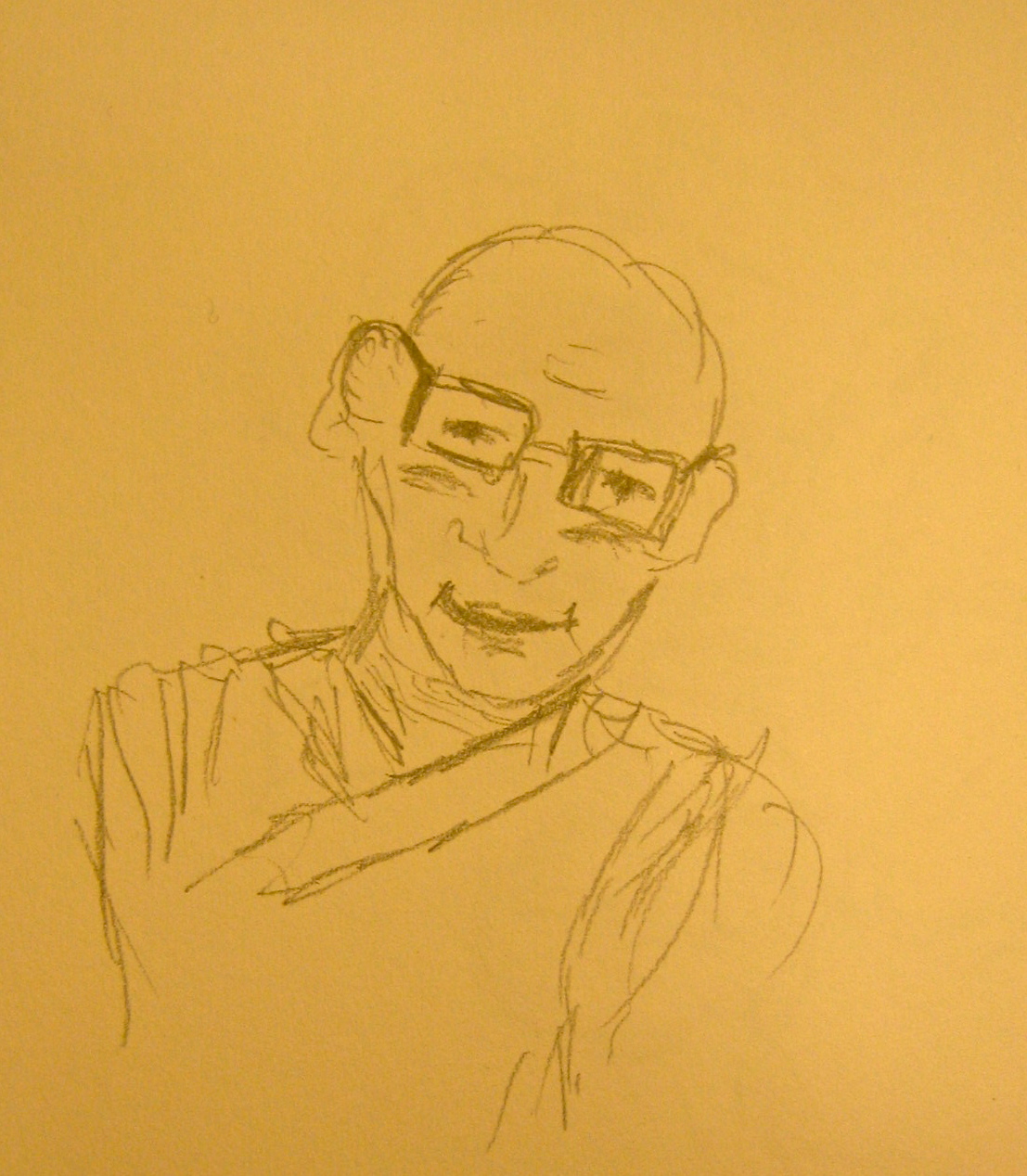
Neither my eye sight nor my seat were good enough to sketch the Dalai Lama without reference to the camera screen, and the images moved quickly.  (Plus, I actively tried to watch him.)   So I include sketches above and below of various monks and nuns on the stage (all those shaved heads) , particularly those behind His Holiness’s translator.

(Note that the elephants in the very first sketch above are not intended to represent the infiltration of Hindu favorites so much as the infiltration of ManicDDaily favorites.

Have a nice night.

Have a nice night.

Recovering Dog Tries To Get Back To Work

Posted May 21, 2010 by ManicDdaily
Categories: dog, Uncategorized

Tags: , , , , , , , , ,

Pearl in Office

I have never much liked Western medicine.  Perhaps my antipathy started with the allergy shots I got for years as a child.  (There’s nothing like an injection once a week to put you right off the smell of rubbing alcohol.)

I’ve also always been a bit suspicious of veterinarians, especially in New York City.  They often seem to be altogether too proactive when suggesting costly diagnostic tests and procedures.  (Could that have anything to do with high rent?)  They also sometimes look askance at my dog’s home-done (i.e. inept and patchy) grooming.

But today, I blog in awe of Western medicine,  a New York City vet, and steroids. I am even almost sympathetic with Floyd Landis.

Yesterday, and the day before, I wrote about my genuine (if not fully voiced) fears that our beloved dog was on her last legs.  (These would be her two front legs, since her hind ones were suddenly completely paralyzed.)  I shouldn’t joke about this—it’s really been terribly sad.

But, a few doses of steroids (for her, not me), and I find myself amazingly light-hearted.  Pearl is not exactly back on her feet, but she can just about push herself up, and she is definitely in much less pain.

She is even back to her old insistence on a ritualistic personal schedule; meaning that, when I was briefly out, leaving her on a pleasant airy pillow, she dragged herself across a large room and hall into her habitual “office” (my closet).   (I think she’s always had a secret affection for Act IV, Scene VI of King Lear, when Lear points out that even a dog is obeyed in office.)

(Sorry.)

(P.S. –yes, to those of you who follow this blog; the drawing above was originally posted here.)

The Sweetness of Fifteen Year Old Dog – Visor of the Dalai Lama

Posted May 20, 2010 by ManicDdaily
Categories: Uncategorized

Tags: , , , , , , , , , ,

Dalai Lama in Visor at Radio City Music Hall

My dog of fifteen years has suddenly shown her age.  There have been hints before—cataracts and a general waning in exuberance in the absence of cheese and/or a homecoming–even through those setbacks, she’s always retained a puppy-like aspect befitting the cutest dog in the world.

Last night, though, something dramatic changed inside her small body.  She  could no longer move her hind legs;  they didn’t limp, they simply became inanimate.   And, she began to tremble.

I have no confusion between dogs and people; my dog is not my child.  That said, it is a true truism that there is a special relationship between dog and human.  Of course, there’s the loyalty, the uncritical companionship, the absolute, wise, wonderful, sweetness supplied by the dog, but there is also deep tie that arises from the sense of responsibility that the human feels for the dog—the duty of care, food, pats, attention.   The love of the dog, and loving a dog, not only makes a human feel more human, it makes him or her feel more humane.

It may be that human beings are simply hardwired to love whimsically cute, communicative but not clearly speaking, beings.  It may arise from the same set of chromosomes that allows us to be loving parents.  Personally, I’m sentimental enough to think that these bonds are not only a matter of chemistry.   Because the bond is not just  towards any dog (although most dog owners are pretty soft-hearted in the canine area), but towards the particular dog that became your dog– maybe because of a certain placement of spots,  maybe, as in the case of Pearl, because she happened to be the only female and the cheapest dog in the litter of a breed that is supposed to be hypo-allergenic–  somehow this randomly chosen dog turns out to be the perfect match, the best dog in the world.

(Of course, this specialness probably only applies in the case of Pearl.)

On another note, well, sort of another note, I was lucky enough to attend one of the Dalai Lama’s lectures at Radio City Music Hall today.  All the time, I was worrying about Pearl, and there is much about Tibetan Buddhism that is hard to follow.  But hearing about the Buddhist sense of cycle, the inevitability of emergence and dissolution and re-emergence, is very wonderful when you feel like you may be actively dealing with the dissolution side (a side that is always there even when you aren’t actively dealing with it.)

Then too, there is that sweetness, even cuteness, about the Dalai Lama, however wise and formidably intellectual.   Now, an old man, he jokes, and, quite wonderfully, wears a dark red visor to shield his eyes from the theater lights.   Even as I struggled to listen to the the analysis, what was most compelling was simply this sweetness, which you feel certain comes from a deep understanding of the way life works.

(For those interested in more specifics about Pearl, and I very much appreciate your concern:  there is something wrong with her spine.  Medication has made her comfortable enough to rest, right this minute, in a lap.  Too soon to predict the short-term outcome.)

Dalai Lama in Visor

More on Sympathy

Posted May 20, 2010 by ManicDdaily
Categories: Uncategorized

Tags: , ,

Further to my post of last night about effective types of sympathy, and the difficulties of being “cheered up” when dealing with difficult circumstances (in this case, a sick dog.)   I think I was a bit hard on the traditionally British clipped approach. (Ironically, I’ll call it the “Hornblower” approach, naming it after Horatio Hornblower, even though that name implies a kind of blowhardness, which is exactly what’s absent there.)

Any sympathy that’s heartfelt is frankly amazingly powerful, and clipped, felt, expressions of it–the brief “hard luck”, “too bad”–are  actually wonderful.  That clipped sort of expression, if felt, doesn’t really diminish the plaint or plight of the sympathizee (the person in trouble or pain), but instead implies that (i) difficulty is part of life; (ii) isn’t it hard?, and (iii) we are all in it together.  It’s a sharing that helps the sympathizee (i) feel some communion, but (ii) also feel strengthened, enabled to do what’s next.

Sorry to be so abstract about all this;  random analysis is also something useful when circumstances are beyond one’s control.