iPad Sunnyside Up–Let Me Just Check My Mail

Posted June 7, 2010 by ManicDdaily
Categories: news, parenting, Stress, Uncategorized

Tags: , , , , , , , , , , , ,


iPad Sunnyside Up

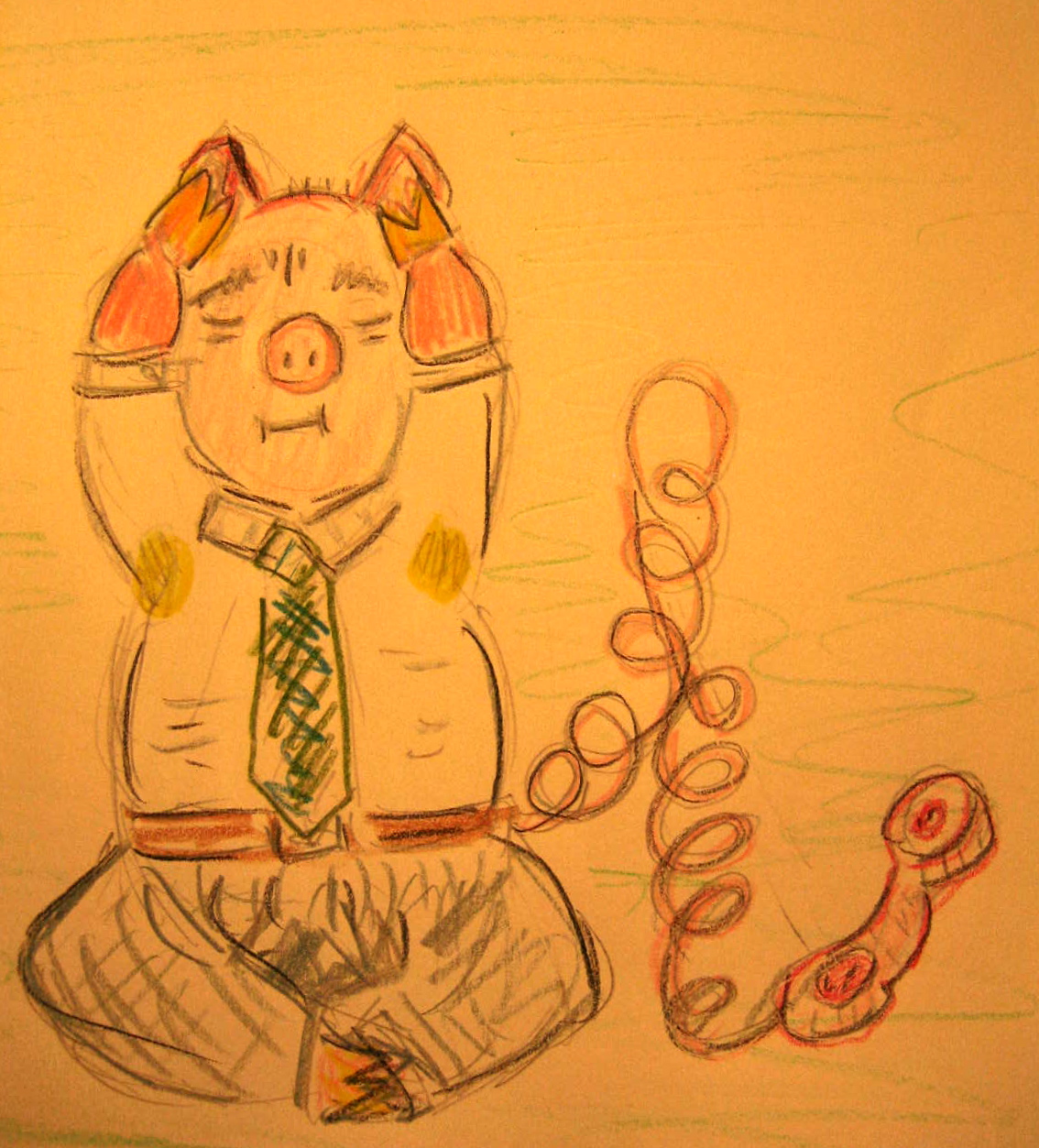
The  New York Times has a couple of articles this morning on how technology is re-wiring our brains; you can find them if you check online—excuse me a sec, I’ve got a new gmail coming in.

The articles talk about the mental and emotional price of a life hooked into, and hooked on—oops—there’s my cell….gizmos.

(Sorry, sweetie, I’m writing my blog.  Can I call you back in two minutes?)

Some people think multi-tasking makes them more productive, but studies show it makes people actually accomplish less, and encourages a kind of shallowness.

Did you know, btw, that Robert Pattinson won MTV awards for best actor, global star, and perpetrator of best 2010 screen kiss last night?   (Does ManicDDaily have her finger on the popular pulse, or what?)

One article depicts a software executive (hey, what do you expect?  The guy’s a software executive, head of a start-up, in Silicon Valley), who “works” in front of three or four large video screens.

In the photos of the guy’s family , they all have iPads.  Even the kids.  The guy even reads Winnie the Pooh on an iPad to his littlest kid.  In bed. (I know it’s kind of awful, but the graphics are also amazing!)

I can’t help wondering if the article will be good for Apple stock.

(I’m just going to check that, okay, it’s bookmarked, so won’t take a mo.)

The guy’s wife say it’s hard for him to be fully in the moment, that when the emotional going gets tough, he escapes into computer games.  But then one of the articles cites a kid who texts a lot in school and that kid says that the “the moment”–that is all the time she spent in school before she had texting–was incredibly lonely and isolating.

I feel sympathy for the kid, but isn’t loneliness and isolation part of what school is all about?  Childhood?  Has she not read Jane Eyre?  Virtually any Dickens?   (I’m sure they are on Kindle.  Maybe even for free.  Or Google Books?  Let me check a sec.)

Oops, there’s my other email, office, you know, my crackberry, the red light is blinking—do you mind?

Summer Mornings Without Air Conditioning – A Certain Slant of Light, Gainsborough Hair,

Posted June 6, 2010 by ManicDdaily
Categories: New York City, Uncategorized, Vicissitudes of Life

Tags: , , , , , , , , , , ,

Sir Thomas Gainsborough - Mrs. Thomas Hibbert

Emily Dickinson writes about a “certain slant of light,/Winter afternoons,” which I’ve been thinking of a lot as I wake up these days. There’s definitely a certain slant of light on summer mornings.  I feel (kind of) sorry for those who sleep in air conditioning and don’t get to fully experience it.

It’s only a trick of my ear that thinks of Dickinson, for this slant of light is not oppressive like the light in her poem.   It’s a low angled, almost curved, light, which accompanies a time of softness, space, invitation.  Movement is easy enough, though after the restlessness of a night of trying to find a cool place on the sheets, you may not want to move much.  Your body feels suddenly dry, almost powdered.  The air, because you are careful not to fully open blinds, is tinged by a slight blue-grey wispiness like the hair in a Gainsborough painting.

Sounds are distinct, but muted—footsteps below your window, water running upstairs—there is nothing like a Sunday morning after a sultry night in New York City for quiet.   Stereos stilled–if there is a music, it’s in the tradition of John Cage.

You can smell that it will be hot again soon; you can even see it after a while –just there, at the corner of your eye.  The promise seems not to come from the sky so much as from the sidewalk, which, with its cached memory of yesterday’s heat, early radiates an incipient over-brightness.

But, the heat’s not forced itself into your apartment yet;  for these minutes, Gainsborough lingers in the air, and the breeze whispers at just the right pitch.

(If you like summer and sultry, but are more into elephants than Gainsborough, check out 1 Mississippi by Karin Gustafson, on Amazon.)

(And, for a complete change of pace, check out yesterday’s post, why people hate banks.)

Why People Hate Banks

Posted June 5, 2010 by ManicDdaily
Categories: Stress

Tags: , , , , , , , , , , , , ,

Bank Phone Customer Service (Hear Nothing, See Nothing, Do Nothing)

We all know the big reasons why people hate big banks.  They were major players in the recent destruction of the U.S. economy;  they were supposed to be slow, plodding, cautious, institutions, but instead tried to behave like growth stocks.  However, their “products” were not actual innovations like iPads or Lattes, but beguilingly packaged jigsaws of future losses, i.e. unsecured debt. ( As Lloyd Blankfein put it, they were packaging “risk.”)

Then, of course, there’s the fact that they needed to be bailed out so that would not sink the rest of us.

But still got bonuses.

All of the above has made me plenty mad, but what’s made me actually hate banks is something much more mysterious and mundane:  their amazingly inept compartmentalization.  That is,  the zillions of separate departments, none of which (even if reached) can ever help you (because it’s not their department).

I don’t mean to attack bank officers in branches.   In my experience, actual people in actual banks try to be helpful.  But often, they can’t help you, because they, like you, are relegated to searching, on the phone, for the right department.

The large banks are like countries, no, continents.  Drifting continents full of separate bureaucracies, none of whom know each other’s name (or language).  They are united, if at all, by a single computer system, which they consult like a gospel.   But while the gospel has actual TEXT, descriptions, lessons and commentary, this computer system has only options, little boxes that are checked. The system allows for no commentary; no context; and no record, it seems, of the ten previous conversations that you have had with the bank on the very same subject.

The phone system of the bank is even worse than the computer system;  any variation from set words gives rise to an outraged robotic voice, then disconnection.

Last year, I had interactions concerning identity theft, committed through (and possibly by) a bank teller.  (The bank would never tell me, or the New York City Police Department, the exact circumstances.)     Even weeks after the initial complaint, after weeks of laborious paperwork, I would find out, in my dogged follow-up that a particular required form had not been given to me; or did not cover everything, or was not sent to the right place.  The bank officers at my local branch were frankly as clueless as I was, and, like me, with every call to some distant Fraud Department, needed to go through a full re-explanation of circumstances.

In my more recent dealings with a large bank, days have been spent trying to reach one employee whose name was given on a regular bank statement as a contact person, but who apparently follows a practice of never actually picking up his phone;  it was only after several days of emailing and messages that he let me know he didn’t actually deal with questions related to the account on the statement and that the bank had no incentive for helping in any case.  He then gave me a number for customer service, which, unfortunately, was actually customer service for WalMart.    (Not a bank subsidiary, last time I checked. )

Since then I have been on the phone with bank employees more times that I’d like to count.  One person put me on hold for a few minutes, during which my call was picked up by a completely new person (Dixie in Manila), who once more needed to be filled in on my inquiry.   Letters I have faxed and emailed to about five different bank employees have not yet been noted on the holy computer system.   One fax number I was given failed to accept faxes.  (Now, there’s a way of reducing paperwork.)

The New York Times had a recent article about people in foreclosure who simply stopped paying their mortgages, and stayed in their homes, forcing their bank to go through the laborious legal process of trying to get them out.  Many people seemed to feel a certain satisfaction about this situation, first because they are saving money, and secondly, because they’ve finally found a way of sending a message to a bank that is being heard.

Prom Season (With Elephants)

Posted June 4, 2010 by ManicDdaily
Categories: elephants, parenting, poetry, Uncategorized

Tags: , , , , , , , , , , , ,

June Prom

The skies take a short break, waiting for the hair.
In one case, it is fine, sleek hair
which will only stay up till
the photo’s click, less than the time
I’ve stood behind the girl, working with
bobby pins.  “Wispy is good,” I say as
she fumbles in the back for smooth.
The make-up is smooth; two-toned
eyes converge with Egyptian directness
onto the shade of dress’s shine.

Skies grumble.  “Maybe
you better hurry,” I say.
“Why did I squeeze it?” one wails.
I palpate tint and powder onto a spot on
her breastbone, repeating a mantra
of don’t worry, it won’t show.

Another wants to keep the price tag on, tucked
inside the dress’s backless back
because it’s the most expensive she’s
ever owned.   Mid-twirl, she cries, “oh no!  It smells
like smoked fish.  Why does it smell like smoked fish?”
I tell her it’s fine, but offer perfume.  The one with the squeezed pimple
leans in supportively:  “I can’t smell it.”
“Oh God,” the twirler moans, “I
can smell it from here.”

Lips stretch shimmer
onto smiles perfected
over eighteen years.   And then, the camera
down, they really smile, not bemoaning
their lack of dates, only—and that less
and less–the possible scent
of smoked fish.

Darkness greets them with what sounds like applause.
I chase down a cab, then, umbrella in
each hand, ferry them one at a time,
hovering over hair, shoulders, skirt.
Slippered feet glisten through the tarred, watery drumroll,
as if made partly of glass,
the other part celluloid.
I laugh with the doorman as the taxi pulls away,
taillights as bright as Christmas in this storm,
the mother, the friend’s mother,
the one left to put away
the little jars, hangers, bobby pins,
to scoop from the floor the finally cast-off
tag, happy to be needed
by these large, beautiful, creatures,
happy to be out of the rain.

Promoting Non-Self-Promotion–Whitman, Dickinson, (Jim) Joyce and Armando Galaragga

Posted June 3, 2010 by ManicDdaily
Categories: Baseball, news, Stress, Uncategorized

Tags: , , , , , , , , , , , , ,

Self-promoter?

Yesterday, I wrote about stress and success, but what I really wanted to write about was my antipathy towards self-promotion.

Self-promotion is a major currency in our culture.  Many believe that fame, celebrity, translates into wealth; that notoriety is an achievement of its own.  (See e.g. Richard Heene, father of balloon boy.)

I personally have an exceedingly hard time with self-promotion.  I don’t mind it so much in others;  I well understand that a certain kind of self-touting is necessary to get attention in our culture, and that, for all my wish to deny it, attention can translate into a kind of power (book sales, ticket sales, advertising and endorsement contracts, appearances on “Dancing With the Stars”).

But, the idea of my self-promotion, that is, my own self-promotion, seems acutely, horribly, embarrassing.

What can I say?  I was raised as a Lutheran (which seems to instill, in its adherents, an overwhelming sense of inadequacy), admire Buddhism (which finds triumph to be illusory in any case), and I’ve been formed (culturally) by the stiff upper lip of English literature.  Besides all that, I am a woman.  (In my generation, feminine modesty did not just mean keeping your clothes on.)

(When I think of historic restrictions on women’s self-promotion as compared to men’s, my mind turns automatically to Emily Dickinson and Walt Whitman ; while Walt, sounding his “barbaric yawp,” openly identifies himself as “Walt Whitman, a kosmos, of Manhattan the son,….Divine am I inside and out, and I make holy whatever I touch or am touch’d from,” Dickenson writes, “They shut me up in Prose–/As when a little Girl./ They put me in the Closet—/Because they liked me “still”—”)

Agh!

Putting me aside (thankfully), I have been heartened by the recent hubbub around two wonderful non-self-promoters—Detroit Tiger pitcher, Armando Galaragga, and supremely penitent umpire, Jim Joyce.  Nothing could have been more graceful than the rueful smile of Galaragga when his perfect game was blown by the wrong call of Joyce, umpire at the first base line during the critical 9th inning third out.   Joyce’s open and sorrowful admission of his mistake was equally refreshing.   (Even the reporters listening to Joyce’s apologies were taken aback, one of them actually telling the ump that he was only human.)

Given our culture’s quest for both celebrity and happy endings, both men will probably get more fame and fortune from Joyce’s wrong call and Galaragga’s acceptance of unfairness than they would have gotten had the perfect game been achieved without incident.  (Society loves a story!  Society loves meaning!  Maybe the whole incident will result in the use of instant replays!)

Still, that doesn’t diminish the men’s grace and sincerity, and the wonder of a modern, heartfelt, and very public, apology.   A pretty perfect interlude no matter how the game is ultimately classified.

Stress and–TaDa!

Posted June 3, 2010 by ManicDdaily
Categories: Stress, Uncategorized

Tags: , , , , , , , , , , , ,


Bridge over River Kwai (Sort of)

I’ve written a lot on this blog about creativity and stress, and also about just plain stress. I’ve also written a fair amount about rhyme.  But what about something that rhymes with stress (sort of)?

Success!  (TaDa!)

Some people consider stress and success as opposite sides of the coin; some (particularly those who have good physical health) even seem to believe that success—I mean here, financial success, or, its great proxy in our culture, fame—will solve major problems.  We all know this isn’t really true;  we all know many successful people who are neither relaxed nor happy.   Still, if you are a creative person, success can feel like one sure way to reduce stress, especially if it means that you no longer need to hold onto your “day job”  and can, instead, devote your energies totally to your creative/artistic endeavors.

It’s certainly true that time, as well as acknowledgement, interest, praise, are great goads to creativity.  But if you do not have success, there are a few compensatory factors which it may help to keep in mind–factors other than a sense of martyrdom and/or the illusion that truly original art is never recognized in its time.

First, of all, day jobs (other than, perhaps, those that involve the postal service), often keep people sane. They tend to get you out of the house (unless you are a housekeeper), put roses on your cheeks (unless you are an office worker), keep your feet on the ground (unless you work for the airlines.)  Most people’s “day jobs” also involve some accommodation of others on a relatively frequent basis.  This interaction with people makes one more human (if more frustrated), and (unless you work for an investment bank) less grandiose.   The skepticism, impatience, and sometimes downright contempt, of co-workers, customers, students, can promote deep self-examination, always a useful pastime for the artistic.

Creative work, on the other hand, is often both solitary and unstructured, which can lead to real head-aches by late afternoon when you either simply have to (i) stop working, or (ii) get working.

Moreover, while a day job may involve a certain amount of self-discipline (i.e. getting there), it often (once you’ve held it for a while) requires little self-promotion.  Achieving and then maintaining even a modest artistic success, in contrast, seem to require vigilant self-aggrandizement; the image must be burnished; the door to opportunity propped open; staleness stubbornly refuted.   While the embarrassing failures of the unsuccessful can just sink into oblivion, the failures of the successful are known and mocked by all.  (Note, in this regard, Sex in the City 2. Even someone like me, who has never seen a single Sex in the City show ever, is making fun of it).

All of which goes to say (as was said in The Bridge Over the River Kwai, a really great film about the conflicted nature of achievement), be happy in your work.  Be glad of what you don’t have (yet.)

Stress and Creativity–Making Choices (Arranging the Lives of Characters Not Family Members)

Posted June 1, 2010 by ManicDdaily
Categories: Stress, Uncategorized, writing

Tags: , , , , , , , , ,

Space

My newly discovered focus on stress and creativity has energized the part of me that loves to give advice.  The one caveat I would make to those reading my advice:  “do as I say, not as I do.”  It is infinitely easier to dish out good counsel than to follow it.

Life is stressful, particularly in the modern world where many play multiple roles; there are the stresses of all that must be done to maintain a job, home, family;  then, there is the added stress of distraction, so many possibilities for avoidance.  Right at the tips of our fingers are the means to while away huge amounts of time—email, Facebook, worldwide news services, horoscopes, blogs, video clips, even favorite TV shows.

In my experience, creative people find it extremely easy to justify giving in to distraction.  We characterize it as “inspiration,” “research.”   We persuade ourselves that it is necessary “keeping up,”  important “networking.”

Some of these justifications may be valid, up to a point.  But the problem is that creativity needs space, a bare spot in the brain to flop around in.  Sure, a brainstorm can arise during a tumult of activity and distraction, but accomplishment (that is, finishing something) generally needs a bit of concentration; time; solitude.

Even if we can restrain our fingertips, nipping computer distraction at the knuckle, there is also the problem of … people; the real live human beings in our lives.  Creativity thrives on people; it wants to speak to people, to impress people, entertain them, awaken them.  Even the most narcissistic artist usually has some genuine sensitivity and empathy.

Still, usually you can’t actually make something (other than perhaps a baby), if you do not cultivate a certain reserve.   By reserve, I do not mean coldness or apathy.  I mean, once again, time, space, quiet, focus.   Given such needs, you may sometimes have to distance yourself from people, to make a choice not to be involved in every family or community drama; to try not to “fix” people (other than your characters).

I should step back here: creativity comes in many different forms.   Some people find their creative expression in mediation or entertainment, in, for example, preparing the perfect family reunion or dinner party.  I had an aunt like this who expressed herself through her elaborate celebrations; I have a cousin who manages to send cards to a wide variety of people not only for their birthdays, but for Christmas, Easter, Thanksgiving, Mother’s Day, etc.

But if you want to focus on something more egotistical– poetry, writing, painting—and you are not making a living from this work—then you simply have to make choices.  Arranging other people’s lives, or even the perfect dinner party, may not always be possible.  Accept that.   (And you may just find that the other people in your life benefit from this choice as much as you do yourself.)

Longterm Focus – Stress and Creativity – Pearl!

Posted May 31, 2010 by ManicDdaily
Categories: Blogging, Stress, Uncategorized, writing

Tags: , , , , , , , , , , ,

Pearl - Habit and Engagement

The other day I worried that I really didn’t have a focus for this blog; something to orient  both me and any readers I may be lucky enough to snare.   What have I been I writing about?  What subject do I even have to write about?

Then I suddenly realized that the general subject of this blog has been stress and creativity.  If I wanted to sound official, I’d say the interface between stress and creativity, but since I can’t say that with a straight face (or interface), I won’t.

What does this mean?  I guess the question for me is how one, in this manically depressed stressful modern world, maintains some kind of creative effort?  How can one use stress as a source for creativity rather than as a wet blanket for its termination?  (How, also, can the manic avoid using creativity as a further source of stress?)

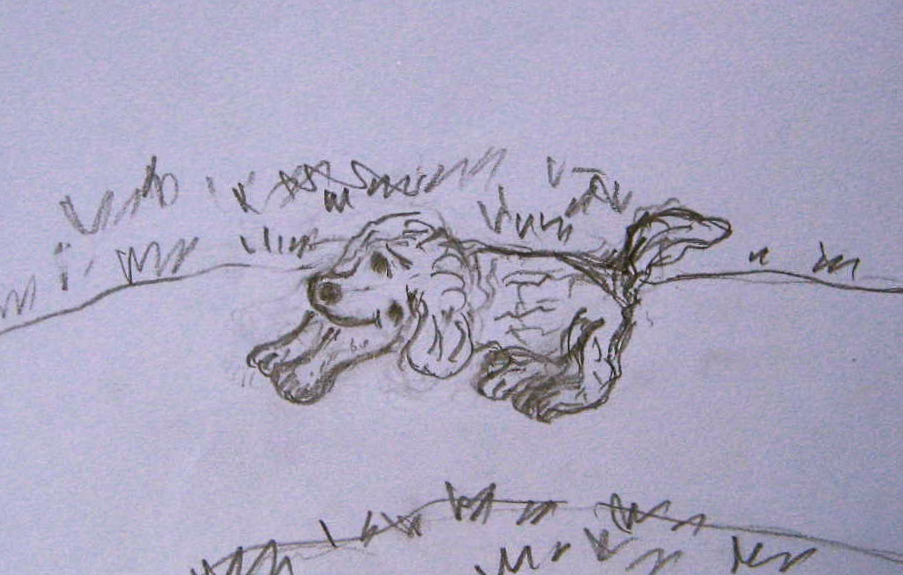
For my first conscious exploration of this subject, I turn to the teachings of my old dog Pearl.  Pearl was struck by a sudden spine problem a couple of weeks ago that paralyzed her from the dog-waist down, rendering her hind legs both insensitive and immobile.  Amazingly, with the help of steroids, she has recovered some use of her legs: she can wobble along now, though she moves like the proverbial drunken sail—dog.  (BTW, after reading several Horatio Hornblower books last week, I now feel enough “expertise” to understand that the unsteadiness of a drunken sailor is archetypical because it arises from at least two sources—(a) alcohol and (b) sea legs, i.e. legs accustomed to the sway of waves that are suddenly posited upon dry land.)

Pearl’s up in the country this weekend, and her reaction to it is a lesson in the maintenance of creativity under stress.  (For these purposes, I’ll consider Pearl’s outdoor explorations and general cuteness her “expression.”)

Pearl still has trouble even walking, and yet, here, in a country place she has loved since puppydom, she wobbles, skips, trots.  What motivates her, what keeps her going, seems to be two factors:  habit and engagement.

There are certain places (a long dirt driveway), and certain times of day, in which Pearl has always run here.  That habit (plus steroids) is so strong that when I put her down on these spots, and at those special times, her legs just move.

Where habit runs out, engagement takes over.  The scent of a place where a deer has recently bedded down will lure Pearl, sniffing, into tall grass, pull her through reeds, propel her into Heraculean effort.  I can only derail her lopsided enthusiasm by physically picking her up and putting her back on her track, where, out of habit, she quickly wobbles off again.

Which brings me back to the creative human mind dealing with stressful obstacles–all those drags upon the consciousness.  How to avoid paralysis?  How to dart and trot, dig and ferret?  How to just keep going?

This (I think) is this blog’s inquiry.

Thanks so much to those who have been following.  Stay tuned.

Memorial Day Weekend- Liquified Whitman

Posted May 30, 2010 by ManicDdaily
Categories: poetry, Uncategorized, Vicissitudes of Life

Tags: , , , , , , , , , ,

Memorial Day Weekend

Here is a draft poem for Memorial Day weekend.  Did you know that Vitamin B is recommended to ward off bug bites?  Apparently, mosquitoes hate the smell.

On the Grass By the Pond

My Vitamin B-infused pee
blends with the blades of yellow-green
below my thighs, like
liquefied Whitman.
Memorial Day Weekend.
First outdoor pee of the season.

Memories of Memorial Day

Posted May 29, 2010 by ManicDdaily
Categories: Uncategorized, Vicissitudes of Life

Tags: , , , , , , , ,


Memorial Day Weekend

Memorial Day Weekend.

When I was a child growing up in suburban Maryland, the weekend was glorious. It meant the opening of swimming pools for summer; it meant the opening of summer for summer.   It meant that any school days we had left would count for nothing but a countdown, in which the sweat accumulating at the backs of our knees would smell faintly of graphite and the white vinegar used to sponge down the school cafeteria.

The pool was where we spent almost every daylight moment in our summers.  We had no air conditioning,  managed the heat through damp bathing suits, that were kept on even after we came home, darting around the slow darkening of summer yards, kept on even in the blue glare of night TV.

Later, as an adult, Memorial Day Weekend meant a chance to drag my two children to upstate New York, leaving the very momentary green of May city for some real, deep, comprehensive, green.  We seemed to be collecting coolness up there too.   (Air conditioning has not been an easy accomplishment in my life and there is nothing like most New York City apartments for jumping into summer fast, each room its own little microcosm of global warming.)

It was only on these trips up to the country that I glimpsed the true meaning of Memorial Day.  There is one cemetery our route passes; actually the road bifurcates it; drives smack down the middle.

Of course, the cemetery is green in May;  it’s green all summer long, the grass lush, fenced in, mown, lined with small brown and grey headstones that look almost like the class of kids in my old schoolroom, half-asleep.

There were always a few little bouquets, some too brilliant against the rectangular stones to be completely real.  But on Memorial Day weekend, there were more, and, with the flowers, small American flags, prongs stuck into the earth or on small stands

Sometimes, driving by, we’d see a few small groups, women with pale hair scalloped around their faces, the curves made by curlers, or permanents, old-fashioned hair.  Women with pastel pants, sometimes worn under dark windbreakers; upstate New York’s weather changeable in May.

Even watching them, with their curled hair and small American flags, it took me a while to catch on.

(For a villanelle about swimming in summer at the pool, check here.)