Archive for the ‘Uncategorized’ category

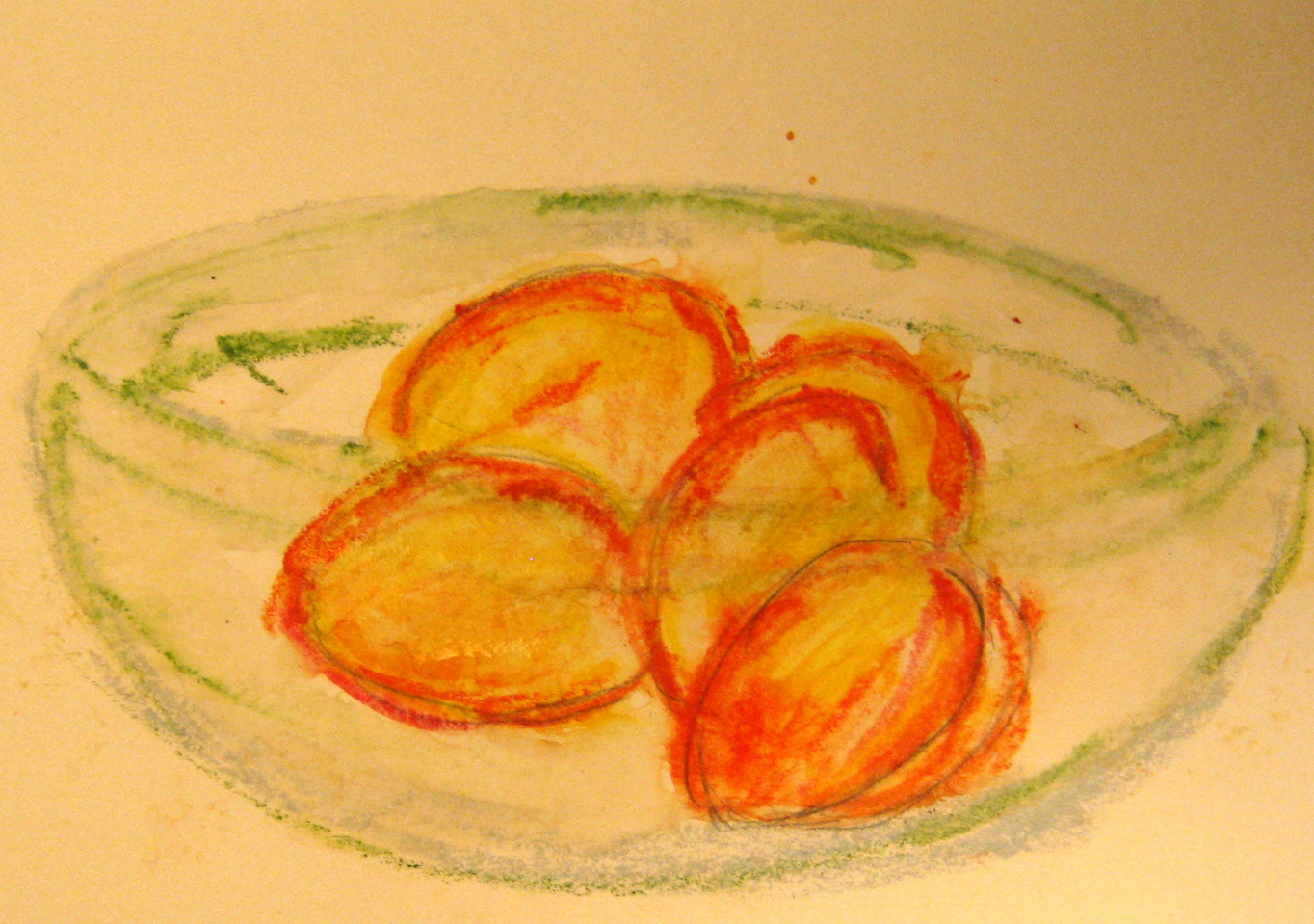
Body of Apricots

July 26, 2010

Apricots

Hard to adjust to a new day after the death of a friend.  The burden of sadness seems to sink into one’s joints (not to mention eyes, chest, forehead).

All day yesterday, I was poignantly conscious of the joy of a body.  What a delight it is when it works.  To simply move — to move simply– is an actual physical pleasure when all the parts are in order, more or less.  To stretch one’s legs, swing one’s arms, feel gravity beneath the feet.  To be touched by air, much less another person.

To eat!

Apricots!

Even less than ripe apricots!

So tart, almost like plums.  (Less than ripe plums.)  With that same inner coolness, but a soft blushed cheek.  Peel.  Skin.  Body.

More Giotto – Fear of Mortality, Fear of Fear

July 22, 2010

More Giotto, Scrovegni Chapel, Detail of Lamentation

It’s hard to visit someone who is very ill.  An instinctive fear arises.  You know that the visit will engender pain–pain for the current loss, pain for past losses, pain for future losses.   The thought of pain alone brings fear; the confrontation of mortality holds additional terror.

There’s almost an animalistic fear that arises–a fear of participating in the pain that the ill person is suffering, a fear (almost) of empathy.

Then too, there are the unanimalistic, highly socialized, almost opposite, fears – a fear that you won’t feel pain, or enough pain; that you won’t react properly; that you are not close enough, that you just don’t belong.

I visited a very sick friend this evening and was a little shocked at the level of fear that overtook me on my way.  Part of what steeled me to go on was simply duty –  past promises to be supportive.  But what finally pushed me into the building was the understanding of how trivial my fears were compared to what my friend was going through; the understanding that I could only help her get through her illness and the fear of what seems sure to come next by rising above my own fear of those things.  Of course, my help would be minor in the greater context, but surely I could do that much.

All this was on the way.  When you are actually in the presence of a very sick friend or family member, the fear part of the equation largely subsides, at least the self-centered parts of those  fears.  That’s your friend there, still there, still your friend.  You are fearful then for their pain, not your own; and while it may be difficult to say things to them, their hearing uncertain, you feel as if you can think things; at least you do think things, your mind suddenly like a calming palm.  It doesn’t make sense, but still brings a kind of relief, even in sorrow.

Palin DeFicted as Shakespeare (In Watercolor!)

July 19, 2010

The Newbie Bard?

To refudiate or not to refudiate, that is the question.

Uh…what is the question?

(Unfortunately, no one who likes her will care.)

Surface Soot in Kashmir – “Glacial” Doesn’t Mean Slow When It Comes To Warming

July 18, 2010
Kashmir (Sooty Glacier With Goat)

Kashmir - Sooty Glacier (With Goat)

Nicholas Kristoff writes in today’s New York Times about the decline of glaciers in the Himalayas, and the resulting damage to agriculture and waterways on the Indian plains.  One factor in the deterioration (aside from a general rise in temperatures) is apparently the soot on the surface of the glaciers, caused by the exhaust systems of trucks and buses traveling the roadways there.   Because the soot reduces the reflective quality of the snow and ice, it causes them to absorb more heat and melt more quickly.

Archival and new photographs illustrating Himalayan deterioration are currently on display at the Asia Society in New York, but I couldn’t resist adding my own photographic evidence.  The photo above (taken June 2009) shows a slice of soot-covered Himalayan glacier; a goat travels on top of the blackened-ice, whitish buses haunt the background.

The roads–the road in that area, which travels from Srinagar, through Kargil, to Ladakh, is only open from mid-May to October.  In these months, it is extremely crowded with both commercial (beautifully decorated) trucks transporting the year’s worth of supplies, and extensive army convoys.  (They move about the thousands of soldiers stationed in Kashmir.)

Drass, Kashmir, India

The glaciers are beautiful, but sadly grey.  As we began ascending the mountains (by car – no crampons), I thought the grey was a sign of the age of the ice (as in humans!) but closer viewing showed it to be the coating of ash and soot that Kristoff writes of.   (It actually reminded me of snow in New York City — say, near the Holland Tunnel.)

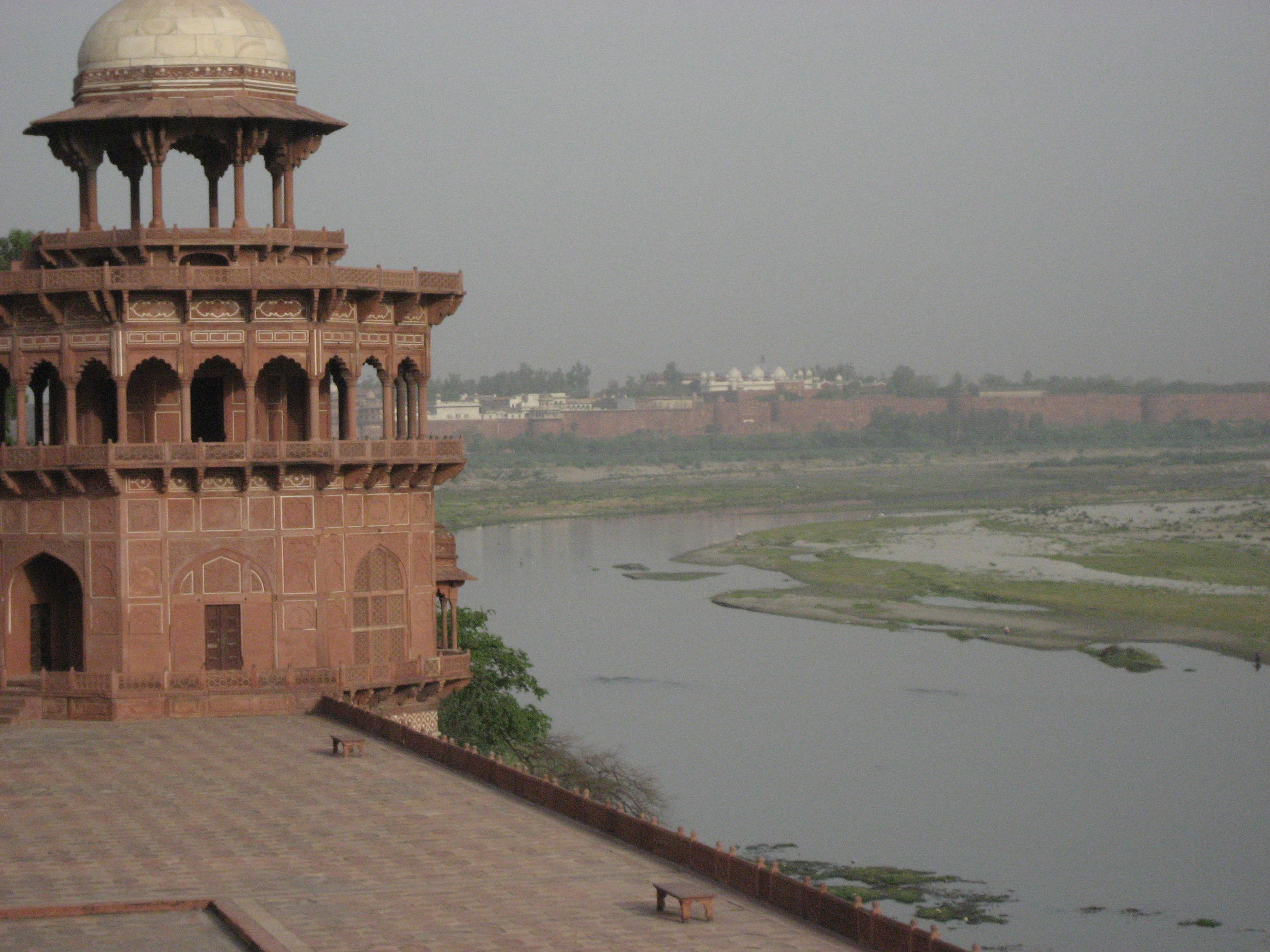
You don’t need to do extensive “backwater” explorations to see an effect on lowland rivers – below is a picture taken in India’s primary tourist city, Agra, the home of the Taj Mahal, showing the riverbed of the Yamuna (part of Indus river system fed by Himalayas.)    It’s my understanding that the “islands” used to be submerged.

Yamuna River, Agra

So many people rely on these waterways.  This is not just a problem of dry pipes or reduced pressure – people (often children or women) actively take livestock, laundry, and their individual selves to the riverbanks.

The reduced flow seems not only to mean lesser water but, increased muck – less dilution of the zillion and one pollutants that burden these poor waterways.

Where else can the people go?  They walk out further onto the caked silt of the old riverbed to get to the mirk of water that’s still there.

Kristoff hopes in the article that the BP spill will make Americans, and others, aware of the increasing degradation of the environment worldwide.   I, for one, think it’s doubtful, since Americans have difficulty recognizing the degradation of their home environment.   But many poorer countries – certainly not just India – which have hopped onto  a developmental train of manufacturing and consumption, have no environmental safeguards, enforcement, or even disposal systems, and  tragedy looms.  As nature is reduced, as true rivers and glaciers “melt down”,  mountains of undisintegrated plastic and pools of shinily suspicious liquids move in to fill (or deepen) the void.  (I couldn’t quite make myself take pictures of those.)

Yamuna River, Agra, India

Little Sleep, Little Function, Little Sloth

July 17, 2010

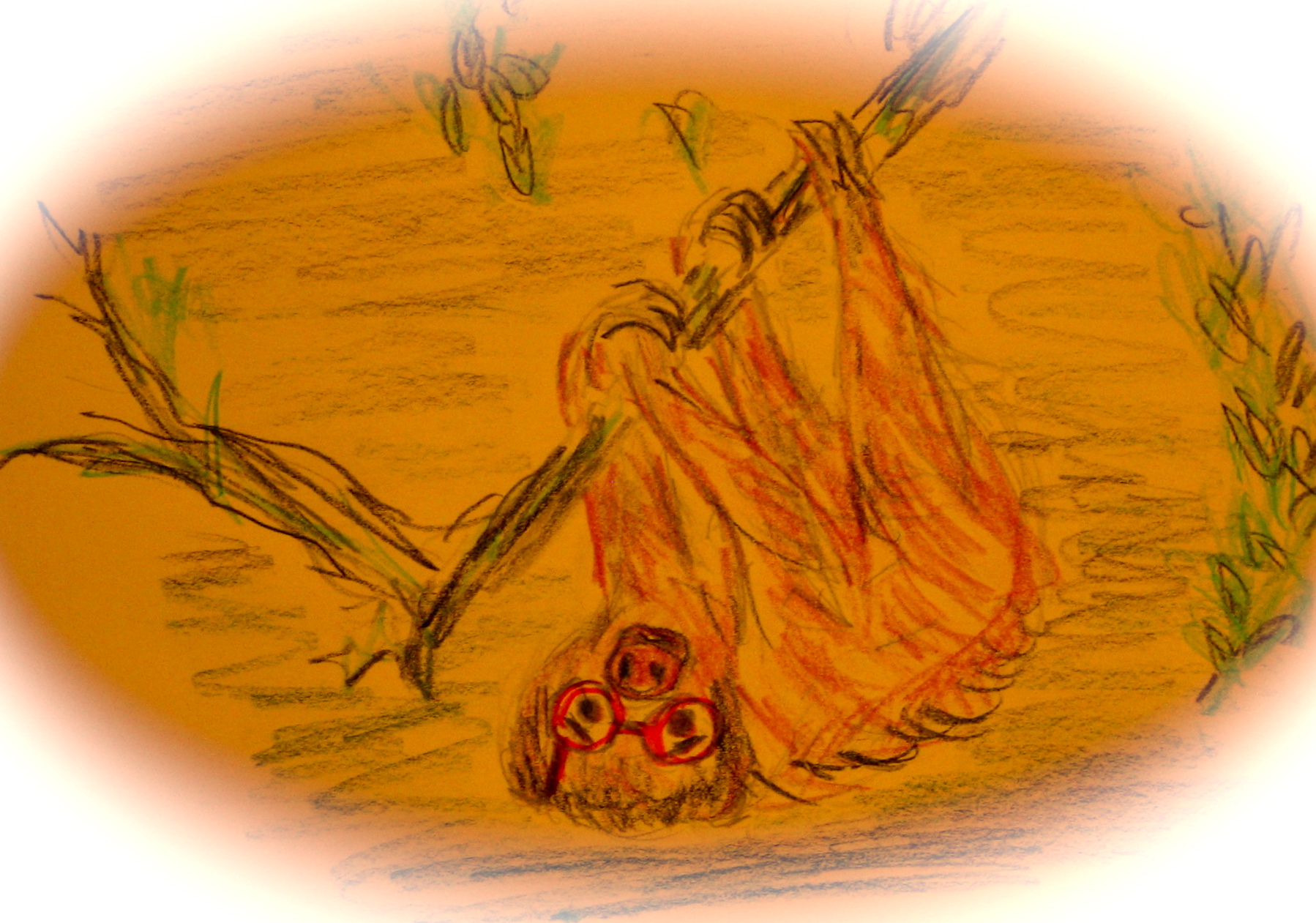
Sloth (Not Elephant)

My husband and I have an ongoing argument about a universal human sleep standard.  He insists that people–all people–need many many hours of sleep for even minimal efficiency;  I counter with the variable sleep needs of different people (citing myself among those who need little); I talk about the efficiency of having extra time to do things in (even if that extended time is burdened with some level of fatigue.)

Sometimes, however, I find that I really do not function all that well without sleep.  Some hints:

  1. At 1.am., folding freshly-cleaned clothes, I come across, in a laundry basket of towels and underwear, the only pair of glasses I own that do not hurt my eyes when working on the computer.  These are old glasses, whose frame has one stem that had been very loose. They are now old glasses, whose frame holds one stem that is not loose.  The lenses are currently very very clean, and shiny.
  2. It is approximately 2:15 a.m.  I am wearing glasses that only hook onto one ear.  I am considering downloading old drawings of donkeys to my computer, since everyone thinks I only draw elephants.  Yes, I know that you have to get up at 4:45 to catch a plane, and that I have not yet packed.  It feels somehow easier to think about donkeys.
  3. It is 2:30 a.m.  I’ll figure out the packing in the morning… that is, in…uh… two hours.  I begin to re-read an old Terry Pratchett novel about wizards whose heads are always up in the clouds, but who somehow manage to come out all right in the end.
  4. 6:30 a.m.  Somehow, despite the repeated last minute changes of clothes, and glasses, I have gotten to the airport.  Feeling extremely efficient, I take my computer out of my suitcase, rather than my little composition book,  and type the original first sentence of this blog as follows: “sometimes you are all too anxious that, in fact, you don’t function very well without sleep.”  I feel just amazingly efficient, though I also worry that the guy next to me is reading over my shoulder.  He, on the other hand, mumbles something about Kansas City while my flight is slated for Orlando.  Hmmm….
  5. After leaning some time on an Delta steward’s counter, I am too tired to be pleased that I’ve been bumped to first class, though I have to say this big wide seat is awfully niiiiii….zzzzz.
  6. Later in the day.  I keep trying to think of some animal to draw, something other than an elephant.  I really can’t come up with anything;  I just feel too tired, too slow, too lazy….
  7. And where did I pack those glasses?

The Only One Engineered To Handle New York City Subway Platform

July 16, 2010

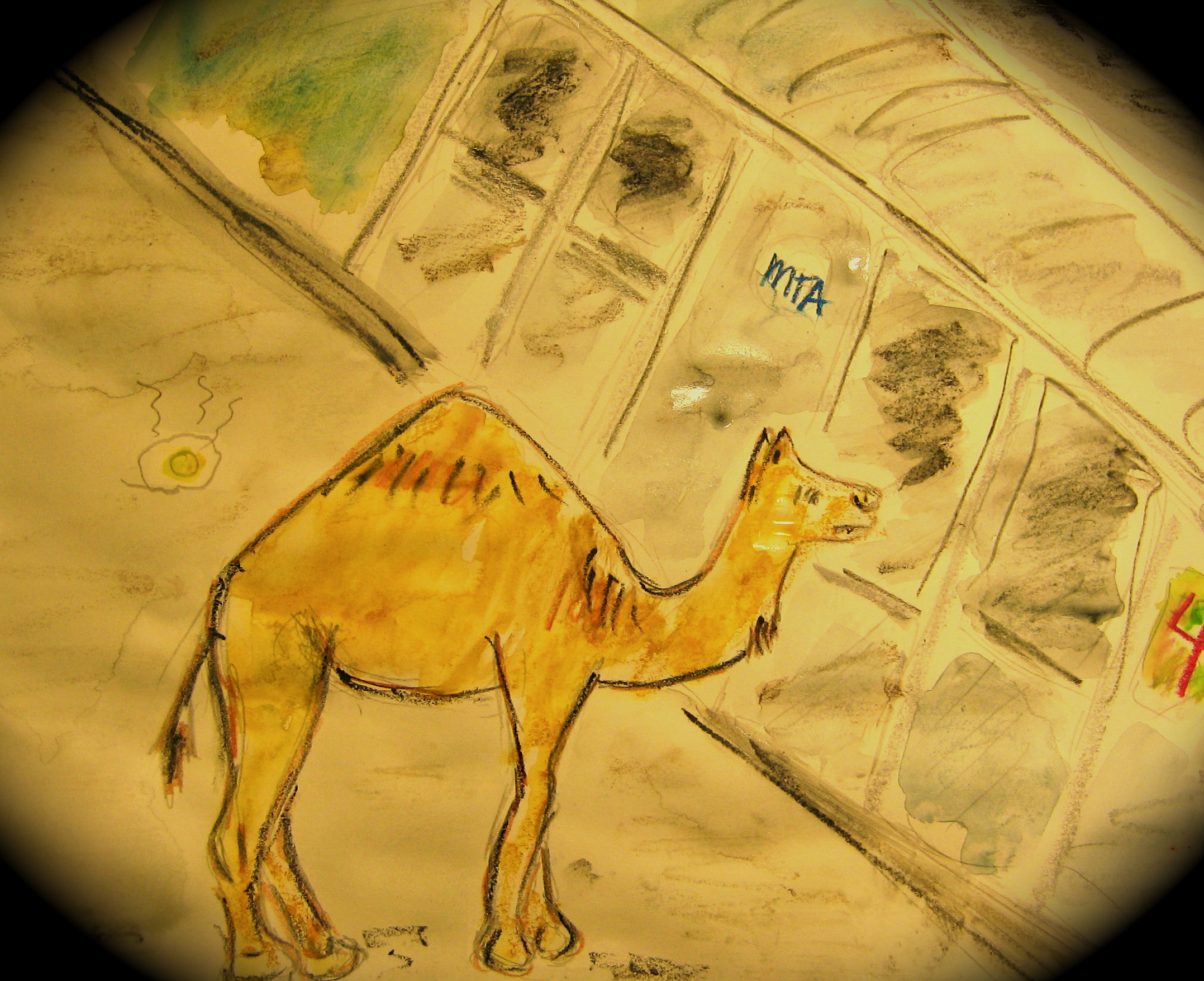
Prepared for Mid-July Subway Platform

Stay cool!  And hydrated!  (If you are thirsty, breathe deeply–there’s more than enough moisture in the air.)

Have a nice weekend.

Acknowledging Sadness

July 15, 2010

I said goodbye to a dear friend this evening.  I very much hope to see her next week but life and health are uncertain, and it seemed best not to leave things unsaid.

It is always amazing to me how important it is to say things.  Granted, I’m a talker.  (Anyone who writes a daily blog probably has to be.)  But even a “talker” (maybe especially a “talker”) can have a great deal of difficulty saying important things.

I was raised by people, Scandinavians, who did not like to draw attention to emotional circumstances.  I’m not saying that they were cold—but when my father kisses my mother, it is a highlighted, discussed, moment (and never publicly on the lips.) My parents’ parents were the kind of people who blanched even at a reference to where a childbirth took place, and would take great pains to avoid discussion of the deemed uncomfortable.  So, for example, they never mentioned blindness to a sightless cousin, or prior spouses to a divorcé or widow, or anything that might occasion offense, even if it really wouldn’t.

But my parents, for all their inherited diffidence, were somehow able to get the important words out–I love you, I’m proud of you, I’m so sorry that this has happened.

I’ve rarely found those important things to be out of place.   When sadness is in the room—not just there—when sadness fills the room, I’ve rarely regretted acknowledging it, if I can make myself.   It can be extremely difficult to make one’s self—the painful is not just awkward in our culture—human nature would truly rather it wasn’t there.   We don’t want to hurt feelings; we don’t want to do something wrong.

I guess the thing to keep in mind is that in some circumstances, sadness is there no matter what you do, feelings are hurting; things are, in fact, wrong.  Better to take on the unrecoverable moment than to let it drape you in stone; the moment itself is not stone, not lasting.  The acknowledgement of the sadness certainly won’t take it away, but at least it can offer the balm of connection, shared tears, the clasped, dear, hand.

Quatorze Juillet – French Burnt Peanuts, Fraternite, Kemp’s Ridley Sea Turtles

July 14, 2010

Oh brother how are thou?

A lot of disparate elements to pull together on today, July 14th, Bastille Day, the French national day.

My only Bastille Day actually spent in France was in Nice at age 8.  Its most memorable element was not the fireworks over the Mediterranean (although I can still picture one beautiful arc of flash) but the French burnt peanuts bought from a street vendor on the nighttime beach.  It was the first time I’d ever tasted French burnt peanuts and they were like fireworks in my mouth–hot, sweet, crinkly, crunchy, touched so delicately with salt that it might have just been the taste of the sea air on my tongue.   The nuts were, despite several prior days in France, my first real evidence of the deliciousness of French food–my parents, traveling on a strict budget, made us eat a lot of ham sandwiches put together by my mother in the car.

My next most important memory of Bastille Day is not actually my personal memory, but one recounted to me by members of my husband’s family—a patriotic group who’d lived through and/or fought in World War II, serving with the U.S. forces.  On one July 14th, during the height of DeGaulle’s France First approach (and U.S. furor at his perceived ingratitude), my in-laws and some friends celebrated  by lying down on the floor to sing the Marseillaise.  This (the floor part) was deemed to show the highest disrespect, although, for my part, I was always impressed that they cared enough about France to actually know all the words.  (Also reflecting a longstanding U.S. love-hate relationship with the French, a/k/a Freedom Fries!)

I personally never learned the full Marseillaise, but was taught the slogan words of the French Revolution – Liberté, Egalité and Fraternité.   Liberté and egalité were expected (except for the “g”) but “fraternité”  – brotherhood  – always took me aback (and not only because I was a girl.)   The American Revolution talked of freedom and justice for all (except for slaves), but did not (at least in my limited understanding) give the same emphasis to this kind of connection among people.  (My off-the-cuff, uninformed, explanation is that the American colonies were already already somewhat united against a common “foreign” enemy, while the French Revolution, more akin to a civil war, needed to emphasize alliance.)

But I don’t want to write today about the French Revolution; what I want to write about are sea turtles.  There is a very sad, if interesting, video piece in the New York Times today about forensic efforts to uncover the exact cause of the huge rise in turtle deaths in the Gulf since the BP oil spill.   (Brent McDonald, Kassie Bracken, and Shaila Diwan.) The oil is an obvious culprit, but deaths also seem to result from sea turtles drowning in shrimping nets, particularly in Louisiana which apparently does not enforce Federal law regarding escape hatches in the nets for turtles.   One thought is that, in addition to poisoning the turtles, the oil may drive them into areas that are inhospitable and unfamiliar;  the spill may have also changed the conduct of fishermen.

Many of the turtles dying are the endangered Kemp’s Ridley turtles; their life span would otherwise go into the decades.   They are beautiful, their faces seemingly embued with a thoughtful intelligence.

Which brings me back to Bastille Day—not because of Louisiana’s French roots – but because of the French Revolutionary tenet of fraternity.  It seems to me increasingly unlikely that much will be done to save turtles or any non-human species, the environment, or even the planet itself, unless and until people feel a meaningful connection with creatures other than themselves.  I don’t mean simply the sentimental connection of how endearing the creatures are (although that’s a start).  I mean a connection that be real enough to inspire actual care and sacrifice.

I don’t mean to diminish people’s concerns about their jobs, what they eat and the temperature at which they keep their dwellings.   But at the moment, there is another kind of love/hate relationship going on here (more serious than the one with the French.)  We love the idea of saving wildlife, the environment;  we hate to actually do anything about it, to change our lives.  Some kind of better balance needs to be reached between short-term, individual concerns, and longer-term, world-wide needs, an understanding that humans may not do very well in a world in which sea turtles are dying in droves, that these creatures deserve lives free from molestation and torture, that the death of a sea turtle is a death in the family.
Pushing/Falling Along

July 10, 2010

Crazy time.  I have a dear dear friend arranging for her hospice care in the city, and am up in the country drawing elephants with young kids.   So much to grieve, so much to joy in.   One of those statements that’s a cliché because it’s so true.

A [ridiculous] clock in the hall coos in the hour with varying bird song.  My mother-in-law, now gone, a true naturalist, really loved that clock, especially as hearing true bird song became difficult for her.

I suppose the deepest approach to the inevitable losses in life, the prospect of the loss of life itself, is to let go of regret, to learn to find contentment in what is before you, to stop wasting time worrying about what’s beyond recall (not of memory but of re-doing).   But that’s so hard, for me at least (a master of discontent).  For me, the more effective protocol is to make a concerted effort to remember regret, to remember, in advance, how it will feel when loss is in front of you, to remember, in advance, that this is a feeling that you don’t want to feel, and to focus, to the extent possible, on what you can possibly do to avoid the having to feel that feeling.

To imagine, in other words, that you are at a place with extremely few choices, and to think, from that position, of the choices that you wish that you had made when you had them.

I understand that it sounds Escheresque.   Perhaps this type of forward/backward thinking only works when you have dear friends who are very sick, when you want to plead with them not to go but know that you really can’t do that to them, that their life is beyond their wish and yours.

They have lived their lives well—you have no question of that–but what about you?   You feel pushed along by life,  by rapids, gravity, momentum, but is that push really irresistible? Really?

On Hot, Tired Days – A Passage To Your Inner India

July 8, 2010

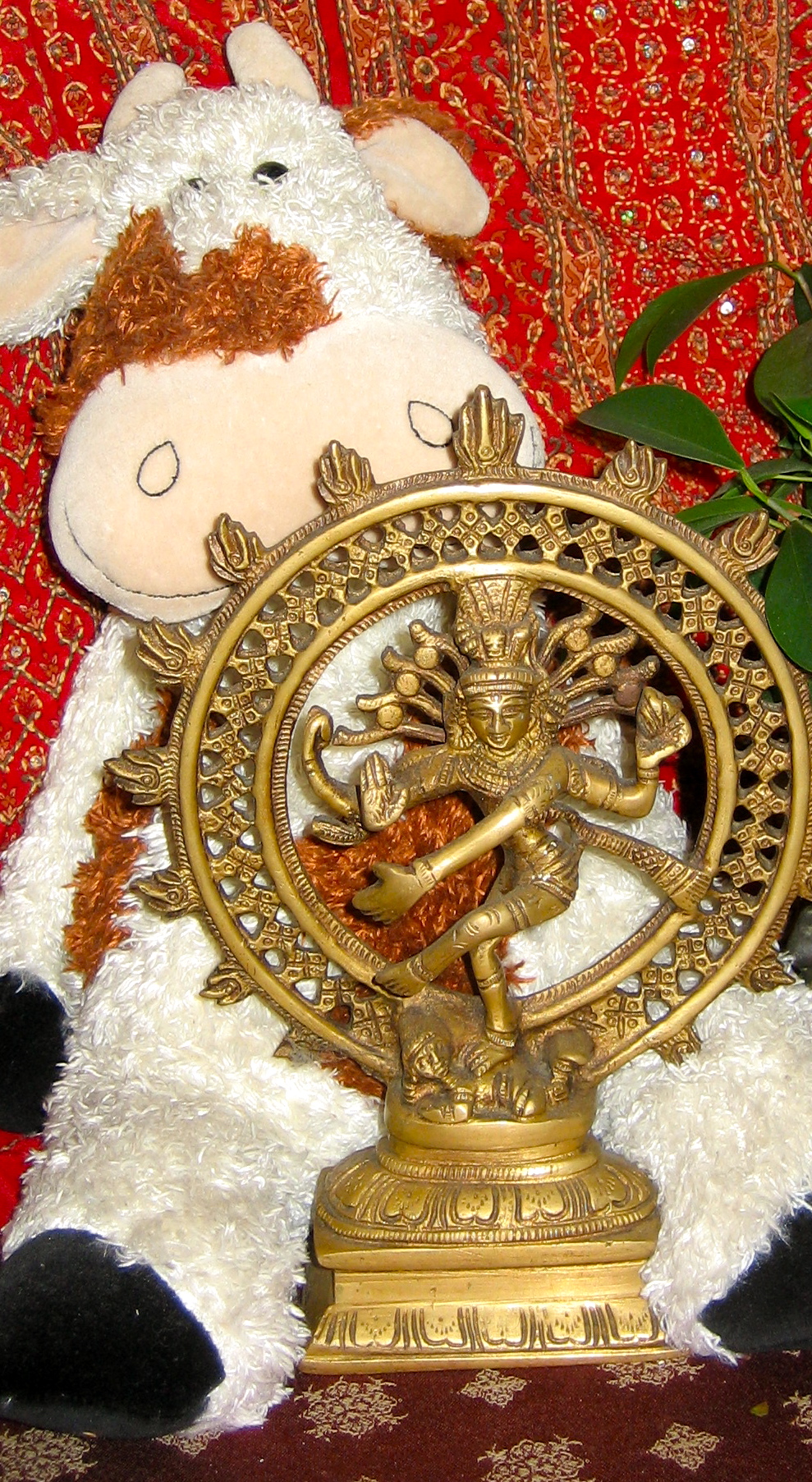
Inner India (No Disrespect Intended)

I thought this morning of a new solution for those, like me, who are having a hard time with the hot muggy doldrums of mid-summer:  find your inner India.

Stop it–don’t groan.  (Especially you who have actually been to India.)

I’m not advising you to find the inner India of flies, squalor, unremitting aridity or humidity (depending upon your location and the monsoon cycle), the smell of burning polyurethane—

I mean the India of cool marble floors where your bare feet moistly slab slab slab, the India of shaded mosaic archways of palaces…er…mausoleums, the India of leafy Banyan trees and purification baths (delicious even if taken with bucket and cup), of endless people to watch and to be watched by, people who squat imperturbably in the midst of chaos or sameness for a very very long time, certain, or nearly certain, that there will be another life beside the one that they are currently enduring; the India of hot spiced chai, and where there is airconditioning, of air so frigid you feel your lips turning blue.

Keep in mind those lessons that are available nearly everywhere but are so quickly learned upon the Subcontinent,  i.e. (i) that there are many many forces beyond your control; (ii)  that yes, you have been cheated but there’s no use worrying about it; and (iii) that you should be really really careful of what you eat.

Don’t expect even that little boy who seemed so charming to have sold you real saffron.  (Is pink food so terrible?   He had a beautiful smile, a genuine chuckle.)

Above all, even when you feel like you are wading through an opaque sameness of muggy weekday after muggy weekday, try to find the good in the difficult, the wonderful in the ordinary (the cow in the doorway, the bubble in the Naan, the cardomom in what would otherwise still be wonderful tea).   Don’t be rushed,  don’t let anyone pressure you,  find a hat that you will actually wear.