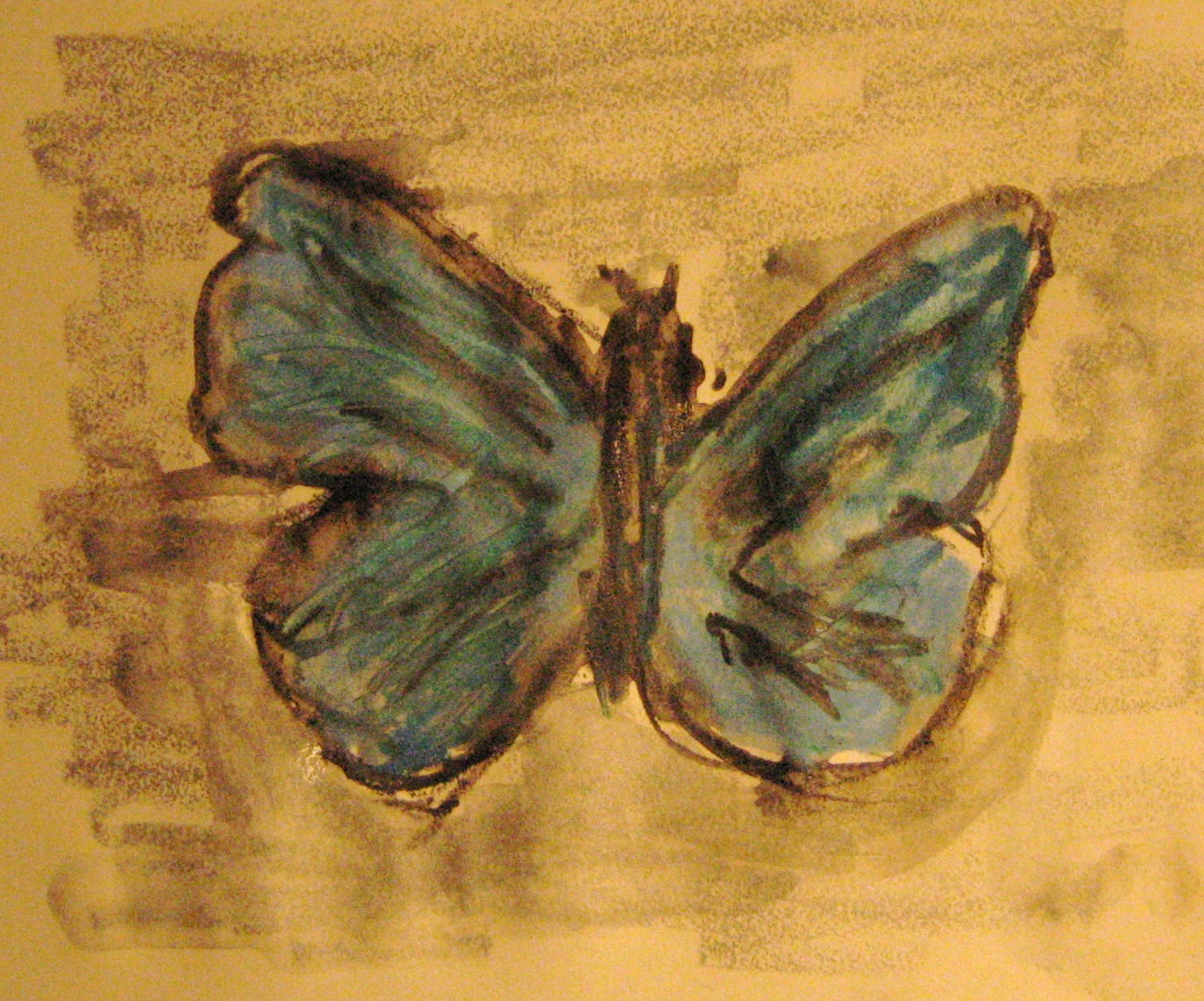
Archive for the ‘Stress’ category

Ephemeral Everything

March 27, 2010

Coming off of good food, abundant wine, a birthday celebration (not mine), wondering why it is that living in the world is so difficult for many of us, so painful.

I should start off by saying that I didn’t experience much of that pain tonight; chopping, cooking, cleaning up; a lot of bending down to wipe up the floor–I tend to be a very fast cook, who both creates and cleans up a fair amount of overflow in a small and somewhat rudimentary kitchen (hey, this is New York City!  Counter space costs!)

Engagement is a great anodyne; busy-ness, work.  The problem one bumps into as one grows older, the wall one bangs one’s head against, is the knowledge that all this really does end sometime.  When young, most of us are insulated from that sense of fragility.  Except for those times that we are being melodramatic (and possibly manipulative), we don’t even truly believe that thwarted lives are possible for us, much less no life at all.   But as we age, we become conscious that people not only take wrong turns, they come to shocking terminal stops.   We actually know people, or at least know of people, whose lives are suddenly cut short, people for whom the question of whether they had the life they wanted is almost insulting, because they are fighting so hard for any life at all.We have a terrifying sense, as we age, that loss is not only possible, but inevitable.

Our culture tries very hard to insulate us from this knowledge.  Some seem to have a belief that the only thing Western medicine cannot save them from is malpractice.

I tell myself that the knowledge of life’s eventual loss should be energizing, activating.  (All that carpe diem business.)  Unfortunately, instead of listening to that kind of archetypical wisdom,  I  tend to be influenced by a guy I heard yelling out to his friend in a New York City parking garage.  “Hey you, come on!  Life’s too short to enjoy it!”

I would post a poem on this subject, but my computer has recently joined the ranks of the ephemeral.  (Perhaps I should say–the ranks of “no longer even ephemeral”.)  Accordingly, all previously written poems are now in a kind of digital purgatory.  Here’s hoping they will be released soon.

Examining Self-Sabotage (A Shot Foot) (Old Dog New Tricks)

March 23, 2010


A Shot Food

An article in today’s New York Times discusses self-sabotage—that is, many people’s unfortunate tendency to ensure that expectations of disappointment are not disappointed: the bizarre attraction to shooting one’s self in the foot,  because (i)  a wound in the foot looks like a stigmata (i.e. is a good accoutrement to a martyrdom guise), and (ii) a familiar pain feels safer than the risk of an unknown pain (or even pleasure).

I, for one, am very good at this type of self-sabotage.  The article talks of repeated masochistic love affairs.  I’m offering, as an example, a long masochistic love affair with fatigue.  (Let’s not get too personal here.)

If I stand back a little from my own conduct vis-a-vis fatigue, I am aware that much of it– taking too many things on; getting to, and leaving from, my office too late in the day; drinking a very strong cup of tea upon my arrival at home in the evening; doing a lot of goofy evening stuff (i.e. blogging), then staying up very very late reading and re-reading silly books, or doing a crossword, or trolling the internet; getting up super-early to do some of the same exhausted internetty/reading/goofy types of strong-tea-fueled pastimes–is not productive or even all that pleasurable.

If questioned, I will say that my staying up late happens by chance, as if I just get carried away (every single night).  If questioned harder, I might admit that the late nights are an act of will—I’ll say that I need that time to myself to feel that my life is expansive.

If questioned extremely probingly, I may even admit that my schedule of late, crowded (but slightly aimless) nights is one that I stick to with extreme rigidity, despite the resulting exhaustion and reduced productivity.

What’s the answer to this kind of self-sabotage?  The article talks of medication, therapy.

But I look to the sage of my apartment, my dog, Pearl.  Pearl (nearly fifteen) is an extreme creature of habit, particularly now that she is losing her vision.  Pearl knows, for example, the direction that each of her walkers (me, my husband, daughters, nephews) like to take her in (North or South), the exact places (within my building) where her walker will get nervous of her bladder control and pick her up and carry her,  the amount of time each walker will let her sniff and mosey.  Pearl then enforces these patterns, tugging in the walker’s habitual direction, stopping stock still in the spots where she is supposed to be carried, turning recalcitrant when a normally tolerant walker tries to pick up the pace.

Most of Pearl’s walkers just let Pearl have her way.  But sometimes the patterns simply have to be changed, when, for example, Pearl’s side of the sidewalk is covered with salt.  It’s hard to shift Pearl—you have to tug her with some determination, which because she is small, cute, fluffy, can be embarrassing.   She will eventually follow the walker’s tug, however, and then, oddly (after a day or so),  she will become just about as rigid about the new habit as she was about the old.

Which means, I guess, that old dogs can learn new tricks.

Of course, some kind of tug must be there, a determination to make the change.   (I have a feeling I’ll be up late.)

Sleep-little Nights, Thinking of “Other Rooms”

March 15, 2010

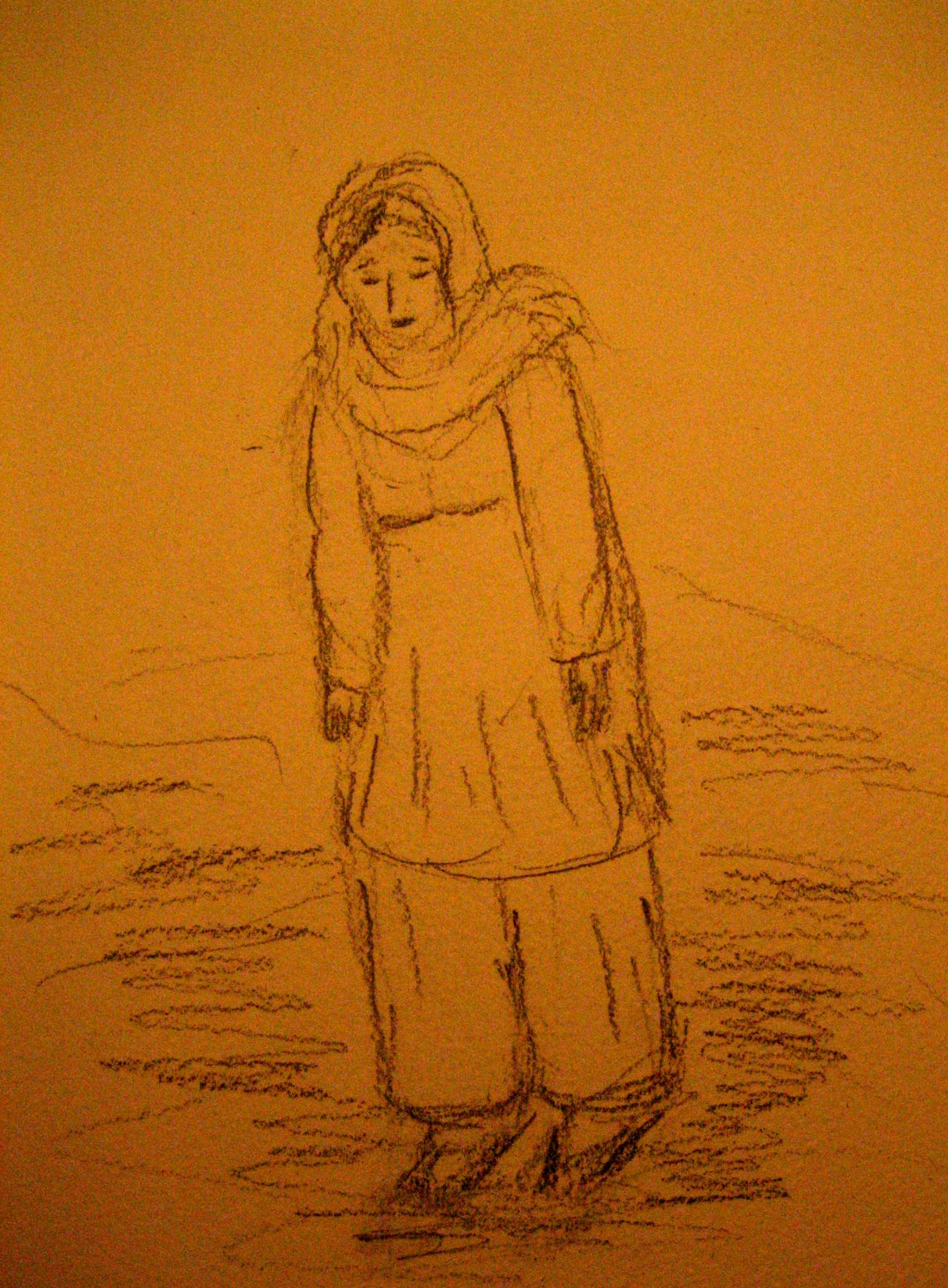
My Attempt at Drawing Forlorn Pakistani Woman. (Sorry it's so sentimental.)

At a bit of a loss for a blog today.  Part of the problem is simple brain fatigue.  For all of the manic person’s mockery of sleep, for all of the insistence that we absolutely must  extend our waking time to fit in all we think we need to do, for all of our resulting delight in staying up into the wee hours, being blissfully (in the end) nonproductive, the body, which, by the way, also contains the mind, has a very definitive answer:  Duh.

Inadequate sleep combined with frantic days leads to mental muzziness—the electric currents just can’t make the synaptic leaps; they get their little electrical feet wet, slow down, trip, short circuit.

I compound this muzziness with some darker-than-usual-reading.  Lately, I can hardly stand dark reading;  still I make myself start, on the subway, In other Rooms, Other Wonders, a National Book Award Finalist book of linked  stories by Daniyal Mueenuddin which take place in Western Pakistan.  I intersperse these with Jane Brody’s article (published today in the New York Times) about the recent death of her husband.

I’ve not yet finished the Mueenuddin stories, but at least one common thread already stands out–each story describes a palpably feudal culture in which both a serving class, and women (women especially), lead lives hinged upon the favor of a dominant man.   The man is the source of protection, livelihood,  survival; his death, downfall, disfavor will quickly bring down the lives of these dependents.

The stories are not sensational, or even particularly dramatic; it’s their matter-of-factness, their verisimilitude, which makes them so painful.

We are relatively immune from this kind of dependence in many parts of the West.  Of course, there are situations of dependence, but women have possibilities of their own; can have some kind of independent life, can be the dominant character for themselves and others.

And then I read Jane Brody’s article about her husband’s diagnosis and death from cancer all in a matter of weeks, reminding me forcefully that even here (with both our greater feeling of control and de facto control), we’re very subject to the vicissitudes of life.  Although perhaps we are not quite as subject to the vicissitudes of other people’s lives, the prospect of sudden loss is still ever present.   (Sorry.)

As I read, I tell myself to be happy that I’m tired, overworked, brain-fatigued, and maybe, just maybe, to even get some more sleep.

Feeling Special, If Not Free

March 14, 2010

Plane

Agh!  (Translation:  Ugh!)   A rainy weekend with lots of work-work (as distinguished from fun-work.)

There is something about working on both days of a week-end which makes one feel automatically deprived, even when also feeling extremely grateful to have the job.

We like to feel special, not, in other words, like drudges.  A week-end of work makes one long for the magical escape, that liberation that waits just around the corner.

Perhaps as a result of that longing, I actually opened and read the Nigerian email that I received this morning.  As a practicing attorney, I get one of these almost every day.  (They seem to be mainly generated from Nigeria, but come from other places as well.)   They involve millions of dollars or British pounds which are awaiting my pick-up if I will only co-operate in some scheme to help a widow, orphan, business partner, collect some mysteriously elusive inheritance, or lottery winnings.  Sometimes, as in today’s mail, it’s an inheritance or lottery winnings actually intended for me.  Today’s subject line  read “dead or alive!!!”  Its sender “Mr.Ron Mills” from “Standard International Bank PLC” warned me that someone named John K. Wheeler was claiming I was dead and trying to collect $2.5 million dollars held in my name.  Mr. Mills, though about to accede to Mr. John Wheeler’s claims, asked: “Did you sign any Deed of Assignment in favor of (MR JOHN WHEELER). Thereby making him the current beneficiary with this following account details….”

Who writes these emails?  What do they hope to gain by them?

On top of the fantastic  elements of the stories (Cinderella diving into Ocean’s Eleven), there are always telltale signs of the scam—awkward word usage, punctuation and grammar mistakes, generic addresses,  as in the email from “Timothy Geithner”, asking me to reply at a  “yahoo” address.  (You know how the Treasury Department always uses those for their high-level employees.)

The urge to feel lucky, singled out, is a deep one.  (An example that comes to a brain suffering from the renewed imprint of Robert Pattinson is the whole Twilight craze—certainly a huge part of that mania arises from the very ordinary-seeming heroine turning out to have special blood, a not-visible-on-the-surface quality which elevates her from the humdrum to the extraordinary.)

My mother calls me excitedly this morning, telling me of an offer received in the mail from her favorite credit card company–free airplane tickets.

I assure her that the tickets are probably not truly “free”.  She checks out the offer’s “details,” reading aloud some fine print about the continental United States.

My mom is a child of the Great Depression;  if something is free, it feels almost a sin to pass it up.  Accordingly, even though she and my father have not felt up to plane travel for the last several years, she immediately begins making plans (at least theoretical plans).

I tell her that there really is a probable catch here, something you need to buy, subscribe to.   She explains that they “have had that card for a long time.”  (I think this means that they are due a thank you from the company.)

“Yes, but—”

“Maybe they just want to get more people on the airplanes?” she answers.

“No.”

“It says ‘free'” she tries again, “even on the envelope.”

Why should I cast a shadow over her sense of good luck?  Just because John K. Wheeler is trying to steal my 2.5 million?

“So then, maybe they are,” I sigh.

Cherry Pie (Not Like George)

March 6, 2010

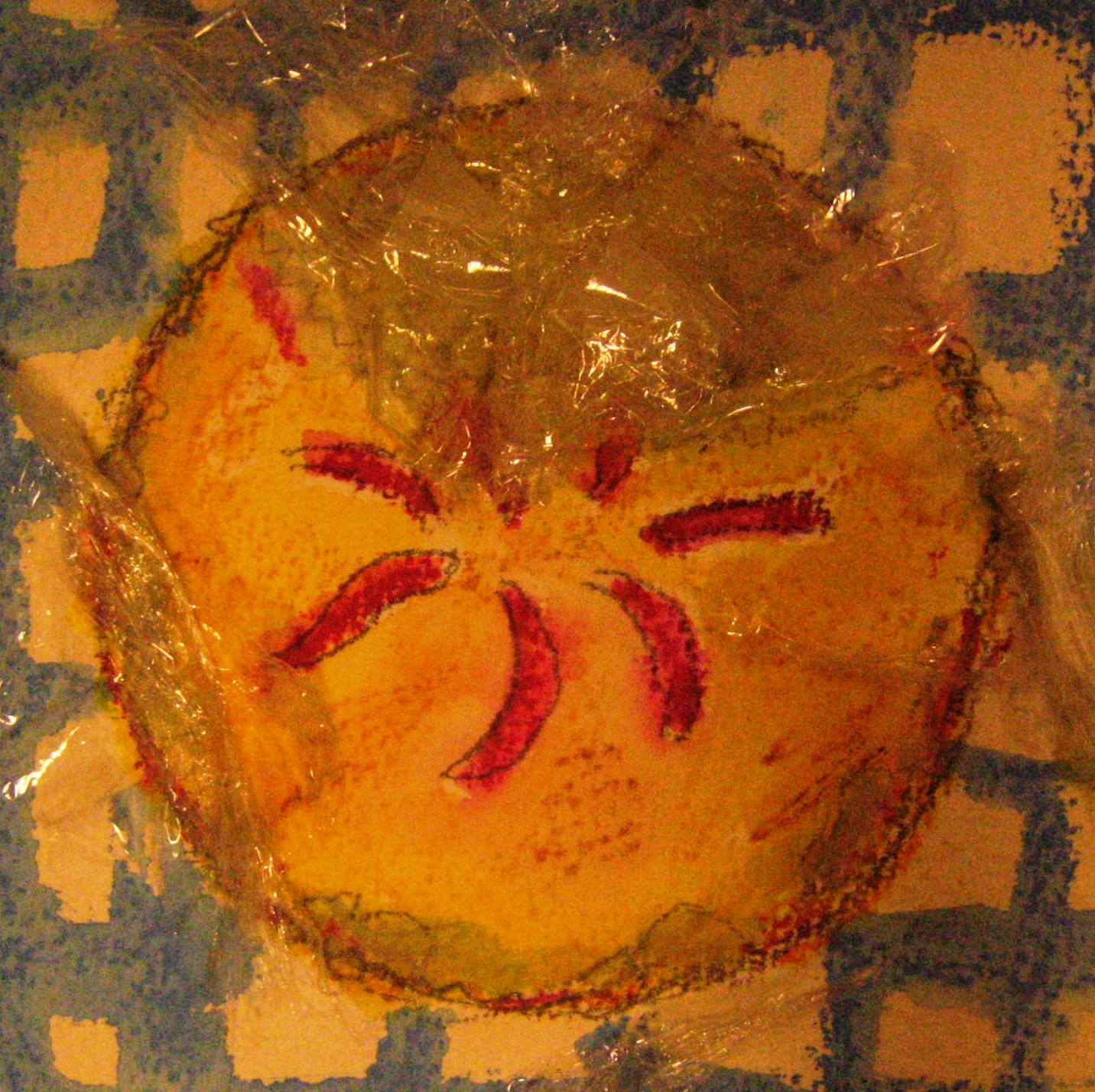
Cherry Pie With Cellophane

Thinking about greed today.   And urges.

Early this morning, bleary-eyed and blind (I was stumbling around my apartment without my glasses), I tore a frozen cherry pie from its box and put it on a baking sheet.  I have been thinking about cherry pie ever since President’s Day, the modern stand-in for George Washington’s and Lincoln’s birthday.  (See e.g. portrait of GW with Cherry Pie.)

As I turned on the oven to pre-heat it, I delighted in the home-made aspect of the frozen pie—that is, the lopsided puff of its upper crust, the slight pucker to one side.  It took me a minute, with my uncorrected vision, to realize that the pie box must have been bumped slightly (there was a crimp on one side of the aluminum pie plate) which seemed to be what was responsible for the asymmetry.  I told myself that the pie still looked wonderful.  I was absolutely determined to like it.

I hurriedly stuck the pie in the oven, deciding that it was preheated enough.

Approximately fifty minutes later when I pulled the pie out (with my glasses on), I found a crumpled partly-melted ripple of plastic sticking to one side of its top crust.

I lifted the large crumple of melted plastic off first, hardly able to believe it.  Concerns about both my vision and idiocy filled my mind, but, then as I noticed suspiciously shiny bits on the ripple of outer crust, these concerns took second place to worry over the pie.

The pie!

Does plastic get smaller when it’s melted?  Could those bits and the big piece really be all there was?

I pictured a residue of cellophane dripping down through the beautiful slits in the golden crust, throughout the ruby of cooked tart cherry.  I felt sick (besides blind and idiotic.)

My husband, more of an optimist than I, was sure the pie was fine.  Especially after we lifted off the whole outer perimeter of crust, even the parts that didn’t have shiny bits sticking to them.  Even after we took a bunch of plastic off the bottom of the pie plate.

“What’s if some of the plastic’s melted down?”  I asked.

“It hasn’t melted down.” he insisted.

With the confidence of a mother, that is, a woman who feels like she can try anything (even poisonous or boiling things) as long as she is doing it fast and supposedly to protect  someone else, I tasted one of the upper cherries.

I was sure I felt a soreness instantly start in my throat, though I was equally sure that the cherry tasted absolutely delicious.

Even though I said, repeatedly, that the pie should be thrown away, that I would get another, my husband served himself a big piece with vanilla ice cream. (We are still talking breakfast.  He has an excellent metabolism and really likes pie.)  And then I ate two or three bites of his piece.  (Since bites of someone else’s food have absolutely no calories, they are very hard to pass up.)

Then my throat began to hurt some more.  And then, a few minutes later, I became convinced that a bitter aftertaste of plastic coated my tongue.

“It’s the tea,” my husband said.

“I drink a zillion cups of tea a day,” I insisted.  “How can it be the tea?”

“It’s the…tannins,” he said, “in the tea.”

But, now his throat was hurting too.  “It’s my cold,” he said, “and the tea.”

He went back to the kitchen to throw out the pie.

“My throat really hurts now,” I called after him.

“It’s psychosomatic,” he called back.

“It’s melted cellophane,” I replied.

“They can’t possibly allow them to put poisons in plastic like that,” he said.  “People must eat it by mistake all the time.”

“We didn’t do it by mistake.  We even saw it.  We just wanted that cherry pie too much.”

“Yes,” he agreed.

“George Washington wouldn’t have eaten it,” I said ruefully.  “He would have resisted.”

“Yes,” he said. “George Washington would probably have resisted it.”

There didn’t seem to be much else to say.

Plié While You Read This (Exercise At The Office)

February 24, 2010

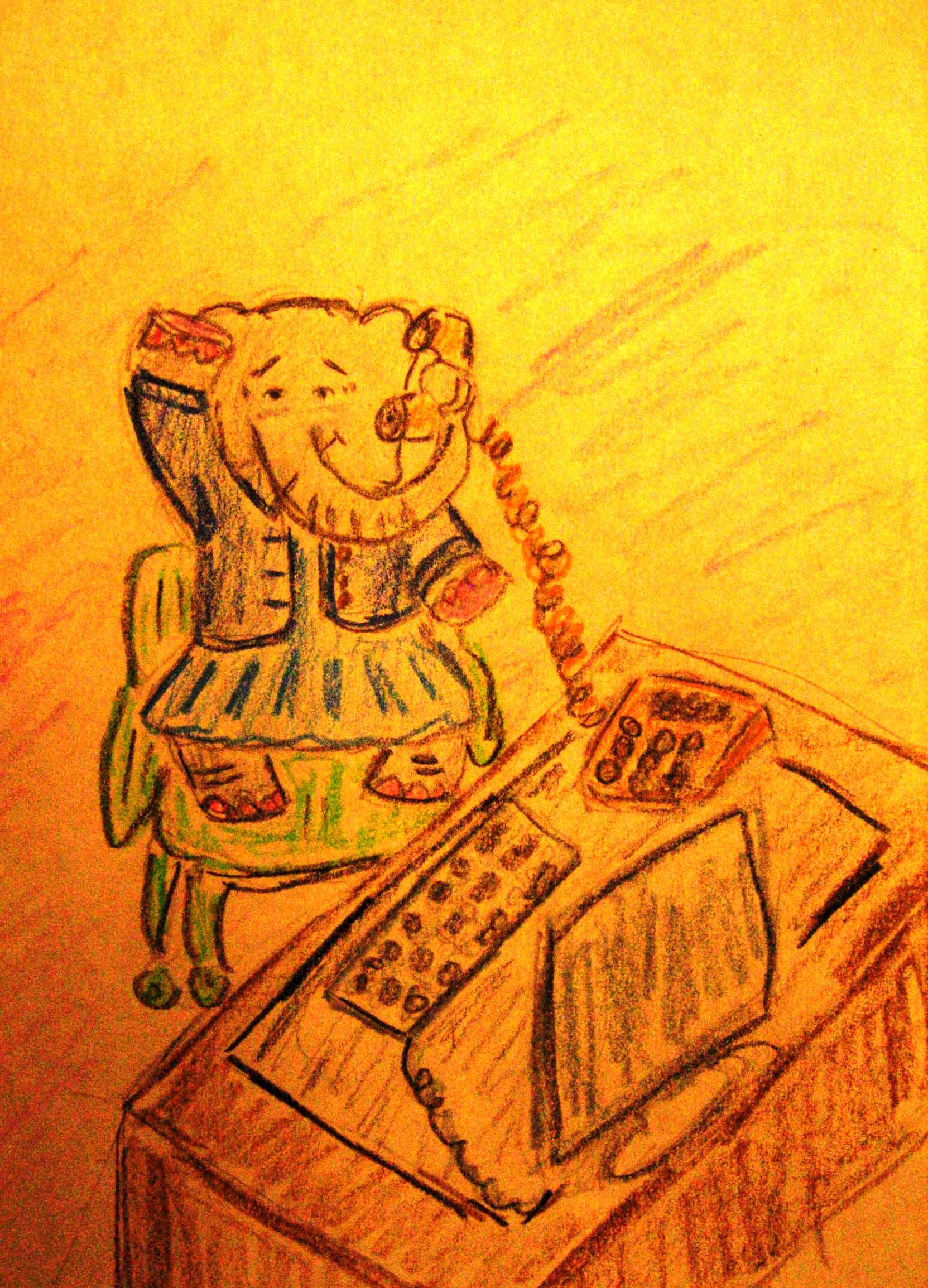
Elephant Plié at Desk

Stand Up While You Read This! is the title of an alarming (if not completely surprising) article by Olivia Judson in this week’s New York Times. Judson discusses new studies that show that sitting for long periods every day contributes to obesity (and a bunch of attendant illnesses) not only because sitting, such a passive activity, doesn’t burn many calories but because it actively changes the body’s metabolism.

What’s worse is that many of the negative aspects of sitting are not countered by regular exercise;  one hour of exercise just can’t do battle against hours of lumpishness.

The trick apparently is to break up those lumpy hours, to stand up more–while on the phone, while on the computer.  Standing up at the computer seems at bit hard to me, but some people advocate standing desks with slow moving treadmills beneath them;  others exchange office chairs for those big bright blue therapy balls.   (Oh yes!  I can see sitting on a therapy ball going over very well at my office!)

I don’t think my employer would pay for a slow treadmill either.  (Generally, employers, outside of factories, only go for metaphorical treadmills.)

So what is a worker with a sedentary job (let’s say, in an office) to do?    Some suggestions:

1.  Plié.  You know, deep knee bends, like a ballet dancer.   During those phone calls that you remember to stand up for.  But also, while washing your hands at the lavatory sink, while waiting for the copy machine or coffee machine or elevator.  While in the elevator. It’s low-tech, stationary, and, if you don’t add in arm gestures and are not wearing a short skirt, may not even be very noticeable.  (You may want to stick to demi-pliés and not the full bore ones.)

2.  Continuing in the dance mode, sashay!  Sashaying is a slightly twisting, slightly waltzy, sidestep, with arms extended. Sashaying will get your blood flowing, make you feel terrific (an aura of Fred Astaire almost instantly descends), and also get you to your destination faster.  While it is, theoretically, a graceful maneuver, you may want to save it for those moments when alone in office corridors, or for the stretches of space between open doors.   If you don’t have enough rhythm for a good sashay, pretend you work for the Ministry of Silly Walks.

3.  Take advantage of whatever privacy finds your way.  You have a moment in the Ladies’ Room—try to squeeze in twenty jumping jacks.  (Your heart will not only race from the exercise but from the fear of discovery.)

4.  Make your chair your friend rather than enemy.  Squat.  (Be careful if your chair has wheels.)  I haven’t seen any studies on this, but squatting’s got to be better than sitting.  (Non-obese people squat all over the world.)  Admittedly, squatting is a bit hard on knees that have been doing a lot of pliés.

If you can’t squat, try sitting cross-legged.  (How many obese meditators have you seen?)

Use your armrests for dips.   Try to keep the weight balanced so your chair doesn’t fall over.   (Work on curls while picking up the chair.)

5.  Use your arms too, extend, wiggle. Yes, it’s a little distracting to do arm exercises while talking on the phone or while looking at a computer screen, but it’s a lot less distracting than talking on the phone WHILE looking at a computer screen.  (You know those long distracted silences.  Sometimes they are even your long distracted silences.)

The great thing about all these techniques is that they will burn calories, reduce your chances of sitter’s metabolism, and also, by raising your silliness level, give a lift to both energy and spirits.  Your co-workers, at least, should have a good laugh.

Buddhist Talks, Vampire Books, The IRT

February 23, 2010

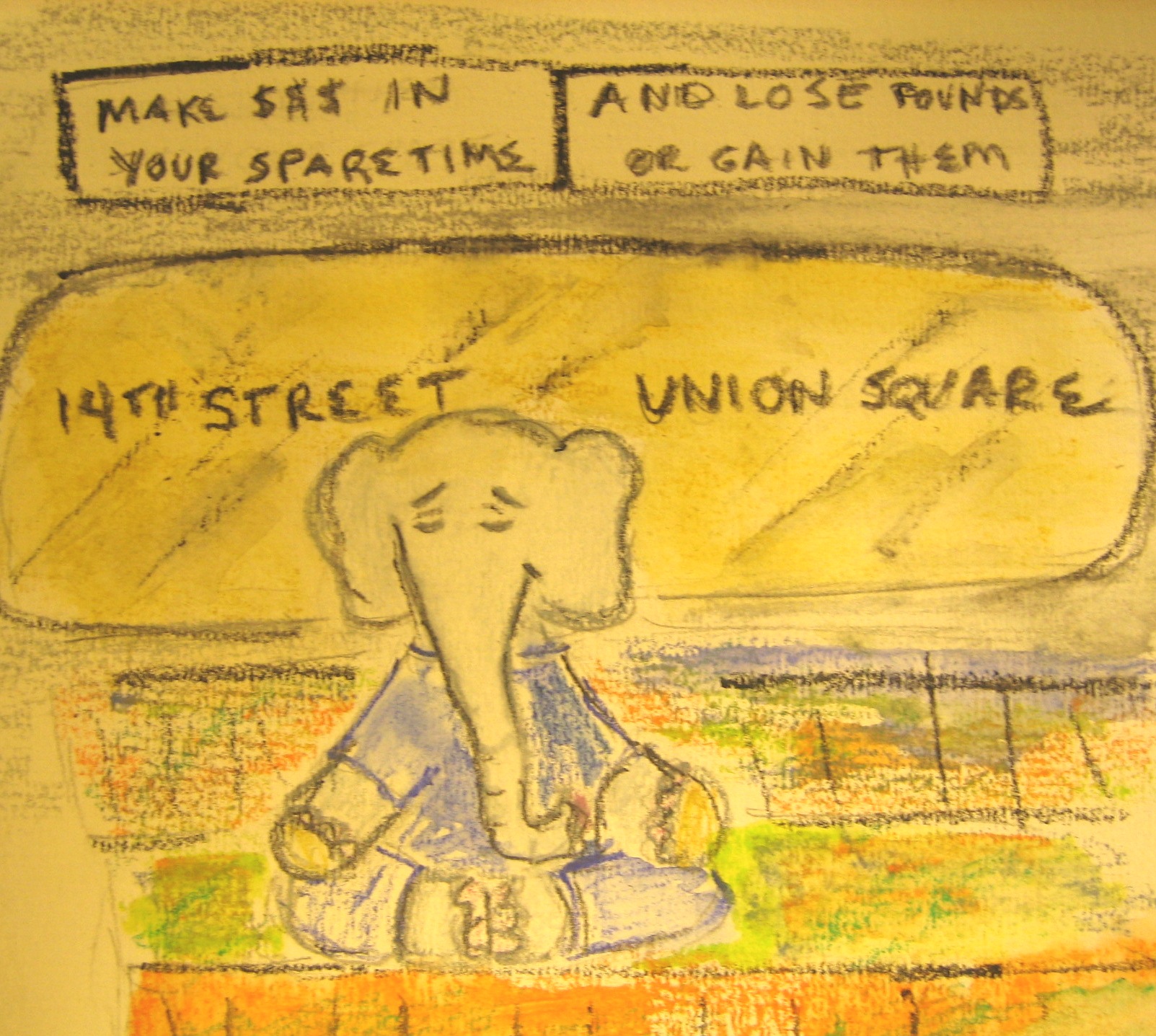
Possibly Vampire Elephant Meditating on IRT

Litstening in the mornings lately to Buddhist meditation talks instead of vampire books on tape.  Although the vampire books are a great diversion when you feel down, I keep thinking that the Buddhist talks must provide a better path to long-term contentment.  (Vampires are typically not big on enlightenment.)

Today, my tape focused on Buddha’s list of ten “unwholesome” actions, which, in a peanutshell, are (i) killing, (ii) stealing, (iii) sexual misconduct, (iv) lying, (v) slander (gossip), (vi) harsh speech, (vii) useless speech, (viii) covetousness or greed, (ix) anger, (x) delusion.

These seem to me both remarkably like, and unlike, the Bible’s Ten Commandments; like, in that they proscribe killing, stealing, lying and coveting; unlike, in that they do not emphasize particular deference to authority.   There are no specific rules about God, no prohibition against idolatry, no special honors reserved for parents.  (Though, presumably, if one avoids harsh, useless, or angry speech, one will also be nice to one’s parents.)   The “not killing” is not even limited to human beings.

This lack of emphasis on a personal authority also shows up in their characterization as  ten “unwholesome actions”  rather than “commandments.”

I realize, as I sit on the IRT, that this is one reason that I kind of like Buddhism, at least my Western dabbler’s form of Buddhism.

It’s not that I resent authority.  (And, btw, Karma is certainly its own kind of authoritative force.)

But there’s something appealing to the (self-centered) babyboomer mind about having no-no’s called “unwholesome” rather than “sins.”

The list of “unwholesome actions” warns against certain conduct not so much because it is offensive to a higher power (remember, there is Karma), but because it is harmful; unwholesome conduct keeps you from being your whole self, and from connecting to the larger self, which, in Buddhism, is the greater world, all beings, loving kindness.  Unwholesome actions will, in other words, inevitably make both you and the world unhappy.

It’s such an interesting juxtaposition to me, sitting here on one of those small bottle blue seats of the subway:  being whole vs. being holy.  Maybe a better way to put it is being whole in order to be holy.    Being whole so as not to be “hole-y” (as in having great big cigarette burns all over the soul/self/spirit).

But even as I write that (we are whizzing through the tunnel), I worry that everything I am thinking smacks of semantics, philosophy too (which I’ve never much liked)  It also sounds pretty PC.   Shallowly exotic.  (After years of doing yoga around many Westerners who eagerly adopted bindis, Indian dress, and Sanskrit chanting, I know that there is a great attraction in the exotic.)

And then I look up from my notebook, returning suddenly to the here and now.  (This is another thing Buddhism urges.)  There is a sign across from me which reads “This Poster Can Make You Happier Than Any Other On The Subway”.   Below that statement is a lot of small print in two columns; a woman stands between them, facing away, her ponytail down the center of her back.  It advertises “The School of Practical Philosophy.”

The next sign over reads “Single Incision Weight Loss Surgery,” and the next “Bed Bugs Are Back.”

So, the Practical Philosophy sign may be right, I think (despite my personal dislike for philosophy.)

Except that then I notice two signs just below the philosophical one.  They are mounted on the top half and lower half of the subway door.  “Do Not Hold Door.”  “Do Not Lean On Door.”   A whole bunch of metaphors jump to mind—doors, gateways, doctrine (as in over-dependence upon), personal experience (as in examining, learning from),  non-clinging, openness….

Like a typical New Yorker, I think: whatever works for you.  (Even, sometimes, maybe,vampire books.)

Purple Teeth – From Generation to Generation

February 20, 2010

Purple Teeth

I’m feeling very tired these days.

Some, as in, my husband, blame this fatigue on lack of sleep.  I say, no way José.  (That’s not quite what I say, but actually pretty close.) 

No, I blame a lot of it on my genetic heritage, those Norwegian women on my father’s side, to be specific.

There is something about Norwegian women and anemia.  So a doctor once told me.  In my possibly anemic brain fatigue, I can’t quite remember what he explained.  Perhaps the problem is that we evolved to gnaw on reindeer bones, and now don’t: I’m vegetarian and my female Norwegian forebears lived mainly on work combined with baked goods, black coffee, and the occasional round of pickled herring.  (Omegas!)

  “Work” (house work, farm work, community work) is perhaps not the best word for what energized them.  How about “will”? 

They each had rounded foreheads, and soft, but high-cheekboned, cheeks.  (Their faces seemed, a la Henry Louis Gates, to hold hints of migrations through central Asia, the Aleutian Islands, the Himalayas, maybe even Hungary.)  They had soft voices too.   (They believed in quiet, remember?)  But beneath all this softness, there were these extremely intense wills–a need to get their way.

That’s not really fair.  They weren’t selfish women;  they worked hard, and mainly for others.  As women of that generation, they were denied much that they didn’t even consider craving–power in the greater world was not just unaccessible, it was unthinkable. 

But in their home world, they maintained a very definite power.  This took the form of standards:  things you were supposed to do, and not do;  things like maintaining, at all times, order, cleanliness, a peaceful facade.   Things like baking hot dishes for the church, and the bereaved, and every day too, for the family, then washing those dishes immediately, drying them instantly with dishtowels (air took too long), and scurrying them back up in neat stacks on shelf-paper-lined shelves.   Washing, ironing and folding clothes, was done only on certain days and at certain times of day.  (To do laundry, for example, at 11 pm, even 9 pm on a Thursday night would be a sign of a breakdown of all that society held dear.  Wash was for Mondays, or at least a.m. hours.)  

But this will was not so good at the creation of red blood cells.   As my Norwegian grandmother, great aunt, greatgrandmother aged, they always seemed to turn to iron-rich vitamin liquids that turned their teeth a dull violet purple.  No matter how wilfully they tossed the little capfuls back—they would do it as if it were a shot of alcohol—the purple taint crept into their smiles.

 I find myself increasingly suffering from this rage for order.  Mine is not like theirs.  Their drawers, closets, were like large jigsaw puzzles, with everything fitted perfectly in its spot.   Mine are… well, let’s just put it this way.  I’m okay with chaos behind closed doors. 

 And did I mention that need for quiet?  Ahem.

But now (and this really is kind of scary), I found myself tired enough to toss back a tiny little capful of some dark brown, herby, iron-rich fluid, and no matter how I brush my teeth….

Fear and Loathing on the Number 4 (The NYC Subway Not Much Of A Tea Party)

February 17, 2010

Boy on Number 4 Train

“The people here are f—ing animals,” said the slightly hard-faced young woman to her ten or eleven year old son as they scooted onto my express.

The train was full, but not jammed; there was space not only to breathe, but even to move around a bit.  The boy, wide-eyed and buzz-cut (his mom was holding his Yankees cap), stepped towards one of the center poles, reaching in between passengers, to hold on—his mom quickly pulled him back towards the door.

“These people push you,” she said, draping an arm around him, “I’ll push them back.”

At their side, I kept thinking how unfair this was.   Saying that people push on the train is a bit like saying that a bunch of clementines slung into a bag, clothes crushed into a hamper, or lemmings urged into the sea, push. Okay, maybe we and the lemmings do.  Some.  Still, in my experience, most New York City subway riders, especially the ones whose faces are almost grazed by my forearm as I reach for something to hold onto are pretty forbearing.  (A very different f-word.)

I’m kind of a busybody, I guess, in the sense that I pay attention to strangers.  (As noted in my previous posts, I believe in a “ripple effect” of trying to be peaceful, pleasant, on the subway.)  So now I tried to smile discreetly at the boy to reassure him that he wasn’t really surrounded by f—ing animals.

But it was hard to smile at the boy.  First, because I was afraid his mom would slug me;  secondly, because I was worrying about the fact that his mother had thrust him into a spot (by the door) where there was nothing at all to hang onto.   (I envisaged lurches, collisions, a huge altercation.)

But as the train pushed from the station, the mom grabbed him again, folding her arm around his neck.

After a minute or so, as the ride stabilized, she loosened her grip, and the boy turned himself around so that he faced the door itself and leaned right into it.   This worried me even more.  GERMS.   (I’m a mother too.)

Then I realized that he was (probably) not pressing his mouth into the rubberized seam of the door, but into the collar of his jacket. And then, that the little boy was gently but firmly hitting his buzz-cut head against the door itself.  Again and again and again.

He did not look autistic.  (Who knows?)   But he did not look like he had any “organic” type of problem that might lead to headbanging.   He just looked, well, down, as he softly banged his head.

The mother gently put her hand on the back of his head to try to stop him.  When that didn’t work, she put her hand on his forehead to shield the place that was banging.  That didn’t stop him either.

Finally, we got to Union Square where she put her arm around his neck again and told him they had to get out—

“This our stop?”

“No, to let the people get off.”

As they stepped back into the train, there was one emptied seat left, which I pointed out quickly to the woman.  I felt a little guilty as there was a little old lady right behind them, but the old lady probably wouldn’t have swooped down on the seat in time in any case, and the boy, with his mom pushing him, was a pretty good swooper.

The mother nodded at me once her son was situated,  half-smiling for just a moment.  Then she leaned heavily against the center pole, her face tired, stressed.

The incident somehow made me think of the Tea Partyers again.  I don’t think I quite said what I wanted to yesterday in my post about sneering.  And I don’t mean to imply that the woman on the train was a Tea Partyer.  Only that she seemed frustrated and fearful, and I’m guessing (with really no clear evidence) that she doesn’t much like or trust government, and probably not Obama.

A big part of me wanted to say to her:  ‘Hey!  Don’t spout the f-word to your kid.  Don’t teach pushing on the train!  Enough with automatic retribution!’

But I was able to stop myself.  Besides the fact that she really might have hit me, that kind of speech would simply not have been very useful.  As it was, I was lucky enough to be able to help her get a seat for a tired boy.  And to get a smile from her.  And for both of us to feel that strangers in our society could, in fact, have a kind of connection.

I don’t mean to pat myself on the back here.   Just to say that it felt good.

Meditation on the Subway – Ripple Effect – Not Quite Tulipomania

February 8, 2010


Subway Stillness

This morning as I sat on the subway I shut my eyes and focused on my breath.  I listened to the inhalation, then the exhalation; I felt the air creep up and down my nostrils.

I did not read; I did not write in my notebook; I did not check my Blackberry.

I felt my forehead loosen, my brain relax.  It was a bit like a too-tight ponytail gently being untied.  I felt too, or at least imagined, my newly-acquired peace radiating out to the entire train car.  (Miraculously, I did not check to see if this feeling was accurate.)

When I walked from my subway to my office, I kept quiet, still not checking my Blackberry, not talking on my cell, smiling in the cold February sunlight, conscious of the lines of granite against sky, the lines of spindly trees against sky, sky.   When I got to my building, I greeted people with genuine attention, catching the eye of the security guards I know without groaning about Monday, joking with my co-workers.  Later in the day, that same joking mood came back my way again.

I did all this because my eldest daughter has recently returned from her first meditation retreat.  Although I believe, at least on a theoretical level, in the benefits of meditation, I have not actually put these beliefs into practice for some time.

(Relaxation?  A glass of wine in the evening in so much easier.  Self-awareness?  Multi-tasking is so much less painful.)

But my daughter recently returned from her first meditation retreat with face fresh, eyes glowing, and an extended radius of appreciative awareness.  And so I went “hmmm…” (if not “om”), and tried for some stillness.

This is called the ripple effect.  Granted in my case, it was a pretty small ripple, still the water shifted.

We all know about word-of-month, trends, Tulipomania.   The transformation of ripples into waves is faster than ever in our computer age (although frankly some of the virtual waves are a bit on the shallow side.)  Word of mouth used to require one person to talk to another and then another and then another in a combination that was exponential but still essentially sequential; but the internet allows for word of mouth times ten.  Click, click, click, and soon thousands of people may be reached.  (Hopefully, not in one of those chain letters.)

At the same time, one’s voice can feel dwarfed by all the chatter.  And if one’s voice is dwarfed, one’s silence is absolutely crushed.  All that buzz makes what’s beneath the buzz both unheard and unhearable.  You can literally not hear yourself think; or worse, all you can hear is yourself think; and all you can think about amounts to so much twittering, so many pip-tweets.

And in the midst of the clicking, the thinking, the tweeting, one can also forget the power of the personal ripple effect; the wonderful contagion of face-to-face quiet, listening, smiles.