Archive for the ‘news’ category

Joe Rollino – Bending Minds As Well As Quarters

January 12, 2010

Is it too late?  Should I see my dentist first?

Here’s the big question:  is it the bending of quarters with one’s teeth that leads to a sprightly 104, or is it the ability to bend quarters with one’s teeth?  Or is it the wacky bravura that thinks up the idea of bending quarters with teeth and then actually tries it?

I like cold water.  I even swam at Coney Island (okay, dunked) on January 1, 2009 when it was 18 degrees on the beach.  But as I contemplate whether it’s worth going out there this weekend, the question once again comes to mind:  is it the swimming every single day for 8 years that leads to long-lived gusto? Or the gusto that gets you into that water in the first place?  (And also saves you from all the bacteria? )

The great Coney Island strongman, Joe Rollino, died yesterday (January 11, 2010) at 104, hit by a minivan, walking his typical five miles a day, somehow too far from a crosswalk, too close to the road.

A wonderful obituary in the New York Times describes Rollino bending a quarter with his teeth at 103, and shows him at age 10, already buff and tendon-y.   At age 89, he kept four motorcycles stationary at full throttle for twelve seconds.

He was a relatively small for a strong man, so seemed driven towards creative stunts to prove his strength.  (Lifting 685 pounds with one finger.)  Somehow the ability to come up with zany, but impressive, tricks seems almost as integral to Rollino’s youthful aging as the discipline that gave him the strength to do those tricks.  (No meat, no cigarettes, no alcohol.)

You almost feel that at, a slightly younger age (say 98), he might have been able to stop that minivan.  With one hand.

Miep Gies, Protector of Anne Frank, Lives A Hundred Years

January 11, 2010

Miep Gies, protector of Anne Frank, died today (January 11, 2010), at the age of 100.

I remember her from Anne Frank’s diary; she was the one whose name I had no clue of how to pronounce, (whom I always called the “M-one” in my many devoted readings of the book).   She seemed so young, lively, enterprising, in the diary, bringing Anne and her family whatever sparse treats and necessities could be found and smuggled in by someone inventive and brave.

Reading the news of Mrs. Gies’ death, I felt amazement,  first, that she had been alive all this time,  not only someone who had actually known Anne, but the woman who had preserved Anne’s diary.

The second, and deeper, amazement arose at the thought that Mrs. Gies had lived at all.

It made me think (strangely) of years I had spent in Brooklyn, some time ago, with very difficult neighbors.  For the sake of this post, I’ll call them “Pat and Mike.”  Pat and Mike were not bad people;  they could be jolly, they certainly had friends.  Unfortunately, they didn’t count my husband and me among their friends.  We are both friendly, and we had two beautiful tiny children (well, soon, after moving in, we had two beautiful tiny children).

Still, Pat and Mike could not be won over.  For one thing, my husband and I were artists (or, at least my husband was an artist) and he had converted a storefront space from an active business (a flower shop) to an art studio (which, to Pat and Mike, made the space look unpleasantly abandoned.)

Additionally, we were new to the neighborhood (they’d lived there all their lives.)  We seemed young to own a building;  they imagined our youth to mean that we were financially spoiled (we did have help from our parents).  Worst of all, we rented an apartment that was at the top of our little building to an inter-racial couple.  This was particularly upsetting to Pat and Mike who viewed our particular block as being “the line” between a poorer black and Hispanic neighborhood, which held a large public housing project, and a neighborhood that was largely working/middle class and Italian.  Pat and Mike, who sat on lawn chairs in front of their own small building all day long, every day, viewed themselves as personally holding this line.  They watched the street like literal (if sunburnt) hawks, Pat especially, whose sharp nose, and heavily made-up eyes, gave her a raptor’s profile.

Generally furious at us, Pat and Mike looked for every possible specific transgression.  Our children’s drawing with chalk on the sidewalk led to a call to the police. An attempt to install a wood-burning stove in the back of my husband’s studio quickly generated a raft of complaints and threats.  Even a tree planted in front of our building was quickly chopped down by Mike, before it had a chance to sprout leaves which might flutter onto their property and lead to pedestrian slippage and law suits.  Before another tree could be planted, Mike poured cement into the plot (our plot).

No charges were ever pressed by either side. But sometimes our dealings with Pat and Mike made me think about Miep, and the others she worked with, to hide the Franks.  Of course, it’s a completely silly comparison (and it had nothing to do with our particular tenants.  We didn’t rent to them as a political statement;  they were simply the best candidates for the apartment.)   Still, it was perhaps the first time I could palpably imagine what it might be like to face the scrutiny of angry, sniping, busybodies.

One likes to think that one would be brave in a totalitarian society; that one would save the persecuted.  But I suddenly understood how many Pat and Mikes a totalitarian society might hold, just watching, watching, just waiting to turn you in.  In that kind of situation, under that kind of scrutiny, would I really be brave enough to put myself at risk?  And what about my two small children?  Would I put them a risk too?

In addition to shielding the eight people in the annex above Otto Frank’s business, Mrs. Gies and her husband hid an anti-Nazi university student in their own apartment.  Mrs. Gies was working in the Frank’s office when the Gestapo came (because of an anonymous tip), and was apparently spared arrest because of a shared Austrian heritage with one of the Nazi agents.  Later, however, she went to the Gestapo in Amsterdam to try, without success, to offer a bribe for the release of the eight whom she had hidden.

Anne Frank’s diary is a testament to suffering and transcendence.  Mrs. Gies was a link to that suffering and transcendence but also personified it.   In her memoir, “Anne Frank Remembered,” published in 1987, Ms. Gies wrote, “not a day goes by that I do not grieve for them.”  So many days.  So sad that they’ve come to an end.
“Connecting the Dots” on Terror – Going Through the Motions

January 5, 2010

I find myself unaccountably depressed tonight.   That is perhaps not accurate–my depression can probably be accounted for by a number of factors—a difficult and contentious day, stress, hormones, age, cold feet.   (I only turn to the comfort of my fabulous hot water bottle in the middle of the night.)

Then too there is Obama’s speech on terrorism,  the continuing failure of U.S. intelligence agencies to “connect the dots”, the continuing sense that while we bicker here, allowing the assignment and/or avoidance of blame to take precedence over doing a job correctly, plots are hatched, terror and destruction are planned.

I don’t particularly blame Obama.  He’s not the guy directly dealing with the “no-fly lists,” or taking calls at the U.S. embassy at Nigeria.  But that doesn’t make me feel a whole lot happier or secure.  One problem is that it’s hard to believe that this is an issue that can be solved simply by putting more systems in place.  The lapses don’t seem to arise from problems with protocol so much as attention, alertness, intelligence, in the truest sense of the word.

There are inherent difficulties:  planning and executing an attack appears to be a whole lot more exciting than working in a comprehensive and general way to stop attacks.  (I don’t mean the foiling of a specific attack;  almost every single James Bond movie ever made demonstrates how exhilarating the foiling of a specific attack or specific villain can be,  especially if the villain is surrounded by scantily clad women.)

But what about the many possible amorphous attacks?  The few hundred thousand, or more,  villains?   The lack of scantily clad women to attract and hold the attention of attack-foilers?  (Perhaps this is one reason to support the installation of body-scanning devices as part of airport security.)

People have a hard time with big numbers, long-term risks, lists of names (even for a state dinner).    It is mind-numbing to try to connect dots where there are tons and tons of them, and yet, no clear underlying picture.   So many bodies, so much shampoo.

There is a failure of attention throughout societal structure, a lot of going through the motions, even when the motions don’t actually do the job.  (Note the S.E.C. and bank regulators.)   The situation reminds me a bit  of the feeding machine in Charlie Chaplin’s Modern Times, which spills soup all over Chaplin’s chest, but still, observing its routine, extends a dainty napkin only to Chaplin’s lips.

The feeding machine is unthinking.  But sometimes people are so dulled by the stimuli and repetition of modern life as to also become unthinking.   They are bored;  they become careless.

I think of several New York City cab drivers I have had lately who actually read the newspaper while driving.   Seriously.  They unfolded the paper over their steering wheels, and not only looked at it while the lights were red, but when traffic was slow (which, in NYC, meant most of the drive.)

I sat in the back seat feeling terribly nervous, but did not say anything, at least not,  “put away that newspaper.”

These are attitudes that are going to have to change.

Another Unhealthy Emission From Palin

December 23, 2009

In the midst of reading Palin’s Facebook posts about climate change I ran into her newest post/poison about Government death panels:  “Midnight Votes, Backroom Deals, and a Death Panel”.  Her images conjure up Harry Reid, dressed the dusty black of a Christmas-hating Ebenezer Scrooge, in a back alley doctor’s office advocating death for all except patients seeking late-term abortions.

Part of what’s disturbing is how manipulative Palin is;  it’s sometimes does not seem possible that she believes her own rants –how does she miss the self-contradiction?   She argues, for example,  that the government health care bill reduces access to health care and promotes  rationing (hence the jump to the idea of the “death panel”) while at the same time she declares that the bill (because it offers so much, unfettered, access to health care) will be ruinously expensive.    (In Palin’s world, private insurers never deny access to health care, and those who can’t pay for health care seem somehow to magically not need it.)

Palin admits in this post that her use of the term “death panel” was “a metaphor”.  This, to me at least, implies an understanding that such decision-making bodies are not a true facet of the proposals.  And yet, she continues to bandy the word about, knowing how it has been, and will be, parroted by followers eager to find totalitarianism in anything connected to Obama.

“This is about politics, not health care,” she says, and then, so nobly apolitical, ends her post with the promise/threat that “2010 is coming.”

More Palin On Climate Change–Emit, baby, emit

December 22, 2009

Yesterday, I wrote about Palin’s tweets on climate change.   (Twitter–such an intelligent way to discuss complex scientific and political issues.)

Palin’s complete-sentence comments on climate change, posted on Facebook (another high level political forum) and in an op-ed piece in the Washington Post, are a little less fragmented than her tweets.  But they illustrate a similar disjointed logic that is geared towards “catchy” reductiveness, self-promotion, and a refusal to face true choices (a “have your cake and eat it too” mentality.)

Catchiness comes in “word bites:”   for example, she accuses California Governer Schwarzenegger of harboring a vain “greener than thou” attitude.  (This put-down does not make a huge amount of sense since she also accuses him of being too green.)   She  accuses Gore and other environmentalists of promoting “Doomsday scenarios.”  (This last is also strange coming from someone who, seemingly, believes in the Book of Revelation.)

Any science that finds a connection between man’s activities and climate change is “agenda-driven,” even “fraudulent”.  (Another odd comment given the known efforts of the Bush administration to politically manipulate scientific data.)  Nonetheless, Palin promotes the idea that there has been a huge conspiracy of scientists for the last twenty years falsifying scientific records related to climate change:  “Vice President Gore,” she writes, “the Climategate scandal exists. You might even say that it’s sort of like gravity: you simply can’t deny it.”

The purpose of this vast scientific conspiracy is never specifically stated by Palin; the scientists seem somehow motivated by a vaguely elistist wish simply to make the American people suffer.

Palin, eager to seem pleasing and maverick at once, typically attempts to pay lip service to both sides of the debate.  She proclaims herself a believer in climate change, and to have initiated “common-sense” efforts in Alaska to deal with its effects.  (Presumably, these efforts did not involve any limitations on snowmobiling, drilling, or safeguarding of polar bear habitats.)   Her bottom line, however, is that she refuses to believe, no matter what,  in any connection between man’s activities and climate change, while she is completely certain that there will be an irremediable economic cost in reducing emissions.  Ergo, emit, baby, emit.

A “real world”, as she calls it, analysis.

Palin andClimat Chng: Happn’g 4 Ions

December 21, 2009

As my family, with some embarrassment, will attest, I am not someone who feels a knee-jerk hatred of Sarah Palin.  I don’t agree with her on virtually any issue, but I think she is smarter, or at least, shrewder, than many people from my neck of the non-woods (New York City) admit.  I also have a soft spot for Palin simply based on the memory of her youngest daughter (Piper?), seen at the Republican convention, earnestly pressing down Palin’s baby’s wayward bangs with a saliva-moistened palm.  (It’s hard not to like Piper.)

But Palin’s blindness to reason and fact really get to me; Palin is especially upsetting because she’s so glib, so willing to cast aside the complications of truth to get to the beguilingly simplistic.  She’s a bit like a cheerleader: as long as something is catchy, short, and supports her team, she will (smilingly) say it, whether or not it makes sense, or is even consistent with her other positions.

The most recent example of Palin’s reductiveness can be seen in her remarks on climate change.  Palin’s comments were made in the form of “tweets,”  a good method of communication for Palin since fractured thinking is not only allowed, it’s practically mandatory:

“Copenhgen=arrogance of man2think we can change nature’s ways.MUST b good stewards of God’s earth,but arrogant&naive2say man overpwers nature.   (Palin Tweet, 11:44 PM Dec 18th from TwitterBerry ).

Earth saw clmate chnge4 ions;will cont 2 c chnges.R duty2responsbly devlop resorces4humankind/not pollute&destroy;but cant alter naturl chng.” (11:57 PM Dec 18th from TwitterBerry)

There’s no room for the complications of science and fact here; no space for actual data.

There’s not even room for eons of change, but only “ions,” those teeny little charged particles that (according to some bogus scientists) make up various atoms and molecules.

I understand that Palin’s position is based, in part, on her Christian faith; but her faith seems terribly reductive here.   Although Palin pays lip service to a broader view of the environmental equation ( “humankind/not pollute and destroy”), this statement seems just a spoonful of sugar (to help the development go down).   It’s worth noting that one of Palin’s earlier tweets that day congratulates the Alaskan legislature on fighting the Endangered Species Act, a fight in which Alaska is working to delist the polar bear and to avoid a listing of the ribbon seal, two species that have been harmed by a severe decline in habitat due to climate change.

Apparently Palin believes that the polar bear and seal can live 4 ions, even without a habitat.

Hating War – Supporting Obama

December 1, 2009

I hate war.   But anyone listening to Obama’s speech at West Point tonight must acknowledge the care he has taken over his decision to deploy more troops to Afghanistan and the deep and pained sense of moral responsibility that was present in his eyes and voice.

The choices are terrible   As a New Yorker especially, I would like all of these dangers to simply go away, to not exist now or ever.   I hate that intermittent  feeling that I really should move  (soon) so as not to be at the epicenter of a devastating attack.  Living in Manhattan through 9/11 and in the post-9/11 years, one wonders whether history will look back at New Yorkers as people who were blind to the writing on the wall, like Pompeians living just below Mount Etna, or German Jews in the 30’s.    (Unlike many German Jews, most of us could leave.)

Obama makes one conscious that these kinds of dangers will not dissolve on their own.  Will war fix them?  I don’t know.  I wept when Bush called the terrorist attack of 9/11 an act of war rather than a crime,  in part because I did not want any kind of war to be waged, and in part because I simply had a harder time trusting Bush’s judgment.   My disagreement with him on other issues, and his difficulty in conveying knowledge or thoughtfulness, made it hard for me to ever be swayed by him.

I worry now that Obama’s continuation of the war feels very short in terms of reaching long-term goals.  (At the same time, I also really don’t want U.S. involvement in the conflict to be longer.   Aside from my general pacificism, anything long-term feels like an occupation, doomed from the start.)

But in the end, I find myself anxious to trust Obama’s judgment.     It is clear that he has thought deeply, explored details, is knowledgeable, and is guided by a clear and well-articulated moral compass.   (He’s like the oldest child in the family, the one who both studies up and leads.)    Listening to him also makes me very anxious that nothing untoward or violent happens to him.  His speeches are sometimes imbued with such a strong sense of destiny and purpose, that it is hard not to worry about his personal safety.

I try to feel better about it all thinking about girls in Pakistan, Afghanistan.  There was a wonderful set of videos earlier this year in the New York Times about a school girl in Swat Valley, the daughter of the headmaster of a girls’ school.  The girl, fierce in her pursuit of an education, was inspiringly articulate; her father’s bravery incredible.   One has to hope that these efforts can somehow help her and girls like her–that is, all girls and women who live or may live in Taliban or Al Quaeda dominated territory.  Ultimately, one feels that it is only through the education of women in these parts of the world that lasting progress towards peace can be made.  Obama, ever the diplomat, did not mention the plight of women in these extremist Islamic cultures, but between his wife, two daughters, and Hillary in the front row, one has to hope he’s giving thought to that as well.

Ten Reasons To Be Thankful In 2009

November 25, 2009

1.  That Robert Pattinson was not in fact hit by a taxi fleeing fans in New York;

2.  and that he exists.

3.  That Lehman Brothers could only fall once;

4.  and that it didn’t happen this year.

5.  That our President (thank God!) has not been the subject of violent attack, despite all the crazy talk.

6.  That we still have a banking system, despite all the crazy talk.

7.  That Captain Sully Sullenberger did not allow his plane to crash into midtown Manhattan, even if the automatic pilot system supposedly could have landed the plane on its own.  (I don’t believe that.)

8.  That Levi Johnston is not our son-in-law.

9.  That Swine Flu has not mutated into a life-threatening epidemic like the 1917 Spanish Flu.

10.  Speaking of the 1917 Spanish Flu, that Edward Cullen didn’t  survive it.   Or did survive it.  Or did whatever he was supposed to have done.

Enjoy your thanks-giving.

And, as always, thank you all for reading.

(If you get a chance, please check out 1 Mississippi by Karin Gustafson at Amazon or on ManicDDaily home page.)

Political Acrimony–Throwing Out Baby With Bathwater

November 18, 2009

In their treatment of Obama, some members of the Republican Party lately remind me of a really angry spouse following an acrimonious divorce.  (Odd, as it’s not clear that there was ever a marriage there.)

Most of us have seen an Angry Spouse (hopefully not our own, or in a mirror).  But ex-spouses do sometimes go through these phases, when things haven’t worked out as planned, and when they are so furious, so cheated-feeling, that they are a bit out of control.

Frustrated, the Angry Spouse resorts to taking it out on the children (the “children” in this case being the U.S. populace.)

By taking it out on the children, I mean, badmouthing the other parent (you know who) to the children; undercutting his/her authority;  denigrating him/her with knee-jerk, snide, negativity.

It doesn’t really matter what Parent No. 2 (the non-angry parent) suggests; the Angry Spouse will put it down.  So, Parent No.2  urges the child to wear a bicycle helmet; the Angry Spouse goes on about how controlling that parent is.

So, Parent No. 2 wants to give the child an allowance; the Angry Spouse criticizes the allowance as either incredibly spendthrift or ridiculously paltry.

So, Parent No. 2 wants the child to do some chores; the Angry Spouse, muttering about child labor, tells the child he doesn’t have to.

So, the child has a behavioral problem about which Parent No. 2 expresses concern.  What? explodes the Angry Spouse, proceeding to blister the air with comments about labeling and low-expectations.

Maybe, says Parent No. 2, the child should take better care of his teeth.   “A little candy never hurt anyone,” snorts the Angry Spouse, buying a case of lollipops.

“Be respectful,'” instructs Parent No. 2, ” especially when visiting another country.”    ‘Absurd,’ growls Angry Spouse.  ‘Who made them king of the world?’

What’s always troubling in such situations is that the Angry Spouse, though perhaps well-meaning, has lost sight of the true goal, which is to help the child grow and thrive.  Rather, he/she, obsessed by fury and disappointment, literally throws out the baby with the bathwater.

A real life child, stuck in such a sorry situation, quickly learns to play one parent off of another, and sometimes ends up a pretty troubled kid. I’m not sure what happens in the case of a country.

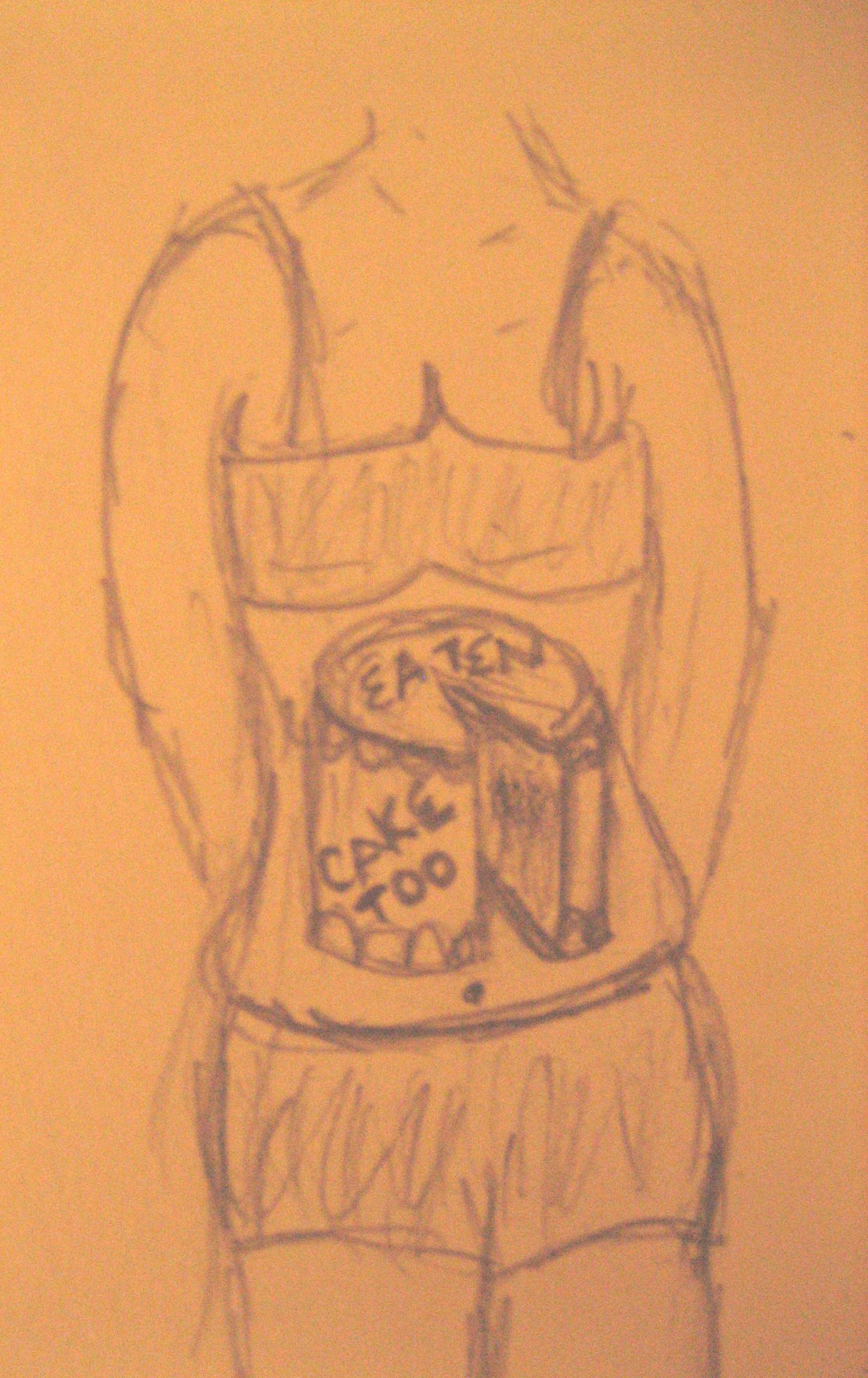
Cake Casuistry and Sarah Palin

November 17, 2009

Eaten Cake Too

“Can’t have your cake and eat it too.”

For much of my life, I did not understand what that expression meant.  Oh, I understood its general import; I heard my grandmother sigh it with a sorry shake of her head often enough.

But I couldn’t understand how it actually worked.   Didn’t you have to have your cake in order to eat it?

Even when I finally did get the literal meaning of the words, (“have” as in “continuing to have”, “eat” as in, you know–), I still resisted their logic.  Why couldn’t you save half the cake and eat the other half?  Even if you did eat the whole piece, didn’t you still have it –in your stomach?  At least for a while?

Ultimately, I think my problem was not so much with the expression’s words as with its meaning, especially its meaning for women of my generation.   There were just so many cakes that we wanted to have and eat too—an engaging career and time to attentively raise children; a good paycheck and creative, non-corporate work; a husband who worked and was available to his family; a daily blog and adequate sleep–

So many secret little nibbles of cake, so many secret little hoardings of crumbs, so very many empty or half-empty mouthfuls.

The parceling out of cake, even talking about parceling it out, was simply very hard for some of us;  it continues to be hard for many younger women too.   (Many women, for example, still feel the burden of keeping quiet about a sick child, an aging parent, a wayward husband, simply to protect perceptions of their job performance.  Others find that the job performance problems created by these factors aren’t limited to perception—such non-work matters demand their energy, time, and decision-making on a dailybasis.)

The genuine complexity of these issues is, I think, one reason why some women find Sarah Palin so troublesome.  Although Palin has clearly had her own difficulties with choices of this kind, she glosses these over, trying to have her cake and eat it too in the very same (somewhat disjointed) sentence.

She purports, for example, to be both attentive mom of five and also hands-on executive, lover of the wild but also driller, generous-spirited but also vindictive enough to ward off challenge, winking Josephine Six-pack but also policy “wonk”, perky but contemptuous of the perky, Alaskan hunter of moose and nationwide hunter of bucks, quitter but also stay-the-courser, insulting, reductive and libelous, but quick to find insult, reduction and libel in others, a self-declared claimant of down-to-earth clarity who obfuscates and confuses.

As my family will groaningly testify, I have sometimes expressed a surprising sympathy for Palin (even when cringing on the opposite side of the fence.)   I don’t like to see any woman ridiculed; I understand how difficult it is for a woman to carve out an individual or powerful style in our culture.  But her glibness has lately introduced so many  quoted untruths into common parlance that it is hard for me to retain much sympathy;  these have not only lowered the debate but significantly damaged it, and, when added to Palin’s  pursuit of earnings in the millions, have lately brought another “cake” phrase to mind.  Not the old saying of my grandmother’s, but the, perhaps, older one of Marie Antoinette: “Let them eat….”