Archive for the ‘news’ category

The BBC, Mitch Miller, Insularity of U.S. News (Mommy Kissing Santa Claus)

August 3, 2010

Mitch Miller? (Looking for Mommy)

I’m a New Yorker.  I tend to read the New York Times and feel proud that it’s not the Post. But every once in a while, I feel a need to go further afield, usually to the BBC, partly so I can just listen to news rather than read it.  (If you don’t already know, the BBC has a wonderful site, in multiple languages with non-stop online “radio” choices.)

An hour of listening quickly changes one’s world view.  For one thing, it converts it into a world view.

This morning, for example, the BBC news stream gave time to the Papauan dissident with whom it had snagged an exclusive interview.  It reported the flooding in Pakistan; it quoted the South African judge sentencing a mendacious police chief; it interviewed the little Yemeni girls whose family took them from school when WHO stopped trading wheat for attendance and the girls’ mother who had to give them blood a couple of times against malnutrition.  It discussed a new novel about Afghanistan, some controversy involving Mossad, the current violence in Karachi.

Some of these stories were also reported in the New York Times, but when I looked at the online Times this morning, my eye kept hooking onto Mitch Miller’s goatee.  (Today’s article on Mitch was actually about an unsuccessful attempt to interview him.  Hmm….)

Sorry.  I actually love human interest stories;  I also loved Mitch Miller.  (Not just the Christmas hits; not only the happy accordian rifs–I will remember how my six-year-old heart twanged to The Prisoner’s Song till my final rest in the arms of my poor darling.)

What strikes one in listening to the BBC is how big the world is, how busy.  What is striking too is how local the many conflicts are–even as they are related to more universal issues of economics, religion, race == how they are played out in so many very local, very complicated ways.  In discussing the killings in Karachi, for example, the BBC talked of the number of Pashtuns in the city.  (To be fair, the Times mentioned Pastuns in their Karachi article too, but in a somehow more muted way.)    And me, I think “Pashtun”, that they are in Central Asia, Afghanistan.  Green eyes come vaguely to mind.

But what I am mainly impressed by is how little I know.  Like, sadly, most Americans.

What also impresses me is how much our regular news  (and I really don’t mean the Times here) often seems to reinforce our insularity and our ignorance of the world rather than dispelling them.   So that we can convince ourselves that we are well-informed simply because our homes have some kind of news feed 24/7–when often all that feed is telling us is about the time Mommy was seen kissing Santa Claus, or worse, suspected of kissing Santa Claus.

No A/C (With Anteater)

July 24, 2010

Anteater with Brain Freeze

My sweaty brow turns now to Stan Cox, an agricultural scientist and author of Losing Our Cool: Uncomfortable Truths About Our Air-Conditioned World (and Finding New Ways to Get Through the Summer), a book which argues against the excessive use of air conditioning in the modern world because of its negative environmental and societal effects and its effects on overall health.   Cox, who lives surrounded by cotton (barely) and fans (liberally) in Salina, Kansas, had the nerve to write an opinion piece in the Washington Post in the midst of this record hot summer, explaining the downside of air conditioning.  He received 67 pages of negative emails, which included death threats, and the epithet “Idiot!”  And these weren’t even from his family!

I know it’s hard to make a choice against A/C.   A New York apartment without it feels not only muggily hot but horribly grimy.

And yet, and yet… if you just stay still enough (so that the sweat congeals to a 98.6 degree layer between your skin and the 102 degree world), and keep your rooms dark enough (so that you can’t quite see the grime), it really is quite liveable.

I can hear some of you thinking—”you call that a life?”  or, “but why?”

All I can say there’s something kind of lovely about heat-enforced laziness; and the relief that comes as evening falls, as cold baths are slithered into, as icy smoothies are sipped (despite the brain freeze), is really pretty cool.

(PS – I’m trying to branch out from elephants, but if you like elephants, check out 1 Mississippi by Karin Gustafson on Amazon.)

Palin DeFicted as Shakespeare (In Watercolor!)

July 19, 2010

The Newbie Bard?

To refudiate or not to refudiate, that is the question.

Uh…what is the question?

(Unfortunately, no one who likes her will care.)

Quatorze Juillet – French Burnt Peanuts, Fraternite, Kemp’s Ridley Sea Turtles

July 14, 2010

Oh brother how are thou?

A lot of disparate elements to pull together on today, July 14th, Bastille Day, the French national day.

My only Bastille Day actually spent in France was in Nice at age 8.  Its most memorable element was not the fireworks over the Mediterranean (although I can still picture one beautiful arc of flash) but the French burnt peanuts bought from a street vendor on the nighttime beach.  It was the first time I’d ever tasted French burnt peanuts and they were like fireworks in my mouth–hot, sweet, crinkly, crunchy, touched so delicately with salt that it might have just been the taste of the sea air on my tongue.   The nuts were, despite several prior days in France, my first real evidence of the deliciousness of French food–my parents, traveling on a strict budget, made us eat a lot of ham sandwiches put together by my mother in the car.

My next most important memory of Bastille Day is not actually my personal memory, but one recounted to me by members of my husband’s family—a patriotic group who’d lived through and/or fought in World War II, serving with the U.S. forces.  On one July 14th, during the height of DeGaulle’s France First approach (and U.S. furor at his perceived ingratitude), my in-laws and some friends celebrated  by lying down on the floor to sing the Marseillaise.  This (the floor part) was deemed to show the highest disrespect, although, for my part, I was always impressed that they cared enough about France to actually know all the words.  (Also reflecting a longstanding U.S. love-hate relationship with the French, a/k/a Freedom Fries!)

I personally never learned the full Marseillaise, but was taught the slogan words of the French Revolution – Liberté, Egalité and Fraternité.   Liberté and egalité were expected (except for the “g”) but “fraternité”  – brotherhood  – always took me aback (and not only because I was a girl.)   The American Revolution talked of freedom and justice for all (except for slaves), but did not (at least in my limited understanding) give the same emphasis to this kind of connection among people.  (My off-the-cuff, uninformed, explanation is that the American colonies were already already somewhat united against a common “foreign” enemy, while the French Revolution, more akin to a civil war, needed to emphasize alliance.)

But I don’t want to write today about the French Revolution; what I want to write about are sea turtles.  There is a very sad, if interesting, video piece in the New York Times today about forensic efforts to uncover the exact cause of the huge rise in turtle deaths in the Gulf since the BP oil spill.   (Brent McDonald, Kassie Bracken, and Shaila Diwan.) The oil is an obvious culprit, but deaths also seem to result from sea turtles drowning in shrimping nets, particularly in Louisiana which apparently does not enforce Federal law regarding escape hatches in the nets for turtles.   One thought is that, in addition to poisoning the turtles, the oil may drive them into areas that are inhospitable and unfamiliar;  the spill may have also changed the conduct of fishermen.

Many of the turtles dying are the endangered Kemp’s Ridley turtles; their life span would otherwise go into the decades.   They are beautiful, their faces seemingly embued with a thoughtful intelligence.

Which brings me back to Bastille Day—not because of Louisiana’s French roots – but because of the French Revolutionary tenet of fraternity.  It seems to me increasingly unlikely that much will be done to save turtles or any non-human species, the environment, or even the planet itself, unless and until people feel a meaningful connection with creatures other than themselves.  I don’t mean simply the sentimental connection of how endearing the creatures are (although that’s a start).  I mean a connection that be real enough to inspire actual care and sacrifice.

I don’t mean to diminish people’s concerns about their jobs, what they eat and the temperature at which they keep their dwellings.   But at the moment, there is another kind of love/hate relationship going on here (more serious than the one with the French.)  We love the idea of saving wildlife, the environment;  we hate to actually do anything about it, to change our lives.  Some kind of better balance needs to be reached between short-term, individual concerns, and longer-term, world-wide needs, an understanding that humans may not do very well in a world in which sea turtles are dying in droves, that these creatures deserve lives free from molestation and torture, that the death of a sea turtle is a death in the family.

Soccer-Soothsayer Paul (The Octopus) Confronts the Competition (Squawk!)

July 12, 2010

Paul Confronts the Competition

I was one of the few people lucky (or unlucky) enough not to need to actually watch the World Cup Final soccer in order to know that Spain would win.

This was not because of my confidence in the wonderful Spanish team’s ability to maintain elegant possession of the ball despite the relative shortness of their players (my not-tall husband’s pre-game desire), or because of any particular hope that the day would be saved by the extremely good looks of several members of the Spanish team (my daughter’s post-game view, most notably with regard to Jesus Naves and team captain and goalkeeper,Iker Casillas), or some wish, of my own, to see that the players that weren’t kicked in the chest would triumph.

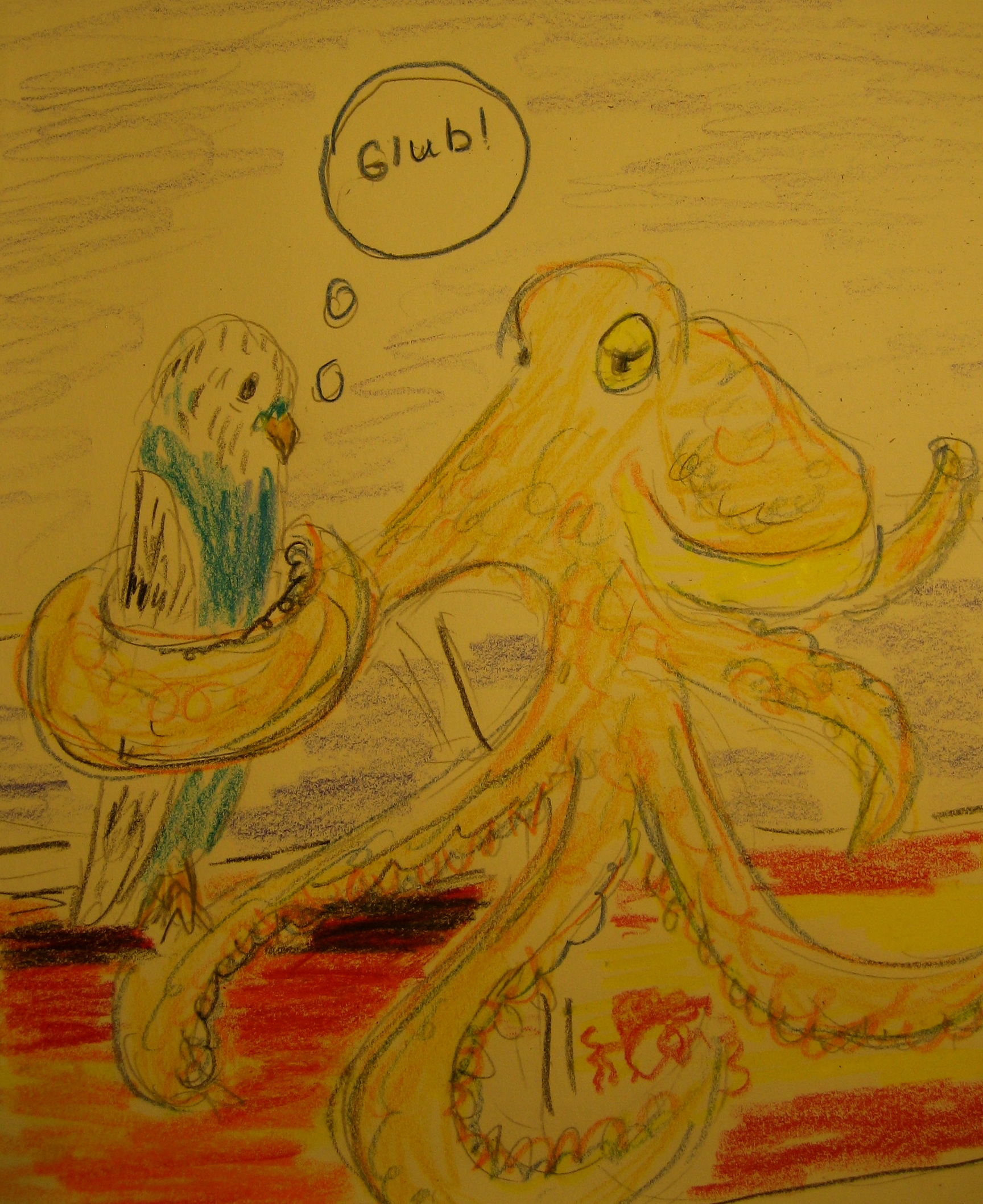
No, my certainty of Spain’s victory resulted completely from my confidence in octopi, particularly the soothsaying Octopus Paul, a/k/a the “Oracle of Oberhausen” (named for the town in Germany in which his aquarium is located.)   A day or so before the game, Paul once again (for the eighth recorded time) exercised his psychic mussel errr…muscle to successfully pick Spain as the winner of the final match.   (What makes Paul’s foresight especially unusual among predictors of the future is that he picked the winners BEFORE the games occurred, and didn’t simply tell us about how right he was after the fact.)

The Dutch, on first hearing of Paul’s prediction, were justifiably downcast until some enterprising Dutch reporter found a competing soothsayer—a parakeet in Singapore.

But I, for one, knew that wouldn’t fly.

Parakeets simply don’t have the grasp of octopi, the breadth, the reach, the slithery coordination—

And let’s just suppose this isn’t all a statistical anomaly, a lucky guess—(could Paul have some tentacular hooks in ensuring the outcomes he predicts?  Could there be something fishy, as it were, going on in FIFAland?)

All I can say is eight for eight!

(And thank goodness the game wasn’t decided on penalty kicks!  A deciding factor that can seem almost as arbitrary as, well, the choice of a cephalopod.)

What Part of “Enough Already!” Doesn’t the Gulf Oil Understand?

July 5, 2010

Lots of horrible videos of the spread of Gulf oil on youtube and elsewhere.

Doesn’t that stupid oil understand the U.S. news cycle?

Doesn’t it realize that it’s gone on for days and days, weeks, months.  Same old same old.

If all the someones (preferably in the Obama administration) who we are really really mad at would just do the right thing (what they are supposed to, whatever that is, to stop this thing), we could just sit back and do what we are supposed to do, what we sort of like to do, what we always do do at least, when it comes to fossil fuels – use large amounts of the stuff until the price gets prohibitive (again), and then be surprised and angry (again).

But we really do hate to see dolphins die.   And hear of turtles burning.  And find (aerially) huge purple slicks upon the sea.  We are kind people.  We like shining seas.   (Not that kind of shining.)

But we just don’t want to think about this anymore.

So, come on, oil!  What part of “enough already!” don’t you understand?

Eclipse/Airbender/Whizzing Fit Bodies/Why?

July 5, 2010

Whizzing Fit Body (In Heels)

What does it mean that the two (by far) top selling movies this weekend are The Twilight Saga: Eclipse, taking in an anticipated $181 million in six days, and The Last Airbender, taking in a very unanticipated $70 million in five?

  1. That American moviegoers couldn’t give a rotten tomato for what professional critics say.
  2. That the male members of families, couples, households going to Eclipse had to see something, and (according to moviegoing statistics) only 20% could be coerced into spending 90 minutes with Tayler Lautner’s abs.
  3. That for all the hype about Team Edward and Team Jacob, the team people really belong to is Team Jasper as played by Jackson Rathbone ( in both movies).
  4. That a lot of households had air conditioners on the blink.
  5. That in times where solutions to problems seem truly intractable, not only beyond execution, but beyond knowledge, there is something beguiling about mayhem that results not from societal, political, economic or natural forces, but, primarily, from the vengeful character of a single good-looking, and possibly destructible, individual.
  6. Aren’t stories with tons of plotlines, subcharacters, flashbacks, unknown connections, secret powers—fantasies that almost need a diagram for anyone but the cognoscienti to follow—fun?  At least rich sources for argument? (Making all that time you thought was wasted reading the books and/or watching the cartoons finally worthwhile.)
  7. Who cares if the actual dialogue is execrable?
  8. Seemingly, moviegoers really do like seeing very fit people whizz around in semi-computer-generated martial art mode.   My concern is that there’s no real “control” to test this supposition, i.e. few alternatives.  Personally, I think at least 80% of the audience at my Eclipse viewing would have been perfectly happy with fewer fight scenes; the other 20% of the audience did not look very happy in any case.

Caveat – all comments on The Last Airbender are based on secondary sources, including those extremely uninfluential reviews.

More About Guns (And Personhood)

July 4, 2010

Elephant With Gun (Sorry, a Repeat on a Busy Day)

I’ve been thinking a lot about guns lately – not particularly because it’s the 4th of July –but because this blog has gotten recent thoughtful comments from someone who is much better informed about gun types and usage than I am.  Also, I’ve been staying in a house with someone who has an active interest in recreational shooting.

I am a non-apologetic supporter of fairly restrictive gun control.   I live in a city; I move in crowds, largely on public transportation.  But my antipathy for readily available guns does not just arise from the fact that I don’t want to get shot in a public space.  (I don’t.)

It doesn’t even arise from the fact that both me and my dog Pearl get totally freaked out by the crack of gunfire up here in the uncrowded countryside.  (We do.)

What really concerns me is madness both as a term for anger, and a term for craziness (they really do overlap.)

What concerns me even more is the combination of madness and power.

Guns are the metallic distillation of power; they pack, as it were, a very great deal of punch; brass knuckles raised to the nth degree.

I’m guessing that punch is one of the reasons recreational shooting is so popular; I’m guessing that it provides a taste of power, excitement, control, release, kickback; a discipline at which one can become skilled and also charged.

I do understand that.  Sometimes you feel like you are jumping out of your skin; sometimes even very cool humans have to physically let off steam.

I’m not saying that gun owners use guns in that way.  I just don’t have the experience to know.  The only time I ever fired a handgun I fell down.

But I do have experience of human nature; of how angry, crazed, mad, people can become, sometimes unexpectedly, sometimes less so.   I especially worry about how that type of anger, madness, may be abetted by a culture that supports a “tit for a tat” as a short-form equation of justice and also as an ultimate deterrent.

I know that hostility for guns may come more naturally to me than others.  I was raised by a mom who was a longtime pacifist; a dad who was an old school turn-the-other-cheek Christian.  More importantly perhaps, I I’ve been lucky enough to have had enough emotional support and societal favor that my ego is not continually on the line.   A sense of personal validity was, thankfully, instilled a long time ago.   As a result, it takes a fair amount of aggravation to make me feel truly “dissed;” even when I have that aggravation, I’m pretty good at just (eventually) swallowing it.

I am sure that most gun owners are not that different from me; that they don’t misuse their guns or assault weapons, view them as tools to support their personhood.

But the fact is that there are many people who do misuse guns; sometimes serially, sometimes just a terrible once.  The availability of a handgun or assault weapon can allow a breaking point to break a very great deal.

Thinking of the Constitution, Divine Writ, Elena Kagan

June 30, 2010

Sorry - this is a recycled picture of Good Old George

I have great respect for the framers of the constitution.  They were endowed with wisdom, prudence, foresight; not, however, wings.

They gave birth, as it were, to a nation;  this was not an immaculate conception but  a political process; i.e.  it involved wrangling and negotiation.  No one was struck dumb or hiked up to a mountaintop.  (Unlike the classic immaculate conception, moreover, there were no women involved.  Nope, not even when looked at through a lens of political correctness and revisionist history.)

I’ve been taught that they were good men and I believe it.  But, although some occasionally have gold radii painted around their heads in respectful murals, they weren’t saints.   Some owned slaves, fought duels, engaged in shady land deals.

Some, such as Ben Franklin and Thomas Jefferson (though I’m not sure he fully counts as a founding father under Christian dictates), were extremely mechanically inventive; even so, the technology of the day was, well, the technology of the day:  George Washington was bled to death by his attending physicians in the course of their healing ministrations.

They knew of muskets, flintlocks, long barreled pistols; it is unlikely that they envisioned firearms that could shoot repeatedly for long periods at very great distances in crowds.

Our culture, of late, seems to love the idea of holy writ, especially when it can be used to justify a “no” to anything other than unlimited guns.  We all know about the movements to teach Creationism and to undercut that messy evolution stuff.  (Although, frankly, the Bible’s got some hodge-podgy sections.)    Creationist zeal also seems, at time, to apply to the Constitution.   It’s as if the document is our country’s very own manifestation of divine Intelligent Design.   (God didn’t just make the sea turtle, but also the Second Amendment.)

Many (such as Senator Jim DeMint of South Carolina) use this argument to oppose the traditional  Anglo-American judicial practice of judicial precedent (so evolutionary) in favor of strict constructionism.  (DeMint characterizes the use of judicial precedent as a game of “telephone.”)

I admit that attorneys use precedent with great creativity.  But this is part of what keeps our law useful, applicable to changing circumstances; and precedent is, of course, rooted in the constitutional text, and in constitutional practices.

Of course, I’m glad that government officials protect, defend and preserve the constitution; and I want them to keep doing it.   But, as a woman, I’m also glad that it hasn’t always been viewed as divine writ,  unchangeable.   That malleability has allowed me the vote; and also (thank God!) has allowed one of me (figuratively) to sit up there in front of the Senate and be voted upon.  (Good luck, Elena.)

Anecdotal Connections: Assault Weapons – Push-up Bras.

June 29, 2010

I’ve heard two interesting stories about stores lately.  One, from my husband about a sports shop in upstate New York.  To give context to the story, my husband is a hunter, has been a hunter from the time he was a boy, was at one point (presumably before dues were required) a member of the NRA.

His memory of upstate sports stores from his youth, and even from ten or fifteen years ago (okay, dear—from his continuing youth), was of showcases filled with hunting rifles.  There might be a few pistols, but even those were, primarily, implements for hunting game–something someone might take on a camping trip.

On a recent visit to a sport store, however, in a very small, seemingly peaceful town, in the Catskill Mountains (prime hunting territory), my husband noted that about half of the store’s showcase was now given over to assault weapons.  These, he said, are not the types of guns one would use hunting animals==that is, non-human animals.  They are weapons modeled on the M-16s carried by soldiers, too heavy, too violent for game.   A couple of times in the store, my husband also heard the name “Nancy” as in “Pelosi” as in “getting one before she takes ’em away.”

The second store story arises from a friend’s recent trip to Victoria’s Secret in search of a bra on sale.  My friend has liked Victoria’s Secret in the past, not so much because of the sexy lacey-ness of its gear (well, maybe a little because of that), but mainly, supposedly, because of its large inventory of sizes and styles, particularly of bras.  On her recent trip, however, she found it impossible to buy:  every single bra was a “push-up” – so wired and padded that it was unclear how a human breast was supposed to fit in.    (It’s supposed to hover, presumably, someplace above the fabric, cushioning, metallic whalebonesque polymers.)

These are second-hand stories from reliable sources (I swear!), but, nonetheless, anecdotal.

Still, I can’t help but wonder about the connection: a seeming rise in assault weapons; a seeming rise in cleavage.

What does it mean?    That U.S. society likes things that are considered, non-aggressive, reserved, even less than usual?

That U.S. society is more than ever obsessed by bombast? Bimbobast?  Blastbast?

It worries me. (I’m sorry, I can’t help it–even the Victoria’s Secret stuff worries me–I’m a child of the Sixties.)

Whatever it means does not seem to bode well for Obama’s mid-term election results.

PS–the drawing above is not meant to imply that women in bras were buying the assault weapons.  I just wanted to put them both…errr.. all… in a single drawing.