Archive for the ‘New York City’ category

When the “Cool Crowd” Becomes the Absolutely Freezing Crowd

January 30, 2010

Question Is: Will She Make Room For You?

Last week, on a relatively balmy day, I wrote about being part of the “cool crowd”.  That is, those people who, out of carbon, monetary, or logistical concerns, keep their indoor heat low (or nonexistent.)

Today, temperatures in downtown Manhattan have sunk to the teens, and the cool crowd is likely to be shivering.  (At least anyone in my apartment is.)

Here are some tips as to how to handle these low temperatures without losing cool crowd status:

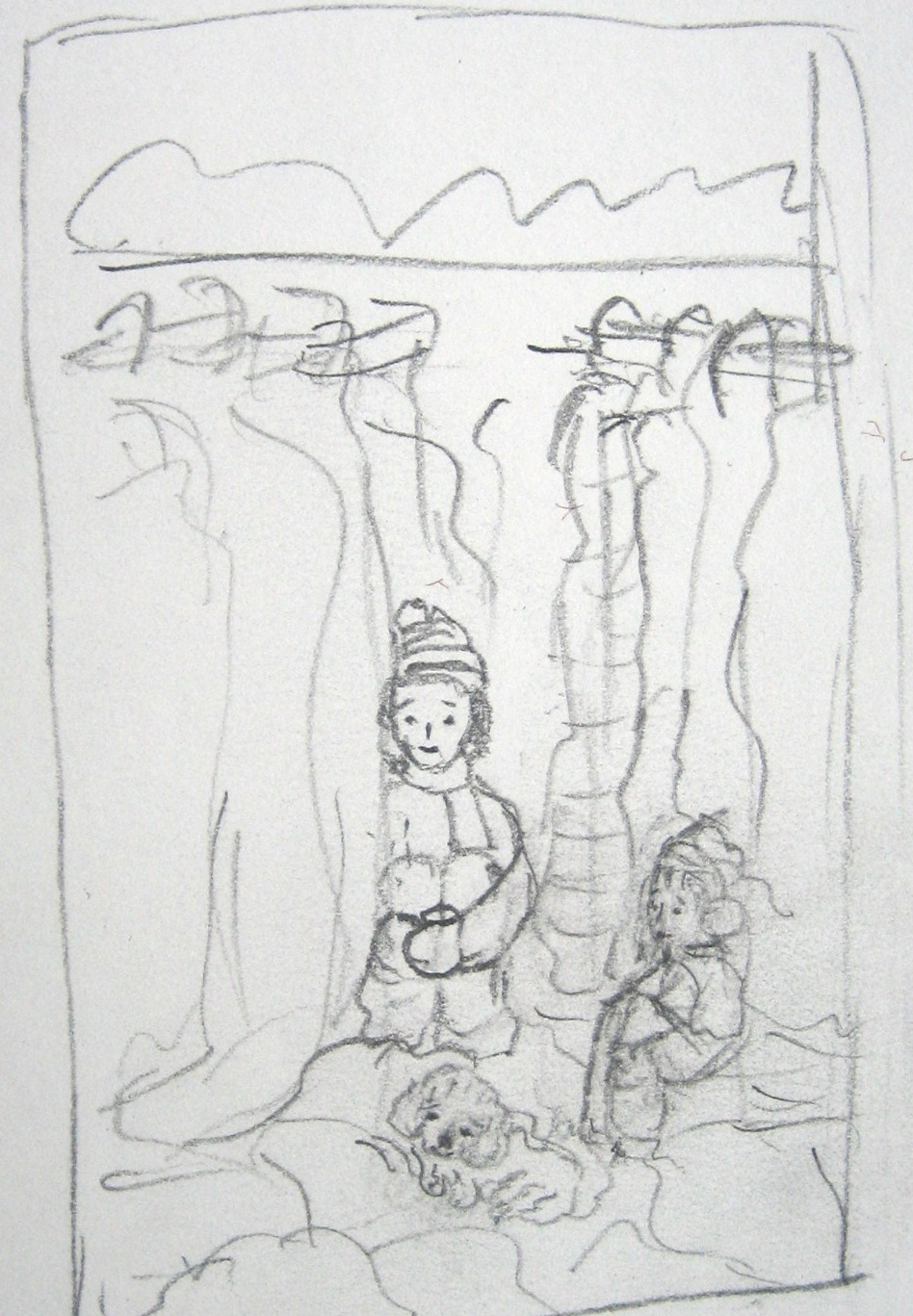
1.  Huddle with your dog in a small closet which is out of the wind and layered with clothing (both hanging and fallen to the floor.)

2.  If the dog won’t make room for you, bake.   Bread, pies, cookies.   (This uses some fossil fuels but is at least productive of something besides heat.)    People say that chopping kindling warms you twice, first when chopping, then when burning, but baking goodies warms you three times:  once in the hot oven, secondly, when supplying you with calories, and third, as an extra layer of flab.

3.  Tape a hot water bottle to your stomach, under the down blanket.   (If you are like one of the followers of this blog, try one of those toasted rice or corn cloth bags that you can heat up in a microwave.)

4.  If you don’t have a hot water bottle, or a toasted rice or corn bag, sit with a turned-on laptop on your bare stomach.  If your ears are cold, try calling your mom on your cell phone.   (That’s a joke, Mom.)  (Seriously, Mom.)   (I like long phone conversations too.)

5.  Drink hot caffeinated beverages (perhaps while talking to your mom) until you get such a splitting head-ache that you really do crave some nice cold air.

6.  Turn on James Brown.  Dance.  Make sure to close your blinds.

7.  Spend as much time as possible outdoors.  Preferably in some cozy little café.  Or, as the evening chill falls, bar.

Yes!

Monday Doldrums – West Side Story Sonnet on the East Side Train

January 25, 2010

Opening of "Somewhere", Music by Leonard Bernstein, Lyrics by Stephen Sondheim

A certain damp dullness hangs over the subway car this morning, the Number 5, Lexington Avenue express.  We diversified New Yorkers are unified here, in our experience of rain-moistened Monday fatigue.  The hems of our pants are limp.  More than half of our eyes are closed.  (By this, I mean, both of the eyes on more than one half of the passengers.)   The guy next to me has a uniquely beady intensity;  he definitely stares at something.  But when I follow his gaze, I find the blank window on the other side of the car.  I notice then too that the corner of his baseball cap also actual drips whole gobs of unheeded moisture, so I’d just as soon not vouch for his alertness.

The girl opposite also has both eyes open, but her mouth is open too.  The movement of her tongue can be seen under her lips, the skin of chin and cheeks; she appears to search the insides of her mouth, though she is not eating, nor is she noticeably carrying food.  These factors tend to put into question her “on-top-of-things-ness.”

The only person who can truly qualify as “engaged” is a tall young African-American man who reads the Daily News analysis of the collapse of the Jets.  So, engaged, yes, but not exactly cheerful.

Seriously.  What shines here is not a single “morning face”, but only the wet spots on the train’s dark linoleum floor shine, and an occasional crumple of cellophane.

All this makes me think that it’s really too bad I wasn’t on the local;  the No. 6 specifically, leaving from Spring Street.  I used to take that train frequently and noticed that a curious configuration of curve and track caused it to sound out a specific musical interval each time it left the platform.   Although it’s an East Side train, the interval corresponds to one  of the song openings from West Side Story. (Which brings up a completely different kind of Jets.)

So, in honor of those three notes, I set forth below a kind of silly, kind of “Shakespearean” sonnet:

Subway Song

The subway sings its broken refrain,
the opening bars of “There’s a Place
For Us” from West Side Story.  The train
croons the first three notes leaving the dais
of the platform, the tune subsiding
to squeak and wind and roar as train races
to a-harmonic levels, providing
speed without Bernsteinian traces,
those tragic lovers defiant of fate
and enmity. Yet, at every station,
they sing again.  Who of those who wait
hear the song of that yearned-for destination,
that lyrical place, beyond how, beyond where,
amazed that the Six Train nearly takes them there?


I am linking this post to Victoria C. Slotto’s Liv2write2day blog, for her prompt on Sacred Music.  The sounds of the Number 6 are not exactly sacred, but they are pretty lovely when you are standing in a grey tunnel.

All rights reserved.  Karin Gustafson

For a more serious subway sonnet, click here.

P.S.  No copyright infringement of “Somewhere” intended, beautiful song.  (Btw, I haven’t noticed that any credit is given to Bernstein by the IRT.)

Missed The Kandinsky Show? One More Reason to Leave New York?

January 18, 2010

Wassily Kandinsky, The Garden of Love (Improvisation No. 27), Alfred Stieglitz Collection, The Metropolitan Museum, New York

This weekend, possibly my 1500th weekend in New York City, I asked myself once again whether I should keep living here.  Here’s a bit of the analysis:

Why You Might Leave

1.  The last play you saw (on Broadway or Off) was The Fantasticks.  (Not in revival.)

2.  About 60% of the apartment that you spend about 60% of your disposable income upon is used for storage.

3.  Repeat, in case some of that last bit was unclear:  you spend about (at least) 60% of your disposable income on said apartment.

4.  One of the best things about that income-expending apartment is that it is located in a part of New York City that hardly feels like New York City.

5.  More importantly, you love Kandinsky.  Boy, do you love Kandinsky.  What, the Kandinsky show closed already?  After only 4 months!?

6.  You pride yourself on knowing such esoteric things as the location of the very best public bathrooms in downtown Manhattan.  (The fifth floor of the Surrogate’s Court building.  The cubicle doors are made of real wood with real carved patterns.)

7.   No, you didn’t get to the William Blake show at the Morgan either.  Is it still open?  (You’re too tired earning disposable income for that apartment that you store your stuff in to check.)

8.  The stress of the City has turned you into a vampire junkie. (There’s something about sucked-out lifeblood that really speaks to you.)    Let’s just say that the last movie you went to was not an art film.

Why Stay

1. The last time you drove a car was almost a year ago.  You don’t miss the experience.

2.   You never really get tired of the Kandinskys that are part of the permanent collections of the Met, Modern and Guggenheim.

3.   The Met also has some good Blakes.

4.  The ladies’ room in the Surrogate’s Court building (fifth floor) really is extremely nice.

5. Your apartment has great closets (at least for the City.)

6.   And is below market rates.  Meaning that there are people paying even more for even less. (Question:  does that truly make you feel better?  Answer:  yes.)

7. Besides that, there’s a gym in your building where, every evening, you can read vampire novels while working out on the elliptical machine.  Yes, they are vampire novels, but hey! you’re working out.

8.  More importantly, said apartment is located in a part of New York City that doesn’t feel like New York City, but is in fact a part of  New York City.

9. Where you can walk nearly anywhere.

10.  Even to permanently-hanging Kandinskys.

11.  Aaah.

Joe Rollino – Bending Minds As Well As Quarters

January 12, 2010

Is it too late?  Should I see my dentist first?

Here’s the big question:  is it the bending of quarters with one’s teeth that leads to a sprightly 104, or is it the ability to bend quarters with one’s teeth?  Or is it the wacky bravura that thinks up the idea of bending quarters with teeth and then actually tries it?

I like cold water.  I even swam at Coney Island (okay, dunked) on January 1, 2009 when it was 18 degrees on the beach.  But as I contemplate whether it’s worth going out there this weekend, the question once again comes to mind:  is it the swimming every single day for 8 years that leads to long-lived gusto? Or the gusto that gets you into that water in the first place?  (And also saves you from all the bacteria? )

The great Coney Island strongman, Joe Rollino, died yesterday (January 11, 2010) at 104, hit by a minivan, walking his typical five miles a day, somehow too far from a crosswalk, too close to the road.

A wonderful obituary in the New York Times describes Rollino bending a quarter with his teeth at 103, and shows him at age 10, already buff and tendon-y.   At age 89, he kept four motorcycles stationary at full throttle for twelve seconds.

He was a relatively small for a strong man, so seemed driven towards creative stunts to prove his strength.  (Lifting 685 pounds with one finger.)  Somehow the ability to come up with zany, but impressive, tricks seems almost as integral to Rollino’s youthful aging as the discipline that gave him the strength to do those tricks.  (No meat, no cigarettes, no alcohol.)

You almost feel that at, a slightly younger age (say 98), he might have been able to stop that minivan.  With one hand.

Miep Gies, Protector of Anne Frank, Lives A Hundred Years

January 11, 2010

Miep Gies, protector of Anne Frank, died today (January 11, 2010), at the age of 100.

I remember her from Anne Frank’s diary; she was the one whose name I had no clue of how to pronounce, (whom I always called the “M-one” in my many devoted readings of the book).   She seemed so young, lively, enterprising, in the diary, bringing Anne and her family whatever sparse treats and necessities could be found and smuggled in by someone inventive and brave.

Reading the news of Mrs. Gies’ death, I felt amazement,  first, that she had been alive all this time,  not only someone who had actually known Anne, but the woman who had preserved Anne’s diary.

The second, and deeper, amazement arose at the thought that Mrs. Gies had lived at all.

It made me think (strangely) of years I had spent in Brooklyn, some time ago, with very difficult neighbors.  For the sake of this post, I’ll call them “Pat and Mike.”  Pat and Mike were not bad people;  they could be jolly, they certainly had friends.  Unfortunately, they didn’t count my husband and me among their friends.  We are both friendly, and we had two beautiful tiny children (well, soon, after moving in, we had two beautiful tiny children).

Still, Pat and Mike could not be won over.  For one thing, my husband and I were artists (or, at least my husband was an artist) and he had converted a storefront space from an active business (a flower shop) to an art studio (which, to Pat and Mike, made the space look unpleasantly abandoned.)

Additionally, we were new to the neighborhood (they’d lived there all their lives.)  We seemed young to own a building;  they imagined our youth to mean that we were financially spoiled (we did have help from our parents).  Worst of all, we rented an apartment that was at the top of our little building to an inter-racial couple.  This was particularly upsetting to Pat and Mike who viewed our particular block as being “the line” between a poorer black and Hispanic neighborhood, which held a large public housing project, and a neighborhood that was largely working/middle class and Italian.  Pat and Mike, who sat on lawn chairs in front of their own small building all day long, every day, viewed themselves as personally holding this line.  They watched the street like literal (if sunburnt) hawks, Pat especially, whose sharp nose, and heavily made-up eyes, gave her a raptor’s profile.

Generally furious at us, Pat and Mike looked for every possible specific transgression.  Our children’s drawing with chalk on the sidewalk led to a call to the police. An attempt to install a wood-burning stove in the back of my husband’s studio quickly generated a raft of complaints and threats.  Even a tree planted in front of our building was quickly chopped down by Mike, before it had a chance to sprout leaves which might flutter onto their property and lead to pedestrian slippage and law suits.  Before another tree could be planted, Mike poured cement into the plot (our plot).

No charges were ever pressed by either side. But sometimes our dealings with Pat and Mike made me think about Miep, and the others she worked with, to hide the Franks.  Of course, it’s a completely silly comparison (and it had nothing to do with our particular tenants.  We didn’t rent to them as a political statement;  they were simply the best candidates for the apartment.)   Still, it was perhaps the first time I could palpably imagine what it might be like to face the scrutiny of angry, sniping, busybodies.

One likes to think that one would be brave in a totalitarian society; that one would save the persecuted.  But I suddenly understood how many Pat and Mikes a totalitarian society might hold, just watching, watching, just waiting to turn you in.  In that kind of situation, under that kind of scrutiny, would I really be brave enough to put myself at risk?  And what about my two small children?  Would I put them a risk too?

In addition to shielding the eight people in the annex above Otto Frank’s business, Mrs. Gies and her husband hid an anti-Nazi university student in their own apartment.  Mrs. Gies was working in the Frank’s office when the Gestapo came (because of an anonymous tip), and was apparently spared arrest because of a shared Austrian heritage with one of the Nazi agents.  Later, however, she went to the Gestapo in Amsterdam to try, without success, to offer a bribe for the release of the eight whom she had hidden.

Anne Frank’s diary is a testament to suffering and transcendence.  Mrs. Gies was a link to that suffering and transcendence but also personified it.   In her memoir, “Anne Frank Remembered,” published in 1987, Ms. Gies wrote, “not a day goes by that I do not grieve for them.”  So many days.  So sad that they’ve come to an end.

“Connecting the Dots” on Terror – Going Through the Motions

January 5, 2010

I find myself unaccountably depressed tonight.   That is perhaps not accurate–my depression can probably be accounted for by a number of factors—a difficult and contentious day, stress, hormones, age, cold feet.   (I only turn to the comfort of my fabulous hot water bottle in the middle of the night.)

Then too there is Obama’s speech on terrorism,  the continuing failure of U.S. intelligence agencies to “connect the dots”, the continuing sense that while we bicker here, allowing the assignment and/or avoidance of blame to take precedence over doing a job correctly, plots are hatched, terror and destruction are planned.

I don’t particularly blame Obama.  He’s not the guy directly dealing with the “no-fly lists,” or taking calls at the U.S. embassy at Nigeria.  But that doesn’t make me feel a whole lot happier or secure.  One problem is that it’s hard to believe that this is an issue that can be solved simply by putting more systems in place.  The lapses don’t seem to arise from problems with protocol so much as attention, alertness, intelligence, in the truest sense of the word.

There are inherent difficulties:  planning and executing an attack appears to be a whole lot more exciting than working in a comprehensive and general way to stop attacks.  (I don’t mean the foiling of a specific attack;  almost every single James Bond movie ever made demonstrates how exhilarating the foiling of a specific attack or specific villain can be,  especially if the villain is surrounded by scantily clad women.)

But what about the many possible amorphous attacks?  The few hundred thousand, or more,  villains?   The lack of scantily clad women to attract and hold the attention of attack-foilers?  (Perhaps this is one reason to support the installation of body-scanning devices as part of airport security.)

People have a hard time with big numbers, long-term risks, lists of names (even for a state dinner).    It is mind-numbing to try to connect dots where there are tons and tons of them, and yet, no clear underlying picture.   So many bodies, so much shampoo.

There is a failure of attention throughout societal structure, a lot of going through the motions, even when the motions don’t actually do the job.  (Note the S.E.C. and bank regulators.)   The situation reminds me a bit  of the feeding machine in Charlie Chaplin’s Modern Times, which spills soup all over Chaplin’s chest, but still, observing its routine, extends a dainty napkin only to Chaplin’s lips.

The feeding machine is unthinking.  But sometimes people are so dulled by the stimuli and repetition of modern life as to also become unthinking.   They are bored;  they become careless.

I think of several New York City cab drivers I have had lately who actually read the newspaper while driving.   Seriously.  They unfolded the paper over their steering wheels, and not only looked at it while the lights were red, but when traffic was slow (which, in NYC, meant most of the drive.)

I sat in the back seat feeling terribly nervous, but did not say anything, at least not,  “put away that newspaper.”

These are attitudes that are going to have to change.

Old/New Source of Alternative Energy (Heat) – The Hot Water Bottle

January 4, 2010

Hot Water Bottle (Remembered)

I’m all for solar power, wind power, and other renewable alternatives to fossil fuels.  But during last night’s bitter cold, which was especially frigid in Battery Park City (where I live), the prow of the stationary ship which is Manhattan, I discovered an eminently traditional, and yet not fully tapped, form of alternative energy (i.e. heat).  The hot water bottle.

Seriously.  It was terrific. Better than wool socks.  (Maybe not as good as a nearby warm body, but warm bodies don’t necessarily put up with cold feet other than their own.)

As a caveat, I should say that I keep my apartment relatively (my kids say, ‘extremely’) cool (my kids say, ‘freezing’) in winter.  Besides trying to keep my carbon footprint to a toeprint, I find hot air heat too dry.   This means that I basically turn all the heat off at night.  (Okay, so maybe my kids are right.)

But last night called for measures beyond wool socks, a down comforter, and even a nearby warm body.

I have to confess to a past prejudice against hot water bottles, their rubbery exteriors so (potentially, at least) slimy and nubbly.  Besides my innate repugnance, my only personal experience with hot water bottles was in Mussoorie, India, a town in the foothills of the Himalayas, bordering Rishikesh (the hang-out of Maharaji Mahesh Yogi the Beatles’ guru)  and Dehra Dun (a favorite locale of Rudyard Kipling).

Mussoorie, though a very nice town, probably sounds more romantic than it is, at least when you are there alone, as I was.   It was green, hilly, and, on the small main road had a small boy who ran alongside a single thin wheel which he propelled with a stick.   On a clear day, there was a tower you could climb where you could supposedly see Tibet.  (I was not there on any clear days.)

Other than that, all I remember about Mussoorie is that it was very cold at night and that in my guest house, a remnant of the Raj, guests were distributed hot water bottles after dinner.  These, a sickly blue green, were covered in a worn crochet of thick bright red and purple yarn;  up by the corked top was a dog-eared yarn flower.

My memory of these hot water bottles is somewhat muddled by the baths in that same hotel.  The tubs were portable, small and tin, just about big enough for a squat.  When I came back to the hotel in the late afternoons, there was, next to the little tin tub, a very large aluminum tea kettle coated in an even larger quilted tea cozy.  Though the water in this kettle was close to boiling (depending upon when one came back to the room), there was only enough to fill the very cold noisy tub to the depth of an inch or two.  I remember taking all baths in at least one wool sweater.

Unfortunately, the crochet-covered hot water bottle and the tea-cozy-covered bath water became inextricably linked in my mind.  As a result, I always thought of hot water bottles with a shiver from the waist down.

Until last night, that is, when my husband, in response to the buzzing cold of my feet,  found a dark red hot water bottle in the back of a bathroom cabinet, and filled it up to the brim.

What a revelation!  My own little heat pillow.  My own little adjustable portable hearth.   At virtually no cost!  Using minimal fossil fuel!

Okay, so, it sounds silly.  But it also seems a useful paradigm for reducing U.S. energy consumption.    Heating one small actually used space, as needed, instead of the nonstop heating of a whole apartment, or house.  A helpful idea even when oil has not yet gotten back up to $100 a barrel.  (News alert—it went over $81 today.)

No crochet required.


ps- if you prefer paintings of elephants to hot water bottles, check out 1 Mississippi by Karin Gustafson.

Ink Pot Pill Box Hat – Beginning of Decade/End of Era

December 28, 2009

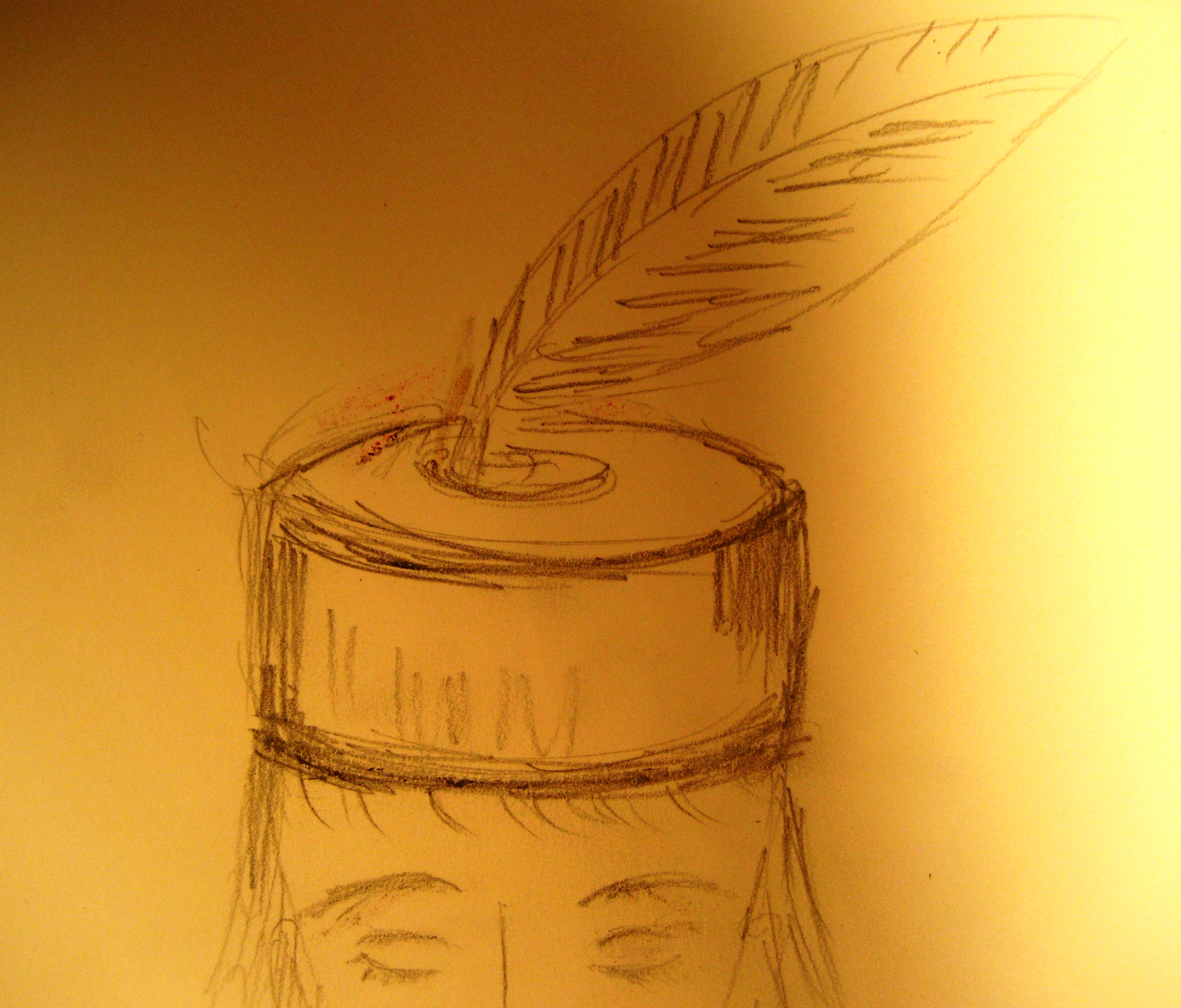
Ink Pot Pillbox Hat (after Rene-Jean Teillard)

With all the newspaper articles, I’m taken back to the beginning of the decade/century/millenium, or maybe just before, when everyone worried that Y2K would wreck havoc with all known security and operational systems, even perhaps bringing the end of the world as we knew it.  Flights scheduled for December 31 sold at heady discounts, and one guy I knew, who had a record of moving violations while drunk, was happily confident that the imminent self-destruction of the DMV’s computer system would finally give him a chance to get another driver’s license.

(Lesson:  the “end of the world as we know it” does not generally happen according to calendared anticipation but with utter unexpectedness of  box cutters taken onto a plane.)

Putting all that aside, the beginning of the decade/century/millennium brought a range of unexpected developments not only in the world, but in  my personal life. The first big event was the bursting of pipes in a snowy country house.  (This led, years later, to a second marriage.)  In the midst of those burst pipes, we also lost electricity for a few days (not because of Y2K, but an ice storm); for a day or two, we had to ship a dear old French friend, then houseguest,  to some one else’s house since our friend, then in his 90’s, suffered in a house lit by candles and heated by firewood.

Thinking back, I can’t help but focus on that same French friend, who died at the beginning of the following year, in early January 2001.  Rene-Jean Teillard, he was born to an aristocratic family in the Pyrenees in 1906 or 7, and there schooled by Jesuits, which instilled  in him a lifelong hatred of Catholicism.  He was a resistance fighter in World War II, who escaped capture by the Nazis by pretending to be mad, and later rescued several U.S. paratroopers in the French countryside.  This rescue (the paratroopers were from the South) led to Rene’s being awarded the “key to the city” of Tupelo, Mississippi, a town which welcomed him on visits throughout his life.

After the war, Rene emigrated to New York City.  I say, New York City, because although Rene later became a U.S. citizen, his move was definitely to New York.  He simply adored New York, believing it to be a place where one could do, see, be, anything; where freedom and possibility were literally made concrete.  He had a talent for design and friendship, was gifted with creativity and charm.  He opened a hat shop, where he made beautiful, stylish and above all, playful hats, whose sales and rentals sent him around the world four times.   (I’ve drawn one of the simpler ones; the more elaborate featured small pianos, flower pots, balloons….)

He was an old-fashioned New Yorker, both generous and parsimonious in the extreme–you probably know the type, a person who will give you absolutely anything while also spending as little as possible on himself.   His rent-controlled apartment, a fourth floor walk-up on Madison Avenue, looked like the inside of a Faberge egg, with hand-marbelized woodwork, a deep purple canopied ceiling (in the bedroom),  and a combination of true Louis XIV antiques and furniture scavenged and re-made from the City streets.

In the hot New York summers, he stayed with friends outside of the City.  He was the ideal long-term guest in that, with his broad life experience (he was probably the only person ever to have had therapy sessions with Carl Jung and to also go to the circus with Elvis Presley), he was both (i) a great talker, and (ii) a great listener.  Above all, he was purposeful, capable of silently, independently,  and beautifully, repairing almost anything broken, torn, fraying.

He was not perfect.  French, he could be snide, classist, gossipy (although not with confidences), and he drank a fair amount of wine.  But he was above all interested.  A taxi ride with him was an education; by the end of it, one had learned, through him, where the driver was from, whom he had left behind, and what he hoped to do when he did or didn’t return.  The driver, magically, did not feel drained by this, but unique, valued.

His favorite word was “marvelous.”

I think of him at the beginning of this century because he was such a creature of the last one.    Who wore hats after Jackie Kennedy?  Who uses ink in the age of computers?  Does Tupelo, Mississippi still have a key?  Does France still have nuns?   Is New York still a place where one can do, see, be, anything?

He missed 9/11, for which I was grateful.  It would have grieved him beyond measure.

Manhattan Before Christmas – The Super is Everywhere!

December 19, 2009

If you live in Manhattan, there are several traditional signs that Christmas is coming–that big white star by Tiffany’s, the tree at Rockefeller Center,  the Strauss Waltzes in Grand Central and the laser reindeer dancing among its regular constellations.

Then there are the signs that are closer to home:

1.   Your doormen suddenly begin opening doors for you.

2.   The Super, whom you’ve not seen in a few months, hangs around chatting with the doormen (despite the fact that they are so busy opening doors.)

3.   Xeroxed sheets with the names of the doormen, the Super, the Super’s assistants, the porters, the cleaners, the plumbers, and even of the people who will come and paint and plaster your apartment once you move out, are stuffed under your door.

4.   Faux fir branches bedeck the outdoor café next to your building.  You realize, on closer inspection, that they have been wrapped around a collapsed outdoor umbrella, which has also been covered with garbage bags, duct tape, and little twinkling lights.  (It actually looks okay at night.)

5.  The huge inflatable rat that sometimes grins at the end of your block due to ongoing labor disputes has been replaced by a huge inflatable elf, announcing the sale of Christmas trees.

6.  The sidewalk holding these trees smells really good for once.    (How do they keep the dogs away?)

7.  You realize, at the gym, that you did not lose the ten pounds you said you would.  The reflection of the twinkling lights from the outdoor umbrella stand just below the gym window reminds you that it’s too late now (unless you can somehow manage a juice fast in the next five days.)

8.  You try a hair cut instead.

9.  The doorman, smiling as he opens the door when you come from the salon, tells you how nice it looks.

10.  You look for that xeroxed piece of paper so that you will spell his name right.

Go-For-The-Throat December–Getting It All Done Now

December 16, 2009

The last few years have led me to the conclusion that I should simply find a way to skip fall.   That sounds like a dance or marital arts move – as in “skip jump” or “break-fall”–but what I’m talking about is that breathtaking (in all senses of the word) period from mid-September (beginning from around the time of year that first the World Trade Center, then a few years later, Lehman Brothers, fell) until Christmas.

The very beginning of September is acceptable.  Even pleasant.  It can still get steamily hot, but there’s a halcyon edge to the sunlight.  The sky is more often blue than white; the farmer’s markets smell like apples; if you live in those parts of  New York City where they still have Korean vegetable stands, the sidewalks are laden with chrysanthemums.  Yes, in early September, you have to get the kids back to school, or, if you’re lucky, move them to college.  But, with practice,  you find that either of those goals can be pretty readily accomplished with several rolls of duct tape and a usable credit card.

But once September merges into October, a go-for-the-throat pressure sinks its teeth into New York City life.   By November/early December, this morphs into a go-for-the-jugular stress which makes one  forget how really beautiful the leaves just were.

So much to do.  Right now.

Do people live this way in the rest of the country?   Certainly, they did not in prior history.  They were physically busier—think of the difficulty of having to heat water just to wash clothes.  (Of course, in the City, I have to carry my laundry up and down a few flights of stairs, and used to have to drag it across two courtyards.  Yes, I appreciate that’s not the same as gathering wood.)

And yet, the busy-ness of today’s constant mind gyrations—the nonstop, if often inconsequential, “right-nowness” of a life lived on the computer—has its own wear and tear.  (Presumably, in prior ages people got to sit quietly for at least a little bit, watching the fire heat up their laundry water.)   Of course, people can probably sit quietly now too, even in New York, without multiple Microsoft “windows”, constant channel changing, commercial breaks, cell phones, emails, deadlines, if they have either (i) a large trust fund, and/or (ii) a certain force of will.

Enough whining!  I felt a tide turn today as we crossed the December mid-point, a place  where it suddenly became clear that what “needs” to get done before the end of the year either will (because it’s already almost done), or won’t.

And then, we will enter those freezing days of January, February, March, when everything—buildings, sidewalk, street, sky—becomes so grey that it’s hard, for a time, to measure the progression of the season.  The words “hunker down” will line our turned-up collars, and we will know once again that we are “in it” for the long haul.

Which, from December’s perspective, looks like a great relief.