Archive for August 2012

An Impression of Motion Sickness on MTA (Flash Friday 55)

August 10, 2012

20120810-071532.jpg

Motion Sick On Train  (Well, Just A Little)

Fake wood encircles
stomach side of cloud=
spattered glass,
stall-start express; outside
sun gleam-shines
river’s shell,
mountains swell
from continental
mist and drift==
slow…halllttttt..(no station stop)…go–
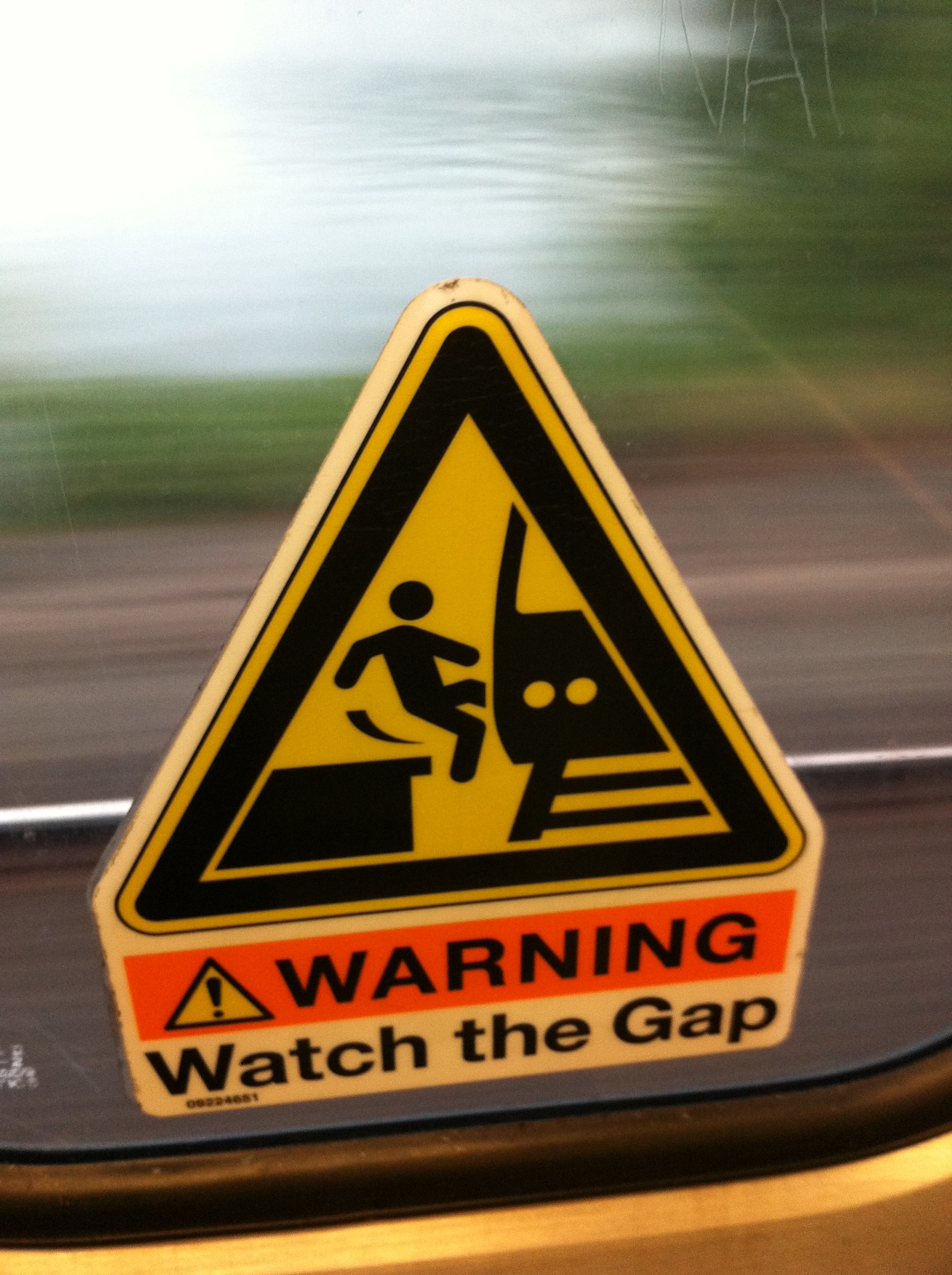
“Watch the Gap” warns yellow-black
stick-fellow, inked leg
incautious==but on train still forever
try not to.

******************************************

I’m posting the above for dVerse Poets Pub “meeting the bar” prompt hosted by the wonderful Claudia Schoenfeld, about impressionistic writing (and, in this case, my impressionistic stomach).  (Since first posting I’ve edited heavily as I have trouble with my stove this morning and still haven’t had morning tea, so nothing’s right.)

I’m also letting the G-Man know since the poem is exactly 55 words.  (Yes, I cheated.)

The train I sometimes take travels along the banks of the beautiful Hudson River. 

“The Spoils Will Crawl With Us”

August 9, 2012

20120809-011828.jpg

The Spoils Will Crawl With Us

When the world bangs shut
mostly,
we
will not whimper, we
will lurk, as accustomed,
in the close crevices of
smolder and freeze, sowing our little
black eggs, seeds that root equally
in the rot and burn of
abundance, need, scrapers-by in the crud
of whatever, until, all together, we blink
our beetle-black eyes and creep free,
finally, our carapaces a shine of silent
smug, without worry of pacing
sole, heel-hammer, stink-nozzled
spray, our antennae un-
cocked crowns reigning feelingly over crisped
crusts, the blue plastic portals
of fosslized fridge doors sky enough
for survivors (no
kitchen lights to scrabble away from
now), the only counters, us, who will tally
and chew, as randomly systematic
as any overlord, all those
crumbs, smears, stains,
our six legs raised
to the power of else.

*************************************

Posting this draft poem (apologies to those who feel a little sick) for Real Toads prompt about some good feeling that may arise at the end of the world, an “Out of Standard” challenge hosted by Isadore Gruye. Check out Real Toads, and check out my books!  From main page!

Roofers in Downtown NYC

August 8, 2012

20120808-103330.jpg

From Indigo, Aqua.

August 7, 2012

20120807-020024.jpg

I’m taking a chance today, posting an excerpt from an old (and, at this point, very page-scattered) manuscript of a novel called INDIGO, about a couple traveling in India.  I thought of this after taking the above photo–yes, I know it’s  not aqua – because the manuscript includes several short segments that bounce around shades of  blue.  A few caveats – the manuscript is entirely fictional – in fact the voice below is even supposed to be a man’s; secondly – warning–there is some “adult” content.  

I am linking this to the wonderful dVerse Poets Pub Open Link night.  Thanks so much for you indulgence; sorry sorry sorry for the length.   

******************************************************

From Indigo -“Aqua”

Aqua–the color of water at my childhood pool, chlorine a somehow trap for sparkle.

As a boy, that blue crystallized all that summer should be, though now I think it was the lamps I loved the most–the pool open till 9–those underwater headlights set into asphalt walls.

In the sunset nights of early summer, their glimmer barely showed, but as the long days waned (though summer itself grew hotter and we stayed late), the lights turned brilliant, each disk radiating the white-embered halo of a magic cave or chest, or, as I liked best to imagine, a sunken porthole, which I, a creature of the true sea (some great mermoth), both battled and defended.

In India, this aqua–a kind of turquoise, truly–can be found in the North, set into Himlayan silver–though, to me, it will always be more of a Native American blue, house paint in New Mexican desert.

I keep wondering what would have happened if I’d gone South instead of East; if I’d taken to shooting those geologically raw mountains of Guatemala or Peru; that macho of green. 

But I came instead to these worn plains, crowded steps, thronged cities; came and came again.

Men hold hands in Delhi, Bombay, of course, here too in Varanasi, arms on necks, a caressing slide around the shoulders.

I’d like to think of aqua as the color of Helen’s throat, too light for Shiva’s. He inhales all the poison in the world, refuses to swallow, turns blue with not breathing.  It makes sense that his blue, so troubled, is darker than aquamarine.

Though she’s not breathing now either. I can feel the caught swell in her throat, the pulse and not-pulse. .

She won’t acknowledge it, of course. Neither of us wants to talk of any of this just yet, still thinking there’s a chance it will go away if we can just avoid mentioning it.

But the unmentionable nags, my mind picturing Tim’s hands between my legs, coupling my balls, a tremor of blue deeper than aquamarine, dyes that swirl in water.  When we meet him in the street, I ache even for the dark bristle of hair on the backs of his hands.

She wants me to just say no, as my entire chest tries to promise, while some other part of me–some careening crazy piece–silently begs him  to refuse any no that I might muster, begs him to make happen what I cannot begin, to turn my life into the dazzle of light on water, floating, irrefutable.

How clear that pool grew as night fell; how I wrapped my arms about the reverse shadows of those lights; how I lingered over them, submerged until I gasped, away from the humid darkness, guarding, loving,ide—I can’t explain it–she doesn’t want me to explain it.  While he already understands.

I feel like I am both dying and being born at once, that despair, that exhilaration, fear.

*************************************
 

This Way Please

August 6, 2012

20120806-095623.jpg

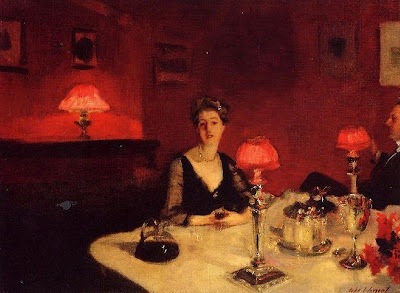
“Not Rightly Re(a)d” (After John Singer Sargent)

August 5, 2012

20120805-020902.jpg

Not Rightly Re(a)d
(Bouncing off of crimson walls painted by John Singer Sargent, 1884)

Her remark was admittedly
oblique, but, she thought, daringly
witty: that her dream was ‘to wake up
each day to something black
and white
and re(a)d all over.’

She had even winked.  (Amazing.)

But a woman’s wish to be
au courant, smudged with the
badge of newsprint, inked (as it
were), was not
considered, and so, and
thus, and accordingly–
her walls
were papered instead
with the soft crimson
of the boudoir, the scarlet
that lined
her laquered jewelbox–an embered
burn that her cheeks
reflected over each morning’s coffee,
while she pondered, silently,
how little re(a)d was
her very own heart.

******************************************
Yes, the draft poem above is very anachronistic!  I don’t think that particular riddle was known in the 19th century.  However, I’m still thinking about the past from yesterday’s post about the French Olympics 1900!

This one is posted for The Mag, a writing blog hosted by Tess Kincaid, in which Tess puts up a pictorial prompt each week.  The prompt, a painting by John Singer Sargent, was painted in 1884, two years after England passed the Married Woman’s Act of 1882, giving married women legal rights in their own property and earnings.  (Such property had previously gone to their husbands.)  (The initial married women’s property law in England was passed in 1870, but was a much weaker more limited act.)  In the U.S., these laws were passed on a state by state basis beginning in the mid-19th century.

Exposition Universelle And Summer Olympics (Paris, 1900)

August 4, 2012

20120804-045859.jpg

Exposition Universelle and Summer Olympics (Paris, 1900)

One likes to imagine
crepes, jam seeping through thin
lace crusts onto delicately curved
fingers, then into those moued-mouth lips
that are somehow
formed by speaking French, as
couples stroll the Tuileries, all of
Paris bobbing with fair.

Though the truth is eating was not for
streets in 1900 and what the delicate fingers
gripped were skirts, scooped slightly
to avoid the underslog, parasols truly
parapluies (umbrellas)–ribbed armor against
sun’s slay, walking sticks (if the fingers men’s),
and chapeaus (hats), even more omnipresent than
the chevaux (horses) that pulled the black-boxed carriages, pleated
hansoms, dusty carts, through the zig-zagging throng
of boulevard and rue, where too,
the marathoners dodged that summer, mis-chased (the favorite forfeiting,
after darting into a cafe for a few beers
against the heat), as much an obstacle course, if
random, as that arranged for the swimmers across the
Seine (up slippery iron poles and across ships’ decks).
Somewhere to the side of the obstacled route submerged
the underwater swim, a questionable treat
for spectators, though relief perhaps
from the pigeon shoot, where bursts of gut-clotted
plumage turned out not to amuser.
In some stray field, far
even from the Left Bank,
the first event for women (croquet)
unfolded, with one lone ticket sold
to a (presumably nice) man
who had just come up from Nice.

Oh, the wonders!  Balloons pumped up and
down on heated air, a competition
in firefighting, and below the
copper-blue roofs of Paris, that filigreed arc
of sky, a moving sidewalk
where people could step up and just
glide by.

Old footage
shows them: some men and boys
greeting the camera with proud smirks, doffed
hats, backtracking
to stay within its frames, a woman
who also jumps in, then shyly lowers
eyes beneath the shade of her
perched brim.

All gone now, gone maybe just a few years
later, World War I – the boy with
the shiny glasses whose shiny smile only half makes
the camera’s view, the lady with the
big plaid umbrella whose bright squares
nearly upstage the curved iron swoop
of the Eiffel Tower overhead,
the light-eyed man who mockingly
holds his arms out to his sides
not to bow to the camera, but to pretend
a charge as one might a bull, gander
or barn-proud cock.

All gone, remaining perhaps only
in that faded flickering, their
caught snickers and downcast
eyes, or, like the man
from Nice, in the records of
a ticket stub.

Who knows why we are
here and what
we will leave
behind, the bold plaid
that we carry overhead
to shield us from
too much
sun.

************************************************************

I wrote the above draft poem for dVerse Poets Pub’s “Poetics” prompt, hosted by the indefatigable Brian Miller.  The prompt asks for a poem that somehow goes back in time.

The Paris 1900 Summer Olympics (called the Games of II Olympiad) were held in conjunction with the Paris World’s Fair.  It appears to have been rather a wild Olympics with new (and one-time only) events such as obstacle swimming, pigeon shooting with 300 live (soon-to-be-dead) pigeons, live game shooting (only this was done with cardboard cut-outs), and non-official sports such as firefighting, delivery van racing, and, allegedly, poodle hair-cutting.  The first women’s only event was inaugurated there, croquet, with one ticket sold.  However, in a mixed (i.e. “co-ed”) event–two person sailing–Helene de Portalèse won the first gold medal ever won by a woman.

Have a nice weekend!  And if you have time, check out my books – poetry, GOING ON SOMEWHERE,  (by Karin Gustafson, illustrated by Diana Barco).  Or if you have time, check out  1 Mississippi -counting book for lovers of rivers, light and pachyderms, or Nose Dive, a very fun novel that is perfect for a pool or beachside escape.

Olympics On Board (NYPD) – Friday Flash 55

August 3, 2012

20120802-063206.jpg

NYPD cruiser noses one spot on riverside, again, again.

Crowd peers over railing, seeking the suspicious.  Six months back, men in wetsuits retrieved a baby carriage (empty), but who knows what now? A corpse? A bomb?  (Could get lucky.)

Inside boat’s cabin, synchronized divers jackknife into water blue as sky, again, again.

All suddenly transfixed.

**********************************************************************

Here’s my Friday Flash 55.  True Story.  Unfortunately, the pic I got shows the TV scanning the (I think) Chinese team rather than the turquoise swimming pool but you get the idea.  Tell it to the G-Man

And dive into a great weekend. 

And speaking of diving!  Check out my very silly (but fun) novel Nose Dive, for those interested in musicals, cheese and downtown NYC, or just in escapist fun. 

“What She Had Wanted (A Pantoum)”

August 2, 2012

What She Had Wanted  (a pantoum)

When it all came down to it,
it wasn’t her father
gave up the baby, who’d spit
at fate and daughter.

It wasn’t her father
left alone now, the shit
of fate and daughter
of misfortune, who’d sit

(left alone) in the shit
of should-have-been, the fodder
of missed fortune; who’d sit
hard, when the hook caught her

of “should.”  Had been fodder
for him, sure. Her cheek hurt
hard when the hook caught her,
connected all her fresh with dirt.

(For him, sure, her cheek.)  Hurt
even with that fist so far away
(connected not with fresh, but dirt);
still squeezed her full breasts’ sway

even with that fist.  So far away,
seemingly– what she had vaunted
squeezed still.  Full breasts weigh
upon her shoulders–all she had wanted,

seemingly.  While what she had vaunted
gave up the baby, who’d spit
upon her shoulder–all that she had wanted,
when it came down to it.


What She Had Wanted (a Pantoum)


***************************************************
Agh!  I wrote the above draft poem for dVerse Poets Pub “form for all” challenge posted by the wonderfully accomplished sonneteer Samuel Peralta (a/k/a Semaphore) .  The challenge is to write a pantoum, a complicated form with interlocking repeated lines (and rhymes).  I’ve posted others; and a brief article on them here (with one of my first  ones.)

I am also linking this poem to With Real Toads for their open link night.  For Real Toads, I added an audio recording (not so great) but I think a reading illuminates a poem like this since the pauses are taken in odd places.  In the light, note that all the pauses are based on punctuation and not line breaks.  (I’m a great believer in punctuation especially for things like pantoums, where it can be used to make changes in the repeated lines.) 

The wonderful picture is of a light sculpture by Jason Martin of a heart in a box (tinfoil/cardboard). 


Shaking Loose Retained Rain (Zuihitsu)

August 1, 2012


Shaking Loose Retained Rain (Zuihitsu)

Eyelids leaves after rain, pale and thinly-veined; overhead, translucent green outlined by opaque damp; my brother calls about his own veins as I walk, hard spots clotting legs after an operation.  And, so, I think, we fail.

Caisson, draped in flag, troops through me as he speaks, lashed curb of long ago November ’63, Washington, D.C., the lone stallion backward-booted stirring reins; what we had been as a people days before.

As a harder percussion begins again–wind shaking loose retained rain, unswaddling the clinging downpour–the pain behind my eyes descends my inner face for no root cause that I can name, other than the fact that life stops short (or long.)

Sure, I’ve known it, like the day’s weather mapped out in advance, but now, as tree limbs sway like upturned skirts, I lie beneath some unknown piano (grand), where a delicately slippered foot, its arch curved like a closed eyelid, periodically pumps the pedal by my head, and, as I hope in that thick of that dust and wood that, if I stay quiet enough, I’ll be allowed to stay up late, I catch the scent of the woman’s hose, a delirium of nylon as seductive as glue, gasoline, a cedar drawer tinged with secret lingerie, blurred together in a child’s mind like raw batter, illicit in a great glass bowl.

One thistle highlights the field, a softly feathered burst of mauve belying thorn; the wind dying now so that raindrops quiet, barely fingering a distant scale.

************************************************************************

I worked on the above draft prose poem for Kerry O’Connor’s Wednesday Challenge as part With Real Toads (poetry site.)  The challenge was to write something like a Zuihitsu, which is a Japanese form based on the idea of a “following brush.”  (Read Kerry’s description for more information.)  For those who follow this blog, this prose poem was the underpinning for a much shorter poem I wrote this past weekend  called Feuille. (Reason for some of the overlap.)  This weekend, I was trying to really shorten everything.  But the Zuihitsu seemed to allow for the digressions of the original piece.  (More or less.)  I’ve edited a fair amount since first posting. 

The poem is supposed to describe a moment after the rain has pretty much stopped, but I could not resist, in these drought-ridden days, posting a short video of a the rain that came before that stopping.