Archive for 2011

Pearl Finds Herself in The Brushes App

May 28, 2011

href=”https://manicddaily.com/wp-content/uploads/2011/05/20110528-052729.jpg”>20110528-052729.jpg
Today, I am making a brief foray into “how-to” blogging.

I am a great devotee of the “Brushes” app for the iPhone and iPad. The “Brushes” app is a painting program; because it is devised for the iPad and iPhone it is actually a finger-painting program.

You might think that painting with one’s finger is clumsy–and certainly, it is much easier for many (including myself) to draw with a stylus. But the Brushes program is designed with an array of possibilities allowing for a great deal of fascination, if not always finesse.(If you get really good with it, like artist David Hockney) subtlety and finesse are possible too.)

The tricks are (i) stroke styles; and (ii) layers. The program allows for a large array of specific brush stroke styles that can be varied by spacing and size. This allows for automatic flowers or splotches, very fine or thick lines, various levels of translucence, lines of little blocks or circles or grasses or even fur. These same strokes can be applied to the eraser, allowing for lots of options there as well.

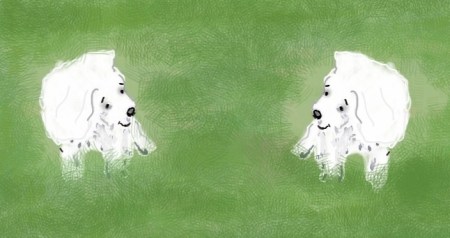
The true magic comes with layering though, and this takes some learning. Up to six layers are allowed in the iPad app. These can simply be used to allow for layers of detail, background, foreground. (The backdrop of solid green, for example, or the grass that goes behind the dogs.)

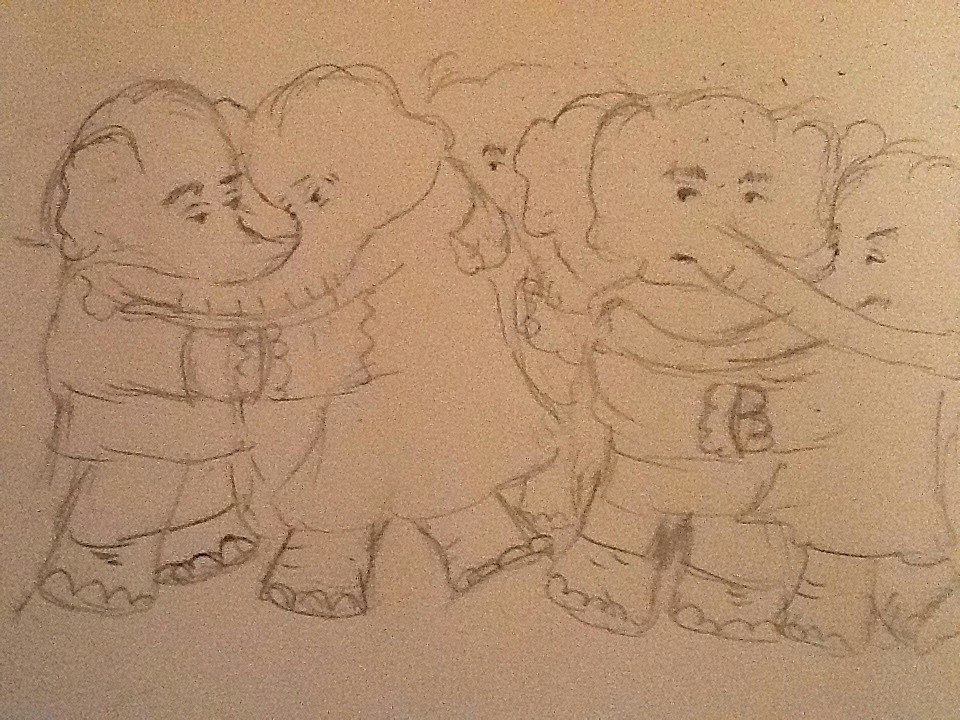
Layers can also be used in more elaborate ways. A photograph can be layered in to your painting, as a template. You can outline the photograph on a different layer, and then trash the photograph itself. Similarly, the iPad Brushes App (as opposed to the iPhone app) allows for the copying and transposition of layers. A layer showing one little dog can be imposed and rotated on top of another little dog, for example, or a bunch of little dogs. (I used this for my tangoing elephants a week or so back.)

Here your eraser feature can be your friend. My initial dog, above, was drawn in a few different layers, to allow the features–eyes, nose–to be on top of the fur. In order to repeat the dog without using more than six layers, I converted it to a finished image (like a photo), which I then transposed onto a duplicate painting. A photo is not a transparent layer, so I had to erase all the grass and background on the second dog to allow it to fit into the first painting without blocking it. This can be a little laborious, but the technology somehow makes it feel more interesting than drawing a whole new dog or bunch of dogs.

(Apologies, this post was first uploaded in blank.)

20110528-052441.jpg

<a

Spring At Last (And Also In My Head!) (The Re-Awakening of Memory)

May 27, 2011

20110527-051125.jpg

As followers of this blog know, in the last couple of days I’ve been inspired by Joshua Foer’s book MOONWALKING WITH EINSTEIN to try to memorize poetry. I’ve pushed my reluctant brain to adopt some goofy age-old mnemonic techniques, imagining characters from my past in absurd, or even obscene, positions, as visual cues for certain poetic lines and segues. And, lo and behold, it has worked! I’ve learned four or five long poems!

Last night, though, something even more amazing began to happen. Poems that I had learned years ago (there are only a few) but that I’d forgotten, that I’d consigned to the dustbin of “what I used to know,” were suddenly revolving around my head like old jingles from chewing gum commercials. Things like the prologue from the Canterbury Tales and bits of Yeats and Shakespeare.

It was like I’d hotwired some big memory circuits in my brain, and that, in turn, had burned the gunk off a lot of old funky fuses.

Remembering those old poems has felt like spring (up in my head)–not a full blown May perhaps, but at least a bit of aprill. (“With its shoures soot.”)

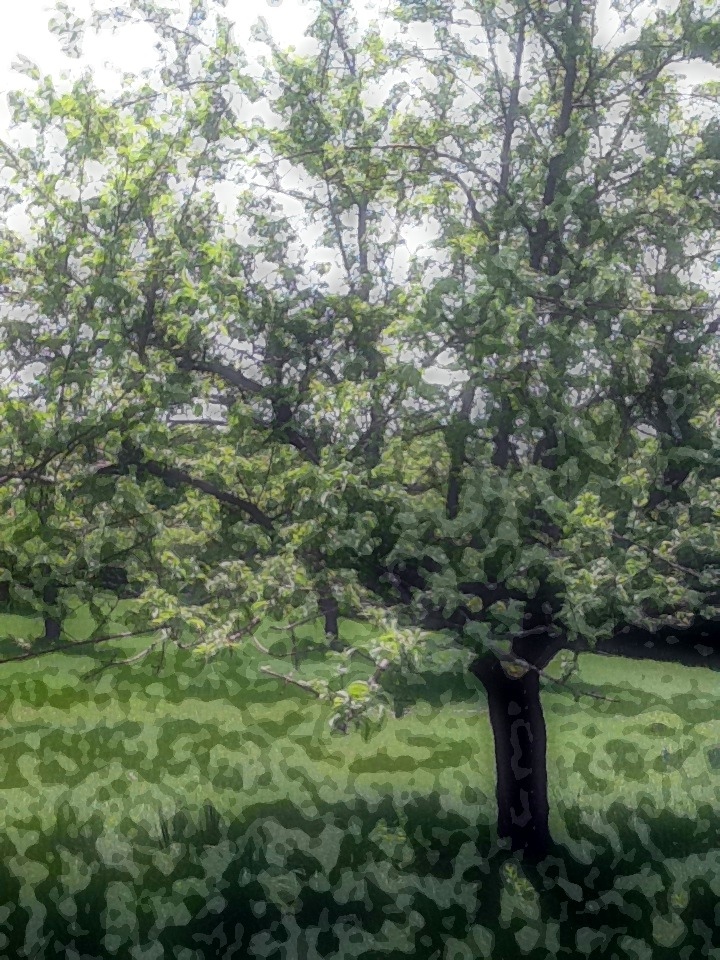
P.S. the above picture is a photograph of an apple tree filtered with the Photogene app on the iPad. Have a lovely weekend.

As I Went Moonwalking With Einstein (And Auden and Bunnies)

May 26, 2011

20110526-045340.jpg

Continuing this morning with the fascinating (if exhausting) exercise of memorizing poetry, using age-old memory techniques outlined by Joshua Foer in his new book, MOONWALKING WITh EINSTEIN. The preliminary results have been quite amazing to me. (Granted, I’ve chosen poems with which I am extremely familiar (and tried to learn before.) Even so, since yesterday I’ve gotten down Andrew Marvell’s “To his Coy Mistress”, T.S. Eliot’s “The Love Song of J. Alfred Prufrock”, and W.H. Auden’s “As I Walked Out One Evening”. (The Auden and the Eliot are long!)

Foer’s classic mnemonic techniques–creating some kind of memory palace or locus, and populating it with visual images or cues to remind you of lines and segues–is tiring, for me at least. I have to really think hard as I try to learn the lines rather than just repeat them On the other hand, once that extra mental activity is expended, the work of memorizing is incredibly shortened.

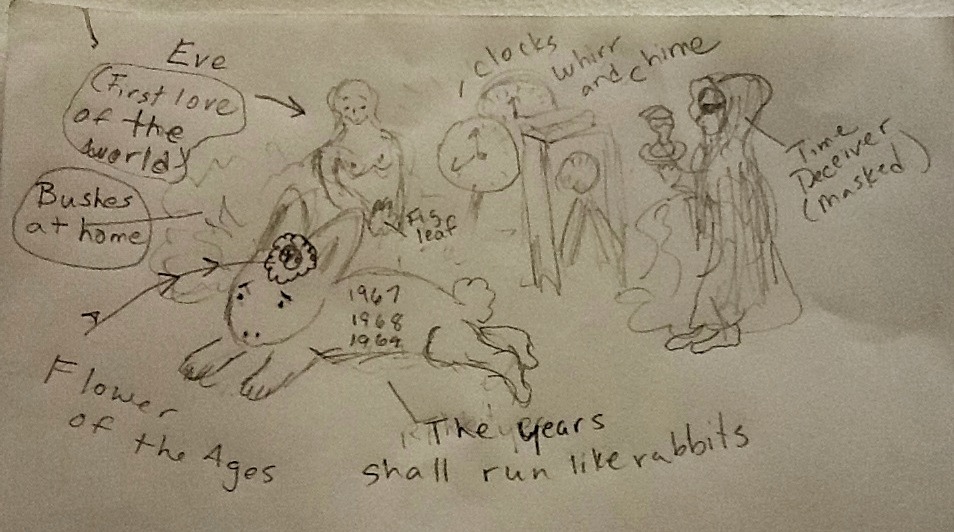
And it is quite interesting to watch one’s head strain to come up with mnemonics. I could only learn the Auden this morning by hopscotching up the front walkway of my childhood home (jumping over China and Africa shaking hands as they were doused by rivers and salmon, noticing rabbits bedecked with flowers and numbers around the bushes by my childhood front door, a naked judge curled up in my old front closet (under the coats and next to a ghastly Father Time). As the poem continued, my mother lay, arm over head, on our deep green couch, which quickly cratered into a valley filled with some powder that looked suspiciously like cocaine. I ended up with toy cars in our old moveable dishwasher, looking out the window at the man who had once been our red-faced and very bow-legged neighbor, adjusting the sprinkler by his hedge.

Here’s the real poem:

As I Walked Out One Evening
by W. H. Auden

As I walked out one evening,
Walking down Bristol Street,
The crowds upon the pavement
Were fields of harvest wheat.

And down by the brimming river
I heard a lover sing
Under an arch of the railway:
‘Love has no ending.

‘I’ll love you, dear, I’ll love you
Till China and Africa meet,
And the river jumps over the mountain
And the salmon sing in the street,

‘I’ll love you till the ocean
Is folded and hung up to dry
And the seven stars go squawking
Like geese about the sky.

‘The years shall run like rabbits,
For in my arms I hold
The Flower of the Ages,
And the first love of the world.’

But all the clocks in the city
Began to whirr and chime:
‘O let not Time deceive you,
You cannot conquer Time.

‘In the burrows of the Nightmare
Where Justice naked is,
Time watches from the shadow
And coughs when you would kiss.

‘In headaches and in worry
Vaguely life leaks away,
And Time will have his fancy
To-morrow or to-day.

‘Into many a green valley
Drifts the appalling snow;
Time breaks the threaded dances
And the diver’s brilliant bow.

‘O plunge your hands in water,
Plunge them in up to the wrist;
Stare, stare in the basin
And wonder what you’ve missed.

‘The glacier knocks in the cupboard,
The desert sighs in the bed,
And the crack in the tea-cup opens
A lane to the land of the dead.

‘Where the beggars raffle the banknotes
And the Giant is enchanting to Jack,
And the Lily-white Boy is a Roarer,
And Jill goes down on her back.

‘O look, look in the mirror,
O look in your distress:
Life remains a blessing
Although you cannot bless.

‘O stand, stand at the window
As the tears scald and start;
You shall love your crooked neighbour
With your crooked heart.’

It was late, late in the evening,
The lovers they were gone;
The clocks had ceased their chiming,
And the deep river ran on.

Drawing On Memory (“Moonwalking With Einstein” On the Way “To His Coy Mistress”) )

May 25, 2011

20110525-102001.jpg

I just finished this morning Moonwalking with Einstein by Joshua Foer. This wonderful book details Foer’s journey from journalist covering a U.S. memory championship competition to competitor and actual winner of the same U.S. memory championship one year later.

Foer, both “mental athelete” and terrific writer, not only describes his training for the memory championship and the crazed and blinkered world of competitive mnemonists, but also explores the historical place of memory as archiving and creative tool, and also (to the extent known) its scientific place in our personalities and brains.

This post is not intended as a review, but to mention that the book has set me off on a project of memorizing poetry.

Unfortunately, memorizing poetry is slightly less amenable to the memory tricks detailed by Foer. This, it seems to me, is because a lot of these tricks involve the use of a “memory palace” or locus, and odd visual cues and puns placed about this memory palace. These tricks are frankly not that easy for a newcomer (who is also becoming an oldtimer), but they can be especially difficult to use for poems because the memorable visual cues sometimes run directly counter to the sense of the poem.

The tricks do work though, and are especially useful for lines or segues that are hard to keep in mind.

I started this morning with two poems I already know well – To his Coy Mistress by Andrew Marvell, and The Love Song of J. Alfred Profrock by T.S. Eliot. The tricks worked much better with the Marvell, maybe because coming up with images for things like “vegetable love” and (as seen above) “youthful Hue” seemed much less irreverant than mucking about with Eliot.

The picture above includes some of the images I used to keep the last stanza of the poem in mind. My memory place was my backyard, my youthful Hugh a guy I once knew (who sat in a pear tree in my yard ), the torn “Lucky Strikes” were my visual attempt to keep torn”rough strife” in mind. Treasure substituted for pleasure. (Yes, I know it sounds crazy–but it worked!)

To His Coy Mistress
by Andrew Marvell
Had we but world enough, and time,
This coyness, Lady, were no crime.
We would sit down and think which way
To walk and pass our long love's day.
Thou by the Indian Ganges' side
Shouldst rubies find: I by the tide
Of Humber would complain. I would
Love you ten years before the Flood,
And you should, if you please, refuse
Till the conversion of the Jews.
My vegetable love should grow
Vaster than empires, and more slow;
An hundred years should go to praise
Thine eyes and on thy forehead gaze;
Two hundred to adore each breast;
But thirty thousand to the rest;
An age at least to every part,
And the last age should show your heart;
For, Lady, you deserve this state,
Nor would I love at lower rate.

   But at my back I always hear
Time's wingèd chariot hurrying near;
And yonder all before us lie
Deserts of vast eternity.
Thy beauty shall no more be found,
Nor, in thy marble vault, shall sound
My echoing song: then worms shall try
That long preserved virginity,
And your quaint honour turn to dust,
And into ashes all my lust:
The grave's a fine and private place,
But none, I think, do there embrace.

   Now therefore, while the youthful hue
Sits on thy skin like morning dew,
And while thy willing soul transpires
At every pore with instant fires,
Now let us sport us while we may,
And now, like amorous birds of prey,
Rather at once our time devour
Than languish in his slow-chapt power.
Let us roll all our strength and all
Our sweetness up into one ball,
And tear our pleasures with rough strife
Thorough the iron gates of life:
Thus, though we cannot make our sun
Stand still, yet we will make him run.

Tornado (Impression) All Swept Up, and Down.

May 24, 2011

20110524-070920.jpg

End of Vacation Comes Too Fast (In Video)

May 23, 2011

Last Day In Buenos Aires

May 22, 2011

20110522-094921.jpg

Last day in Buenos Aires, and it feels, for the first time, like some form of winter could actually be coming. (Maybe because this is also our first day of rain.) The city, by the way, is lovely in the rain.

Wait! Sun has come out! (Forget about some form of winter! And loveliness in the rain! Actually its still raining, but brightly sunny too, and lovely.)

Correction – More Tango In B.A. — Elephants in Boca (Dancing AND Using Brushes App)

May 21, 2011

20110521-073456.jpg

Last Tango In Buenos Aires? (With Elephants)

May 21, 2011

20110521-103820.jpg

Tango of Cars in B.A. (Not Immediately Bumping into Others, Unlike Me)

May 20, 2011

20110520-051016.jpg

I am sitting here at a sidewalk cafe in a shopping-residential, not particularly distinguished, section of Buenos Aires. Although not a touristy area, it is a place with a bunch of leather stores, and I’m trying to gather up the strength and resolve to go into some of them. (I hate shopping. Much caffeine and concentration is required to even get me to make the attempt.)

What’s really taking up my concentration though–aside from the need for even more caffeine–is the question of how it is possible that so many cars are passing through the intersection next to this cafe–and buses and trucks and pedestrians and bicycles, with no one bumping into each other. Each of the crossroads–Mallabia and Murillo–allows, more or less, two lanes of moving traffic; each has a pretty continual stream; there is no traffic light, or even stop sign.

Here’s how it basically works. If a car/bus/truck/ is part of a current flood of traffic dominating the intersection, they whizz by. If they are not part of the current dominating flow, they nudge nudge nudge, until they can brazen their way across. Then, when there is a break in one side of the flow, the other (brazening) side begins its flood.

I am sure that there are many accidents overall. But in the time that I’ve sat here, there has not been so much as a tap.

Which, I am forced to remember, is completely different from certain parts of my experience in last night at the wonderful La Viruta Tango (housed in an Armenia community hall), where during an informal beginner’s tango session, I could not go a whole set of steps (as in eight beats) without bumping into another set of dancers.

Maybe this is because the drivers are not looking only at their feet.

More on wonderful tango, and better milonga (a faster, simpler form of tango), later.

20110520-054329.jpg