
Go Yankees!
Top of the Ninth, Yankees ahead, Mariano on the mound, hoping for luck, continued luck. (And pennant.)
If you like elephants, with or without baseball, check out 1 Mississippi, by Karin Gustafson, at link on homepage, or on Amazon.
Go Yankees!
Top of the Ninth, Yankees ahead, Mariano on the mound, hoping for luck, continued luck. (And pennant.)
If you like elephants, with or without baseball, check out 1 Mississippi, by Karin Gustafson, at link on homepage, or on Amazon.
This morning, I wrote a post that suggested that many Twilight fans may not be rooting for “Robsten” (that is, a real life romance between Robert Pattinson and Kirsten Stewart) because it runs counter to the whole gist of the Twilight fantasy (which is the nearly perfect Edward Cullen pursuing the nearly ordinary Bella Swan.) The emphasis of the Twilight series on Bella as “everygirl” (who is secretly strong, brave, and deeply attractive) made me think that many fans may be hoping for a romance between RPatz and another everygirl (that is, a fan rather than a movie star.) Given the lives of the two Twilight stars though, I compared the magic (and likelihood) of such a fan-tastical relationship to the existence of Santa Claus.
Thinking about this post later, I worried that I was a bit ungenerous to Twilight fans. Frankly, I think many fans find the alleged romance between Rob and Kirsten to be fairy-tale-like enough to be perfectly satisfying. In other words, for these New Moon-struck fans, Robsten may be Santa Claus enough.
Then I wondered, what exactly makes these fans root for Robsten?
1. Rob and Stewart are simply both so young.
2. And good-looking.
3. Not just plain old ordinary good-looking—go-together, top- of- wedding-cake good-looking.
4. Kirsten is very pretty, but, at least when playing Bella (and not going too heavy on the eyeliner), has a definite American girl-next-door quality.
5. The paparazzi have hounded Rob and Kirsten enough to give them an “underdog” quality. (You really can’t have a fairy tale without an underdog quality.)
6. The alleged interest in Pattinson by established female stars, such as Shakira, makes Kirsten a double-underdog.
7. Most importantly, if “Robsten” is real, other elements of Twilight, New Moon, Eclipse, Breaking Dawn, also become credible … elements such as the existence of perfect male romantic heroes pleading for marriage (and abstinence beforehand), the happily ever after ending for one and all (even third wheel Jacob), one little bite turning Bella into a super-model.
(The repeated requests of certain Twilight fans to Rob to “bite them” tends to support this last theory.)
For prior post in favor of Team Fan (and no Santa Claus) check out: https://manicddaily.wordpress.com/2009/10/25/is-there-reall……errr…-robsten/
For more Robsten, RPatz, Stewart, and Twilight, check out other posts in thosoe categories, by going to my homepage: https://manicddaily.wordpress.com.
Waiting to get my hair cut yesterday, I happened onto a magazine covered with pictures of Rob and Kirsten. (To the non-cognoscenti, Robert Pattinson and Kirsten Stewart.)
Yes, I only happened onto the magazine (OK!), although I confess I had noticed it before (on nearly every newsstand I walked by.)
The headline is something like “Welcome to Our Home” and describes the 34th floor of a hotel in Vancouver as the Robsten “love nest.” As “proof” of the Kirsten/Pattinson relationship, the article declares that Rob refused to leave Vancover during a recent solo one-week break, because Kirsten was stuck there still filming.
During my shampoo, I tried to reconcile OK’s article with (i) recent reports in other “news” sources of Kirsten firmly disclaiming any love relationship with Pattinson, and (ii) the sinking feeling in my stomach. That sinking feeling reminded me of the terrible disappointment I felt in the December of my fourth or fifth year of life when, after I had badgered her nonstop for several weeks, my mother finally admitted that there was no Santa Claus.
It was odd. I had been quite sure that there was no Santa Claus. I had gone through the impossibility of it repeatedly in my head; my endless questions were framed with the statement, “I already know the truth, so just tell me okay?” But when my mom actually said the words aloud, tears sprang to my eyes, a huge lump filled my throat and chest, and I could hardly stand to believe her.
“Reliable reports” posit that Summit Entertainment, the maker of the Twilight movies, won’t let Rob and Kirsten admit to their relationship for fear of scuttling the credibility of the Jacob-Bella focus in the upcoming New Moon and Eclipse movies. (For any non-cognoscenti still reading this post, Jacob, played by brawny Taylor Lautner, is the werewolf rival, of the divine vampire Edward, played by RPatz.)
That doesn’t make sense to me. First of all, even the most rabid Twilight fans must know that the Twilight movies are just movies. (Although some are crazed enough to seem to need Midsummer Night’s Dream’s Peter Quince explaining that “Lion” is really played by a man.) Still, it’s hard to see Jacob as a credible rival to Edward, even in the books.
Even so, Summit may be on to something (besides publicity) in keeping “Robsten” under wraps. The fact is that the people who like Twilight like fantasy. And the true fantasy of the books and movies (other than the werewolf/vampire bit) is not the love affair of two super-glamerous, wealthy, and successful movie stars who are constantly thrown together, but the unbreakable romance of the nearly perfect (though secretly flawed) Edward and the nearly ordinary (though secretly attractive and brave) Bella, despite all of his efforts to keep his distance.
As a result, I suspect that the true Santa Claus story for most fans is not the real-life probability of “Robsten” but the other-wordly possibility of Rob holding out for a real life Bella, someone who, like them, is loyal, brave, true, klutzy, and, with the right makeover, could look really great.
Sorry, girls, but I don’t think there is a Santa Claus.
If you’re interested in slightly silly…errr… thoughtful posts re RPatz, Robsten, and Twilight, check out my other posts in those categories, especially post discussing why some modern females prefer Robert Pattinson to Marlon Brando, and why I know my feelings for RPatz are strictly maternal. Find these from ManicDDaily home page: https://manicddaily.wordpress.com.
Also for subsequent post re Yes, Virginia there is a Santa…errr… Robsten, check out: https://manicddaily.wordpress.com/2009/10/25/yes-virginia-t……robsten-maybe/
In the last couple of posts, I’ve discussed a poetry exercise for the inspirationally-challenged. (See prior posts for the inspirationally-challenged for detailed instructions.) The exercise basically involves choosing a craft or occupation, and listing the verbs associated with that craft or occupation. These tend to be strong, particular, and colorful words and verbs. These are then used in the drafting of your exercise poem.
Here is another set of examples, which again, I’ve grouped as a single poem since they were all based on the same exercise. This one involved the craft of carpentry. (See e.g. “level,” “sand,” “smooth,” “measure,” “adorn,” “glue,” “hammer,” “file,” “nail,” “shape,” “cut,” “drill,” etc.) I haven’t been able to locate the list of exercise nouns in my disorganized notebooks, but I know I included certain good generics like “mother”, as well as the nice specific tangible words “tulips” and “stickiness.”
Family Finishes
I.
The perfect mother sands the child down to her image, or
an image, filing away the
unsightly, the angry, the unspeakable.
She drills in a face fit for a pageant, as
smooth as balsam, as modeled as
the keel of a canoe.
Cutting the child to measure, she
ignores the stickness of any unseamed tar.
II.
A family levels itself to just folks with enough distance,
an occasional pageant – picnic or funeral – joins the blood again,
a bienniel application of glue.
The occasions are muddled with the stickiness of the blood, the
mother hammering away at the grandmother, the son
nailing the father, the family portrait gathering a sullen patina.
III.
Steeped in tradition, the young mother thought
to measure out love in spoonfuls,
smoothing away excess and screwing it into a tied-up sock.
Blasphemy to mount to ecstasy over your child. No. Passion
was to be hammered down to fit the furniture, adorn the home,
like a bowl of tulips shaped to
its interval. But the small white
fist that gripped her finger leveled her training,
proper restraint transmuted from an aged wine to water,
casks burst to loose a stream, river, flow barely banked,
clear, sparkling.
All rights reserved. Karin Gustafson
Also, check out the updated page re ManicDDaily. With a photo! (Ha.)
For those, like me, who want to write but have limited time and mental space, inspiration can be difficult to come by.
In large part, this is a “limited mental space” problem. Your “free” moments may be free of immediate obligation, but your brain may still be tangled in worry, chores, regret, lonliness.
The problem is that you don’t want to just whine. Whining in print may offer some relief to the writer, but it’s a lot like the relief that vomiting offers to a person who is sick to their stomach. It’s not all that great for the person doing it; it’s even less appealing to their audience.
So how can you make good use of your writing time when inspiration is otherwise engaged?
Here’s a trick: try something that’s both completely arbitrary, and yet carefully defined. In other words, a writing exercise! The arbitrariness of the exercise can nudge you out of your over-trod groove, while the structure turns into something like a game, reducing both decisions and ego-involvement. (It’s only an exercise!)
In July and August, I wrote about exercises aimed primarily at prose writers. This one is for the inspirationally-challenged poet.
Before reading on, please set side aside snobbery. The exercise below is a bit stupid, but it is offered as a springboard. It relies on the fact that many poems involve tropes (a wonderful word I hardly ever get to use), that is, metaphors. The exercise sets up a structure which is intended to turn an extended metaphor into something resembling a poem. And it’s intended to make you think about verbs.
The specifics:
First, choose an occupation, preferably one that involves some physical craft. (Carpenter, fisherman, cook, for example, not stock analyst.) Now, list all of the verbs that are particularly associated with that chosen occupation. (Usually, “crafty” occupations have strong verbs. Cook, for example: “braise, broil, boil, peel, sauté, fry, deep-fry, mince, cube, slice, skewer, stab.”) List at least ten of these verbs. This list is called Column B.
Second, make a list of nouns which will be called Column A. These nouns should be fairly randomly chosen and NOT specifically associated with your Column B verbs. (For example, if you’ve chosen “cook” as your occupation, you can choose “mother” as a random noun, but not “chef.”)
While it’s nice to choose some specific nouns – such as “lilac” rather than “flower”–choose at least a couple that are very flexible (examples: “mother,” “father”, “ocean”.) You should list at least ten.
NOW, imagine you are at a Chinese restaurant ordering a luncheon special in which you are allowed to mix and match items from Column A (egg rolls or dumplings) with items from Column B ( bean curd homestyle or General Tso’s chicken.)
And NOW, write a poem of at least five lines, using a noun from Column A and a verb from Column B in every line. (Example: “the ocean braised the shore.”) (Sorry!)
Clarifications: (i) Verbs from Column B can take any tense; (ii) you do NOT need to use every word listed in Column A and Column B, just one from each Column in every line; (iii) line length is up to you (meaning you can use some long lines with lots of extra uncolumned words.)
Finally, remember the two most important rules of any writing exercise:
1. Follow the rules.
2. Cheat. (Remember that you’re trying to write a poem, not an exercise.)
And, NOW, get going.
Tomorrow, I’ll post some samples of my own.
An article that caught my eye from the October 20, 2009, The New York Times was titled “One Reporter’s Lonely Beat, Witnessing Executions,” (by Richard Pérez-Peña.)
Because I was reading the Times online, I picked the title out of the list of most currently emailed articles and clicked on it. This meant that I had no idea what newspaper section it had been printed in, no sense of the other stories around it, no context.
As a result, I clicked with the calm certainty that the article would be about Iran, or Afghanistan, or China, some distant locale of renowned penal severity. In fact, it was about Texas.
The article, moreover, did not truly focus on the high number of annual executions in Texas, but on the press coverage (or lack thereof) of so many of such executions.
Apparently, there is now only one reporter regularly covering the “execution” beat, an Associated Press reporter, Michael Graczyk, based in Houston. Mr. Graczyk has witnessed more than 300 executions, although he has, in fact, lost count.
Mr. Graczyk has increasingly become the only member of the press at these Texas executions, the only only non-interested witness (neither a family member of the victim, or inmate.) This is attributed to (i) the shrinking size of newsrooms and budgets, and (ii) the fact that executions in Texas have become so routine.
In the interest of neutrality, Mr. Graczyk does not reveal his personal views on capital punishment, though he says he often stands in the viewing room of family members of the victim. (There are apparently two viewing rooms, one for family members of the inmate, and one for family members of the victim.) However, he says he makes this choice partly because it’s easier to get out of victim’s room faster and file his story faster.
I am against capital punishment. I know that the crimes involved are beyond heinous. I have to admit that I probably would be too wimpy to even hear about many of them; Mr. Pérez-Peña says that the details of many are “so gruesome it is hard to imagine that they are real.” I also believe that it is possible that some relief is felt by a victim’s family upon the extermination of a person who has caused so much horror and suffering. Even so, I am against state participation in further violence. I certainly wouldn’t release a killer (and I understand that that is what many fear), but I don’t believe in adding more killing into the equation. It concerns me that violence begets violence; it worries me that pre-meditated, state-justified, violence makes for an even more violent culture; a place where violence is a readily-thinkable option.
Even if one is not against capital punishment, however, it is chilling to think that there are parts of our country, including the localities in which many of the executions are actually held, in which they are increasingly not considered newsworthy.
As the article says, “the only sound regularly heard during the execution itself, is, of all things, snoring.”
Yesterday, I explained how to rush through the whole Ashtanga primary yoga series in just a couple of short pants (as in breaths, not trousers.)
Below is an illustration of Ashtanga yoga done right, with steadiness, cheefulness, balance, and most importantly, an elephant. (Also practicing are a little white dog and a yogini mouse.)
The pose depicted is trichonasana (triangle pose). The animals are really quite good at it, particularly considering all the extra legs.
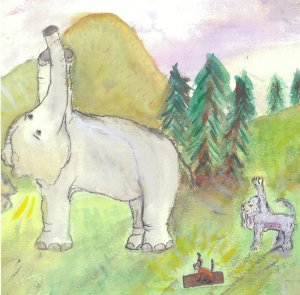
Elephant - Dog - Mouse Trichonasana
(All rights reserved. Karin Gustafson)
Unfortunately, the elephant-dog-mouse yoga book, from which this picture is taken, is not yet finished. But, if you like the style, check out 1 Mississippi, by Karin Gustafson at the link above.

Elephant Baseball.
A masterful job by Sabathia. (I’m sorry–I think I draw elephants better than people.)
Though if you like elephants, check out 1 Mississippi, by Karin Gustafson at link above.
I am a longtime and very proud devotee of Ashtanga Yoga. This is a form of yoga pioneered by Shri T. Krishnamacharya and the much beloved Shri K. Patabhi Jois. It involves six fairly long series of poses (though most practitioners stick to the first “Primary” series), which are intended to energize the body, clarify the mind, and purify just about everything. Ashtanga is supposed to be practiced six days a week, preferably in the morning. (An empty stomach is recommended; a non-empty stomach is regretted.)
It is a great form of yoga, especially for people, like me, who have a hectic schedule, as it is designed for self-practice. Not only does Ashtanga provide a series of pre-set poses, it includes certain transitional movements between each pose. This takes decision-making out of home practice, an immense benefit for those who already have too many other things to think about.
Breathing in Ashtanga, as in all yoga, is super important: each transitional movement corresponds to a specific inhalation or exhalation, and each pose is ideally held for eight steady breaths. This means that Primary series, if done right, should take between an hour and an hour and a half, to complete.
Some of us, however, have managed to shorten the required time span to approximately fifteen minutes.
Here’s how:
1. First, practice for years. It’s important to know the poses in your bones so that when you whiz through them you don’t need to spend a single extra second thinking about what comes next.
2. Second, be Manic.
3. And slightly depressed.
4. Start a daily blog.
5. But keep your day job.
6. Most importantly, fuel the flames of family and personal drama with long drawn-out conversations or email each morning, so that you really don’t have more than fifteen minutes to do yoga. (Ignore possible effects of yoga’s calming influence, if done correctly.)
7. Don’t mind if you wrench your knee or shoulder throwing yourself into convoluted positions. (Alignment always felt kind of boring anyway.)
8. Who said you had to do the complete pose? At least, your bending that wrenched knee.
10. Try not to mind that a practice that is supposed cultivate deep breathing and energetic stillness is whipping by in panting exhaustion
11. Congratulate yourself on the fact that you are practicing yoga at all.
12. (If you can call that practicing . Or Yoga.)
13. But keep practicing anyway. (As that great sage Scarlett O’Hara said, tomorrow is another day.)
 ManicDDaily
Recent Comments