Posted tagged ‘writing tips’

Blocking Writer’s Block – Tired of Editing? Next Step (If You Dare.)

June 20, 2011

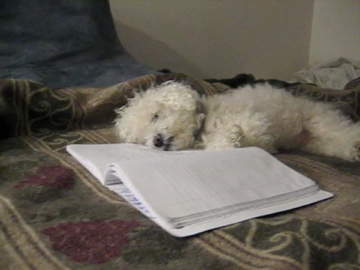
Pearl is really really tired of editing.

I am still working on finishing the manuscript of a novel that I thought was just about finished ages ago.

By finishing, I mean editing, and re-editing.  Cutting and cutting more, adding teeny bits.

I am not changing the plot at this point, even though it’s a bit silly.  I am just honing.  This needn’t be such a long process, except that, unfortunately, I am not somewhat who carves, but rather, someone who whittles.  Meaning that I have to go over the same surface again and again and again, smoothing and chipping rather than making decisive definitive cuts.

The big problem with whittling is that it feels endless.  (If every time you go through the manuscript, you find more to change, it’s hard to ever feel “finished.”)

Though I am quite sure that at a certain point, I’ll feel pretty certain that I am finished.  This will undoubtedly be before I truly am finished.  It will still feel good.

I am not there yet.

My next step is to read the whole thing aloud.  I shudder at the thought, but reading aloud is truly a great way to edit, especially when you are sick and tired of editing.   When you read a manuscript aloud, all of the habitual acceptance disappears, and you immediately understand that that part you always liked is simply boring, or redundant, or run-on, or (if you are lucky), pretty good.

You can see why I shudder!

Pearl just wants me to get on with it.

(For more on writer’s block, see multiple other posts in this category.)

Blocking Writer’s/Editor’s Block – Major Restructuring? (Maybe Focus On the Laundry)

October 24, 2010

A bit of a dreary Sunday.

The good news:  This morning, I finished a re-write of an old Nanowrimo novel.  This does not mean that I actually finished re-writing it, but that I finished another complete round of revisions.

The bad news:  I haven’t done my laundry yet and the laundry room here gets really crowded Sundays.

The good news:  This afternoon, I started another round of revisions on this same old Nanowrimo novel, going through it one more time.  For a while, the whole thing just seemed to work.

The bad news:  Then, I ran into a chapter that I seem to have over-edited my last time through, trying to break up the scene.  Now I think I have to seek out some of that old deleted material.

The good news:  I have a bunch of laundry to do.

As I’ve mentioned before in posts on writer’s block, my block does not arise in my initial writing, but in the editing and revising.

Part of my problem is that I sometimes want to make the manuscript to take a shape it doesn’t want.   I will try a major restructuring, hoping that certain kinds of manipulation–flashbacks, changes of view–can supply the momentum and drama that the plot is lacking.

This type of re-organization may work for some writers.  I’m not sure I’m not one of them.

Please understand that I am not saying here: “first thought best thought.”  I strongly believe in revision and editing.  (Except perhaps on this blog–sorry!)

But, for me, the editing sometimes works best on a sentence to sentence basis.  Or, even better, through cuts.   (One can get very enamored of sections that don’t move a story forward, especially when you’ve heavily re-written these sections on a sentence to sentence basis.)

But changes that involve fitting the manuscript into a different framework, or inserting a… device… tend to be less successful for me.

A good test of whether structural changes are useful is whether you can actually carry them out.  If, as you go through the manuscript, the changes feel increasingly hard to write, they are probably not helping you.

Again, I’m not saying that re-envisioning of a manuscript is not sometimes important.  Filling in blanks or making blanks can help you find your voice and your audience; it can feel both creative and compelling.

The key word is “compelling”.

Good writing does not re-write itself, but if it becomes too much of a tussle, you might consider a return to your initial, rawer, vision.  This at least will have a certain energy and drive.

Here’s the point:  be realistic about the true nature of your first draft.  If you have made an amuse-bouche, don’t try to stretch it into a full course meal.  If you keep trying to inject further substance into it, you may end up with something that can hardly be chewed (much less digested).

Now, about that laundry….

Blocking Writer’s Block – Hold Your Nose Perhaps (But Don’t Shut Your Eyes)

October 20, 2010

As a daily blogger, I probably don’t seem much affected by writer’s block.  (Even when I don’t have much to say, I seem to be able to get it onto the screen.)

Here’s a confession:  my writer’s block, which is intense, comes towards the end of the process.

Getting a major project  done to the point of being able to say–this is the best I can do, the final shape I want these ideas to have–is nearly impossible for me.

The closer I get to completion, the more my stomach turns.  My whole being becomes one huge wince.   Unfortunately, squinched-up eyes don’t copy edit.

In the midst of this ongoing wince, I tend to make one of three bad choices – (i) I let the manuscript languish; (ii) giving up, I simply send it off.   (When the recipient mentions that it’s not quite finished, I cringe more and let it languish.), or (iii) I change the manuscript so radically that it is once again far from completion.  (Then, growing tired of it, I let it languish.)

Some of these difficulties may come from childhood, the curse of precocity.  When you are a precocious child (as many writer/artist types are), you always have the benefit of a certain handicap.  (“So what if his monograph spells Nietzche wrong a couple of times?  He’s only four years old!”)

Precocity is a protective clothing, highlighting every good quality, blurring every fault, chafing, at times, sure, but other times cozy.  But when the precocious child grows up, he or she, like the emperor, suddenly finds that all that clothing has blown away.  Oops!  Embarrassment sets in big-time.

Since this is a truly difficult problem for me, it’s hard to come up with tips.  These sound promising:

  1. The classic advice is to get a little distance from a nearly finished manuscript (i.e. put it in a drawer.)  This does help you to see the manuscript more clearly, but do not expect it to make the process significantly less painful.
  2. Make yourself begin.  Hold your nose if you must, but don’t shut your eyes.  (Keep in mind that eventually some interest or craft will kick in and it won’t feel so bad.)
  3. Make yourself move along.   I really like the Apple software “Pages” because when I re-open a manuscript, it takes me right to the place I left off instead of back to the beginning.    (In Word, I tend to spend months and months snagged on the first twenty pages.)
  4. Make yourself stop.  At a certain point, you will be playing around with minor edits that do not make your manuscript better. Worse, you start making such major changes that you are really writing a completely different piece, one that is farther than ever from being finished.  Maybe your original concept needs these major changes, or maybe you are just sick of it.  Try to be honest.  Allow yourself to begin something new.  (So what if you, like Shakespeare, are using similar themes and characters?)  (P.S. when your ego’s in tatters, feel free to glom on to some  good old grandiosity.)
  5. At some point, you really should proofread the printed pages, and not just look at the screen.  My best advice for this–get outside help (i.e. a really good friend or, maybe, an M.D.)

(Ha!)

A Pearl For the Blocked Writer: Let Go of The Bad News; the Grandiosity; Just Do What You Do.

October 9, 2010

I woke up today feeling terribly depressed.  Yes, it’s probably my chemistry (the down side of the m-word), but, as I browsed through the online New York Times, I also felt that I had every right to blame my hopelessness on the world in general.

Everything seemed to bring up Reagan’s old (deficit-producing) supply-side economics;  they seemed not just to have been swallowed by the American people but to have become an integral part of the body politic–its eaten-out heart (as in “eat your heart out’);  the idea that compassion is bad while greed is good (for society as well as the greedy), almost a moral imperative.

There was the article about the refusal of politicians to support improvements in infrastructure despite the terrible need both for the improvements and the jobs the improvements would provide.  Then the negativity towards healthcare (in one, a Florida politician whose company was indicted for massive medicare fraud.)

Then there were the  little children bullying other little children, seemingly egged on by parents who are happy, primarily, that their kids are at the top of the popularity heap.

I don’t want to detail the stories of truly horrific brutality, stories where even the words “lack of compassion” can’t be squeezed in.

Normally, I try to spend Saturday re-writing one of my old children or teen novels.  (I have a few that for years have seemed sort of finished, and yet still aren’t quite “done.”)  But, suddenly, my little fictional tales seemed ridiculously trivial.   Sure, they all promote compassion; but they are also, due to my lack of talent and vision, not particularly life-changing, society-changing.  Not even, perhaps, life or society-nudging.

Of course, one would like to write life-changing books!  But what if you just don’t/can’t.

Feeling grandiosely whiney, I looked over at my very conveniently located muse–that is, my good old dog Pearl, snoozing at the bottom of my bed.

Talk about a lack of grandiosity!  Talk about forging ahead!

Pearl might very well like to be a noble dog, a celebrated dog (a Balto!) even just a big, strong dog. But she was born cute and fluffy and a little bit clownish.

Pearl might even like to be young again, with fully functioning limbs.

Nonetheless, Pearl presses doggedly through life each day, doing what she does as best as she can.   And not doggedly just in the sense of persistently and dutifully–but with a joy us non-canines (and blocked writers) can only wonder at.