Posted tagged ‘sick dog’

Longterm Focus – Stress and Creativity – Pearl!

May 31, 2010

Pearl - Habit and Engagement

The other day I worried that I really didn’t have a focus for this blog; something to orient  both me and any readers I may be lucky enough to snare.   What have I been I writing about?  What subject do I even have to write about?

Then I suddenly realized that the general subject of this blog has been stress and creativity.  If I wanted to sound official, I’d say the interface between stress and creativity, but since I can’t say that with a straight face (or interface), I won’t.

What does this mean?  I guess the question for me is how one, in this manically depressed stressful modern world, maintains some kind of creative effort?  How can one use stress as a source for creativity rather than as a wet blanket for its termination?  (How, also, can the manic avoid using creativity as a further source of stress?)

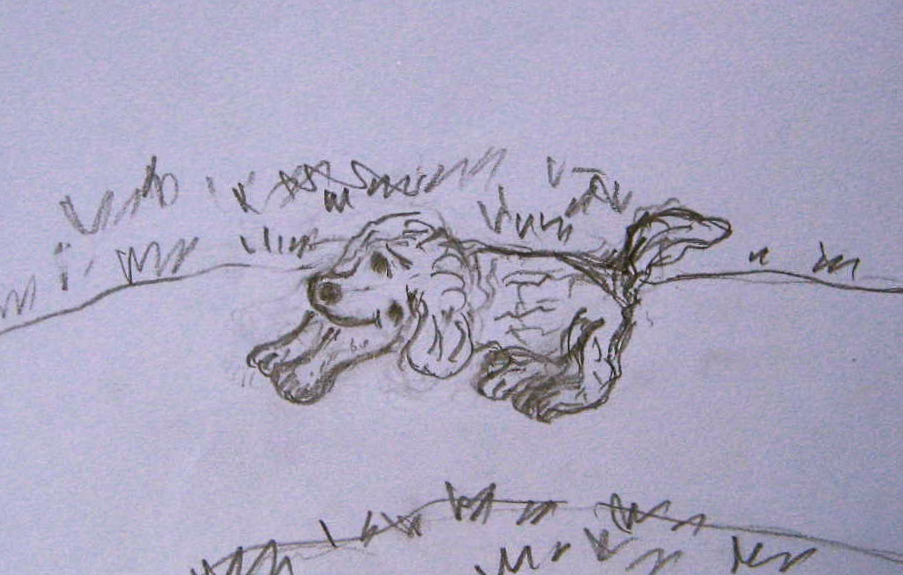
For my first conscious exploration of this subject, I turn to the teachings of my old dog Pearl.  Pearl was struck by a sudden spine problem a couple of weeks ago that paralyzed her from the dog-waist down, rendering her hind legs both insensitive and immobile.  Amazingly, with the help of steroids, she has recovered some use of her legs: she can wobble along now, though she moves like the proverbial drunken sail—dog.  (BTW, after reading several Horatio Hornblower books last week, I now feel enough “expertise” to understand that the unsteadiness of a drunken sailor is archetypical because it arises from at least two sources—(a) alcohol and (b) sea legs, i.e. legs accustomed to the sway of waves that are suddenly posited upon dry land.)

Pearl’s up in the country this weekend, and her reaction to it is a lesson in the maintenance of creativity under stress.  (For these purposes, I’ll consider Pearl’s outdoor explorations and general cuteness her “expression.”)

Pearl still has trouble even walking, and yet, here, in a country place she has loved since puppydom, she wobbles, skips, trots.  What motivates her, what keeps her going, seems to be two factors:  habit and engagement.

There are certain places (a long dirt driveway), and certain times of day, in which Pearl has always run here.  That habit (plus steroids) is so strong that when I put her down on these spots, and at those special times, her legs just move.

Where habit runs out, engagement takes over.  The scent of a place where a deer has recently bedded down will lure Pearl, sniffing, into tall grass, pull her through reeds, propel her into Heraculean effort.  I can only derail her lopsided enthusiasm by physically picking her up and putting her back on her track, where, out of habit, she quickly wobbles off again.

Which brings me back to the creative human mind dealing with stressful obstacles–all those drags upon the consciousness.  How to avoid paralysis?  How to dart and trot, dig and ferret?  How to just keep going?

This (I think) is this blog’s inquiry.

Thanks so much to those who have been following.  Stay tuned.

Love’s Offices – Ailing Dog

May 24, 2010

Place of Love's Offices

Those who follow this blog know that our old dog, Pearl, has recently suffered a problem with her spine which paralyzed her hind legs.  Under the influence of steroids (go Floyd!), she’s doing somewhat better, but still not walking.  Nonetheless, we have to be very careful where we leave her in the apartment as, when she is left alone, she insists on dragging herself to her “office”, a cluttered, dark clothes closet.

There are many meanings of the word “office.”  One is Pearl’s closet; another, perhaps more accurate use, refers to duties or functions. pIn a beautiful poem called “Those Winter Sundays”, Robert Hayden writes of “love’s austere and lonely offices,” describing his stern dad’s early rising on frigid Sunday mornings, hustling the house fires back to life with competent, chapped hands, and polishing the shoes of the son (poet.)

I love the poem.  It does make me wonder, however, why so many of love’s offices in my personal experience involve, not home fires, or even scuffed shoes, but plain old bodily fluids.  I’m not talking sex here, but of the effluvial tides of sickness known to almost any parent, pet owner, (woman).  These have poured from a host of sources–from travel with children (at least, my children) on sea, air, or roadway; to shepherding them through flu’s, colds, allergies, nights out, even cuts and cold sores.  In family life, stuff flows.

And now, here’s my little half-paralyzed dog.

I should be (and am) happy that even under her current difficulties,  she has retained pretty iron-clad bladder control (except for the other morning, just as I got her down the stairs into the building lobby).  But the lack of functioning hind legs makes such matters difficult for a dog.

So, now, love’s office involves carrying her down to a small fragrant square of dirt on the Esplanade by the Hudson River, squatting there to hold her up with the help of an old but strong and soft silk undershirt slung under her belly, waiting….waiting…trying, while waiting, not to worry too much about the spindly tree that somehow lives in that besotted patch of dirt.

Since she cannot exactly say what she wants, love’s offices also involve waking up several times during the night to try to figure out why the dog is struggling to a seat or shaky stance, and then propping her up over some folds of old newspaper.

Love’s moist and ignoble offices.

The Sweetness of Fifteen Year Old Dog – Visor of the Dalai Lama

May 20, 2010

Dalai Lama in Visor at Radio City Music Hall

My dog of fifteen years has suddenly shown her age.  There have been hints before—cataracts and a general waning in exuberance in the absence of cheese and/or a homecoming–even through those setbacks, she’s always retained a puppy-like aspect befitting the cutest dog in the world.

Last night, though, something dramatic changed inside her small body.  She  could no longer move her hind legs;  they didn’t limp, they simply became inanimate.   And, she began to tremble.

I have no confusion between dogs and people; my dog is not my child.  That said, it is a true truism that there is a special relationship between dog and human.  Of course, there’s the loyalty, the uncritical companionship, the absolute, wise, wonderful, sweetness supplied by the dog, but there is also deep tie that arises from the sense of responsibility that the human feels for the dog—the duty of care, food, pats, attention.   The love of the dog, and loving a dog, not only makes a human feel more human, it makes him or her feel more humane.

It may be that human beings are simply hardwired to love whimsically cute, communicative but not clearly speaking, beings.  It may arise from the same set of chromosomes that allows us to be loving parents.  Personally, I’m sentimental enough to think that these bonds are not only a matter of chemistry.   Because the bond is not just  towards any dog (although most dog owners are pretty soft-hearted in the canine area), but towards the particular dog that became your dog– maybe because of a certain placement of spots,  maybe, as in the case of Pearl, because she happened to be the only female and the cheapest dog in the litter of a breed that is supposed to be hypo-allergenic–  somehow this randomly chosen dog turns out to be the perfect match, the best dog in the world.

(Of course, this specialness probably only applies in the case of Pearl.)

On another note, well, sort of another note, I was lucky enough to attend one of the Dalai Lama’s lectures at Radio City Music Hall today.  All the time, I was worrying about Pearl, and there is much about Tibetan Buddhism that is hard to follow.  But hearing about the Buddhist sense of cycle, the inevitability of emergence and dissolution and re-emergence, is very wonderful when you feel like you may be actively dealing with the dissolution side (a side that is always there even when you aren’t actively dealing with it.)

Then too, there is that sweetness, even cuteness, about the Dalai Lama, however wise and formidably intellectual.   Now, an old man, he jokes, and, quite wonderfully, wears a dark red visor to shield his eyes from the theater lights.   Even as I struggled to listen to the the analysis, what was most compelling was simply this sweetness, which you feel certain comes from a deep understanding of the way life works.

(For those interested in more specifics about Pearl, and I very much appreciate your concern:  there is something wrong with her spine.  Medication has made her comfortable enough to rest, right this minute, in a lap.  Too soon to predict the short-term outcome.)

Dalai Lama in Visor

Looking For Cheer (With a Sick Dog)

May 19, 2010

Sick Dog

I was ready tonight to write about the wonderful reserve of the old-time British hero, Horatio Hornblower (created by C.S. Forester);  this is a character that knows how to pack a great deal of meaning into a very few words; who is masterful at mastering his feelings, careful to mask and make do with discontent, sadness, anxiety.   But I come home from work to find my very old dog suddenly immeasurably older.   Something is very wrong with her, and suddenly reserve feels immediately like a much less interesting quality to me.

When your old beloved dog is sick, you really are not looking for a friend to say, crisply, “hard luck.”

Certain types of cheerfulness are even worse than the crispness of a stiff upper lip.  For example, when you are anxious or grim, it’s not always helpful to have someone tell you, brusquely, to cheer up, or to not give up hope yet.

Maybe it’s just me.  Perhaps I am of an argumentative nature.  (Actually, there’s probably no “perhaps” about that.)  But, when someone tells me cheerfully not to give up hope, I want to respond tearfully, (i) that hope is already far gone, and (ii) just leave me alone.

I find that instead what helps when I am truly anxious or upset is some kind of commiseration–an echoing or mirroring of the upset feelings.  Yes, I know this sounds  like wallowing–or, even worse, getting your friends to wallow with you–but instead of strengthening bad feelings, this kind of commiseration seems to give a stepping stone for getting out of them.   This could be my peculiarly argumentative nature.  All I know is that if I am upset, and someone agrees that my situation is pretty awful, my kneejerk impulse is to say that it’s not so bad, and to actually feel some kind of  hope.   (It’s as if the sympathy gives me enough strength to become my own comforter.)

In a similar play of opposites, many look for someone to take care of them–financially, emotionally, physically–while the being that most readily captures their heart is one that they take care of.

A dog.

Here’s hoping.