Posted tagged ‘Sarah Palin’

George Washington, Sarah Palin, Cherry Pie and Christian with a capital “C”

February 15, 2010

Washington and Cherry Pie

Presidents’ Day.  In my youth, we had Lincoln’s Birthday on February 12 and Washington’s Birthday on February 22.  I don’t remember specific rituals around Lincoln’s Birthday, but Washington’s was celebrated with cherry pie.

And, of course, big sales.

Now, what we mainly have are the sales.

I could not help thinking of Washington today.  Partly because I still had Sarah Palin’s Tea Party speech on my mind, “American Exceptionalism”, and the attempt (apparently among certain members of the Texas Education Board) to characterize the founding fathers as Christian (with the capital “C” and silent “F” of Fundamentalism).

Even when I was little, the one thing we all knew about George Washington was that whole incident with the cherry tree. We had been told that the story was probably not true, but understood that the point was that Washington himself was true; a good man; that even as a child (like us), he could not lie.  (I thought about him as a kind of American Pinocchio.)

Of course, even the true stories about Washington stress the strength and nobility of his character, noticeable in both his age and youth.  I read today, in connection with thinking of Washington’s character, the precepts Washington copied out at sixteen:  Rules of Civility & Decent Behavior in Company and Conversation, 110 maxims which are believed to have come from a book published in 1664 in London entitled, The Young Man’s Companion, and which, in turn, were derived from rules developed by French Jesuits in 1595.

The Rules are a detailed compendium of how to show respect and consideration to others, both in matters of literal nit-picking as well as “not-picking-upon.”  Although the rules urge a young man to keep the “celestial fire” of conscience alive, they do not seem to teach how to please a Christian God (there are no biblical references), but how to be a good, honorable, admirable person.

The founding fathers, shaped as they were by the Enlightenment, seem to me to have been big on such precepts, guidelines, universal rules.  One thinks of Ben Franklin, who, in his Poor Richard’s Almanac, published literally hundreds of adages, rules to live by.  While some of Franklin’s adages do mention God (as in “God helps those who help themselves”), and many castigate immorality (especially hypocrisy), the focus is more on prescribing a moral life because it is a key to happiness, contentment, self-fulfillment, societal good:  “Sin is not hurtful because it is forbidden but it is forbidden because it’s hurtful. Nor is a Duty beneficial because it is commanded, but it is commanded, because it’s beneficial.”  (Poor Richard’s Almanac, from 1739.)   In other words, a good life is its own reward, and, more importantly, is a reward.

Thomas Jefferson was particularly interested in theology;  he even wrote specifically about Jesus, but again, his interest seems to focus not so much the specific religious meaning of Jesus, but in Jesus as a sublime paradigm of the ethical life.  (Apparently, Jefferson’s book, published in 1820, The Life and Morals of Jesus of Nazareth, sets forth Jesus’s ethical pronouncements, while editing out the Virgin birth, the miracle stories, Jesus’s claims to divinity, and the resurrection.)

I really do not know as much about the history of these men as I would like, so forgive me (and comment) if I’m mischaracterizing them.  I’m certainly not trying to make them out as “anti-Christian”, but simply saying that it seems bizarrely reductive, simplistic, and manipulative (i) to argue that the use of the word “God” or “Creator” in our founding political documents aligns the founding fathers with the religious right; (ii) to ignore the historical context of these guys (as heavy readers of both the Bible and Voltaire), and (iii) to treat them as if they were somehow more mainstream versions of Joseph Smith, i.e. specific transmitters of divine will.

Agh!

And yes, it’s possible to be ethical and even christian without the capital “C” or the capital “F”, in the same way that one can honor the American flag without being pro-war.  One can even like cherry pie.

(All rights reserved.)

PS- if you like elephants, as well as watercolors, check out 1 Mississippi by Karin Gustafson on Amazon.
The Twilight Zone – Lessons Obama Might Learn From Stephanie Meyer

February 10, 2010

I’m still reacting to the news that Stephenie Meyer has sold over 45 million Twilight Saga books.  To put this into a bit of perspective, Barack Obama only got about 69 million votes when he was elected President in 2008. 

Granted, 69 million is substantially more than 45 million, and, of course, that 69 million only consisted of U.S. citizens.  (I believe Stephanie’s tally is worldwide.)   But, on the other hand, Obama’s voters were not paying more than $10 per shot. 

These figures have led me to think that if Obama is looking to “up his numbers”, he might consider some lessons in popularity from Stephenie Meyer, and her prime male Twilight character, Edward Cullen.

 (Note: these are not my lessons.  But popularity is, unfortunately, not my strong point.)    

Here are some I’ve gleaned: 

1.  Make the trappings of wealth–big house, fast car, great clothes–seem easily attainable;  do not gloat after these trappings yourself, but do not poohpooh the pleasure they give others.  

2.  Abolish speed limits.

3.    Make it very clear (a la Edward)  that you are subject to murderous rages which you hold back through iron (but imperfect) self-control.

4.  Always tell the American voter (we’re your Bella) that we’re beautiful.   (Even if we’re fat.) 

5.   Make us feel (a la Stephanie here) that magical thinking really does work, i.e. that if we truly want something, we will get it.  Yes, there may be a bit of dramatic bustle along the way, but no significant trade-offs, sacrifices, or even analysis, will be required.   (Sarah Palin seems to have mastered this one.)

6.    Keep it sweet.  Simple.   No big words.  

7.  Think about change, sure.  But use paradigms that are familiar, instantly understood.  (Don’t worry about inconsistencies.)

8.  Don’t worry too much about those that can’t keep up or get caught in the cross-fire.  Think of them as the tourists who are the victims of the Voluturi while Edward saves  Bella.   Yes, it’s too bad.   But hey, Edward and Bella are back together again.  

9.  If all else fails, hire Robert Pattinson.

Another Unhealthy Emission From Palin

December 23, 2009

In the midst of reading Palin’s Facebook posts about climate change I ran into her newest post/poison about Government death panels:  “Midnight Votes, Backroom Deals, and a Death Panel”.  Her images conjure up Harry Reid, dressed the dusty black of a Christmas-hating Ebenezer Scrooge, in a back alley doctor’s office advocating death for all except patients seeking late-term abortions.

Part of what’s disturbing is how manipulative Palin is;  it’s sometimes does not seem possible that she believes her own rants –how does she miss the self-contradiction?   She argues, for example,  that the government health care bill reduces access to health care and promotes  rationing (hence the jump to the idea of the “death panel”) while at the same time she declares that the bill (because it offers so much, unfettered, access to health care) will be ruinously expensive.    (In Palin’s world, private insurers never deny access to health care, and those who can’t pay for health care seem somehow to magically not need it.)

Palin admits in this post that her use of the term “death panel” was “a metaphor”.  This, to me at least, implies an understanding that such decision-making bodies are not a true facet of the proposals.  And yet, she continues to bandy the word about, knowing how it has been, and will be, parroted by followers eager to find totalitarianism in anything connected to Obama.

“This is about politics, not health care,” she says, and then, so nobly apolitical, ends her post with the promise/threat that “2010 is coming.”

More Palin On Climate Change–Emit, baby, emit

December 22, 2009

Yesterday, I wrote about Palin’s tweets on climate change.   (Twitter–such an intelligent way to discuss complex scientific and political issues.)

Palin’s complete-sentence comments on climate change, posted on Facebook (another high level political forum) and in an op-ed piece in the Washington Post, are a little less fragmented than her tweets.  But they illustrate a similar disjointed logic that is geared towards “catchy” reductiveness, self-promotion, and a refusal to face true choices (a “have your cake and eat it too” mentality.)

Catchiness comes in “word bites:”   for example, she accuses California Governer Schwarzenegger of harboring a vain “greener than thou” attitude.  (This put-down does not make a huge amount of sense since she also accuses him of being too green.)   She  accuses Gore and other environmentalists of promoting “Doomsday scenarios.”  (This last is also strange coming from someone who, seemingly, believes in the Book of Revelation.)

Any science that finds a connection between man’s activities and climate change is “agenda-driven,” even “fraudulent”.  (Another odd comment given the known efforts of the Bush administration to politically manipulate scientific data.)  Nonetheless, Palin promotes the idea that there has been a huge conspiracy of scientists for the last twenty years falsifying scientific records related to climate change:  “Vice President Gore,” she writes, “the Climategate scandal exists. You might even say that it’s sort of like gravity: you simply can’t deny it.”

The purpose of this vast scientific conspiracy is never specifically stated by Palin; the scientists seem somehow motivated by a vaguely elistist wish simply to make the American people suffer.

Palin, eager to seem pleasing and maverick at once, typically attempts to pay lip service to both sides of the debate.  She proclaims herself a believer in climate change, and to have initiated “common-sense” efforts in Alaska to deal with its effects.  (Presumably, these efforts did not involve any limitations on snowmobiling, drilling, or safeguarding of polar bear habitats.)   Her bottom line, however, is that she refuses to believe, no matter what,  in any connection between man’s activities and climate change, while she is completely certain that there will be an irremediable economic cost in reducing emissions.  Ergo, emit, baby, emit.

A “real world”, as she calls it, analysis.

Palin andClimat Chng: Happn’g 4 Ions

December 21, 2009

As my family, with some embarrassment, will attest, I am not someone who feels a knee-jerk hatred of Sarah Palin.  I don’t agree with her on virtually any issue, but I think she is smarter, or at least, shrewder, than many people from my neck of the non-woods (New York City) admit.  I also have a soft spot for Palin simply based on the memory of her youngest daughter (Piper?), seen at the Republican convention, earnestly pressing down Palin’s baby’s wayward bangs with a saliva-moistened palm.  (It’s hard not to like Piper.)

But Palin’s blindness to reason and fact really get to me; Palin is especially upsetting because she’s so glib, so willing to cast aside the complications of truth to get to the beguilingly simplistic.  She’s a bit like a cheerleader: as long as something is catchy, short, and supports her team, she will (smilingly) say it, whether or not it makes sense, or is even consistent with her other positions.

The most recent example of Palin’s reductiveness can be seen in her remarks on climate change.  Palin’s comments were made in the form of “tweets,”  a good method of communication for Palin since fractured thinking is not only allowed, it’s practically mandatory:

“Copenhgen=arrogance of man2think we can change nature’s ways.MUST b good stewards of God’s earth,but arrogant&naive2say man overpwers nature.   (Palin Tweet, 11:44 PM Dec 18th from TwitterBerry ).

Earth saw clmate chnge4 ions;will cont 2 c chnges.R duty2responsbly devlop resorces4humankind/not pollute&destroy;but cant alter naturl chng.” (11:57 PM Dec 18th from TwitterBerry)

There’s no room for the complications of science and fact here; no space for actual data.

There’s not even room for eons of change, but only “ions,” those teeny little charged particles that (according to some bogus scientists) make up various atoms and molecules.

I understand that Palin’s position is based, in part, on her Christian faith; but her faith seems terribly reductive here.   Although Palin pays lip service to a broader view of the environmental equation ( “humankind/not pollute and destroy”), this statement seems just a spoonful of sugar (to help the development go down).   It’s worth noting that one of Palin’s earlier tweets that day congratulates the Alaskan legislature on fighting the Endangered Species Act, a fight in which Alaska is working to delist the polar bear and to avoid a listing of the ribbon seal, two species that have been harmed by a severe decline in habitat due to climate change.

Apparently Palin believes that the polar bear and seal can live 4 ions, even without a habitat.

Celebrity News

November 29, 2009

Addiction has long plagued man (and woman).  (Even, as was shown at the Central Park Zoo a few years ago, polar bear.)   There are the standard traps—alcohol, drugs, gambling, sex, and, if you are a polar bear, your 9 by 12 artificial arctic pool.   But addiction is not only a by-product of human nature, it’s also a creature of its time.  As a result, there are always new and interesting practices that people can get taken over by—crystal meth, online shopping, computer gaming, non-stop twittering or facebook checking (non-stop “stat” checking if you are a blogger), texting while driving, the 24 hour news cycle.  Even worse than an addiction to the 24-hour news is an addiction to the 24-hour celebrity news cycle;  worse than that, is the intense craving for celebrity status itself–the obsession with achieving fame.

Some addictions are obviously more damaging than others.  I, for example, view an addiction to either (a) Robert Pattinson, or (b) the Twilight books, as relatively benign.  They may be damaging to one’s reputation as a serious and/or thoughtful person, but they  are a relatively cheap indulgence, don’t truly harm others (except, perhaps, a thoroughly bemused spouse), and can even be satisfied in chocolate.  (See e.g. new Twilight assortments with foil wrapped and embedded portraits! )

Both Twilight and Pattinson also have the absolutely most healthy quality an addiction can have, which is that they get pretty boring pretty quickly.  (No offense, Rob; it’s not you so much as the dialogue.)

The addiction to the pursuit of celebrity status is a little more troubling.   Recent examples include Michaele and Tareq Salahi, the couple who crashed last week’s White House State Dinner, and Richard Heene, the father of the “Balloon Boy,”–all people apparently addicted to the pursuit of their fifteen minutes.

What’s more worrisome to me, however, is the Salahish, I mean salacious, pursuit of celebrity by people who once played serious and dignified roles in our culture.   I particularly mean people in the news business, who seem, increasingly, to want also to be people “in the news.”

In the early years of televised news, there was a dignity to the newscaster–Walter Cronkite, Frank McGee, David Brinkly, were TV personalities, but soberly somber.   We all know how this has changed in more recent years.   The reasons are obvious and not new—advertisers want ratings, outrageous and/or boorish commentators, perky blonde reporters, and “news” which is really entertainment (i.e. reality shows, sports, sensational crime shows) apparently achieve them.   Recently, however, the “celebritization” of newspeople on TV has not only become more intense, it has also spread to other sections of the press, which, due to commercial pressures and online versions, have  become increasingly TV-like.  For example, the New York Times now posts photos and videos, and advertises blogs and tweets, of its op-ed writers.  To some degree, this is useful;  you can better understand the overall stance of a commentator, and, if you like, you can read a lot more of them, but sometimes, well, you end up wanting to read a whole lot less.

Politicians increasingly crave “celebrity-style” status as well.  (Yes, Sarah Palin.)  As Colbert has demonstrated through his “Colbert bumps,” it’s better, election-wise, to be known, even if slightly ridiculed.  (Ideally, if apearing on Colbert,  it’s better to be known, and if ridiculed, also good humored.)

I guess people want circuses, even when bread is in short supply.

Cake Casuistry and Sarah Palin

November 17, 2009

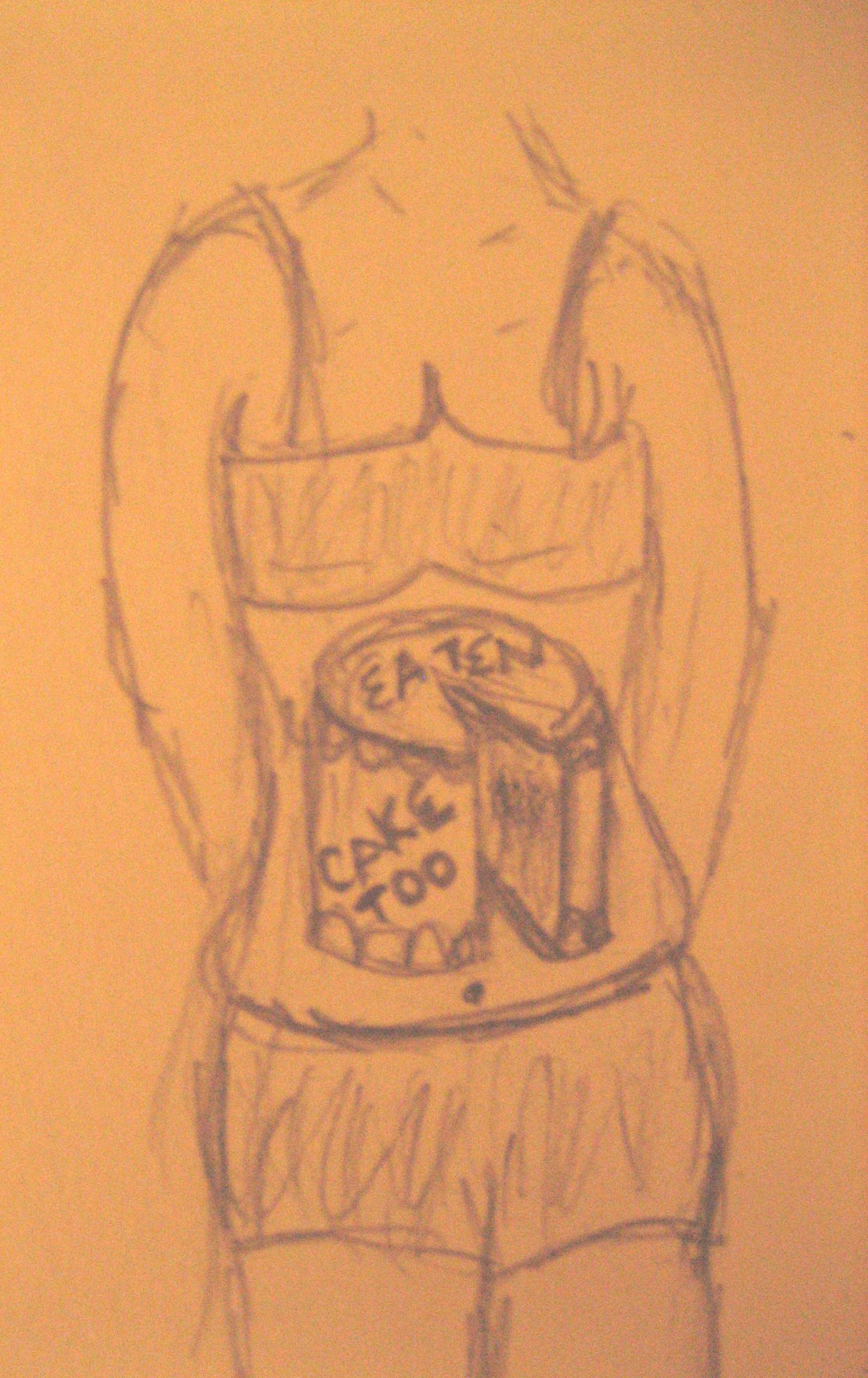
Eaten Cake Too

“Can’t have your cake and eat it too.”

For much of my life, I did not understand what that expression meant.  Oh, I understood its general import; I heard my grandmother sigh it with a sorry shake of her head often enough.

But I couldn’t understand how it actually worked.   Didn’t you have to have your cake in order to eat it?

Even when I finally did get the literal meaning of the words, (“have” as in “continuing to have”, “eat” as in, you know–), I still resisted their logic.  Why couldn’t you save half the cake and eat the other half?  Even if you did eat the whole piece, didn’t you still have it –in your stomach?  At least for a while?

Ultimately, I think my problem was not so much with the expression’s words as with its meaning, especially its meaning for women of my generation.   There were just so many cakes that we wanted to have and eat too—an engaging career and time to attentively raise children; a good paycheck and creative, non-corporate work; a husband who worked and was available to his family; a daily blog and adequate sleep–

So many secret little nibbles of cake, so many secret little hoardings of crumbs, so very many empty or half-empty mouthfuls.

The parceling out of cake, even talking about parceling it out, was simply very hard for some of us;  it continues to be hard for many younger women too.   (Many women, for example, still feel the burden of keeping quiet about a sick child, an aging parent, a wayward husband, simply to protect perceptions of their job performance.  Others find that the job performance problems created by these factors aren’t limited to perception—such non-work matters demand their energy, time, and decision-making on a dailybasis.)

The genuine complexity of these issues is, I think, one reason why some women find Sarah Palin so troublesome.  Although Palin has clearly had her own difficulties with choices of this kind, she glosses these over, trying to have her cake and eat it too in the very same (somewhat disjointed) sentence.

She purports, for example, to be both attentive mom of five and also hands-on executive, lover of the wild but also driller, generous-spirited but also vindictive enough to ward off challenge, winking Josephine Six-pack but also policy “wonk”, perky but contemptuous of the perky, Alaskan hunter of moose and nationwide hunter of bucks, quitter but also stay-the-courser, insulting, reductive and libelous, but quick to find insult, reduction and libel in others, a self-declared claimant of down-to-earth clarity who obfuscates and confuses.

As my family will groaningly testify, I have sometimes expressed a surprising sympathy for Palin (even when cringing on the opposite side of the fence.)   I don’t like to see any woman ridiculed; I understand how difficult it is for a woman to carve out an individual or powerful style in our culture.  But her glibness has lately introduced so many  quoted untruths into common parlance that it is hard for me to retain much sympathy;  these have not only lowered the debate but significantly damaged it, and, when added to Palin’s  pursuit of earnings in the millions, have lately brought another “cake” phrase to mind.  Not the old saying of my grandmother’s, but the, perhaps, older one of Marie Antoinette: “Let them eat….”