Posted tagged ‘manicddaily’

Observations – Teenage-People, Child-People, Adults

December 12, 2009

Some people are born teenagers.  This is not to say that they don’t age and grey—sometimes with unfortunate clothing and very heavy make-up—but only that they have a certain kind of self-centeredness that focuses their whole lives.  They want what they want with little apology, their sense of entitlement profound enough to smother most glimmerings of guilt.  They can be antic and fun, spoiled and indolent.  They are pretty good at “moving on” from sadness and loss, less good at moving on from a perceived offense; a certain narcissism (which is different from self-confidence) makes the offenses of others feel pretty serious, also making forgiveness come hard.

Some people are born children; usually “good” children.  As good children, they  crave approval so much that the absence of it (a simple silence) can feel like implied castigation.  Child-people want to feel taken care of, by a benign fate as well as a loved one.   (Often, this doesn’t happen; the child-people are concerned enough about pleasing that they tend to do a fair amount of caretaking.)  Even so, always in search of signs of such care, they look for “silver linings,” justifications, explanations, nuance.  They can hardly bear not finding what’s “right” about something wrong, and go through endless convolutions trying to make it right.   This convolution makes it difficult for such child-people to make decisions, an abstract difficulty magnified by the obstacles child-people have identifying their own needs.  A sense of entitlement not natural to them, they need “permission” to satisfy their needs.  Because others may not be paying close attention to these needs  (the teenage-people in their lives, for example), the child-people may have a hard time getting this permission.

Some people are born adults.  They can make thoughtful decisions, understanding the concept of cutting losses.  They are happy to help others, but also understand the airplane rules of the dangling emergency oxygen mask (put your own mask on first.)   They also understand the limitations of help (i.e. that the helpee must be willing and able to be helped.)

Each of these types of people can be happy, indifferent, troubled, content.  (Well, I don’t know about content.)
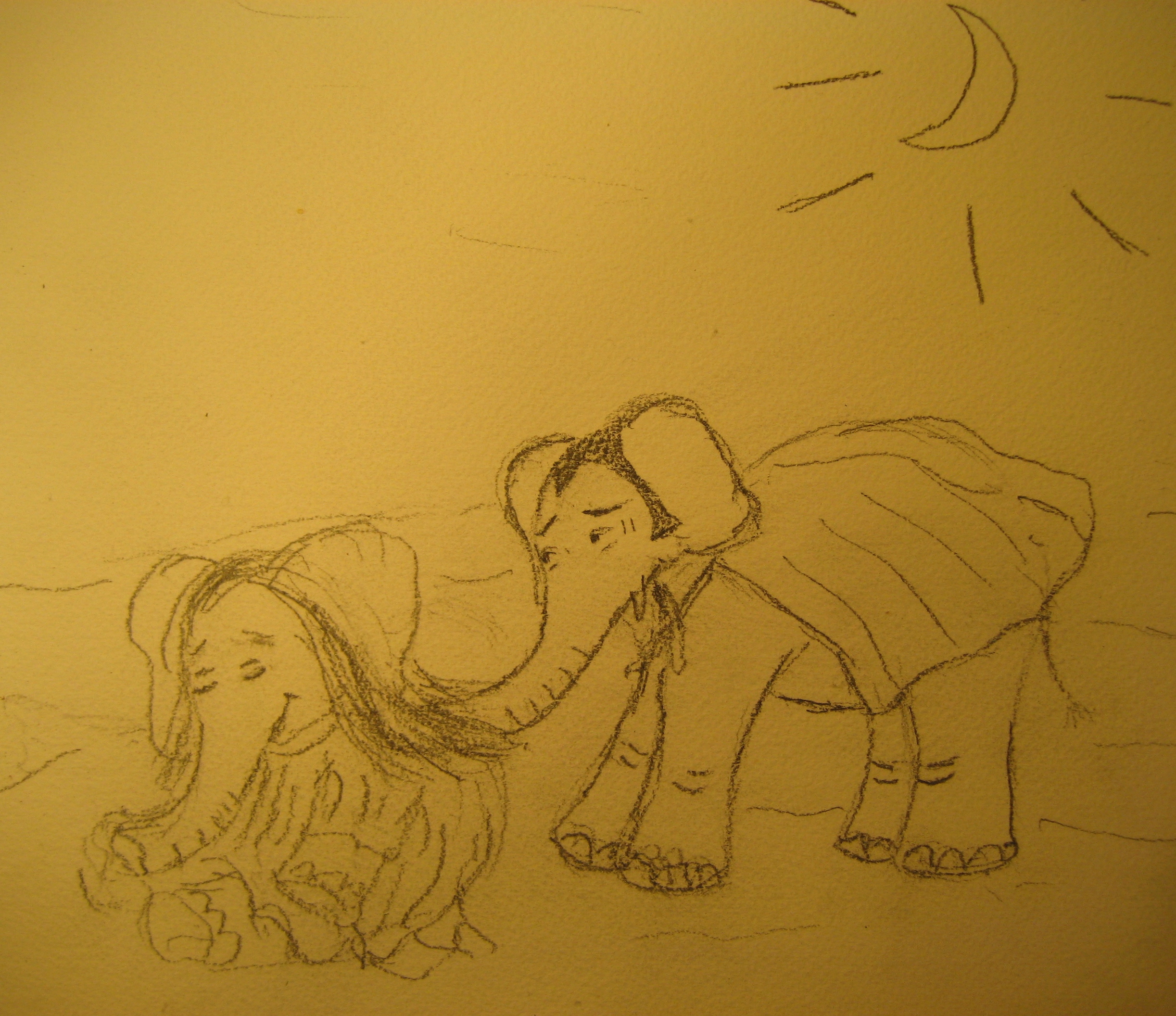
Bill Compton, Sookie Stackhouse, Elephants

December 11, 2009

Bill Compton in Sookie Stackhouse's Hair (as Elephants)

I haven’t seen the HBO series, True Blood, so my depiction of Sookie Stackhouse and Bill Compton is based solely on the Southern Vampire Mystery Series (by Charlaine Harris), plus my own preference for drawing elephants over humans.

For those who haven’t read the books, Bill the side-burned vampire loves to detangle the long blonde hair of Sookie, the cocktail waitress.

(All rights reserved.)

For elephants without fangs, check out 1 Mississippi by Karin Gustafson at Amazon.

Friday! Canine Christmas Tree

December 11, 2009

This one looks good!

Enjoy the weekend.

PS – If you like elephants as well as dogs, check out 1 Missississippi by Karin Gustafson on Amazon.

All rights reserved.

In Search Of Saddle Shoes, Catholicism, Advent Calendars,

December 9, 2009

Two things I dearly wished for as a child were (i) to be Catholic, and (ii) to have saddle shoes.

They both represented a certain organization in my mind.  (Not organization, as in the Church, or Thom McCann;  organization in the sense of order, structure, rhythm.)

Catholicism was represented  by the couple of Catholic families on my street.  These each had enough children to require regimentation.  Rooms were shared; chores were assigned; eating was done only at meals, which were also on a kind of rota.  Fish sticks, of course, on Friday—these were not a particular source of envy.  Spaghetti on Saturdays.  The smell of the sauce emanated from my Catholic neighbor’s kitchen for hours, an unseen tomatoey aura that seemed to heighten the heavy greens of our semi-rural suburbia.  My Catholic friend, Susie, came out afterwards with sunsetty orange stains around her mouth.

Saddle shoes seemed in my mind to be Episcopalian.  (At least, the two girls I knew who wore them were.)  The mothers of these girls, like the Catholic mothers, did not work outside the home.  Less stressed than the Catholic mothers  (fewer children),  they wore their hair with either a schoolgirlish flip or bound in braids, and, on their feet,  trim white anklets.  (Seriously, anklets.)   They organized Brownies, Girl Scouts, volunteer stuff.  This, plus the anklets, seemed to give them a clear edge in the saddle shoe department:  they knew where to buy them.

I had a working mother, a rarity back then.  Yes, she made spaghetti sauce, but not for hours.   She wore hose.  And was too busy, and guilty (like many working mothers), to maintain a clear structure of delegated tasks.

As I grew older, a working mother myself, my childhood envy of Catholicism and saddle shoes spread to Advent calendars.  Setting aside all religious elements, Advent calendars represented patience, organization. If you’re going to have an Advent Calendar for your kids, you need to keep it in a special place,  consult it every day, only allow one little square to be opened at a time.

I tried.  But some  of us veer towards the energetic rather than systematic.  We squeeze things in, eating when we are hungry,  reading a book all night long.  We can hardly wait to wrap a present before we give it, make spaghetti sauce from a jar.  And will likely never ever get to wear saddle shoes.

Awww…

ps – for anyone who doesn’t know (I find this hard to imagine), saddle shoes are those beautiful, cow-like, curvy, black and white, or brown and white oxfords.

Sonnet in Winter – Hospital Visit

December 8, 2009

For a change of pace, here’s a sonnet, written about a winter’s visit to a sick friend.

The sonnet follows the Shakespearean rhyme scheme, and though it tries for Iambic Pentameter, I’m not sure that attempt is truly successful.  As noted in previous posts about sonnets and formal poetry, I tend to use a syllabic rule of thumb rather than to follow strict rules of scansion.

For further explanation of the Shakespearean rhyme scheme and some approximation of the rules of meter in formal poetry, check out prior posts re poetic meter, and sonnets, and for reasons to write formal verse .  (And plenty of others – check out poetry category.)

No chance

I wanted to give her time, a summer’s day,
a perfect green blue day that I would pluck
from my summers to come, that I would lay
upon her bed, and, shimmering, tuck
around her.  It should have been an easy offer,
easy to say.  After all, the future
can’t be readily assigned; life’s coffer
holds nothing forfeit.  Tubes followed suture
to a darkness barely gowned; I searched around
my jangling brain for words, but what came out
were stones that lined her pillow, the sound
not meaning my meaning, and not about
summer days; my own fierce will to live
hoarding what I had no power to give.

All rights reserved, Karin Gustafson.

(If interested in different forms of poems–sestinas, pantoums, villanelles, and more villanelles, and even more villanelles–there are a lot of villanelles.   Really.  Check out these links, and others.  Thanks.)

After the Ninth Southern Vampire Novel

December 7, 2009

Under pressure of pressure (that is, randomized, yet persistent, work and life demands), I read nine vampire books last week.  (The “Sookie stackhouse Southern Vampire Mysteries” by Charlaine Harris).  This is not something I am proud of.

I also managed (for the record) to get to work every day, to work while there, even to put in several hours on Sunday.  Cooking was done Laundry was not.  (I hereby send an open apology to all members of my gym.)

Sleep was intermittent.   Perhaps, as a result, I felt a bit dazed finishing the ninth novel this morning (“benighted” may be a better description.)

I’m not quite sure why one (“I”) turn to silly books under pressure. Of course, there’s the whole mind candy business.  (See my earlier post “When Escapism Hits Hard –  https://manicddaily.wordpress.com/2009/12/03/blocking-write…pism-hits-hard/ )

And yes, it’s embarrassing.  Still, there it is.  Some nights (and mornings, Saturday afternoons, and subway rides) will have their vampires (in print.)

Since I am new to this genre, I don’t know what is standard.  I did notice a considerable overlap between the Sookie Stackhouse novels and the Twilight Saga – cool, perfectly handsome, powerful, vamps in love triangles with warm, slightly less handsome and powerful, “were” figures (werewolves, shape shifters, were tigers) and a humble but cute gal who has an extra-special zing to her blood.  There are also characters who can read minds (Edward Cullen and Sookie Stackhouse), but who fall in love with those whose minds they cannot read.  Jokes about the ridiculousness of vampires and baseball.   Enforcers of  vampire “law”.  Many descriptions of clothes.

The Sookie Stackhouse books are much more diverse than Twilight, with (i) a soap-opera-sized number of characters, (ii) nearly non-stop corpses, (iii) an interesting social context (Northern Louisiana); (iv) an interesting political context (the vampires have “come out of the closet” with worldwide TV announcements), and, of course, (v) actual sex/frequent biting (as opposed to abstinence/last-resort biting ).  No wonder the books have successfully translated to a television series (True Blood, which I confess I’ve never seen.)

And yet, despite the fact that I read all the Sookie Stackhouse books straight through, I can also see why they do not have the devoted readership of Twilight.   First, the books are not written for tween/teenage girls, a viciously loyal  group.   Secondly, the books are basically crime mysteries,  inherently written for just one read.

Third, and most important,  where’s the Edward (i.e. Robert Pattinson)?    Bill Compton (and remember, I haven’t seen the TV series) is the closest to unconditionally devoted and droolworthy. (Eric is promising but sneaky, Alcide too hairy, and Quinn, the were-tiger, too unintelligent.)  But after the first book or so, poor Bill only briefly passes, longingly, through the dark of Sookie’s yard.

By the ninth (and last published) book, anyone with a romantic temperament  (read “me”) is getting really tired of Bill’s near-absence.  But, lo and behold, the series is not yet finished.  Ms. Harris has apparently realized that, in our high-pressure world, the appetite for mind candy, like the appetites of Sookie’s vamps, takes many many bites to satisfy.

UPDATE TO THIS POST FROM JANUARY 7, 2010–After much “review”, I’ve found that the Sookie Stackhouse novels are pretty good “re-reads” after all.  If you are in the mood for escapism, they definitely hold up for repeated reads.  I also want to revise my question: “Where’s the Edward?”  The male characters, especially Eric and Bill, do grow on one.  “Like a fungus,” as Sookie says in one of the books (to Eric).   Eric and Bill have certain advantages (for the reader) over Edward as well that almost make up for the fact that they are not embued with the image of Robert Pattinson.  They are quirky, definitely flawed, have senses of humor, and are very sensual.   Fun.

More Advice For Blocks – Sugarcoating The Bullet

December 6, 2009

Followers of this blog know that I have devoted a series of posts to blocking writer’s block and other creative blocks.  But the most common blocks don’t concern projects that are creative, but tasks that are onerous.  These are usually tasks that feel extremely uncreative and yet are difficult, daunting, impossible to begin.

I have developed a number of strategies to deal with such onerous projects:

1.  Close your eyes and wish for as long as possible that the project will just go away. You’ll be amazed how often, with enough procrastination,  a  project will simply be mooted, no longer relevant.  (Christmas cards are, of course, a prime example.  Though the worst case I ever had was with a wedding present I delayed sending long enough for the couple to break up.)

This strategy even works with projects that are not time-sensitive.   Take a cluttered closet that houses, in its depths, scads of missing clothes—time doesn’t make the clutter go away, but usually other demands surface, new clothes are purchased, pounds are put on—suddenly the disorder in the closet just doesn’t seem to matter.

2. Involve someone else.  Often you will still be the person who ends up doing the work, but you’ll at least have someone to witness the work, and, hopefully, to listen to you kvetch.  If it’s that cluttered closet you are working on, you can also ask them for permission to throw your things out.  (Generally, if it’s a good, useful, sort of person, they will be quite willing to have you throw your old stuff out.)

3.  Sugarcoat the bullet.  Sometimes you just can’t put a task off any longer; i.e. the tension of procrastination and insecurity has gotten way more uncomfortable than any amount of despairing but determined slogging away.

You have to bite the bullet. And yet you just can’t bear to clamp down.

Some kind of sugarcoating of the bullet may be required.  This should be a pampering that will make the task easier,  but won’t cause further delay.    (Don’t say, for example, I’ll just take a nap first. And don’t spend a couple of hours, shopping for items that will supposedly make your work oh so much easier.)

If your task is relatively mindless, listening to an audiobook or pod cast can make the work palatable.  If the task does demand a lot of your mind, try listening to music or an audiobook that you know too well to find fully distracting.  (Or, for example, the audio, with only occasional glimpses of the visuals, of a Robert Pattinson trailer.)

Remember that the point of all this is to create a distraction, but a mild one–a distraction that does not take you away from the work, but from your resistance to the work.

(Not the TV.)

4.  Just do it.  I hate to paraphrase a corporate slogan.  Still, once you’ve shut your eyes, delayed, given up on involving anyone, and used up all the sugar you have and still haven’t been able to get it to stick to the bullet,  just make yourself begin.  Momentum is a physical reality, but it can only kick into gear when you do.

Faux Fir, Birch, Time

December 5, 2009

My little piece of Manhattan (way downtown) has been transforming itself.  Faux fir, twinkly lights, and all manner of gilded Christmas ornamentation, have infiltrated almost every public space.

The decorations are intended to inspire Christmas cheer.    Instead, they usually make me feel guilty, irritated.    (So much to do, and now Christmas!)   I sometimes think I’d just rather have big neon signs blinking,  “Shop Shop Buy Buy”.

What especially bothers me are the white sprays of some kind of wooden (or plastic) branches that seem intended to represent birch.

I’m not sure what birch has to do with Christmas.  (In fact, the branches may actually represent some variation of ice storm rather than birch.)

Their starkness, leaflessness, has a morbid quality.    Even punitive–I think of  the switches given to bad children by some European version of Santa Claus—the Italian witch La Befana?

The sprays of birch” may especially bring me down because the main place I see them is the South Bridge, an overpass over the West Side Highway, which is one of the prime viewing spots for Ground Zero.  The stark white branches punctuate each window except for the one with the best bee-line view of the old World Trade Center site.    (That last bunch of birches has been tactfully moved inward to an interior wall.)

The fire station directly across from Ground Zero is also festooned with a thick ornamented bunting.    Tourists peer in its garage.  The 9/11 Tribute Center next store sells teddy bears.

I know all of this is part of the natural progress of time—the transition of these few acres from unintended graveyard to must-see tourist sight;  I’m sure it’s all good on some level, as well as inevitable.

So why does it bother me?

Simple snobbery?  A bit.  Some of the decorations seem kind of plasticky.  Though actually, they are pretty nice for plasticky.  Also re-usable.   I can testify to this re-usability because they are exactly the same the year as the year before, and too, the year before that.

This, I realize, is what truly bothers me. The “before” element, the “last year” piece.  It seems too soon for Christmas decorations to be up again;  too quick for “before” to have become “again”.

(I’m not referring here to the fact that it’s too early to celebrate Christmas.   That prematurity was also the same last year.)

No, what bothers me is that it’s too soon to be this year.  Where did the last one go?   I can come up with specific moments, but certainly not 525600.

The idyllic version of time passing shows  leaves turning red, snow falling, that electric lime green of spring, black-eyed susans reaching out to a brilliant summer sky.

But here we are in downtown New York City.  Faux fir sprouts, dead white “birch” splays, ornaments blossom.

All this time I thought those decorations were goading me to shop, but what they were really telling me was to pay attention.  Right here, right now.

In the midst of that realization, I hurry on to work, late again.

Friday Night in Winter Poem

December 4, 2009

Here is a poem written in Jaipur, India  (the “Pink City” in Rajasthan).

Jaipur

Cold inside, I foolishly drink
Two cups of strong hot tea.
Now I will sit awake all night
Thinking of you.

All rights reserved.  Karin Gustafson.

(PS- shameless plug:  Jaipur is a place of elephants.  If you like elephants, check out  1 Mississippi by Karin Gustafson, at Amazon, or link from home page.)

Blocking Writer’s Block – When Escapism Hits (Hard)

December 3, 2009

Sometimes the mind needs candy.  It just can’t bear to chew over ideas of substance; it’s too tired to wrestle with gristly debates; it doesn’t want to pick nuance from its teeth.

No sirree, what it wants are donuts.  (It’s not even up to “doughnuts”.)  And it wants them all night long.

Who knows what makes the mind revert to pablum?

(Actually, I think it’s stress, a rebellion from pressure, an internal decision not to bullied by one’s own sense of responsibility.)

During such periods, some minds, usually of the male persuasion, will watch sports  or play video games; some females will watch several seasons in one sitting of Grey’s Anatomy, even though they well understand that both McDreamy and McSteamy are McStupid, and that Meredith Grey would be more properly named “MiMi Beige.”

In my case, the reversion is to puerile, but somehow, entertaining books.  (And, of course, a certain new movie star whose name is only known to regular followers of this blog.)

I’m not quite sure what to advise when times like this arise.  I guess the most important question is—are you getting your work done?  By work, I mean your day job, your school work, your obligations to family, friends, dog, your toothbrushing and hairwashing, your eating and some minimum amount of sleep.  Hopefully, most of us can put down the mind’s donutty distraction for the hours it takes to perform the tasks that keep us in the daily life business.

But what about that creative work that we think of as a second career (or a true vocation)?

Unfortunately, it can be very hard for creative work to serve as a significant block to a donutty mindset, especially if you are not getting either money or acknowledgement for the creative work.

Luckily, the mind has some natural defenses:

  1. Boredom.  Most escapist fare does not, per se, hold an overwhelming amount of food for thought.
  2. Pride.  An OC (obsessive-compulsive) attraction to escapist fare can become really embarrassing.    It’s true that innocuous plastic book covers, and a Kindle can go a long way towards mitigating that embarrassment.  Still, when you mother keeps telling you how much she’s enjoying Cormac McCarthy while you are obsessively reading Charlaine Harris (author of The Sookie Stackhouse novels, the basis for the series, True Blood), it gets a bit much.
  3. Duty.  Trees.

While you are waiting for boredom, pride, and duty to kick in, here’s another trick:    try to find something useful in your mind candy.  Look at it from a “maker’s” point of view.  If you are interested in writing, read the dumb books with an eye for their plotting, their narrative structure, their momentum, their sex scenes (!)   (Yes, it’s all a bit of an excuse, but there can be some valuable lessons there.)

Finally try to just enjoy yourself a bit.    Be giddy, stay up late, read while you walk to and from the subway.   More importantly, get some much-needed confidence.     And don’t worry too much.   If you are truly interested in doing creative work, the angst will be back soon enough.