Posted tagged ‘manicddaily’

More on ‘If Not Now, When?’

December 30, 2009

In connection with my post of Carpe Decade–If Not Now, When (Say Never!), you may like to check out John Tierney’s December 28th article about carpe diem.  Tierney discusses, among other things, the commercial effects of procrastination (all those unused gift certificates) as people wait for the perfect moment to use them.  Unfortunately, expiration (or forgetfullness) often seems to precede this perfect moment.

Tierney’s answer:  “Remember the advice offered in the movie “Sideways” to Miles, who has been holding on to a ’61 Cheval Blanc so long that it is in danger of going bad. When Miles says he is waiting for a special occasion, his friend Maya puts matters in perspective:

“The day you open a ’61 Cheval Blanc, that’s the special occasion.”

Carpe Decade – ‘If Not Now, When?’ (Say Never!)

December 29, 2009

I was going to list, in today’s blog, all the reasons not to escape into a vampire novel in the few early morning hours one might capture alone on a family vacation.  These are hours in which a beach might be jogged, meditation attempted, a blog written.  As tempting as it may be to succumb to the dark echoless depths of Bill Compton’s eyes, do not give in!

Since I did give in, and no more free time presented itself until now when it’s almost midnight, I feel bound to come up with something better.   (If not now, when?!)   How about this:

A new decade is about to begin.  In some ways, it’s pretty random to divide time into decades.  Yes, our mathematical system is based on ten, but unless you happen to be born in a year ending in zero, the societal division of years tends not to correspond with one’s personal age markers.

I was not born in a year ending in zero.  And yet the beginning of this past decade did correspond with some fairly dramatic markers for me.  This had something to do with the fact that it was the beginning not just of a decade but a millennium.

I grew up during a time when 1984 represented some distant (horrible) future.  When that grew old hat, the futuristic was represented by 2001.  But there we were—on the cusp of the year 2000!

For me, the turning of all four digits on the calendar brought an intense understanding of the facts that time truly did pass, green browned, life dried up;  that roads not taken, lights at the end of hallways, might not be encountered again;  that turning back is an act with consequences every bit as real and possibly shattering as moving forward.

The beginning of a new decade/century/millennium not only raised the question, ‘if not now, when?’  but answered it with sparkling and demanding clarity—’never!’   If not now, never.

This ‘never’ is very important.  Without it, the question, ‘if not now, when?’ is often not enough to goad action.   (Instead, vampire books may just be re-read again and again.)

The problem is that there is a part of one that waits for a portal–a gateway labeled ‘NOW’, which will swish one from hesitation, fear, escapism, to ‘yes, yes, yes.’    Which will not just be a ‘yes yes yes’ in the brain, but the ‘yes, yes, yes’ of sustained and directed action.

For me, the coming of the year 2000, combined with a few other things that are a bit personal to go into here but may be summed up by the image of someone else’s hands upon a steering wheel (strong, long-fingered hands), served as that portal.  Until, well, the days began turning over with less dramatic numbers on them, and drudgery, excuse, kicked in again, at least in many areas.   Every once in a while something would catapult the brain into ‘if not now, when!’ alertness—national catastrophe, the dying of certain friends (beloved friends, friends my age)—but these negative events are not exactly liberating.  They are as likely to send one’s shoulder  slumping heavily to the wheel as to inspire high-spirited high-rolling.

But now we are here again.  2010.  If not at the turning of a millennium, at least a decade.

So, come on.  Here’s your chance.  If not now, when?

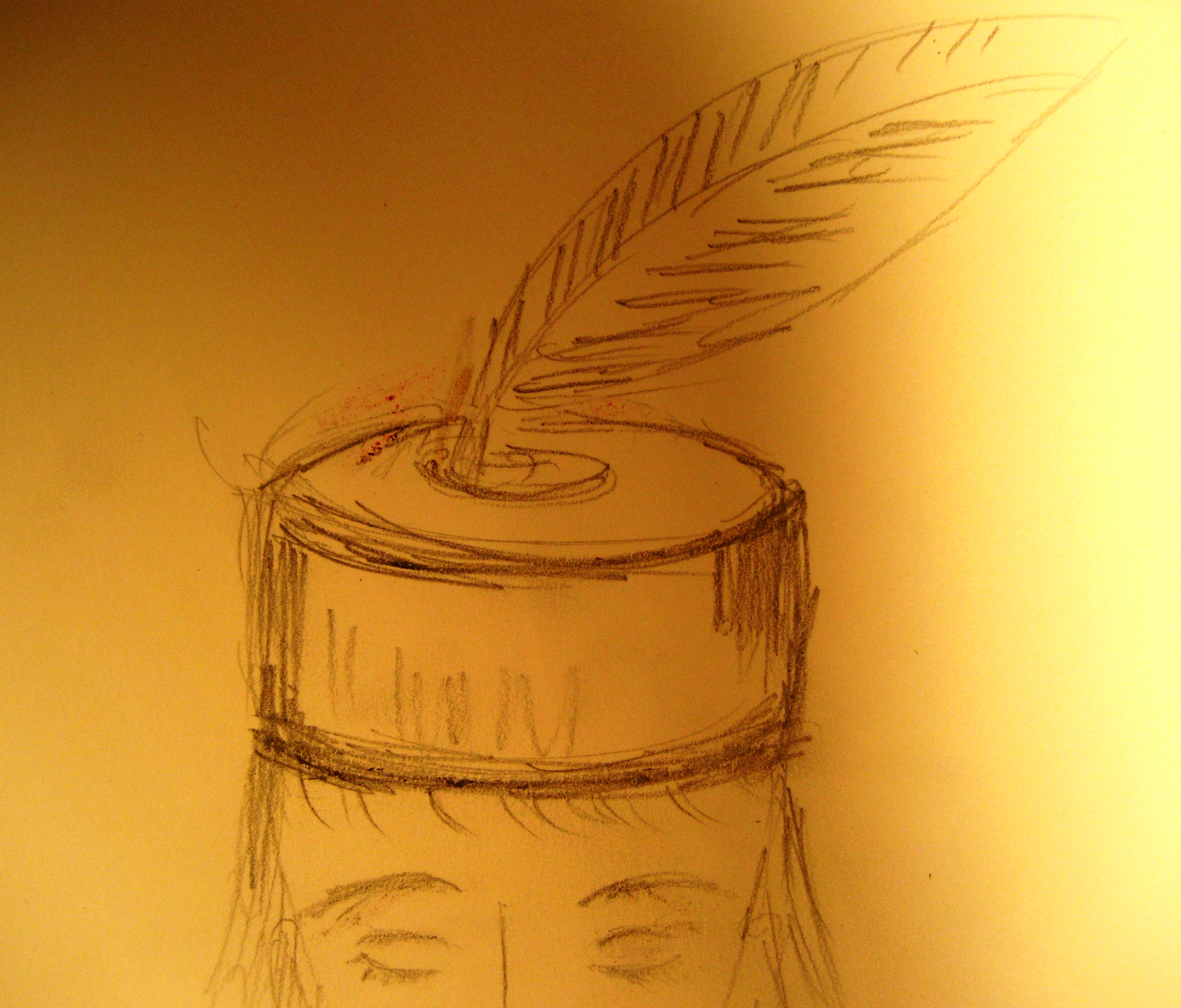
Ink Pot Pill Box Hat – Beginning of Decade/End of Era

December 28, 2009

Ink Pot Pillbox Hat (after Rene-Jean Teillard)

With all the newspaper articles, I’m taken back to the beginning of the decade/century/millenium, or maybe just before, when everyone worried that Y2K would wreck havoc with all known security and operational systems, even perhaps bringing the end of the world as we knew it.  Flights scheduled for December 31 sold at heady discounts, and one guy I knew, who had a record of moving violations while drunk, was happily confident that the imminent self-destruction of the DMV’s computer system would finally give him a chance to get another driver’s license.

(Lesson:  the “end of the world as we know it” does not generally happen according to calendared anticipation but with utter unexpectedness of  box cutters taken onto a plane.)

Putting all that aside, the beginning of the decade/century/millennium brought a range of unexpected developments not only in the world, but in  my personal life. The first big event was the bursting of pipes in a snowy country house.  (This led, years later, to a second marriage.)  In the midst of those burst pipes, we also lost electricity for a few days (not because of Y2K, but an ice storm); for a day or two, we had to ship a dear old French friend, then houseguest,  to some one else’s house since our friend, then in his 90’s, suffered in a house lit by candles and heated by firewood.

Thinking back, I can’t help but focus on that same French friend, who died at the beginning of the following year, in early January 2001.  Rene-Jean Teillard, he was born to an aristocratic family in the Pyrenees in 1906 or 7, and there schooled by Jesuits, which instilled  in him a lifelong hatred of Catholicism.  He was a resistance fighter in World War II, who escaped capture by the Nazis by pretending to be mad, and later rescued several U.S. paratroopers in the French countryside.  This rescue (the paratroopers were from the South) led to Rene’s being awarded the “key to the city” of Tupelo, Mississippi, a town which welcomed him on visits throughout his life.

After the war, Rene emigrated to New York City.  I say, New York City, because although Rene later became a U.S. citizen, his move was definitely to New York.  He simply adored New York, believing it to be a place where one could do, see, be, anything; where freedom and possibility were literally made concrete.  He had a talent for design and friendship, was gifted with creativity and charm.  He opened a hat shop, where he made beautiful, stylish and above all, playful hats, whose sales and rentals sent him around the world four times.   (I’ve drawn one of the simpler ones; the more elaborate featured small pianos, flower pots, balloons….)

He was an old-fashioned New Yorker, both generous and parsimonious in the extreme–you probably know the type, a person who will give you absolutely anything while also spending as little as possible on himself.   His rent-controlled apartment, a fourth floor walk-up on Madison Avenue, looked like the inside of a Faberge egg, with hand-marbelized woodwork, a deep purple canopied ceiling (in the bedroom),  and a combination of true Louis XIV antiques and furniture scavenged and re-made from the City streets.

In the hot New York summers, he stayed with friends outside of the City.  He was the ideal long-term guest in that, with his broad life experience (he was probably the only person ever to have had therapy sessions with Carl Jung and to also go to the circus with Elvis Presley), he was both (i) a great talker, and (ii) a great listener.  Above all, he was purposeful, capable of silently, independently,  and beautifully, repairing almost anything broken, torn, fraying.

He was not perfect.  French, he could be snide, classist, gossipy (although not with confidences), and he drank a fair amount of wine.  But he was above all interested.  A taxi ride with him was an education; by the end of it, one had learned, through him, where the driver was from, whom he had left behind, and what he hoped to do when he did or didn’t return.  The driver, magically, did not feel drained by this, but unique, valued.

His favorite word was “marvelous.”

I think of him at the beginning of this century because he was such a creature of the last one.    Who wore hats after Jackie Kennedy?  Who uses ink in the age of computers?  Does Tupelo, Mississippi still have a key?  Does France still have nuns?   Is New York still a place where one can do, see, be, anything?

He missed 9/11, for which I was grateful.  It would have grieved him beyond measure.
Disturbance on the Central Florida Coast – Views of Obama

December 27, 2009

Arrived in Florida (Central Atlantic Coast) in the middle of the night.

Arriving in Florida is always a bit of a shock;  usually, it’s the humidity, the immediate and improbable moistness of the air.  But this time we left an onslaught of driving rain in New York City and arrived to a dry cool night.

We were met by a car service driver I’ve used for years whom I view as something of a friend.  I think the friendship is reciprocated (as evidenced by the fact that he was willing to wait for us till 1 a.m.)

Although my daughter asked me, before we met our driver’s car, to please not get in an argument about Obama, one started almost immediately.  The driver began it, actually, bringing up a story about how some other passenger, a military guy, had told him Obama was a terrorist against the U.S.  (This seemed to be a view for which the driver had some sympathy.)

I protested, despite my daughter’s stiffening in the backseat.

Our discussion heated up from there.  Eventually, even the daughter who had asked me not to argue broke in on the pro-Obama side.

I really like this driver.  He is extremely good-natured and sweet.  Even after I resorted to the F-word— our discussion had moved on through a variety of topics to 9/11–as a New Yorker who lives in downtown Manhattan, I feel like I have a closeness to 9/11 that simply cannot be approximated by people living on the Florida coast—he chuckled,  surprised both by my vehemence and my views, but not offended.

It all goes to show how different the country is outside of New York City, a difference that is almost unimaginable to me from downtown Manhattan.

The difference was reinforced later in the day, as we walked (which is unusual in itself here–but hey I’m a New Yorker, I walk) to a fast food franchise to pick up a favorite dish of my dad.  These places exist in New York City, but they are not on my immediate family’s radar.  Yes, this is probably due to a kind of elitism–though it’s really more of a nutritional and culinary elitism than economic.  New York has a plethora of amazing, unfranchised, food.   If my kids are hungry, they’ll go for a slice, a bagel,  spring rolls,  salt and pepper squid.

All the young and middle-aged people both serving and being served  were big, almost overflowing.   It’s a cliché, but, in this case at least, the truth.    We felt puny in comparison, ordered baked potatoes to share.

In the evening, the difference I went jogging on the only  nearby bit of sidewalk.  I tripped twice—the sidewalk turned out to be rutted—then was chased by a free-roaming Pomeranian that actually ran all the way across the street.

Okay, I’ll admit it;  I’m emphasizing the negative.   Frankly, there are lovely things about Florida and almost all the people  I deal with here are kind, polite, patient, personally generous; many  are not in the least bit overweight; the State, in fact, went for Obama in the 2008 election.

But when I hear this knee-jerk dislike/distrust of Obama, a distrust that not only questions the legitimacy of his presidency but also of his citizenship, it’s hard to feel like we are from the same planet, much less the same country.

The good news, I guess,  is that I called the driver to apologize;  he laughed again, said he really enjoyed our discussion, seemed to mean it.

Boxing Day – Checking Up On Robert Pattinson

December 26, 2009

December 26th, Boxing Day, which is not, as one might expect, a day for finally hashing out all of the tension that has been building over Christmas (but which one felt compelled by the very fact of Christmas not to hash out.)  (Oh, wait, maybe that compulsion was not quite strong enough.)

Whatever.  The “boxing” in Boxing Day actually refers to boxes.  In England and Commonwealth countries, December 26th was traditionally the day in which presents were exchanged particularly with the “worthy but less worthy” people in one’s life, servants, trades people, slightly more distant friends, rather than on Christmas itself which was reserved for family, religion, and eating.

In the U.S., many devote Boxing Days to frantic sales shopping, to acquiring boxes, I guess.

But since I’m not much of a shopper, I’ve always viewed the day as a time of ultimate, luxurious, relaxation, a day which is far less regimental than Christimas, but still has a lot of festive food hanging about—panetone, figs, gingerbread, slightly wilted champagne.

Nowadays, presents from friends, rather than family, are typically given before rather than on Boxing Day.  The very best one I got this year, from a follower of this blog, was a Robert Pattinson calendar.    The calendar cover shows Rob pushing back his trademark hair so that a slightly enlarged vein shows on one-side of his forehead.  (The vein is somehow vampiric, although I’m not sure if it’s the type of thing that would be typical of vampires, or attractive to them.)

Rob has been conspicuously absent from the public scene of late, and even from this blog.   First, Rob seems to be trying hard to lay low.  (He must be exhausted.)   Secondly, his appearance in New Moon was enough to dose many people for a long long while.  (No offense, Rob.  The lines, the stiltedness, all those animatronic wolves, aren’t really your fault.)

There have been stories, of course; a whole industry has been built on Rob Pattinson stories, and it can’t wind down on a dime.  The biggest was how Rob “freaked out” when one fan jumped out of a car to kiss him, and then confessed that her mom had tried to stop her because she had Swine Flu.   (Frankly, I don’t think it’s fair to call Rob getting irritated over this “freaking out.”)

Also, Rob went to a birthday party and was photographed getting a ride afterword with Katy Perry (and others), and was immediately declared to be Perry’s lover.  (The next day he was disowned by Perry who tweeted that she doesn’t “do vampires.”)

He was also reported to be wooing Emilie de Ravin (costar in “Remember Me”) with high culture because they had a photo session in an LA museum.

Despite his reduced appearance on the tabloids, Rob was voted the man girls would most like to find under the mistletoe.  Ever the gentleman (and I actually mean this), he responded to an interviewer’s question as to whom he would most like to find under the mistletoe with a giggle, and  “Ricky Gervais.”  This was reported under the blockbuster headline, “Robert Pattinson Reveals His Fantasy ‘Under The Mistletoe’ Kiss.”

Boxing Day, the kind of day that gives you the leisure to look into such important matters.

Ah.

Dog/Elephant Christmas Activity! On Ice!

December 25, 2009

Skating At Sunset!

Thanks so much for all your support (and views)!

All rights reserved.  Karin Gustafson.

Christmas Eve Traditions- No More Oyster Stew

December 25, 2009

Christmas Eve.  My mother’s tradition (which was her own family’s tradition and so just had to be followed year after year) was Oyster Stew, a milky soup which was topped with blots of butter, bottomed with weird heavy blobs of whole oysters.  We all, except for my Dad, hated it.  The only part my brother and I found edible were the oyster crackers, those little round pale ones, which floated about like puffly, hole-less, life preservers, and,  if eaten fairly quickly, soaked up a little, but not too much, of the soup.   (It was important to use up the soup so that we were not seen to be wasting food.)   My cousin, who was not as well-trained and, in general, was a more dive-in kind of guy, crumbled whole handfuls of crackers into his soup; a little mound of crumbs rose like a pale volcano above the milky sea.

In my own family, that is, the family of my own children, I did not feel compelled to follow the Oyster Stew tradition.  (Parents of my generation probably made a bigger point of reaching a food consensus with children.)  Instead , we have Latkes, our homage to New York City and to my kids’ elementary school which (almost comically) trained them in a gamut of Winter traditions, from Christmas to Hanukkah to Kwanza to Solstace.

I make the Latkes after we go to a Christmas Eve church service, which sports a Christmas pageant, in which small children wear burlap if they are shepherds, velvet hats if they are kings, sheep ears if they are sheep, flower crowns if they are angels, and sing sibilant carols in a beautiful federalist church of white walls, dark wood, and deeply gilded angel statues.

We always go to this service, because we have always gone to this service.  It is beautiful, and early enough to fit in before the Latkes.  But, most importantly, this is the service we have always gone to.  It started when my children were children, a time when they especially liked seeing other children perform.  (Even infants have an eye for the pint-sized.)

Though we don’t go to that church so regularly, we have gone long enough to recognize others there; the woman with the frizzy hair who seems to arrange things,  the guy with the muscles in drag and sleeveless sequins, the woman minister with the divine voice, who, singing all the liturgy, embues it with a beautiful minor-keyed profundity, the devoted-looking gay couple who used to hold an infant and now carry a small girl in a red hat and coat, the very nice looking family with the pretty mother with hennaed hair, glasses,  and bangs, who has a little dark-eyed boy who sometimes studies “Where’s Waldo?”, a little girl with wispier bangs who has at least once fallen completely off the pew, and a little dark-eyed baby, now toddler, who really doesn’t seem to care for church, and who is passed from the mother to the dark-eyed father, and finally carried from the service when he begins to fuss too much.

Latkes are much much better than oyster stew.  Although there are no crackers to chase, there are no grey blobby bits to avoid.  Besides, it’s what we always have; it’s what we eat Christmas Eve.


(I am linking this post to Victoria C. Slotto’s liv2write2day blog about Christmas experiences and imperfect prose.in the hush of the moon

Getting Ready….

December 24, 2009

Sshhh!

Have a lovely Christmas Eve!

(All rights reserved.  Karin Gustafson)

Christmas Eve’s Eve

December 23, 2009

When I was a child growing up in suburban Maryland, it was somewhat unusual to have a working mother, or, as she might be called today, a mother who “worked outside the home.”

Just about all the mothers I knew stayed at home, though they also worked pretty hard—this was partly because the ones I knew best had more than six children a piece.  Still, there was something different about a mother who actually had a job.

On the good side, we seemed to have slightly more disposable income than many families on my block.  We took trips; we shopped at real department stores (and rarely at the “five and ten”); my brother and I had an assortment of private lessons (from tap dancing to piano).

On the less good side, our lives, without the attention of what was basically a full-time servant, were sometimes a bit chaotic; let’s say, rushed.

This chaos was most pronounced at holidays, because my mom usually did not get off from work until almost the last minute.   Christmas Eve Day was intense, the modern world’s post-Thanksgiving frenzy squeezed into about sixteen hours.  On Christmas Eve Day, a tree was bought (among those few remaining available), put up, decorated.  Traditional foods were purchased and prepared; presents were acquired.

The day was a bit like one long Iron Chef competition, except it involved stores rather than a kitchen.  Wrapping took place well after darkness fell.

Christmas morning was a joy to my mom partly because it meant the end of Christmas Eve.

I’m a working mother too.  And whether women become more like their mothers when they age, or the aging of children makes the planning for Christmas somewhat less of a priority than the payment of second semester college tuition, I find myself in a mom-like situation this Christmas Eve’s eve.

I have tried to stave off the panic and guilt by warning my family repeatedly that I’m really not doing a lot for Christmas this year, that I am just too busy, too pressured  (not mentioning the weird assortment of vampire novels I’ve managed to read.)   I’ve told myself too that my kids are old enough I should just take it a bit easy, let myself off the hook.

But I expect that by tomorrow, all those warnings, and even resolutions,  will go by the wayside.   Like a Christmas Eve’s Eve, burdened with the knowledge of good and evil–that is, of what good mothers are supposed to do for Christmas as opposed to bad mothers who don’t do all those wonderful things–I will frantically shop, buy, prepare.   I will get us to church, cook, wrap;  and when Christmas morning dawns, I will be very happy.

Another Unhealthy Emission From Palin

December 23, 2009

In the midst of reading Palin’s Facebook posts about climate change I ran into her newest post/poison about Government death panels:  “Midnight Votes, Backroom Deals, and a Death Panel”.  Her images conjure up Harry Reid, dressed the dusty black of a Christmas-hating Ebenezer Scrooge, in a back alley doctor’s office advocating death for all except patients seeking late-term abortions.

Part of what’s disturbing is how manipulative Palin is;  it’s sometimes does not seem possible that she believes her own rants –how does she miss the self-contradiction?   She argues, for example,  that the government health care bill reduces access to health care and promotes  rationing (hence the jump to the idea of the “death panel”) while at the same time she declares that the bill (because it offers so much, unfettered, access to health care) will be ruinously expensive.    (In Palin’s world, private insurers never deny access to health care, and those who can’t pay for health care seem somehow to magically not need it.)

Palin admits in this post that her use of the term “death panel” was “a metaphor”.  This, to me at least, implies an understanding that such decision-making bodies are not a true facet of the proposals.  And yet, she continues to bandy the word about, knowing how it has been, and will be, parroted by followers eager to find totalitarianism in anything connected to Obama.

“This is about politics, not health care,” she says, and then, so nobly apolitical, ends her post with the promise/threat that “2010 is coming.”