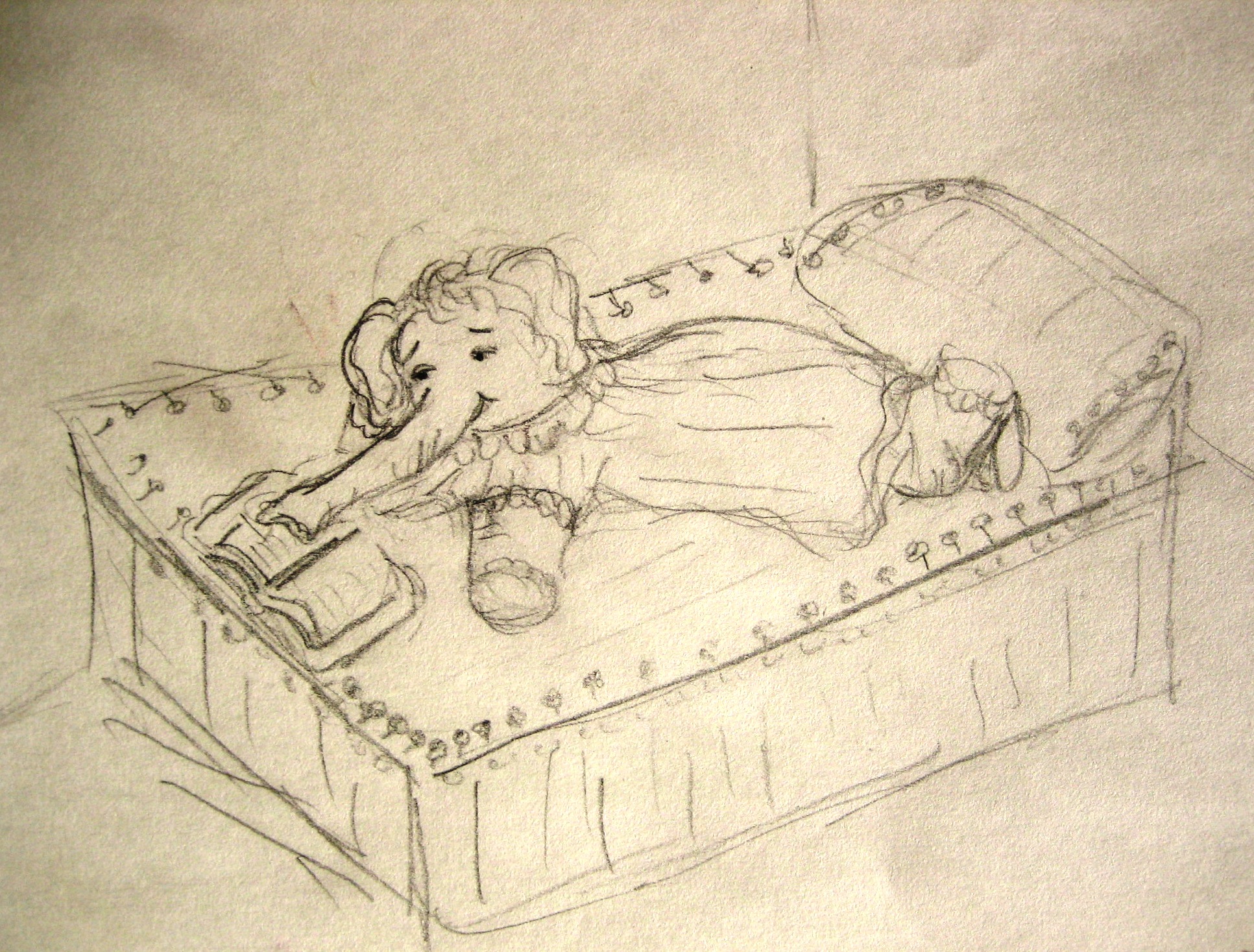
Will It Be As Good As This?
Hmmm…..
(Disclosure: the illustrator is a fan of Apple and owns the stock.)
Will It Be As Good As This?
Hmmm…..
(Disclosure: the illustrator is a fan of Apple and owns the stock.)

Opening of "Somewhere", Music by Leonard Bernstein, Lyrics by Stephen Sondheim
A certain damp dullness hangs over the subway car this morning, the Number 5, Lexington Avenue express. We diversified New Yorkers are unified here, in our experience of rain-moistened Monday fatigue. The hems of our pants are limp. More than half of our eyes are closed. (By this, I mean, both of the eyes on more than one half of the passengers.) The guy next to me has a uniquely beady intensity; he definitely stares at something. But when I follow his gaze, I find the blank window on the other side of the car. I notice then too that the corner of his baseball cap also actual drips whole gobs of unheeded moisture, so I’d just as soon not vouch for his alertness.
The girl opposite also has both eyes open, but her mouth is open too. The movement of her tongue can be seen under her lips, the skin of chin and cheeks; she appears to search the insides of her mouth, though she is not eating, nor is she noticeably carrying food. These factors tend to put into question her “on-top-of-things-ness.”
The only person who can truly qualify as “engaged” is a tall young African-American man who reads the Daily News analysis of the collapse of the Jets. So, engaged, yes, but not exactly cheerful.
Seriously. What shines here is not a single “morning face”, but only the wet spots on the train’s dark linoleum floor shine, and an occasional crumple of cellophane.
All this makes me think that it’s really too bad I wasn’t on the local; the No. 6 specifically, leaving from Spring Street. I used to take that train frequently and noticed that a curious configuration of curve and track caused it to sound out a specific musical interval each time it left the platform. Although it’s an East Side train, the interval corresponds to one of the song openings from West Side Story. (Which brings up a completely different kind of Jets.)
So, in honor of those three notes, I set forth below a kind of silly, kind of “Shakespearean” sonnet:
Subway Song
The subway sings its broken refrain,
the opening bars of “There’s a Place
For Us” from West Side Story. The train
croons the first three notes leaving the dais
of the platform, the tune subsiding
to squeak and wind and roar as train races
to a-harmonic levels, providing
speed without Bernsteinian traces,
those tragic lovers defiant of fate
and enmity. Yet, at every station,
they sing again. Who of those who wait
hear the song of that yearned-for destination,
that lyrical place, beyond how, beyond where,
amazed that the Six Train nearly takes them there?
I am linking this post to Victoria C. Slotto’s Liv2write2day blog, for her prompt on Sacred Music. The sounds of the Number 6 are not exactly sacred, but they are pretty lovely when you are standing in a grey tunnel.
All rights reserved. Karin Gustafson
For a more serious subway sonnet, click here.
P.S. No copyright infringement of “Somewhere” intended, beautiful song. (Btw, I haven’t noticed that any credit is given to Bernstein by the IRT.)

Cool!
I am currently lying under a fleece blanket and two down comforters. The heating unit at my side is turned off. I could jump quickly into the cold, twist it on, then slip back into my lair, but, for some reason, I just don’t.
I’m not quite sure what this reason is. I pay for heat in my apartment, so there’s an element of miserliness. It’s blown hot air (dry and noisy), so there’s simple distaste. There’s also, of course, my heightened, if terribly inconsistent, environmental consciousness. Then too, there’s the memory of my last apartment where Super-controlled heat blasts made for January sweats.
All of these combine into a perverse, hardier-than-thou, pride that keeps the heating units switched off.
I have recently found that this pride makes me part of “Cool Crowd,” a class of people depicted in the New York Times the other day who eschew indoor heat in cold climates.
Being part of this cool crowd feels really great (despite the weight of the blankets). I always was embarrassingly unhip as a child. Actually, I’ve felt unhip my entire life. I’ve rarely known the names or music of hot bands, TV shoes, movies, films. My slang, like Alec Guiness’s “Mahtabili” in the film classic Kind Hearts and Coronets, has always been “a little bit rusty.”
Given the fact that the temperature in my apartment probably rarely dips below 50/45 (I don’t have a thermostat), I’m guessing that I’m only on the “luke” edge of the “cool crowd”. Even so, no less than three members of my family separately asked me if I had seen the NY Times article.
These family members are extremely patient. They don’t openly groan during my monologues about the merits of long silk underwear, the importance of wool, the risks of sock-removal. They joke about the fact that I constantly tell them that they can turn on the heat, if they want, then proceed to turn it off again (if they’ve dared) after only a few minutes.
I warn them against wimpiness. I regale them with tales about the time the water in my toilet bowl froze. I protest that this is not about me disliking warmth, reminding them that I don’t turn on the AC in summer either. They don’t actually need reminders of that.
Ah, Summer. That’s when we get to be part of “who’s hot.”
P.S. – sorry for any misspelling of Mahtabili. Please feel free to correct.

Breaking News: Rob Pattinson joins the wolf pack (in animatronic form) in Hope for Haiti telethon. Apparently (finally) broken by the constant onslaught of paparazzi and palpitating Twilighters, Rob seems to have traded fangs for fur, smolder for shell shock. Although Rob’s message, delivered with the lightness (and facial hair) of Alexander Soltzenitsyn, was taped from London, he looked dazed, as if he’d seen, first hand, the horrors of Port-au-Prince. I like Rob, and despite my sympathy for charity, I hate celebrities simpering about disasters, so I’m going to assume that he wasn’t simply stoned or disinterested, but young, embarrassed, and not great at reading from a teleprompter.

Thermos
I’m going back today to the endless snack/media culture: children hooked in and chomping little individually wrapped servings all day long. (See prior post ‘The Matrix of Cheetos”.) This worry has been compounded by a new Australian study describing the increased mortality (for adults) associated with increased hours of TV viewing. (Although the report of the study seems to blame sitting for the increased mortality, the actual activity that seemed to lead to the deaths was sitting in front of the TV.)
This Australian study makes it clear that parents should consider limiting their own media time. But we all know the problems with that.
So going back to trying to limit kids: “just say no,” is easy to say; “no” is a lot harder.
With young children (under ten or twelve), reading aloud may be a useful substitute; by this, I mean adults reading aloud to children, not children, especially children with difficulties, practicing reading. (I’m certainly not against children working on their reading with their parents, but I’m talking about fun activities here, not torturous ones.)
If parents are not great read-alouders, even listening to books on tape together seems preferable to the nonstop perusal of little teeny (or oversized) screens.
Snacks: I’m an inveterate snacker, meal skipper, meal avoider. But, like many, I am very happy to tell people to do as I say and not as I do.
The obvious advice—make meals. Even if snacks are going to be snuck in throughout the day, try to provide your kids with a real, if ceremonial, breakfast, dinner. Sit down together while dinner is eaten. (Even if the TV is also a companion, at least sit in front of it together.)
To the extent possible, eat these meals on plates and not from packaging. Try not to allow eating, directly from boxes, cartons, bags! (Okay, okay, I do it too, but it definitely undercuts the understanding that food has been in fact consumed, and how much.)
Last tip: when taking snacks into the world, add in a thermos. There is nothing like a hot drink, shared with child (or adult) that gives a sense of quiet community. Granted, some hot drinks from thermoses; i.e. milky tea, can have a bit of a tinned flavor. Even so, warm feelings arise from the fact that you and your child have carried along your own little liquid home-made hearth; that you have prepared your own little portable tea party. The steam tinges the moment with the specialness of a memory-to-be. (For me, who really does love hot tea, it feels like having my own little traveling Delphi, though I’m not sure it helps much with the oracular.)

Delphi On A Checked Cloth

The Matrix On Cheetos
Two tremendously scary articles in today’s New York Times.
No, I don’t mean the one about Robert Gates in India warning of interlocking Asian terror networks. Or the one about ex-convicts from the U.S. joining with Yemen radicals. Or even the ones about the defeat of Martha Coakly in Massachusetts.
I’m talking about the article by Jennifer Steinhauer reporting that “Snack Time Never Ends” for U.S. children, and the one by Tamar Lewin, “If Your Kids Are Awake, They Are Probably Online.” (This one reports that, with the advent of smart phones, personal computers, and other digital devices, internet time never ends for U.S. children.)
Reading these articles, one gets a picture of a U.S. child blindfolded by a miniature screen, which he manipulates with one hand, while using the other to repeatedly lift crinkly snacks to his lips. (It’s kind of like the Matrix on Cheetos.)
I don’t mean to sound critical. I myself spend much of the day on the computer. I am also an inveterate “grazer.”
The difference between me and most U.S. children, however, is that I’m old enough to know better. I have had enough experience of the benefits of (a) uninterrupted concentration, (b) delayed gratification, and (c) discipline, to understand that there is something to be gained from thinking deeply and quietly while repressing the urge for non-stop stomach and mind candy. Even my body (especially the toothy bits) has a deep (if sometimes neglected) understanding of the benefits of not constantly chewing.
In other words, I feel guilty.
My personal difficulties bring up the fact that adult society has, to a large degree, fomented this conduct among children. In the case of adults, however, ADD (attention deficit disorder) is generally called “multi-tasking.”
It’s bad for us too. There has been study upon study about the dangers of texting while driving, texting while walking, texting while taking care of young children. Then, of course, there are the soaring obestity rates.
But it all seems worse when children are involved.
Though I don’t mean to criticize parents, part of the problem is simply their busy-ness. Working hard, their lives, and the lives of their children, are highly scheduled. Snacks and media are used to silence childish impatience; both allow parents to participate in their children’s lives in a way that makes them feel (and is) caring, as cook, food-buyer, internet-regulator, but is also somehow less personal and confrontational, than acting as direct companion and/or adversary.
Older generations focused on the behavior of children (and both parents and children had the relief of unsupervised play–time that was free and apart from each other); but in our world, it’s not enough for children behave the way that we want them to; we also want them to be happy while behaving this way (while remaining in a fairly confined location). Some parents trot out long explanations to children, trying to secure agreement to restrictions; others (or maybe the same parents) trot out snacks, gameboys, smart phones, trying to pre-empt disagreement, discomfort, wear and tear.
It doesn’t really work. But the parent is busy, stressed; besides, he or she has some browsing to do.

Tuesday Morning
That it’s not four days.
(Check out 1 Mississippi, also by Karin Gustafson, if you like elephants, and sleep.)


Recent Comments