Posted tagged ‘Manicddaily pencil drawing’

“Know-Nothings”, “Know-Not-Enoughs”, Breastfeeding, Obesity, Food

August 4, 2010

The “Know-Nothings” has always been my favorite name for an American political movement.  It just seems so forthright. (In fact, the 1850s movement got its name not because of the self-awareness of its members but because, if questioned about their affiliation, they were supposed to answer, “I know nothing.”)

Realistically, no one today is likely to adopt a name as truthful as that, even sarcastically.    I’d settle for a movement called the “Know-Not-Enoughs.”

This comes up for me today not in the context of politics, but health.   It’s raised by two unrelated articles in the Times – one about new discoveries of further merits of breastfeeding (“Breast Milk Sugars Give Infants A Protective Coat” by Nicholas Wade); and one about the unsolved problem of the rising rates of obesity in the U.S. (“Obesity Rates Keep Rising, Troubling Health Officials” by Denise Grady.)

The breastfeeding article talks about how undigested complex sugars in breastmilk have now been found to play an important role in providing beneficial intestinal bacteria for infants.  The findings have made the researchers more sharply aware of the evolutionary miracle that is breastmilk:  “It’s all there for a purpose, though we’re still figuring out what that purpose is,” Dr. [David] Mills said. “So for God’s sake, please breast-feed.”

I have always been a major proponent of breastfeeding but the doctor’s strong urging still surprised me.  For many years, health professionals seem to have routinely mentioned the benefits of breastfeeding, but then everyone seemed to quickly change the subject to personal preferences.  No one wanted to make a new mother feel guilty or pressured; no one wanted to step on cultural toes, even if they were not traditional cultural toes. especially if the preferences seemed to correlate to any ethnic group or educational level.  There has been a feeling, as in much of dialogue about just about everything, that everyone was entitled to their opinion or preference, and that all of these opinions and preferences were wonderfully equal on some vast universal scale.

I don’t let scientists off the hook.  When I grew up, scientists creating and even pushing infant formulas  were the opposite of “Know-Not-Enoughs.”

Now, among other things, we have a society that’s obese.   Putting aside any specific causal connection between the reduction in breastfeeding and obesity, there are certainly parallels between the substitution of formula for breastmilk, and the replacement of fresh, traditional foods, with fake “know-everything” food.  For the last few decades, people have eaten as if food could be manufactured, and as if such manufactured foods could satisfy all nutritional needs (which were also considered to be more or less known.)

No wonder people eat and eat;  no wonder flesh clings to what it ingests.  Bodies seem to know something is missing, but not where or how to get it.

The BBC, Mitch Miller, Insularity of U.S. News (Mommy Kissing Santa Claus)

August 3, 2010

Mitch Miller? (Looking for Mommy)

I’m a New Yorker.  I tend to read the New York Times and feel proud that it’s not the Post. But every once in a while, I feel a need to go further afield, usually to the BBC, partly so I can just listen to news rather than read it.  (If you don’t already know, the BBC has a wonderful site, in multiple languages with non-stop online “radio” choices.)

An hour of listening quickly changes one’s world view.  For one thing, it converts it into a world view.

This morning, for example, the BBC news stream gave time to the Papauan dissident with whom it had snagged an exclusive interview.  It reported the flooding in Pakistan; it quoted the South African judge sentencing a mendacious police chief; it interviewed the little Yemeni girls whose family took them from school when WHO stopped trading wheat for attendance and the girls’ mother who had to give them blood a couple of times against malnutrition.  It discussed a new novel about Afghanistan, some controversy involving Mossad, the current violence in Karachi.

Some of these stories were also reported in the New York Times, but when I looked at the online Times this morning, my eye kept hooking onto Mitch Miller’s goatee.  (Today’s article on Mitch was actually about an unsuccessful attempt to interview him.  Hmm….)

Sorry.  I actually love human interest stories;  I also loved Mitch Miller.  (Not just the Christmas hits; not only the happy accordian rifs–I will remember how my six-year-old heart twanged to The Prisoner’s Song till my final rest in the arms of my poor darling.)

What strikes one in listening to the BBC is how big the world is, how busy.  What is striking too is how local the many conflicts are–even as they are related to more universal issues of economics, religion, race == how they are played out in so many very local, very complicated ways.  In discussing the killings in Karachi, for example, the BBC talked of the number of Pashtuns in the city.  (To be fair, the Times mentioned Pastuns in their Karachi article too, but in a somehow more muted way.)    And me, I think “Pashtun”, that they are in Central Asia, Afghanistan.  Green eyes come vaguely to mind.

But what I am mainly impressed by is how little I know.  Like, sadly, most Americans.

What also impresses me is how much our regular news  (and I really don’t mean the Times here) often seems to reinforce our insularity and our ignorance of the world rather than dispelling them.   So that we can convince ourselves that we are well-informed simply because our homes have some kind of news feed 24/7–when often all that feed is telling us is about the time Mommy was seen kissing Santa Claus, or worse, suspected of kissing Santa Claus.

The Unkind Cut (Loss of a Friend in Western Culture)

August 1, 2010

Opening Up To Pain

Still coping (expect to be coping for some time) with the death of a friend.

Sometimes when we experience loss, we get mad at the culture.  It didn’t prepare us for this.  It pushes death so far to the sidelines that it somehow masks its inevitability.

If you are like me, you may even feel that the culture’s dissonance with death has an economic underpinning–that it (the culture) wants to catch people up in the samsara of production and consumption with the implied promise that they will have some period of retirement, some deferred time, in which they can give importance to the less-material aspects of life.

If you are like me and already have a propensity to Eastern religions, you may think about the Buddhist practice of cultivating an awareness of death.  Traditionally, Buddhist monks would visit cremation grounds, expressly inhaling death and decay as part of their training.

If you are like me, you might compare that awareness with Western culture’s focus on youth and unbridled exuberance.   You may feel especially misled by the Western “can do” philosophy, the incipient moral of so many stories, fables, movies, news stories, that if one simply tries hard enough, the attainment of all goals, the extension of life itself, is possible.

If you are like me, you may blame this mythology for causing you pain, as if a big part of what you are feeling is the inability to make things right (especially difficult to accept when you have been conditioned to give tasks your all, and then to receive some positive result).

In some ways, this anger is comforting.  It shields you, at least for a while, from focusing on how painful the loss itself is; from understanding that the ongoing pain really doesn’t have all that much to do with the culture (however, misleading the culture might be).

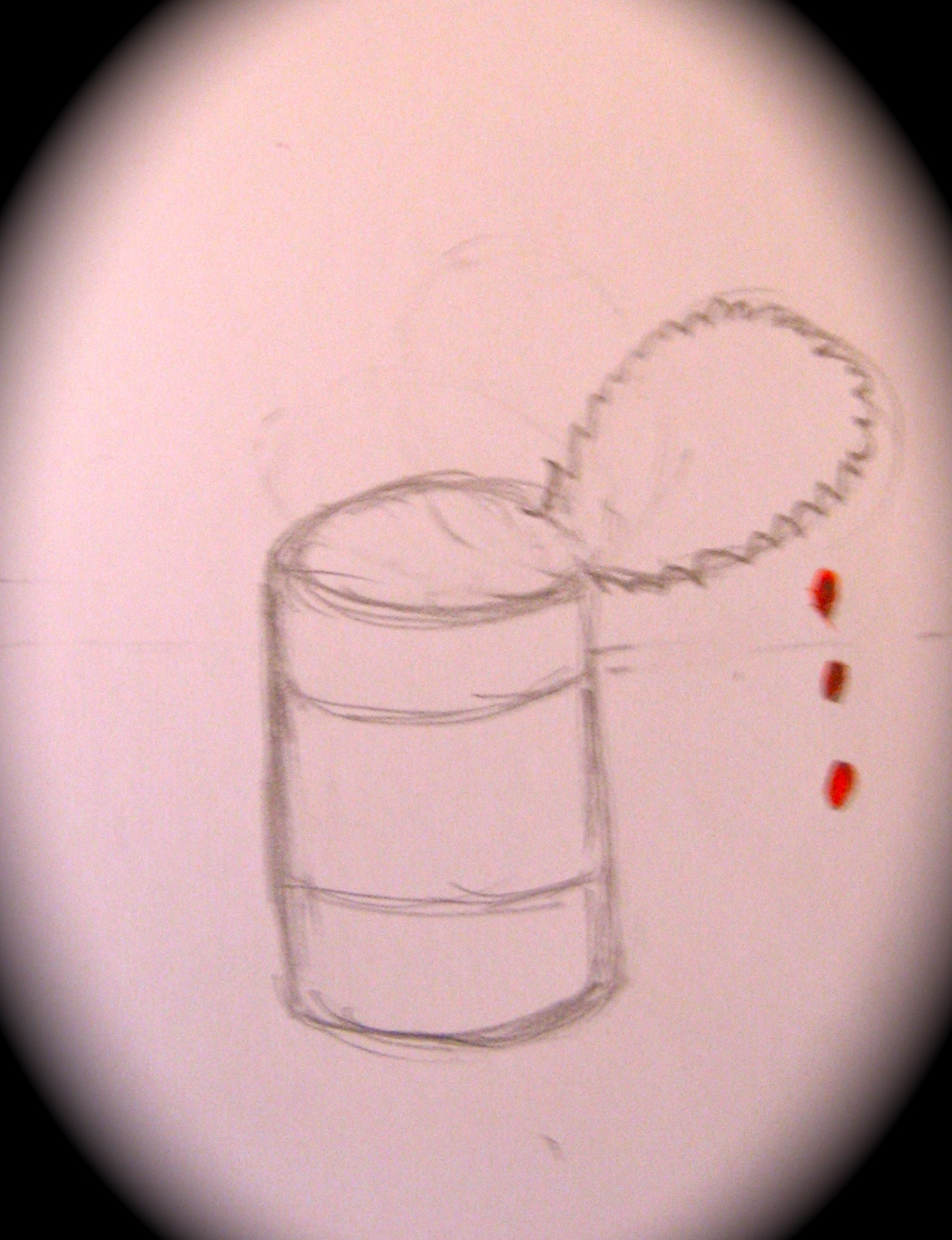
All I can come up with as an analogy is cutting yourself while opening a can.  Yes, you can blame the can opener, the can manufacturer, yourself too;  you can be mad about how badly the whole thing is made, about how clumsy or ignorant you are; about how poorly schooled you’ve been in can-opening.  But putting aside all that, the cut just hurts.

My Afghani (in Goa)

July 31, 2010

My Afghani's Nose

Last week I wrote variously about warmth, watermelon, Proust, Afghanistan.  With all that floating about, I thought today about my own experiences of Afghanistan.

They are extremely limited.  Haven’t even been there.  I only came close once, in the early 80s, on a bus that had an overland route from Delhi to London (the “Magic Bus”).  I got on in Istanbul, and was seriously tempted to head East.  But, aside from the fact that I had already overstayed my trip, there was a Brit continuing on from the Delhi/Pakistan/Afghan side who warned strenuously against it.  He was a tousled (and tired) young lad who, after getting very drunk in London after breaking up with his girlfriend, woke on a plane to Bombay.   With no return plane ticket, he’d ended up on the bus home, which, he shuddered, had gotten through Afghanistan only by chance.  Theyhad been pulled over—by Freedom Fighters?  The Taliban?–somehow he’d managed to hide the fact that he was British and get through.

I got on the bus for London, but my interest/passion for Asia was further inflamed.  Turkey had ignited it.   Some people just love the exotic, I suppose, and patterns –that wonderful conglomeration of patterns that I always associate with Central Asia had already captivated me – the layers of geometry – rugs, mosaics, scarfs, tunics, pants, arches.

Soon after, I was able to go to India myself.  And all those things I’d thought to find fascinating were, in fact, fascinating.  Also overwhelming.  A few months into my stay, I took a break in Goa.

Goa, back then, was not India.  Yes, it was legally part of the country, but well–women greeted my boat at dawn with gathered skirts and baskets of freshly-baked yeasted bread.   They even had sausages!  Sausages!  It was mindblowing (and I don’t even eat meat!)

The beachtowns were largely taken over by Westerners, if I can include Australians and Israelis in that category.  Sun-beached, sun-tanned people that seemed like stragglers from Haight-Ashbury, refugees from the 60s. Everybody was beautiful, welcoming, (at the beach) nude.

I soon discovered one important difference from Goa of the 80s and my sense of the hippified 60’s.  There was lots and lots of of heroin.  People, stupid people, had the idea that it would not be addictive if smoked, so they were constantly rolling it up into tobacco.

I’ve never been very interested in drugs, any drugs.   I suppose I was just too (a) unconsciously maternal (had to preserve the good old bod); and (b) concerned about my own inherent manic-d-daily tendencies, to want to take anything that could hurt me, or induce feelings I couldn’t just stop.   So trying to  steer clear of the drug scene, I quickly took a room outside of town, and focused on yoga.

Easier said than done.  My room turned out to be in a house, that yes, had a very nice Goan family in one half, but also had a group of young Himalayans in the back (they sold Hashish); a very helpful older British man in the front (he turned out to be financing his trip by being a mule), and, in the house next store, a group of Afghanis.  They were apparently the center of the heroin trade.

My Afghani was not one of the guys next door; he lived, he always told me, at the edge of the beach.  He was wonderful– tall, broad-shouldered, handsome in a non-movie star, real person kind of way, with a slightly hawkish nose, very thoughtful eyes, a sweet smile.  He was quite pale – well, pink–you couldn’t completely escape the sun in Goa even if you only came out late afternoons.

I met him in the late afternoons at a little straw hut that served tea and fruit (watermelon!) and little omeletty things.

He, like all the Afghanis, always kept his clothes on – those long tunic-like shirts that have a western style collar and sleeves but drape almost to the knees over billowing pants, always pastels.  I too always had my clothes on in that little hut.

Usually, we’d just sit and talk about literature and look at the sun setting over the Indian Ocean.  He loved Jack London.   “The Call of the Wild,” he’d smile, shaking his head.  The sun went down incredibly quickly when it got to the lip of the horizon, so slow so low so slow, and then, blip, disappearing in less than a glance.

He said he’d been a chemist in Afghanistan, but had to leave because of the war.  (This one with the Russians.)   He seemed to have fought, to have been particularly targeted, to have to leave.

He laughed a lot, gently.  Sometimes we watched a bunch of Germans, in the distance, who did nude calisthenics in the evening cool.  They were red, some wiry, some not–luckily a bit too far to see clearly.

It was an odd scene, Goa.

Because my Afghani did not live with the rest of the Afghanis, I never connected him with the heroin trade, but, now it’s difficult to imagine how or why he could have been there if he was not part of it.

My housemate, the drug mule, was furious with the Afghanis by the end of his stay, complaining how they followed people out to the beaches.  These were always people who were making a point of trying to quit heroin; who were avoiding the towns, the late night cafes, but, my housemate fumed, the dealers themselves would track them.

I used to think, as my housemate raged, that if these friends of his really wanted to quit, they should probably not stay in Goa.  But they didn’t seem able to leave.


This is reposted for Imperfect Prose.

in the hush of the moon

Buck Off!

July 30, 2010

!!!

Terry Pratchett, my favorite writer of all time (other than, perhaps, William Shakespeare), has a wonderful scene in Guards Guards! in which Lady Sybil Ramkin surveys the rank and file of the Ankh-Morpork City Night Watch–that is, Corporal Carrot, Sergeant Colon, Nobby Nobbs, and an orangutang (the Unseen University’s Librarian) who is serving as an ad-hoc guard.

‘A fine body of men….errr anthropoids,’ Lady Ramkin puffs as she sails down the line.

The guards, their chests sticking out, felt considerably “bucked up,”  by Lady Ramkin’s inspection, Pratchett notes, ‘which was several letters away in the alphabet from how they usually felt.’  (This is quoted from memory but you get the gist.)

Bucking up, cheering up, “chin up”, are old British watchwords;  activities as seemingly traditional as stiff upper lips and tea at 4.

With all due respect to Lady Ramkin, just give me the tea.

Bucking up makes me feel trivialized; patronized, sometimes furious.    (Does it even make traditional Brits feel better?  Or does it just make them adopt other “up” activities as in “put” and “shut.”)

Sympathy implies someone sharing your feelings, not trying to lever them away.  (I have a  image of the bucker heaving dirt from a hole in the ground into an upper level window box, which, ironically, holds only plastic flowers.)

The sharing of gloomy feelings may confirm gloominess, but that comfirmation, that added firmness, gives me, at least, a foundation to step up from.  (And a step works better than a push, here.) 

Examples:

Bucked-up Exchange:

Low Person:  “I’m so low.”

Bucker-Upper:  “Awww.. Just get going and you’ll feel better.”

Low Person:  “No, I won’t.”

Bucker-upper:  “You will, I promise you.”

Low Person:  “I WON’T.  [There follows a compendium of the many ways in which the bucker-upper is contributing to the “won’tness.”]

Non-Bucked-Up Exchange:

Low Person:  “I’m so low.”

Ideal Answer:  “Boy, you sound really low.”

Low Person:  “Yes…  But I’ve got to going.”

Ideal Answer:  “It’s hard.”

Low Person:  “Yes.”  {As Low Person begins moving.)

Of course, the tea helps too.

Cancer – Fight For the Miraculous – Hard with Cannons

July 24, 2010

Trying to regroup a bit today, not to think too much about sad things, after the death of a dear friend.  Cancer does keep popping to the brain, though in a curiously disengaged way.  Not so much why people get it – that one’s a bit too scary.  As an inhabitant of New York City who’s ingested all kinds of particulate matter, and still makes decisions that are not proactively anti-carcinogenic, I prefer not to think of it.

What comes to mind more easily is how people fight cancer, and why?

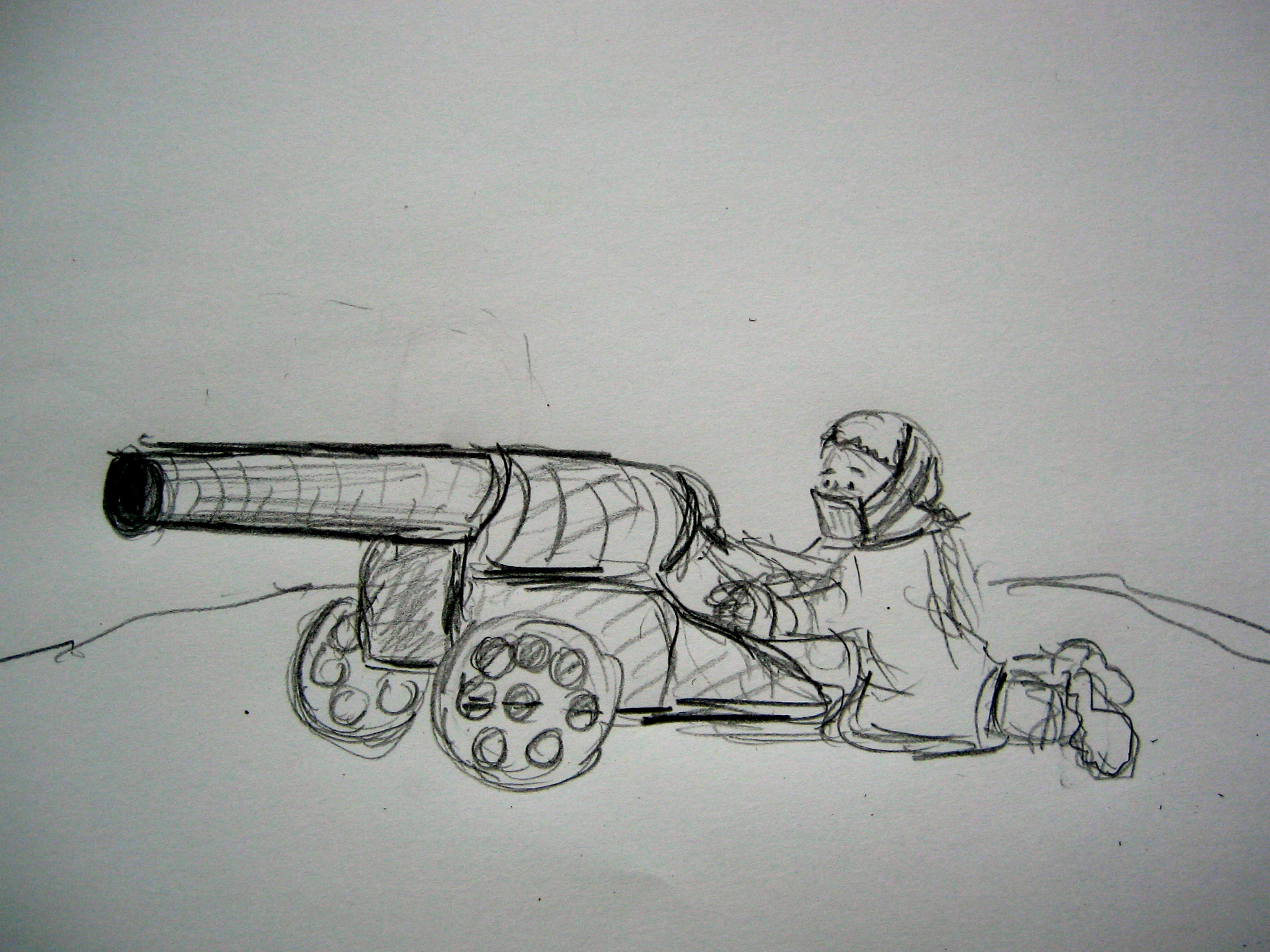
I, thankfully, have not had a personal reason to study these issues minutely, but I have to confess to some general bias against Western medicine.  It’s always seemed to me to specialize in cannons;  approaches to illness that involve heavy artillery used on a landscape (the body) which is nuanced and delicate (despite all those limbs and outgrowths), a landscape which one would just as soon save more rather than less of.   I am skeptical enough that the concept of a “surgical strike” seems hardly more precise to me when conducted by people in masks around an operating table than by pilots over a tableau of largely civilian dwellings.

I don’t mean to say that modern surgeons aren’t capable of precision (the whole skill seems to me to be absolutely amazing).  But I do think that the medical profession sometimes underrates the complications attending the procedures, the truly difficult healing processes and side effects.  The body is so complex and self-regulating;  it doesn’t particularly like to be messed with (even when its systems are out of whack.)

Pharmaceutical applications seem even less precise.  Dealing with my father’s diabetes has been an interesting lesson in this, his blood-sugar-lowing medication having been the prime cause of every emergency room visit and hospitalization over the last few years.

So complicated.  Does early detection of cancers save lives, or does it just extend the counting period?  How much good do chemotherapy and radiation do against aggressive cancers?  Does this good outweigh their stress on the healthy parts of the body, the body’s own defense mechanisms?  Or would the healthy parts of the body be weakened even faster by the cancer itself? Does the fight for extra time actually give extra time or just wear the patient out?

Of course, each case is different;  results are not fully knowable in advance.  And though experts seem to be getting better at identifying really aggressive cancers, those marked by a terrible predictability,  they have to allow for the slim chance; some possibility of unpredictability, some miraculous outcome.   Of course, it’s difficult to force the miraculous, but, as modern Americans – proud fighters, believers in belief itself, and above all, dutiful family members  – we cling to these slim chances, feel bound to try for them.

A difficult arena.

Early Morning in Orlando Airport – Oh, the Glory of Modern Air Travel

July 21, 2010

Hang on Tight! (Fasten your Seatbelt?)

Oh, the glory of modern air travel.  I got up at 3:45 this morning (it looked like night) to make an early flight.  I always imagine an early flight to somehow be advantageous; I imagine that it will not be delayed because of problems somewhere else down the line; that I will theoretically be first.  Unfortunately, some airlines seem to do their maintenance in the early morning.  Or schedule crews that get in very late the night before.  (Airline regulations require crews to have a minimal sleep time.  This is not a regulation that I am complaining about –I just wish it applied to passengers.)

So now I am sitting here, hopeful of being bumped to an earlier later flight.

Bumped?  Hoping to jump onto, slip onto, hang onto, an earlier later flight.

No such luck.

Soccer-Soothsayer Paul (The Octopus) Confronts the Competition (Squawk!)

July 12, 2010

Paul Confronts the Competition

I was one of the few people lucky (or unlucky) enough not to need to actually watch the World Cup Final soccer in order to know that Spain would win.

This was not because of my confidence in the wonderful Spanish team’s ability to maintain elegant possession of the ball despite the relative shortness of their players (my not-tall husband’s pre-game desire), or because of any particular hope that the day would be saved by the extremely good looks of several members of the Spanish team (my daughter’s post-game view, most notably with regard to Jesus Naves and team captain and goalkeeper,Iker Casillas), or some wish, of my own, to see that the players that weren’t kicked in the chest would triumph.

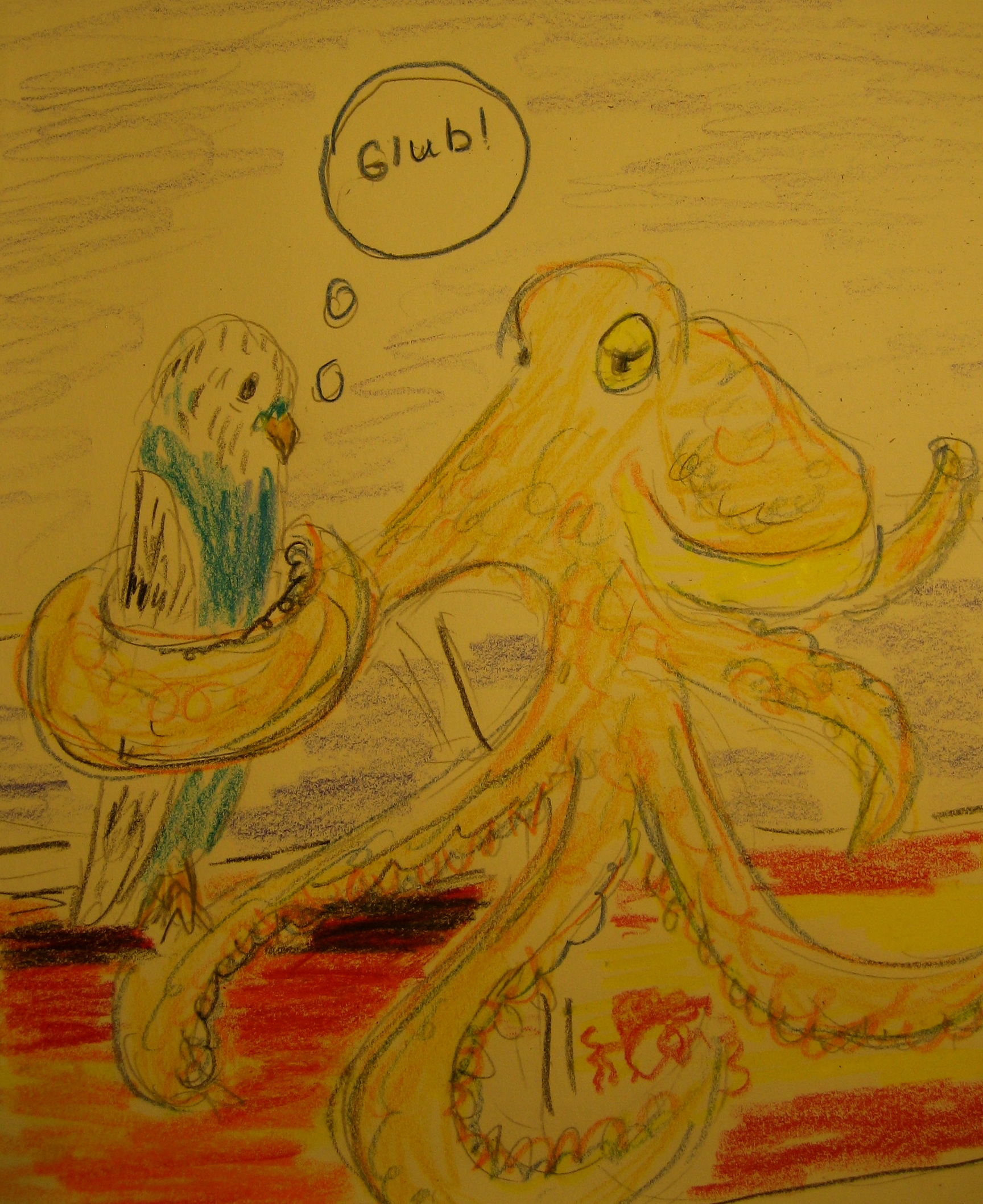
No, my certainty of Spain’s victory resulted completely from my confidence in octopi, particularly the soothsaying Octopus Paul, a/k/a the “Oracle of Oberhausen” (named for the town in Germany in which his aquarium is located.)   A day or so before the game, Paul once again (for the eighth recorded time) exercised his psychic mussel errr…muscle to successfully pick Spain as the winner of the final match.   (What makes Paul’s foresight especially unusual among predictors of the future is that he picked the winners BEFORE the games occurred, and didn’t simply tell us about how right he was after the fact.)

The Dutch, on first hearing of Paul’s prediction, were justifiably downcast until some enterprising Dutch reporter found a competing soothsayer—a parakeet in Singapore.

But I, for one, knew that wouldn’t fly.

Parakeets simply don’t have the grasp of octopi, the breadth, the reach, the slithery coordination—

And let’s just suppose this isn’t all a statistical anomaly, a lucky guess—(could Paul have some tentacular hooks in ensuring the outcomes he predicts?  Could there be something fishy, as it were, going on in FIFAland?)

All I can say is eight for eight!

(And thank goodness the game wasn’t decided on penalty kicks!  A deciding factor that can seem almost as arbitrary as, well, the choice of a cephalopod.)

Pushing/Falling Along

July 10, 2010

Crazy time.  I have a dear dear friend arranging for her hospice care in the city, and am up in the country drawing elephants with young kids.   So much to grieve, so much to joy in.   One of those statements that’s a cliché because it’s so true.

A [ridiculous] clock in the hall coos in the hour with varying bird song.  My mother-in-law, now gone, a true naturalist, really loved that clock, especially as hearing true bird song became difficult for her.

I suppose the deepest approach to the inevitable losses in life, the prospect of the loss of life itself, is to let go of regret, to learn to find contentment in what is before you, to stop wasting time worrying about what’s beyond recall (not of memory but of re-doing).   But that’s so hard, for me at least (a master of discontent).  For me, the more effective protocol is to make a concerted effort to remember regret, to remember, in advance, how it will feel when loss is in front of you, to remember, in advance, that this is a feeling that you don’t want to feel, and to focus, to the extent possible, on what you can possibly do to avoid the having to feel that feeling.

To imagine, in other words, that you are at a place with extremely few choices, and to think, from that position, of the choices that you wish that you had made when you had them.

I understand that it sounds Escheresque.   Perhaps this type of forward/backward thinking only works when you have dear friends who are very sick, when you want to plead with them not to go but know that you really can’t do that to them, that their life is beyond their wish and yours.

They have lived their lives well—you have no question of that–but what about you?   You feel pushed along by life,  by rapids, gravity, momentum, but is that push really irresistible? Really?

Subway Blog – An Eye Out For Spiritual Texts on Train

July 9, 2010


Me , rather I, (in the seat there) on NYC Subway Car

On the subway this morning, I move quickly from the side of a guy reading the Bible, not so much because he is reading the Bible—well, a little because of that—but  mainly because I see an open solo seat further down the car.

I realize after I sit down, however, that I am now sitting directly opposite another guy who is swaying back and forth over a copy of the Torah (or at least some seemingly spiritual Hebrew text).  He moves his lips distinctly as he reads, and he reads very very fast.

I’ve already tried to be the Good Samaritan on the train this morning myself, holding the door open as long as I could for two elderly tourists who, having a hard time with their Metrocards, had just barreled through the barred iron gates onto the incredibly muggy platform as the train doors began to close.  But the train doors are programmed against Good Samaritanism and nearly took off my hand before the tourists could stumble in.

As a result, I feel like I’ve already brought too much attention to myself to move one more time.   Still, it’s a bit hard to focus with the Torah guy swaying and reading so—loudly is not the correct word–energetically.

His nose itches; he’s congested; it’s bothering him.  The hand motions dealing with his nostrils are out of sync with the rhythm of his sway, which goes on without interruption, as does his free hand, following of the characters of his text with a stiff, three-fingered point.

I don’t want to watch him so closely; I don’t want to know about his nasal issues.  To be fair, he’s dealing with them discretely enough (as discretely as a swaying, gesticulating, lip-moving, man can) but it is almost impossible not to be aware of him when he is shouting—okay, not shouting—gesticulating so much.

I make myself look up the car.  I see a guy, next to the guy with the Bible, looking at himself with a small hand mirror, and I began to really wonder about (a) the nature of this particular subway car and (b) narcissism when I realize that he truly holds a small rectangular magnifying glass which he is using to read a newspaper article about LeBron James.   (Okay, so just narcissism.)

But I find myself increasingly agitated by the Torah reader.  It has nothing to do with the Torah.  I realize, to my embarrassment, that if someone were reading the Koran opposite me with the same avidity, I would be considerably more concerned.

When the train pulls into the next station, the Torah reader bolts away, and I am amazed at my sudden relief.  How wonderful it is on a Friday morning to have the car taken over by silence, stillness, near emptiness.  I catch the eye of a woman on a far bench, who, for once, smiles back, and I feel so suddenly relaxed that I don’t realize, until the mechanized voice begins and those inexorable doors prepare to close once more, that this is my stop too.

I make the steaming platform just in time.

A long week.