Posted tagged ‘ManicDdaily drawing’

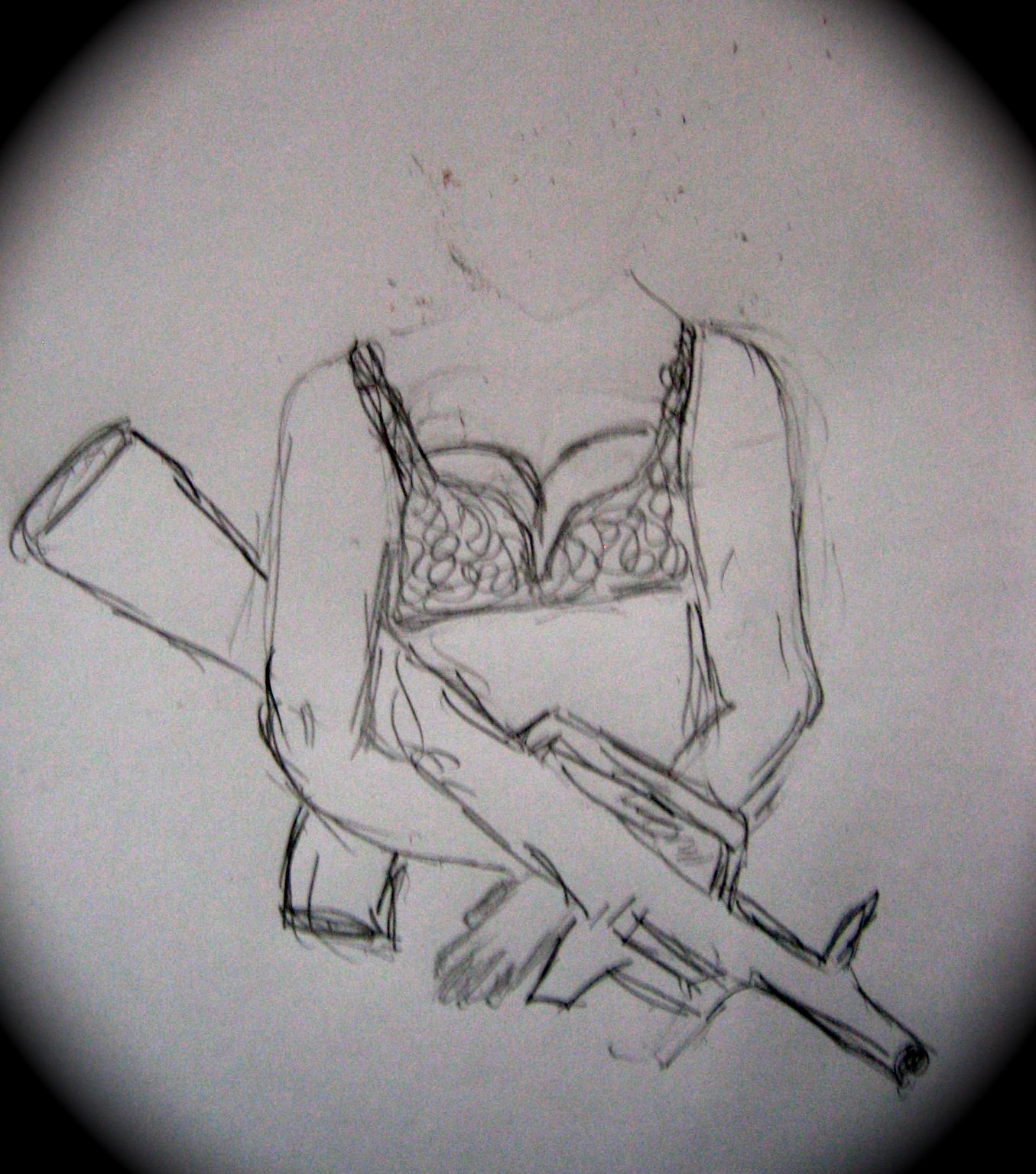
Anecdotal Connections: Assault Weapons – Push-up Bras.

June 29, 2010

I’ve heard two interesting stories about stores lately.  One, from my husband about a sports shop in upstate New York.  To give context to the story, my husband is a hunter, has been a hunter from the time he was a boy, was at one point (presumably before dues were required) a member of the NRA.

His memory of upstate sports stores from his youth, and even from ten or fifteen years ago (okay, dear—from his continuing youth), was of showcases filled with hunting rifles.  There might be a few pistols, but even those were, primarily, implements for hunting game–something someone might take on a camping trip.

On a recent visit to a sport store, however, in a very small, seemingly peaceful town, in the Catskill Mountains (prime hunting territory), my husband noted that about half of the store’s showcase was now given over to assault weapons.  These, he said, are not the types of guns one would use hunting animals==that is, non-human animals.  They are weapons modeled on the M-16s carried by soldiers, too heavy, too violent for game.   A couple of times in the store, my husband also heard the name “Nancy” as in “Pelosi” as in “getting one before she takes ’em away.”

The second store story arises from a friend’s recent trip to Victoria’s Secret in search of a bra on sale.  My friend has liked Victoria’s Secret in the past, not so much because of the sexy lacey-ness of its gear (well, maybe a little because of that), but mainly, supposedly, because of its large inventory of sizes and styles, particularly of bras.  On her recent trip, however, she found it impossible to buy:  every single bra was a “push-up” – so wired and padded that it was unclear how a human breast was supposed to fit in.    (It’s supposed to hover, presumably, someplace above the fabric, cushioning, metallic whalebonesque polymers.)

These are second-hand stories from reliable sources (I swear!), but, nonetheless, anecdotal.

Still, I can’t help but wonder about the connection: a seeming rise in assault weapons; a seeming rise in cleavage.

What does it mean?    That U.S. society likes things that are considered, non-aggressive, reserved, even less than usual?

That U.S. society is more than ever obsessed by bombast? Bimbobast?  Blastbast?

It worries me. (I’m sorry, I can’t help it–even the Victoria’s Secret stuff worries me–I’m a child of the Sixties.)

Whatever it means does not seem to bode well for Obama’s mid-term election results.

PS–the drawing above is not meant to imply that women in bras were buying the assault weapons.  I just wanted to put them both…errr.. all… in a single drawing.
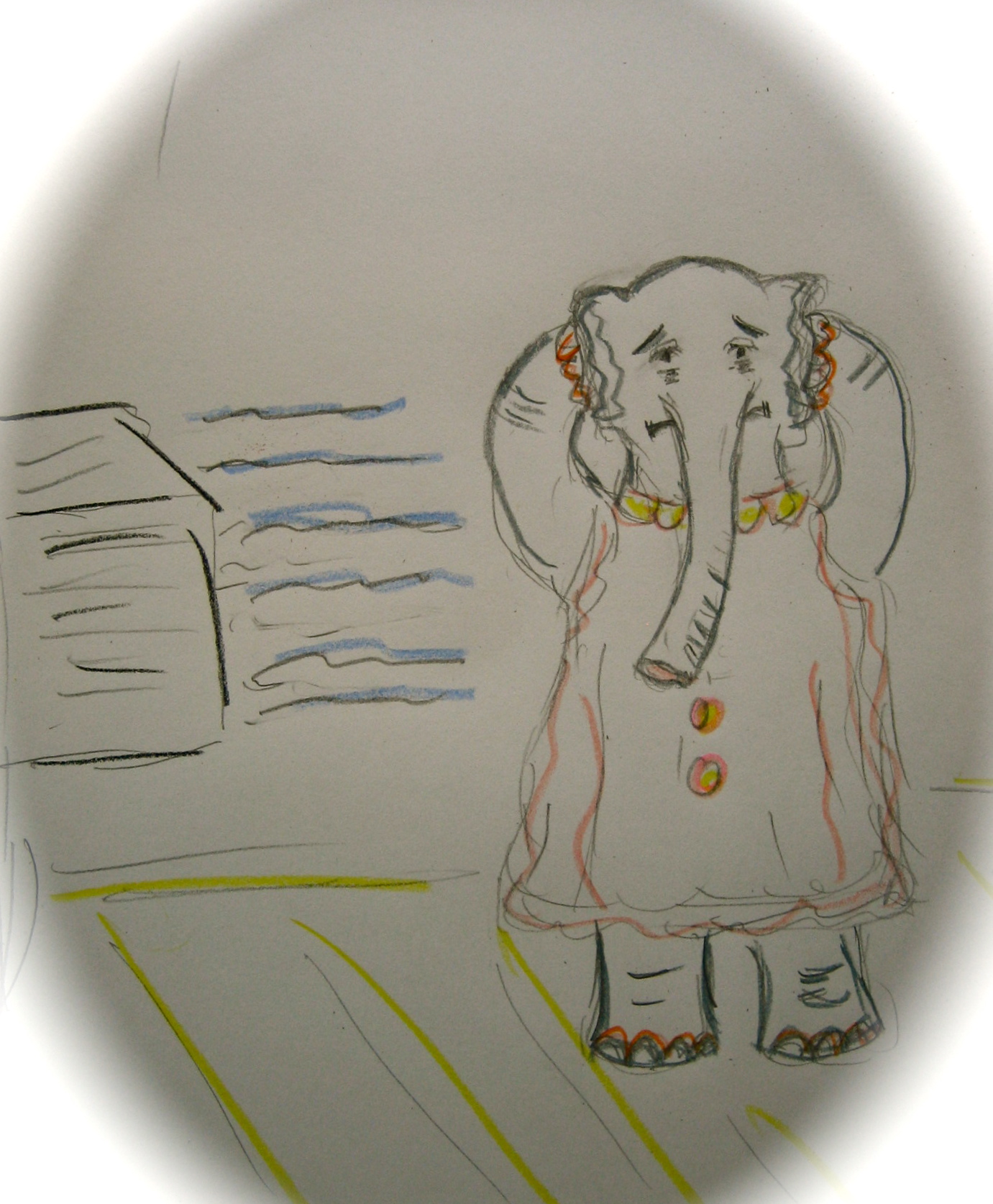
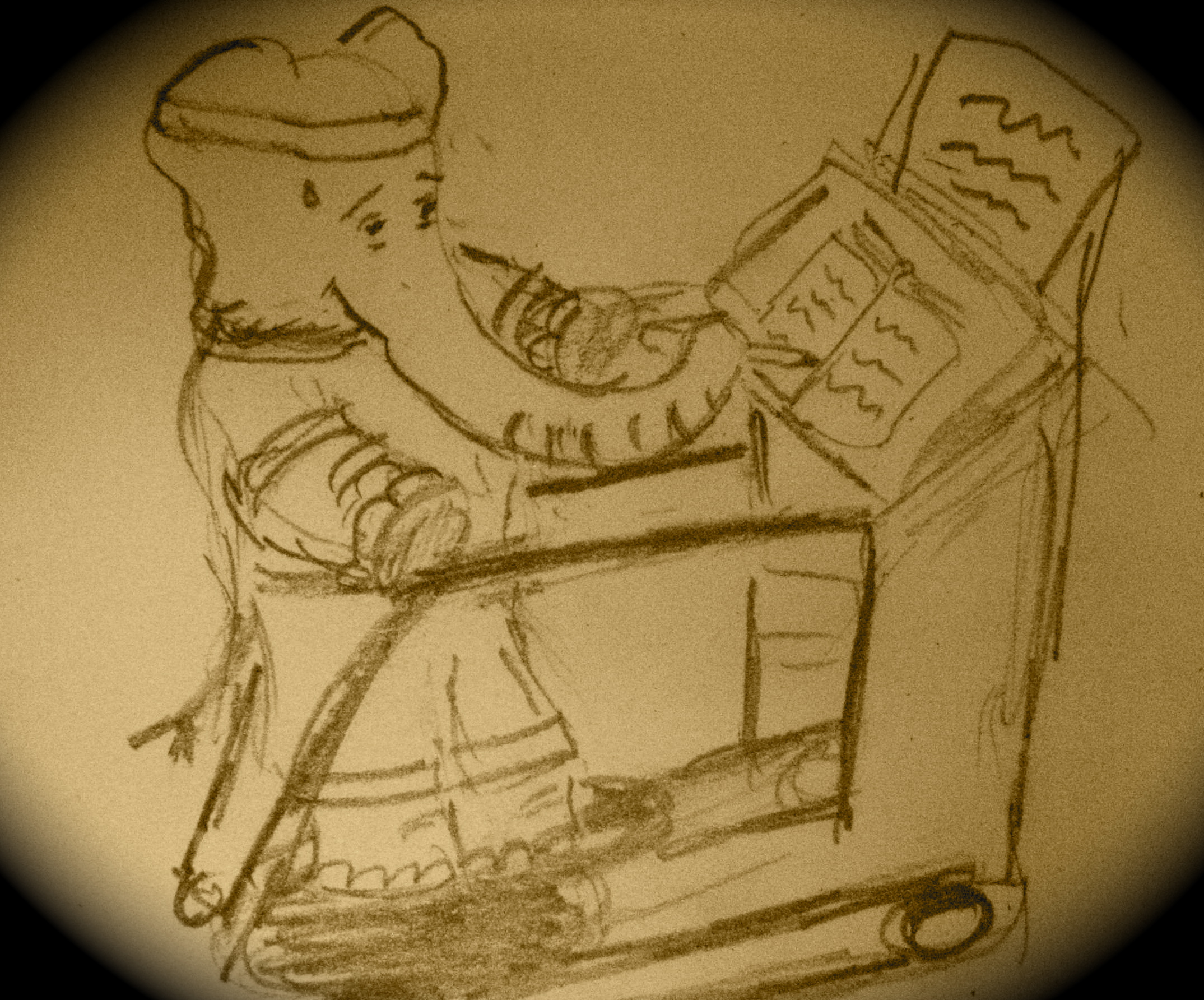
Letter from a Hot Apartment (With Elephant)

June 26, 2010

Hating Air Conditioners

Letter From a Hot Apartment

Dear dear one,
I miss you tons.
I hope you are not too hot up there.

Down here, it’s hot.
Yes, I could turn on
the air conditioners, but
you know how I am.
I don’t believe in air conditioners.
I say it’s because of the war.
I say it’s because of the environment.
I say it’s because I’m so broke.
All of which is true.
But the greater truth is that I just hate
their buzzing hum, and worse, the vacuum that descends
when windows that can open
are closed up tight.
You could say that I
am a sensitive type,
with issues of
control.

Though if you were here, I’d let you put
one on just as much as you wanted,
(for a few minutes at least.)
(No, seriously, for just as long as you wanted),
(as long as it wasn’t too long.)

Because despite what I am,
which is not
an air conditioner.
I really would do just about anything
for you, dear, whom I miss
tons.

Prayers (and Thoughts) For Abby Sunderland

June 10, 2010

Feeling sad and worried about little Abby Sunderland tonight, the 16-year old girl who is missing in the Indian Ocean in the midst of a round-the-world voyage.  Also feeling alternately sad for, and upset with, her parents.

Finally, I’m feeling guilty, guilty to write about this when the parents already must be suffering terribly.  So I want to start by saying I wish that nothing but good comes from this voyage, that Abby is found promptly, that she is safe and uninjured, that she receives a heroine’s welcome, that she is reunited with her family, and that she gets whatever wisdom the experience offers her and also whatever benefits fame can offer her.

And now, after all that, I want to say that there is a reason that 16-year olds are not legally competent to sign a binding contract; there is a reason that they are traditionally tried as juveniles; there is a reason why in the eyes of the law they are treated as infants and not adults.

The reason is that they are considered too young to fully understand the possible consequences of their choices.   Because of this lack of understanding, i.e. immaturity, their relevant adults– parents or guardians–are legally charged with making important choices for them.

In the modern age, however, there is no longer much notion of being “too young” for anything.  (It’s a new addition to the canon of Wallis Simpson, the Duchess of Windsor: “you can never be too rich or too thin.”) We confuse the vitality and beauty of youth with smarts, innate wisdom, a cool invulnerability. Kids want to pursue extreme activities that put their youth, their long-term health, and sometimes even their lives at risk—from nonstop training for Olympic sports or pro-tennis, to modeling careers, to concert tours, to solo trips in small boats around their world—and their parents, often incredibly loving parents, view their job as to “support” these youthful drives rather than to act as moderator, protector, shepherd, guide; the drive for fame and fortune and some form of “bestness” is just so strong.

A childhood (and possibly childish) dream is born, and the culture acts as if it is destined, with enough determination, to become a dream come true.

Of course, the dream often doesn’t come true (maybe not ending in calamity but simple failure, burn-out).  But the culture is determined to find fairy-tale endings, a magic of obstacles surmounted.

I feel terribly terribly sorry for the entire family, and pray for the absolute best.

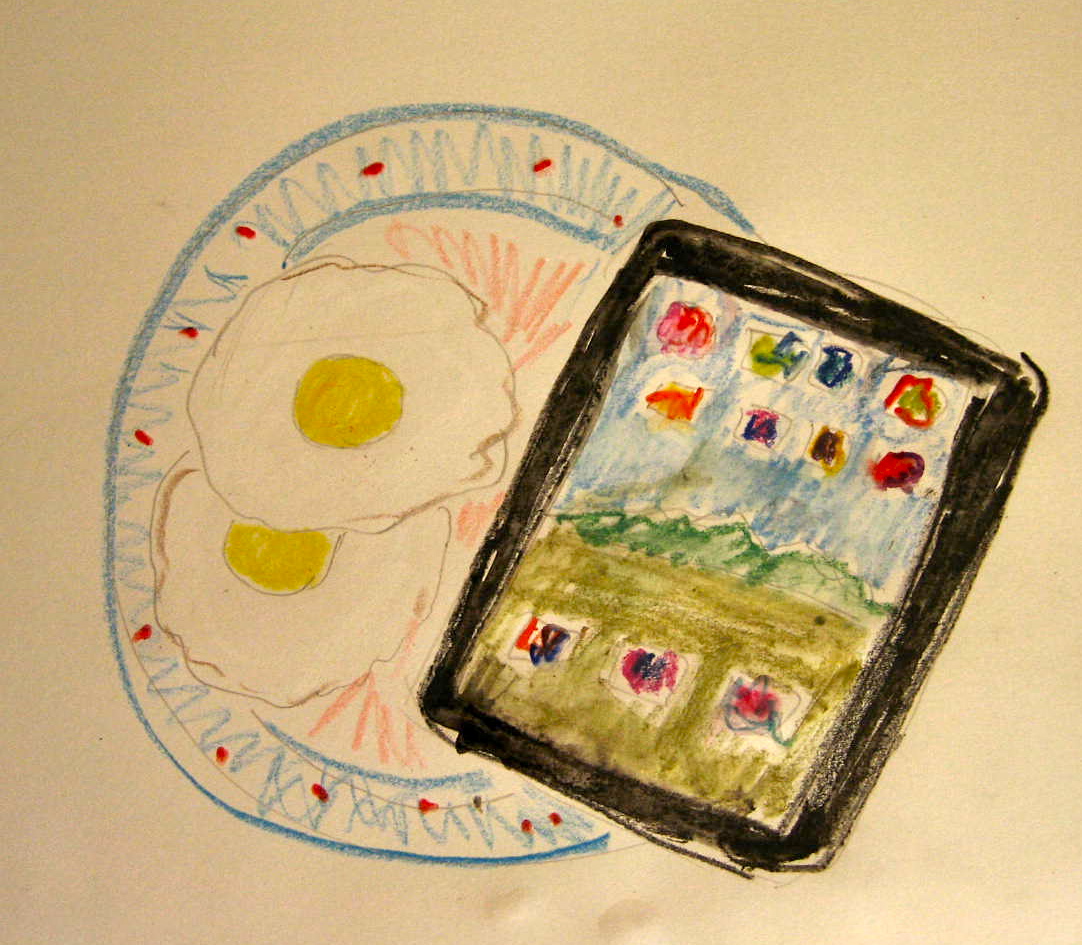
iPad Sunnyside Up–Let Me Just Check My Mail

June 7, 2010


iPad Sunnyside Up

The  New York Times has a couple of articles this morning on how technology is re-wiring our brains; you can find them if you check online—excuse me a sec, I’ve got a new gmail coming in.

The articles talk about the mental and emotional price of a life hooked into, and hooked on—oops—there’s my cell….gizmos.

(Sorry, sweetie, I’m writing my blog.  Can I call you back in two minutes?)

Some people think multi-tasking makes them more productive, but studies show it makes people actually accomplish less, and encourages a kind of shallowness.

Did you know, btw, that Robert Pattinson won MTV awards for best actor, global star, and perpetrator of best 2010 screen kiss last night?   (Does ManicDDaily have her finger on the popular pulse, or what?)

One article depicts a software executive (hey, what do you expect?  The guy’s a software executive, head of a start-up, in Silicon Valley), who “works” in front of three or four large video screens.

In the photos of the guy’s family , they all have iPads.  Even the kids.  The guy even reads Winnie the Pooh on an iPad to his littlest kid.  In bed. (I know it’s kind of awful, but the graphics are also amazing!)

I can’t help wondering if the article will be good for Apple stock.

(I’m just going to check that, okay, it’s bookmarked, so won’t take a mo.)

The guy’s wife say it’s hard for him to be fully in the moment, that when the emotional going gets tough, he escapes into computer games.  But then one of the articles cites a kid who texts a lot in school and that kid says that the “the moment”–that is all the time she spent in school before she had texting–was incredibly lonely and isolating.

I feel sympathy for the kid, but isn’t loneliness and isolation part of what school is all about?  Childhood?  Has she not read Jane Eyre?  Virtually any Dickens?   (I’m sure they are on Kindle.  Maybe even for free.  Or Google Books?  Let me check a sec.)

Oops, there’s my other email, office, you know, my crackberry, the red light is blinking—do you mind?

More on Blocking Writer’s Block – Maintaining Bad Habits (Advice from the Dalai Lama?)

May 25, 2010

Rotating Storm

At the Dalai Lama’s lectures in New York City over the last weekend, he advised (naturally) meditation as a means to slowly effect change in one’s life.  “One lecture not enough,” he chuckled.

He encouraged the audience to start a practice even if their beginning steps felt very small.  He advised just “five minutes” every morning, particularly if the five minutes were “quality time;” that is, five minutes spent with some attempt at genuine focus.  A small period of quality time seemed better to him than a longer, more wandering attempt, simply because it helped one avoid bad habits.  In His Holiness’s view, a bad habit was harder to break than a new habit to instill.

All of that sounds right.   And I hesitate to argue with His Holiness the Dalai Lama.  Particularly about matters related to meditation.

So I won’t.  Still, I was thinking this morning as I did my slightly desultory, bad-habit-infected, yet daily, yoga practice that I’m not in complete agreement with these principles, at least not when they are applied in areas other than meditation, such as a practice of daily writing.

Here’s my problem:  of course, quality time writing is better than going-through-the-motions time.  But what if you are faced with a choice between going-through-the-motions-time vs. zero time?  Is a bad habit really worse than no habit? (That is, not writing at all?)

I am concerned that many people when starting any kind of discipline make a good and earnest beginning–then, things bog down, especially as the glow of initial results fades, and the hard slog begins in earnest.

I don’t know what His Holiness would advise for a bogged-down meditator—I’m guessing that it would be a combination of continued effort, and a little less fretting.

I would co-opt that same (surmised) advice for a writing practice.  At times, it is likely that some bad, escapist, habits may creep in;  they may in fact be all that keeps you going–the background distraction of a book on tape; the muddled support of three cups of tea and a glass of wine;  writing on the elliptical machine;  relaxing with vampire novels so as to avoid the schaden freude of more challenging works.   Perhaps it does make sense to scale down during such a period–when you are having a hard time finishing anything, you may be better off working on a short story (or  blog) than the great American novel.   Still, it’s important to keep putting in your five minutes, even a fitful five.

The most important caveat here is not to get smug about your fitful efforts.  Stay honest.  Sometimes you may not feel capable of more than a thread of creativity; but don’t assume either (i) that it’s all you will ever be capable of; or (ii) that it’s enough.

One other suggestion (taken from a yoga teacher, David Life, who was trying to help me with backbends)–if you need to cheat a little to do your work (or pose, in the case of yoga), try alternating your form of cheating.   Rotate your bad habits to avoid letting any single one become the norm.  In the case of backbending, that meant sometimes turning out my feet too much, other times, bending knees.  In the case of a writing practice, that may mean sometimes just writing a very boring journal entry; other times, a very boring prose poem!

Elliptical Thinking ….errr….Writing

May 12, 2010

Gym Blogger

The other day I blogged about learning to write wherever–not, in other words, using one’s lack of a writer’s cabin as an excuse to put off work.

Today, I’m putting that admonition to the test by blogging at the gym.  Right now, I’m writing as I walk down the stairs to my gym, now I’m writing as I swipe my gym pass, now as I walk past the yoga class (writing there might be considered anti-Om). The place I’m heading is the elliptical machine, a machine which is dull, repetitive, and has a good ledge for my notebook.

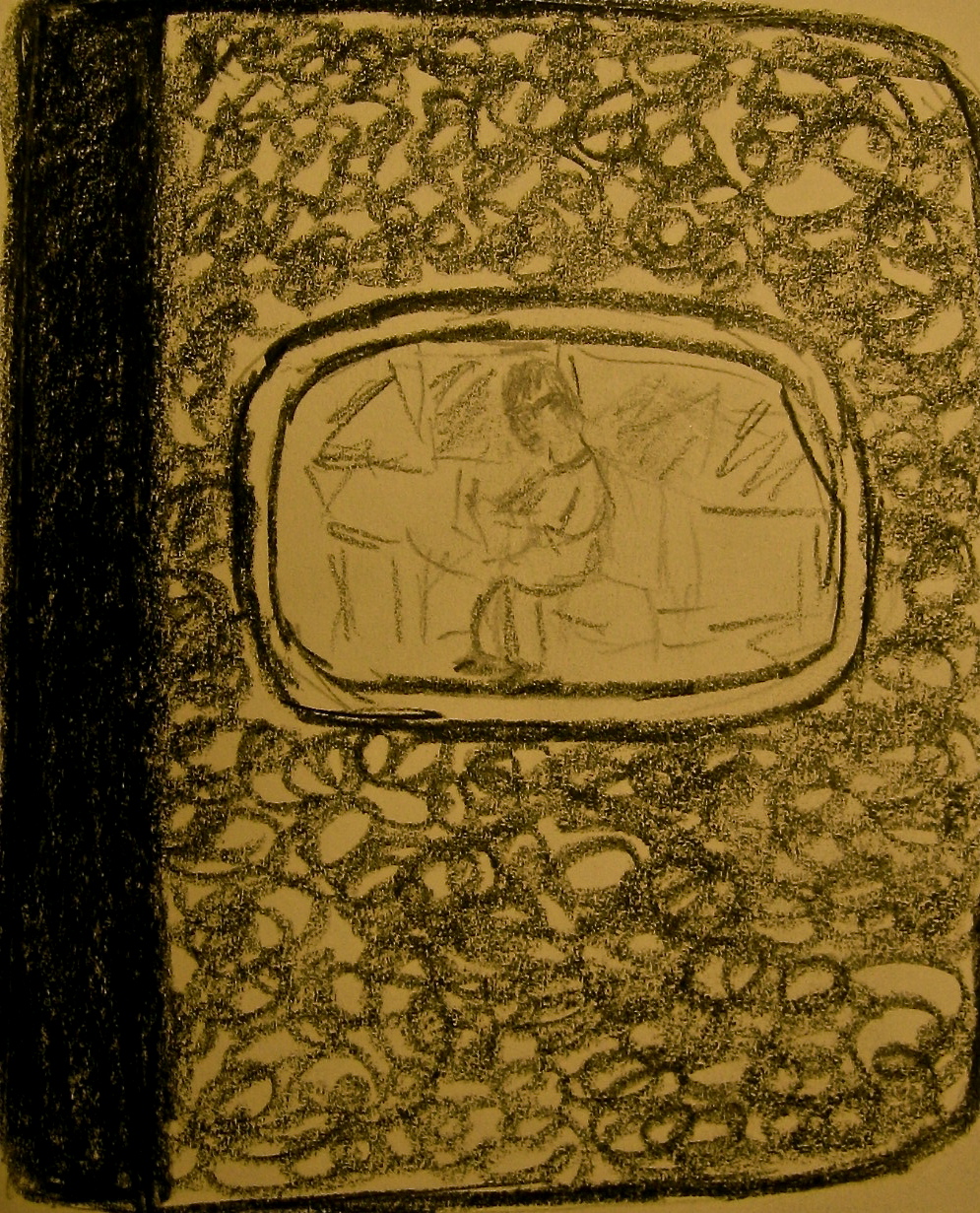
And now I’m on the elliptical machine, and, in fact, I am already experiencing a slightly uncomfortable burn in my upper thighs and a definite twist in my lower back.  (One problem with writing on the elliptical, or perhaps any exercise, machine is that it’s hard to keep your body symmetrical.  I should note here that I’m writing in an old-fashioned composition notebook and not in an iPad or other electronic device which would perhaps allow one to jog and blog in perfect two-handed symmetry.)

Ah.  (It’s working… I mean, I’m working,  sort of.)

Though there are a few caveats to writing on an elliptical machine:

1.  Take care not to press your notebook into the electronic display or you will completely lose track of your time, strides per minute, calories, distance and heart rate.  Actually, forget about heart rate.  You are not holding to the hand bars and those heart rate measuring strips never truly work in any case.

2.  Do not expect to reach your maximum speed.  Maybe, in fact, it’s best not to even try for your maximum speed.

3.  Do not expect to write the great American novel.  At least not on the elliptical machine.   Frankly, if you wish to avoid disa—

Oops!  Just pressed the display  and the whole machine is rearing up, meaning that I’ve not only lost my time and calories, but all my resistance settings have plummeted and I’m suddenly going about a mile a minute.  No, only 141 strides per minute, but that’s still a bit fast for good sentence structure, and it also feels–

As I was saying (I’ve reset the settings now), if you want to avoid disappointment, you may be wise to let go of expectations of writing the Great American Novel, whether on or off the elliptical machine.

But seriously, the points of all this are:

1.  You can write anywhere.  Granted, the writing may not be always that great, but it can help you keep your writing muscles toned.

2.  We (I) seem to have this need to both multi-task and communicate.  Yes, it might be better to quell these needs, but sometimes there can be real comfort in just accepting your predilections–your fullest, most manic self (if you are not actually hurting that self or others).

Sure, people may view your truest self as being a bit strange–for example, the people around me right now may think I am a pretty poor excuse for a gym rat.  But, who cares?   There are plenty of empty machines to my sides.  In fact, my whole little section of this fairly crowded gym is completely unoccupied….

Hmmm……

Brain Teeming? Try Rhyme!

May 11, 2010

Locust Leaves

What to do when your brain is teeming too much to think straight!  Write a poem, especially a rhyming poem.

A rhyme offers a wonderful thread away from fretful pre-occupations;  it can take you somewhere quite magical.   So, in the stress of mid-week, even though I no longer have the excuse of National Poetry Month, I am posting a draft poem written this evening, made up of rhyming quatrains.  (I don’t think it qualifies as magical, but it was a fun exercise.)

Behind the Locust

She tiptoed under the locust trees,
their shade bared earth, her shorts bared knees.
Their bark was rough, as rough as you please,
though the wood is soft in locust trees.

Though the wood is soft, the thorns are not;
sticks fall down, and leaves on top.
She tiptoed through the thorny plot
of earth and stem and leaf and rot.

The trunk was thin but she was small
and stood at angles–so, and so,
shifting from tip to the other toe,
to hide from all who’d come and go.

No one was looking, but still she hid,
looking herself at all they did.
She watched them walking, watched them sit,
keeping close the tree’s close fit.

What mystery to be lost and found
beneath the slightly rustling sound
of leaves like grapes; inside, the pound
of a heart that’s longing to be grown.

Blocking Writer’s Block: Don’t Worry About the Where

May 11, 2010

Writing IN Your Notebook

I am returning to my series of posts on blocking writer’s block this morning at one of my favorite secret places for writing—the New York County Supreme Court building at  111 Centre Street.

Yes, the downstairs lobby is a bit tacky.  From the outside, the place looks dark, shut down; you feel almost certain from the sidewalk, that the main exterior doors will not open when you push.  (In fact, they do not open–much.   They squeak, scrape, and stick; with a lot of force, you can just wedge yourself through.)

But when you do get inside the building, past the metal detectors, beyond the dingy elevators, up to a highish floor, a sea change occurs—the main corridors here are lovely, with granite floors, marble (or faux marble) walls, and tall windows edging the South, West and East exposures, looking out over lower Manhattan.

I’m not saying that these corridors are particularly posh—there’s a definite utilitarian cast to the white plaster-board of the dropped ceilings.  Even the granite and marble look as if the colors were chosen not to show dirt.  (These are public buildings, after all.)

But the wooden benches that line the windowed walls are smooth and comfortable,  sunny and light, and, if you are not on a floor of bored and disgruntled jurors, the corridor carries such a serene hush that when, in the midst of muted steps, you hear a murmur about “what street informants want,” you are definitely taken aback.

I have to say upfront that I’ve never gone to New York Supreme just to write—I’ve always had some official purpose, and had to sit there waiting to fulfill it.   But it is nonetheless a very good place for writing.  (If you haven’t been sub poenaed, virtually no one bothers you.) Important caveat:  I think that coming in here just for a quiet place to work might actually constitute some kind of crime; it’s probably best not engage in it in a place filled with cops.  (They tend to be big cops, their hips bulging with handguns and, well, hip.)

So now, I’m on the subway writing.  It’s also not bad.  Yes, an unseasonably cold day makes the seasonal air conditioning drafty; the mechanized voices jabber nonstop, and there is the constant loud whir, bing, squeal of the engine, wheels, track.  Still, I have a seat.   (It’s not a rush hour train.)

More importantly,  I’m not just writing on the train right now—I’m mainly writing in my notebook. Which is about as quiet and uncluttered and spacious as lined white paper can be.

The point of all this:  don’t worry about where you are doing your work.  Don’t put it off because you don’t have the right space (a writer’s room, cabin, desk, even computer).  Don’t put it off even to wait for  the right moment.   I know it sounds clichéd, but the fact is that the only place you ever have to write is the place you are right now;  the only moment you ever have is this one.

To some degree, the same reasoning can be applied to drawing and painting. Again, of course, it’s wonderful to have a lovely studio, easel, table, but your drawing is not made only in your studio.  The place it truly inhabits is the page (or napkin or envelope.)

Of course, some places are genuinely more inconvenient or conducive than others;  if you have access to a convenient, conducive place, take it!  But the factor that most quickly makes a space workable is simply working in it.  Engagement is a great architect/decorator.

I don’t write this to be annoying, or to tout my own powers of concentration.  (They are not very good–when I write in a public space, I sometimes just follow my mind’s meanderings.)  I write to help counteract the many forces that lull one into procrastination.

If you want to work, then get to work!  Wherever!

(P.S. For more on blocking writer’s block, check out the writer’s block category on the ManicDDaily home page.)

(P.P.S. Computer problems delayed the posting of this post beyond my daily deadline, drat!  Sorry!)

Mother’s Day Evening

May 9, 2010

Hiding in Lilac Bush

The post below, for mothers and infants, was originally posted in the springtime, for Mother’s day evening, but I am linking it to Bluebell Books Short Story Slam.


It’s a poem for mothers–though I suppose it doesn’t so much express appreciation of mothers as of motherhood.  (Happy Mother’s Day everyday!)

Going In to Look at My Daughter Asleep

When I walk into your room,
I try to sneak
beneath your soft
small breaths like
hiding inside the
lilac bush, trying not to laugh, like
the dreams in which I
sit with my dead
grandmother, so happy to
have her back.  It’s a rebirth
each time I see you after
not seeing you; it’s
as if, you miracle, made
the dead rise.

Kept Awake By Meditation and Sookie Stackhouse Novel (“Dead” The Next Day)

May 5, 2010

Meditation and Vampire Novels

As some followers of this blog know, I’m a longtime devotee of Astanga yoga (sometimes, unfortunately, known as “power yoga”).  Astanga is a relatively active form of yoga in which the practitioner jumps from pose to pose;  each pose in turn is held for a relatively short set number of breaths.  Because I do “self-practice,” meaning that I do Astanga yoga at home by myself, my practice has somewhat deteriorated over the past few years.  I do it, sure, but the requisite number of breaths has shortened to second hand levels (as in, about one second per pose) and my focus has become increasingly… diffused.

Great returns rarely come from casual investments (i.e. no pain, no gain).  Meaning that my rushed, unfocused yoga, does not yield a significant amount of inner peace.  (Sigh.)

One possible remedy would be to simply give more time and energy to my existing yoga practive.

But that’s not really the ManicD way of handling an issue of this kind.  Instead, what I’ve tried is to add in something else, something which I can also pursue in a slightly desultory way:  meditation.

Ah, meditation.

Meditation is probably harder for the Manic personality than Astanga yoga, as it involves minimal jumping.

But unlike my self-led yoga-practice, I’ve tried to meditate in a mediation session, at a meditation center, with a teacher and pillows, and other, sincere-looking people, and one of those beautiful bells in a bowl.   This structure, given my achievement-oriented personality, actually inspires me to sit still.

Ah.  (Meditation.)

I really do like the sessions.  When I’m in one, I feel more aware, more tolerant, more wise, more balanced.  The problem is that after I come home from one of these sessions, I seem to be driven to some form of extreme behavior. I don’t rent a race car, or go out on the town–I just do things that are, as they say in Buddhist terminology, unskillful.

After last night’s session, for example, I stayed up till about 3:30 a.m. reading the new Sookie Stackhouse mystery from Charlaine Harris—Dead In the Family, the tenth in the series.

With all due respect to Ms. Harris, some of whose work I have truly enjoyed, it’s not a terrifically good book.   The story has gotten very complex, too full of ancillary characters, too dependent on prior knowledge, too rushed, too soap-opery.  If you are not (a) escapist, (b) already addicted to her main characters (Sookie Stackhouse, Bill Compton, and Eric Northman), and possibly (c)  just coming out of a Buddhist meditation session, it is extremely unlikely that you would find it worthy of a virtually all-night read.   (Maybe not even any read.)

But the meditation teacher last night, a very thoughtful and meticulous speaker, had a curiously bloodless quality.  She smiled frequently;she said things that, if not original, were useful; she wore a very tasteful, shawl.  And yet she also left me in a state ripe for self-indulgence, blood–errr—lust, the super-handsome, super- passionate Eric healing Sookie of her post-Fairy-torture trauma.

Ah, vampire novels.

(By way of further excuse, I should note that I’ve only read Sookie Stackhouse novels; I’m not really familiar with the TV series.  Also, to those of you that can’t understand my obsession with these books—umm…..how about ‘it’s a great way, as a writer, to learn how to put action in one’s work.’)