Posted tagged ‘Magpie Tales’

“Great Scott!” says Andy (“What ho, Marilyn?)

February 26, 2012

20120226-121526.jpg

Move over, Ican

What say you, Marilyn?
Now that he kneels
before the True Icon,
with curves so ho
supreme, lids
silvered, cheeks
rouged, surface
steamy, the object
of heated
exchange all over
the word, spooning with
the Plebian, can-
noodling with
the Sublime.
Great Scott! says
Andy, can this really
be love?

The above is for Mag 106, Magpie Tales, hosted by Tess Kincaid.  My picture is based upon an unidentified photo, posted as Tess’s photo prompt, appearing to depict good old Andy Warhol.   I’m sorry that I cannot resist re-posting another version of Warhol’s icon/can below.

Lavender–“When All Else Fails” (Mag 105)

February 19, 2012

20120219-050448.jpg

Here’s my offering for Tess Kincaid’s Mag 105.

(Tess posts a wonderful weekly photographic prompt.  The original photo this week, and basis of my picture above, was by Epic Mahoney.)

I hate to double (or triple) up but, due to onslaught of demands (beside poeticizing), am also linking this to Imaginary Garden With Real Toads and dVerse Poets Pub Open Link Night.

When All Else Fails

And then there are those times
when one resorts
to lavender–
the scent in a drawer (tempered by cedar),
and folded inside, a kerchief with initials
cross-stitched in bottle blue–
when all has gone wrong, when
there is
no
last minute saving grace.

Even honey
can block a throat, lines cut, engine not
turning over, the days of horseback
gallop like the wind
no more.

Still, one pedals/pushes/pulls
through the pale of night as
across a sea or desert, holding,
in the chest of the mind, that drawer, that
handkerchief, the ghost
of lavender worn at wrists
that worked their way
through all of this before
(or something similar), the
lettered threads, cornered by
sieve edge 
of persistent lace,
signing the possible.

(As always, all rights reserved.  And as always, check out my comic novel, NOSE DIVE,  book of poetry, GOING ON SOMEWHERE, or children’s counting book 1 MISSISSIPPI.)

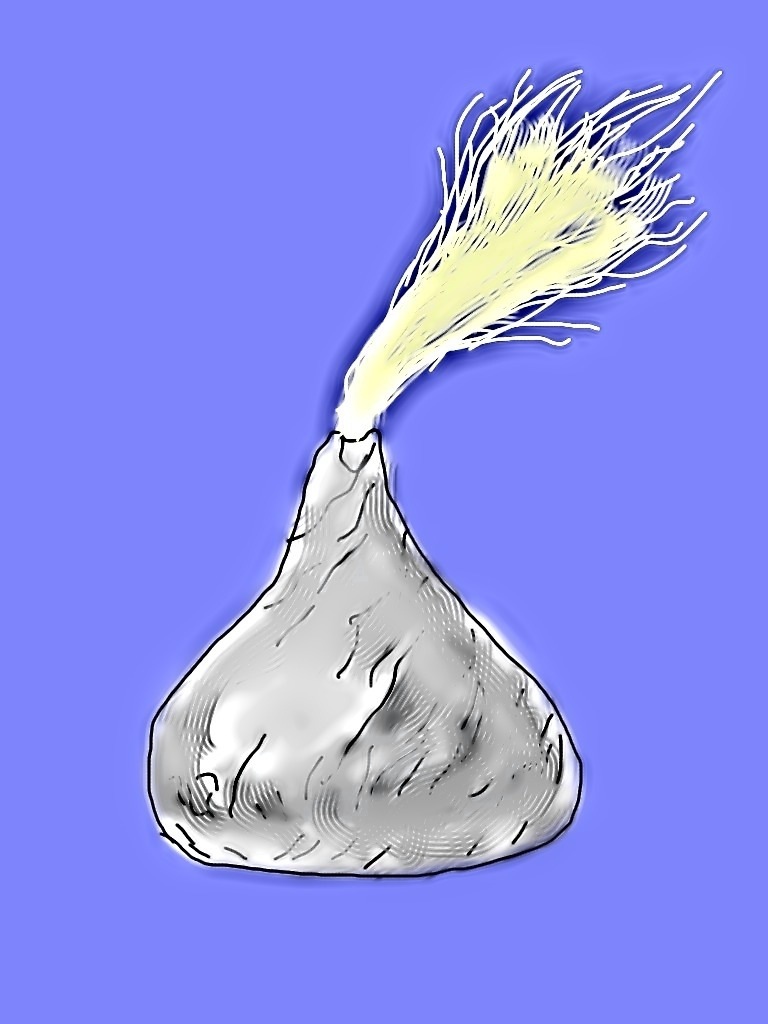
Chocolate/ Blonde Hair – (Lady Godiva replaced by H. Kisses)

February 12, 2012

20120212-044422.jpg

I wrote the draft poem below for Tess Kincaid’s Magpie Tales, where Tess posts a weekly photo prompt.  This week, I’ve really just used Tess’s photo as a springboard;  my drawing and poem are not meant as direct interpretations.

Chocolate/Blonde Hair

I.

Some people have a real hankering
for long blonde hair.
Do you really think
there would be a certain overrated
chocolate chain,
if Lady Godiva
had paraded atop her nag
with a short shag?

II.

“You can’t get that out of a bottle,” strangers would
say about my hair as a kid, when it was
long and straight and naturally
blonde.  Dyed hair, my mother
declared was blocky, all one
shoddy shade, nothing that could even compare
with what I grew, and so, for a while,
I felt a certain halo, until growing
tired of halos, I
insisted on hair cut short, though because
it was my hair,
collected the swathes in
a small and dark brown
box, which both amazed and
hurt me, for what had felt so long
(for so long) and golden, had spun down
to a handful of softish straw.

When I looked in the mirror,
what I saw there too was
diminished, not the sly pixie,
but a confused Delilah,
shorn by mistake,
whose face was round and
who didn’t even have the name
right.

III.

You can’t get that out of
a chocolate– 

a memory:
tobogganing, the sky turning lavender above
tracked speed, as if
we were a flexibly flying flame
amidst the drifts, and below the
blur of snow-flaked lashes, everyone’s
skin shone, till legs trudged (toes urging faster),
to get to the burnish of gas-fired
stove, pot of milk, melt–

a taste:
it was Colombian chocolate, cut in squares
sprinkled with brown sugar, leaving a trace
of smoke in the throat, the kind of smoke that, bluish, always
carries dawn or dusk as it slinks down
steep altitudes;

a friend:
she was my best, and on different visit, when the wind
chilled and I’d had to wear some older sister’s old beau’s sweater
and thick shoes, she’d laughed at my discomfiture, till I learned not to care
about such things for a short
while–truly not at all–the look of them–not
once she re-filled my cup.

(As always, all rights reserved.  Sorry this so long–a draft!)

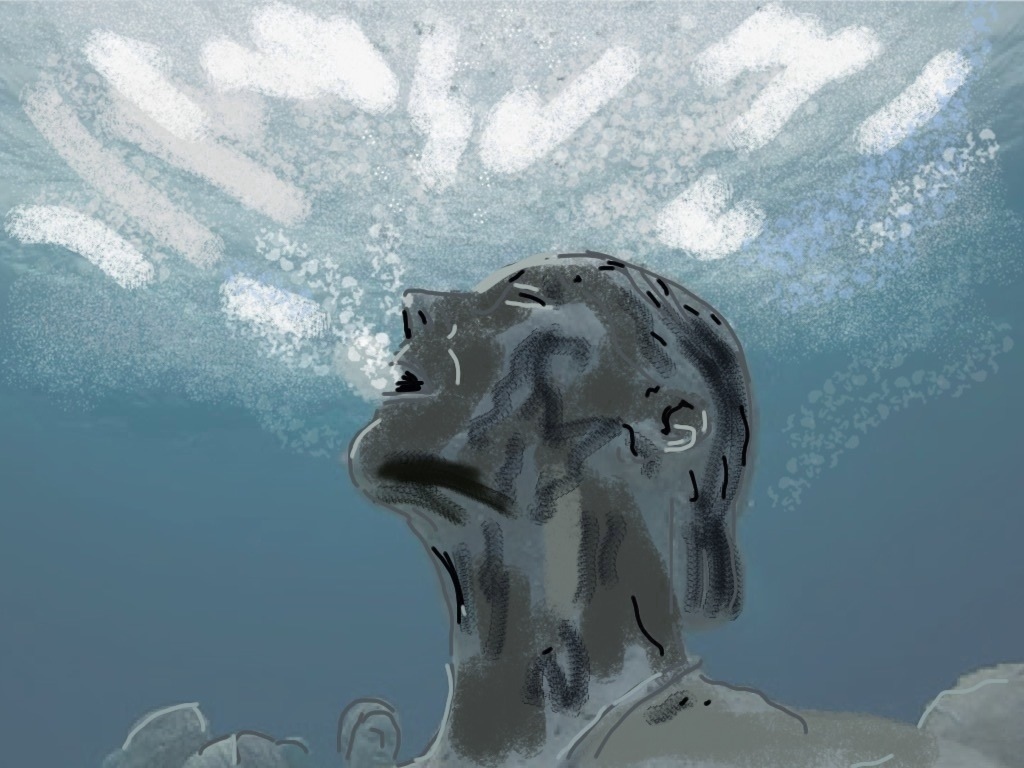
Magpie Tales – “You Too” (Light After Death?)

February 5, 2012

20120205-075241.jpg

Here’s a poem for Tess Kincaid’s Magpie Tales.  Tess puts up very interesting photoprompts.  The above and below are my take on this week’s.

You Too

There is that will
in some
that assays a reach
from the grave, that
would pull from raw earth
gems
for barter, that would store
oxidation; that, below
the mine, will still insist, “that’s mine–” those
whose fingers grasp
even as limbs moulder.

And then there are those
who proffer treasure, who, in
their last sighs and beyond, exhale
a gift, their life’s blood like a current
of air a bird
might sail upon, or you too might feel
ruffling your hair beneath
the noon or setting
sun.

These last do not just raise flowers
from their remains, but instead,
a hard brilliance: someday, you too will
pass; someday, you too
will be faceless; someday,
you too will know life
as a stone; catch
light
now.

“Nursing Mother Commutes” (Oddly based on Kandinsky).

January 29, 2012

20120129-102818.jpg

Yesterday, I had the fun and honor of hosting dVerse Poets Pub Poetics prompt, challenging people to write about undercurrents–the layers of a moment or experience.   I was not very pleased by my own poem, which I had cut hugely before posting.  I tend to think that almost all poems are a bit too long; but I worried all day that I had eviscerated it.  (Ugh.)

But the great thing about blogging is that you learn to just move on to the next thing.  So, here’s a new poem for MagPie Tales, hosted by Tess Kincaid.  The poem is based upon the Kandinsky overhead (Red Spot II).

Nursing Mother’s Trip Home

She runs, takes stairs aslant by twos,
tethered purse banging at purposeful
hip, diagonals by the commuter who
doesn’t have a nursing baby at home, weaves
around this woman with the slow high heels, that backpack
that blocks her dash, this stack
of newspapers–anything that would collapse
the pace pounding her brain; pushes
onto her next train, squeezing her newly reduced
body between limbs, suppressing inner
relief sob, pulling slash
of coat from pinch of train doors; leans for the
long part of the ride–the passage beneath
the river–against
the conductor’s silver
booth, trying now
to control her chest–the harsh
breath of hurry, the milk whose heated
seep already pushes
her nipples,
stopping only in her 1-2-3
to pray for no stoppage, no moment of
slowdown between shores when she will feel crushed
by crinkle and murk, the image of tons
of river overhead–even as she knows –she does
not need to tell herself, she knows it
so absolutely–that nothing, not even a burst
of flood through train’s fluorescence—-will keep
her from getting home.

It is only the delay that crazes
her–the time it takes from
this grey metal door to
her infant at her breast–for
she knows, yes,
in every mote of
her being she knows,
that it is only
a matter of time.


(P.S. I am also linking this to Imperfect Prose.  Have a great week. K.)

It is difficult to mourn a pet clam.

January 15, 2012

20120115-032636.jpg

The above is my pictorial take on a photographic prompt of Tess Kincaid, of Magpie Tales, which, in turn, is a photograph of a sculpture by Jason deCaries Taylor.  The picture looks a bit grim–my tale, below, is actually on the humorous side. 

Pet Clam

When I was a young child, desperately wanting a pet to pat and love and call my own, I got a clam.

He or she (with mollusks, it’s hard to tell) sat on the crushed ice in the blue enamel shelf of the old A&P shellfish section.  The lobsters who crawled around the murky bubbling tank in that area of the grocery store were clearly alive, but somehow I learned that the clams sprawled on the ice lived too, and one of them, stonily asserted itself, ‘pick me.’  With the permission of my mother,  I brought him home and the next day took him into school for show and tell==(how the clam has suddenly become male, I’m not sure).

I don’t remember if he actually made it to show and tell.  Only that at a certain point in my first grade afternoon, his jaw (as it were) drooped, the shell opening in my desk in the trough reserved for pencils, while dribble, like that that sometimes collects at the corners of the lips of the infirm, glimmered along the edges of his crack, his body a velvety mute tongue.

As an adult, I used to like to joke about the episode, until one morning when my own child was small, I pointed to a basket of clams sitting woodenly beside the counter of an old-fashioned Brooklyn fishmonger–we breathed through our mouths because of the reek–and told her that the clams were still alive–the merchant concurred–and how I myself had one owned one as a pet.

An awe=struck light filled her eyes.

I’m not sure what came over me.  Typically, I try to be a good parent, shielding my children from heart-ache.  Yet, in this instance, I invited it in–perhaps telling myself she needed experience of the world, perhaps tired of hearing requests for pets, perhaps because I thought she too would eventually join in upon the joke.  I let her pick one.  She chose carefully from the slats of the basket labeled Cherrystone.

In my defense, I did emphasize that clams were not in fact great pets, listing the obvious.  She carried it proudly, gently from the store, in a paper bag which she peeked into often on the walk home, deciding upon the name of Cherry Merry Clam, a variation of her own name mixed with Cherrystone.  (And Clam.)

Once home, she carefully alternated Cherry’s sojourns in the fridge, where it stared blindly up from the metal rack, with short visits to the couch, an old beigish velour, with a square back and arms that served as good ledges for the clam’s rounded bottom (and top).

Every few minutes of fridge time were punctuated by a request of whether Cherry could come out again.  When she was released, my daughter stroked the clam’s ridged grey surface with a small forefinger, and spoke to it in those high-pitches reserved for coddled infants–babies, puppies, now clams.  Occasionally, she would pass a finger over the line where the shell closed, telling me she thought it was smiling.

Guilt filled me.  I replayed my own distress at the open clam languishing in my first grade desk.  I warned my daughter of the clam’s vulnerability.  Which, beyond serving as warning, raised the question of its care.

I realized that I knew nothing of clams.  Did they drown/suffocate in the open air? Did they, inside that hard shell, suffer?

We rinsed Cherry in the sink.  (Wait–what about the chlorine?)  We put Cherry in a bowl of salted water.

As if glued to destiny, I let my daughter take Cherry to nursery school the next day where, despite best efforts and the school fridge, the clam opened, and the assistant teacher pronounced its passing.

It is difficult to mourn the death of a pet clam.  There is a passivity about the creature that makes one’s grief seem ridiculous.

But grief is manifest in the mourner, not the bemoaned, and the loss of something imbued with love, whether or not it even smiled back, is grief-worthy.

So when I think of Cherry Merry now, I feel a true sadness–first, of course, for my daughter who genuinely suffered that day, then too, for myself–both as first grader, but more as guilty mother–the grief of any mother conscious of her mistakes and faced with their consequences.

And then, there’s a sadness simply at the death–not for the clam (no, not for the clam!) but for the struggle, or at least, the image of struggle–the seemingly gasping shell.  (What does the clam do when it opens?  What does it do when it shuts, for that matter?)

The visage of human death comes to mind–the fight for breath, the seeming drowning in air, the moment when this Earth (as one has known it) is no longer one’s element.  Or maybe it’s the here and now that can no longer be processed at death–maybe that’s what can no longer be negotiated when our life escapes its shell in that unwilled opening.

P.S.  Linking this to Imperfect Prose for Thursdays (Emily Weiranga’s meme.0

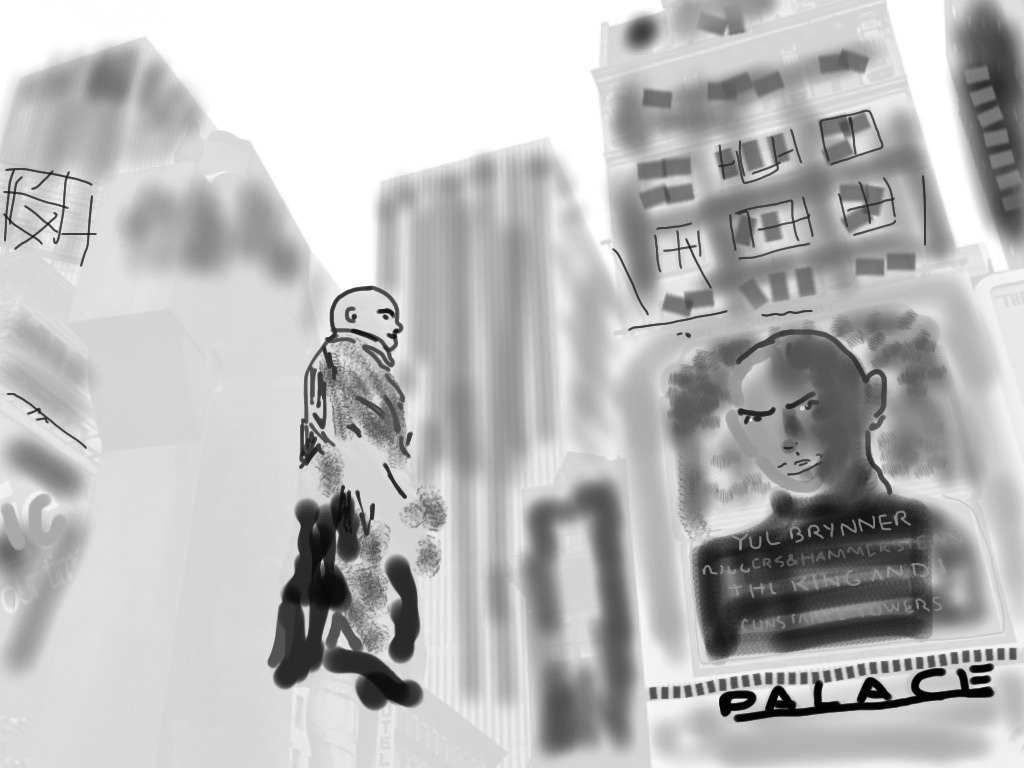
Magpie Tale – Odd Poem on Baldness (“Arched/Domed”)

January 8, 2012

20120108-090040.jpg

This is an odd poem written for Tess Kincaid’s Magpie TalesMagpie Tales. Tess posts a photographic prompt. I prefer to use my own art in my blog, so do my own version of Tess’s photo. And here’s the poem:

Arched/Domed

There is arched baldness and there is domed baldness,
Polished baldness and (simply) overly-shiny baldness,
Smooth baldness and whiskery baldness,
Waxed baldness (hair shaved) and waned baldness (hair receding),
Diabolic baldness and sweet baldness,
Destroyer-of-worlds baldness and lab-scientist-with-oddly-ruffled-
sides baldness.

The sweet (domed) baldness sits above a chest on which
one feels safe to rest one’s head,
While the arched baldness overlooks an
appraising brow.

You may wonder how I know
so much about no-hair.
Wonder on.

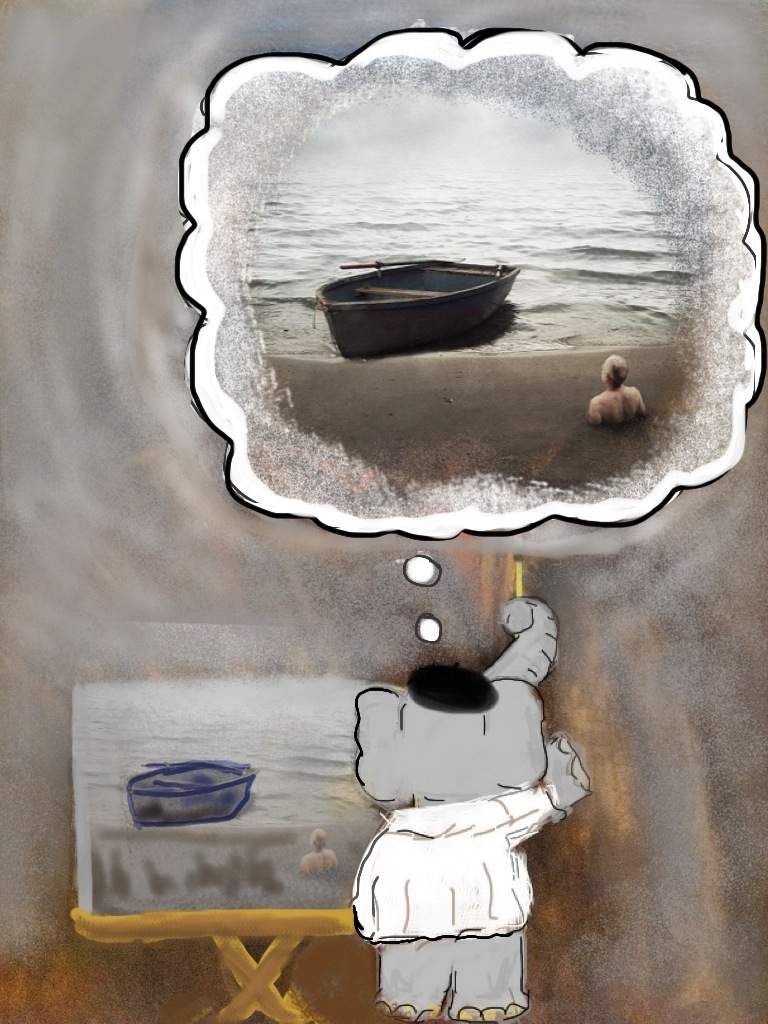
Mag 95- “Futility-Ha!” Mired in Schadenfreude, With Elephant

December 11, 2011

20111211-124855.jpg

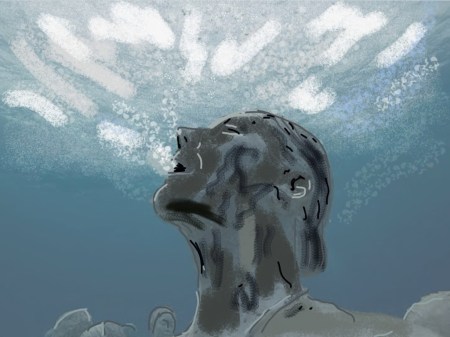
When I saw the photo prompt of Tess Kincaid of Magpie Tales this week–a wonderful painting/photo of a swimmer partly buried in sand, my brain filled instantly with heavy poems.  But in the midst of a sun-filled walk, silliness came to mind, and, true to nature, I opted for that:

Futility-Ha!

The fledgling surrealist, mired in schadenfreude, built his
scene with greyed hues and competitive passion–
Take that, Dali, with your dribble of melting clocks, your
self-referential facial hair; your stinking thrown arched cat–

He sniffed.
And you, de Chirico,
forget the portentous shadows–
he darkened
the outlines of empty rowboat– that grandiose
trapped geometry, I’ll
show
you Futility.

A moment bent towards the palette,
milking color.  What he sought was
the suggestive but mysterious, just a touch
of squeamish–wrinkles in caught
flesh: I’ll put my oar in now, ha ha!
(The tenor of that laugh was getting worrisome, thought the
studio assistant, scurrying for more turp.)

A person chest-swallowed in sand, a nearby boat, parked
boat, sober waiting
boat–  So much for Rimbaud–dab dab–(a muted blue
that should be steel filled the inner keel)– and it will be my passenger
who is sunk
and not the ship; the actor, the observer both, an
image to get stuck from
shore to shore-

To turn up the volume (as it were),
he bared the dim-pale back, turned shoulders
to swimmer’s rounds,
sculpted with cylindrical precision (but unclear
detail) a bathing cap.

Profundity, eh! he grinned, the assistant quietly
checking the studio door–sometimes he locked it
from the inside–
And you, Magritte!  How do you like
them apples?

P.S.  A few side notes: the creator of the true image (without elephant) is Mostafa Habibi, who, to the best of my knowledge, has no beef with Salvador Dali, Giorgio diChirico, Arthur Rimbaud, or Rene Magritte, all of whom I admire greatly.

P.P.S. – if you like silliness, please please please check out my new silly, but fun, teen novel, Nose Dive, by Karin Gustafson, illustrated (terrifically) by Jonathan Segal.   On Amazon.  When you’re there–take a look at Going on Somewhere (poetry) or 1 Mississippi (elephants).  Thanks much!

Magpie Tales 94– Lunch Counter Painting (Reproduced and Poeticized)

December 4, 2011

20111204-093515.jpg

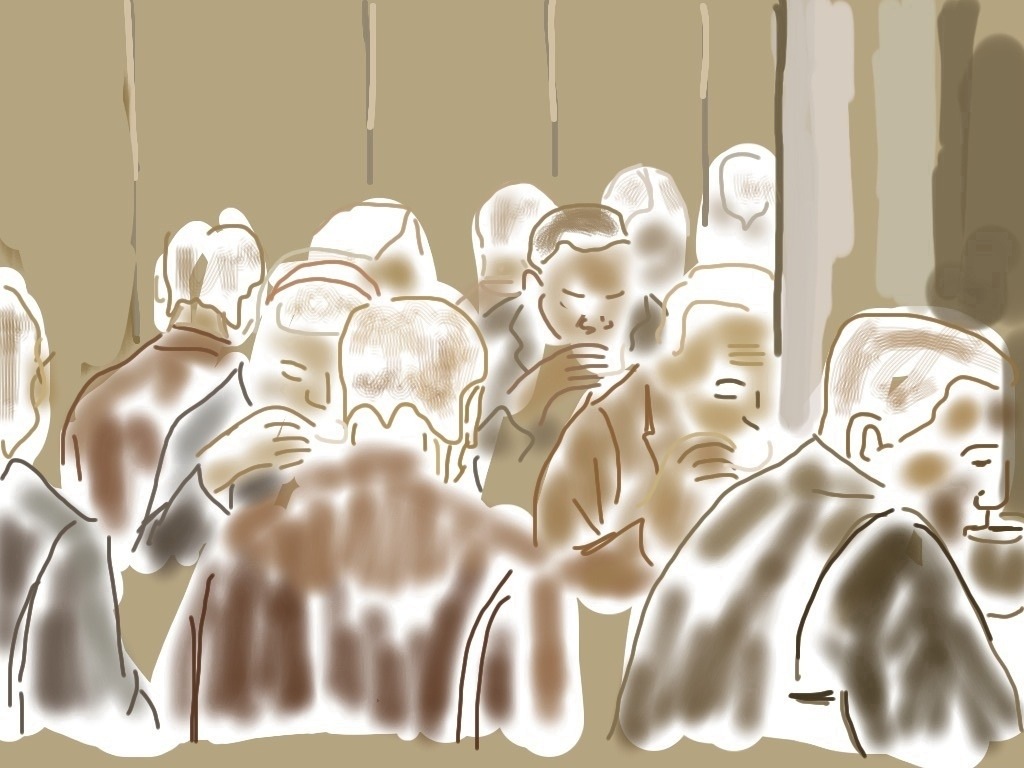
I am posting this (fresh off the brain and iPad 2) for Tess Kincaid’s Magpie Tales 94. Tess gives a weekly pictorial prompt; this week is a wonderful painting by George Tooker called Lunch, exhibited at the Columbus Museum of Art. (The above is my personal reproduction, which I’ve put up just because I enjoy doing my own and can fit it more to my own post. The beautiful original can be seen at Magpie Tales.)

1960‘s Lunch Painting (George Tooker)

Hunched over lunch
as square as
white bread on
processed cheese, each
in a napkin of his/her own–suit
jacket, collar, sleeves–but
what lurks in the hearts
of the beige people?

My guess–everything.
Don’t discount the
counter, fail to read
between the forehead
lines–rainbows
found even in the surface of
coffee regular; a darker face
sandwiched in, intent on the
same meal, not
alien, not, at least,
in this picture, a
painting.

PS- Please please please for Christmas and any purchasing period, check out my new comic teen mystery novel, called NOSE DIVE, on Amazon, written by Karin Gustafson, wonderfully illustrated by Jonathan Segal, available in print and soon on Kindle (for just 99 cents!) Also check out my poems, Going on Somewhere (illustrated by Diana Barco, cover by Jason Martin) and children’s picture book, 1 Mississippi (pictures and words by me. A great book if you like counting and elephants.)

MagPie Tales 93 – “When The Couch Was Saved”

November 27, 2011

20111127-083421.jpg

Here’s a piece for Magpie Tales 93, a writer’s blog hosted by Tess Kincaid, and also GooseberryGoesPoetic.  I have made my version of Tess’s photographic prompt above. The first piece I did for the prompt was about “Hello Dolly!”, but then I started thinking of Novembers in years past, and ended up with the piece below.

When the Couch, at least, was Saved 

It was a time in which couches were saved for company,
their cushions, if not under actual wraps, under threat of maternal bemoan.

It was an age of short white gloves for Sunday School, and
a brand new outfit at Easter–hats with brims if a child, a prim
round edge, if not.

It was a period when the National Anthem was played in movie theaters, and we would stand, conscious, in the projected ripple of stars and stripes on the screen and the echoing thrill in our chests, of the seats at the backs of our knees, the brush of velvet cushion, the chill of metal frame.

It was a day when we parked at McDonalds, its arches like a movie theater too, and from the radio of our white-finned Olds, heard the news about Jack Ruby and his sawed-off shotgun in Dallas.

It was a day we had spent much of standing, down at the Capital, in grieving awe at the jagged prance of the dark riderless horse, the turned-back polished boots.

The news of Ruby, Oswald dead, hit like a third anvil, an odd blank thud on the already crushed. My mother leaned from the car door as if sick, “what in God’s name is happening to this country?”

It was a whisper she would repeat several times over the next few years as we sat on the living room floor before the ultraviolet of aging TV, my mom in a kitchen chair (the couch still saved for company), praying for someone we had loved from afar not to have been shot, or at least, not to die, watching too the riderless wave of what came next and next and next, a velvet place in our aching chests more and more conscious of metal.