
Six, Count 'em, Six
Labor Day Weekend Sunday. Ah.
(If you like rafts and elephants and counting, check out 1 Mississippi by Karin Gustafson at link above or on Amazon.)
Six, Count 'em, Six
Labor Day Weekend Sunday. Ah.
(If you like rafts and elephants and counting, check out 1 Mississippi by Karin Gustafson at link above or on Amazon.)

Last Voyage of the Summer
Enjoy the weekend!
If you like both elephants and bodies of water (in close proximity with each other), check out 1 Mississippi by Karin Gustafson at Amazon and at the link above.
Since I’ve been writing so much about the value of writer’s exercises, I thought it might be interesting to actually give you one.
The rules are:
(As noted previously, these rules are derived from Natalie Goldberg, Writing Down the Bones.)
The topic is “I remember“. This is a nice topic for writers who are blocked, for writers who are not blocked but very tired, for people who don’t consider themselves writers but would simply like to write. Hardly anyone can truly say that they can’t come up with something.
I will post mine tomorrow.
Check out 1 Mississippi, for people who don’t care so much about writing, but want to learn to count. Link to the side. On Amazon.
I want to begin with apologies for my last post to those who are not interested in Robert Pattinson’s struggle with paparazzi. I find the subject fascinating – the part about the struggles with the paparazzi, that is — but I understand it’s not everyone’s cup of tea. So let’s try blocking writer’s block again:
Rule No. 8 – Be Brave. Read Aloud.
If you’ve been following this blog at all, you may remember Blocking Writer’s Block Rule No. 3 – Get a Friend.
By “friend,” I mean writing buddy, someone that you actually write with, meaning right next to, someone with whom you do writing exercises. Your writing buddy may also be someone with whom you share finished, or nearly finished work, but the exercises I’m talking about are the ones that you do on the immediate spur of a new topic, the ones that you write for a set period of time (ten to twenty minutes usually) without stopping, erasing or crossing out.
The next step- after your set time for each exercise is finished –is for you and your buddy to read your exercises aloud.
To each other.
Right then and there.
(I’m not joking, and I want to take advantage of this break in the flow to give credit to Natalie Goldberg, Writing Down the Bones, who originally popularized these types of writing processes.)
Yes, I know. Reading aloud is a bit like taking off your clothes in a crowded room. Only worse. Because the crowd may be so busy, people may not even notice your nakedness. Okay, they’ll probably notice. But it’s a crowd, right? There may be no one that you know, no one that you need ever see again
Your writing buddy is presumably a friend of sorts. He/she is staring (i.e. listening) right next to you. At/to just you. You hope to know each other for a long time to come.
Plus, you’ve just done an exercise that absolutely proves how idiotic you are.
But here’s the trick of it. Your writing buddy has to read aloud too. You might even be able to make them read aloud first. They too have written an exercise that exposes their idiocy.
When you each start removing the clothes… ahem… reading aloud, it’s a tremendous feeling—of freedom, exhilaration, acknowledgement, even if coupled with acute embarrassment.
I don’t know if it helps, but usually my writing buddy and I preface each reading aloud with some well-worn warning such as “this one is so stupid.” Or “I don’t know where this came from.” Or a simple heartfelt groan. This type of introduction is not obligatory, but it does tend to clear the throat.
Natalie Goldberg sets a few ground rules for the listeners of read-aloud exercises. These include a prohibition against evaluating the work—against saying anything akin to either “I really like that,” or “eeuww.” In Natalie Goldberg’s workshops, she urges the listeners simply to echo the phrases that they remember from the piece, a practice which encourages closer listening, but also tends to emphasize what was most vivid about the writing.
That’s probably a good idea. Even praise can be stultifying in the case of exercises; soon you are distracted, writing your exercise for the praise, and frankly, you can’t always do a good one. (Then, when you don’t, you feel horrible.)
But for me and my buddy, Natalie’s prohibitions are hard to follow. We really don’t have the short-term memories anymore to repeat too many phrases that we’ve just heard. And we know each other too well not to guffaw, or say “wow” or “whoops!” So we are usually quite free with our commentary. This makes our writing time more fun. I would warn you, however, that beginners at these exercises might want to be a bit more circumspect.
Still, the question of evaluations raises an important point. One of the greatest things about reading an exercise aloud is that you are putting your work out into the world. You are exposing your work in a very intimate way; it’s not just your words you are putting out there, it’s also your voice. It could hardly be more personal.
But what’s great, what might even make it possible, is that you’re only doing it for a minute or two. You’re reading aloud, and then you are done. No one’s taping you. No one has your printed page to peruse. You’ve put it out there, then grabbed it back.
Besides, it’s a DRAFT. You did it in ten minutes, fifteen minutes.
It’s relatively easy under these circumstances to follow the first rule of blocking writer’s block which is simply not to care too much.
Nonetheless, they are your words, it is your voice, it does take courage. So be brave—read aloud.
You’ll be very glad you did.
(To be continued with Rule No. 9– Don’t be too brave too soon! Know your limits.)
Also, sometime soon, I’d like to write about the benefits of reading drafts aloud to yourself, and reading at public readings. But that’s for the future.
For now, please check out the link for 1 Mississippi, my counting book for children who like elephants (and watercolors) on Amazon. See the link above.
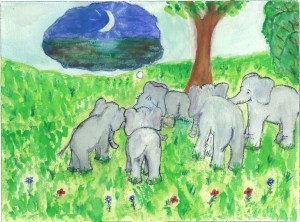
From 1 Mississippi (On Amazon - see link)
Rule No. 6. Go into yourself.
Yes, I know. Yesterday’s rule (Blocking Writer’s Block – Part III) was get out of yourself. And yes, if you are following this blog at all, you probably see a certain pattern emerging. (Other than the pattern in which I write a few serious blogs and then sneak in some commentary on Robert Pattinson.)
But my advising you to go into yourself right after I’ve told you to get out of yourself is really not a contradiction. Because what I’m advocating is that the two steps be taken at different times. (Also, remember that I am writing about writer’s block here. If things are flowing, do whatever you want.)
Getting out of yourself means getting out of your normal grooves. Getting a fresh starting point.
But once you have that starting point, you need to have something to say, right? Something not generic, something unique. You have one great big source of the non-generic right at your fingertips. This is yourself. Your own set of experiences, which if observed with precision and care, are inherently unique.
Now, I really do not push the idea that all writing should be memoir, or confessional, or navel-gazing. Besides the huge danger of self-indulgence, self-justification, martyrdom, in that kind of writing, your friends and family will never speak to you again.
But it really is helpful in getting out of writer’s block, in writing exercises, in loosening up your writing sinews, to feel free to write from your own experience, to write of what you know well.
This does not have to be directly about yourself. It can be the mood of your childhood kitchen summer mornings, or Sunday mornings, or Sunday nights—each one way way different. It can be the geometry of light on the bottom of your community swimming pool; it can be the lines on the bark of a locust tree you used to lean against, counting, when “it” in hide and sick.
Don’t get me wrong. I love plot, narrative. And I love things that are created and fantastical. (I’ve written a fantasy novel which I hope to publish soon.) And frankly, getting too caught up in your own experience can inhibit invention, and can be very very limiting.
But in an exercise in which your primary goal is to simply learn how to think with your hands, to let words flow through your fingertips, it is usually easiest at first to focus on what you know.
It actually takes a lot of courage. The subject is there, but grasping the details, and then putting them on the page, can take real fearlessness. Especially when writing with a buddy. Especially if ever actually re-reading on your own.
But be brave. Take up the thread you’ve been given, that surprising thread that you got from someone else—that topic, or those random words—and follow the thread into yourself. Follow it through curve and cranny. Take a Rube Goldbergesque approach to your exercise. Put in the leaky bucket and the grandmother in the rocking chair, don’t worry about sleekness–whatever works is terrific, whatever gets the job done.
Remember always, if not now, when?
And if you do follow the thread to something that actually happened to you, then sit inside that happening and look at it freshly. Can you see the pores in your Uncle’s nose? Tell us about them. Were there fireflies blinking right next to the laces of your husband’s hiking boot? Make them blink on the page.
Pretend that a brain surgeon has accidentally stimulated that place in your brain where all that particular data are stored. Was there mica in the dust in the curb? Did your friend hold out her hands as she balanced on the brick wall? Did her fingers lengthen in the grey air? Use memory, but feel free to mix in invention. And if you’re stuck, look around the room you are writing in. Or rustle further around inside. You’ve had tons of experiences. Mix it up. You don’t need to stick with just one.
And remember always always, that this is an exercise, a draft. Is your time really so precious you can’t spend a bit on something that you might end up throwing away? Oh please!
To be continued. …
Check out my children’s picture book 1 Mississippi on Amazon: http://www.amazon.com/1-Mississippi-Karin-Gustafson/dp/0981992307/ref=sr_1_1?ie=UTF8&qid=1249231671&sr=8-1
Rule Number 5 – Get Out of Yourself.
Sometimes all you can think when you sit down to write is that you can’t write, you hate writing, you have nothing at all to say.
Jotting down this litany can be a legitimate way to get started. At least, it gets your pen or fingers moving. Pretty soon, though, it’s boring—or in the case of the variation used in The Shining – ‘all work and no play makes Jack a dull boy’ – seriously creepy. In other words, you are putting something down on the page, but you are still stuck in a rut, a rut of your own stuckness.
One way to avoid this stuckness is to try to get out of yourself, your typical grooves. If I were more Buddhist, I would probably suggest looking around yourself, feeling your connection to the greater world. But since I am a dyed-in-the-wool pragmatist (who likes the idea of Buddhism but is not so good at its practice), my advice is to get someone else to give you a topic (or, even better, a simple set of words.)
By “topic”, I don’t mean a paper topic, something to mull over and explicate. I mean a writing exercise topic, something to use as a jumping off point; a stepping stone into your stream of consciousness. But a new stepping stone, not one of the habitual ones that’s become a boulder sealing off flow.
Writing exercises are a wonderful tool for breaking down writer’s block. They deserve their own posts, which I hope to write. As a brief introduction here, I’ll just say that the exercises I prefer are short, sweet, and relatively low risk. They have three basic parameters (derived again from Natalie Goldberg, Writing Down The Bones):
1. Pick a set short time period for each exercise in advance. Use a clock, and make yourself and your writing buddy stick to it. (Ten minutes is a good amount to start with. If you want to be anarchical—try seven, twelve or thirteen minutes. Five is a bit short.)
2. Keep your pen moving or your fingers typing throughout your set time. (Meaning don’t stop and think about what you are going to write next, just write.)
3. No crossing out; no back-spacing, no deletes. (Not during your time limit.)
So back to your topic (someone else’s topic). Choices are infinite. It can be a single starting point: “I remember” can be a good one, or “I don’t remember.” Something about grandmothers often works (almost everyone has something to write about their grandmother.)
But although that kind of single topic can be interesting, you can also get stuck all over again trying to pick the “right” one.
To skip that quandary, it’s sometimes best to just use a list of 5-7 random words as “topic”. The advantage of several words is that none has to be ideal. The requirement is that you simply have to use the words, not actually write about them—they are not your theme (unless you want one of them to be.)
It’s best if the words are not chosen by you, or at least not by you alone. (Choosing with a buddy is fine.) This is because it can be very very hard to make a fresh channel through your own head. The mind is just so tricky—it tends to cling to the old grooves, comfortable with the familiar, even the painful, tiresome familiar. The mind is also a master of self-justification; it loves to set up situations in which it can say, ‘I told you so.’
A quick example: let’s say that you’re stuck trying to write about your cousin’s wedding last year (or last decade) when you suddenly realized that everyone in your family thought you were too bossy, too demanding, to insecure, to ever feel loved. You’ve tried to write the story, you may even need to write the story, but you just haven’t been able to.
So maybe you need to put it aside for a bit; warm up those fingers with something completely different. But if you’re picking you own random words, you may still end up with “rice, veil, resentment, glare, daggers, heart, tin cans.” Pretty soon you’re stuck all over again; you may be writing, but your subject may also be the same old thing–how lousy you feel about yourself and your family.
But if your buddy, or if you have no buddy, your friend, your child, or even your dictionary, picks the words, you might end up with things like” drill, jackhammer, whammo, smudge, chocolate cake” words that have a better chance of taking you into unexplored territory.
You may not initially feel like exploring that territory. Let’s say you’re completely disinterested in drills, only mildly interested in chocolate cake. Your exercise doesn’t need to be about drills; it just needs to use the word. It can come out as metaphor: “the chords of Wagner’s wedding march were like a jackhammer, drilling into her brain.” Or, “the icing formed a snowy veneer, but she knew that her cousin, who truly was the bossy, demanding one in the family, had insisted on a chocolate cake beneath it.”
So maybe you can’t leave your groove. Still you can at least approach it from a different direction. The direction may just feel like a detour but, like the classic detour, it may also help you bypass the closed lanes of your normal route and to miss all those pesky orange cones.
Please check out my picture book, 1 Mississippi, at Amazon.com. http://www.amazon.com/1-Mississippi-Karin-Gustafson/dp/0981992307/ref=sr_1_1?ie=UTF8&qid=1249155338&sr=8-1
Silence in New York. Hard to find. It’s like an animal here, furtive, shy, our native snow leopard. Barely glimpsed, in this case, heard (or perhaps not heard would be a better way of putting it).
I am lucky enough to find it usually. I live at the bottom of Manhattan where winds require closed windows in the winter and concrete floors hurt joints but make an effective barrier to footsteps, bass beats, gnawing arguments next door, moans through bedroom walls.
But now it’s summer; the windows are open wide and the constant whoosh of a broad courtyard of air conditioning units sucks silence like a vacuum right down its multiheaded tube. Drives me crazy at night. In the day time, I can almost ignore, the sight of sun, leaves, windows overwhelms, the low whoosh, but at night, there’s that big vacuum sucking at my consciousness.
I think “car waiting” when I first hear it, but it’s a car that never drives away. Whoosh is not the right word as that implies movement and these air conditioners do not move on. But there’s too much airflow for hum, and it’s just too level for roar.
And it goes on and on and on. I know I’m hopelessly spoiled. When I lived in the West Village, three a.m. was frequently shattered by wailing arguments and the harsh splats of breaking bottles, slaps, cries of “I trusted you.” And then of course there was that bass beat, woofers on every side.
Speaking of noise, Greenwich Village and Bass beats, here is an excerpt from a novel I’m about to publish called “Nose Dive.”
Yes, it’s a teen novel, but it’s funny, and I like to flatter myself- Hiassen-esque.
Check it out below.
Also check out my picture book. 1 Mississippi, available on Amazon. http://www.amazon.com/1-Mississippi-Karin-Gustafson/dp/0981992307/ref=sr_1_1?ie=UTF8&qid=1248518809&sr=8-1
All copyrights preserved.
NOSE DIVE excerpt, copyright Karin Gustafson 2009:
I remembered the night I first brought up the nose job.
“Mom,” I pleaded, “can’t you just focus on me for a minute?”
“Celia,” she protested. “I am focusing on you.”
But what she was actually doing was bending down on all fours, one ear pressed to the floor. She can often be found in this position these days.
“Why do you think I’m trying so hard to get them to turn down that bass?” she went on. “It’s for you.”
The problem is that my mom has become obsessed by noise. This is a big problem. Because, unfortunately, New York is not a particularly quiet city. Even more unfortunate is the fact that we don’t live in a particularly quiet part of New York. We live in the Village, a place with small, echoing, streets that people like to roam at night, often after drinking heavily.
We don’t even live in the quietest part of our building. We live in an apartment that is partly over a pizza parlor, partly over a Lebanese deli, and sort of catty-corner above a bar.
My mom’s obsession began when the bar got a new sound system and, informally, introduced dancing. At approximately the same time, the staff of the Lebanese deli brought in a private boom box, which, when their energy got low—let’s say at 3 in the morning—they’d turn up to brickshaking levels.
My mom went berserk, quickly jumping into full battle mode. “Battle” meant calling the bar and/or the deli several times a night and going down to talk to them in person every other day.
Victory, which took some months to attain, meant (a) the bar soundproofing every spare surface, and (b) the owner of the Lebanese deli, a super nice guy with thick eyebrows and a sweet, sad smile, making his staff get rid of their boom box.
But just as my mother was feeling gleeful, though also a little bit guilty—she gave a huge tip to the deli staff—the pizza parlor turned up the volume.
“It is them!” she cried. “When I called, they said it must be a car, a woofer—” She pushed herself up from the planking. “Who do they think they’re kidding?”
“Mom, it’s not that bad.”
“Can’t you hear that bass?”
“Probably. If I pressed my ear to the floor.”
Actually, that wasn’t true. I could hear the bass even without my ear pressed to the floor. But I didn’t want to encourage her.
“Let’s just go in the living room,” I pleaded.
“How are you ever going to get to sleep with all that racket?”
“Mom, it’s only 8:30.”
“Come downstairs with me.”
“I really don’t want to stand there while you complain.”
“I’m not going to complain. I just want to take a listen. You can pick up a slice.”
“I don’t like their slices. And I’ve got work to do. And I really really really need to talk to you.”
“Please, Celia.”
I got my jacket. But as we stepped down into the street and she positioned her ear on the glass store front right next to the words “Sal’s Pizza”—
“I’m going back upstairs.”
“Celia, please. They may recognize my voice.”
“You mean they may think you’re that nutty woman upstairs?”
“Stay positive.”
We pushed into the vinegary smell of warmed-over bread—no wonder the slices weren’t great—and yes, music.
Which wasn’t all that loud.
The bass was a little insistent—the melody barely peeked over the drum beat. But it definitely wasn’t deafening.
My mother’s eyes, confused, searched the counter, the walls, the oven—
The pizza guy nodded, waiting for our order.
I went to the refrigerator case, got two bottles of water, took them to the counter.
“Aha!” my mom nudged, staring pointedly upwards. A small boom box was jammed onto a teeny shelf right above the soda machines, about two inches from the ceiling—
I paid the pizza guy, then dragged my still upturned mom to one of the small wooden tables.
“It’s not the volume; it’s where they’ve got it sitting,” she whispered. “Celia, I know. Ask him to move it down.”
“I can’t buy two waters, and ask him to move the boom box. Besides, they’ve got all the pizzas down there.”
“So ask him to turn down the bass.”
“You ask him.”
“Please Ceel. They already think I’m a nut case—”
“You are a nut case—”
“Please.”
I wished (and not for the first time) that I was my sister. Maddy was the kind of person who would either (a) just tell the guy to turn down the bass, because she truly believed that my mother’s rights, as the upstairs residential tenant, were being infringed upon, or (b) just tell my mom to shove it because she truly believed that the guy had every right in the world to listen to slightly loud music before 10 p.m. on weekdays. Either way, Maddy wouldn’t just sit there, feeling like an idiot; she’d have a position.
But I wasn’t Maddy, and, at that point, I still hoped to get my mom’s help with my nose. I stepped back to the counter.
“Would you mind…uh…turning down the bass?” I pointed up to the boom box. “My mom’s a little, you know, funny—” I circled my finger at the side of my head, the universal gesture for looniness.
Then felt a sudden swish of sound and air. Uh-oh.
When I turned towards the door, I expected not to see anything except the far side of my mom’s back. Instead, there was windswept blonde hair. A chiseled nose. Grey-flecked seriously profound eyes that, thankfully, were not looking at me at just that moment.
My cheeks heated up like a slice about to be served. I quickly turned back to the counter.
The pizza guy had propped a chair next to the soda machine. He stood on it reaching up to the boombox. “What you want?” he asked, looking down at me.
What I wanted was to sink into the smudged floor tiles.
“Lower?” the guy asked as the music dropped to a whisper.
“It’s just the bass she wants lower.”
“What you say?”
I refused to allow myself to look in Brad’s direction. Still I could feel him, now to my left. At the refrigerator case.
“The bass,” I tried again.
The pizza guy stared at me quizzically.
Praying that Brad was too involved in the refrigerator to pay attention, “the BASS,” I repeated, voice deepening.
The music swung between whoosh and whisper as the pizza guy fiddled with the boombox. In the meantime, I watched Brad out of a corner of my hair.
He didn’t have his girl moat. Which meant I could actually talk to him, say hi, or hey, or Brad! I could remind him that he knew me from math.
He was taking out a beer now.
A beer?
I gently shook my hair to get a better view. Suddenly the green bottle, which I thought I’d just seen at his fingertips, was no longer visible; I could have sworn it went under his jacket.
“There’s no bass control?” my mom asked, coming up to the counter.
“There just this one button.” The pizza guy turned the volume control back and forth again with one large flour-dusted hand.
Cold air swept the space behind me. I knew, without looking, that Brad was gone.
The music was barely audible now. The pizza guy, holding the soda machine for balance, stepped down from the chair. His face was red from the heat of the oven. I realized that he’d been standing about two inches below and to the side of my bed upstairs. No wonder that part of my floor was also always warm.
“Thank you so much,” my mom gushed.
But the pizza guy just stared at her, wiping his hands on his apron, then turned and went back to the kitchen.
Her face turned almost as pink as his had been. “Oh I feel awful,” she moaned. “Am I absolutely terrible?”
I couldn’t answer her. All I could think of was that Brad had stolen a beer while we were distracting the pizza guy.
I tried to tell myself that I must be wrong, that I really hadn’t been watching him.
And anyway, maybe he had some kind of arrangement with the place. You know, because he was a minor and they weren’t allowed to sell him beer.
So he stole it?
Come on Celia, I told myself. This is Brad, you’re talking about.
But I didn’t actually know what that meant.
As we trudged upstairs, my mom’s voice vacillated between triumph and guilt while I tried to not think about Brad.
That’s not exactly accurate. I tried to not think about Brad’s fingertips clasping the beer. What I tried to think about was his beautiful tanned face, his announcement that he was in charge of the spring musical, and my certainty that he was going to have a lot to do with the casting.
“So now can we talk?” I asked.
copyright Karin Gustafson 2009
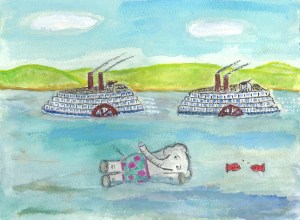
From 1 Mississippi
 ManicDDaily
Recent Comments