Agh! (“Childing” Aging Parents)

Posted September 28, 2010 by ManicDdaily
Categories: parenting, Uncategorized, Vicissitudes of Life

Tags: , , , , , ,

As some friends know, an aging me has spent much of the last month trying to sort out health and care issues of aging parents.  I am not really writing this post to complain (or vent!) but because it seems that this is an increasingly common situation in today’s world, at least among people of my generation.  Following years of parenting children, many are suddenly trying to learn how to skillfully “child” aging parents.

I am not at all good at it.  It is simply excruciatingly difficult to persuade parents, especially parents, who like mine, were marked by the Depression and World War II, to accept the idea of outside help, especially paid help.

There are generational obstacles at play, then too, the natural reluctance of age==issues of ego and feelings of self-worth.

Of course, there are also “simple” problems of logistics, economics, ethics (issues, for example, of free will).

Perhaps more difficult are problems inherent with certain types of personalities.  People change as they age– some distinguishing characteristics (hair, for example) fade or even wear away, while many other traits (let’s say, noses, or ears, or how about stubbornness seem to accentuate.

Some of these personality traits, as well as age-old habits, even belongings, can feel like like life rafts for the elderly–they are clung to with desperate persistence even when the weight of years of flotsam causes them to drag their charges down, or worse, speed them headlong into a dangerous waterfall.  (Leave out the water.)

More painful difficulties arise from  the emotional history between the parent and child–all those incidents, tendencies, expectations, frustrations–similarities.  The same personal traits mentioned above may have already played starring roles in each of the parties’ lives–sometimes to great and wonderful effect, sometimes less so.

History, memory, reverberation–even small sounds are magnified in an echo chamber.  How confusing that these same echoes are interpreted so differently by each side–the parent who feels that they can never please the bossy child; the child who feels that they can never please the bossy parent.

An impasse.  With a history.  And echoes.  Complicated by love, guilt, control!  All played out with a semi-reversal of roles, and with the backdrop of looming disaster.

Agh!

Colbert Link (Congressional Testimony Re Undocumented Migrant Farmworkers)

Posted September 28, 2010 by ManicDdaily
Categories: news, Uncategorized

Tags: , ,

For those interested in my last (sincere but kind of goofy) post re  yard work and Stephen Colbert’s recent testimony in Congress, here’s the link to Colbert’s (sincere but kind of goofy) opening statement.

Yard Work – Colbert In Congress – Draft poem

Posted September 27, 2010 by ManicDdaily
Categories: elephants, news, poetry

Tags: , , , , , , , , , ,

Yard Work is Hard Work

Stephen Colbert, amazingly, made an appearance before the House Judiciary Committee Subcomittee on Immigration last Friday, testifying on issues related to illegal migrant farmworkers in the U.S.  Colbert’s alleged expertise on the issue arose from one day spent with migrant laborers in which he learned that farm work is “hard.”

Colbert’s testimony is fascinating on many levels; a few that especially struck me:  (i) his chutzpah in appearing at all (to highlight the issue with his celebrated bump);  (ii)  his chutzpah in maintaining the Colbert “persona” (the narcissistic, jingoistiic, know-it-all, conservative talk-show host) throughout the testimony, even when it did not seem much appreciated by his audience; and (iii)  his chutzpah in making an oddly sincere and thoughtful contribution to the debate.  It’s all pretty crazy; the aftermath too.

In the meantime, I had an independent, and far more pampered, experience of agricultural “work” this weekend.  (I hesitate to make the comparison to either Colbert or migrant farm workers–my experience was as much in the nature of exercise as work and completely voluntary.)  But, it gave rise to a draft poem.  (Note that the competitiveness at stake is not with Stephen Colbert.)

Raker’s Progress

Yard work is hard work;
raking makes for aching
even for the frequent
grass-comber, but for the grandiloquent,
hell-bent on proving that she
can too do it, that she can more
than do it, certainly
as well as he,
it makes for a sore
next day.

To Hope, Boot Camp, Tortellini

Posted September 26, 2010 by ManicDdaily
Categories: Vicissitudes of Life

Tags: , , , , , , , ,

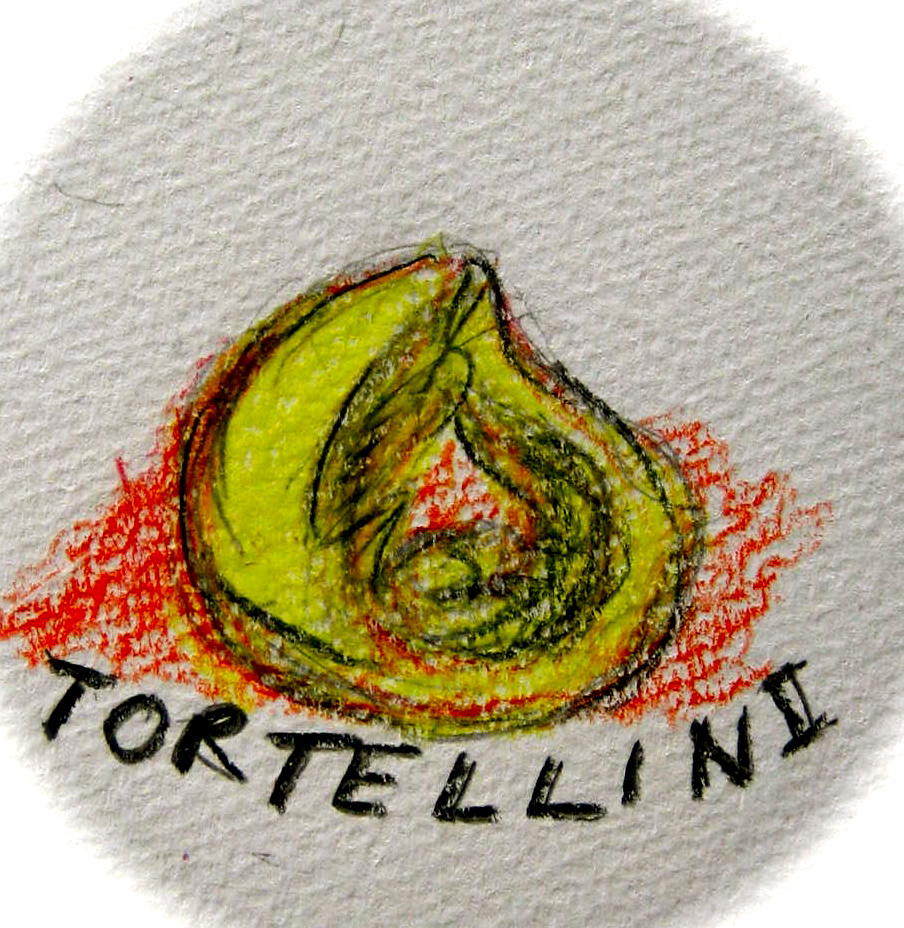
Is Just One A Tortellino?

We have a wonderful young family member soon to complete Boot Camp.

He loves tortellini.

We worry about him.

I’m sure they have plenty of pasta in the Army, but is it the right kind of pasta? Even noodles are acceptable (he’s a tremendously adaptable guy), but what he loves are tortellini.

So far he seems to like the food okay; still we worry.

Here’s to hope; here’s to prayer; here’s to good fortune; here’s to tortellini.

Bernadette Peters and A Chocolate Egg Cream (With Fry)

Posted September 25, 2010 by ManicDdaily
Categories: New York City, Vicissitudes of Life

Tags: , , , , , , , , , , , ,

Bernadette Peters With Egg Cream

I really like Bernadette Peters.  She is all the things a musical performer should be–supremely professional and uniquely graceful with a vast range (not just of the vocal but of the dramatic).   But I realized recently that my affection for her was based on more than all that.  There is also a certain warmth by association, the kind of personal, Proustian aura that may incite much fandom.

It started with her wonderful performance in Annie Get Your Gun on Broadway years ago.  My children and I went to the show because we had a friend in the cast.   He very kindly arranged for us to meet Peters backstage.  She seemed then (and now) just about the prettiest person I’d ever seen, like a creamy bouquet of purplish pink flowers.  My younger daughter especially was entranced.

But my affection for Ms. Peters really sparked the second time we saw that show (my daughter was extremely entranced).  We went with another set of friends, also with children.  I was feeling a little guilty.  Seeing the show twice was a huge extravagance–I had recently separated from my husband and had moved back from Brooklyn into Manhattan to be near my children’s private school–all factors which made money extremely short.

As a result,  I was happy that we settled on HoJo’s, a place that seemed both affordable, but had real seats, for the post-Broadway snack.

Oh HoJo’s!–I hadn’t been there for years and had almost forgotten the HoJo mojo–that wonderful creamsicle orange, swimming pool turquoise, giddy scent of fried clams!   (Oh childhood!   Oh tartar sauce!  Oh New Jersey turnpike!)

The father of the other family, Alan, was the only male in the group so he tended to fill a rather large spot in our table’s center stage.  A friendly, wise-cracking and rather short guy (otherwise completely unlike Bernadette Peters), he ordered a chocolate egg cream, which, when it was brought to the table, had one small crisp french fry floating below the foam–at  first  a source of mystery (was it a bug?) then amusement, as was the egg cream itself.  It all just seemed so New York.

Which brought me to the bemoaning of our new apartment.   It had been the best I could afford, but had turned out to have several significant drawbacks–features which I felt I should have noticed before I signed the lease.

Ah, but there was a learning curve in assessing urban real estate, Alan said.  On renting his first apartment, for example, he had not noticed that there was only one electrical outlet–in the whole apartment–which was located in the bathroom ceiling as part of the bulb light fixture.

He recounted the next several months, hooking up a full-size fridge to the light socket, unplugging it to shave  (with electric razor), reaching in (once he squeezed into the bathtub) for the occasional cold beer.

Whenever he rented an apartment after that, he said, he was very careful to check for electrical outlets.

With a rueful grin, he ordered another egg cream, asking the waitress to hold the fries…errrr… fry.

We could not stop laughing.  Alan had great delivery, but there was something more –the reflected brilliance of Times Square/Broadway/theater–whatever–that evening became imprinted as a silly, happy, children-in-New York memory, indelibly linked to Bernadette Peters.

Which is one reason that I recently went to see her in the revival of A Little Night Music. by Stephen Sondheim.

Frankly, there were several times in the production when I wished for a little less night music.  The actors were good, and though I admire the type of mind that can coherently rhyme “raisins” and “liasons,” good actors and cleverness alone can’t quite carry me through three hours.  There is just too much of everything in the play except for likeable, fleshed-out characters and/or an intriguing plot.

Except that there is also Ms. Peters.  Send In The Clowns, her big number, is not a favorite song, with all its potential for the hackneyed.   But her sensitivity, vulnerability, voice, timing, expressions, put one in touch with what is the best in performance–the sculpted but true moment–the poeticized real–something that is both wondrous and immediately recognizable; an empathy-inducing shimmer that, incredibly, is reproduced again and again, night after night.

I was so happy to see that my affection wasn’t all based on egg creams (with or without fries.)

Slopes (By The Hudson – Draft Sonnet)

Posted September 24, 2010 by ManicDdaily
Categories: poetry

Tags: , , , , , , ,

Slopes

Difficult days call for draft sonnets.   Here’s one written on the MetroNorth train up to Poughkeepsie, a beautiful ride along the shore of the Hudson River.

(This really is a draft, freshly minted; suggestions welcome.  I’ve used slant rhyme and, I’ll admit it, an uncertain rhythm though I do work with a certain foot count.)

Slopes

On the Hudson, they’re almost horizontal.
(In the heart, their sheer drop takes the breath.)
At riverside, they wear a dusky mantle
as they carve out the only darkness
in the evening sky.  I am the kind of
person who wants to beg a dying friend
not to go, but keeps enough of the mind of
reason, science, skill, to make me bend
that hurting will to the speakable.
Still, it echoes in my soul–’don’t go, don’t go’.
Eating on the train, my lap a table,
outside, a sudden night blanks high and low,
slopes of grass and bank no longer seen,
only lights–across, here, there–and, where close, green.

What Didn’t Quite Suit Us – Women’s Wear Workplace Circa Some Time Ago

Posted September 24, 2010 by ManicDdaily
Categories: Uncategorized, Vicissitudes of Life

Tags: , , , , , ,

Speaking of pens, I am writing with a new one.  And it’s blue!  (Cobalt!)

And I’m wearing a bright green sweater (chartreuse!) on a day in which I am to meet with a client.

And shortish pants–cropped!

(I actually put on a suit jacket before leaving home, and then a blouse, and then a different sweater, and then the jacket again, and different, longer, pants, and then the green sweater again–instead of the jacket and that blouse–and then an underblouse, and then back with the cropped pants, and then I was really getting kind of late so I had to just keep on what I had, although when I got to the office I did take off the underblouse once more, but kept on the sweater.)

There has been a revolution in women’s workplace clothing over the past twenty years.

When I started as a young (I’ll admit it) lawyer, it was all blue (as in midnight) or possibly black, and cut into cookie-cutter suits.  I am talking jacket and skirt suits.  A woman partner (woman partner!)– there were a few of those back then but they were mainly wealthy women who practiced trusts and estates on their wealthy friends–could get by without lapels and possibly even red , but the lowly first year associates had to stick to the basics.  (As in blue, black/blue-black.)

I bought my first suit at a small dark shop on Orchard Street.  Harvey Bernard, midnight blue, pinstriped—the narrow skirt was a real b—- to try on behind some bolts of fabric and dust.  (For that price, I expected a changing room?!)

I wore the suit nearly every day for several months.  It was a curiously hermaphroditic ensemble with padded square shoulders, mannish lapels on top, below, a narrow slightly slit skirt.  The inside held a curly-q bow and some kind of silky blouse (no cotton).

I remember getting an extremely short hair cut a couple of years later and a senior partner pulling me into his office to berate me on its boyishnesst:  (i) “how could you do this without consulting me?” and (ii) “you might as well wear trousers.”

Trousers were introduced at the firm by a visiting Japanese attorney who would not have comprehended any complaints about her attire.  We all quickly followed…. suit.

The good part was that it was kind of uniform—you couldn’t really worry about whether the clothing was an expression of your inner self .  (What you worried about was whether the job was an expression of your inner self.)   This made for a relatively easy morning—stockings, skirt, jacket, bow, worrying about the job.

No Return/Reprieve For the Pen

Posted September 22, 2010 by ManicDdaily
Categories: Vicissitudes of Life

Tags: , , , , , , , ,

This was a stupid incident, but it’s stuck with me.  It happened when I went to the office of an accountant on a recent trip to Florida to visit to my elderly parents.

A part of me really does believe that you shouldn’t just a book by its cover.  But there’s another part of me that makes judgments based on “covers” all the time, that makes judgments before I even see covers.

Here the judgment started with a phone conversation with the accountant’s receptionist/secretary.  The timbre of her phone voice was crisp, nice enough but edged–the kind of “niceness” that said I darn well better be nice back.   I hate to politicize everything, but I sometimes associate this kind of crisp, slightly demanding, nice voice with a certain worldview–one that  favors Nixonian law and order, the Rockefeller drug sentencing mandates, three strikes you’re out, black and white (no grey), and multiple tours of duty for reservists (‘they signed up,after all’).  In my mind, the voice goes with very neat, slightly curly hair and a certain kind of Republicanism.  (Yes, I know this is unfair.)

I should confess that I was also being nice but edged back (though my hair is stick straight.)

I had initiated the call to check on a missing tax return that I found out (from the receptionist) was being done on  extension.  I quickly explained that if the return could be completed while I was in the area, I could save the accountant a lot of trouble by picking it up (it is usually delivered by the accountant personally), filing it, and making arrangements for the payment of the accountant’s fee.

The receptionist mumbled something grumpy about the accountant just finishing corporate returns, the due date not being until October, and the end of the week coming fast.  I asked her to please relay my message.

The next day, sure enough, I got a call that the return would be finished that afternoon and that I could pick it up the following day.

And here’s where the interesting part began.  (Sorry for all the prologue.)

I got to the accountant’s office mid-afternoon.  It was empty, but I was also tousled, and the receptionist had me wait while she licked some envelopes, finished some notes.

I gave her the check for the accountant’s fee.   She reviewed it, then asked me to sign a receipt for the return, handing me a pen.

The pen didn’t work;  I apologetically (but probably slightly triumphantly) handed it back. 

“That’s funny.  It worked this morning,” she said with some irritation.

I apologized that it might be me, something about the way I held it.  But she, with a quick flick of her wrist, and not a single experimental scribble, tossed the pen into the garbage.

Maybe it’s the writer in me, but I never throw away a pen lightly.  Not even after multiple tries.  And shaking.  And very vigorous scratching about.

“It really might be me,” I repeated.

But she nodded dismissively–”better safe than sorry.”

(There would be no more trouble from that pen.)

I have thought about her words for some time.  What could be unsafe about a possibly malfunctioning pen?  What, the source of sorrow?  That someone in the accountant’s office (chockfull of other pens) might have to retrace their signature?

I wanted to actually slither through her receptionist’s window and retrieve the poor pen, but she was so definite; her lips pressed together, her hair immoveable, her safety protected, that I did not dare make an appeal.  Thankful that she worked for an accountant, and not the IRS, I grabbed the return and ran.

Alanna in Afghanistan? Girls Raised as Boys Taste Freedom And Sadness.

Posted September 21, 2010 by ManicDdaily
Categories: news, Uncategorized

Tags: , , , , , , , ,

The Shield of "Boyhood"

Today’s New York Times has a fascinating and rather sad article by Jenny Nordberg about families in Afghanistan raising a daughter as a son to cope with the pressures of a society in which boy children are incomparably prized.  The reasons for raising a girl as a boy differ – in some cases, the “boy” is the only one who can work in the world, providing support for a family of females who are not allowed to earn their keep; in others, it is to provide some protection from the rebuke and ill fortune deemed the lot of a family solely of daughters.  The selected girl (usually a youngest daughter, chosen when hope of a boy child wears thin) is raised as a boy till puberty or beyond (sometimes even till marriage) , despite the risk of the girl’s body betraying her.  The “change back” to traditional female comes as a brutal shock to women who have been used to the freedom–societal, mental, and physical–that only “boyhood” allows.  Such women have difficulty not only in assuming their circumscribed feminine lives, but also in relating to other women.

How do you regurgitate a taste of freedom?  Some women (such as one of the main mothers interviewed) hope that that the experience of boyhood will enlarge the ambitions of their daughters, empowering them even after they are forced to revert.

Obviously, the article–the phenomenon–raises lots of questions, many of which can be summed up by the word “how”?  But one obvious point is simply the difference in Afghani culture from the mainstream West.   This is the stuff of fantasy in the West  (setting aside transgender girls and boys, which are a somewhat different phenomenon).   Alanna!  The wonderful/horrible series of children’s  fantasies by Tamara Pierce about the girl who disguises herself as a boy to train as a knight.

It’s also the stuff of history–those ages in which women could not own or manage property.  (In the children’s book area, this territory has been beautifully mapped by Phillip Pullman in the Sally Lockhart series.)

Okay, I’m not saying that everything is so clear and straightforward for girls in the West now.  Factors in Western culture push girls to all kinds of self-distortions–i.e. anorexia, cosmetic surgery. I recently received an Urban Outfitters catalogue in which all the female models look like underage prostitutes on quaaludes.

Oddly, many of these distorted means to power have a stereotypically feminine aspect in the West.   Girls who can only roam with relative freedom when they can pretend to be boys?  Girls who shield their whole families through such conduct?   This is something apart.

Pauvresse Oblige

Posted September 20, 2010 by ManicDdaily
Categories: news, Obama, Uncategorized

Tags: , , , , , , , ,

It sounds paternalistic; it is paternalistic; but the concept of noblesse oblige, or as Sergeant Colon of Terry Prachett’s Discworld calls it – nobblyesse obligay–used to make the wealthy and/or aristocratic feel guilty enough to do the right thing, at least some minor sacrifice which passed as the right thing.

The “right thing” in this paternalistic, but noble, world meant something that was fair-minded,  generous (i.e. not greedy).  This seems to have been a little more clearcut in times before trickle-down economics or of  ‘get as much of it while you can’ economics (the system we seem to have now.)

As Paul Krugman points out in today’s New York Times (“The Angry Rich”), many of the rich in the U.S are hopping mad.  They feel absolutely entitled to  (or perhaps psychotically defensive about) their hundreds of millions and are really really worried about a return to a tax system that was in place a mere ten years ago.   An especially angry billionaire, Steve Schwarzman, has compared President Obama’s proposals to tax the earnings of hedge fund managers as ordinary income to Hitler’s invasion of Poland.   (I’m not completely sure who is more injured by this type of statement–Obama or the people of Poland, whose suffering in World War II seems horribly demeaned by such an idiotic comparison.)

What’s crazier, and sadder, is that so many ordinary Americans are caught up in the defense of the rich and super-rich.  Such Americans, angered by the more visible entitlements of the poor (which in the big scheme of things are pretty paltry–that’s why they are poor). give the rich a free ride.   Many of the working and middle class seem to view the rich as a parallel (if luckier) group to themselves; hard-working folks who deserve to keep absolutely all of what they have.   They don’t seem to ask if the rich are really thousands of times more hard-working or deserving than a poor guy or gal with two low-paying jobs.

The idea has been spread that protecting a billionaire’s billions from a pre-George W. Bush level of tax is somehow incremental to protecting a middle or working class person’s thousands (or hundreds); the fact that it’s the Republicans who are holding tax reductions for the middle class hostage has also been obfuscated.   What’s saddest is that many of the working and middle class do not seem to recognize that by fighting any return to the former tax regime for the rich, they are unknowingly offering to make big sacrifices for them–sacrifices in safety, public services, decent schools, a civil society.

A not so minor sacrifice.

Pauvresse oblige.