Archive for the ‘writing’ category

Twilight Saga Eclipse – Embarrassing – Something To Learn From

July 1, 2010

Embarrassed Pattinson

I’m putting aside all this discussion of constitutional issues and the Second Amendment today and getting to something really important:  the new cinematic installment of the Twilight Saga – Eclipse.

And I’ll stop right here.  I can’t, with a straight face, call it really important.  With a straight face, all I can call it is really terrible.

The most fun part, in fact. was standing in line in the theater with two twenty-somethings who kept talking about how much they hoped that they would not run into anyone they knew, and which particular person they would least want to run into.

At the end of the movie, we all three walked away very very fast.

The problem, aside from idiotic dialogue, and visuals that, on individual shots, make the actors look incapacitated by angst or glum boredom, and group shots, as if they are on a fashion photo shoot, is that its makers disdain the basic material.  Yes, the books are goofy; yes, the writer is a Mormon; yes, a big feature in the plot is the maintenance of chastity before marriage; and yes, Edward is just too “good” to be true—yes, these factors are all pretty dumb and very uncool (as is a lot of the Twilight crowd),  but they are the givens; a big part of what made the books popular.

One can feel the director, David Slade, the script writer, Melissa Rosenberg, strain against these very uncool, unhip, givens; they seem embarrassed to be connected to a movie promoting them  (just as we, hip New Yorkers, were embarrassed to see it.)  (Although Slade and Rosenberg are, I’m sure, eager enough to make money from it.)

The exceptions here are perhaps Taylor Lautner who seems, sorry, clueless enough, not to mind the story, and still too thrilled by the fact that they kept him in to be disdainful of anything, and Billie Burke, who is just a good professional actor.  Okay, okay—I’m not going to blame Pattinson (who is given truly awful lines, and very little leeway to smile charmingly) or Stewart either.  It’s the Director and Screenwriter, who seem like the true teenagers here, mortified by their parent, i.e. their base storyline.

But a movie that doesn’t like itself is just not likeable.   To make a stupid, uncool, story work, you have to just go with the stupid, uncool flow, not try for a stupid cool flow.  (Otherwise, it just doesn’t make internal sense.)

Bringing this around to something that may be of more interest to followers of this blog:  it really is important, in pursuing any kind of artistic endeavor, to make a kind of peace with it, to let go of that edge of embarrassment that sometimes clouds one’s work and commitment.  If you find your work truly embarrassing (not because of modesty, but because of something deeper—because the work is it is too personal, too openly reflective of your goofy side, or the opposite, too blatantly commercial and not reflective of your goofy side), it will be very difficult for you to really push it to any kind of happy fruition.

Happy Belated Bloomsday!

June 18, 2010

Happy Belated Bloomsday!

I missed it yes I did an important day I don’t know where my mind was under the bed or out the window or most likely in a screen where real life and even book life can pass you by it’s not really an important day not like a birthday they made a lemon cake this year orange really out of lemons and didn’t want to drive to town moist as anything the zest of orange so sweet if anything a book holiday not bank those manicured sons of bitches O and now its too late to even talk about it much less write but Ive always been on the late side running for the train my suitcases better have strong wheels

I actually did go to Dublin years ago so grey and blue and gusty the Irish Sea like that scarf that’s been lost and found all crinkled not with huge waves but on every single inch of it pressing me to the railing the whole night long freezing over the side I was and sick as a dog while the natives kept to the warmth in the saloon of course like a parody of Irish drink and song I could hardly stand and neither they staggering out red faced morning with cheap black pants legs clumping over stuttering shoes it was so long ago and poorer then though now is not great either what with the crash me as green as sea ice even on land I was pale back then O not like now maybe get some special cream for redness wrinkles too real soda breads on the shelves lined up like little school kids I tore the pieces that’s how hungry I was when I finally got over it no knife and my fingers scrabbling among the caraway and crumbs Martello Tower what I most wanted to see the Joyce stuff most were grey toned streets but it with all its grey stones was blue that morning out by the sky and sea and Im standing there on the pavement admiring tea I can’t help thinking of tea with Martello Tower in front of me thick brown irish tea with the thick slabs of bread and butter Stephen Dedalus and Kinch his sort of friend  the milk in that chapter so thick and sweet as well the whole breakfast one I dream of porridge sometimes too humble not French toast or pancakes or what do they call them crepes but those thick sweet slabs of tea in sun and cold and tower though its not all sweetness Joyce not exactly generous to his past not is the word forgiving?  Art like a knife the wind then too December not June when I got closer to the tower and a woman all bare and white her flesh as creamy as the milk only with pink folds where she rubbed she had a little towel and then just undies bra and panties overflowing robust that’s what you had to call her her flesh so white and pink and flowing like the wave crests maybe a nice bit of pork I hate the way they hang those sides up in the window no not like pork everything about her lived fresh from the sea she had been swimming and her curls the only thing that didn’t glisten curly hair don’t with its frizz I wish I had it mine straight as a stick my whole life long but what I really wished for then was that glow smiling at me towel rubbing the nape of her neck below the curls.

In the movie she has curls too her dark hair spread upon the grass in Andalusia some place south and is kissed and saying yes though I’m not sure about the grass in the book itself and how do you make a movie of a book like that or any book to tell the truth I do know that she says yes though I’m sure of that even though I missed the date that’s the one thing I won’t ever miss that she says yes.

Stress and Creativity–Making Choices (Arranging the Lives of Characters Not Family Members)

June 1, 2010

Space

My newly discovered focus on stress and creativity has energized the part of me that loves to give advice.  The one caveat I would make to those reading my advice:  “do as I say, not as I do.”  It is infinitely easier to dish out good counsel than to follow it.

Life is stressful, particularly in the modern world where many play multiple roles; there are the stresses of all that must be done to maintain a job, home, family;  then, there is the added stress of distraction, so many possibilities for avoidance.  Right at the tips of our fingers are the means to while away huge amounts of time—email, Facebook, worldwide news services, horoscopes, blogs, video clips, even favorite TV shows.

In my experience, creative people find it extremely easy to justify giving in to distraction.  We characterize it as “inspiration,” “research.”   We persuade ourselves that it is necessary “keeping up,”  important “networking.”

Some of these justifications may be valid, up to a point.  But the problem is that creativity needs space, a bare spot in the brain to flop around in.  Sure, a brainstorm can arise during a tumult of activity and distraction, but accomplishment (that is, finishing something) generally needs a bit of concentration; time; solitude.

Even if we can restrain our fingertips, nipping computer distraction at the knuckle, there is also the problem of … people; the real live human beings in our lives.  Creativity thrives on people; it wants to speak to people, to impress people, entertain them, awaken them.  Even the most narcissistic artist usually has some genuine sensitivity and empathy.

Still, usually you can’t actually make something (other than perhaps a baby), if you do not cultivate a certain reserve.   By reserve, I do not mean coldness or apathy.  I mean, once again, time, space, quiet, focus.   Given such needs, you may sometimes have to distance yourself from people, to make a choice not to be involved in every family or community drama; to try not to “fix” people (other than your characters).

I should step back here: creativity comes in many different forms.   Some people find their creative expression in mediation or entertainment, in, for example, preparing the perfect family reunion or dinner party.  I had an aunt like this who expressed herself through her elaborate celebrations; I have a cousin who manages to send cards to a wide variety of people not only for their birthdays, but for Christmas, Easter, Thanksgiving, Mother’s Day, etc.

But if you want to focus on something more egotistical– poetry, writing, painting—and you are not making a living from this work—then you simply have to make choices.  Arranging other people’s lives, or even the perfect dinner party, may not always be possible.  Accept that.   (And you may just find that the other people in your life benefit from this choice as much as you do yourself.)

Longterm Focus – Stress and Creativity – Pearl!

May 31, 2010

Pearl - Habit and Engagement

The other day I worried that I really didn’t have a focus for this blog; something to orient  both me and any readers I may be lucky enough to snare.   What have I been I writing about?  What subject do I even have to write about?

Then I suddenly realized that the general subject of this blog has been stress and creativity.  If I wanted to sound official, I’d say the interface between stress and creativity, but since I can’t say that with a straight face (or interface), I won’t.

What does this mean?  I guess the question for me is how one, in this manically depressed stressful modern world, maintains some kind of creative effort?  How can one use stress as a source for creativity rather than as a wet blanket for its termination?  (How, also, can the manic avoid using creativity as a further source of stress?)

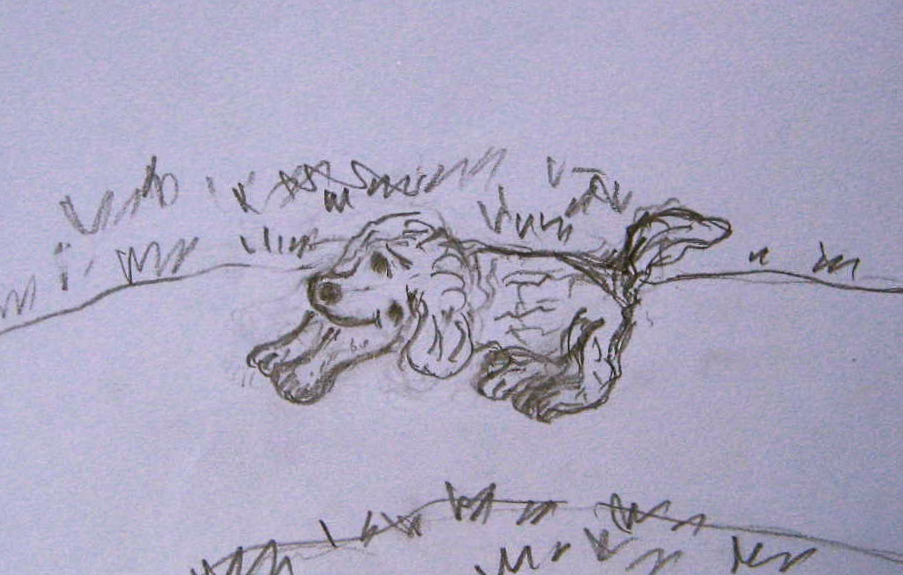
For my first conscious exploration of this subject, I turn to the teachings of my old dog Pearl.  Pearl was struck by a sudden spine problem a couple of weeks ago that paralyzed her from the dog-waist down, rendering her hind legs both insensitive and immobile.  Amazingly, with the help of steroids, she has recovered some use of her legs: she can wobble along now, though she moves like the proverbial drunken sail—dog.  (BTW, after reading several Horatio Hornblower books last week, I now feel enough “expertise” to understand that the unsteadiness of a drunken sailor is archetypical because it arises from at least two sources—(a) alcohol and (b) sea legs, i.e. legs accustomed to the sway of waves that are suddenly posited upon dry land.)

Pearl’s up in the country this weekend, and her reaction to it is a lesson in the maintenance of creativity under stress.  (For these purposes, I’ll consider Pearl’s outdoor explorations and general cuteness her “expression.”)

Pearl still has trouble even walking, and yet, here, in a country place she has loved since puppydom, she wobbles, skips, trots.  What motivates her, what keeps her going, seems to be two factors:  habit and engagement.

There are certain places (a long dirt driveway), and certain times of day, in which Pearl has always run here.  That habit (plus steroids) is so strong that when I put her down on these spots, and at those special times, her legs just move.

Where habit runs out, engagement takes over.  The scent of a place where a deer has recently bedded down will lure Pearl, sniffing, into tall grass, pull her through reeds, propel her into Heraculean effort.  I can only derail her lopsided enthusiasm by physically picking her up and putting her back on her track, where, out of habit, she quickly wobbles off again.

Which brings me back to the creative human mind dealing with stressful obstacles–all those drags upon the consciousness.  How to avoid paralysis?  How to dart and trot, dig and ferret?  How to just keep going?

This (I think) is this blog’s inquiry.

Thanks so much to those who have been following.  Stay tuned.

Elliptical Thinking ….errr….Writing

May 12, 2010

Gym Blogger

The other day I blogged about learning to write wherever–not, in other words, using one’s lack of a writer’s cabin as an excuse to put off work.

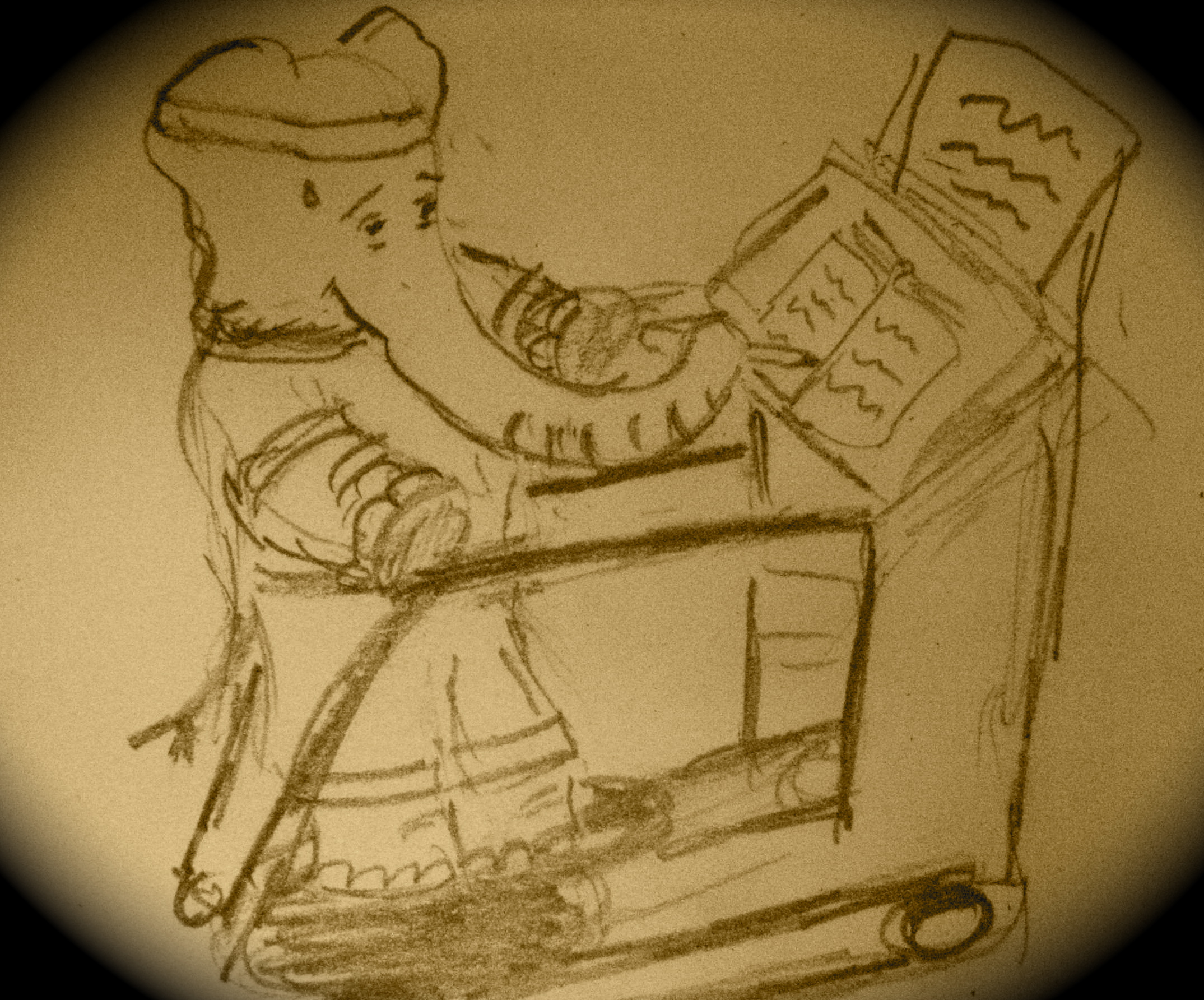
Today, I’m putting that admonition to the test by blogging at the gym.  Right now, I’m writing as I walk down the stairs to my gym, now I’m writing as I swipe my gym pass, now as I walk past the yoga class (writing there might be considered anti-Om). The place I’m heading is the elliptical machine, a machine which is dull, repetitive, and has a good ledge for my notebook.

And now I’m on the elliptical machine, and, in fact, I am already experiencing a slightly uncomfortable burn in my upper thighs and a definite twist in my lower back.  (One problem with writing on the elliptical, or perhaps any exercise, machine is that it’s hard to keep your body symmetrical.  I should note here that I’m writing in an old-fashioned composition notebook and not in an iPad or other electronic device which would perhaps allow one to jog and blog in perfect two-handed symmetry.)

Ah.  (It’s working… I mean, I’m working,  sort of.)

Though there are a few caveats to writing on an elliptical machine:

1.  Take care not to press your notebook into the electronic display or you will completely lose track of your time, strides per minute, calories, distance and heart rate.  Actually, forget about heart rate.  You are not holding to the hand bars and those heart rate measuring strips never truly work in any case.

2.  Do not expect to reach your maximum speed.  Maybe, in fact, it’s best not to even try for your maximum speed.

3.  Do not expect to write the great American novel.  At least not on the elliptical machine.   Frankly, if you wish to avoid disa—

Oops!  Just pressed the display  and the whole machine is rearing up, meaning that I’ve not only lost my time and calories, but all my resistance settings have plummeted and I’m suddenly going about a mile a minute.  No, only 141 strides per minute, but that’s still a bit fast for good sentence structure, and it also feels–

As I was saying (I’ve reset the settings now), if you want to avoid disappointment, you may be wise to let go of expectations of writing the Great American Novel, whether on or off the elliptical machine.

But seriously, the points of all this are:

1.  You can write anywhere.  Granted, the writing may not be always that great, but it can help you keep your writing muscles toned.

2.  We (I) seem to have this need to both multi-task and communicate.  Yes, it might be better to quell these needs, but sometimes there can be real comfort in just accepting your predilections–your fullest, most manic self (if you are not actually hurting that self or others).

Sure, people may view your truest self as being a bit strange–for example, the people around me right now may think I am a pretty poor excuse for a gym rat.  But, who cares?   There are plenty of empty machines to my sides.  In fact, my whole little section of this fairly crowded gym is completely unoccupied….

Hmmm……

Brain Teeming? Try Rhyme!

May 11, 2010

Locust Leaves

What to do when your brain is teeming too much to think straight!  Write a poem, especially a rhyming poem.

A rhyme offers a wonderful thread away from fretful pre-occupations;  it can take you somewhere quite magical.   So, in the stress of mid-week, even though I no longer have the excuse of National Poetry Month, I am posting a draft poem written this evening, made up of rhyming quatrains.  (I don’t think it qualifies as magical, but it was a fun exercise.)

Behind the Locust

She tiptoed under the locust trees,
their shade bared earth, her shorts bared knees.
Their bark was rough, as rough as you please,
though the wood is soft in locust trees.

Though the wood is soft, the thorns are not;
sticks fall down, and leaves on top.
She tiptoed through the thorny plot
of earth and stem and leaf and rot.

The trunk was thin but she was small
and stood at angles–so, and so,
shifting from tip to the other toe,
to hide from all who’d come and go.

No one was looking, but still she hid,
looking herself at all they did.
She watched them walking, watched them sit,
keeping close the tree’s close fit.

What mystery to be lost and found
beneath the slightly rustling sound
of leaves like grapes; inside, the pound
of a heart that’s longing to be grown.

Blocking Writer’s Block: Don’t Worry About the Where

May 11, 2010

Writing IN Your Notebook

I am returning to my series of posts on blocking writer’s block this morning at one of my favorite secret places for writing—the New York County Supreme Court building at  111 Centre Street.

Yes, the downstairs lobby is a bit tacky.  From the outside, the place looks dark, shut down; you feel almost certain from the sidewalk, that the main exterior doors will not open when you push.  (In fact, they do not open–much.   They squeak, scrape, and stick; with a lot of force, you can just wedge yourself through.)

But when you do get inside the building, past the metal detectors, beyond the dingy elevators, up to a highish floor, a sea change occurs—the main corridors here are lovely, with granite floors, marble (or faux marble) walls, and tall windows edging the South, West and East exposures, looking out over lower Manhattan.

I’m not saying that these corridors are particularly posh—there’s a definite utilitarian cast to the white plaster-board of the dropped ceilings.  Even the granite and marble look as if the colors were chosen not to show dirt.  (These are public buildings, after all.)

But the wooden benches that line the windowed walls are smooth and comfortable,  sunny and light, and, if you are not on a floor of bored and disgruntled jurors, the corridor carries such a serene hush that when, in the midst of muted steps, you hear a murmur about “what street informants want,” you are definitely taken aback.

I have to say upfront that I’ve never gone to New York Supreme just to write—I’ve always had some official purpose, and had to sit there waiting to fulfill it.   But it is nonetheless a very good place for writing.  (If you haven’t been sub poenaed, virtually no one bothers you.) Important caveat:  I think that coming in here just for a quiet place to work might actually constitute some kind of crime; it’s probably best not engage in it in a place filled with cops.  (They tend to be big cops, their hips bulging with handguns and, well, hip.)

So now, I’m on the subway writing.  It’s also not bad.  Yes, an unseasonably cold day makes the seasonal air conditioning drafty; the mechanized voices jabber nonstop, and there is the constant loud whir, bing, squeal of the engine, wheels, track.  Still, I have a seat.   (It’s not a rush hour train.)

More importantly,  I’m not just writing on the train right now—I’m mainly writing in my notebook. Which is about as quiet and uncluttered and spacious as lined white paper can be.

The point of all this:  don’t worry about where you are doing your work.  Don’t put it off because you don’t have the right space (a writer’s room, cabin, desk, even computer).  Don’t put it off even to wait for  the right moment.   I know it sounds clichéd, but the fact is that the only place you ever have to write is the place you are right now;  the only moment you ever have is this one.

To some degree, the same reasoning can be applied to drawing and painting. Again, of course, it’s wonderful to have a lovely studio, easel, table, but your drawing is not made only in your studio.  The place it truly inhabits is the page (or napkin or envelope.)

Of course, some places are genuinely more inconvenient or conducive than others;  if you have access to a convenient, conducive place, take it!  But the factor that most quickly makes a space workable is simply working in it.  Engagement is a great architect/decorator.

I don’t write this to be annoying, or to tout my own powers of concentration.  (They are not very good–when I write in a public space, I sometimes just follow my mind’s meanderings.)  I write to help counteract the many forces that lull one into procrastination.

If you want to work, then get to work!  Wherever!

(P.S. For more on blocking writer’s block, check out the writer’s block category on the ManicDDaily home page.)

(P.P.S. Computer problems delayed the posting of this post beyond my daily deadline, drat!  Sorry!)

26th Day of National Poetry Month – “Horizon of the Closed Heart”

April 26, 2010

Closed Heart (Actually, Locked Heart In this Case.)

26th day of National Poetry Month; a busy, social day, in which it was very very hard to come up with a poem draft.  (As followers of this blog know, I’m “celebrating” National Poetry Month, by writing a draft poem a day.  I hope you too are trying some.)

Horizon of the Closed Heart

The horizon of the closed heart is very short.
It is not like sun on water, that orb of glisten
that swallows the sea, and then is swallowed by it.
It is not like snow on mountains,
amazingly there in May, a dust of lost white.
Not even like a tall building edging the sky,
a compass hand to point this way as downtown,
this way up.
It lurks in the belly, pelvis, thighs; darts
into the forehead; but what it mainly does
is bind the chest, a second set of ribs bruised
by all the bumping into, bouncing back,
those reflections of the self turned in on itself,
the self, the self, the self, and all that it wants,
all that it lacks, spread thinly upon a small, mean space.

25th Day of National Poetry Month – “Thin Birthday”

April 25, 2010

Birthday Grapefruit

25th Day of National Poetry Month, and my 25th draft poem of the month.  As those following this blog know, I am writing a draft poem every day this month, and I sincerely hope that some of you are inspired to also try some drafts.

The following poem has a rhyme scheme I just made up;  I suppose it could be considered a modified (and much less musical) terza rima.  The stanzas are three lines, with the first two lines of each stanza rhyming as a couplet, and the third line rhyming with the third line of the next stanza:  AAB, CCB, DDE, FFE, GGH, IIH.  (It makes more sense if you look at the poem, although, because many of the rhymes are slant rhymes, it may not make that much more sense!)

Thin Birthday

On one birthday when she was very thin,
he brought out, after much whispering,
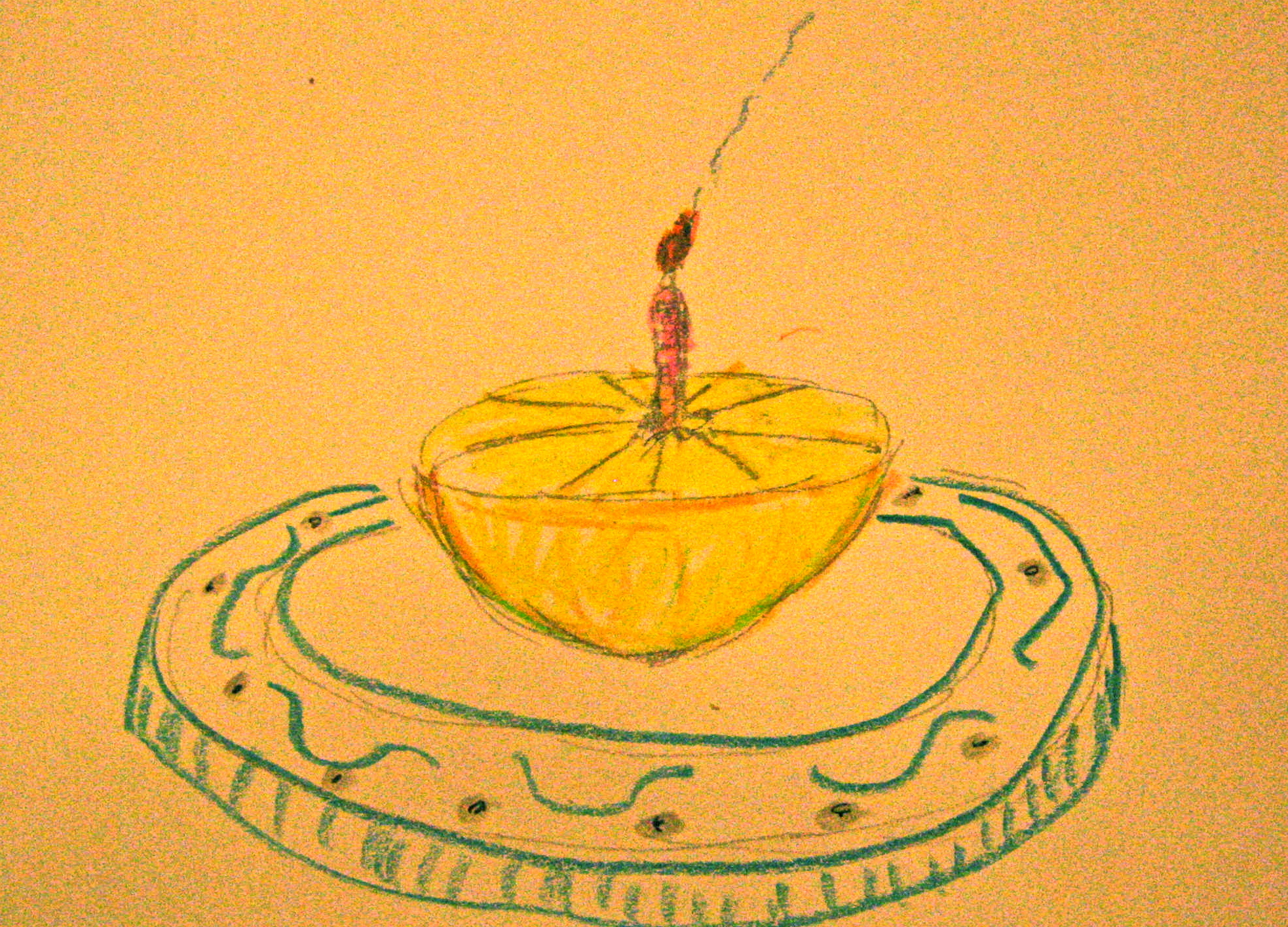
a half-grapefruit set upon a platter.

It was their birthday cake platter–wooden,
painted with blue ribbon swirl, holes put in
careful spaces along its perimeter.

The lone half grapefruit balanced in the place
for cake; a pink candle centering its face
like a faded, twisted cherry, stretched out tall.

He looked at her with such worry, not
(she thought) for her condition, but to please.  What
to give a child stuck in rigid refusal?

She’d disdain cake, she’d groan (he knew), oh Dad.
So, for her to weep, to get so very sad,

was quite unfair.  I wanted to give you

something you would take, he said, as they sat
out in the car and he awkwardly pat
her arm, reaching for something flesh and true.


(This poem was posted some time ago, but I’m linking it today, May 31, 2012 (the day before my birthday in fact) to Imperfect Prose, hosted by Emily Wierenga, who’s publishing a book on anorexia.

Since this original post, the poem has also been published in my book of poetry, “Going on Somewhere,” by Karin Gustafson, available on Amazon.   Check it out!!!!

(As always, all rights reserved.)

Blocking Writer’s Block – Post-Partum Embarrassment

March 25, 2010


Circle of hell for one's own work


Embarrassment is not so much of a problem when one is writing as when one has written. Shortly after the piece is more or less “done”, the excitement, the satisfaction, the engagement, of doing the work peters out.

Okay, sure, there’s a moment of “whew”.  Maybe even “wow.”  And then, like carefully-cut fruit turning brown around the edges, the whole thing seems  tawdry, sour, over-ripe.

This feeling often sets in around the time you start showing your work to others. When you glance at the piece through their imagined eyes, you wonder how you were ever satisfied.  You feel exposed, ridiculous.

It’s worse than seeing one’s self in a bad photo, in a brightly-lit mirror, at one’s worst angle.  When looking at a depiction of one’s physical self, feelings of inadequacy are often tempered by surprise, even disbelief—( Is that really what I look like?)  Even as one cringes, one’s image is so different from the self one imagines it hardly feels possible.  Besides that surprise, we are most of us well trained enough in the idea of people not being able to help their looks to have some grudging acceptance of our physical aspect.  (Other than of our fat, I suppose.)

A special circle of hell is saved for the sound of one’s own voice, either heard or read.

This hell, this embarrassment, can make it almost impossible for a writer to get his or her work out in the world.

Despite the daily appearance of blog, I really do have some problems with this.  Nonetheless (with typical “do as I say, not as I do” bravura), I’ll posit some suggestions:

1.  Collaborate.   Share the work process before your work is finished so that it’s less of a struggle to share it afterwards.  There are many different levels of collaboration, which may or may not include co-authorship.   The simplest may just be doing writing exercises with someone—writing at the same time as they are, then reading your writing aloud to each other.    (This is like taking your clothes off absolutely simultaneously with someone else.  Easier if you both pull down the pants at one time. )

The frigid sea (of exposure) also feels better if you hold hands with someone and run into the surf together.  Meaning, if you want to try to read in public fora—poetry readings or slams—go with a writing buddy first;  make yourselves both sign the sign-up sheet.  No turning back.  Clap loudly for your friend.

2.  Shut your eyes.  Get your piece as good as you can, send it into the world,  and then, if you can’t bear to face it again, don’t.  Don’t re-read it endlessly once you start circulating it (at least not for a while.)   If it’s published, and you can’t bear others to know, just don’t tell them.

3.  Understand that you are not your work.  It is, at most, a glimpse of your brain’s inner workings for one relatively short period of time;  a simulacrum of a synaptical dance.  If someone doesn’t like it, it doesn’t mean they don’t like you.  If someone reads it, it doesn’t mean that they actually know you.  Distance yourself from the content of the work;  distance yourself from the feelings of exposure.   This takes discipline.  Don’t wallow.

4.  Don’t worry that everything you do may not be your best work.  People’s taste run wide gamuts.  Sometimes you/they are in the mood for brown rice; sometimes you/they are in the mood for whipped cream;  sometimes for oranges.   (i.e. you can’t please all the people all the time;  actually,  you can’t even please some of the people all the time.   And maybe, well, you should worry a little less about pleasing. )

5.  Be happy that you have completed some work at all.  Always keep in mind how wonderful that feeling was when you first finished, how wonderful to have just slogged through.