Archive for the ‘Uncategorized’ category

Robert Pattinson, Stanley McChrystal, Judge Martin Feldman – I know which one I’d rather think about

June 22, 2010

Short-haired Rob

I suppose that today I could try to find something charitable to say about General Stanley  A. McChrystal, the general who blabbed his discontent with various top level administration figures to the Rolling Stone (of all places), or, perhaps, something diplomatic about Judge Martin L.C. Feldman, the judge blocking Obama’s moratorium on deep-water drilling.  Unfortunately, I don’t have enough energy to quash the cynicism, despair, and plain old irritation that each of these figures raises in me.

So instead I’m going to focus on a proper Rolling Stone subject and a cinematic (rather than environmental) vampire, and one of this blog’s traditionally favorite people – poor/lucky/hounded/sought-after Robert Pattinson.

I am responding here not to anything that Pattinson has done recently–gotten a hair cut!  Awkwardly kissed Kristen Stewart on stage!  Seriously—a hair cut?!–but to one of the few articles in the New York Times that isn’t seriously depressing me: “His Cross To Bear; Heartthrob Vampire.”

The article discusses Pattinson’s fatigue with all things Twilight, including (quite understandably) the fame and the fame surrounding the fame, the phenomenon and the phenomenon of the phenomenon. (Our media is so self-referential that attention is itself a huge story.)

Poor Pattinson reminds me of King Midas, except that everything he touches turns to Twilight –no, that’s not right – everything Twilight that he touches turns to gold.   And everyone wants gold, right?   Rob seems a bit unsure at this point.
And yet, grateful, always grateful.   (Unlike some Generals we could name.)

The Twilight success has theoretically given Rob freedom to do whatever he wants, whether or not it makes sense (like some judges), but because his other projects have not, thus far, been terribly successful, they supposedly risk tying him further to Twilight, causing him to be the guy who is only deemed successful as Edward Cullen.

I, for one (smitten and non-McChrystally loyal), don’t believe that.  The problem with Rob’s other projects has not been his performance, so much as a quirk in the overall project:  any movie in which a Brit, an Irishman, and an Aussie, sit down to discuss the New York Yankees is going to lack a certain credibility for U.S. viewers.  (Remember Me performed much better overseas.)

Still, Pattinson’s been working non-stop for the last few months.  Can all the other films counterbalance his identification with handsome vampires:  we’ll/I’ll see.  In the meantime, there’s always Eclipse coming out on June 30th.   Yes, it looks bloated, overproduced, schmaltzy, draggy, and his eyebrows are way too thick.

But at least he’s not threatening pelicans, nor talking trash.

Happy Belated Bloomsday!

June 18, 2010

Happy Belated Bloomsday!

I missed it yes I did an important day I don’t know where my mind was under the bed or out the window or most likely in a screen where real life and even book life can pass you by it’s not really an important day not like a birthday they made a lemon cake this year orange really out of lemons and didn’t want to drive to town moist as anything the zest of orange so sweet if anything a book holiday not bank those manicured sons of bitches O and now its too late to even talk about it much less write but Ive always been on the late side running for the train my suitcases better have strong wheels

I actually did go to Dublin years ago so grey and blue and gusty the Irish Sea like that scarf that’s been lost and found all crinkled not with huge waves but on every single inch of it pressing me to the railing the whole night long freezing over the side I was and sick as a dog while the natives kept to the warmth in the saloon of course like a parody of Irish drink and song I could hardly stand and neither they staggering out red faced morning with cheap black pants legs clumping over stuttering shoes it was so long ago and poorer then though now is not great either what with the crash me as green as sea ice even on land I was pale back then O not like now maybe get some special cream for redness wrinkles too real soda breads on the shelves lined up like little school kids I tore the pieces that’s how hungry I was when I finally got over it no knife and my fingers scrabbling among the caraway and crumbs Martello Tower what I most wanted to see the Joyce stuff most were grey toned streets but it with all its grey stones was blue that morning out by the sky and sea and Im standing there on the pavement admiring tea I can’t help thinking of tea with Martello Tower in front of me thick brown irish tea with the thick slabs of bread and butter Stephen Dedalus and Kinch his sort of friend  the milk in that chapter so thick and sweet as well the whole breakfast one I dream of porridge sometimes too humble not French toast or pancakes or what do they call them crepes but those thick sweet slabs of tea in sun and cold and tower though its not all sweetness Joyce not exactly generous to his past not is the word forgiving?  Art like a knife the wind then too December not June when I got closer to the tower and a woman all bare and white her flesh as creamy as the milk only with pink folds where she rubbed she had a little towel and then just undies bra and panties overflowing robust that’s what you had to call her her flesh so white and pink and flowing like the wave crests maybe a nice bit of pork I hate the way they hang those sides up in the window no not like pork everything about her lived fresh from the sea she had been swimming and her curls the only thing that didn’t glisten curly hair don’t with its frizz I wish I had it mine straight as a stick my whole life long but what I really wished for then was that glow smiling at me towel rubbing the nape of her neck below the curls.

In the movie she has curls too her dark hair spread upon the grass in Andalusia some place south and is kissed and saying yes though I’m not sure about the grass in the book itself and how do you make a movie of a book like that or any book to tell the truth I do know that she says yes though I’m sure of that even though I missed the date that’s the one thing I won’t ever miss that she says yes.

Obama’s Speech – The Need to Speak Outside the Box (And Desk)

June 16, 2010

Part of the Problem?

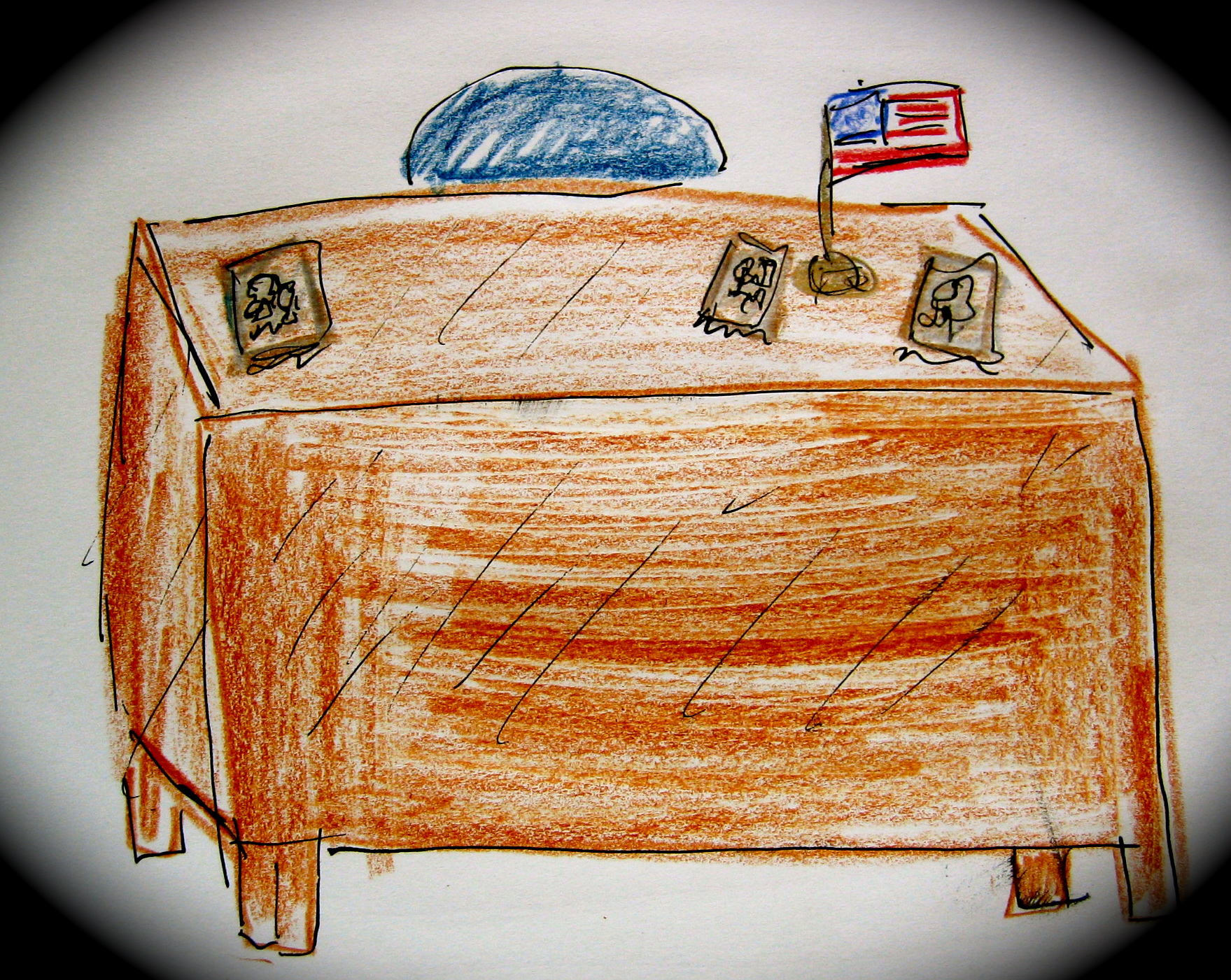
I have to say that I find almost any presidential speech made from the Oval Office desk immediately suspect.

I can remember Nixon looking shifty (even before we were sure he was), his face shining with sweat and the nervousness of sweat; Johnson managing to combine both elephant and basset hound in one sorrowful gaze; Reagan with the actorly aw-shucks confidence of the perfect-haired;  Carter, lips moving less than a ventriloquist’s, irritated arrogance barely hidden by humble bangs.  I can even summon up a few traces of Kennedy, elegance nearly obscuring message.   (Johnson weirdly enough is one of the most compelling memories;  there is something about a massive and slightly rumpled head that counters the irritatingly punctiliousness of the desk’s carefully staked-out surface.)

My dislike does not particularly target the Oval Office desk;  I dislike desks generally.   I am a floor sitter (or bed sitter) by nature.  When I do sit at a desk, I tend to squat or sit cross-legged.  (Thank God for  “modesty panels.”)

Desks are automatically a little disempowering—the person is foreshortened;  their breath doesn’t flow right;  their gestures are crimped.  (How many opera singers do you see singing from desks?)

A desk is particularly bad for Obama whose youthful appearance and natural neatness already give him an overly-studenty aspect.

What’s on the desks bugs me too.  (Enough, I know….)  I can understand wanting photos of one’s wonderful family as talismen for one’s self, but when I see the photos facing out to the audience, I feel, well, manipulated.

Given my feelings about desks, I was a bit put off by Obama’s speech at the start.

I was also put off by the end, the story of the fishermen’s prayer ritual.  Obama may be a genuinely religious person (I think he is), and he may be right that a collective consciousness of suffering, a collective prayer, is worth some promotion (though a little of this goes an awfully long way.)  But an extended discussion of prayer tends to make one feel as if there is no hope for human solutions.

Now for the middle of the speech.   Yes, I know problems need to be studied, but arranging for a commission sounds  like “sending something off to committee”—a way to keep change from happening rather than to make it happen.

So what part of the speech sat well with me, as it were (though not at a desk)?   We simply have to change the way we consume and produce energy in this country, and the ways in which we regulate exploration and production.  Obama has got it absolutely right here, and, hopefully, in the wake of all of the despoliation and waste, in the midst of the desk and prayers, people will sit up and listen.

Greene v. Rawl in South Carolina. (Echoes of Al v. Lou?) “You’ll Never Find—-”

June 15, 2010

Green is good. People like green.

I admit that I’ve done it.  Gone into a voting booth to vote for a presidential or mayoral nominee, and then, faced with a long list of unknown candidates for lesser offices, gone down the line flipping levers.   I admit too that the rationale of my lever flipping has sometimes been fairly random, or at worst, based on knee-jerk biases.  I used to, for example, go for the unknown women candidates, feeling certain, in the days before Sarah Palin, that increasing the number of women in politics was sure to be for the good.

In my defense, I’ve never voted randomly for a United States Senator.  Whatever you think of government, these people have power.  Whatever you think about politics, all politicians are not the same.

And now we have Alvin Greene, an unemployed vet, living in his father’s basement, with an obscenity charge against him, winning the Democratic primary by 60% in South Carolina.  This might not seem completely unusual if Alvin Greene were a talkative, attention-getting, barnstorming, issue-oriented kind of guy.  But in his first free media exposure,  he seems extremely taciturn and more than a bit evasive.

Some, wondering how Greene came up with the $10,000 filing fee, have suspected that he is a Republican “plant”.   A bigger question, it seems to me, is how he won 60% of the vote .

I suspect that  both political operatives and marketing executives are studying this one.  What about Greene lured voters?  Could it just be dislike of his opponent, Victor Rawl?  But did the voters, who seemed to know nothing about Greene, know enough about Rawls to kick him out?  (No one’s mentioned any major scandals—only that Rawl has been in Congress for several terms.)

Were voters basing their votes on race?  Did they know the candidates’ race?

Jon Stewart, in a pretty hilarious skit on the Daily Show, suggests the victory arose from the alphabetical order of the names.  Greene was first on the ballot.

Then, there’s the benefit of a color name.  People like color names—there is something innocuous, common, unthreatening about them. On the same Daily Show discussing Alvin Greene, Stewart had unrelated segments about Robert Green, the British goalie in the U.K.-U.S. World Cup game, and Betty White.

And, frankly, if you have a color name, green is a good one—the color of money AND the environment.  (Granted, it may be slightly less good after the U.K.-U.S. soccer match, but it is unlikely that that game had any impact on the South Carolina primary.)

Then, of course, there are the echoes of popular music—the singer Al Green v. the singer Lou Rawls.  In my mind, Al Green wins that contest hands down.  (“I am so in love with you” sounds a lot better to my ears than “you’ll never find another lover like me.”)

Green (Al)  is also alive, unlike Rawls (Lou), and has recently become a very good gospel singer.

Keep in mind, that I am not saying that Alvin Greene may not be a good guy, just that no one seems to know.

I, for one, am going to be a lot more careful in the future to leave all unknown levers unturned

Abby Sunderland Found (Thank Goodness)! Happy Endings Prevail!

June 11, 2010

Abby Sunderland has been found, thank goodness.   Safe in her small boat, Wild Eyes, which is afloat but without rigging.  She is bobbing around, able to be spoken to on the phone, to be picked up in the next day.

The happy ending will happily have its day, at least for today.  (I don’t mean to sound sarcastic.  It’s wonderful.  Crazy but wonderful.)

She will not resume her solo voyage.  (Her family recognizing, I guess, that even great training, wonderful pluck, and digital safety devices, can be dwarfed by thirty foot waves.)   (Kind fates should not be overly tempted.)

Now, we can go back to worrying about other parts of the world’s oceans, and other sea-travelers–pelicans, sea turtles, fish.

Repeal of the Estate Tax – A Capital Gain For the Rich–What About the Rest of Us?

June 9, 2010

No Step-Up

In dying this year, Dan Duncan appears to have become the first U.S. billionaire to leave a multi-billion dollar estate to his children and grandchildren free from U.S. estate tax.  This avoidance of U.S. estate tax does not result from charitable giving, nor from the clever use of U.S. estate tax loopholes, but from a curious quirk of the Bush tax cuts of 2001, which repealed the estate tax for persons dying in the year 2010.  Only.

Under the Bush tax cuts, the one-year 2010 estate tax repeal is “sunsetted” next year, 2011.  At that point, the federal estate tax will come back into force with a vengeance, with higher rates and lowered exemptions, limiting the amount passing to non-spousal and non-charitable heirs, without federal estate tax, to only $1 million.

What this means is that if you are a relatively wealthy person and your heirs are likely to have tried very hard to keep you alive on December 31, 2009, but may not try nearly so hard on December 31, 2010.   In other words, if you are a wealthy old person, or wealthy young person, trust no one this year!  Don’t let an heir touch a hair on your head!

For the last ten years, trust and estate attorneys have made jokes about the prospective 2010 effect of the Bush tax cuts, sure that the Federal Government would act to change the rules before the end of 2009.  But in December 2009 congressmen were so fearful of being tagged as voting for an increase in the notorious “death tax” that no agreement was reached.

This is not a post about the unfairness to wealthy people of a weird one-year loophole.  Nor is it about the dangers of allowing increasingly high concentrations of wealth in the society.  Nor even about the dangers to old rich people from greedy heirs.

No, this post is about how this year’s rules (surprise! surprise!) actually raise the prospective tax burden of the middle class and lower.   Here’s how it works:

(Because I’m a lawyer, I’m going to start out by saying that this is a vast oversimplification, even though it will sound very complicated.  I’m also going to say that nobody should rely on this post for tax advice.)

Actually, I just spent about four paragraphs writing my oversimplification and then, in sympathy for you, I cut it. I’ll just go for the juglar:

In 2009, a person could leave an estate of 3.5 million or less (not including bequests for spouses and charities), without federal estate tax.  Under the traditional (non-2010) rules, appreciated assets that were inherited got a “stepped-up” cost basis to their value as of the date of death of the decedent.  This meant that the assets could be sold by heirs with relatively reduced capital gains tax (or, if sold promptly, with none at all.)  This also means that in 2009, the heirs of a person with an estate of approximately 3.5 million or less did not have a federal estate tax burden, and actually had some federal income tax benefits, related to the death.

In 2010, the Bush tax rules offset the loss of fiscal revenue from the repeal of the estate tax by eliminating the capital gains benefits that had previously been granted on dying.   Just as there is no estate tax, there is, in 2010, no “step-up” in cost basis for the appreciated assets of the deceased.  For the very wealthy, this exchange of tax burdens is a bonanza—(i) because capital gains tax rates are considerably lower than estate tax rates;  and (ii) because capital gains tax is only assessed if gains are actually realized, i.e. when assets are sold.  Many wealthy heirs may not need to sell inherited assets, such as stock or jewelry or houses, or can offset the gains by realizing losses on other assets.

However, the loss of the capital gains step-up imposes additional tax costs on those less wealthy people whose estates would not have been subject to the federal estate tax under prior rules, but who now will have to pay higher capital gains taxes on the sale of inherited appreciated assets.   (Keep in mind that the lower cost basis will not get changed at the end of this year, so could affect sales far in the future.)

So once again (even after Bush leaves office), his tax policies favor the rich.

The amazing thing to me is that no one is talking about this.  (Yes, I know it’s complicated.)

Even weirder is the feeling I have that many lower and/or middle-class Americans, who seem to have a perverse habit of rooting for economic policies which do not, in fact, favor them, may be happy about the one-year repeal of the estate tax.  I imagine them thinking that it’s a blow against big government, not realizing, of course, that they may personally pay the price tag.

IRS CIRCULAR 230 Disclosure:  To ensure compliance with requirements imposed by the IRS, please be aware that any U.S. federal tax advice contained in this communication (including any attachments or enclosures) is not intended or written to be used and cannot be used for the purpose of (i) avoiding penalties that may be imposed under the Internal Revenue Code or (ii) promoting, marketing or recommending to any other person any transaction or matter addressed herein.

Dear President O: Sorry, But Talk Of Kicking A– Just Sounds L—

June 8, 2010

With All Due Respect, It Just Hurts You

Dear Mr. President,

I don’t blame you for being p—–.  You were down there in the rain.  You were down there before all these talking heads even knew what was going on.  You were down there even before there was a Web cam.

I don’t blame you for being very very frustrated.  People seem to expect that a President, like a king, can cure scrofula with the touch of a hand.  I’m not sure what scrofula is, but you get the point—they seem to think that you have quasi-magical powers, and that any hesitation in the use of this magic is a sign that you just don’t care.

I absolutely believe that you are hopping mad at BP, just as you are hopping mad at NBC, ABC, CBS, CNN, FOX, CNBC, AP, and practically every single commercial organization out there with a name of three letters or less.  But when your showing pique is actual news, when Brian Williams has to make a televised announcement telling us that your showing anger is what we are about to see (from a clip of an interview with Matt Lauer) then you have just got to accept that the voice of rage does not come readily to you.

Personally, I think that’s fine.   No one ever disparages George Washington for keeping his temper.  Washington himself, in the Rules of Civility & Decent Behavior In Company and Conversation, which he transcribed before the age of 16, set down Rule 45th, “in reproving Shew no Sign of Cholar but do it with all Sweetness and Mildness.” 

I happen to be someone who shows Choler a fair amount.  But, when I’m in a better mood, I generally understand that anger to be a sign of my immaturity—the ManicDDaily part of me.  I get angry because I want the world and people in it to be different than they are.   But the world is what it is; s— happens; people can be jerks; sometimes, my own anger (as warranted as it is!)  just adds to the general jerkiness of it all.   A few curt admonitions definitely have their place;  still, it’s often more useful to focus on concrete steps than to rant at the nature of nature (human, mechanical, or divine.)

The point is that some people angry are cold, clear, analytical.  (Often such people are mainly angry at themselves–for not predicting jerky people, jerky circumstances.)

I don’t know, Mr. President, if your anger takes you into those cold, clear waters  (the kind we’d really like to protect), but I’m pretty sure it’s not the type of anger that rants about “kicking a–.”  The words are dumb words, and they sound especially dumb coming from you.  They don’t flow from your lips correctly; there’s a stutter, a disconnect, that comes across as forced and petulant.

So, let it go.  Be yourself.  Stop worrying about the anger bit; just keep worrying about the doing bit.

iPad Sunnyside Up–Let Me Just Check My Mail

June 7, 2010


iPad Sunnyside Up

The  New York Times has a couple of articles this morning on how technology is re-wiring our brains; you can find them if you check online—excuse me a sec, I’ve got a new gmail coming in.

The articles talk about the mental and emotional price of a life hooked into, and hooked on—oops—there’s my cell….gizmos.

(Sorry, sweetie, I’m writing my blog.  Can I call you back in two minutes?)

Some people think multi-tasking makes them more productive, but studies show it makes people actually accomplish less, and encourages a kind of shallowness.

Did you know, btw, that Robert Pattinson won MTV awards for best actor, global star, and perpetrator of best 2010 screen kiss last night?   (Does ManicDDaily have her finger on the popular pulse, or what?)

One article depicts a software executive (hey, what do you expect?  The guy’s a software executive, head of a start-up, in Silicon Valley), who “works” in front of three or four large video screens.

In the photos of the guy’s family , they all have iPads.  Even the kids.  The guy even reads Winnie the Pooh on an iPad to his littlest kid.  In bed. (I know it’s kind of awful, but the graphics are also amazing!)

I can’t help wondering if the article will be good for Apple stock.

(I’m just going to check that, okay, it’s bookmarked, so won’t take a mo.)

The guy’s wife say it’s hard for him to be fully in the moment, that when the emotional going gets tough, he escapes into computer games.  But then one of the articles cites a kid who texts a lot in school and that kid says that the “the moment”–that is all the time she spent in school before she had texting–was incredibly lonely and isolating.

I feel sympathy for the kid, but isn’t loneliness and isolation part of what school is all about?  Childhood?  Has she not read Jane Eyre?  Virtually any Dickens?   (I’m sure they are on Kindle.  Maybe even for free.  Or Google Books?  Let me check a sec.)

Oops, there’s my other email, office, you know, my crackberry, the red light is blinking—do you mind?

Summer Mornings Without Air Conditioning – A Certain Slant of Light, Gainsborough Hair,

June 6, 2010

Sir Thomas Gainsborough - Mrs. Thomas Hibbert

Emily Dickinson writes about a “certain slant of light,/Winter afternoons,” which I’ve been thinking of a lot as I wake up these days. There’s definitely a certain slant of light on summer mornings.  I feel (kind of) sorry for those who sleep in air conditioning and don’t get to fully experience it.

It’s only a trick of my ear that thinks of Dickinson, for this slant of light is not oppressive like the light in her poem.   It’s a low angled, almost curved, light, which accompanies a time of softness, space, invitation.  Movement is easy enough, though after the restlessness of a night of trying to find a cool place on the sheets, you may not want to move much.  Your body feels suddenly dry, almost powdered.  The air, because you are careful not to fully open blinds, is tinged by a slight blue-grey wispiness like the hair in a Gainsborough painting.

Sounds are distinct, but muted—footsteps below your window, water running upstairs—there is nothing like a Sunday morning after a sultry night in New York City for quiet.   Stereos stilled–if there is a music, it’s in the tradition of John Cage.

You can smell that it will be hot again soon; you can even see it after a while –just there, at the corner of your eye.  The promise seems not to come from the sky so much as from the sidewalk, which, with its cached memory of yesterday’s heat, early radiates an incipient over-brightness.

But, the heat’s not forced itself into your apartment yet;  for these minutes, Gainsborough lingers in the air, and the breeze whispers at just the right pitch.

(If you like summer and sultry, but are more into elephants than Gainsborough, check out 1 Mississippi by Karin Gustafson, on Amazon.)

(And, for a complete change of pace, check out yesterday’s post, why people hate banks.)

Prom Season (With Elephants)

June 4, 2010

June Prom

The skies take a short break, waiting for the hair.
In one case, it is fine, sleek hair
which will only stay up till
the photo’s click, less than the time
I’ve stood behind the girl, working with
bobby pins.  “Wispy is good,” I say as
she fumbles in the back for smooth.
The make-up is smooth; two-toned
eyes converge with Egyptian directness
onto the shade of dress’s shine.

Skies grumble.  “Maybe
you better hurry,” I say.
“Why did I squeeze it?” one wails.
I palpate tint and powder onto a spot on
her breastbone, repeating a mantra
of don’t worry, it won’t show.

Another wants to keep the price tag on, tucked
inside the dress’s backless back
because it’s the most expensive she’s
ever owned.   Mid-twirl, she cries, “oh no!  It smells
like smoked fish.  Why does it smell like smoked fish?”
I tell her it’s fine, but offer perfume.  The one with the squeezed pimple
leans in supportively:  “I can’t smell it.”
“Oh God,” the twirler moans, “I
can smell it from here.”

Lips stretch shimmer
onto smiles perfected
over eighteen years.   And then, the camera
down, they really smile, not bemoaning
their lack of dates, only—and that less
and less–the possible scent
of smoked fish.

Darkness greets them with what sounds like applause.
I chase down a cab, then, umbrella in
each hand, ferry them one at a time,
hovering over hair, shoulders, skirt.
Slippered feet glisten through the tarred, watery drumroll,
as if made partly of glass,
the other part celluloid.
I laugh with the doorman as the taxi pulls away,
taillights as bright as Christmas in this storm,
the mother, the friend’s mother,
the one left to put away
the little jars, hangers, bobby pins,
to scoop from the floor the finally cast-off
tag, happy to be needed
by these large, beautiful, creatures,
happy to be out of the rain.