Archive for the ‘news’ category

Loaded Lawyer v. AK-47

May 6, 2010

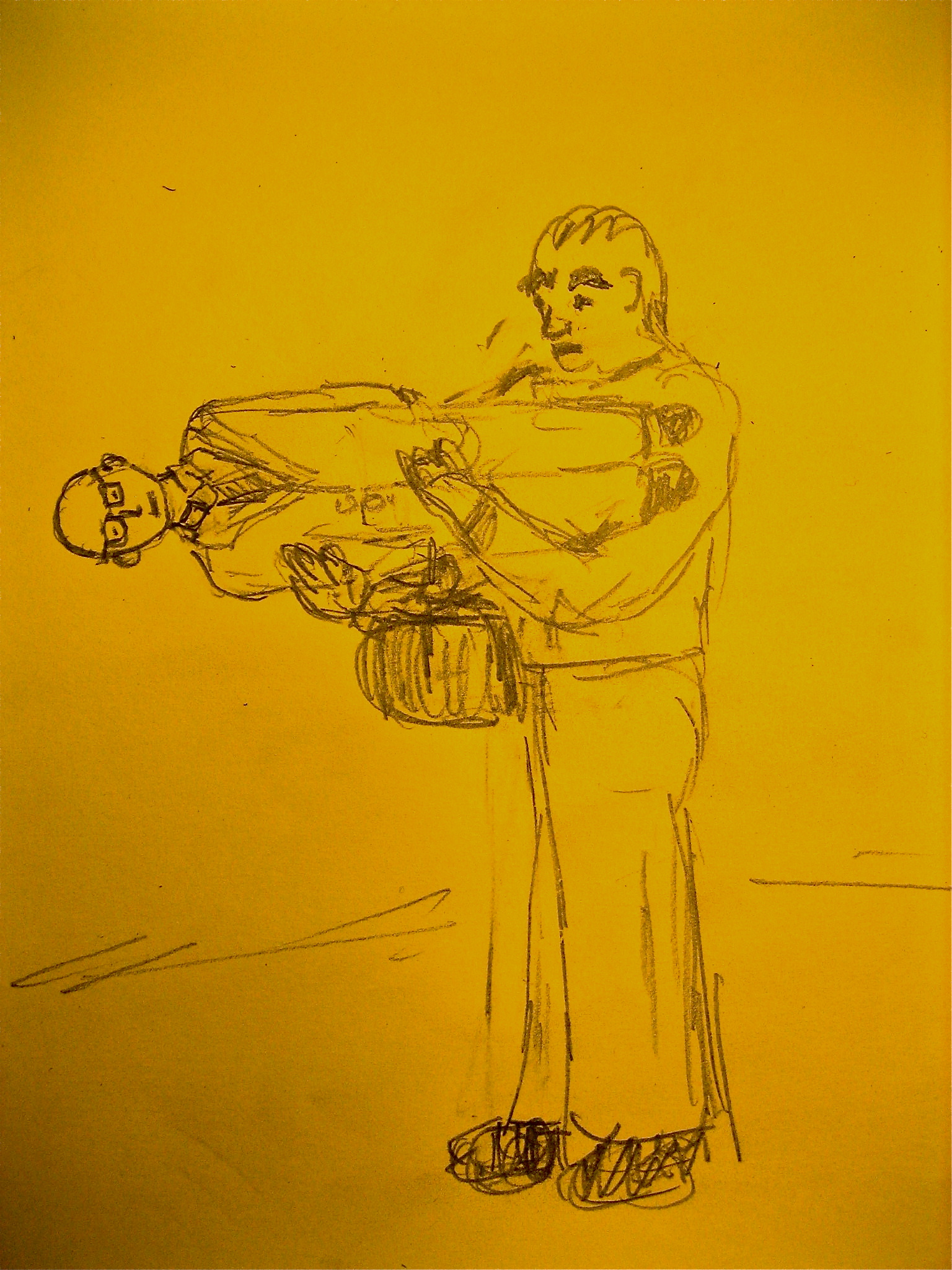
Suspect with Loaded Lawyer

I’ve always found the age-old male/Freudian question “what do women want?”  irritating.   I don’t particularly like the way it lumps women together.  But what really annoys me is the undercurrent of exasperation–the idea that the answer to the question is just too irrational or illogical to be discoverable.

Even though I don’t care much for this formulation, but a variation seems appropriate for tonight’s post:  what do Congressional Republicans want?   What, especially, when it comes to reconciling issues of anti-terrorism and gun control?   Here’s a place where the undertone of illogic and irrationality seems appropriate.

(Sorry, to any of you who thought this post was going to be about women.  Or Freud.  You’re stuck with Lindsay Graham.)

On the one hand, the Republicans in Congress, as exemplified by Graham, are very upset at the idea of offering suspected terrorists access to lawyers (as in Miranda rights); on the other, they are perfectly willing to grant such suspects access to automatic weapons of all types and calibers.   As Gail Collins describes in a wonderful Op-Ed piece in the May 6 New York Times, “I think you’re going too far here,” said Graham, in opposition to a bill that would keep people on the F.B.I. terrorist watch list from buying guns and explosives.

Distrust of governmental intervention and power are a watchword with many congressional Republicans.   Except when it comes to torture.  Many urge the government to take on that power–as long as people who are water boarded have a right to purchase a handgun before submergence.

Part of the problem, of course, is limited imagination and memory.  Many can’t seem to conceive of someone who may be labeled “right-wing” being arrested for terrorist activities; they don’t seem to remember names like McVeigh and Hutaree.

What they do seem certain of (whether rightly or wrongly) is the power of the NRA.  Which, as Gail Collins notes, gives one answer to my question—what do Congressional Republicans want?  To get a 100% score in the NRA grading system.

Call me naïve.  Call me (those of you who know I’m an attorney) biased.   Even call me a woman who knows at least some of what she wants.   If I have to be confronted, I would rather face a terrorist armed with a lawyer, than an AK-47.

Trying to Think About Pie and Not Faisal Shahzad, Though Perhaps Not Hard Enough

May 4, 2010

Smoking Pie

I wanted to write about pie today—the fact that my mother (now nearly 87) sprinkles sugar on top of the slice she will serve herself, while, if I eat a slice of pie at all, I spoon on plain, unsweetened yogurt; while my daughters will take the time to whip up heavy cream.   All evening, I’ve been wondering, in snatches, whether this is the natural progression of life.

But I live in New York City, and even though I really would rather think about pie toppings, I find my mind taken up by the 53 hour saga that began with the smoking car in Times’ Square, and has led to the arrest of Faisal Shazad, the alleged car owner and bombsetter.

I have to start by saying (and I’m mainly addressing this to you, Mom, if you ever happen to read this blog) that the attempted car bomb has had virtually no effect on my particular New York life.

It seems actually not to have affected many New Yorkers very much.  I noticed the absolute ordinariness of my evening rush hour train:  in the bank of seats I leaned over, the three people front and center of me either had eyes shut below furrowed brows, or eyes shut below a hand shielding said eyes (from the delightful train lighting or, perhaps, my stare).  The next guy was playing solitaire on a electronic game player; the next two were smiling and talking with great animation.

New Yorkers’ natural tendency to put their personal fatigue, or personal conversations, over hyper-vigilence has probably been accentuated by the fact that the Times’ Square bomb does not appear to have been a really well-constructed device.  A sense of security has also been created by the fact that the authorities, amazingly, have already taken the guy into custody.  (Even though it seems that they almost lost him as he boarded a plane to Dubai.)

I congratulate the New York City police force, the New York City bomb squad, the Times Square vendors (!), the FBI, the TSA, Homeland Security, all those authorities who coordinated efforts so quickly.

Still, one very frightening question comes to mind–what would have happened if the bomber had stayed inside the car?   Had, in other words, been a suicide bomber?  Committed enough to his mission (due to political or religious zealotry, bitterness, brainwashing, craziness, drugs, duress, whatever,) to physically see it through?   Would a smoking car with a driver have seemed that extraordinary?   Would vendors have been as likely to question it, even if it did seem strange?

Hollywood tends to depict New Yorkers as “in your face”, but, in fact, New Yorkers are pretty good are minding their own business, the art of non-confrontation rather important when you are all squished together.

So what would have happened?  I, for one, would rather think about pie, but there’s smoke in the background.

Fifth Day of National Poetry Month – Engagement (New Baghdad, July 12, 2007)

April 5, 2010

Engagement (New Baghdad, July 12 2007)

Sad and horrifying video posted on Wikileaks.org about two Reuters employees (a photographer, Namir Noor-Eldeen, and his driver, Saeed Chmagh) killed  in a raid by two Apache helicopters on an Iraqi neighborhood, New Baghdad.   It’s a video that makes one really very very sad for all involved.

In keeping with my National Poetry Month commitment, here’s a poem draft for the day;  sorry that it doesn’t really do justice to its subject.

Engaged (New Baghdad, July 12, 2007)

Static static beep beep.
Static.
Cross crosses blurred grey screen.
“There’s more that keep walking by and one of them
has a weapon.” (Camera.)
“Look at all those people.”
“Fucking prick.”
There’s a weapon.”  (Camera)
“Five or six with AK47s.”
The men on the screen, as grainy as the dust at their feet,
walk without concern, awareness,
right through the crossed sight, some together, some not;
two hold dark bags (cameras); two more, it seems, do hold something long,
rifle-like, points down.
“Request permission to engage.”
“Roger that.”
“Keep shoot’n…
keep shoot’n….
keep shoot’n.”
“We’ve just engaged eight individuals.”
“Dead Bastards.”
“Nice….
Nice.”
“Good shoot’n.”
“Thank you.”
Static.
“One individual appears to be wounded, crawlin’ away.”
Static.
“Come on Buddy.  All you gotta do is pick up a weapon.”

March Winds; Mental Health; Greater Parity In Health Care Legislation

March 30, 2010

Brain Chemistry

March is nearly over.  Anyone who lives in the gale force winds of downtown Manhattan will be extremely glad to see its end.  This includes my old dog Pearl, who, despite her near perfect bladder control, peed once in the apartment and once in the lobby this evening in an effort to avoid spending any time at all in the rain-spattered winds outside. (Darn you, Pearl!)

Somehow these gusting winds and my leaking dog bring up… mental health.  Forceful emotions, mood swings, bouts of depression, clinging to a fence post, or something worse, and (you got it), the recently passed health care legislation.

One of the changes wrought by the new legislation is a greater parity of treatment for mental and physical health issues.   This is, of course, welcomed by mental health professionals;  even an outsider, like myself, tends to agree that a greater focus on mental health seems needed in this country (and I say this not only as an observer of the Tea Party movement.)   The National Institutes of Mental Health estimate that approximately one in four Americans suffers from a diagnosable mental disorder in a given year, and about one in seventeen from one of the most serious mental illnesses;  an illness that affects one’s mind, one’s ability to really perceive and truly gauge reality, one’s self, the people around one, can certainly put a halt to one’s ability to function in the world as powerfully as a physical illness.   (To say nothing of putting a serious dent in the old happiness budget.)

The greater parity makes sense too because the line between mental and physical health is sometimes thinly drawn;  both just seem so chemical.    As one ages, one becomes particularly conscious of how circumstances, conditioning, genetics, chemistry, all seem to play upon each other in one’s brain.  (I have to confess that I base this statement on instinct more than scientific measurement.  I can feel in my water that it’s true, however.)

One problem with the new parity is that the benefits of many mental health treatments seem very uncertain;  side effects can be problematic;  some treatments lose efficacy over time;  additionally, some people whose functioning really isn’t very impaired may seek ongoing and expensive treatment (people who just really like the attention of a therapist).   Of course, efficacy, risk, side effects, and over or unnecessary usage, are issues with physical health treatments as well; (people who just really like the attention of a physical therapist).   Who knows yet how all of this will play out?    For many (the one in seventeen at least), it seems good that future choices may not be made simply on the grounds of what’s covered.

Moscow Subway Bombings Reverberate In New York

March 29, 2010

The headlines today about the bombings in the Moscow subway system held a double whammy for New Yorkers.  First, there was tremendous sadness and horror at the loss of life in Moscow.   Secondly, there was the guiltily, self-centered fear, not of whether it could happen here, but whether it will.

Even so, there was no new tension on the New York City subway system;  this may be because it is the first day of Passover, which means that the subways were less crowded than usual, and that many observant Jews (who unfortunately may be particular targets in New York) were not on the trains.

On top of this, New Yorkers are a bit fatalistic;  to get on the train day after day, particularly after 9/11, you have to just hope/assume/pray that if something happens on one train, you (and everyone you know) will be on the next one, or the one before it, or the one stopped in the tunnel way way down the line.

Then there’s the New Yorker bravura, the gritty sense of invulnerability that makes us all feel a bit like the Yankees–that we will somehow make it to the play-offs no matter what.  (Of course, many of us also feel like the Mets, that no matter how much we try, we won’t really win, but that’s mainly a feeling about our economic status, not our basic survival.)

Many New Yorkers have little tricks.  Avoiding rush hour trains;  getting on less crowded cars; even occasionally getting off the train if someone who looks suspicious (unfortunately, this may be someone simply in foreign dress) with several large square-cut, plaid, plastic bags.   But most New Yorkers don’t follow these tricks very much–with transportation cuts, almost any hour is rush hour (i.e. crowded); more importantly, if you avoided people who looked suspicious or foreign in New York, you’d probably have to stay in your own apartment (and even then, you’d most likely have to avoid mirrors.)

The Russian bombings seem particularly troubling because of the participation of female suicide bombers.  There is a history of female suicide bombings in Russia and around the world, with some groups such as the Liberation Tigers of Tamil Eelam using women bombers in 30-40% of their attacks.  (From a 2004 study of suicide bombers by Debra D. Zedalis for the Strategic Studies Institute, U.S. Army War College.)  Females have not figured largely among the images of terrorists in the U.S. however.  As someone with an instinctive trust of most of my fellow women, I find this perhaps the most shocking part of these terrible bombings.

My grandmother used to always ask my mother if she thought that her “life was laid out” for her;  meaning pre-destined.   My mother said no; she believed that people had some choice in their fate.  But my grandmother, an old lady by that time, had suffered much more loss than my mother–one young brother to the Spanish Flu, later, her parents, a child, her husband.   I don’t think I believe in pre-destination, and yet I can certainly understand the comfort of it on a day like today, and one like tomorrow, and the next day too;  how do you get to work each morning if you have to worry whether you are making the right choice of train, car, seat, city, life?

So sorry for the suffering in Moscow.

Amendments Republicans Didn’t Think Of

March 26, 2010

No Transfusions For Vampires

On Thursday, in the confusing process which I understand is required by our bi-cameral very-keen-on-procedure Congress, the Senate passed a budget reconciliation bill which allowed for the final passage of the new health care legislation.  In the process, more than forty amendments to the bill were proposed by Republican senators, including several from Republican Tom Coburn of Oklahoma;  perhaps the most colorful of these was an amendment prohibiting coverage of Viagra and other Erectile Dysfunction medications to convicted child molesters, rapists, and sex offenders.

Somehow one feels certain that the purpose of this type of amendment is to cast a shadow of malevolence on the benefits offered by the new legislation.  (There seems to be a desire to create a feeling that, without the amendment, the bill would operate as a kind of Americans With Disabilities Act for those covered by Meghan’s Law.)

Here are a few amendments that got dropped from the Republican list:

1.  No more than fifty (50) month-supply prescriptions per day may be covered for convicted narcotics offenders.

2.  No “herbal” supplements for potheads.

3.  No chiropractic coverage to W.W.E. hall of famer Quebecois Mad Dog Vachon unless an American passport and an original American birth certificate are provided.

4.   No acupuncture coverage for acrobatic Shaolin Monks temporarily visiting the U.S. from China.

5.   No acupuncture coverage to anyone permanently moved to the U.S. from China.

6.   Or Mexico.

7.  Or anywhere else.

8.  Including Hawaii.

7.  No rolfing for residents of California.

8.  No medical tattoo removal coverage for Jesse James.  Such expenses may be coverable for Michelle Bombshell McGee but on only on personal application.

9.  No blood transfusions for vampires unless named Bill Compton or Edward Cullen.  (Sorry, Eric.)

The Threats of Loss (Health Care Vigilantism)

March 24, 2010

What I meant to say was....

Sore losers.

I do understand.  When George W. Bush won the presidency in one of those two awful elections (I can’t remember which), I had to avoid my pro-Bush secretary from early November until the office Christmas Party.   This was not easy.   First of all, I really liked my secretary.  Secondly, I needed his help.

He didn’t taunt me; he didn’t gloat.

Still I felt so upset, so exposed, that I found myself gently avoiding direct contact, waiting until he was out getting a smoke before I passed by his desk to drop off a signed letter to be mailed, or a document to be filed.  (I used a lot of little post-its.)

What was even more galling was that his desk was en route to the office coffee/ tea machine, so I had to resort to long-cuts, i.e. detours through out-of-office corridors in order to fill up on my daily six or seven cuppas.

A hard-fought loss is painful,  leaves a bitter taste.  I understand that.   But I really am sick of what’s going on at the moment;  all this talk of Obama “ramming” the health care legislation through the Congress; Republicans and talk radio/TV conservatives acting as if Obama’s somehow done something unconstitutional or illegal to get the bill passed, as if a crowbar, a gun to the head, an arm behind the back, has been used, when, in fact, there was a vote of legally-elected senators and congressmen.

This is how the system works.  It is how it also worked under President Bush, who despite failing to win the popular vote in the first term, governed as if he had both an electoral mandate and divine fiat.  It is how it has worked since the U.S. government was formed.

Incendiary talk sparks slash and burn conduct.   The slurs aimed at congressmen who were going to vote in favor of the health care bill has now morphed into threats and vandalism against those who cast their votes.

Republican leader, John A. Boehner, has said that the violence is unacceptable, but in the same message he added, “I know many Americans are angry over this health care bill, and that Washington Democrats just aren’t listening.”   Come on, John.  You can do better than that.

Similarly, the guy that shouted out “Baby-killer” at Bart Stupak, Representative Randy Neugebauer, a conservative Republican from Texas, now claims that what he really said was ‘it’s a baby killer,” referring not to Stupak, but  to the agreement under which Obama said he would issue an executive order pledging that no federal funds be used for abortions.

Oh, please, Randy.   I’m sure that’s exactly what you meant.   And I just bet that’s what you are telling all the high-spirited people who are writing you to praise of the original “baby-killer” remark.  (Wink wink nudge nudge.)

Stupak has now received threatening phone calls.  Democrat Louise M. Slaughter has had a brick thrown through her office window.  The office of Representative Gabrielle Giffords (Democrat from Arizona) has been vandalized.  Black Congressman James Clyburn received a fax of a noose.   The brother of one Congressman, Tom Periello, had a propane line snipped (after his address was wrongly reported on a Tea Party website as the Congressman’s address.)

Is this from the folks so eager to protect the Constitution?

Water Water Not Everywhere Nor Any Drop To Drink

March 22, 2010

Masterful Water Drinker

Today, March 22nd, is “World Water Day”.   The New York Times “Lens” blog posts a couple of photographs showing a very polluted-looking Yamuna River passing by New Delhi, and  a drought-stricken area of Orissa, in Eastern India, where the surface of the earth looks as cracked as an unrestored Old Master.

A U.N. report published today says that more people are killed by dirty water each year than violence.

It seems apt (to me at least) that photographs illustrating water issues are taken from India.   Everyone loves water, but I remember being struck on my first trip to India, almost (gulp!) thirty years ago, how particularly involved Indians were with it.  I was amazed, first, by how masterful they were at its consumption:  just about everyone I saw could hold a metal cup  of “panni” appreciable inches from their faces and still manage to pour every single drop inside their mouths in a seamless, non-choking arc.

Then, there was all the bathing.  Real or ritual baths seemed a major part of daily life.   Even very poor people, people who lived in the street, would sit down with a jug or tap, carefully working their portion of whatever water they happen to get over arms and limbs.  (Baths taken while semi-clothed are no less baths.)

Cans of water were kept ready by fruit and vegetable sellers to douse cucumbers or fruit salads, heightening their appeal with regular applications of glisten and dewdrop.

Sacred rivers were jammed, but even less important pools were active.  Boys cooled off, water buffalos watered, jugs filled, clothes, endless clothes, were scrubbed and twisted and thwacked.

I particularly remember Udaipur (Rajasthan), a city famous for its beautiful lake and, especially its lake palace (which is a famous hotel now, also the site of the James Bond movie, Octopussy).  I was touring something, a fort turned into museum, and heard through the thick walls the thump thump thump of what sounded like an immense heart.  (Dobis, washer women, pounding clothes by the shore line.)

I have been told recently that the lake in Udaipur is almost completely dried up (at least during major portions of the year.)   On a recent trip, I saw the Yamuna River (shown frothy with chemicals outside of New Delhi in today’s Times) shrunk to about half its former size as it passes the back of the Taj Mahal in Agra.   And some of those smaller bodies of water, pools outside towns and villages were scummy with a toxic bright green, edges clogged with polyurethane.   Do people still use this water?  What other do some of them have?

Shrunken Yamuna River behind the Taj Mahal

News/Olds – New York City Cab Drivers – Texas School Board

March 13, 2010

Extra!  Extra!  In The New York Times yesterday:  (i) not all New York City cab drivers are honest, and (ii) Texas will be Texas.

In the first “amazing” news item:  New York City cab drivers have cheated millions of riders in the last two years.  This has been accomplished by illegally charging an alternative (doubled) meter rate applicable to Westchester and Nassau County within New York City limits.

Some drivers have excused these overcharges on the grounds that the buttons activating the meter rates are small and that it is easy for pre-occupied fingers to accidentally activate the wrong rate.   (The excuse, which doesn’t take into account the higher bucks received,  smells like those sometimes sent to car insurance companies:  “a pedestrian hit me and went under my car.”   “The guy was all over the road. I had to swerve a number of times before I hit him.”)

If New York cab drivers being New York cab drivers is disheartening, Texas being Texas is even more so.  As reported by James McKinley Jr.: “the Texas Board of Education on Friday approved a social studies curriculum that will put a conservative stamp on history and economics textbooks, stressing the superiority of American capitalism, questioning the Founding Fathers’ commitment to a purely secular government and presenting Republican political philosophies in a more positive light.”

Example:  the new rules will replace the term “capitalism” as a description of, you know, capitalism, with the term “free enterprise system,” (to avoid the negative connotations of phrases like “capitalist pig”.)

Example:  Thomas Jefferson (not liked because he coined the term “separation between church and state”) will be cut from a list of figures whose writings inspired revolutions in the 17th and 18th centuries.  (I guess the Declaration of Independence doesn’t count.)  (Is it worth noting that there are no historians on the Texas School Board?)

The proposed changes in Texas make me almost as upset with the left as the right;  I can’t help but feel that,  in the last decades, the left has also actively pushed for a politicization of history texts, and now is being hoist by their own petard.   (I’m sorry to those readers who disagree with me.)

Yes, the old 50’s and 60’s texts were incredibly jingoistic and one-sided; many of the changes of the last decades created a much  more historically accurate, as well as broader, picture of the past.   (Some terrific history texts resulted, such as Joy Hakim’s wonderful The Story of US.)

However, attempts to right old sins, and to emphasize the accomplishments of groups and genders who had historically been overlooked (as well as oppressed), also sometimes went overboard.  My children went to a grade school, for example, where every child knew of Rosa Parks, but extremely few had knowledge of FDR (except, perhaps, for his disability) ,  World War II (other than perhaps Japanese internment camps), or even, though it was a secular school, Thomas Jefferson (except perhaps for his relationship with Sally Hemmings.)    (An attempt to be inclusive, in other words, sometimes seemed exclusive, and to almost perversely avoid a broader historical context.)

Of course, an even bigger problem (to amplify on a quote by the great education president and Texan, George W. Bush):  “Is our children learning” anything at all?

In The Truth, a Discworld satirical fantasy by Terry Pratchett, the tyrannical Lord Vetinari warns a budding newspaper publisher that what people crave is not “news” but “olds”.   “They like to be told what they already know,” Vetinari explains—not man bites dog, but dog bites man.

I’m not sure I completely agree with Vetinari here;  while both these stories are certainly “olds”, they only offer a kind of painful satisfaction, the kind available from from scratching a bite, picking a sore.

For more on this subject, and one of my best paintings ever (of George Washington), check out my post on George Washington, Sarah Palin and Christian With a Capital C.

Mid-March Resolutions (Easier For Me Than Obama)

March 9, 2010

Snow Drops and Red Wine

This morning I saw snowdrops (honest-to-goodness clumps of little white flowers) blooming behind the iron fence that runs along the esplanade in Battery Park City.  (Flowers in public spaces seem to be kept behind bars in New York City, I guess, to keep them from becoming flowers in private spaces.)   The snowdrops, combined with what was really a glorious morning, made me worry that I was too harsh about the month of March in yesterday’s post.  I called it the cruelest month.

March really isn’t cruel; it’s just, you know, brusque, brutal (think Ides).

It’s all a matter of timing.  Even to the jaded, January feels like a new start; the year is fresh;  change seems genuinely possible.  (Sort of like Obama’s inauguration.)  But, hey, it’s just January.  You’re a little tired from Christmas (the election); you want to be kind to yourself (bipartisan),   and besides, you’re still working on getting the digits on your checks right (i.e. the collapsing banking system).  You feel like you can take a little time for the life changes.

Then February hits.  But, hey, it’s February.   Cold, grey, stormy (the continuing worrisome instability of the economy), and above all, short.  Nobody really expects you to make life changes in February.

And then, suddenly… it’s March.  Not just March, mid-March.  And suddenly, the year doesn’t feel so new any more.  The stores don’t even have half-priced calendars.   (The banks are doing okay, but now everyone worries about budget deficits, or uses them as political cover.)

In March, change feels very hard.   Obligation looms (i.e. taxes) (i.e.  budget deficits) and the scent of Spring in the air seem to bring up the repeating cycle of the season as much as “newness”.   That sense of cycle (another winter over, another year already mid-swing) feels more relentless than reviving.  (Can one have schadenfreude towards a season?  Can politicians let go of their schadenfreude for other politicians?)

For all of you feeling left behind by Spring, and by time itself, I have good news: first, a new and fairly extensive study conducted by researchers at Brigham and Women’s Hospital in Boston shows that women who drink alcohol regularly, particularly red wine, are significantly less likely to gain weight and become obese than non-drinkers. Secondly, spending on cosmetic plastic surgery, such as breast augmentation, tummy tucks, and liposuction, dropped significantly last year.

One would like to think that the drop in spending on such cosmetic procedures was a result of people coming to their senses—hard economic times making them realize what was important in life—but the drop may simply mean that hard economic times gave people less money to spend.  This later view is unfortunately born out by the fact that spending on less expensive treatments, such as Botox injections, actually rose in 2009.

Nonetheless, nonetheless, both studies offer hope, at least to me.  At last, there are some health resolutions and fashions I should be able to adopt in the coming year (even beginning as late as mid-March)—(i) drinking more red wine, and (ii) not getting expensive cosmetic surgery.     Definitely doable.

I wish it were as easy for the President.