Archive for June 2014

Onomatopoeia (For You)

June 8, 2014


20140608-220326-79406551.jpg

Onomatopoeia (For You)

Words heard
as themselves,
words that sound out
what they mean–
I’m not speaking about just
“banging”
(siss boom bah),
but, for example,  “bound,”
as in leaping bouncily,
or “bound” as in
tied ’round,
or “bound”–aimed
from lost to found,
or “bound”-as in you
clasped by me
and me
locked into
you.

Or take, for another, “missive,”
as inside the envelope we make
of each other
(addressed to “dearest”, sealed
with a loving kiss),
or, for example, “missive,”
which when one of us must leave
is all we have, meaning,
like this poem,
“missive.”


*******************************

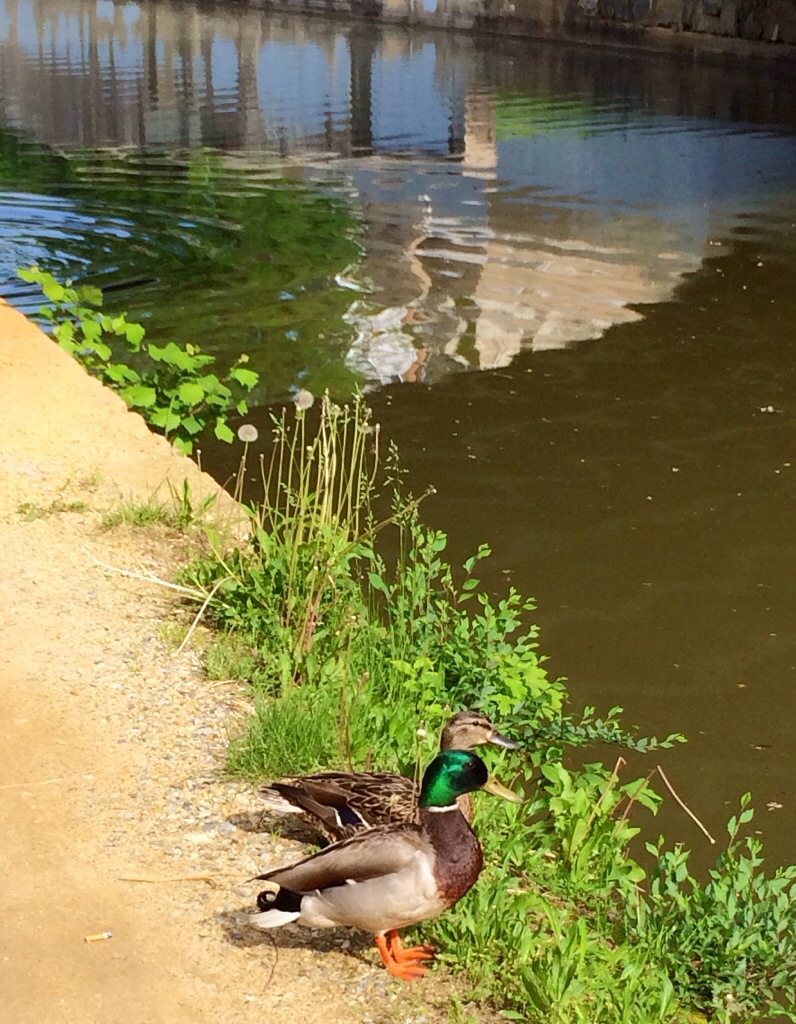
A draft poem of sorts for my husband. (Pic also by me, taken in Washington, DC by C&O Canal, all rights reserved.)

Red Letter Day

June 6, 2014

20140606-222948-80988150.jpg

Red Letter Day

D–Day
D– Night–
what makes laden men alight
into depths of icy water,
if not drowned,
met with slaughter–
Is it the one behind
who pushes?
Is it the naught behind
that rushes?

Dear Day
becoming night,
sun itself takes iron flight–
cloudburst sand replaces dawn
streaking crimson on and on–
Trees leave craters
coast apes moon
scraps of limb
strafe every dune–

D– Day,
dear God–
what remains–
so thick the sod
sown with crosses
row on row
on row on row on row on row–
**********************************

I feel a little pretentious writing of D-Day, but my dear dad was in World War II, in the European Theater as well as Pacific, coming through the beaches of Normandy (a short while after the initial invasion force), so can’t help feeling especially moved  on the 70th anniversary.  Please note that I don’ t mean the poem to be flippant–I am very uncertain of the title for that reason and worried that the poem has a very negative feel. Of course I do not mean to diminish in any way the intense bravery of the troops or of the allied cause. I mainly was just thinking of the terrible casualties.  

The poem was inspired by Herotomost’s post on with real toads about writing a letter.  I tended to think of  letter in both senses.   

There are vast cemeteries in Normandy, of troops who died in the Allied invasion.

I don’ t think this photo particularly goes with the poem, but I took the photo a few days ago and like it.  


Words that Failed Me

June 5, 2014


Though I never do.

Though I never do.

Words that Failed Me

The only words that ever failed me
were those I uttered,
voiced, when even the scrape
of toast buttered
was the better choice, more
meaningful.

For those who need badly
to be heard
need extra space
for their words to move around in,
like someone learning to park
not used to a rear-view
mirror,
like someone learning to dance
afraid to take chances,
like someone who’s been told
what to do too long,
for whom listening
is a tired song–

The words that failed me–
the ones I crowded into
the distance between us–
oh, what a fuss
they made–

****************************

I know I call them all drafts, but generally–as in the case of my last few posts–I know I should cut cut cut! However,  when you/me first write something, it’s a bit hard to cut as much as you should.  In this case, which I’m calling a draft poem, I don’t know that I’d cut but have come back since posting to change some words.  

It’s for Brian Miller’s prompt on dVerse Poets Pub prompt about when words fail you. Frankly, I believe the English language is pretty comprehensive, and really when words fail me, it is my (i) lack of good vocabulary; (ii) failure of nerve, or (iiI) as described here, talking too much.

Thinking of Sergeant Bergdahl and T.V. Commentators

June 4, 2014


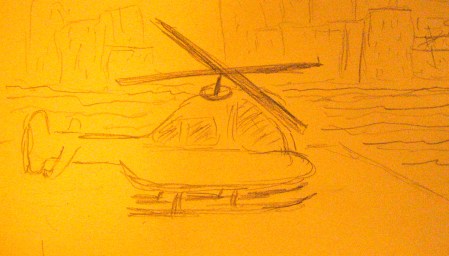
Helicopter

Helicopter

Thinking of Sergeant Bergdahl and T.V. Commentators

I grew up in the sixties when
the phrase was born,
so I can tell you that
“my country right or wrong” was not
the song of the young, but a croaking ode, reconstituted
beneath flat garrison caps, over
flapped bellies,
while the young, the young–vibrating
like reeds that whistle high
and scrape by low, the young–
for whom life is, for a while,
a succession of first times–
voice varying measures–

So, why don’t you made-up faces on television
talk about the 50,000 U.S. soldiers who deserted
the European theater, World War II,
the 100,000 Brits?

Men, riddled
by bombardment (part of the war package),
who slipped, stunned,
from their own sides’ guns, tried to stowaway
in blanks,
to secrete their crazed selves
from crazy;

men, who wanted, with unforetold
desperation, to fold their arms
on a kitchen table nights,
the room lit yellow
as a lantern in July,
only curtains ruffling,
the animals outside
not human–

I’m not saying
they should be honored,
only that your sacred cows,
the shibboleths sprouting
from your lip-glossed mouths
are highly tippable, unlike
the real kind, those still, sound, beasts
who will stand through wind and storm, their bones
propping wayward tents in their hides,
their soft dumb eyes aware in every stare
of the world’s perverse
complexity.

Something solid.
Which brings me back
to love of country,
love of
my countrymen,
right or wrong,
of thee I sing.


*********************

This is very much a draft poem, way too long, written for a “get listed” prompt by Fireblossom (Shay) on With Real Toads. I’ve edited it since posting as well.

I refer in the poem to a recent history by Charles Glass, The Deserters, A HIdden History of World War II, that reports 50,000 U.S. troops deserting from the front (a  fairly high number given that only 10% of U.S. troops involved in World War II were in combat.)   Those in combat were kept for terribly long and arduous tours, probably what caused the breakdowns  The larger number of deserting British soldiers–100,000–relates, it seems,  to the longer period of war for the British.  There were far fewer defections on the Pacific front, in part because the battles were on islands.  The desertions were very little spoken of during the war as discussion of this was thought to weaken morale and to give comfort to the other side.

According to Glass, there were a number of desertions where a man would wander off sometimes just for a few days, and then after some emotional repair, find his way back to his unit.  Apparently, front line soldiers rarely turned in the name of a deserter; if a deserter were reported it was by someone from the rear echelon.  A very interesting interview of Glass can be found here.

In terms of Bergdahl–I confess that I’ve only read aspects of the case. (I don’t have a TV, so my main knowledge is from written news sources.)  However, I am appalled at the rush to judgment.
I seed and I believe (writing poems)

June 3, 2014

20140603-225836.jpg

I seed and I believe (in writing poems)

It’s like planting
an echo.
I set down in rows, words–
they want to be heard,
to sprout sounds that will carry,
to wind their way
to some stray mind, to say
I’m here–
and for that mind to reply
oh, there you are–
somehow grounding us both–
those words flying
through pleine air-
propelled at times
by the kickstart
of metered feet,
other times just flapping
for all they’re worth.

*******************
Draft poem for Shanyn’s prompt on dVerse Poets Pub about what we’d like our poems to seed.

Walking the Line (pic)

June 2, 2014

20140602-052652-19612463.jpg

After discovery/confession/wearing-off of charm

June 1, 2014

After discovery/confession/wearing-off of charm

The thorns are everywhere
and sharp,
as if for one hundred years,
she’s slept.
No place to turn
without pain.

He lies next to her, still,
sheet pulled over
one shoulder,
only, she thinks, the sleep is feigned;
perhaps his eyes
aren’t even closed.

This is not a bed
of roses.


*****************************

Here’s a poem of sorts inspired by the suggestion of “M” of the Grapeling blog, to write a poem based upon my process notes for “Rosa Multiflora Gore.”  The note is the first two lines of this poem.  The poem does not in anyway reflect my current state of mind (!) but it’s what came up thinking about the line. I am also linking to dVerse Poets Open Link Night, hosted by Mary.