Archive for August 2010

My Own “Take This Job And Shove It” Moment

August 13, 2010

Should We Take The Guitar?

Thinking of Steven Slater brought me back to my own “Take This Job And Shove It” moment.  It really didn’t have much to do with shoving a job (I was raised to be very very nice).  It arose more in the context of seeking a job, and had to do with the Johnny Paycheck (the country music singer about whom I wrote yesterday).

This was back in my own country music days.  They were also my  law school days, but law school, as you may have heard, is not exactly scintillating, and my brilliant, beautiful, roommate, Cynthia, and I decided that writing country music would be a viable (and far more interesting) career alternative.

The problem with the music world is that it’s difficult to just decide to have a career in it.  Especially if you are not all that talented.  You need an “in”, a break, some significant help from the stars, both celestial and human; at least a hook.

Our hook came (we thought) in the form of the “Paycheck Song”, a song we wrote while interviewing for summer jobs.

It would be just perfect (we thought) for Johnny Paycheck, his next hit after “Take This Job and Shove it”.

But how could we get it to him?

We had the young and blonde part going for us; but we were far from Nashville.  (We were in school in New Haven, Connecticut.) Our efforts at groupydom were going to be significantly mitigated (to use a good law school word.)

Our chance came when Johnny Paycheck came to New York, to the Lone Star Cafe.

The show was on a weekday, but hey! this was important.  We took the train down in our best (in my case, only) Texas boots.  Cynthia’s had tassles.  Our hair gleamed, our eyes glommed, the lashes thick with mascara.  Our hopes were crazily high.

So many decisions to make:  should we should mention that we were in law school?  (No.  It would make us stand out, but might seem weird.)

Should Cynthia bring her guitar?  (No.  Her playing wasn’t that great, my singing worse.)

We would just give him the print version of the Paycheck song, with big smiles, a little enthusiastic crooning.

Johnny Paycheck was a short grizzled man back then; his skin had the slightly leathery look of hard living in hard weather–sun, wind, cigarette smoke.

He gave a great performance, but even in a small place like the Lone Star, the back stage was, well — way back.  I remember a glimpse of the dressing room; black cowboy hats blocked the wedge of open door, a make-up mirror was overbright behind them.   The people at the door didn’t seem all that interested in our page of sheet music.

Did we hand it to someone?  I think so, but we couldn’t really wait all night to see what happened to it.  We had a train to catch, class in the morning.
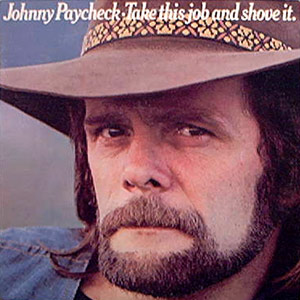
Steven Slater – The New Johnny Paycheck (Sans Guitar) – “Take This Job And Shove It”

August 12, 2010

Johnny Paycheck ("Take This Job And Shove It" by David Coe)

“Take This Job And Shove It” made a career for Johnny Paycheck in the recession of the Carter years.  It looks like Jet Blue flight attendant Steven Slater may have found a similar niche.   (If you’ve been on another planet, he’s the flight attendant,  who after getting hit on the head with a nasty passenger’s carry-on, told the passenger off on the PA system, and then activated and slid down the plane’s emergency chute.)

Americans love someone who gets sick of it all with panache–such a welcome relief from people who get sick of it all with a gun.   (See e.g. Omar Thornton, the Connecticut employee who shot himself and eight others at a disciplinary hearing.  “Everybody’s got a breaking point”, Joanne Hannah, the mother of Thornton’s girlfriend, said of him.)

I can’t comment on Thornton’s state of mind, except to think it was truly broken.

Slater’s mood  is a lot easier and more pleasant to try to read.  Everyone has “been there” as it were, on a literal or figurative airplane where their head has been hit by someone else’s overbearing physical or psychic baggage one too many times.

Most people restrain themselves (and tend to be glad that they did.)   Even so, there is something especially dramatic (tempting) about leaving or losing a job during difficult employment conditions: something that you can’t readily leave automatically feels confining  (see e.g. prison.)

When you feel like you can’t just walk away, in other words, there’s an exhilaration in watching someone whoosh, beer in gesticulating hand.

(For a recording of  Johnny Paycheck’s, “Take This Job And Shove It”, click here.)

Revisiting The Past – Butting Up Against “Because”

August 11, 2010

Butting Up Against "Because"

Today, I had to go back to a neighborhood in which I lived for years, some years ago.  (Important years.)   I tend to really dislike this kind of journey.  In my ManicDDaily way, I often wax glowingly nostalgic about old haunts (from a distance), but succumb to a terrible grimness when I actually have to go back to them.  Such visits makes me revisit every road taken and not taken; also those roads that were somehow (seemingly unfairly) boarded up.    In the ensuing self-castigation and resentment, all past actions  (even those that turned out very well) take on the smudged hue of mistake.

Today, there was a news story that put these kinds of unuseful regrets and resentments into perspective:  this was about a guy, James Fisher, described in an article in the New York Times by Dan Berry. Fisher was held on death row in Oklahoma for approximately 28 years during which the question of his guilt (for first-degree murder) was never truly adjudicated.   After two trials were eventually overturned for for ineffective assistance of counsel, Mr. Fisher, though maintaining his innocence,  instructed a third attorney to seek a plea bargain;  on pleading guilty, he was released on the condition that he leave the State of Oklahoma immediately and never return.

Dan Berry’s article describes Mr. Fisher departure from Oklahoma, traveling, at one point ,with Stanley Washington, an aide from the Equal Justice Initiative, who himself served 16 years for non-violent drug offenses.  Fisher, in the hot winds of Texas, “vented for a while about his banishment from Oklahoma. He asked Mr. Washington why they would do that, but seemed satisfied by Mr. Washington’s answer of: Who cares?”

Maybe not a just answer, but a useful one for moving on.

Why is what’s done done?  Why is what’s past past?  In The Thief of Time, the wonderful writer Terry Pratchett has another great answer to these types of questions:  “as you accumulate years, you will learn that most answers boil down to ‘Because’.”

Apology re Misplacement of Park51 (Park Place Not Park Row – Same Difference)

August 11, 2010

Apologies, apologies!  In yesterday’s post, I said that Park51, the proposed mosque in downtown Manhattan was to be located on Park Row (two blocks east of the World Trade Center site);  in fact , the proposed location is Park PLACE, which is two blocks north of the site.

So sorry to add to the misinformation about this issue, especially since misinformation was what I was complaining about. (My cheeks are burning.)

I live in downtown Manhattan and should definitely better.  The problem is that Park Place is an undistinguished street which, frankly, I often overlook even when I am walking around.  It houses a jumble of junky little stores (other than the wonderful Tent & Trails- a camping equipment store).  Park Row, in contrast, a slightly more prominent street, mainly houses all the arms of J&R music.

My basic argument from yesterday is the same;  downtown Manhattan is relatively small; Ground Zero is relatively large within it.  This means that virtually everything downtown is “near” to Ground Zero.  And yet, at the same time, the spaces are big enough, the crowding of buildings within those spaces is intense enough, that the differentials between blocks feel immense.   Immense enough that, even putting arguments of religious tolerance and what the country and city stand for aside, the claim that the mosque would somehow be a shadow on Ground Zero doesn’t make much sense, especially given the invasive, and sometimes ghoulish, commercialism that currently haunts parts of the site.

Mosque Near Ground Zero – Really? (Park51)

August 10, 2010

What's Going On Now at WTC Site

I’m not a huge fan of Islam–I don’t know enough about it to have a position of any substance.  I admit that I am suspicious of any faith which seems to keep women in a subordinate position (but that makes me suspicious of many orthodox faiths).

As a result, perhaps, I haven’t much followed the “Ground Zero Mosque” debate, even though I live in downtown Manhattan.  Based on the extent of emotion stirred up, I thought the mosque was planned for the actual Ground Zero site; that it was somehow, with other shrines, to be on one of the memorial “footprints” of the two towers.   Despite my own strong bed towards religious tolerance, I could understand why this might upset some.

After actually reading more, however, I’ve realized how misguided I’ve been; that the whole issue is another tempest based on stewpot of misrepresentation.  The planned Mosque isn’t to be at the Ground Zero site at all; but on Park Place (Park51) , a couple of blocks away.

Okay, Park Place is near Ground Zero in the same way that anything in downtown Manhattan is near Ground Zero.  Downtown Manhattan is the thinnest part of the island; the World Trade Center site is large.

If you live down here, you quickly realize that everything (especially the subway stations) is both close and far – that is, technically, just a few blocks away, but a long frigging walk.  Blocks are big, and the differentials in blocks–in cityscape, tenor, view, even in weather (wind shear)– are consequential.

The news accounts highlight factors such as “500 yards” and “13 stories” in a way that gives one the  vision of a face-off–  Ground Zero on one side, the Mosque (whose visitors will surely be tittering inside) on the other.   These terms are just ridiculous in the context of downtown Manhattan.  500 yards = if that’s even accurate–is many buildings away;   13 stories is a shrimp.

What makes the debate stranger – setting aside the whole issue of what this country and city stand for – are the facts of what is currently happening at Ground Zero:

Hawking.  People selling ghoulish photo albums and NYFD hats and cheap American flags with the names of victims stenciled in.

Posing.

Shopping.  Right opposite the site stands a true world trade center – Century 21.

And, on the site itself,  which, as some 9/11 families have pointed out, is a de facto burial ground due to the impossibility of recovering ashen remains, a large building is rapidly rising, destined to lease commercial and office space.

(THIS POST HAS BEEN CORRECTED; An earlier version mistakenly referred to the location of the proposed mosque as Park Row – a couple of blocks east of the WTC, rather than Park Place, a couple of blocks north.)

Tax Shortfalls – Tax Shortsightedness – Right Wrong – Krugman

August 9, 2010

In a wonderful opinion piece this morning, Paul Krugman writes of “American Going Dark” – state and local governments forced into budget cuts that are destroying all those things government typically provides –street lights, roads, schools.  Although the Federal Government could help the states out, Krugman says it is strapped by deficit reducers and, worse, tax deniers – those determined to extend the Bush tax cuts for the top two percent of earners.  Krugman believes that  this is the natural result of a society that has decided (really since Reagan) that all government spending is bad; that it all just ends up in the pockets of “welfare queens.”  (A society that ignores, for example, the government spending that goes into the pockets of Halliburton Kings.)

Actually, that last parenthetical probably doesn’t support my point (or my oversimplification of Krugman’s point), which is that government spending is necessary for a decent community and individual life, and that, in addition, by imposing taxes that allow the hiring of more service providers, government fuels the economy in ways that allowing more money to stay in the hands of millionaires does not.

Palin and others on the right insist that the end of the Bush tax cuts will hurt the “job creators” and further ruin the economic situation.

Once again you want to ask the question “where have these guys (on the right) been for the last ten years?”  If the Bush tax cuts were so great for the economy, why was it in such a mess at the end of his tenure?

More importantly, the end of the Bush tax cuts will be the end of a rather special (and not distinguished for anything good) period of the U.S. economy.   Allowing the cuts to expire is not a forced march into the withering desert of socialism, but a return to the tax regime in place during Clinton’s era–a time, if memory serves, of prosperity, peace, relative deficit reduction, and better employment.

Peace is an operative word in the last sentence; as Bush failed to understand, an ongoing war is not a justification for lowering taxes.   The lowering of taxes in a time of two wars not only weakened us economically, it contributed to a certain blitheness about the wars, a notion that such wars could be maintained with no cost borne by the average American, but only by those GIs, reservists, and National Guardsmen (not usually among the group that profited from the tax cuts) who served tour after tour.

I don’t particularly like taxes.  (I also don’t particularly like electric bills or rent.  If we’re talking about lowering my financial burdens, I would put in a word for lowering the costs of fruits and vegetables, fine tea, and vampire novels.)

But I do like having subways that run on time, streets that are not infested with rats; an educated population; a national park system; culture which does not rely solely on high ticket prices; enforcement of clean food, water, air standards, and other environmental values; a medical system in which a health care provider will actually spend time with you; money that has a stable value; and protection, both at home and abroad.

Those on the “right”, and I hesitate to even give them that characterization, are simply wrong about all this.

Summer Clean-Up – STUFF – “But Will It Make You Happy?”

August 8, 2010

Collector of Bunnies (Dust)?

Every once in a while the clutter of daily life, compounded by the dust and grit of open-windowed life, mounts up to a level that a general clean-up is called for, especially if you have a need to get to the front door of your apartment.

While it would be nice if this general clean-up also included closets, closets seem kind of spring-like, not appropriate for a humid mid-summer attack (which tends towards the front and center.)

A clean-up day can’t help but raise the question of why you/I/all of us have so much stuff.  Stuff needs to be put places (hopefully out of sight).  Worse yet is the way the stuff itself collects stuff, stuff that seems to be almost its anagram–not ffuts – but tufts (of dust), fluffs (of dust), dust must dust.

There is an article in the New York Times today called “But Will It Make You Happy?”, which focuses on a movement of people who divest themselves, narrowing themselves down to approximately 100 items;  people who have purposely whittled down their income too, and who, in the process, have magnified their available time and general contentment.

I would very much like to get myself to be like these people.

I notice, however, that couple described by the article does not have children.

Children certainly bring happiness.  They also inspire accumulation.  Even parents who never bought absolutely goofy things like baby wipe warmers (honestly!) may find themselves with:

Both store-bought and handmade (that is, child-made) books about bunnies.

Beloved stacks of bath-tub matted paperbacks.

Many Harry Potters.

Old photographs, videos, year books, diaries, school reports, papers, programs, TROPHIES, paintings, really really favored stuffed animals.

An old computer whose files were never downloaded.

Soccer balls, cleats, sleeping bag pads, never-opened bottles of bug dope, text books.

Even when children are grown – the extra pjs for when they come to visit and don’t bring any; the extra sweaters because it may be cold on that visit; those dress shoes that in a pinch (despite the pinch)–

So I suppose some of that could go—

But as for whittling income down by means other than spending it….

On the other hand, when one has children, more non-job time is even more priceless.  And too, a simpler, less consumption-filled life–

Still too hot to go after the closets.

More Pants on Fire – Palin on Taxes; Ahmadinejad on 9/11

August 7, 2010

Pants On Fire

I had been planning to write about Sarah Palin today –  I dreamt last night of her scoffing at Copernicus with an aw-shucks smile and a “now, don’t go all helio-what’s-it on me.”

Only that didn’t seem truly apt.   Copernicus’s theory of a sun-centered universe, as set forth in De revolutionibus orbium coelestium, was, in fact, revolutionary, hard for many to accept.   (See e.g. what happened to Galileo.)

A better illustration of what I’m trying to get at would be Palin saying that the sky isn’t blue.  (But even that’s not a great example – some could say that color is just an illusion of refracted light.)

What I’m looking for a flat-out lie.  How about focusing on Palin’s statements that Democrats are now pushing the largest tax increase in history and that it will have an effect on every American who pays income taxes.

The Pulitzer Prize winning Politifact characterized this as a “pants on fire” statement.  Poltifact details the various inaccuracies,  but one of the basic points is that the Bush tax cuts expire on their own in 2010; the Democrats are not terminating them.  If no one does anything – something this Congress is quite good at – the cuts will simply end.

More importantly, if Congress were to follow Obama’s and the Democrat’s plan – Palin says they don’t have one but that’s another flat-out lie – only the Bush tax cuts for high earners would be allowed to expire.  This would result in a tax increase smaller than one passed by (hero of heroes) Ronald Reagan.  Even if all the Bush tax cuts expire, and not simply those on high earners, the increase would not be the greatest in American History.  (It’s also worth noting that the expiration of the cuts returns the country to the pre-Bush tax regime; it does not push it to totally new tax altitudes.)

My concern here, however, is not  taxes, but political dialogue; the popularity of the flat-out lie.  One would think that speaking in front of a camera would discourage lying, but the cameras just spread the lie farther, faster, even endowing it with a kind of authority, something Sarah well (shucks) knows.

So, I was going to write about Palin.  And then I opened up the online Times to see Ahmadinejad denying the death toll of 9/11.  “They announced that 3,000 people were killed in this incident, but there were no reports that reveal their names. Maybe you saw that, but I did not,” he blithely announced.  (Where was he?)

I’m not comparing the substance of Ahmadinejad and Palin, or their general truthfulness.   I hesitate to even put them in the same post because I don’t wish to imply that their aims or world view are in anyway comparable.   I am struck though by the similarity of political tactic in this instance–the technique of just saying something that you think will resonate with supporters, even though you must know it’s untrue;  an audacity of cynicism rather than hope.

NYC Sub(way) Sahara – Unlined Wool Pants

August 6, 2010

NYC Subway Platform Feeling Saharan

Subway platform today like a damp Sahara.  Made of concrete.

Which, I know, doesn’t sound Saharan at all.

But what I haven’t yet mentioned are the blasts of fevered air shooting through the tunnels as if from across miles and miles of sunbaked sand.

Those oven-y winds feel very Saharan.  As does the waiting.   For something, anything, to appear on the horizon.  A flash of light.  An oasis.  (An airconditioned car!)

Service cuts seem to be well in effect now  (My wait for the Number 4 or 5, probably the busiest line in Manhattan, was about 25 minutes this evening.)

Which brings me to unlined wool pants  I was thankfully NOT wearing those this evening, not even cropped ones, but I inadvertently ordered two pairs online.  (I intentionally ordered the pants; I didn’t expect them to be unlined.)  Wool pants which were on final sale, but still not THAT cheap.   I didn’t think to check the description because women’s wool pants are ALWAYS lined – especially from an upper end company.  (Hint, Michelle Obama wears their clothes.  Which makes me wonder–do they line the pairs sent out to her?)

How does this connect to Subway service cuts?  It’s one more sign, to me, of paying more – getting less, the persistence of hard times.

Yes, I know–unexpectedly unlined wool is the least of the problem. Especially if on the legs, rather than over the eyes.  Still, they are a symptom.  Like the nearly unbearable platforms that we wait upon, for a long long time.

Happy/Sad/Stolen French Fries

August 5, 2010

Feeling both happy and sad tonight:  happy because I went to a large art store early this evening – Pearl Paint – a large art store.  There is nothing like going to a large art store in a self-justifying, tax-deducting, frame of mind for delivering a certain wondrous satisfaction.  Forget about the visuals, though those are pretty great (nearly every imaginable  tint displayed in nearly every conceivable medium)==simply enjoy the smells–the paper, the graphite, the charcoal, the slightly musty cinderblocks–

Then, I was taken out to dinner by a wonderful friend.  There is nothing like a really good Frenchified restaurant for making you feel as delicious as the food–yes, a lot of the other customers look slightly bored and eminently self-satisfied, and at least 65%, or more, of the women are dressed entirely in black (it’s New York!  It’s Soho!  Who cares that it’s 90 degrees) but hey! you’re in navy!  And you’re not bored at all!  And the wine was really quite good, not to mention the frise salad…

What makes me sad, of course, is my heightened sense, at the moment at least, that this is a world in which people die before they are ready, that they are swept away from the wine and the frise and the beautiful multi-aquamarine pencils.    It’s very hard for me to get this out of my head at the moment.  I am quite sure that I will get it out of my head.  Humans – American humans especially – have evolved for that.  But it’s sticking with me for now, like a perverse oatmeal next to my ribs, a knowledge that’s probably useful, still uncomfortable.

What to do about it?  Maybe be more vegetarian?  (As in not trying not to cause extra deaths yourself.)  That sounds doable but a bit superficial.

Maybe the answer is to be more grateful, more alive.  To be thankful, for example, that my host let me steal french fries off his plate.  At least until he rotated it slightly so the french fries were on the far side.

(Hey, did he actually do that?)

Hmmm…..