Archive for July 2010

Quatorze Juillet – French Burnt Peanuts, Fraternite, Kemp’s Ridley Sea Turtles

July 14, 2010

Oh brother how are thou?

A lot of disparate elements to pull together on today, July 14th, Bastille Day, the French national day.

My only Bastille Day actually spent in France was in Nice at age 8.  Its most memorable element was not the fireworks over the Mediterranean (although I can still picture one beautiful arc of flash) but the French burnt peanuts bought from a street vendor on the nighttime beach.  It was the first time I’d ever tasted French burnt peanuts and they were like fireworks in my mouth–hot, sweet, crinkly, crunchy, touched so delicately with salt that it might have just been the taste of the sea air on my tongue.   The nuts were, despite several prior days in France, my first real evidence of the deliciousness of French food–my parents, traveling on a strict budget, made us eat a lot of ham sandwiches put together by my mother in the car.

My next most important memory of Bastille Day is not actually my personal memory, but one recounted to me by members of my husband’s family—a patriotic group who’d lived through and/or fought in World War II, serving with the U.S. forces.  On one July 14th, during the height of DeGaulle’s France First approach (and U.S. furor at his perceived ingratitude), my in-laws and some friends celebrated  by lying down on the floor to sing the Marseillaise.  This (the floor part) was deemed to show the highest disrespect, although, for my part, I was always impressed that they cared enough about France to actually know all the words.  (Also reflecting a longstanding U.S. love-hate relationship with the French, a/k/a Freedom Fries!)

I personally never learned the full Marseillaise, but was taught the slogan words of the French Revolution – Liberté, Egalité and Fraternité.   Liberté and egalité were expected (except for the “g”) but “fraternité”  – brotherhood  – always took me aback (and not only because I was a girl.)   The American Revolution talked of freedom and justice for all (except for slaves), but did not (at least in my limited understanding) give the same emphasis to this kind of connection among people.  (My off-the-cuff, uninformed, explanation is that the American colonies were already already somewhat united against a common “foreign” enemy, while the French Revolution, more akin to a civil war, needed to emphasize alliance.)

But I don’t want to write today about the French Revolution; what I want to write about are sea turtles.  There is a very sad, if interesting, video piece in the New York Times today about forensic efforts to uncover the exact cause of the huge rise in turtle deaths in the Gulf since the BP oil spill.   (Brent McDonald, Kassie Bracken, and Shaila Diwan.) The oil is an obvious culprit, but deaths also seem to result from sea turtles drowning in shrimping nets, particularly in Louisiana which apparently does not enforce Federal law regarding escape hatches in the nets for turtles.   One thought is that, in addition to poisoning the turtles, the oil may drive them into areas that are inhospitable and unfamiliar;  the spill may have also changed the conduct of fishermen.

Many of the turtles dying are the endangered Kemp’s Ridley turtles; their life span would otherwise go into the decades.   They are beautiful, their faces seemingly embued with a thoughtful intelligence.

Which brings me back to Bastille Day—not because of Louisiana’s French roots – but because of the French Revolutionary tenet of fraternity.  It seems to me increasingly unlikely that much will be done to save turtles or any non-human species, the environment, or even the planet itself, unless and until people feel a meaningful connection with creatures other than themselves.  I don’t mean simply the sentimental connection of how endearing the creatures are (although that’s a start).  I mean a connection that be real enough to inspire actual care and sacrifice.

I don’t mean to diminish people’s concerns about their jobs, what they eat and the temperature at which they keep their dwellings.   But at the moment, there is another kind of love/hate relationship going on here (more serious than the one with the French.)  We love the idea of saving wildlife, the environment;  we hate to actually do anything about it, to change our lives.  Some kind of better balance needs to be reached between short-term, individual concerns, and longer-term, world-wide needs, an understanding that humans may not do very well in a world in which sea turtles are dying in droves, that these creatures deserve lives free from molestation and torture, that the death of a sea turtle is a death in the family.

Body-Mind Dichotomy – Who’s the Daddy? (With Elephants on a Napkin….)

July 13, 2010

On the napkin at the restaurant while thinking these things through

Increasingly I realize that I really don’t own my body; if anything, my body owns me.

I don’t use the word “ownership” to refer to title, so much as in the Pedro Martinez sense of “who’s your daddy?” i.e. who dominates.

I use the word “me” in the sense of personality/soul/ what makes me lively, gloomy, manic, depressed, loving; what makes up my understanding of myself.  I suppose a philosophical type would think of “me” as the “watcher”; that part of my brain which observes everything, including, sometimes, itself.

My first conscious memory of my body’s overriding vote in matters of self-image is from my childhood, hearing  my voice on audio tape.  Back then, it came in big brown reels; it was slick, difficult to manage.  (The old tape recorders remind me of slippery sewing machines, except that they used brown tape instead of thread and tried to stitch a past moment into the present one.)

Agh!  My voice sounded like a baby’s.  A baby’s. When it came on, I was mortified, crushed, had to leave the room.  I had imagined myself to sound sophisticated, an echo of Julie Andrews.  That babyfied voice could not be me, and yet I knew that it was.

These older days, I have the surprise that my body is not “me” every single time I look in the mirror, every time I hear my voice on an answering machine.  There’s always a small second of surprise, sometimes even shock, absolute non-self-recognition.  Worst of all, every time I get familiar (which does not happen much), it changes;  the body refuses to stay put, pat, in place.  (It droops, it sags, it grows, it bags.)

My surprise at my body is one way in that it continually tells me that I’m not its daddy (or mommy).   This doesn’t even begin to address the problem of what the body feels like:the lungs that are suddenly winded, the hips that want to sit down, the eyes that just won’t focus properly.

All that complaining!  And I’m not even someone who actually suffers physical pain. In that case, the body would really take up the reins.

The good news, I guess, is that when Pedro Martinez taunted the Yankees with the question of who their Daddy was, he went on to lose badly and to be taunted right back.

My body is not really Pedro.  (Somehow I know I should bring up George Steinbrenner here, but just can’t.)  And I don’t truly want to taunt it, or to cause it to lose anything (except perhaps a few pounds.)  Still, it would be  nice to see the taunted sometimes come out on top; for the “me” in this case to suddenly feel some identification with itself.

It only happens every once in a while, sometimes even when you hardly think about it, when, for example, you are just walking, simply walking along.

Soccer-Soothsayer Paul (The Octopus) Confronts the Competition (Squawk!)

July 12, 2010

Paul Confronts the Competition

I was one of the few people lucky (or unlucky) enough not to need to actually watch the World Cup Final soccer in order to know that Spain would win.

This was not because of my confidence in the wonderful Spanish team’s ability to maintain elegant possession of the ball despite the relative shortness of their players (my not-tall husband’s pre-game desire), or because of any particular hope that the day would be saved by the extremely good looks of several members of the Spanish team (my daughter’s post-game view, most notably with regard to Jesus Naves and team captain and goalkeeper,Iker Casillas), or some wish, of my own, to see that the players that weren’t kicked in the chest would triumph.

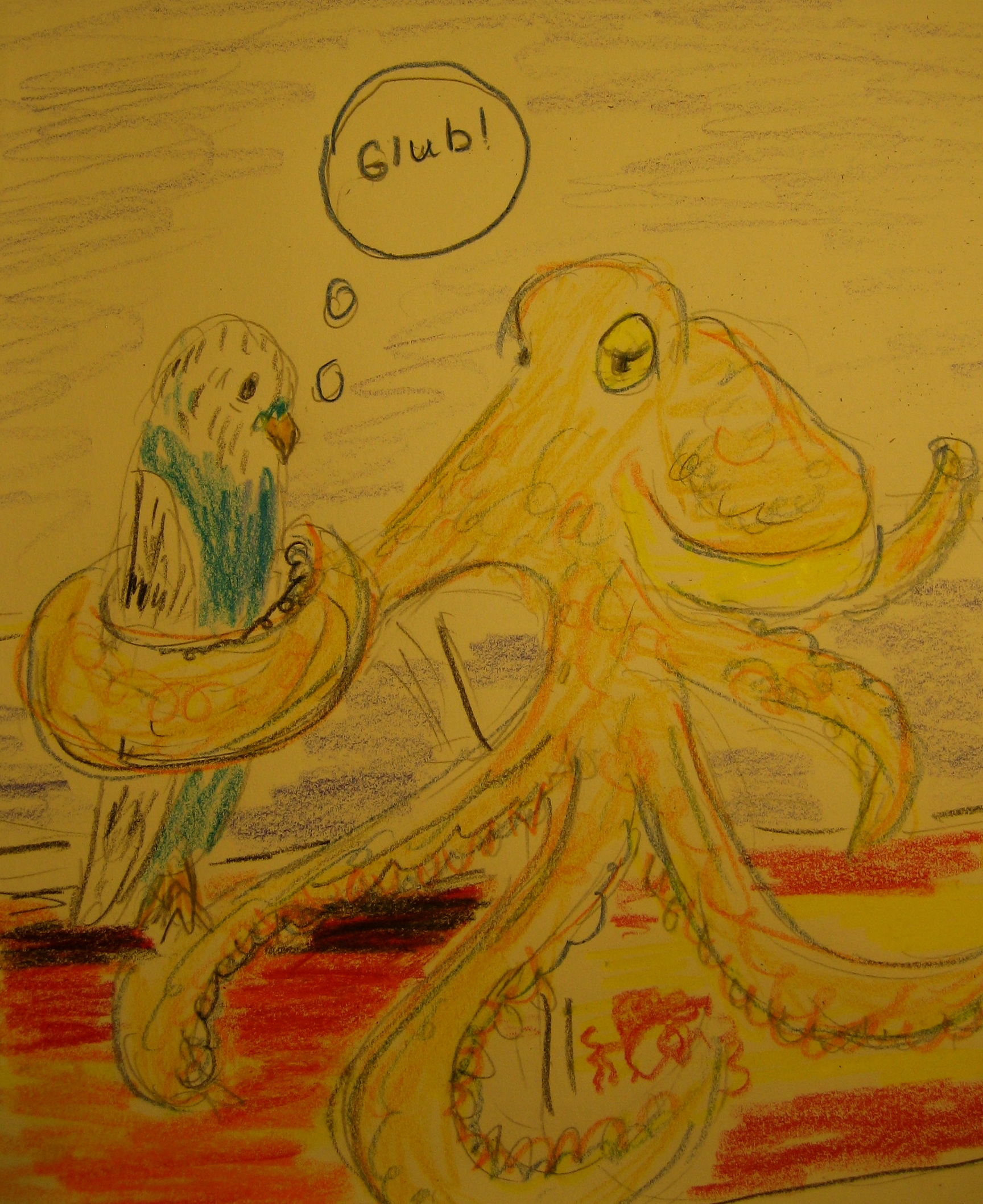
No, my certainty of Spain’s victory resulted completely from my confidence in octopi, particularly the soothsaying Octopus Paul, a/k/a the “Oracle of Oberhausen” (named for the town in Germany in which his aquarium is located.)   A day or so before the game, Paul once again (for the eighth recorded time) exercised his psychic mussel errr…muscle to successfully pick Spain as the winner of the final match.   (What makes Paul’s foresight especially unusual among predictors of the future is that he picked the winners BEFORE the games occurred, and didn’t simply tell us about how right he was after the fact.)

The Dutch, on first hearing of Paul’s prediction, were justifiably downcast until some enterprising Dutch reporter found a competing soothsayer—a parakeet in Singapore.

But I, for one, knew that wouldn’t fly.

Parakeets simply don’t have the grasp of octopi, the breadth, the reach, the slithery coordination—

And let’s just suppose this isn’t all a statistical anomaly, a lucky guess—(could Paul have some tentacular hooks in ensuring the outcomes he predicts?  Could there be something fishy, as it were, going on in FIFAland?)

All I can say is eight for eight!

(And thank goodness the game wasn’t decided on penalty kicks!  A deciding factor that can seem almost as arbitrary as, well, the choice of a cephalopod.)

Blocking Writer’s Block – Love Your Elephant

July 11, 2010

Love Your Elephant!

Readers of this blog may not realize it but I love Virginia Woolf, Walt Whitman, Dostoyevsky, the plays and poetry of Shakespeare (who doesn’t?), Rilke, Wallace Stevens, John Donne, Sharon Olds.

But what comes out half the time when I sit down to write this blog is…Robert Pattinson….

And when I write my non-blog work (aside from legal memos and poems), I often end up with children’s novels about talking dogs, teen novels about oversized noses, young adult fantasies about Royal beauty and magical gifts.  (Yes, I’ve written grown-up types of things too, but the number of pages devoted to the talking dogs and magical gifts is undoubtedly higher.)

I love Goya, Velasquez.  Matisse and Giotto.  Fra Angelico, Francesco Clemente, Kandinsky, Anselm Kiefer, Alfred Jensen;  I have a great deal of respect for Tintoretto. (The Scuolo di San Rocco is not exactly my style but absolutely amazing.)

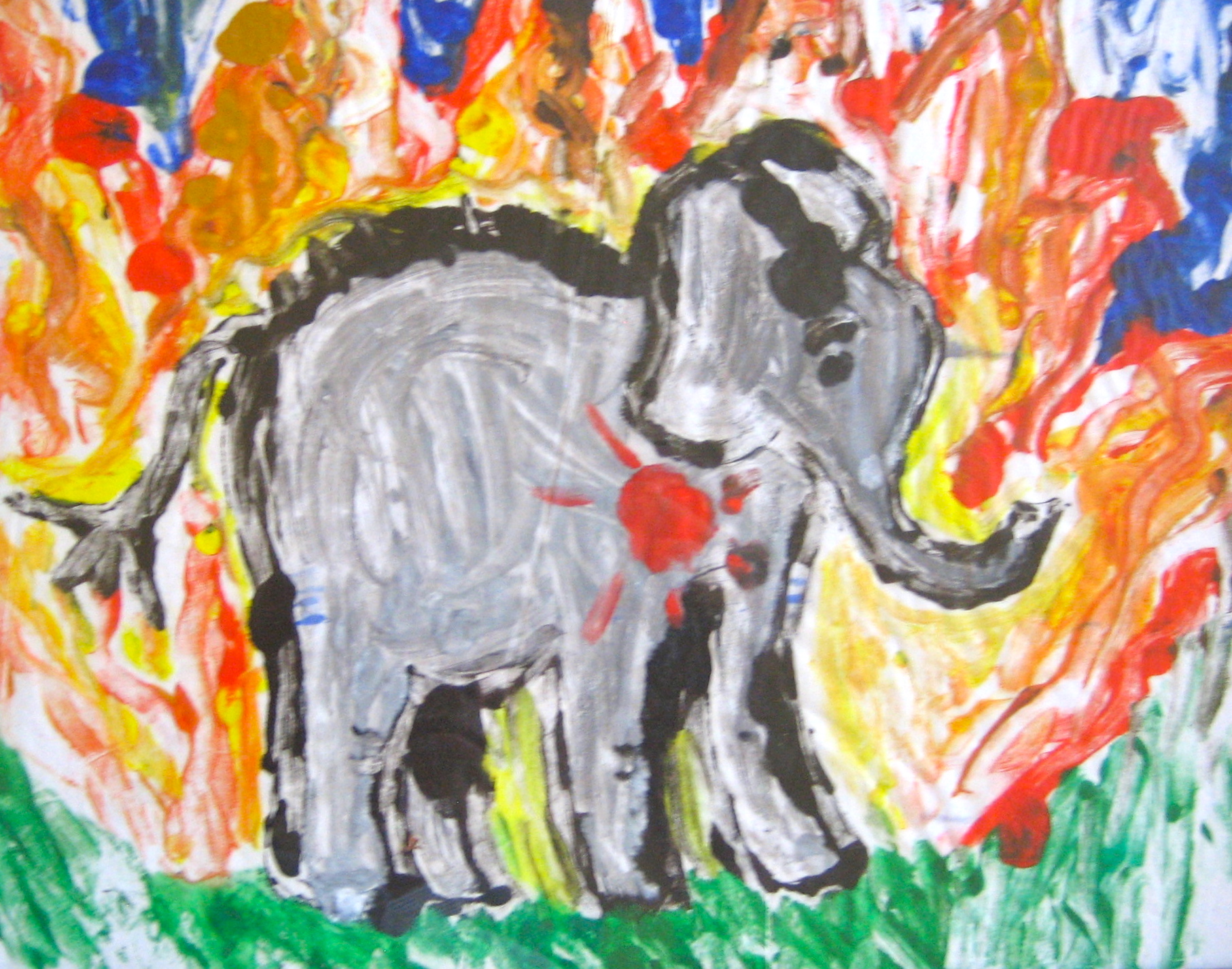
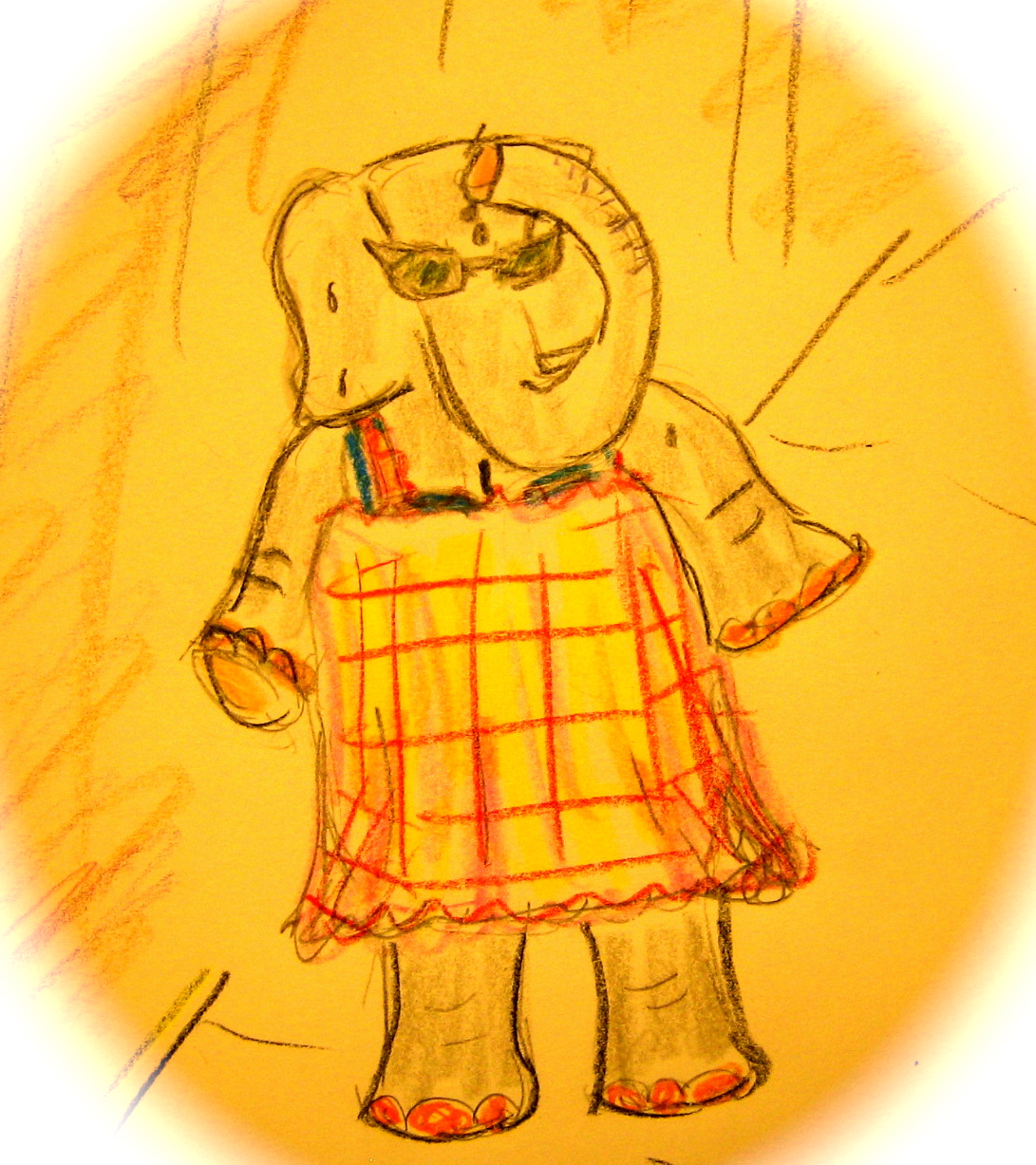
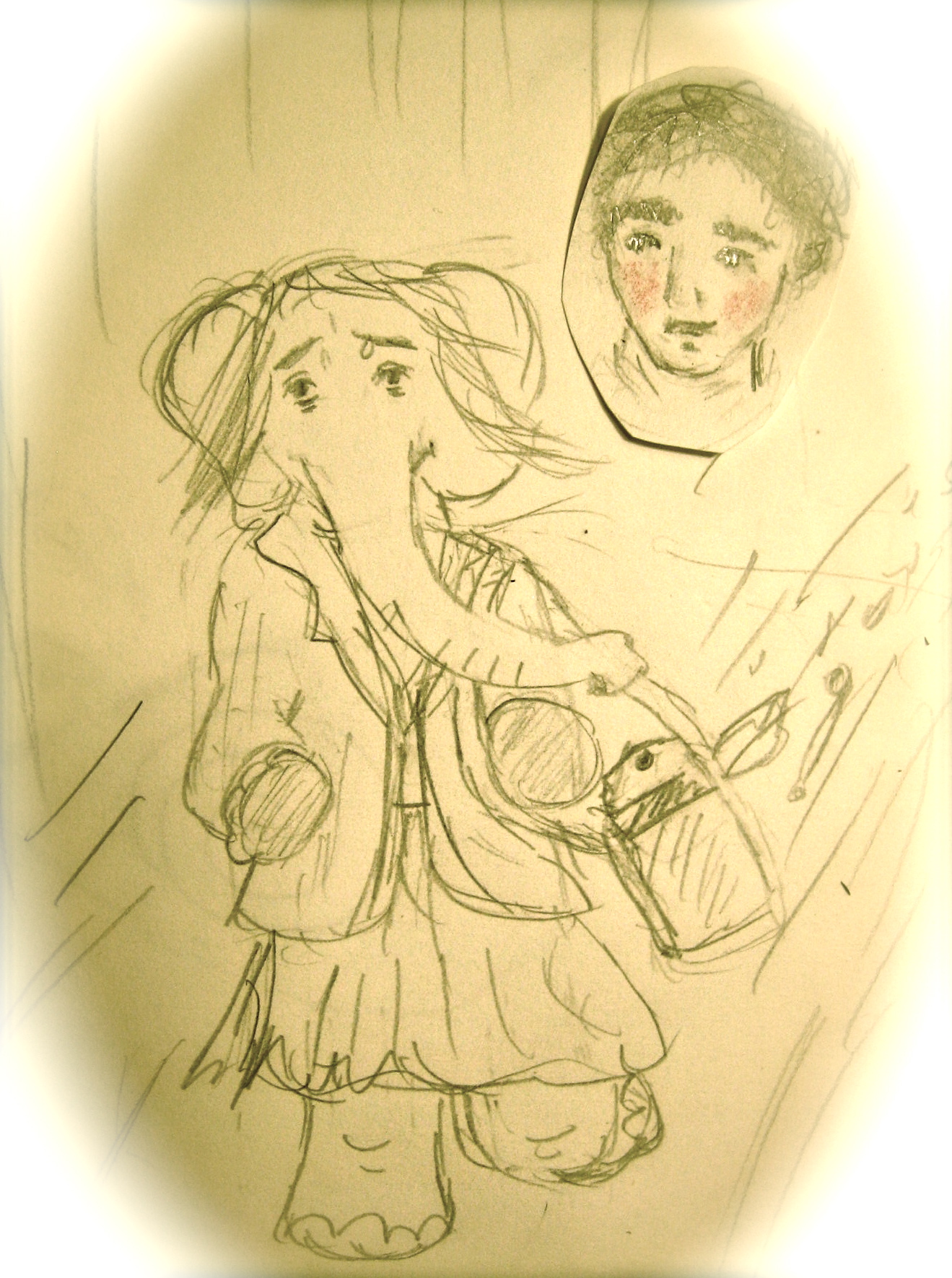
But what (more than half the time) comes out when I put my own pencil to the page?  Elephants.

The curves of trunk, humped back, toe nails, seem to just form.  I long ago stopped fighting against it.

I’m not saying that it’s not good to rail against one’s natural tendencies;  to stretch one’s self.  But it also can be both skillful and liberating to just accept where your energies take you; especially if you are suffering, or have a tendency to suffer, from writer’s or artist’s blocks.

I would be the first to admit that it can be very embarrassing to hieroglyph in pachyderm.  If you have any pretense of sophistication, you may hate that all your cuneiforms are cutieforms.

You may feel disdainful of your talking dog.  (His name is Seemore by the way; as in see—more, since he’s so very observant.  He has taught himself to read and is an amazing speller.)

You may give up re-writing your novel about the beautiful princesses with magical gifts, not because it’s derivative (it really isn’t), but because it’s feels just sort of… silly.

Don’t.  At least don’t give up on these things because of embarrassment.

If your voice or vision tends towards another direction—science fiction, prose poetry–camels!—check it out!    (I don’t mean here to try a lot of different things—I mean if you happen not to be interested in children’s book or elephants, but in something equally unhip—check it out!)

What you are ultimately looking for is authenticity, a channel for energy, a bunson burner to create energy (which really is difficult to sustain if you are not genuinely caught by your material. )  Don’t be put off if what is authentic to you takes an odd, or unexpected, form.  The fact is that your own voice is by its nature somewhat unique (and, if you are anything like me, it may also be kind of odd.)

For more on writer’s block, check out the category from the ManicDDaily home page, and for more on elephants, check out 1 Mississippi by Karin Gustafson on Amazon.

Pushing/Falling Along

July 10, 2010

Crazy time.  I have a dear dear friend arranging for her hospice care in the city, and am up in the country drawing elephants with young kids.   So much to grieve, so much to joy in.   One of those statements that’s a cliché because it’s so true.

A [ridiculous] clock in the hall coos in the hour with varying bird song.  My mother-in-law, now gone, a true naturalist, really loved that clock, especially as hearing true bird song became difficult for her.

I suppose the deepest approach to the inevitable losses in life, the prospect of the loss of life itself, is to let go of regret, to learn to find contentment in what is before you, to stop wasting time worrying about what’s beyond recall (not of memory but of re-doing).   But that’s so hard, for me at least (a master of discontent).  For me, the more effective protocol is to make a concerted effort to remember regret, to remember, in advance, how it will feel when loss is in front of you, to remember, in advance, that this is a feeling that you don’t want to feel, and to focus, to the extent possible, on what you can possibly do to avoid the having to feel that feeling.

To imagine, in other words, that you are at a place with extremely few choices, and to think, from that position, of the choices that you wish that you had made when you had them.

I understand that it sounds Escheresque.   Perhaps this type of forward/backward thinking only works when you have dear friends who are very sick, when you want to plead with them not to go but know that you really can’t do that to them, that their life is beyond their wish and yours.

They have lived their lives well—you have no question of that–but what about you?   You feel pushed along by life,  by rapids, gravity, momentum, but is that push really irresistible? Really?

Subway Blog – An Eye Out For Spiritual Texts on Train

July 9, 2010


Me , rather I, (in the seat there) on NYC Subway Car

On the subway this morning, I move quickly from the side of a guy reading the Bible, not so much because he is reading the Bible—well, a little because of that—but  mainly because I see an open solo seat further down the car.

I realize after I sit down, however, that I am now sitting directly opposite another guy who is swaying back and forth over a copy of the Torah (or at least some seemingly spiritual Hebrew text).  He moves his lips distinctly as he reads, and he reads very very fast.

I’ve already tried to be the Good Samaritan on the train this morning myself, holding the door open as long as I could for two elderly tourists who, having a hard time with their Metrocards, had just barreled through the barred iron gates onto the incredibly muggy platform as the train doors began to close.  But the train doors are programmed against Good Samaritanism and nearly took off my hand before the tourists could stumble in.

As a result, I feel like I’ve already brought too much attention to myself to move one more time.   Still, it’s a bit hard to focus with the Torah guy swaying and reading so—loudly is not the correct word–energetically.

His nose itches; he’s congested; it’s bothering him.  The hand motions dealing with his nostrils are out of sync with the rhythm of his sway, which goes on without interruption, as does his free hand, following of the characters of his text with a stiff, three-fingered point.

I don’t want to watch him so closely; I don’t want to know about his nasal issues.  To be fair, he’s dealing with them discretely enough (as discretely as a swaying, gesticulating, lip-moving, man can) but it is almost impossible not to be aware of him when he is shouting—okay, not shouting—gesticulating so much.

I make myself look up the car.  I see a guy, next to the guy with the Bible, looking at himself with a small hand mirror, and I began to really wonder about (a) the nature of this particular subway car and (b) narcissism when I realize that he truly holds a small rectangular magnifying glass which he is using to read a newspaper article about LeBron James.   (Okay, so just narcissism.)

But I find myself increasingly agitated by the Torah reader.  It has nothing to do with the Torah.  I realize, to my embarrassment, that if someone were reading the Koran opposite me with the same avidity, I would be considerably more concerned.

When the train pulls into the next station, the Torah reader bolts away, and I am amazed at my sudden relief.  How wonderful it is on a Friday morning to have the car taken over by silence, stillness, near emptiness.  I catch the eye of a woman on a far bench, who, for once, smiles back, and I feel so suddenly relaxed that I don’t realize, until the mechanized voice begins and those inexorable doors prepare to close once more, that this is my stop too.

I make the steaming platform just in time.

A long week.

On Hot, Tired Days – A Passage To Your Inner India

July 8, 2010

Inner India (No Disrespect Intended)

I thought this morning of a new solution for those, like me, who are having a hard time with the hot muggy doldrums of mid-summer:  find your inner India.

Stop it–don’t groan.  (Especially you who have actually been to India.)

I’m not advising you to find the inner India of flies, squalor, unremitting aridity or humidity (depending upon your location and the monsoon cycle), the smell of burning polyurethane—

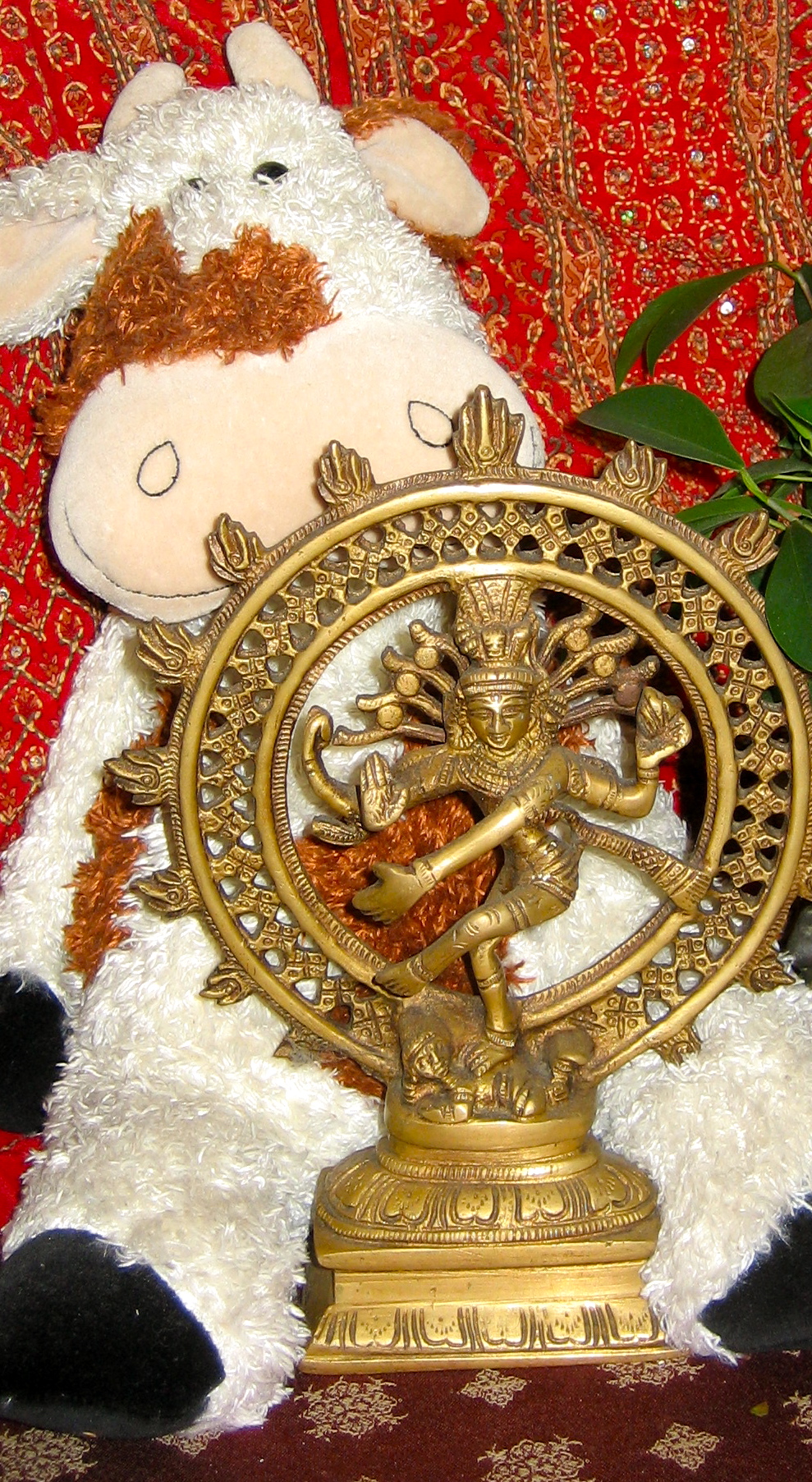
I mean the India of cool marble floors where your bare feet moistly slab slab slab, the India of shaded mosaic archways of palaces…er…mausoleums, the India of leafy Banyan trees and purification baths (delicious even if taken with bucket and cup), of endless people to watch and to be watched by, people who squat imperturbably in the midst of chaos or sameness for a very very long time, certain, or nearly certain, that there will be another life beside the one that they are currently enduring; the India of hot spiced chai, and where there is airconditioning, of air so frigid you feel your lips turning blue.

Keep in mind those lessons that are available nearly everywhere but are so quickly learned upon the Subcontinent,  i.e. (i) that there are many many forces beyond your control; (ii)  that yes, you have been cheated but there’s no use worrying about it; and (iii) that you should be really really careful of what you eat.

Don’t expect even that little boy who seemed so charming to have sold you real saffron.  (Is pink food so terrible?   He had a beautiful smile, a genuine chuckle.)

Above all, even when you feel like you are wading through an opaque sameness of muggy weekday after muggy weekday, try to find the good in the difficult, the wonderful in the ordinary (the cow in the doorway, the bubble in the Naan, the cardomom in what would otherwise still be wonderful tea).   Don’t be rushed,  don’t let anyone pressure you,  find a hat that you will actually wear.

Few Clothes in Egg-Frying NYC – Tu-be or not Tu-be

July 7, 2010

Wishful Thinking? (On ManicDDaily's part)

One thing that has taken me aback in these last few egg-frying days in New York City is how few clothes women have been wearing in public.

I’m someone who has always worn a fair amount of clothing in public.

One reason for this is a lot of my travel has been to hot places which are also very prurient places, places where women, people in general, cover up (i) because of cultural modesty (in situations where people live in tight quarters, they sometimes seem to use cloth as a boundary), and (ii) to try to protect their arms, shoulders, eyes, heads, from blistering sunshine.

I tell myself I’ve adopted such practices—longish sleeves, highish necks, loose clothing—in the name of comfort and good sense.  But another reason for the cover-up, and perhaps the truer one, is simply that I grew up with a strong bodily sense of original sin.  This is different from traditional original sin in which the soul is embued with innate moral failings;  rather it is a sense that the body is embued with innate imperfections, imperfections which, if not corrected by diet and exercise, are at best camouflauged.   (I’m not sure whether to blame this on Twiggy or my mom.)

Whatever the reason, tube dresses were never my style.

I seem to be an anomaly in the modern U.S., however, at least on 102 degree days.  I find it frankly breath-taking.

So many breasts, so many thighs, so many fleshy bits, bits that in my sheltered mind are usually not seen outside a dressing room or swimming pool.

So much confidence, so much nonchalance, so much skin!  And so many many different attitudes (from “God I’m hot!” to “God I’m hot!to “God I’m hot!”)

I vary between admiration (for the freedom and unself-consciousness), to understanding (of why certain other cultures are so very hostile to us), to confusion (on one level it seems anti-feminist and self-negating while on another it seems incredibly feminist and self-accepting), to chagrin (I don’t always want to see all that skin), to–

God I’m hot.

Looking For Relief at 102 Degrees (With Elephant)

July 7, 2010

Ah!???.....

Keep cool.

(And, while doing so, check out 1 Mississippi by Karin Gustafson on Amazon.)

Super Hot Day Brings Up Edward And Bella Again – Is The Fascination About Sex, Marriage, Feminism (Or Lack Thereof)? Or Just All the Carrying?

July 6, 2010

Modern Harried Female and Embarrassed Robert Pattinson (as Edward Cullen)

I hate to try the patience of my regular followers.  I ask for forgiveness based on the fact that it was 102 degrees in my city today, and  I have used very little AC for several hours in a perhaps misguided attempt to support Con Edison (as well as our troops abroad, and our environment at home.)

So, under guise of a very wilted brain, I am returning to a discussion of Twilight, it having re-entered my consciousness with the new Eclipse movie.  Only this time I’m approaching it from a sociological perspective and not an “isn’t-Robert-Pattinson-so-much-cuter-than-that-Lautner-guy” perspective.

There has been much discussion of the sexual conservativism of Mormon Stephanie Meyer’s books (the lesson of “sure, dear, sneak a vampire up to your bedroom every night, just don’t, you know, have, like, sex with him. “)

But the truly old fashioned aspect of the books relates to sex as in gender roles, rather than to sex (or the lack thereof) as an activity.  Frankly, when viewed through this lens, the appeal of the books to middle-aged women (the mothers or grandmothers of the target teen audience) is really kind of sad.

Much is made in the movies of a love triangle between Bella and her vampire suitor Edward and werewolf suitor Jacob, but, frankly, in the books – spoiler alert- Edward wins hands (ahem) down.

No, the true choice for Bella (as written) is not between Edward and Jacob, but between a) Edward, a life of very ample financial security, sex (finally) and devoted, if controlling, companionship, and b) having a life on her own—that is, going to college, having a career (vampires have to keep too low a profile to pursue work or renown in any meaningful way), having an ongoing relationship with her birth family, having children (although this one doesn’t come up for a while), having her choice of friends, having to wear sunblock, and (though rarely mentioned) eating food.   (Edward sort of sums all these things up in “having a soul”.)

This choice, if you think about it, sounds an awful lot like the choices faced by many women in the past (and currently in much of the world) in marriage.   Going from one set of fairly controlling males (the father and his sphere) to another (the husband and his sphere).   Trading off the possibility of independent personal development for material security and sex with a sole partner.

Even more strange from a feminist perspective is the fictional fact that Bella feels forced to make her choices quickly primarily because of her vanity.  (Okay, and hormones.)  She can’t stand to delay a transformation to vampiredom, even to go to college for a couple of years, because it will cause her to become “older” than her vampire beau.  She feels the tick of a biological clock that is not based on reproductivity but firm thighs and an unlined countenance.

Yes, young love is powerful.  But why do older women (much to their own embarrassment) read the books so avidly?

The only answer I can come up with (and I should know) is that Edward promises to take care of everything.   He is handsome, considerate, unconditionally loving, but, more importantly, extremely attentive to detail.  He loves to buy presents.   He arranges for house cleaners.  He cooks!  He carries Bella around, never ever complaining about how heavy she is.  One big reason he wants to get married is simply to be allowed to pay Bella’s bills.

The modern older woman a) rarely has anyone carry her groceries much less herself, and b) generally has to pay her own bills.

Of course, the success of the books probably also arises from the fact that even as Bella makes some very unliberated choices, she ends up repeatedly saving the day, and generally doing adventurous, independent, types of things.   (All the while being carried at moments, and having important bills, such as medical and travel, paid.)

It’s interesting that the non-Mormon director and screenwriter of Eclipse, presumably sensitive to feminist issues, actually change the dialogue to have Bella say that her motivation for becoming a vampire is to be her truest self (rather than her love of Edward.)   While the change may be intended to promote the idea of strong women, it ends up meaning that Bella’s choice is for wealth, supermodel looks, superhero/bloodthirsty strength.  (And still no college or family!)  Somehow the doing-it-all-for-love part seemed better.   (Especially given the carrying.)  (And the saving the day.)