Posted tagged ‘Manicddaily pencil drawing’

Longterm Focus – Stress and Creativity – Pearl!

May 31, 2010

Pearl - Habit and Engagement

The other day I worried that I really didn’t have a focus for this blog; something to orient  both me and any readers I may be lucky enough to snare.   What have I been I writing about?  What subject do I even have to write about?

Then I suddenly realized that the general subject of this blog has been stress and creativity.  If I wanted to sound official, I’d say the interface between stress and creativity, but since I can’t say that with a straight face (or interface), I won’t.

What does this mean?  I guess the question for me is how one, in this manically depressed stressful modern world, maintains some kind of creative effort?  How can one use stress as a source for creativity rather than as a wet blanket for its termination?  (How, also, can the manic avoid using creativity as a further source of stress?)

For my first conscious exploration of this subject, I turn to the teachings of my old dog Pearl.  Pearl was struck by a sudden spine problem a couple of weeks ago that paralyzed her from the dog-waist down, rendering her hind legs both insensitive and immobile.  Amazingly, with the help of steroids, she has recovered some use of her legs: she can wobble along now, though she moves like the proverbial drunken sail—dog.  (BTW, after reading several Horatio Hornblower books last week, I now feel enough “expertise” to understand that the unsteadiness of a drunken sailor is archetypical because it arises from at least two sources—(a) alcohol and (b) sea legs, i.e. legs accustomed to the sway of waves that are suddenly posited upon dry land.)

Pearl’s up in the country this weekend, and her reaction to it is a lesson in the maintenance of creativity under stress.  (For these purposes, I’ll consider Pearl’s outdoor explorations and general cuteness her “expression.”)

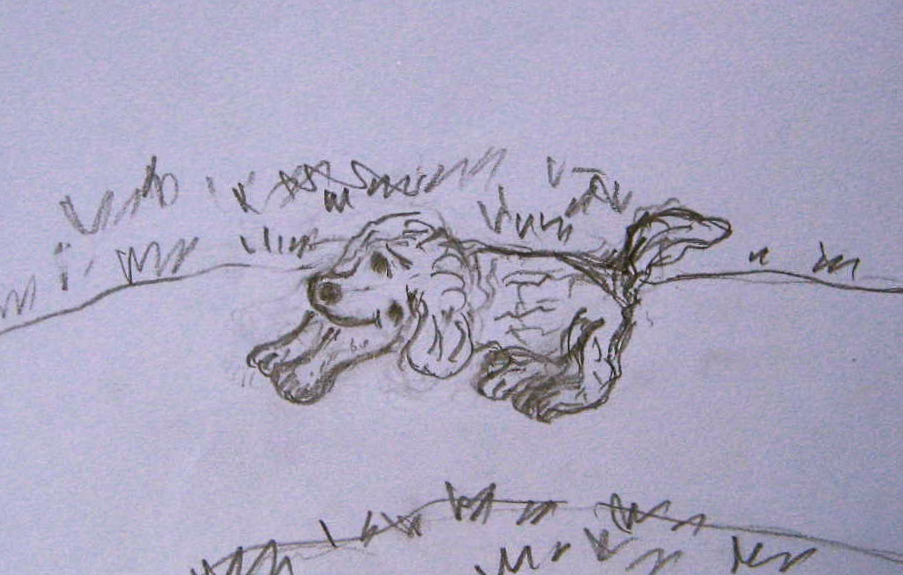
Pearl still has trouble even walking, and yet, here, in a country place she has loved since puppydom, she wobbles, skips, trots.  What motivates her, what keeps her going, seems to be two factors:  habit and engagement.

There are certain places (a long dirt driveway), and certain times of day, in which Pearl has always run here.  That habit (plus steroids) is so strong that when I put her down on these spots, and at those special times, her legs just move.

Where habit runs out, engagement takes over.  The scent of a place where a deer has recently bedded down will lure Pearl, sniffing, into tall grass, pull her through reeds, propel her into Heraculean effort.  I can only derail her lopsided enthusiasm by physically picking her up and putting her back on her track, where, out of habit, she quickly wobbles off again.

Which brings me back to the creative human mind dealing with stressful obstacles–all those drags upon the consciousness.  How to avoid paralysis?  How to dart and trot, dig and ferret?  How to just keep going?

This (I think) is this blog’s inquiry.

Thanks so much to those who have been following.  Stay tuned.

Memorial Day Weekend- Liquified Whitman

May 30, 2010

Memorial Day Weekend

Here is a draft poem for Memorial Day weekend.  Did you know that Vitamin B is recommended to ward off bug bites?  Apparently, mosquitoes hate the smell.

On the Grass By the Pond

My Vitamin B-infused pee
blends with the blades of yellow-green
below my thighs, like
liquefied Whitman.
Memorial Day Weekend.
First outdoor pee of the season.

Memories of Memorial Day

May 29, 2010


Memorial Day Weekend

Memorial Day Weekend.

When I was a child growing up in suburban Maryland, the weekend was glorious. It meant the opening of swimming pools for summer; it meant the opening of summer for summer.   It meant that any school days we had left would count for nothing but a countdown, in which the sweat accumulating at the backs of our knees would smell faintly of graphite and the white vinegar used to sponge down the school cafeteria.

The pool was where we spent almost every daylight moment in our summers.  We had no air conditioning,  managed the heat through damp bathing suits, that were kept on even after we came home, darting around the slow darkening of summer yards, kept on even in the blue glare of night TV.

Later, as an adult, Memorial Day Weekend meant a chance to drag my two children to upstate New York, leaving the very momentary green of May city for some real, deep, comprehensive, green.  We seemed to be collecting coolness up there too.   (Air conditioning has not been an easy accomplishment in my life and there is nothing like most New York City apartments for jumping into summer fast, each room its own little microcosm of global warming.)

It was only on these trips up to the country that I glimpsed the true meaning of Memorial Day.  There is one cemetery our route passes; actually the road bifurcates it; drives smack down the middle.

Of course, the cemetery is green in May;  it’s green all summer long, the grass lush, fenced in, mown, lined with small brown and grey headstones that look almost like the class of kids in my old schoolroom, half-asleep.

There were always a few little bouquets, some too brilliant against the rectangular stones to be completely real.  But on Memorial Day weekend, there were more, and, with the flowers, small American flags, prongs stuck into the earth or on small stands

Sometimes, driving by, we’d see a few small groups, women with pale hair scalloped around their faces, the curves made by curlers, or permanents, old-fashioned hair.  Women with pastel pants, sometimes worn under dark windbreakers; upstate New York’s weather changeable in May.

Even watching them, with their curled hair and small American flags, it took me a while to catch on.

(For a villanelle about swimming in summer at the pool, check here.)

Fleet Week – Where are you, Horatio?

May 26, 2010

Fleet Week in New York (See Statue of Liberty in background!)

It’s Fleet Week in New York!   It corresponds, oddly, with my current personal absorption with Horatio Hornblower, the mythical hero of C.S. Forester, who through a series of eleven books makes his way through the ranks and at least some of the depredations of the British Navy during the Napoleonic Wars.

It’s an interesting testament to the power of narrative that I had a very hard time tearing myself from the printed page of Forester’s Ship of the Line this morning to watch actual battle ships course down the Hudson, right next to my apartment building.   (So much for living in the moment.)

I just wanted to stick with Hornblower, even though the ships were hugely impressive, and lined with living, breathing human beings.

Much has changed since Hornblower’s time.  The U.S. Navy ships seem inordinately plain compared to Hornblower’s schooners, frigates, ships of the line, with their top gallants, topsails, reefed topsails, mainmasts, mizzen masts, jury masts, rigging,  netting, and long nines.  There are a few small towers of gizmos, presumably related to radar, but for the most part, these new ships are large slightly curved trapezoids of painted grey.

It’s hard  to imagine these huge wedges of steel as the descendants of the beautiful, if gnarly, sailing ships of the British Navy.  Though there they were–men (presumably women too) lined up in rows of white (the sailors) and dark blue (the marines), roughly in the same divisions of rank and service as on Hornblower’s ships.

Other similiarities: decks!  Portholes!  (Wait–are there portholes now?) Starboard, port, stern, bow, lee, tack–vocabulary.

Space constrictions–though I expect modern seamen have more than 18 inches per hammock.

Some monotony of food?  But, hopefully, today’s soldiers  do not have to tap their sea biscuits to scare out weevils.  (They only need to be concerned about trans fat and high fructose corn syrup.)

What else do Forester’s sailors and today’s share?  The sea!  The sky!  The horizon!  Occasional seasickness!

Reading C.S. Forester makes one very conscious that conditions of the British navy during the Napoleonic Wars were almost unimaginably severe, especially with so many sailors press-ganged to begin with.  (Hardly a volunteer force.)

Scurvy, disease, amputation, the requirement of absolute obedience at the threat of flogging, court martial, hanging.  Though, actually, the biggest danger seems to arise from the incompetence and/or greed of supervising officers. (Hornblower, of course, excluded.)  And too, less-than-reliable allies.

Hmmm….

Of course, what ultimately makes the books compelling is not the politics, the tacking and heaving of sails, or even the discussions of sea biscuit, but the character of Hornblower himself — outwardly indomitable, inwardly hyper-sensitive, noble (in spirit if not rank), brave, and amazingly quick-witted even when in a near stupor of fatigue and stress.

Did one of his spiritual descendants sail by this morning?

Maybe.   (I, for one, was too busy reading to notice.)

Even Stouter than Hornblower?

Love’s Offices – Ailing Dog

May 24, 2010

Place of Love's Offices

Those who follow this blog know that our old dog, Pearl, has recently suffered a problem with her spine which paralyzed her hind legs.  Under the influence of steroids (go Floyd!), she’s doing somewhat better, but still not walking.  Nonetheless, we have to be very careful where we leave her in the apartment as, when she is left alone, she insists on dragging herself to her “office”, a cluttered, dark clothes closet.

There are many meanings of the word “office.”  One is Pearl’s closet; another, perhaps more accurate use, refers to duties or functions. pIn a beautiful poem called “Those Winter Sundays”, Robert Hayden writes of “love’s austere and lonely offices,” describing his stern dad’s early rising on frigid Sunday mornings, hustling the house fires back to life with competent, chapped hands, and polishing the shoes of the son (poet.)

I love the poem.  It does make me wonder, however, why so many of love’s offices in my personal experience involve, not home fires, or even scuffed shoes, but plain old bodily fluids.  I’m not talking sex here, but of the effluvial tides of sickness known to almost any parent, pet owner, (woman).  These have poured from a host of sources–from travel with children (at least, my children) on sea, air, or roadway; to shepherding them through flu’s, colds, allergies, nights out, even cuts and cold sores.  In family life, stuff flows.

And now, here’s my little half-paralyzed dog.

I should be (and am) happy that even under her current difficulties,  she has retained pretty iron-clad bladder control (except for the other morning, just as I got her down the stairs into the building lobby).  But the lack of functioning hind legs makes such matters difficult for a dog.

So, now, love’s office involves carrying her down to a small fragrant square of dirt on the Esplanade by the Hudson River, squatting there to hold her up with the help of an old but strong and soft silk undershirt slung under her belly, waiting….waiting…trying, while waiting, not to worry too much about the spindly tree that somehow lives in that besotted patch of dirt.

Since she cannot exactly say what she wants, love’s offices also involve waking up several times during the night to try to figure out why the dog is struggling to a seat or shaky stance, and then propping her up over some folds of old newspaper.

Love’s moist and ignoble offices.

Recovering Dog Tries To Get Back To Work

May 21, 2010

Pearl in Office

I have never much liked Western medicine.  Perhaps my antipathy started with the allergy shots I got for years as a child.  (There’s nothing like an injection once a week to put you right off the smell of rubbing alcohol.)

I’ve also always been a bit suspicious of veterinarians, especially in New York City.  They often seem to be altogether too proactive when suggesting costly diagnostic tests and procedures.  (Could that have anything to do with high rent?)  They also sometimes look askance at my dog’s home-done (i.e. inept and patchy) grooming.

But today, I blog in awe of Western medicine,  a New York City vet, and steroids. I am even almost sympathetic with Floyd Landis.

Yesterday, and the day before, I wrote about my genuine (if not fully voiced) fears that our beloved dog was on her last legs.  (These would be her two front legs, since her hind ones were suddenly completely paralyzed.)  I shouldn’t joke about this—it’s really been terribly sad.

But, a few doses of steroids (for her, not me), and I find myself amazingly light-hearted.  Pearl is not exactly back on her feet, but she can just about push herself up, and she is definitely in much less pain.

She is even back to her old insistence on a ritualistic personal schedule; meaning that, when I was briefly out, leaving her on a pleasant airy pillow, she dragged herself across a large room and hall into her habitual “office” (my closet).   (I think she’s always had a secret affection for Act IV, Scene VI of King Lear, when Lear points out that even a dog is obeyed in office.)

(Sorry.)

(P.S. –yes, to those of you who follow this blog; the drawing above was originally posted here.)

Looking For Cheer (With a Sick Dog)

May 19, 2010

Sick Dog

I was ready tonight to write about the wonderful reserve of the old-time British hero, Horatio Hornblower (created by C.S. Forester);  this is a character that knows how to pack a great deal of meaning into a very few words; who is masterful at mastering his feelings, careful to mask and make do with discontent, sadness, anxiety.   But I come home from work to find my very old dog suddenly immeasurably older.   Something is very wrong with her, and suddenly reserve feels immediately like a much less interesting quality to me.

When your old beloved dog is sick, you really are not looking for a friend to say, crisply, “hard luck.”

Certain types of cheerfulness are even worse than the crispness of a stiff upper lip.  For example, when you are anxious or grim, it’s not always helpful to have someone tell you, brusquely, to cheer up, or to not give up hope yet.

Maybe it’s just me.  Perhaps I am of an argumentative nature.  (Actually, there’s probably no “perhaps” about that.)  But, when someone tells me cheerfully not to give up hope, I want to respond tearfully, (i) that hope is already far gone, and (ii) just leave me alone.

I find that instead what helps when I am truly anxious or upset is some kind of commiseration–an echoing or mirroring of the upset feelings.  Yes, I know this sounds  like wallowing–or, even worse, getting your friends to wallow with you–but instead of strengthening bad feelings, this kind of commiseration seems to give a stepping stone for getting out of them.   This could be my peculiarly argumentative nature.  All I know is that if I am upset, and someone agrees that my situation is pretty awful, my kneejerk impulse is to say that it’s not so bad, and to actually feel some kind of  hope.   (It’s as if the sympathy gives me enough strength to become my own comforter.)

In a similar play of opposites, many look for someone to take care of them–financially, emotionally, physically–while the being that most readily captures their heart is one that they take care of.

A dog.

Here’s hoping.

Richard Blumenthal’s Pants

May 18, 2010

Richard Blumenthal's Pants

Breathtaking spectacle of Richard Blumenthal, Democrat, Attorney General in Connecticut, running for Senate.  You’ve probably heard already–he’s the guy who got five deferments from military service in the Sixties, then joined the Reserves (which, unlike now, was a safe harbor from combat service, and basically consigned him to community service in D.C. and New Haven rather than transport to Vietnam)—and , more recently, has cited his service in Vietnam, or homecoming from Vietnam, in speeches that leave the impression he actually was there.

One big question comes to my mind, well, two big questions—the first being variations on how could he do it?   Oh, I’m sure there’s some casuistic explanation.  But how could he look himself in the mirror afterwards?  How could he actually utter the words?

The second is, why?

Actually, scratch the why.   Obviously, he thought active military service would seem more appealing, less effete, to a wide cross-section of voters than, say, Yale Law School.

So, I guess my second question is how in the world did he think he could get away with it?  We live in a world where the past is public.  Did he honestly think no one would check?  Granted, the press tends to largely feed off itself, simply repeating repeating repeating one brave soul’s original reporting; but in a campaign!? !

The answer to this question seems to be that, in addition to problems with integrity, Blumenthal has problems with common sense.   It doesn’t seem to me to be stupidity (which shows, I guess, a certain bias on my part towards the basic intelligence of  Yale Law School graduates).  Maybe egomania?  Maybe… arrogance.

The commentary of people reading about Blumenthal is interesting, in part, because it is so partisan—about half seem to say, “what do you expect?  He’s a Democrat.”  The other half:  “what do you expect?  He’s a politician—just like Bush and Cheney.”   And the other half (and my proportions may be a bit off here):  “what do you expect?  He’s from Connecticut.”  (Sorry, Connecticut.)

And then there are the realists.  Correction.  Maybe I should call them the wishful thinkers:  they simply say, he’s finished.

PS – they talk about strong politicians helping the election of others in their party with their “coattails.”   Will there be a drag-down effect of Blumenthal’s liar liar burning pants?

Junk “News” Nation – Twinkie/French Fry Speak Takes Bat At Kagan

May 16, 2010

Junk News Speak

Over the last few months on this blog, I’ve periodically embarrassed myself with confessions of my escapist fascination with vampire novels (and certain actors who play their starring characters.)  My only excuse has been a combination of stress, a decaying brain, and—I admit it—a wish to get “hits”.

Given my own weaknesses, I very much understand the drive of the news media (a) to sell papers; and (b) to get people to watch, or click on, their programming.

I also understand that legal theorizing, judicial precedent, and the parsing of amici briefs, can be–well, let’s say, boring. (We won’t go all the way to stultifying.)

As a result, I can imagine the glee of cable TV newsrooms when, faced with new Supreme Court nominee, Elena Kagan, they found something other than Roe v Wade to hang a story on.

But, come on!  An old photograph–not of  the judicial nominee drunk and philandering, or speaking at a segregated club, or even wearing a funny hat–but playing softball?!  A game which is supposed to be the all American past-time, but which we now discover (after endless media discussion) is truly a code activity for gayness!

It’s all just so goofy (and sickening)–a dumb and dumber approach to news which relates to relevant fact in about the same way that tweeting relates to exposition.  Snarkiness substitutes for commentary; smirks for analysis; talking heads become chuckle heads as they fall over themselves to say that (a) they are not saying anything; and (b) by the way, did you get it?

In the same way that fast and processed food has taken the place of real food (food stripped of nutrients and hyped instead with artificial color, ultra-fructose sweeteners, and loads and loads of trans fat and salt), we now have fatty, salty, simpering gossip replacing real news, news that takes thought, and provokes thought.

At least, vampire novels don’t pose as anything but entertainment;  at least, the vampires in them openly show their fangs.

Running Late – Exercise On the Go

May 15, 2010


Running Late (and Slightly Elongated)

Followers of this blog know of my earnest, if multi-tasking, devotion to Astanga Yoga and the elliptical machine, but I’ve yet to discuss my most efficient method of getting regular exercise.  This is to leave a bit late for nearly everywhere I go.

I am not sure that this exercise method would be effective in more car-friendly environments (where you might only accumulate speeding tickets), but if you are running late in New York City, you usually are also trotting, jogging, speed walking, scooting, maneuvering, and dashing, late.

There’s nothing like that “whiled-away fifteen minutes” after your pre-set time of departure –you know, that time spent not departing when you are hopelessly trying to find something to wear that feels “right”, sweeping your kitchen, taking your vitamins, circling back to your apartment to turn off your iron—to get the old legs moving, and that regretful heart pumping.

In addition to the physical benefits of running as quickly as possible, for as long as possible, along a crowded street, there are also certain psychological benefits to a chronic lack of punctuality.  If, for example, you are trotting alongside your husband, who is also perennially late, you will find every single unresolved issue between you coming to the fore and absolutely ripe for frank discussion.

Even if you are chasing along on your own, you will happen onto epiphanies.  Chief among these is a clear understanding, usually (eventually) reached while waiting for a subway train (which, because you need to make time, is delayed) of the impotence of your individual decisions; your relative puniness in the universe; the fact that you are subject to great forces—fate, the MTA, your own inability to leave on time–forces that are determined to always make you late, forces that you must simply accept.

Hopefully, around the time you reach this understanding, you will find yourself in a place with cell reception.