
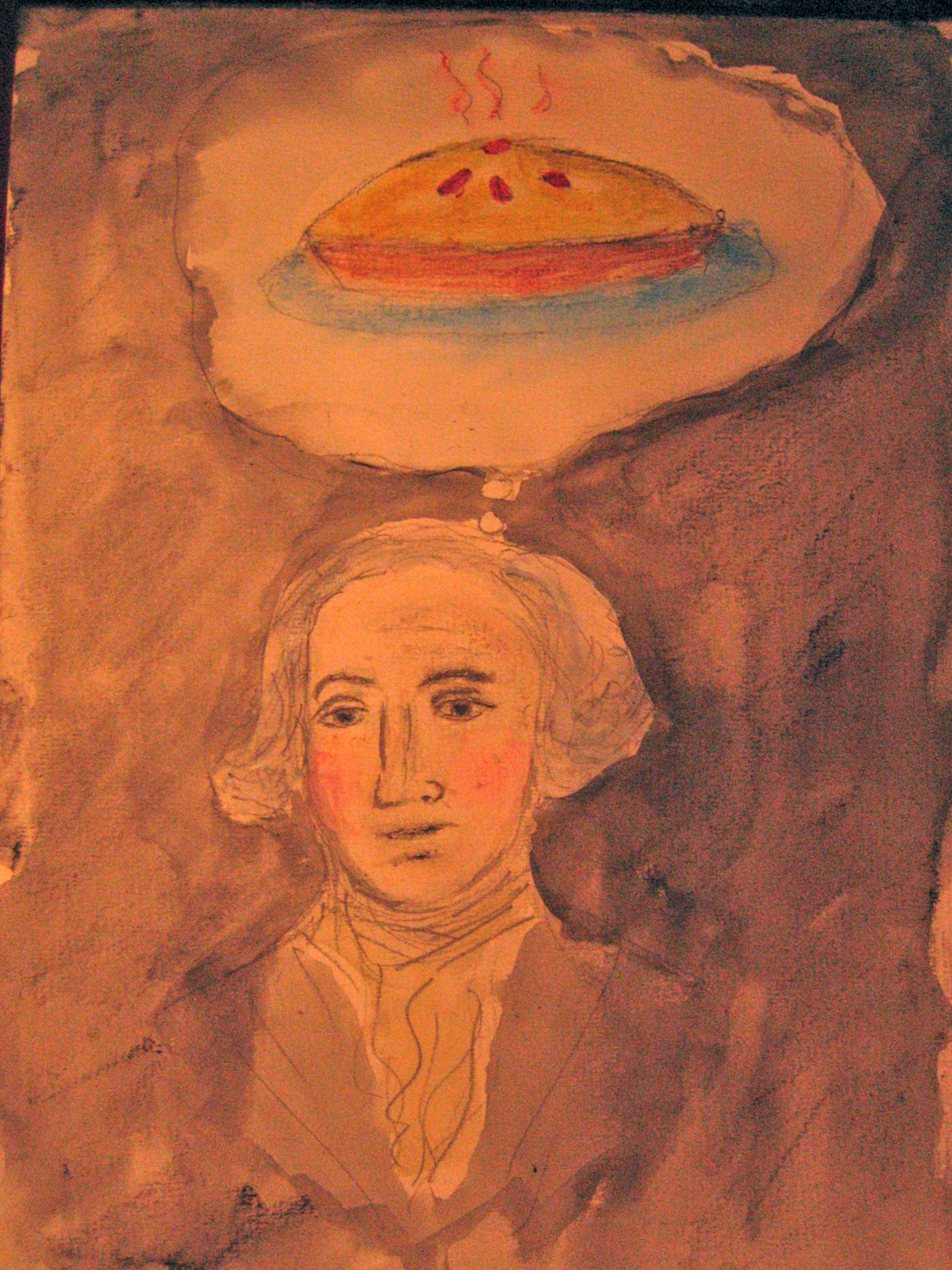
Washington and Cherry Pie
Presidents’ Day. In my youth, we had Lincoln’s Birthday on February 12 and Washington’s Birthday on February 22. I don’t remember specific rituals around Lincoln’s Birthday, but Washington’s was celebrated with cherry pie.
And, of course, big sales.
Now, what we mainly have are the sales.
I could not help thinking of Washington today. Partly because I still had Sarah Palin’s Tea Party speech on my mind, “American Exceptionalism”, and the attempt (apparently among certain members of the Texas Education Board) to characterize the founding fathers as Christian (with the capital “C” and silent “F” of Fundamentalism).
Even when I was little, the one thing we all knew about George Washington was that whole incident with the cherry tree. We had been told that the story was probably not true, but understood that the point was that Washington himself was true; a good man; that even as a child (like us), he could not lie. (I thought about him as a kind of American Pinocchio.)
Of course, even the true stories about Washington stress the strength and nobility of his character, noticeable in both his age and youth. I read today, in connection with thinking of Washington’s character, the precepts Washington copied out at sixteen: Rules of Civility & Decent Behavior in Company and Conversation, 110 maxims which are believed to have come from a book published in 1664 in London entitled, The Young Man’s Companion, and which, in turn, were derived from rules developed by French Jesuits in 1595.
The Rules are a detailed compendium of how to show respect and consideration to others, both in matters of literal nit-picking as well as “not-picking-upon.” Although the rules urge a young man to keep the “celestial fire” of conscience alive, they do not seem to teach how to please a Christian God (there are no biblical references), but how to be a good, honorable, admirable person.
The founding fathers, shaped as they were by the Enlightenment, seem to me to have been big on such precepts, guidelines, universal rules. One thinks of Ben Franklin, who, in his Poor Richard’s Almanac, published literally hundreds of adages, rules to live by. While some of Franklin’s adages do mention God (as in “God helps those who help themselves”), and many castigate immorality (especially hypocrisy), the focus is more on prescribing a moral life because it is a key to happiness, contentment, self-fulfillment, societal good: “Sin is not hurtful because it is forbidden but it is forbidden because it’s hurtful. Nor is a Duty beneficial because it is commanded, but it is commanded, because it’s beneficial.” (Poor Richard’s Almanac, from 1739.) In other words, a good life is its own reward, and, more importantly, is a reward.
Thomas Jefferson was particularly interested in theology; he even wrote specifically about Jesus, but again, his interest seems to focus not so much the specific religious meaning of Jesus, but in Jesus as a sublime paradigm of the ethical life. (Apparently, Jefferson’s book, published in 1820, The Life and Morals of Jesus of Nazareth, sets forth Jesus’s ethical pronouncements, while editing out the Virgin birth, the miracle stories, Jesus’s claims to divinity, and the resurrection.)
I really do not know as much about the history of these men as I would like, so forgive me (and comment) if I’m mischaracterizing them. I’m certainly not trying to make them out as “anti-Christian”, but simply saying that it seems bizarrely reductive, simplistic, and manipulative (i) to argue that the use of the word “God” or “Creator” in our founding political documents aligns the founding fathers with the religious right; (ii) to ignore the historical context of these guys (as heavy readers of both the Bible and Voltaire), and (iii) to treat them as if they were somehow more mainstream versions of Joseph Smith, i.e. specific transmitters of divine will.
Agh!
And yes, it’s possible to be ethical and even christian without the capital “C” or the capital “F”, in the same way that one can honor the American flag without being pro-war. One can even like cherry pie.
(All rights reserved.)
PS- if you like elephants, as well as watercolors, check out 1 Mississippi by Karin Gustafson on Amazon.

 ManicDDaily
Recent Comments