Archive for the ‘Uncategorized’ category

Kristoff’s Moonshine, Hirsi Ali’s Feminism, “Honor Killing”

May 23, 2010

A couple of articles in the New York Times today are enough to make a woman a feminist for the sake of bettering the world as a whole, and not simply the lot of women, (although since I am already a feminist, I may not be a good judge of that. )

One from Nicholas Kristof describes the situation among the poor in Africa where spending choices by fathers favor alcohol and cigarettes over anti-malarial mosquito netting and children’s tuition fees.  To combat this problem, micro-bankers are trying to put more money in women’s hands, as women tend to be more likely to spend money on the welfare of their children than on their personal habits or pleasures.

Another article by Deborah Solomon, portrays Ayaan Hirsi Ali, an ex-Muslim woman, the author of Nomad:  From Islam to America, and discusses the Islamic view of women as family property, only with the twist that women are property that is capable of devaluing itself (like silver that self-tarnishes, an oven that self-chars.)

To some degree, the articles discuss unpopular topics; some in the West are so anxious to compensate for cultural biases and depradations of the past (and present)  that they are reluctant to criticize, or even acknowledge, practices that are unjust and oppressive.  This, to my mind, is political correctness at its worst: when there is a pretense that all points of view are equally valid and that cultural norms (even those that are unjust to women and children) are somehow fine simply because they are foreign and/or tradiional.)

Here is a poem on the subject on honor killing.   It was inspired by an incident in the Middle East where a brother killed a sister suspected of dishonoring her family:

Honor killing

The knife slides in,
with force.
She is thinner than he has remembered,
her collarbone sharp as
a hook he thrashes upon.
Mind snags heart, but
cannot aim for breast,
only the knife can look past nipple.
Smaller than he’s remembered,
with too-soft skin that folds within
whites of eyes big as
blade.
He tries to think
of flame, the filmy body
of smoke, the dryness of
ash, but blood,
fountains,
in honor of
the righteous,
fountains.
Why has she made him,
righteous,
do this,
with force.

Monks At Radio City

May 22, 2010

Monks at Radio City

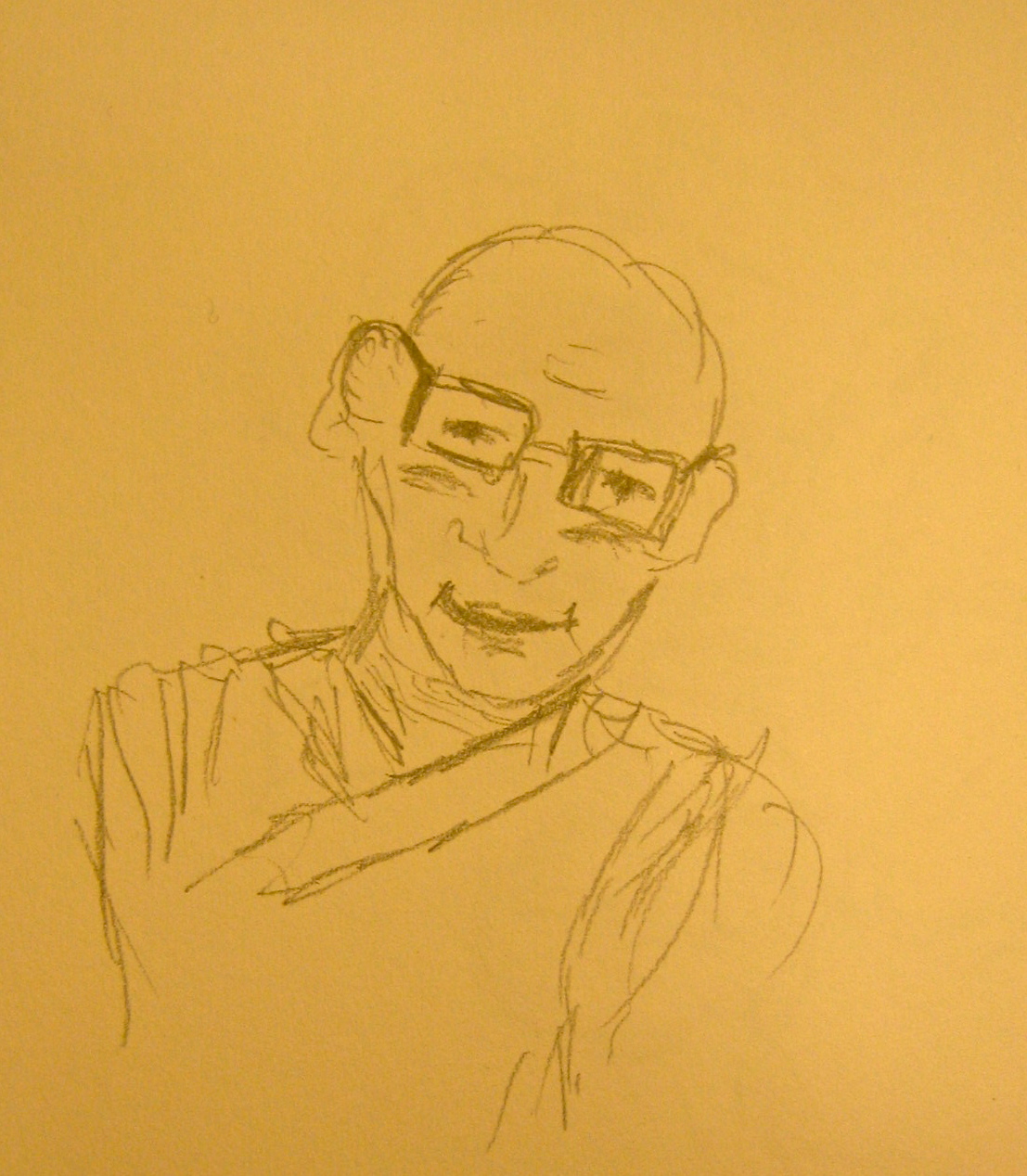
I was lucky enough to get to see the His Holiness the Dalai Lama again today for two of his final lectures in a series at Radio City Music Hall discussing Buddhist commentary on the Bodhicitta Bodhisattva’s way of life.  The Dalai Lama and Richard Gere both!   One whose bald head was (shockingly) partly covered by a thick maroon visor, the other whose head was (shockingly) totally covered by a thick shock of extremely white hair.

“What a good guy,” someone said as we walked up the aisle at the end of the last lecture.   (Meaning, I believe, the Dalai Lama, and not Richard Gere.)

Yes, a very good guy.   But what struck me as much as his goodness was his simple common sense; for all his idealism, for all of his adeptness at finding great benefit in the arduous and difficult, the Dalai Lama is a realist.  (“Hope for the best, prepare for the worst.” )

I had not, before this, focused on the pragmatic aspects of Buddhism–the fact that it doesn’t seem to push truths, so much as accept them..  Okay, I’m not so sure how well karma and reincarnation fit with that last sentence, but certainly the understanding of universal suffering and death, the illusory quality of perception, and the advocacy of altruism as a skillful means to happiness, are pretty clear-cut.  And the emphasis on investigation and acceptance leads to a great openness.  (At one point, His Holiness laughed at some of the astronomic views of Buddhist science, for example, and called them a “disgrace”, a “disaster”–no pushing fundamentalism on that front.)

Neither my eye sight nor my seat were good enough to sketch the Dalai Lama without reference to the camera screen, and the images moved quickly.  (Plus, I actively tried to watch him.)   So I include sketches above and below of various monks and nuns on the stage (all those shaved heads) , particularly those behind His Holiness’s translator.

(Note that the elephants in the very first sketch above are not intended to represent the infiltration of Hindu favorites so much as the infiltration of ManicDDaily favorites.

Have a nice night.

Have a nice night.

Recovering Dog Tries To Get Back To Work

May 21, 2010

Pearl in Office

I have never much liked Western medicine.  Perhaps my antipathy started with the allergy shots I got for years as a child.  (There’s nothing like an injection once a week to put you right off the smell of rubbing alcohol.)

I’ve also always been a bit suspicious of veterinarians, especially in New York City.  They often seem to be altogether too proactive when suggesting costly diagnostic tests and procedures.  (Could that have anything to do with high rent?)  They also sometimes look askance at my dog’s home-done (i.e. inept and patchy) grooming.

But today, I blog in awe of Western medicine,  a New York City vet, and steroids. I am even almost sympathetic with Floyd Landis.

Yesterday, and the day before, I wrote about my genuine (if not fully voiced) fears that our beloved dog was on her last legs.  (These would be her two front legs, since her hind ones were suddenly completely paralyzed.)  I shouldn’t joke about this—it’s really been terribly sad.

But, a few doses of steroids (for her, not me), and I find myself amazingly light-hearted.  Pearl is not exactly back on her feet, but she can just about push herself up, and she is definitely in much less pain.

She is even back to her old insistence on a ritualistic personal schedule; meaning that, when I was briefly out, leaving her on a pleasant airy pillow, she dragged herself across a large room and hall into her habitual “office” (my closet).   (I think she’s always had a secret affection for Act IV, Scene VI of King Lear, when Lear points out that even a dog is obeyed in office.)

(Sorry.)

(P.S. –yes, to those of you who follow this blog; the drawing above was originally posted here.)

The Sweetness of Fifteen Year Old Dog – Visor of the Dalai Lama

May 20, 2010

Dalai Lama in Visor at Radio City Music Hall

My dog of fifteen years has suddenly shown her age.  There have been hints before—cataracts and a general waning in exuberance in the absence of cheese and/or a homecoming–even through those setbacks, she’s always retained a puppy-like aspect befitting the cutest dog in the world.

Last night, though, something dramatic changed inside her small body.  She  could no longer move her hind legs;  they didn’t limp, they simply became inanimate.   And, she began to tremble.

I have no confusion between dogs and people; my dog is not my child.  That said, it is a true truism that there is a special relationship between dog and human.  Of course, there’s the loyalty, the uncritical companionship, the absolute, wise, wonderful, sweetness supplied by the dog, but there is also deep tie that arises from the sense of responsibility that the human feels for the dog—the duty of care, food, pats, attention.   The love of the dog, and loving a dog, not only makes a human feel more human, it makes him or her feel more humane.

It may be that human beings are simply hardwired to love whimsically cute, communicative but not clearly speaking, beings.  It may arise from the same set of chromosomes that allows us to be loving parents.  Personally, I’m sentimental enough to think that these bonds are not only a matter of chemistry.   Because the bond is not just  towards any dog (although most dog owners are pretty soft-hearted in the canine area), but towards the particular dog that became your dog– maybe because of a certain placement of spots,  maybe, as in the case of Pearl, because she happened to be the only female and the cheapest dog in the litter of a breed that is supposed to be hypo-allergenic–  somehow this randomly chosen dog turns out to be the perfect match, the best dog in the world.

(Of course, this specialness probably only applies in the case of Pearl.)

On another note, well, sort of another note, I was lucky enough to attend one of the Dalai Lama’s lectures at Radio City Music Hall today.  All the time, I was worrying about Pearl, and there is much about Tibetan Buddhism that is hard to follow.  But hearing about the Buddhist sense of cycle, the inevitability of emergence and dissolution and re-emergence, is very wonderful when you feel like you may be actively dealing with the dissolution side (a side that is always there even when you aren’t actively dealing with it.)

Then too, there is that sweetness, even cuteness, about the Dalai Lama, however wise and formidably intellectual.   Now, an old man, he jokes, and, quite wonderfully, wears a dark red visor to shield his eyes from the theater lights.   Even as I struggled to listen to the the analysis, what was most compelling was simply this sweetness, which you feel certain comes from a deep understanding of the way life works.

(For those interested in more specifics about Pearl, and I very much appreciate your concern:  there is something wrong with her spine.  Medication has made her comfortable enough to rest, right this minute, in a lap.  Too soon to predict the short-term outcome.)

Dalai Lama in Visor

More on Sympathy

May 20, 2010

Further to my post of last night about effective types of sympathy, and the difficulties of being “cheered up” when dealing with difficult circumstances (in this case, a sick dog.)   I think I was a bit hard on the traditionally British clipped approach. (Ironically, I’ll call it the “Hornblower” approach, naming it after Horatio Hornblower, even though that name implies a kind of blowhardness, which is exactly what’s absent there.)

Any sympathy that’s heartfelt is frankly amazingly powerful, and clipped, felt, expressions of it–the brief “hard luck”, “too bad”–are  actually wonderful.  That clipped sort of expression, if felt, doesn’t really diminish the plaint or plight of the sympathizee (the person in trouble or pain), but instead implies that (i) difficulty is part of life; (ii) isn’t it hard?, and (iii) we are all in it together.  It’s a sharing that helps the sympathizee (i) feel some communion, but (ii) also feel strengthened, enabled to do what’s next.

Sorry to be so abstract about all this;  random analysis is also something useful when circumstances are beyond one’s control.

Looking For Cheer (With a Sick Dog)

May 19, 2010

Sick Dog

I was ready tonight to write about the wonderful reserve of the old-time British hero, Horatio Hornblower (created by C.S. Forester);  this is a character that knows how to pack a great deal of meaning into a very few words; who is masterful at mastering his feelings, careful to mask and make do with discontent, sadness, anxiety.   But I come home from work to find my very old dog suddenly immeasurably older.   Something is very wrong with her, and suddenly reserve feels immediately like a much less interesting quality to me.

When your old beloved dog is sick, you really are not looking for a friend to say, crisply, “hard luck.”

Certain types of cheerfulness are even worse than the crispness of a stiff upper lip.  For example, when you are anxious or grim, it’s not always helpful to have someone tell you, brusquely, to cheer up, or to not give up hope yet.

Maybe it’s just me.  Perhaps I am of an argumentative nature.  (Actually, there’s probably no “perhaps” about that.)  But, when someone tells me cheerfully not to give up hope, I want to respond tearfully, (i) that hope is already far gone, and (ii) just leave me alone.

I find that instead what helps when I am truly anxious or upset is some kind of commiseration–an echoing or mirroring of the upset feelings.  Yes, I know this sounds  like wallowing–or, even worse, getting your friends to wallow with you–but instead of strengthening bad feelings, this kind of commiseration seems to give a stepping stone for getting out of them.   This could be my peculiarly argumentative nature.  All I know is that if I am upset, and someone agrees that my situation is pretty awful, my kneejerk impulse is to say that it’s not so bad, and to actually feel some kind of  hope.   (It’s as if the sympathy gives me enough strength to become my own comforter.)

In a similar play of opposites, many look for someone to take care of them–financially, emotionally, physically–while the being that most readily captures their heart is one that they take care of.

A dog.

Here’s hoping.

The Benefits of Being Embarrassed. (Before Being Found Out.)

May 18, 2010

Untethered

I have been thinking about a post I wrote this morning about Richard Blumenthal, illustrated with a drawing of burning pants (liar liar pants on….)  and I am concerned now that I was too arch, too glib.

The fact is that even though I feel pretty disgusted by  Blumenthal, I also can’t  help but feel sorry for him.   He’s had a long career, a distinguished career, which now seems to be in tatters because of stupidity, hubris, and, perhaps, cowardice (fear of embarrassment, fear of consequences.)   Who knows how the original exaggerations got started?  Perhaps he did feel a true connection with those serving in Vietnam;  perhaps he really did feel spat upon when he finished his long-avoided service with the Marine reserves.  Probably, he genuinely does feel sympathy for returning veterans.

Is any that enough to excuse his mischaracterizations? No.

Nor is it an excuse to look to our culture–its emphasis on self-promotion and anecdote, where expertise is frequently alleged on the basis of minimal experience (see, e.g. Sarah Palin on foreign policy based on neighboring Russia).

I’ve recently been reading the Horatio Hornblower books by C.S. Forester, about the perfect English seaman in the Napoleonic Wars, and also just finished watching the new episodes of “Foyle’s War” about the perfect police detective in Hastings (England), at the end of World War II.   In the old-style British traditions explored by each of these narratives, the heroic impulses are just the opposite of those so common today.   These heroes are not only stiff-upper-lipped; they are close-mouthed.  They forbear to advance themselves through reference to even true accomplishments; a self-touting speech would be deemed unseemly, undignified, even dishonorable.

But we live in an age of self-promotion, an age when memoirists and fiction-writers alike make up their autobiographies; an age too where everyone takes credit for the good stuff, points fingers with respect to the bad, avoids liability at all costs.  (People use words like “taking responsibility” but shy, ultimately, from “owning up.”)

None of this lets Blumenthal of the hook.  Still, what does it all mean?   That we should look for politicians who have the strength and integrity to sometimes be embarrassed, or even openly ashamed, of themselves?  In advance of being found out?

Hmmm…..

Richard Blumenthal’s Pants

May 18, 2010

Richard Blumenthal's Pants

Breathtaking spectacle of Richard Blumenthal, Democrat, Attorney General in Connecticut, running for Senate.  You’ve probably heard already–he’s the guy who got five deferments from military service in the Sixties, then joined the Reserves (which, unlike now, was a safe harbor from combat service, and basically consigned him to community service in D.C. and New Haven rather than transport to Vietnam)—and , more recently, has cited his service in Vietnam, or homecoming from Vietnam, in speeches that leave the impression he actually was there.

One big question comes to my mind, well, two big questions—the first being variations on how could he do it?   Oh, I’m sure there’s some casuistic explanation.  But how could he look himself in the mirror afterwards?  How could he actually utter the words?

The second is, why?

Actually, scratch the why.   Obviously, he thought active military service would seem more appealing, less effete, to a wide cross-section of voters than, say, Yale Law School.

So, I guess my second question is how in the world did he think he could get away with it?  We live in a world where the past is public.  Did he honestly think no one would check?  Granted, the press tends to largely feed off itself, simply repeating repeating repeating one brave soul’s original reporting; but in a campaign!? !

The answer to this question seems to be that, in addition to problems with integrity, Blumenthal has problems with common sense.   It doesn’t seem to me to be stupidity (which shows, I guess, a certain bias on my part towards the basic intelligence of  Yale Law School graduates).  Maybe egomania?  Maybe… arrogance.

The commentary of people reading about Blumenthal is interesting, in part, because it is so partisan—about half seem to say, “what do you expect?  He’s a Democrat.”  The other half:  “what do you expect?  He’s a politician—just like Bush and Cheney.”   And the other half (and my proportions may be a bit off here):  “what do you expect?  He’s from Connecticut.”  (Sorry, Connecticut.)

And then there are the realists.  Correction.  Maybe I should call them the wishful thinkers:  they simply say, he’s finished.

PS – they talk about strong politicians helping the election of others in their party with their “coattails.”   Will there be a drag-down effect of Blumenthal’s liar liar burning pants?

Vegetarian Along the Hudson

May 17, 2010

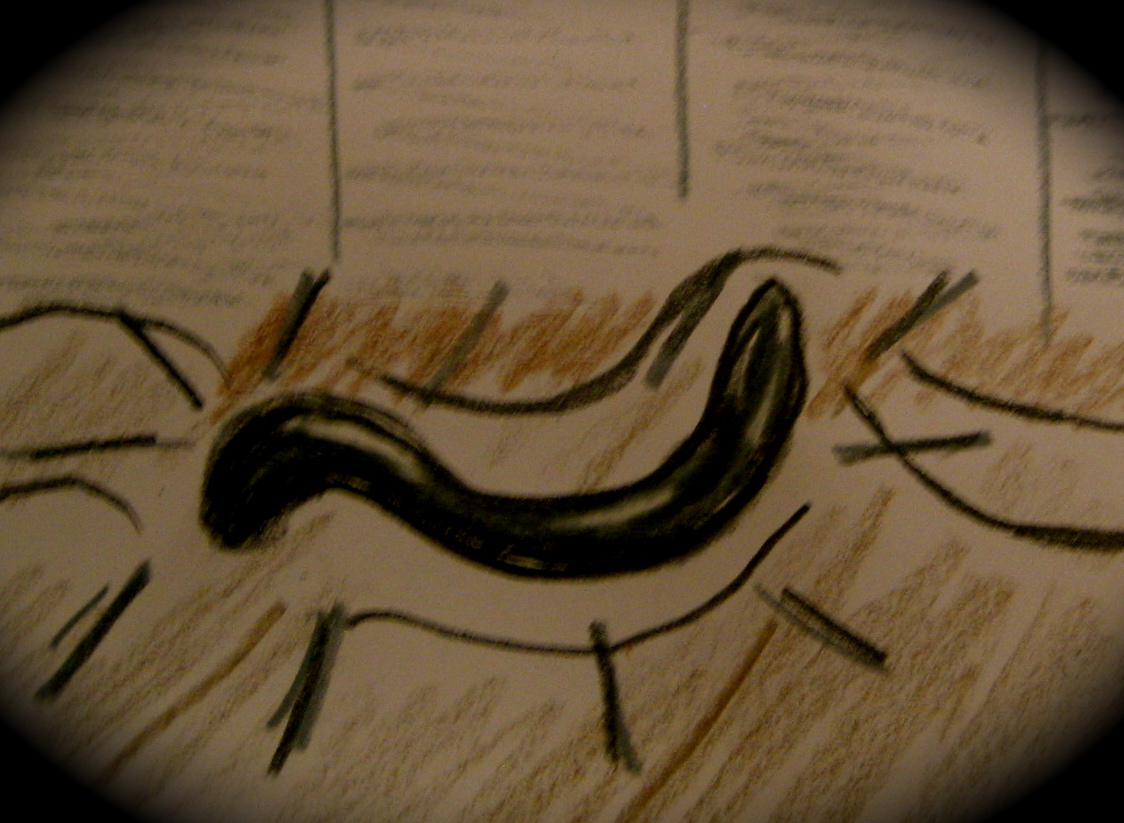
Eel on the Esplanade

The late part of the evening started with me semi-bragging about, semi-bemoaning, an adult lifetime of limited ice cream consumption.  I won’t go into all the reasons for this, but will simply say that I really haven’t eaten much true ice cream (as opposed to some weird kind of frozen diet delite) since about age 17.

Actually, there’s a distinction here between ice cream eaten (that is, other people’s ice cream tried, and spoonfuls taken straight from a quart), and ice cream purchased for one’s own consumption.    What I’ve done little of, as an adult, is buy myself ice cream.  (I estimated less than ten cones’ worth.)

My husband, a person raised with a high esteem for dairy fat, told me that was the saddest thing he’d ever heard.

Somehow this led to the idea of his feeding me huge amounts of ice cream if I ever developed full-blown Alzheimers.  This then transmuted into a joke about feeding the projected non compose mentis me large amounts of meat, despite my many years of vegetarianism.

“You wouldn’t do that.  Promise me you wouldn’t do that,” I said, surprised with the sudden depth of my feeling.

A sweet guy, he quickly promised repeatedly that, of course, he would not.

Later tonight, walking my dog along the Hudson on the esplanade in Lower Manhattan, I saw a man dart across the sidewalk.  He darted with the urgency of traffic-avoidance though there are no cars on the esplanade (other than the little truncated electric trucks in which the Park Police whiz around.)

He was darting to retrieve one of three fishing poles propped against one of the more solid walls that line the river bank.  With swift jerky movements, he pulled something that was totally black, but marked with a mirror-like shine, over the wall, then let it drop and flop onto the sidewalk.

Passers-by stopped, stared.  I pulled my very reluctant old dog (she was sure her obligatory walk should be already done) down from the upper walkway to get a better view.

The length of dark shine swiveled and flipped.  The man bent down to it with what looked a knife—it seemed like he was cutting, jabbing—but it must have been the line, because when he straightened, the fish still whirled and twisted.

I am always a bit suspicious of fisherman along this fairly polluted part of the Hudson.  Because they are out here late, and in very cold, damp weather (although tonight was neither), they do not look like mere “sportsmen.” That may be part of why I couldn’t stop staring at the dark satiny creature and thinking (1) toxins; (2) suffering;  (3) eel.

Eel?

Too long and uniformly narrow to be a fish.

I pictured (unwillingly) unagi.  Some kind of brown sauce.  And thought again, toxins, gills, suffering. More suffering. I wished the fisherman would just pick the darn thing up and bonk it hard on the head.

But he was attending to his other poles and paid little attention to the persistent, if slowing, squirm of the eel, except to look down now and again, more carefully after it wriggled into the shadows in the lee of the wall.

I sometimes think of vegetarianism as a bit precious, elitist, even PC, though I’ve been vegetarian for a very long time.   But for the second time in one night, it felt suddenly genuine, meaningful.

Still I didn’t say anything.  (Meaningful?)  Took the dog inside.

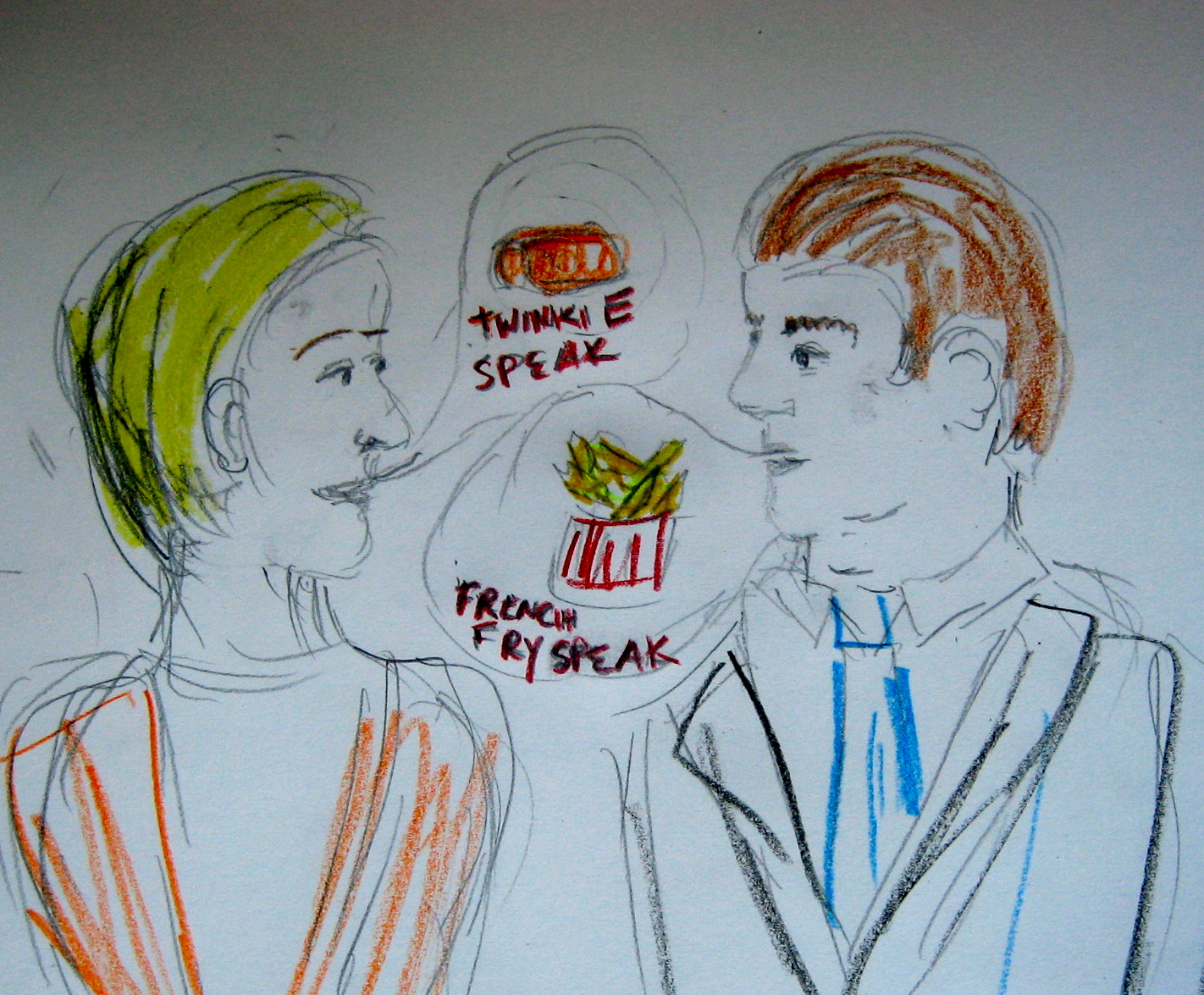
Junk “News” Nation – Twinkie/French Fry Speak Takes Bat At Kagan

May 16, 2010

Junk News Speak

Over the last few months on this blog, I’ve periodically embarrassed myself with confessions of my escapist fascination with vampire novels (and certain actors who play their starring characters.)  My only excuse has been a combination of stress, a decaying brain, and—I admit it—a wish to get “hits”.

Given my own weaknesses, I very much understand the drive of the news media (a) to sell papers; and (b) to get people to watch, or click on, their programming.

I also understand that legal theorizing, judicial precedent, and the parsing of amici briefs, can be–well, let’s say, boring. (We won’t go all the way to stultifying.)

As a result, I can imagine the glee of cable TV newsrooms when, faced with new Supreme Court nominee, Elena Kagan, they found something other than Roe v Wade to hang a story on.

But, come on!  An old photograph–not of  the judicial nominee drunk and philandering, or speaking at a segregated club, or even wearing a funny hat–but playing softball?!  A game which is supposed to be the all American past-time, but which we now discover (after endless media discussion) is truly a code activity for gayness!

It’s all just so goofy (and sickening)–a dumb and dumber approach to news which relates to relevant fact in about the same way that tweeting relates to exposition.  Snarkiness substitutes for commentary; smirks for analysis; talking heads become chuckle heads as they fall over themselves to say that (a) they are not saying anything; and (b) by the way, did you get it?

In the same way that fast and processed food has taken the place of real food (food stripped of nutrients and hyped instead with artificial color, ultra-fructose sweeteners, and loads and loads of trans fat and salt), we now have fatty, salty, simpering gossip replacing real news, news that takes thought, and provokes thought.

At least, vampire novels don’t pose as anything but entertainment;  at least, the vampires in them openly show their fangs.