



Memorial Day Weekend. These were days of great joy for me as a child–the swimming pools opened! Water, still shiver-producing, but already shimmering in bright sun, could finally be dived into, waded through, lingered in. My life, for at least the next couple of months, would no longer be just lived on earth.
Memorial Day still fills me with a kind of reflexive exhileration, and I still use it as pretty much as the marker for the beginning of the swimming season. (I have a childish heart.) Except that now, of course, I’ve lived long enough now for the weekend to be imbued with not just anticipation, but remembrance.
In my case, the memorial is not so much for victims of wars, as for two specific friends, now lost, whose birthdays happen to fall on this weekend, just a day or so ahead of my own.
I used to joke that I felt so akin to these two people–a French man much older than myself named Rene-Jean Teillard, and a friend my own age, Rhona Saffer–because we were all three Geminis. Although Rene and Rhona did not know each other, we all three shared certain classic (if you believe in that kind of thing) Gemini traits–a quickness to both delight and bemoan, a love of the verbal, an inability to ever do just one thing at a time.
Having gone through the deaths of each of these dear friends, having met the cluster of kith and kin around them, I increasingly suspect that my feelings of closeness with them had little to do with our supposedly shared Geminicities.
Each of them was simply an incredibly good friend. By this, I do not only mean that they were each a good friend to me–but that they were each very very talented at friendship itself. They were thoughtful, loyal, fun, caring; they had the even more unusual quality of being able to inspire thoughtfulness, loyalty, fun and caring in others.
I think of them now–of Rhona Saffer especially, whose birthday is today–this beautiful, lilacy, water-filled day, a day when swimming has always begun for me, in pools and ponds; when the flickering shimmer of light is not just seen, but moved through, floated upon, and, briefly, briefly (it’s cold below the surface) plunged into.
Other posts on Rene, Rhona, swimming in summer.

I just finished this morning Moonwalking with Einstein by Joshua Foer. This wonderful book details Foer’s journey from journalist covering a U.S. memory championship competition to competitor and actual winner of the same U.S. memory championship one year later.
Foer, both “mental athelete” and terrific writer, not only describes his training for the memory championship and the crazed and blinkered world of competitive mnemonists, but also explores the historical place of memory as archiving and creative tool, and also (to the extent known) its scientific place in our personalities and brains.
This post is not intended as a review, but to mention that the book has set me off on a project of memorizing poetry.
Unfortunately, memorizing poetry is slightly less amenable to the memory tricks detailed by Foer. This, it seems to me, is because a lot of these tricks involve the use of a “memory palace” or locus, and odd visual cues and puns placed about this memory palace. These tricks are frankly not that easy for a newcomer (who is also becoming an oldtimer), but they can be especially difficult to use for poems because the memorable visual cues sometimes run directly counter to the sense of the poem.
The tricks do work though, and are especially useful for lines or segues that are hard to keep in mind.
I started this morning with two poems I already know well – To his Coy Mistress by Andrew Marvell, and The Love Song of J. Alfred Profrock by T.S. Eliot. The tricks worked much better with the Marvell, maybe because coming up with images for things like “vegetable love” and (as seen above) “youthful Hue” seemed much less irreverant than mucking about with Eliot.
The picture above includes some of the images I used to keep the last stanza of the poem in mind. My memory place was my backyard, my youthful Hugh a guy I once knew (who sat in a pear tree in my yard ), the torn “Lucky Strikes” were my visual attempt to keep torn”rough strife” in mind. Treasure substituted for pleasure. (Yes, I know it sounds crazy–but it worked!)
| To His Coy Mistress |
| by Andrew Marvell |
Had we but world enough, and time, This coyness, Lady, were no crime. We would sit down and think which way To walk and pass our long love's day. Thou by the Indian Ganges' side Shouldst rubies find: I by the tide Of Humber would complain. I would Love you ten years before the Flood, And you should, if you please, refuse Till the conversion of the Jews. My vegetable love should grow Vaster than empires, and more slow; An hundred years should go to praise Thine eyes and on thy forehead gaze; Two hundred to adore each breast; But thirty thousand to the rest; An age at least to every part, And the last age should show your heart; For, Lady, you deserve this state, Nor would I love at lower rate. But at my back I always hear Time's wingèd chariot hurrying near; And yonder all before us lie Deserts of vast eternity. Thy beauty shall no more be found, Nor, in thy marble vault, shall sound My echoing song: then worms shall try That long preserved virginity, And your quaint honour turn to dust, And into ashes all my lust: The grave's a fine and private place, But none, I think, do there embrace. Now therefore, while the youthful hue Sits on thy skin like morning dew, And while thy willing soul transpires At every pore with instant fires, Now let us sport us while we may, And now, like amorous birds of prey, Rather at once our time devour Than languish in his slow-chapt power. Let us roll all our strength and all Our sweetness up into one ball, And tear our pleasures with rough strife Thorough the iron gates of life: Thus, though we cannot make our sun Stand still, yet we will make him run. |

I’d like to blame it all on Steve Jobs, but the fact is that I was a bit of a rule bender even before I constantly carried a little portable camera on my phone.
In my defense, I don’t bend rules that make sense to me–I’d never walk on struggling grass, for example, or let my dog hinder the health of a city tree. But, lately, when it’s come to non-flash photography and museums (especially museums without competing post cards), I’ve found it a little hard to follow the straight and narrow.
It started in Colonia del Sacramento in Uruguay where one buys a single pass to about six small town museums. I really enjoyed these museums, several of which were housed in Colonial buildings and showed wonderful artifacts and reproductions of artifacts of Colonial life or depicting Colonial life, especially when I could take little photos of them (as shown below.)
href=”https://manicddaily.com/wp-content/uploads/2011/05/20110519-063651.jpg”>
Though there was also a sense sometimes that town curators were pushing just a bit too hard to give visitors their money’s worth. Take, for example, the Armadillos in the natural history portion of the Museo Municipal (otherwise devoted to Colonial furniture and armaments), the stuffed Caiman under a table and the framed 1950’s poster of the evolution of canine breeds.
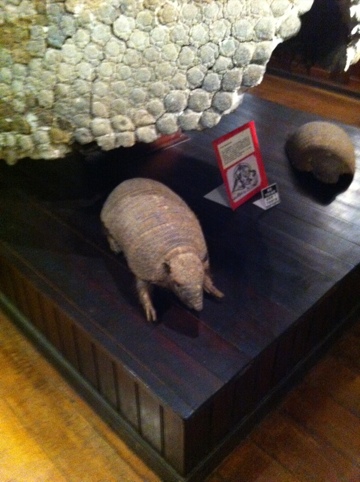

This feeling of an overly-pushed curatorial envelope was intensified at the teeny Museo del Indios in Colonia, which primarily displayed shelves and shelves of stones, some of which seemed pretty certain to have been used in native slings. (Fine. I liked the rocks. But none of them looked like they would be hurt by non-flash photography.)
Maybe this past arbitrariness was what put my teeth on edge today at the much more sophisticated Malba, Museo de Artelatinoamericano de Buenos Aires. Or maybe it was the head lice. (One of my family members picked some up in a youth hostel and we have spent some portion of this trip making sure that they were all ALL gone)
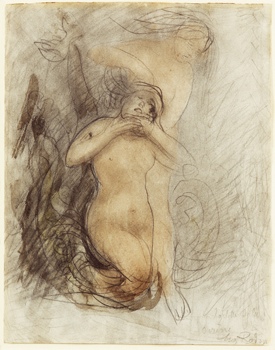
Both factors came up in the context of a beautiful drawing by Rodin. The Delousing of the Siren, I mean, Toilette de la Sirene.
The drawing, part of a terrific Works on Paper exhibit, begged to meet my iPhone. But I had already been advised by one very handsome and incredibly fashionable museum guard on a lower floor, a guard whose coiffed hair and bored expression seemed ironically calculated for a shoot, that photography was forbidden.
The guard at the works on paper exhibit was also handsome and fashionable. I was not even certain that he was a guard, until he looked up from his cell phone and began to focus on me, at which point, a quintessential guardness seemed to come to the fore. (I smiled. Probably a mistake.)
Although, to tell the truth, he may not have been focusing on me at all. The fact is that the Rodin drawing also hung in the only room of that exhibition that had an upholstered bench.
What to do? As I walked into the other rooms of the exhibition (he stayed on the upholstered bench), I tried to figure out how to turn off the clicking noise on the iPhone camera. ((I ended up with several photos of the floor.)
Every time I walked back to the Rodin, there he was. Should I pretend I didn’t know the rule? It wasn’t like I was carrying a yellow card from the first guard, but, at a certain point, I seemed to have smiled just too darn much, and I couldn’t somehow snap.
Finally, we went to a completely different floor and exhibit–Christine Pippa, a woman who makes rather political art with laminated meat and dessicated cow’s blood. I was going to settle for a surreptitious photo of the meat, despite the effect on my stomach, just to get some of my own back. But the first guard, the one who had actually seen me with the camera, had been moved down to this lower gallery, and I’d still not figured out how to turn off the iPhone’s clicking noise.
In short, I gave up, until back in our room, online, on the Malba site, I found it—-La Toilette de la Sirene! A much nicer photo than I could ever have taken.
What makes it even better: everyone’s heads (and consciences) are clear.
<a<br
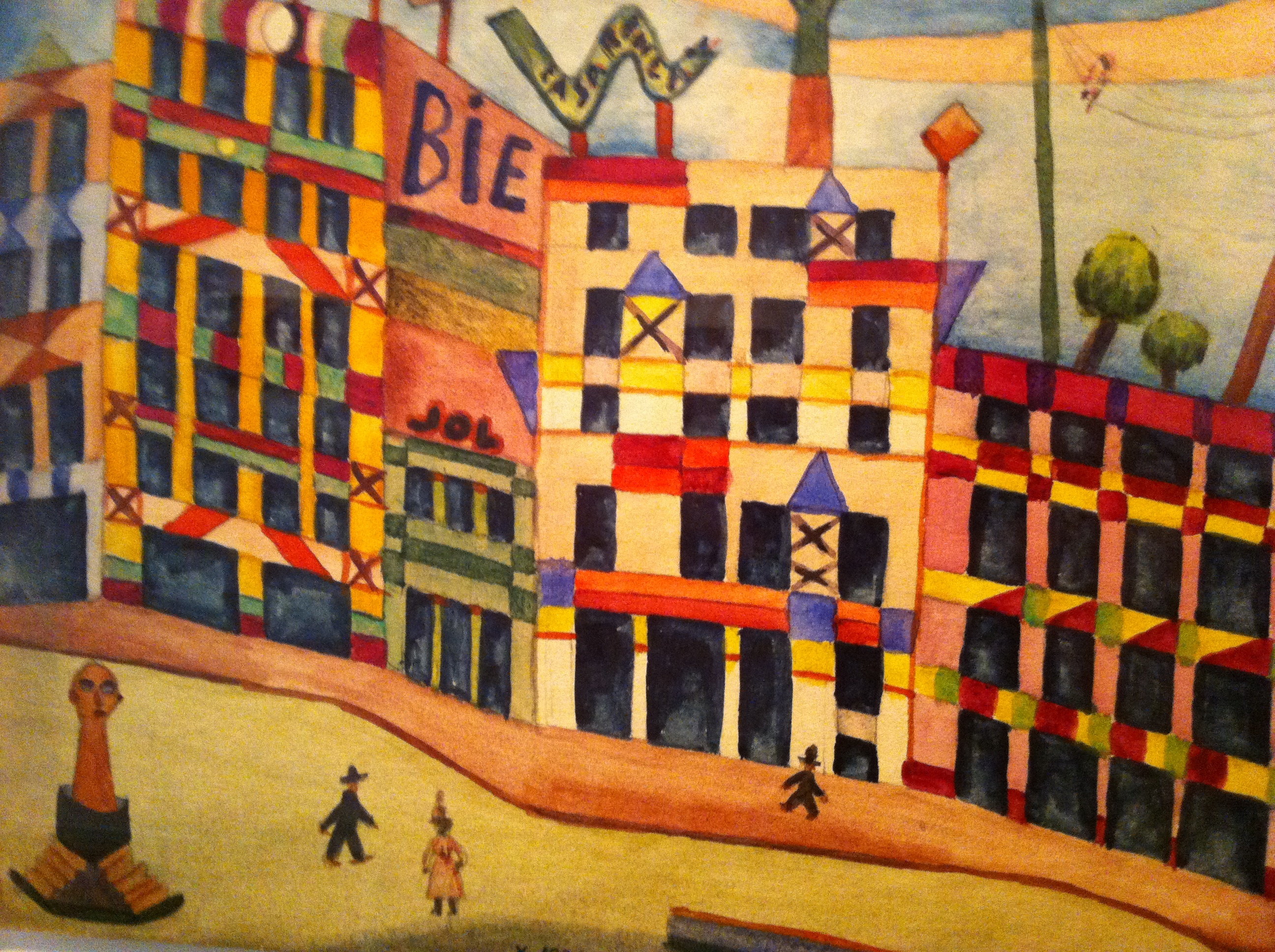
I am at the wonderful Malba today – the Museo de Arte Latinoamericano de Buenos Aires – where I am lucky enough to have the opportunity to see works by artists previously known (by me, I mean)–Frieda Kahlo, Diego Rivera, Fernando Botero–and artists previously unknown (I confess to a terrible ignorance here) – like Alejandro Xul Soler (above).
The bad news: the guards won’t let me take little photographs to draw elephants in. (For fine art with elephants, search prior posts.)
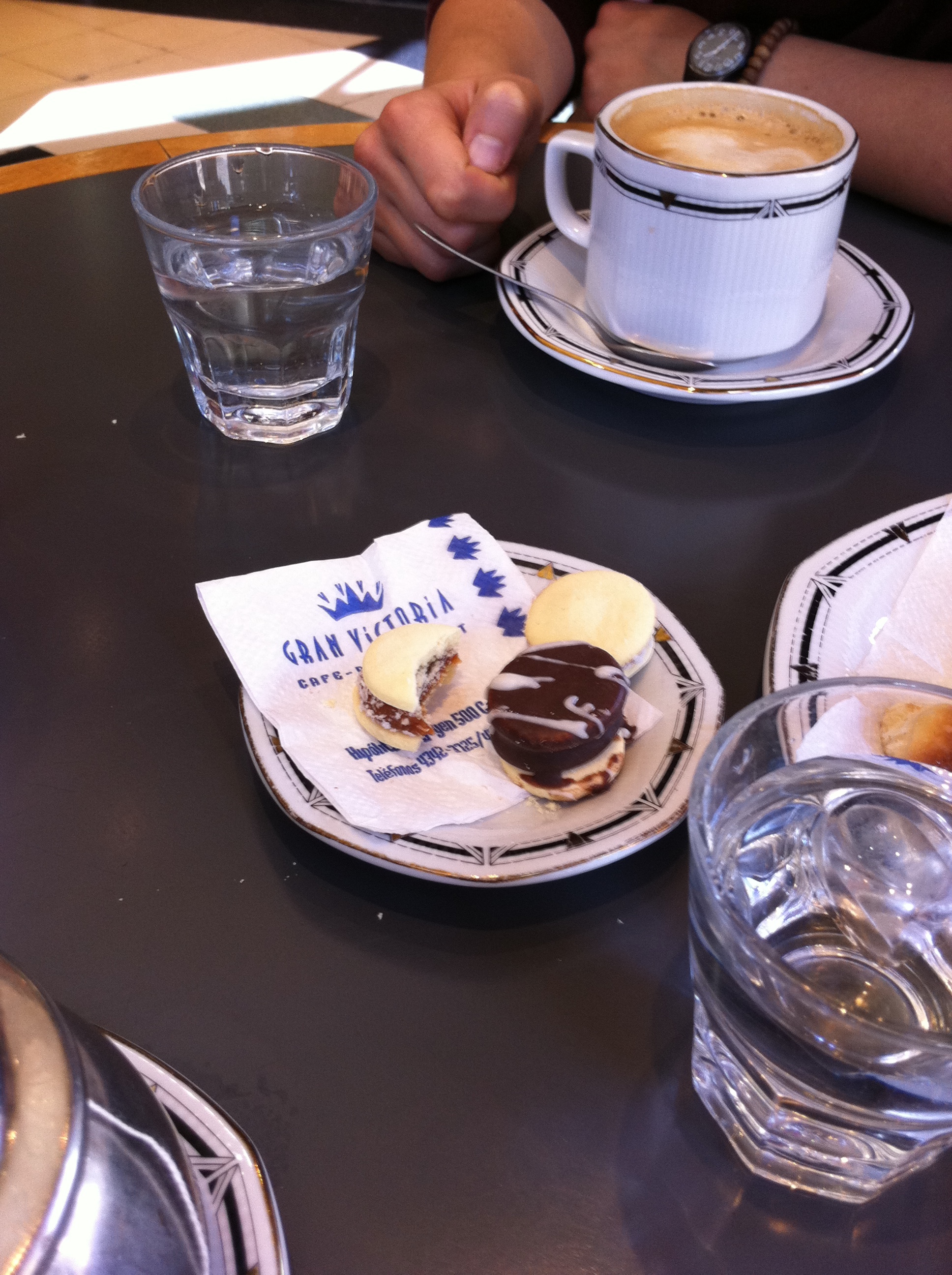
The good news: the cafe honors the city-wide tradition of serving a little plate of unordered treats with your order of coffee. Ah.
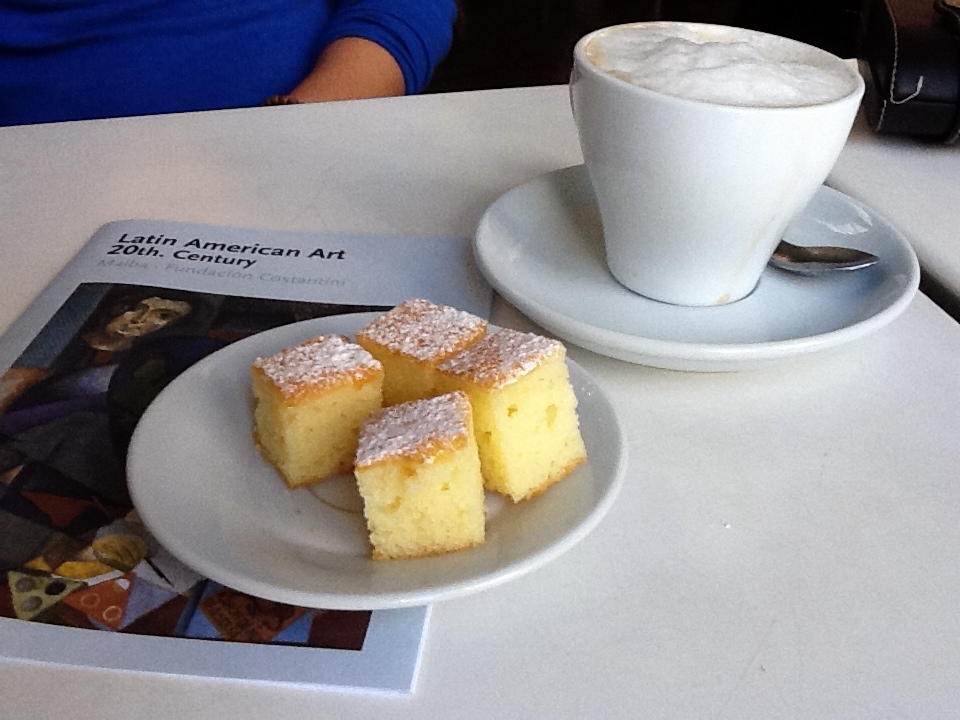

As one of my daughters has noted, one of the great pleasures of getting coffee or tea at a cafe in Buenos Aires are all the little dishes.
This is only one of the great pleasures. The cafes are pleasant in and of themselves, with tables both inside and out, with leafy trees usually somewhere in view, if not directly overhead, with internet service and quiet and nice smells, and, above all, a sense, the minute you enter, of time stretching out before and all around you.
Of course, you do kind of need time if you are going to a typical B.A. cafe. The experience is not susceptible of rushing. Waiters typically take some appreciable fraction of an hour to note of your little fidgeting movements, or large body, at one of their tables. (This is not a complaint. Serving staff is almost invariably kind, and while they do not seem to notice little subdued bleeps of “we’re here,” they also, on the reverse side, never make signs that it’s time for you to go. It seems pretty certain, in other words, that one coffee could allow you to maintain a station in a cafe for several hours.)
Eventually, then, the order is made and one is, eventually, brought all the little dishes– a cup of coffee, a small container of sugar, a glass of water. If you are ordering tea, a small ceramic pot, and pitcher of milk. And then, the coup de grace, a little plate of some abbreviated treat–itty-bitty cream puffs, bite-sized cookies, smidgeons of brownie. (At one cafe, even side dishes holding a small scoop of ice cream.)
The treat is not something ordered by you; it just appears, as if the stimulus of caffeine demands a side of sugar for true absorption.
The best thing about the treats–well, the best thing is that they are incredibly delicious. And always a bit of a surprise. And free. And did I say delicious?
But the next next next best thing is that they are that exact size understood by any diet-conscious person to contain absolutely zero calories. Amazing.
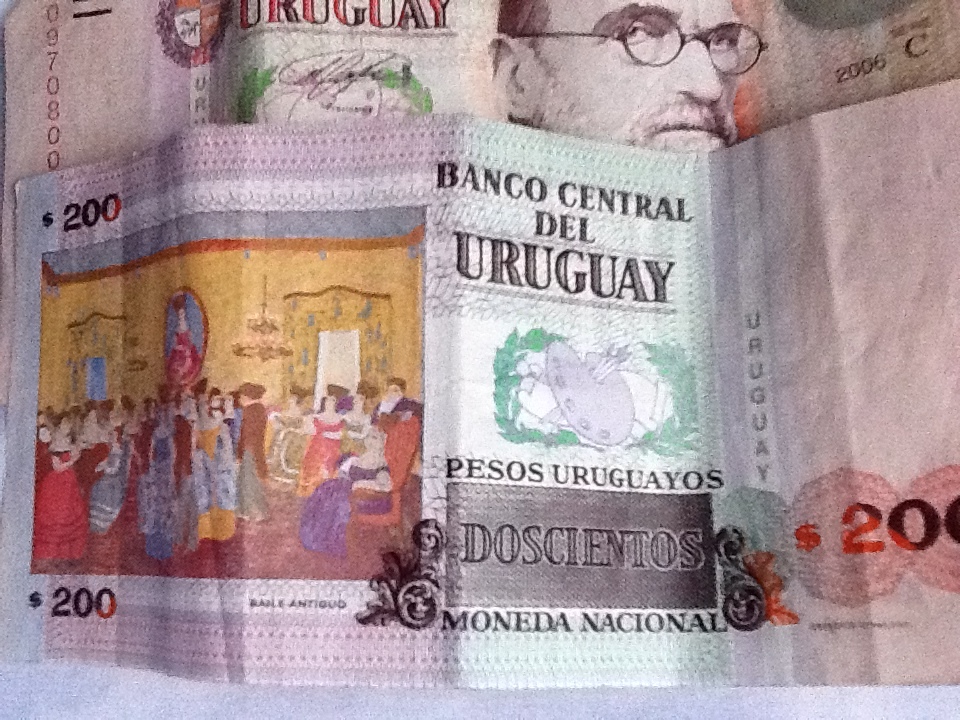
One of the hard things for me in traveling in Argentina/Uruquay is the prevalence of a cash economy. Effectivo (the real stuff) is what people want.
When I had young children in my house, and hired sitters, and took the kids to farmer’s markets for outings (okay, okay, there was also a playground there), and was late for everything (thus needing cabs), I used to carry a fair amount of cash. But I have slowly morphed into a New Yorker who buys groceries online and pays for even subway fares, much less taxis, by credit card.
The transition to cash is especially confusing when moving from country to country, especially given the various unclear fees that are attached to whatever transactions produce effective cash. Here in Uruguay, for example, one can get either dollars or Uruguayan pesos from the ATM machine, or if one finds a store that will take credit cards, one can charge in either dollars or pesos. But here’s the rub–are you converting from dollars to pesos back to dollars? And so multiplying fees? Or, by using dollars, are you skipping the 3% that most U.S. banks charge as a commission for transactions in a foreign currency and also skipping any other exchange fees?
Then, there’s the whole issue of the exchange rate that the particular establishment is offering in terms of the translation of price. In one Uruguayan restaurant, for example, one could pay in cash only, but in Uruguayan pesos, Argentine pesos or dollars. There, for some reason (an old menu?), the Argentine peso was valued at significantly more as against the dollar than in Argentina itself.
One would like to think that this confusion would make one pause before spending any money at all. Alas, it doesn’t seem to be effectivo, for that.
“`

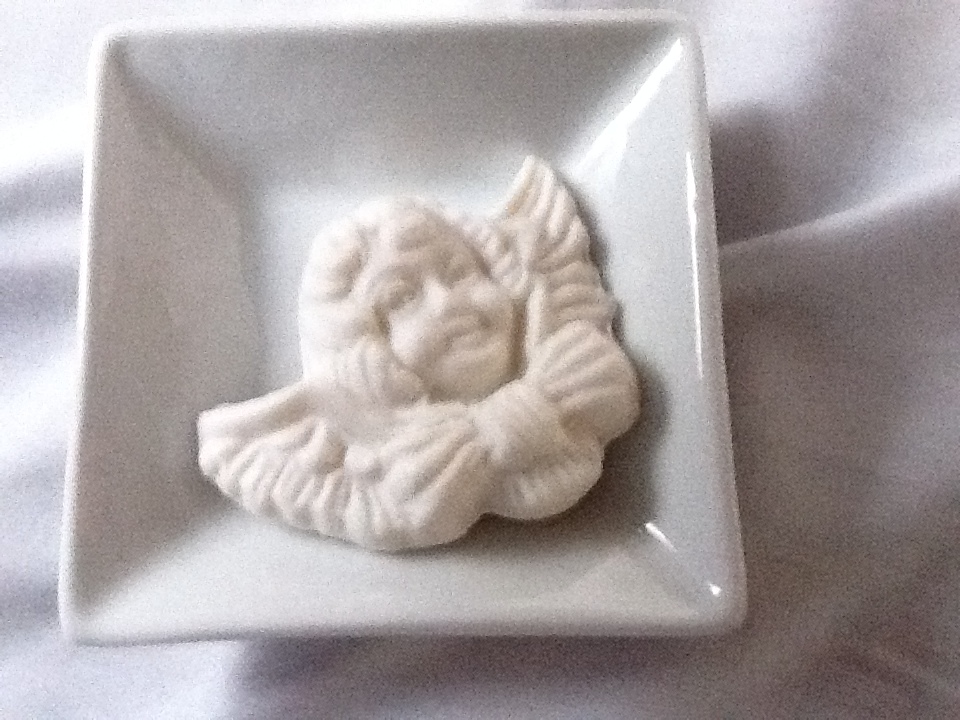
This wonderfully sweet hotel in Colonia del Sacarmento, Uruguay, really knows how to take a decorating theme and run…errr…fly with it.


Even down to the soap.
There is, however, one important sub-type missing.

 ManicDDaily

Recent Comments